Stories indexed with the term ‘public transit’

AATA Special Meeting: 5-Year Transit Plan

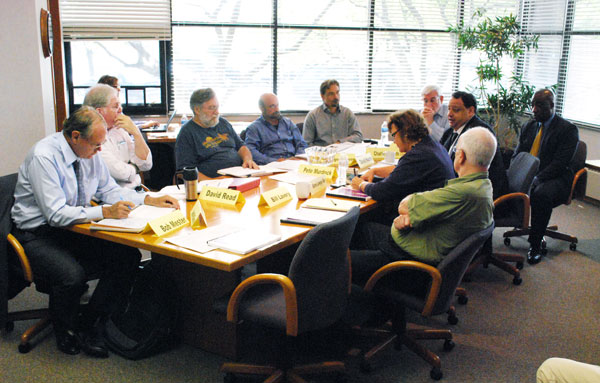
Ann Arbor Transportation Authority board meeting (April 26, 2012): At a special meeting, the board of the Ann Arbor Transportation Authority voted formally to release for public review a five-year service and funding draft plan as part of a possible transition to expanded governance and service throughout Washtenaw County. The draft plan incorporates the advice of a financial task force that signed off on recommendations at its Feb. 29 meeting. [.pdf of draft five-year plan]

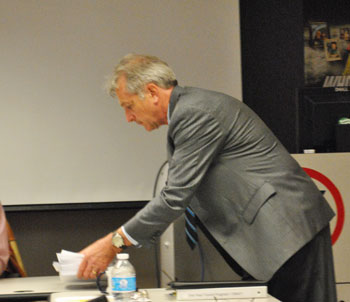
AATA strategic planner Michael Benham sets a stack of draft reports on the table at the April 26 special board meeting.

AATA strategic planner Michael Benham sets a stack of draft reports on the table at the AATA's April 26 special board meeting, held at its headquarters on South Industrial Highway. (Photos by the writer.)

The draft plan is to be reviewed by the public for a 30-day period. Eventually, a final plan will be adopted by the AATA after incorporating public feedback and consultation with an as-yet unincorporated board of a countywide authority.

Like the task force recommendations, the AATA’s April 26 draft service and funding plan stops short of recommending a new tax to fund additional services. However, the draft plan does identify 0.5 mills as the countywide tax rate that would be needed to cover the $32 million gap between revenues and costs for expanded service. One mill is equal to $1 for every $1,000 of a property’s taxable value. The draft plan also provides a program of overall fare increases as well as differentiated ticketing for specific services – like service on express routes, or discounted fares for families.

The draft five-year service plan includes: (1) countywide demand-responsive services and feeder services; (2) express bus services and local transit hub services; (3) local community connectors and local community circulators; (4) park-and-ride intercept lots; and (5) urban bus network enhancements. For Ann Arbor, the program includes increased bus frequencies on key corridors, increased operating hours, and more services on weekends. The total hours of operation in the Ann Arbor district are expected to increase by 33% on weekdays and over 100% on Saturdays and Sundays.

Publication of a final funding and service plan is a required step in a framework that could lead to the formation of a new transit authority, tentatively being called the Washtenaw Area Transportation Authority. The new authority would have broader representation, funding and coverage area than the AATA. The “four-party agreement” framework under which the transition could take place has been ratified by only one of the four parties – Ann Arbor. The Ann Arbor city council voted 7-4 at its March 5, 2012 meeting to ratify the agreement.

As a party to the agreement and the initiator of the process, the AATA board is expected to ratify it in the near future. The Ypsilanti city council is expected to take up the issue after the May 8 election, when Ypsilanti voters will make a decision on a city income tax and a bond issuance to cover debts associated with the Water Street property. Washtenaw County is the fourth party to the agreement.

In another action item on the short April 26 agenda, the board authorized the purchase of a six-foot strip of land from the city of Ann Arbor, adjacent to the Blake Transit Center. The acquisition of the land will allow the AATA to reconfigure the new Blake Transit Center (now expected to start construction in the fall of 2012) with a transit center on the southeastern corner of the parcel, on Fifth Avenue. The Ann Arbor city council had authorized the $90,000 sale last year at its Sept. 19, 2011 meeting.

In an item added late to the agenda, the board also authorized a change order to a painting contract for the expanded part of the AATA bus storage area that’s being constructed. To the original $66,187 contract, the board added another $68,000 to include the cost of painting the pre-existing portion of the structure, as well as the cleaning and surface preparation of the pre-existing area. [Full Story]

AATA Receives Unqualified Audit

Ann Arbor Transportation Authority board meeting (March 15, 2012): After waiting out a tornado warning in the basement of the downtown Ann Arbor District Library building, the AATA board made relatively quick work of its monthly meeting.

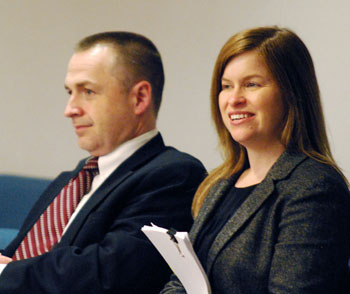
Auditors David Helisek and Pam Hill of Plante Moran PLLC.

Auditors David Helisek and Pam Hill of Plante Moran. (Photos by the writer.)

Still, the board transacted two pieces of business. The first was to approve the report of its auditor, Plante Moran. The overall opinion was “unqualified,” which is the highest rating that can be given. Still, the audit revealed some issues that need to be addressed, one of which was dealt with as part of the audit – the recording of revenue from the tax levy in the year it’s received. That actually increased the amount of AATA net assets by $7 million, but is an accounting change, not an actual change. The auditors found one case of a contract that should have been subjected to Davis-Bacon compliance requirements but was not.

Another issue identified by the auditor involves the AATA’s practice of investing in fuel futures as a hedge against the volatility of diesel prices – the advice was to review the practice with legal counsel. Plante Moran also flagged an issue involving the shelf-life of federal grants – but the AATA and auditors see that issue differently.

The second business item was approval of revisions to the AATA management personnel handbook – it was part of a periodic review and revision. Among myriad other changes, the amended document adds “sexual orientation” to the list of protected classes. [Full Story]

Ann Arbor Takes Late Bus to Transit Accord

Ann Arbor city council meeting (March 5, 2012): The council’s meeting did not conclude until almost 1 a.m., prompting resident Thomas Partridge to remark during public commentary at the conclusion of the meeting, “It’s almost time to plan for breakfast!”

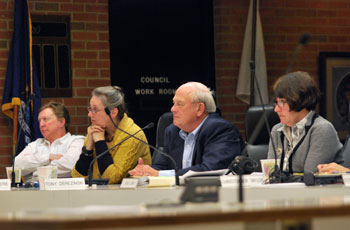
Sandi Smith, Sabra Briere, Tony Derezinski, Jane Lumm

Left to right: Councilmembers Sandi Smith (Ward 1), Sabra Briere (Ward 1), Tony Derezinski (Ward 2) and Jane Lumm (Ward 2). (Photos by the writer.)

The issue driving the lengthy meeting was an agreement between four different entities, including the city of Ann Arbor, that would set up a framework for a transition of the Ann Arbor Transportation Authority to a new funding and governance structure. The intent of transitioning to a new authority would be to provide increased transportation service both within the city of Ann Arbor as well as throughout Washtenaw County.

The Ann Arbor city council approved the agreement on Monday night on a 7-4 vote, after postponing it three times previously. That sets the stage for the city of Ypsilanti, Washtenaw County and the AATA to approve it as well. Even after approval by those three entities, several steps would remain before a new transit authority, incorporated under Michigan’s Act 196, could take over transportation services from the AATA.

The council considered several amendments to the agreement, but approved only two relatively minor, clarificational items. [.pdf of agreement as amended]

Toward the end of the meeting, the nomination of University of Michigan planner Sue Gott to the AATA board was given spirited discussion by two councilmembers, but was ultimately confirmed on a unanimous vote.

Falling victim to the lengthy deliberations on the transit agreement was a resolution that would direct the city attorney to delay enforcement of medical marijuana laws for local dispensaries, except for zoning violations. A vote on that resolution was postponed without deliberation, due to the late hour. That resolution comes in the context of a recommendation from the city council’s medical marijuana licensing board, currently pending with the council, to award the first 10 medical marijuana licenses under local legislation enacted last year.

Related to a different kind of licensing, the council approved a resolution that recommends non-renewal of liquor licenses for two establishments in Ann Arbor – Dream Nite Club and Rush Street. A hearing on the two licenses will be held on March 19, with the city council’s final recommendation to the Michigan Liquor Control Commission to be made that same day.

The council also passed several resolutions related to land and its use. The council approved the acquisition of another 58.85 acres under its greenbelt program, as well as the purchase of property on West Kingsley so that a long-vacant house there can finally be demolished. A rain garden is to be constructed on that parcel, because it’s situated in the Allen Creek floodway. In a related item, a new Federal Emergency Management Agency (FEMA) flood map was also given final approval by the council on Monday night.

The council gave initial approval to a revision of parking regulations in open space at the front of land parcels, but postponed any action on a proposed revision that would eliminate a requirement on landscape buffers in areas zoned R4C (multi-family residential).

Receiving approval from the council were a total of nearly $1.7 million in renovations to several of the city parks. The funding includes improvements to ballfields at Veterans Memorial Park, Southeast Area Park and West Park, as well as upgrades to roads and paths at Buhr Park and Cobblestone Farm.

The council also approved the issuance of $120 million in revenue bonds for the reconstruction of the city’s sewage treatment facilities, long planned and in the works. [Full Story]

Transit: Ridership Data Roundup

Editor’s note: The Ann Arbor city council is currently contemplating a major decision on adopting the legal framework by which its local transit authority could transition to a countywide system of governance – or at least one that is geographically bigger than the city of Ann Arbor. The decision on ratifying a four-party agreement – between the city of Ann Arbor, the city of Ypsilanti, the Ann Arbor Transportation Authority and Washtenaw County – was postponed for the second time at the council’s Monday, Jan. 23 meetingThe council meets next on Feb. 6. 

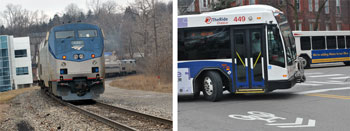
Amtrak train and AATA Bus

Amtrak train pulling away (despite appearances) from the Ann Arbor station on Jan. 25, 2012. Later that same day, Ann Arbor Transportation Authority buses converging on downtown Ann Arbor's Blake Transit Center. (Photos by the writer.)

The Chronicle is taking the pause between council meetings as an opportunity to offer readers a look at Ann Arbor’s current bus system ridership numbers over the last several years.

Part of a 30-year transit vision developed by the AATA includes the relocation of the Amtrak station – from Depot Street to a spot in the city’s Fuller Park. The proposed city/University of Michigan collaboration on the Fuller Road Station includes a large parking structure for the UM medical complex as its first phase. So we’re also taking a look at current ridership data on the Amtrak line through Ann Arbor.

Ann Arbor’s regular fixed route bus system provided 5.95 million rides for fiscal year 2011, which ended Sept. 30, 2011. That’s slightly better than the previous year, but was slightly off the record high year of 6.02 million rides delivered in FY 2009. The first three months of the 2012 fiscal year – October, November and December 2011 – show slight increases over the monthly numbers for FY 2011.

Of those 5.95 million rides provided by AATA in FY 2011, 2.43 million of them (41%) were provided through the University of Michigan MRide program – which allows faculty, students and staff of the university to board AATA buses without paying a fare. The cost for the service is paid by UM to the AATA. It was a record-setting year for the MRide program.

Also making up a portion of those 5.95 million rides were trips taken by holders of the getDowntown go!pass program, which allows downtown Ann Arbor employers to provide free bus passes for their employees for a nominal cost – the cost of the rides is funded through a grant from the Ann Arbor Downtown Development Authority.

In FY 2011, 634,000 rides were provided under the go!pass program – a 23% increase over FY 2010, adding to the trend of monotonically increasing numbers of go!pass rides over the last decade. The first three months of FY 2012 don’t show the same kind of double-digit increases for go!pass use as FY 2011 – they’re tracking roughly the same as last year.

The number of riders getting on and off the Amtrak trains that passed through Ann Arbor during the 2011 calendar year was 141,522. That figure tracked close to the same level of activity the station has seen since 2006 – from 140,000 to 145,000 riders. Through May 2011, Amtrak was on pace to eclipse the record number of riders in 2010 (145,040). But starting in July 2011, ridership was lower in every month (compared to 2010) through the end of the year.

Charts and graphs by The Chronicle – as well as more detailed breakdowns – are provided after the break. [Full Story]

County Board Briefed on Washtenaw Corridor

Transportation issues, regional cooperation and economic development were the focus of two presentations at a working session for the Washtenaw County board of commissioners earlier this month.

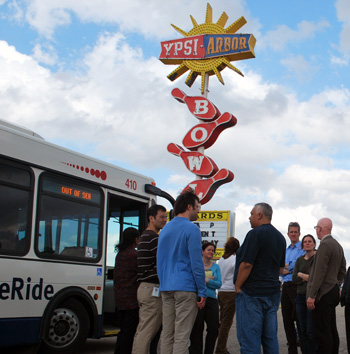
Ann Arbor planning commissioners and staff on Washtenaw Avenue

Ann Arbor planning commissioners and staff on a late April bus tour along Washtenaw Avenue, focusing on a project to improve that corridor between Ypsilanti and Ann Arbor. The iconic Ypsi-Arbor Bowl sign has since been removed. (Photos by the writer.)

The board got an update on the Washtenaw Avenue corridor improvement project, an effort to revitalize the county’s most congested – and, in many sections, blighted – commercial stretch. The project is focused on the roughly five miles between Ann Arbor and Ypsilanti, which also crosses land within Pittsfield and Ypsilanti townships. All four communities are involved in the project and several government leaders from those jurisdictions attended the working session, including Ypsilanti city councilmember Pete Murdock, Ann Arbor councilmember Tony Derezinski, Ypsilanti Township supervisor Brenda Stumbo and clerk Karen Lovejoy Roe, Ypsilanti Township planning commissioner Larry Krieg, and Craig Lyon, director of Pittsfield Township utilities and municipal services.

Anya Dale, the Washtenaw County planner who’s been coordinating the project, briefed commissioners on both the history and the current status of efforts along the corridor. One of the main questions – how the four communities will formally partner on the project – remains undecided. One option would be to form a corridor improvement authority (CIA), a tax increment finance (TIF) district that would provide revenues to fund improvements. Though governing boards and councils for each jurisdiction have passed resolutions of intent to form a CIA, Dale said they’re waiting on possible state legislative changes that would allow for one CIA to be formed along the entire corridor.

Another uncertainty relates to staff: Commissioners learned that Dale is leaving the county to take a job at the University of Michigan’s Office of Campus Sustainability. She’s been spending about a third of her time on the Washtenaw Avenue project, and it’s unclear who will pick up that work.

The same meeting also included an update from Michael Ford, CEO of the Ann Arbor Transportation Authority, on a possible countywide transit system. That presentation will be included in an upcoming Chronicle report. [Full Story]

In the Archives: A Coldwater Doll

Editor’s note: Laura Bien’s look back into the archives this time around is not really about trains. But there’s a public transit titbit that will likely stand out for readers who’ve been following The Chronicle’s coverage of the Ann Arbor Transportation Authority’s effort over the last year to develop a transit master plan for Washtenaw County.

Thirteen-year-old Ida ran upstairs into the bedroom and opened the closet. Such beautiful things – skirts, dresses and blouses – which one to pick? She selected a long brown skirt of light, glossy brillantine and a brown wool shirt stitched in red silk. They would look lovely with Ida’s brown hair. The clothes were too large, but so much nicer than the drab blouse, faded blue skirt and worn, over-the-ankle black shoes she had on.

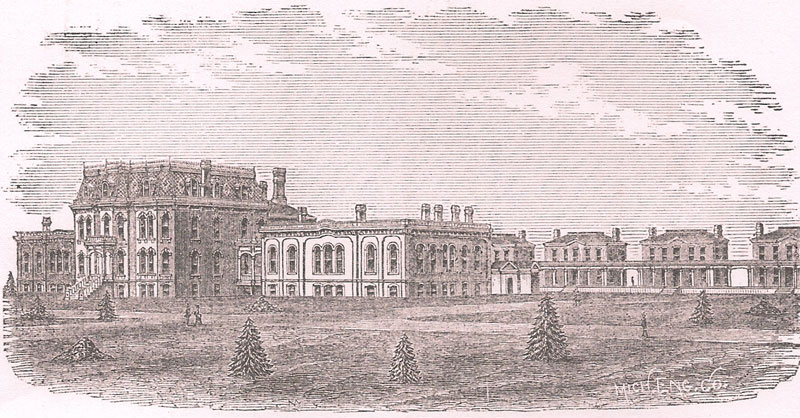
Coldwater School 1874

Coldwater Public School as it appeared at its opening in 1874, with the administration building in the foreground and children's cottages in the rear.

There wasn’t much time – she quickly changed.

“Ida!” called a woman from downstairs. “Suppertime!”

It was the eve of Halloween in 1905, but Ida wasn’t selecting a costume, or playing dress-up before Saturday dinner. She was planning an escape.

And although she lived with Mr. and Mrs. Curson* in Ypsilanti’s prosperous Normal Park, she wasn’t their daughter, or even a relative. Ida’s relatives had abandoned her.

That night, her place at the table remained empty. [Full Story]

Column: Chevy Volt – Private Transit Choices

Last week The Chronicle received a cold-call from Suburban Chevrolet out at Wagner and Jackson roads with an offer to test-drive a Chevy Volt.

Chevy Volt

Even if you don't know me, this photo is a dead give-away that I am not a car guy. I deliberately shot that photo from an angle that would include Suburban Chevrolet's sign in the background, And I thought I'd nailed it – because the sign said "Suburban." (Photos by the writer.)

The sales consultant was keen to point out that Suburban Chevrolet was the first area dealership to have a vehicle available for test drives. But test-driving a car is pretty remote from The Chronicle’s mission, and even more remote from my personal transportation choice.

I share a membership in Zipcar with my wife, but don’t even remember the last time I’ve sat behind the wheel of a car myself. Zipcar, a car-sharing service, is like an insurance policy – a backup plan I never use. I get around by bicycle.

Still, in the Chevy Volt, I spotted a chance to write about a major public works construction project in downtown Ann Arbor – the Fifth Avenue underground parking structure, which will feature around 640 parking spaces on a lot that previously offered 192 spots.

Twenty-two of those new spots will be equipped with electric car charging stations. Dave Konkle, former energy coordinator for the city of Ann Arbor who now consults for the Ann Arbor Downtown Development Authority on its energy projects, identified the federal grant that’s helping to pay for the stations. The grant is worth $264,100 and will also pay for photovoltaic panels that will provide the energy for two of the spots – it was obtained through the Clean Energy Coalition’s Clean Cities Program.

That public project is closely tied to the assumption that visitors to downtown Ann Arbor will continue to make a personal choice for private transportation in the form of an automobile, and that some of those people will choose electric cars like the Volt.

The idea I want to think about in this column is that public choices depend on the sum of many private, independent choices made by actual people. It’s an idea that was driven home to me at a public transportation forum hosted earlier this week by the Ann Arbor Transportation Authority at SPARK East in Ypsilanti.

At that forum, Bob Van Bemmelen – recent Republican candidate for the Washtenaw County board of commissioners – had this advice for the AATA as it pitches to the public the idea of countywide public transit: You have to make it personal, he said.

So I’ll begin by telling you a little bit more about the Suburban Chevrolet sales guy who gave me a ride in the Chevy Volt – who is as much a car guy as I am a bicycle guy: Nic Allebrodt. [Full Story]

AATA Speaks Volumes on Draft Transit Plan

Ann Arbor Transportation Authority board meeting (April 21, 2011): In its one piece of formal business, the board of the Ann Arbor Transportation Authority approved a resolution to disseminate the draft of a countywide transportation master plan, which it has been developing over the last year. At least five public meetings will be held in May to introduce the plan to the community.

Charles Griffith AATA

Ann Arbor Transportation Authority board member Charles Griffith flips through his copy of the draft transportation master plan. (Photos by the writer.)

The plan currently comprises two separate volumes – one outlining a vision and the other outlining how that vision would be implemented.

[.pdf of draft "Volume 1: A Transit Vision for Washtenaw County"] [.pdf of draft "Volume 2: Transit Master Plan Implementation Strategy"]

A third volume, on funding options, is forthcoming. It will not include a detailed discussion of governance. But the tax revenue portion of future funding will depend in part on the future governance structure of whatever agency is responsible for public transit in Ann Arbor and the rest of the county. Options for future governance include a countywide authority, which could eventually supplant the AATA as the agency responsible for public transit. On Thursday, the board received an update from CEO Michael Ford on conversations he’s been having, and will continue to have, with elected officials about the governance of a countywide authority.

In general concept, a countywide transit authority could first be formed and exist simultaneously with the AATA, but with no source of tax revenue. At some point, probably not this year, a millage proposal to support the countywide transit authority would be put in front of voters across the county. And if that millage were to succeed, the AATA’s assets would be folded into the new countywide transit authority.

In other work at Thursday’s meeting, the board held a public hearing on its planned federal program of projects.

The board also entertained the usual range of reports from its committees. Highlights included the fact that ridership has increased in the last month slightly compared to last year, and cost per service hour is better than what has been budgeted. The board also received an update on efforts to improve its real-time information to riders by working with its current software vendor, Trapeze. [Full Story]

Concerns Aired over Transit Governance

Washtenaw County board of commissioners working session (April 7, 2011): At their working session, county commissioners heard – most of them for the first time – a proposal on structuring the board for a possible new countywide transit authority. It was not universally well-received.

Michael Benham, Wes Prater

Washtenaw County commissioner Wes Prater, right, talks with Michael Benham of the Ann Arbor Transportation Authority following the April 7, 2011 working session of the county board. During the meeting, Prater raised concerns over the proposal for governance of a countywide transit system. (Photos by the writer.)

The tentative proposal includes allocating Ann Arbor seven seats on a 15-member board. While most of the other seats are based on population, Ann Arbor and Ypsilanti would be given special consideration because both cities have millages dedicated to pay for public transit. [Ypsilanti – with a population of 19,435 compared to Ann Arbor's 113,934 – would be allocated one seat.] The assumption of the proposal is that those millages would remain in place, on top of another transportation millage levied on all county taxpayers. A countywide millage would require voter approval.

Commissioner Kristin Judge, whose district covers Pittsfield Township, protested the way board seats were assigned, saying it gave an unfair advantage to Ann Arbor. Commissioner Wes Prater, who represents southeast portions of the county, said he was “flabbergasted” that the governance plan had been developed so fully without consulting the county board, which under the current proposal would be asked to ratify the new transit authority’s board members. However, some individual commissioners were previously aware of the proposal, including board chair Conan Smith and Yousef Rabhi, chair of the board’s working session. Both Smith and Rabhi represent Ann Arbor districts.

Ronnie Peterson – a commissioner representing Ypsilanti and parts of Ypsilanti Township – expressed strong support for a countywide system, saying details of the proposal could be worked out. It’s important to have a board that allows for all parts of the county to take part in policy-making decisions, he said, noting that’s not the case with the Ann Arbor Transportation Authority board. Both Judge and Prater said they supported public transit, but were concerned about how the system might be structured.

The proposal for governance has been developed separately from a 30-year transit master plan, which the AATA has been working on for more than a year – a process that has included dozens of public meetings to solicit feedback. If the current proposal stands, a countywide transit authority would be formed to operate a system that could expand bus service throughout the county, as well as bring commuter rail to the area. Capital costs for the system are an estimated $465 million over the 30-year period, with roughly $100 million in annual operating expenses. AATA would be dissolved, and its staff and assets would be transferred to the new entity.

Thursday’s working session was attended by six of the 11 commissioners. Three of the four commissioners representing Ann Arbor – Barbara Bergman, Leah Gunn and Conan Smith – were not present. [Full Story]

“Smart Growth” to Fuel Countywide Transit

Ann Arbor Transportation Authority board meeting (March 17, 2011): At its regular monthly meeting, the AATA board voted unanimously to adopt a “Smart Growth” scenario as the basis for a countywide transit master plan (TMP). The transit authority has been developing the TMP over the course of a planning and public engagement process that began in the summer of 2010.

Jesse Bernstein

AATA board chair Jesse Bernstein's green button was not selected in honor of St. Patrick's Day. It reads: I <3 Transit, www.publictransportation.org (Photo by the writer.)

The final phase of that process included 20 public meetings in February, where three different scenarios were presented: Lifeline Plus, Accessible County, and Smart Growth. The three scenarios were nested subsets, starting with Lifeline Plus as a base, which would simply have expanded on existing services and focused on expanding services for seniors and disabled people throughout the county. Accessible County would have added fixed-route bus service to connect all the county’s urban centers. Smart Growth included all the features of Accessible County, as well as high-capacity transit along local corridors, plus regional commuter rail.

At Thursday’s meeting, board chair Jesse Bernstein characterized the TMP as a reflection of where the community wants to be 30 years from now. The entity that would be implementing the TMP, he stressed, would likely be organized under a different legal framework than the current AATA, which is an Act 55 transit authority, with a tax levied just in the city of Ann Arbor. The AATA board has actively discussed for at least the last two and a half years the idea of transforming the transit authority to a countywide funding source, possibly using Act 196.

The meeting included three other pieces of business: (1) approval of a contract for the AATA’s paratransit services; (2) acceptance of an auditor’s report on the AATA’s books from the previous fiscal year; and (3) approval of a contract for media services.

Also discussed, but not acted on, was a memorandum of understanding with the city of Ann Arbor for construction of a bus pull‐out on eastbound Washtenaw Avenue east of Pittsfield Boulevard. The bus pull-out is part of a larger project – a transfer center on the south side of Washtenaw Avenue at Pittsfield Boulevard, opposite Arborland mall – which will include a “super shelter.” The project is being funded with federal stimulus money granted to the AATA. The board was in favor of the agreement with the city, but was reluctant to vote on the memorandum absent a copy of the text of the memorandum itself. [Full Story]

AATA: Transit Study, Planning Updates

Ann Arbor Transportation Authority board meeting (Jan. 20, 2011): The AATA’s first monthly board meeting of the year featured a presentation on a connector feasibility study on the Plymouth and State street corridors. The study is now nearing completion.

Jesse Bernstein

AATA board chair Jesse Bernstein points to a pie chart projected on the screen as part of the presentation the board heard about the Plymouth-State street corridor connector study. (Photo by the writer.)

In their one main business item, the board approved the capital and categorical grants program for 2011-15. The program will form the basis for upcoming state and federal grant applications.

Board member David Nacht prefaced the discussion of the connector feasibility study by encouraging his colleagues to share their thoughts on it – because the board had argued a long time about whether to help fund the $640,000 study, along with the other partners: the city of Ann Arbor; the Ann Arbor Downtown Development Authority; and the University of Michigan.

In the course of their discussion, the board touched on another major planning initiative: the countywide transportation master planning process.

Beginning Jan. 31, the AATA is launching the final round of public engagement meetings to develop a countywide plan for transit. Currently the AATA is funded by an Ann Arbor transit millage, plus purchase of service (POS) agreements with other municipalities. Voters in the city of Ypsilanti passed a millage in November 2010 that will cover most of the cost of Ypsilanti’s POS, for example.

Twenty additional meetings on the countywide planning effort are scheduled at locations throughout the county, to get feedback on three transit scenarios developed so far. Transit options in the three scenarios – which the AATA has labeled Lifeline Plus, Accessible County, and Smart Growth – are nested subsets, starting with Lifeline Plus as a base, which expands on existing services and focuses on services for seniors and disabled people.

According to representatives of the AATA and its consultant on the project, Steer Davies Gleave (SDG), the goal of the last phrase of public interactions is not for people to appear at the meetings and simply vote for their preferred option. They’re interested in hearing what options from the various scenarios might be combined to build a “preferred scenario.” [Full Story]

AATA Mulls Living Wage, Adds Chelsea Trip

Ann Arbor Transportation Authority board meeting (Dec. 16, 2010): At their last meeting of the year, the AATA board unanimously approved a contract for janitorial services at the Blake Transit Center, which had been postponed from its November meeting amid concerns about how the new vendor was achieving its considerably lower cost.

From AATA documentation, before (left) and after (right) bus stop improvements at the Mallets Creek branch of the Ann Arbor District Library. (Image links to higher resolution file.)

Board member Rich Robben had raised concerns regarding whether appropriate wages were being paid, but was convinced to support approval of the contract in part because of another resolution on the agenda. That resolution, which the board also passed unanimously, directed AATA staff to explore the possibility of a living wage provision for its contractors that would be similar to the ordinance used by the city of Ann Arbor.

The board also approved adding an additional return trip for the AATA’s commuter express service between Chelsea and Ann Arbor. The trip will leave Ann Arbor for Chelsea at 7:10 p.m. It was added in part due to feedback from current riders, who would have greater flexibility to work later on days when they take the bus to work. Many of the riders are University of Michigan employees. Robben, who is executive director for plant operations at the university, reported that the value placed on the express service by riders had been “bludgeoned” into him by some of his coworkers. He voted for the additional trip, along with the rest of the board.

The board was also given a presentation on the AATA’s bus stop improvement program, which featured several before-and-after slides. And among the topics reported out by the board’s committees and CEO Michael Ford was the on-time performance of AATA buses.

At the start of the meeting, during the time for communications and announcements, board member David Nacht noted the passing of Rev. S. L. Roberson, whose memorial service was taking place that evening. Nacht described Roberson as a force for equality in Washtenaw County and an important person in the community. Board chair Jesse Bernstein recalled having worked with Roberson in the ’70s at Ford Motor Co., and described him as an excellent person.

Bernstein concluded the meeting by thanking the AATA staff and the board for all their hard work this year, and suggested that next year they’d be asked to work even harder. [Full Story]

AATA Extends Countywide Planning Time

Ann Arbor Transportation Authority board meeting (Nov. 18, 2010): Starting things off on Thursday – an hour earlier than the board’s usual 6:30 p.m. start time – was an update from the consultant and AATA staff who are leading the community in developing a countywide transportation master plan (TMP).

bernstein-mccormick

Board members Jesse Bernstein and Sue McCormick confer before the start of the Nov. 18 meeting. (Photos by the writer.)

The steps outlined for developing the TMP include a chronology for identifying the following: a shared community vision; a transit needs assessment; transit options; a set of scenarios. The consulting team is in the midst of a phase that identifies a range of various options. The creation of various scenarios – combinations of different transit options – will constitute the final phase of work before production of the TMP in mid-April 2011.

That projected completion date reflects an extension of the original timeframe, which was originally set to conclude in late February. The extra time will allow for an additional step in the process – a step that will allow the consultant to present a set of scenarios without specifying any one of them as the recommended scenario.

To allow for the extra time, later in the evening the board approved a resolution increasing the $399,805 contract with Steer Davies Gleeve – the consultant AATA hired to help with the work – by an amount not to exceed $32,500.

In other business, the board discussed, but did not approve, a new janitorial contract for Blake Transit Center, which specified a different vendor from the current one. The new vendor’s bid came in at a cost a bit more than half of what had been budgeted for the year: $72,000 compared to the budgeted $126,069. Concerns by board members about how the cost savings were being achieved were serious enough that they chose, on a split vote, to table the issue.

In a move that did not authorize any current expenditure, the board adopted a compensation philosophy over which there was some brief but firm debate. Board member David Nacht weighed in against the idea of a public entity creating such a document – they’re only used to justify increases in payment but never decreases, he said. Expressing the view of the majority, however, was board member Sue McCormick, who stressed the importance of a public entity making a clear and transparent statement of how salaries are set.

The board entertained its usual range of committee reports and remarks from the public. [Full Story]

Know Your AATA Board: Roger Kerson

“I grew up in New York City, Queens, where the world was very different and mass transit was a daily part of everybody’s daily life,” says Roger Kerson. But Kerson opted for personal transit when he biked to the Sweetwaters café on West Washington to discuss with The Chronicle his recent appointment to the board of the  Arbor Transportation Authority (AATA).

Roger Kerson at the AATA board retreat on Aug. 10. (Image links to higher resolution file.)

The AATA, branded on the sides of buses as “The Ride,” aims to be the public transportation provider for Ann Arbor and Ypsilanti, as well as all of Washtenaw County. Kerson is one of seven members on the AATA board.

While he may be the newest board member, Kerson does not lack for eagerness in promoting the AATA’s current initiative to develop a countywide transportation plan. “We’re engaged in a planning process,” he says, “for developing mass transportation and we encourage people to go to MovingYouForward.org … We need to engage in a lot of conversation.” The Moving You Forward website seeks community feedback on every aspect of public transportation.

“Where do you live? Where do you work? Where do you shop? Where do you go to the movies? Are there ways in which you could reduce your carbon footprint by using transit, using the bike?” Kerson asks, adding that the AATA welcome views from all Ann Arborites and county residents, whether they use transit or not.

Encouraging that kind of communication is familiar ground to Kerson. He is currently a media consultant at RK Communications, his consulting firm. Kerson’s roots in Ann Arbor stretch from his time at the University of Michigan, where he graduated with distinction in 1980. “I think Woodrow Wilson was president then,” he quipped. Kerson stayed in Ann Arbor after college, soon becoming interested in journalism.

He began writing for a publication called The Alchemist, which he describes as “The Ann Arbor Chronicle in its day, before the Internet.” [Full Story]

Transit Forum Critiques Fuller Road Station

Chris Leinberger was blunt in his assessment of the proposed Fuller Road Station: If the parking structure is built as proposed, in 20 years it will be torn down.

Fuller Road parking lot

The city-owned Fuller Road parking lot, site of the proposed Fuller Road Station. To the south of the lot is the University of Michigan medical complex. (Photos by the writer.)

Speaking at a forum on transit-oriented development, Leinberger – a University of Michigan professor of practice in urban planning – said current plans for the joint UM/city of Ann Arbor project do a good job of incorporating different kinds of transit, from bikes and buses to perhaps, eventually, commuter rail.

But Leinberger criticized the project for taking some of Ann Arbor’s most valuable land and turning it into something that won’t generate revenue for the city. He told Eli Cooper, the city’s transportation program manager, that “whoever’s in your position 20 years from now will tear it down.”

Monday’s forum, held at the UM Art & Architecture building on north campus, was organized by members of the WALLY Coalition and the 208 Group, among others, to focus on local transit-oriented development efforts. Moderated by local developer Peter Allen, the event included presentations by Cooper, Richard Murphy of the city of Ypsilanti and Shea Charles, Howell’s city manager. [Full Story]

AATA on County Transit: READY, Aim, Fire

Ann Arbor Transportation Authority board meeting (Jan. 20, 2010): Board member Jesse Bernstein outlined a process Wednesday night for moving towards an expanded countywide transit service, which he characterized as “ready, aim, fire” – with a heavy emphasis on “ready.” A resolution passed by the board on Wednesday establishes a timeframe that would not begin the implementation phase of a plan until the beginning of 2011.

Jesse Bernstein

Jesse Bernstein, who chairs the AATA board's performance monitoring and external relations committee, outlined a plan for expanding service that sees the next six months devoted to making the organization more transparent and gathering information from the community. (Photos by the writer.)

The emphasis on community engagement and listening to the needs and wants of the people who might use an expanded service – before trying to design the specifics of the service – would not be something confined to this particular initiative. Said Bernstein: “This is not a one-shot campaign; this is how we’re going to behave going forward.”

The board adopted a resolution to advance their plan for the future of public transportation in the county.

The board also heard a presentation on the results of a survey of voter attitudes towards a possible transit millage in Washtenaw County. The survey measured support of a millage at 51% – with 17% and 34% of voters saying they’d definitely or probably vote yes, respectively.

In other business, the board adopted its capital and categorical grant program, approved a contract to replace some doors and windows at AATA headquarters, authorized an application to the Michigan Department of Transportation and approved a 21-month purchase-of-service agreement with the city of Ypsilanti. [Full Story]