Stories indexed with the term ‘R4C’

Planning Group Weighs R4C/R2A Report

Ann Arbor planning commission working session (May 8, 2012): Nearly a year after planning commissioners were briefed on a draft report for zoning changes for Ann Arbor’s near-downtown residential neighborhoods, commissioners were presented this month with the final report from the R4C/R2A zoning district study advisory committee, which has been working on the issue since December 2009.

Matt Kowalski

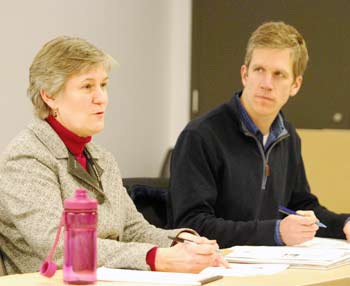
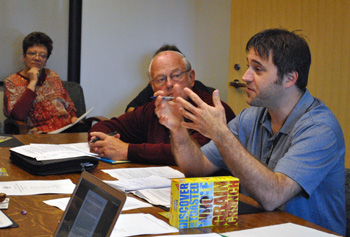
Matt Kowalski, right, gives a report on recommendations from the R4C/R2A advisory committee at a May 8, 2012 work session of the Ann Arbor planning commission. Next to him is Tony Derezinski, a planning commissioner and city council member who served on the advisory committee. To the left is Wendy Carman, an advisory committee member who took issue with some aspects of the final report. Two other committee members – Eppie Potts and Julie Weatherbee – attended the working session.

Both kinds of zoning districts were established in the 1960s, and applied to existing neighborhoods. R4C allows for multiple-family residential dwellings, such as apartment buildings, while R2A zoning limits density to two-family residential structures. Planning manager Wendy Rampson described the R4C zoning as “broken” –and most of the committee recommendations relate to R4C districts.

Concerns about R4C/R2A districts have been raised since at least the mid-1980s, and are tied to the question of how dense these areas can be. Although there were smaller projects that caused concern,  two more recent large housing proposals – The Moravian, and City Place – brought the issue to the forefront for people on both sides of the density debate.

In particular, the controversial City Place project on South Fifth Avenue, which combined multiple lots and demolished seven residential houses to build two apartment buildings, has been cited as an example of the need to address R4C zoning. City Place changes the streetscape of that neighborhood, but is analyzed as conforming to current zoning code.

The final committee report includes 10 recommendations, with accompanying analysis. [.pdf of recommendations] The major recommendations relate to: (1) rebuilding structures that don’t conform to existing zoning; (2) rezoning certain areas from R4C to R2A; (3) reducing minimum lot sizes and minimum lot widths; (4) exploring the creation of zoning overlay districts; (5) revising density calculations; (6) revising parking standards; and (7) changing requirements for lot combinations.

Commissioners praised the work of the committee, but much of the discussion related to future process: What are the next steps to take, now that the report has been completed? It’s likely that the group’s ordinance revisions committee will tackle the job of making recommendations for specific ordinance language to implement the changes. Those ordinance revisions would then be reviewed by the planning commission, which would forward its recommendations to city council.

In terms of content, commissioners mostly focused on the idea of overlay districts, which would be a way of preserving the character of different, distinct R4C neighborhoods. Commissioner Bonnie Bona floated the concept of form-based code as an option. Described in a very general way, a form-based approach tends to be more proscriptive regarding the types of buildings that the community wants to see in a particular district, including their design. In contrast, traditional zoning typically sets an allowable range of uses, sizes, placements, and other aspects for a development, but generally leaves the details of those decisions to the developer.

It was generally acknowledged that either approach – form-based or one with overlay districts – would be a complex issue to tackle.

Three advisory committee members – Wendy Carman, Ethel “Eppie” Potts, and Julie Weatherbee – attended the May 8 session. Carman and Potts spoke during public commentary to amplify written comments they had provided as supplements to the report, expressing concerns that some aspects of the report don’t accurately reflect the committee’s views.

During the May 8 session, commissioners also were updated on the city’s sustainability goals, which they’ll be asked to vote on at their May 15 meeting. This report focuses only on the R4C/R2A portion of the working session. [Full Story]

Landscaping Buffer Change Rejected

At its March 19, 2012 meeting, the Ann Arbor city council rejected changes in landscaping and land use buffer requirements in the city code. The council had previously postponed the vote from its March 5, 2012 meeting.

The first change would have restricted some requirements that have been added recently just to those plans that require city planning commission or city council approval: (1) providing landscaped islands for every 15 parking spaces; and (2) providing bioretention areas in 50% of the interior landscaping areas. Administrative amendments to existing plans would not trigger the requirements.

The second change would have involved existing requirements to provide buffers between parcels with conflicting land uses. Recent amendments to the code had added requirements that properties in … [Full Story]

No Consensus on Residential Zoning Changes

A committee that’s worked for a year and a half to develop recommendations for zoning changes in Ann Arbor’s near-downtown residential neighborhoods has been unable to reach agreement. So it’s now likely that the city’s planning commission will weigh in on the controversial issue. The outcome of changes – if approved by the city council – could affect the density of residential development in the city.

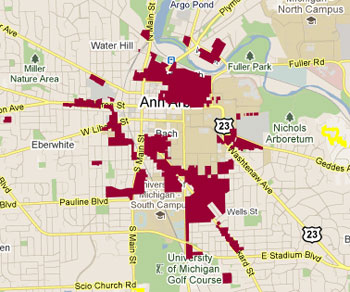
R4C City of Ann Arbor Zoning

The dark red areas are those areas zoned R4C in the city of Ann Arbor. (Image links to Google Map)

At a recent working session, planning commissioners were briefed on a draft report from the R4C/R2A advisory committee, which has been meeting since December 2009. Both kinds of zoning district were established in the 1960s: R4C allows for multiple-family residential dwellings, such as apartment buildings, while R2A zoning limits density to two-family residential structures. The committee was unable to reach consensus on its recommendations, nearly all of which relate to the R4C districts.

At the June 14 planning commission working session, two commissioners who serve on the committee – Jean Carlberg and Tony Derezinski – expressed frustration at the outcome. The draft recommendations don’t provide any guidance about where the city might encourage greater density, Carlberg said.

Derezinski, who is the city council’s representative to the planning commission, added that many committee members worked hard, but were interested in protecting what they’re used to, especially concerning density and parking in their neighborhoods. As it stands, he said, the report won’t be helpful to the city council. Derezinski supported the idea of having the planning commission study the issue and make its own recommendations.

Commissioner Evan Pratt suggested that the first question to ask is whether there should be greater density, and where – the answer to that would guide the recommendations.

In a follow-up phone interview with The Chronicle, Wendy Rampson – the city’s planning manager, who also attended the working session – said there are several possibilities that planning commissioners might pursue. They could discuss the report at one of their regular meetings and make their own recommendations or comments about it. Those recommendations and comments could be made either informally – communicated to the council via Derezinski – or through a formal resolution or memorandum.

Another option would be for the commission’s ordinance revisions committee to tackle it first, developing specific ordinance language that the full commission could then review and possibly recommend to the city council. Or commissioners could ask to hold a joint session with the council, she said, to talk through these issues directly.

Regardless of how the planning commission proceeds, Carlberg will no longer be at the table. The June 14 working session was her last meeting as a commissioner. Her term ends on June 30, and she did not seek reappointment. The former city councilmember served 16 years on the planning commission, overlapping with her 12 years (1994-2006) as a Democrat representing Ward 3 on the council. Eleanore Adenekan was nominated during the council’s June 20 meeting as a replacement for Carlberg – her nomination is expected to be confirmed at the council’s July 5 meeting. [Full Story]

Demolition Moratorium for Two-Block Area

Ann Arbor City Council meeting (Aug. 6, 2009): Two kinds of moratoria were on council’s agenda for Thursday’s meeting – which had been rescheduled to accommodate the Aug. 4 Democratic primary elections in Wards 3 and 5. The first was a moratorium on new development in districts zoned with the classification of R4C (multi-family residential) or R2A (two-family residential). The second was a moratorium on demolition, attached to the creation of a study committee for a possible historic district in a two-block area just south of William Street on Fourth and Fifth avenues.

Council voted down the more general prohibition on new development in R4C/R2A residential districts, but approved the historic district study committee with its attached moratorium on demolition. It’s a case where the vote tally alone doesn’t tell the whole story – or even an accurate one: Counter to what one might expect, Mike Anglin (Ward 5) voted against the R4C/R2A moratorium, while Leigh Greden (Ward 3) voted for it.

A third major agenda item facing council was also related to new development: the Near North planned unit development (PUD) proposed for North Main Street just south of Summit Street, which is an affordable housing project that includes the nonprofit Avalon Housing as a partner. The council voted to move Near North on to a second reading, when a final decision will be made.

But probably the most important matter considered by council on Thursday appeared on the agenda as an “introduction” by the city’s chief financial officer, Tom Crawford, who spent around a half hour telling the city council why the city’s projected financial condition is worse now than it had been when the FY 2010 budget was adopted in the spring. Crawford’s presentation was characterized during commentary from the public later in the meeting as the “first salvo in a PR campaign” for a city income tax.

A bit of breaking news from Crawford’s report: bonds for the Fifth Avenue underground parking garage were issued on Aug. 5. [Full Story]

Postponed: A2D2, City Place, Moratorium

Ann Arbor City Council Meeting (July 20, 2009): Postponements of decisions on A2D2 zoning, the City Place “matter of right” site plan, and a proposed moratorium on development in R4C and R2A zoning districts meant that the most controversial items on council’s agenda were delayed.

lyricstodevgoesmarching

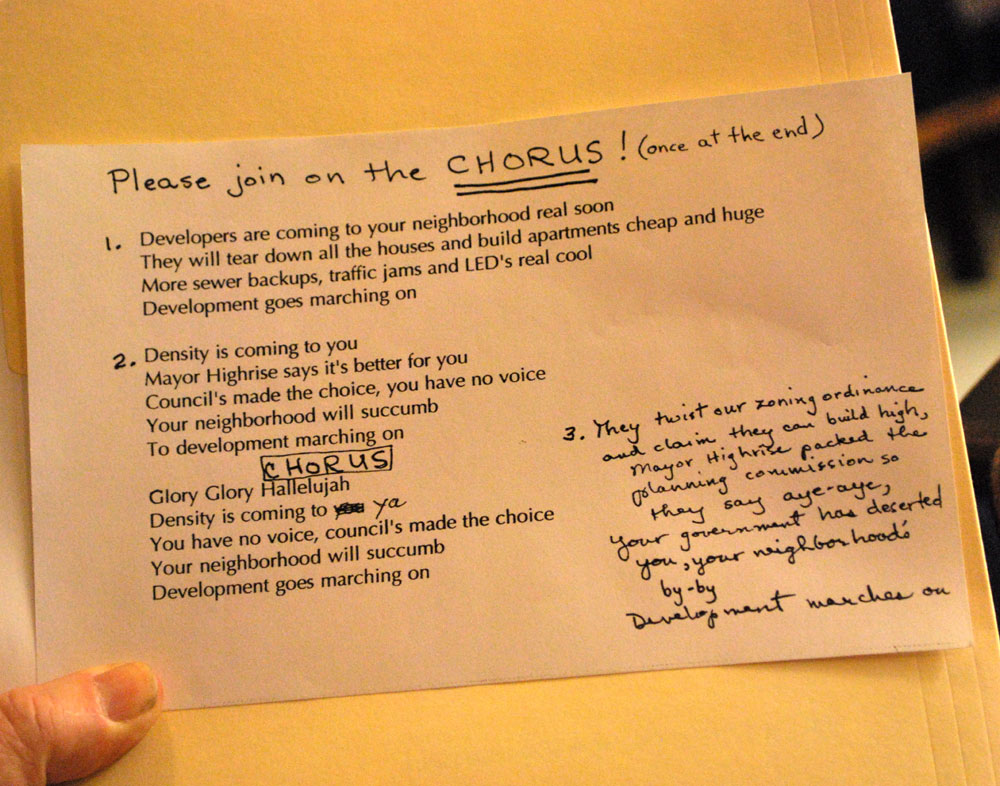
Lyric sheet to a song sung by Libby Hunter at the public hearing on the City Place site plan. (Image links to higher resolution file.)

Even an apparently mundane proposal from Leigh Greden (Ward 3) to allow for an additional exception to parking on front lawns was not acted on by council. In that case, they referred it to the planning commission.

However, the council did accomplish a substitution of taxable Build America Bonds for the tax-free general obligation bonds already authorized for the Fifth Avenue underground parking structure, plus a site plan approval for the Ann Arbor Transportation Authority’s park-and-ride lot at Plymouth Road and US-23.

And finally, Mayor John Hieftje gave an interpretation of council public hearing speaking rules that precludes audience members from joining in a group chorus when a speaker at the podium is singing: To the strains of “Glory, Glory Hallelujah, Density is coming to ya,” Hieftje warned he might “clear the room.”

The meeting was also notable for the closed session conducted in the course of the meeting to discuss attorney-client privileged information – it lasted over an hour, but provided a chance for attendees to mingle. [Full Story]