The Ann Arbor Chronicle masthead
it's like being there

Stories indexed with the term ‘school budgets’

AAPS Issues RFPs for Privatization

Ann Arbor Public Schools Board of Education meeting (Jan. 20, 2010): Wednesday’s meeting of the AAPS board of education was a study in contrasts.

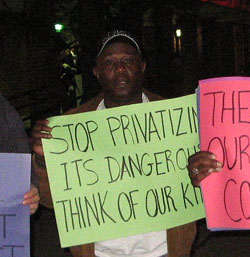
Demonstrating against privitization

Outside the Jan. 20 school board meeting, one of four demonstrators against privatization of certain school services. (Photo by the writer.)

On one hand, it was an evening of accolades and celebrations.  The board heard recommendations to pay tribute to the work of two longtime AAPS staff members by naming facilities in their honor, community participation in budget planning was lauded, and the students from this year’s Hikone Exchange Program reported on their trip to Ann Arbor’s sister city of Hikone, Japan.

At the same time, concerns about possible privatization of custodial, maintenance, and transportation services dominated the meeting’s public commentary. And when the same presentation that was made to recent public budget forums was repeated for the board, looming school budget cuts again came to the fore. Requests for proposals (RFPs) for outsourcing that are a part of those cuts were also briefly discussed. [Full Story]

Ann Arbor Schools Seek Input on Budget

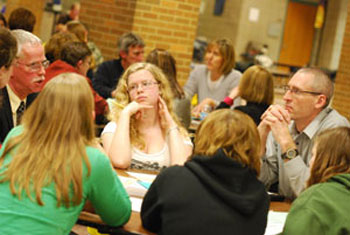
A group of people sitting around a table

One of the tables at the Jan. 7 Ann Arbor Public Schools budget forum, where participants discussed options for cutting expenses and raising revenues. (Photos by the writer.)

Todd Roberts, superintendent of the Ann Arbor Public Schools, didn’t have much good news to deliver at Thursday’s budget forum, the first of four that the district is holding this month. Heavily reliant on declining state funding, AAPS faces as much as a $20.9 million deficit by fiscal 2010-11.

And after voters rejected a countywide schools millage in November that would have brought some financial relief, school officials are faced with difficult decisions as they work to close the funding gap between revenues and expenses.

Despite the season’s first significant snowfall, more than 100 people attended the Jan. 7 forum at Huron High School’s cafeteria, a gathering that included parents, teachers, administrative staff, some school board members, students and others in the community. Leaders of groups that supported the November schools millage proposal, as well as those who successfully led efforts to defeat it, also attended the meeting.

Roberts told the crowd that it’s unlikely the state will see a turnaround anytime soon, and their biggest hope is that revenues for schools at least remain flat. “But that’s certainly not a foregone conclusion,” he added. [Full Story]

New State Cuts Add to School Crisis

Gov. Jennifer Granholm’s decision on Monday to make additional cuts in state funding to some of Michigan’s school districts means an additional $3.7 million loss to the Ann Arbor Public Schools in its current fiscal year, which began July 1.

In addition to $165 per-pupil cuts that were already anticipated, Granholm vetoed a portion of a bill that specified school-aid payments to be made to the state’s “hold harmless” districts, one of which is AAPS. She vetoed that item in a comprehensive K-12 school-aid bill that she signed on Monday. The new cuts of $233 per pupil will take effect unless the state legislature overrides her veto.

AAPS superintendent Todd Roberts told The Chronicle this morning that combined with the previous $165 per-pupil cuts, the Ann Arbor district now must deal with a $6.4 million loss in funding for the current fiscal year. They’ll likely need to tap their $28 million fund equity – the equivalent of a district’s savings account – as well as make cuts to services, trying to identify those that will be the least disruptive to the schools, he said.

Roberts said that Monday’s action at the state level makes it even clearer for the need to take more local control of school funding – referring to a proposed countywide millage that’s on the Nov. 3 ballot. [See Chronicle coverage: "Does It Take a Millage?"] “If we’re going to rely on [the state], then shame on us,” he said. [Full Story]

Does It Take a Millage?

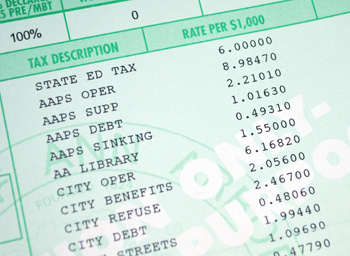
Ann Arbor tax document

An Ann Arbor summer tax bill, showing some of the assessments for Ann Arbor schools. For Ann Arbor Public Schools (AAPS), the millage rates reflect half the amount collected annually.

Among Michigan’s public educators, the 2010-11 fiscal year is being called “The Cliff.” Based on a grim downward trajectory of funding from the state, decreasing revenues from local property taxes and expenses like health care continuing to climb, that’s the year many districts are expected to plummet over the edge into the red.

Robert Allen, deputy superintendent of the Ann Arbor Public Schools, described this scenario at a sparsely attended forum last Thursday at Huron High School, where he and superintendent Todd Roberts made a pitch for voters to support a proposed countywide millage on the Nov. 3 ballot. They didn’t claim that AAPS would be among those districts falling off the cliff, but they did say their district faces a $15 million deficit that year. Without new revenue from the millage, they contend that the district would need to make dramatic cuts, and that those cuts would almost certainly affect students in the classroom. Michigan’s financial crisis is hitting hard, they say.

“As the state goes, so goes our funding,” Allen told the group on Thursday.

The state isn’t going so well.

But opponents argue that school districts haven’t done enough to cut costs, and that taxpayers can’t absorb the added burden of another millage. Beyond that, people on both sides say there’s an urgent need to reform the way schools are funded in Michigan, regardless of the success or failure of the Nov. 3 millage vote.

This Chronicle report looks at how Michigan funds K-12 public schools, why local school districts say they need a special enhancement millage and why critics say they don’t, and what that proposed millage would entail. Ann Arbor Public Schools is the largest of Washtenaw County’s 10 school districts, and would receive over a third of the $30 million collected from the millage annually – we’ll focus our coverage on that district. [Full Story]

» Text size:

larger text default text smaller text

Skyclock