The Ann Arbor Chronicle masthead
it's like being there

Stories indexed with the term ‘single-stream recycling’

Council Banks on Single-Stream Recycling

Ann Arbor City Council meeting (March 15, 2010) Part 2: Part 1 of the meeting report handles the range of various topics at the meeting that did not fall into the general category of recycling. Part 2 focuses specifically on the two recycling-related resolutions approved by the council.

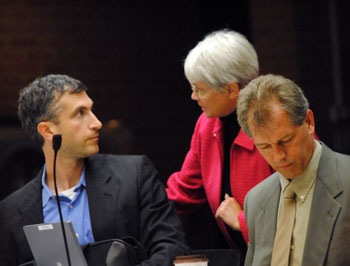
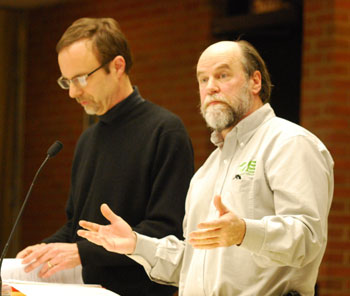
Jim Frey and Tom McMurtrie

Tom McMurtrie, left, is the city's solid waste coordinator. Jim Frey, right, is CEO of Resource Recycling Systems, a consultant for the city on recycling.

The two separate resolutions correspond to the two facets of the new recycling system for Ann Arbor, which will be deployed in July 2010.

One resolution revised the contract with Recycle Ann Arbor (RAA) for curbside recycling pickup to reflect the single-stream character of the system. Residents will no longer place paper and containers in separate 11-gallon stackable totes to be hand-emptied by RAA drivers.  Instead, residents will put all their recyclable materials into a single rollable cart with a lid. Drivers will operate a robot arm from inside the truck to lift and tip the single cart’s recyclable contents into the truck.

The other resolution approved by the council authorized a contract with RecycleBank to implement an incentive program for residents, based on their participation in the recycling program and the average amount of materials recycled on their route.

Both the conversion to the new system and its associated incentive program came under criticism  during public commentary. During council deliberations it was the incentive program that was given the most scrutiny by councilmembers – with Stephen Kunselman (Ward 3) voting against it. The contract with RAA was given unanimous support from the nine councilmembers who were present.

The arrangements with RAA for collection and with RecycleBank for the incentive program are separate contracts with separate entities – the single-stream system could be implemented without the incentive system. But it became apparent during council deliberations that the idea that the city council might opt for a single-stream system without the incentive program was not something city staff had planned for: The single-stream carts are already molded with labels “Earn rewards for recycling.” [Full Story]

Mixed Bag: Phones, Fiber, Fire

Ann Arbor City Council meeting (March 15, 2010) Part 1: In its main business of the evening, the city council took the last in a series of steps towards converting the city’s twin-tote curbside recycling program to a single-stream system.

Dominick Lanza fire chief Ann Arbor

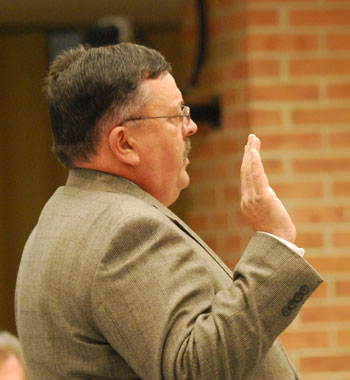
Dominick Lanza is sworn in as the city of Ann Arbor's new fire chief. (Photos by the writer.)

Part 1 of this report will not include single-stream recycling. Part 2 of the meeting report will focus on that issue, and will be somewhat delayed, in order to increase the possibility that an information request from the city for relevant data can be included in that article. [In this, we thus take a dual-stream approach.]

Aside from the single-stream recycling issue, the council addressed a range of other disparate topics.

The council undertook a wholesale replacement of the housing commission board, a move that will see the return to city service of recently-departed community services area administrator, Jayne Miller. She’s one of the new appointees to the housing commission board.

The council also approved a resolution urging Google to select Ann Arbor as a site for a fiber optic network. Accompanying that resolution was a pubic hearing during which seven people – two from Ypsilanti – spoke in support of the city’s bid, which also enjoys the support of the University of Michigan.

The city’s new fire chief, Dominick Lanza, was sworn in, though his start date comes a few days in the future – March 22, 2010. [Full Story]

Ann Arbor Cell Phone Ban Possibly Delayed

Ann Arbor City Council Sunday caucus (March 14, 2010): On the Ann Arbor city council agenda for Monday is the final vote on a proposed city ordinance banning cell phone use while driving. At a sparsely attended Sunday night caucus, Sabra Briere (Ward 1) and mayor John Hieftje indicated that a vote on the proposed cell phone ban would likely be postponed.

Other agenda items receiving some discussion were the public hearing scheduled on the Google Fiber initiative, plus a contract revision for Recycle Ann Arbor to perform single-stream curbside recycling using automated carts. [Full Story]

Environmental Indicators: Resource Use

Editor’s Note: This is the second in a series written by Ann Arbor city staff on the environmental indicators used by the city of Ann Arbor in its State of Our Environment Report.

Trash and Recycling in Ann Arbor

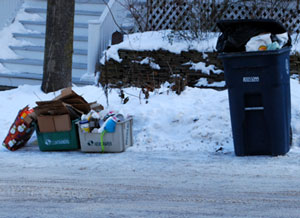
Recycling totes and a trash cart await collection in Ann Arbor. The totes will be replaced with bins similar to the blue trash cart in mid-2010. (Photo by The Chronicle.)

Although Matt Naud, the city’s environmental coordinator, is listed as the author of this piece, he received “a boxload of help” from Adrienne Marino, Tom McMurtrie, and Nancy Stone.

The SOE report is developed by the city’s environmental commission and designed as a citizen’s reference tool on environmental issues and as an atlas of the management strategies underway that are intended to conserve and protect our environment. The newest version of the report is organized around 10 environmental goals developed by the environmental commission and adopted by the city council in 2007. This installment focuses on responsible resource use.

All installments of the series are available here: Environmental Indicator Series.

With the closing of the 2009 holiday season, and many of us surrounded by lots of new “stuff” – including the associated boxes and packaging – and even a few of us with New Year’s resolutions to “simplify” our life in the coming new year, it seems like a good time to talk about all of the stuff we buy, use, reuse, recycle, and then throw out in Ann Arbor. [Full Story]

Column: Pedaling and the Price of Recycling

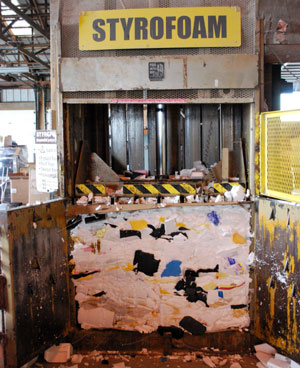
Styrofoam baler

Styrofoam baler with gates open, and the masher in the "down position." In this position, the operator can slide wires through slots in the top and the bottom to wrap the bale securely, before releasing the pressure on the masher. (Photos by the writer.)

About once a month, I load up my bicycle cargo trailer with an assortment of gallon jugs – plastic and glass – plus a mountain of rigid Styrofoam, then pedal off to Recycle Ann Arbor’s drop off station at the corner of Platt and Ellsworth.

When I drop my load of recyclables there, I’m not wearing my Ann Arbor Chronicle editor’s hat. Rather, I’m working as the sole-proprietor of a (very) small bicycle-based business called HD Hauling and Delivery.

I bring this up mostly to establish some sort of credibility as a friend of the environment.

That way when I reveal what I’ve been thinking about recently, there might be a brief hesitation before readers reach into their recycling totes, retrieve a well-rinsed artisanally-crafted mayonnaise jar, and chuck it at my noggin. Not that it will do those readers any good – I generally wear my bicycle helmet, even when I’m just typing.

Now, when I say I’ve been “thinking about” the idea of turning Huron Hills Golf Course into a landfill, I’m not saying that I advocate creating a landfill there. I’m not even saying that it’s a good idea to research the question. I’m just saying that the idea crossed my mind, okay? Why?

It’s because of a recent decision by Recycle Ann Arbor to charge a $3 entry fee for their drop off station, starting Jan. 2, 2010. How do you whack a rhetorical ball all the way from that $3 fee to a landfill at Huron Hills Golf Course? Believe me, you need a lot of club. Fore! [Full Story]

Budget Crunch Backdrop Drives Council

Ann Arbor City Council meeting (Dec. 21, 2009) Part II: In Part I of our report, we handled two meeting topics clearly related to the looming budget shortfall: public art expenditures and parking revenue.

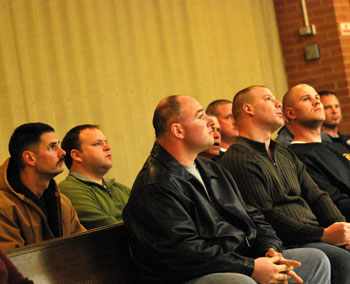
members of firefighters local union

Members of International Association of Firefighters Local 693 waited past midnight until their president finally was able to take his turn at public commentary during unreserved time at the end of the meeting. (Photo by the writer.)

Two rows of firefighters from the International Association of Firefighters Local 693 – layoff notices have already been sent to some of them – sat in the audience through the whole meeting, which lasted until midnight.

Like the firefighters, sitting at least in the background of nearly every item on the agenda, were the looming budget issues that the city council faces.

When they came to the foreground, the concerns about the budget managed to connect topics as seemingly disparate as Verizon antennae and parking revenues.

Even a garden-variety contract with a consultant for the greenbelt provoked some brief discussion related to the budget shortfall.

The impetus behind the council’s committee reorganization was again … the budget. What was previously one budget and labor committee was split into two committees: (i) the budget committee, and (ii) the labor committee, which is now combined with the council administration committee. That reorganization was pitched as a way to allow representation from each ward on the five-member budget committee.

Councilmembers and the city administrator also made robust use of the communications section of the agenda to provide status updates on their recent work – much of it related to efforts to identify new revenue streams and ways to cut expenses as part of the effort to meet budget goals.

In other business, the purchase of carts for single-stream recycling was authorized, plus an energy grant totaling over $1 million was accepted. [Full Story]

Council OKs Recycling, Transit, Shelter

people standing in a semi-circle

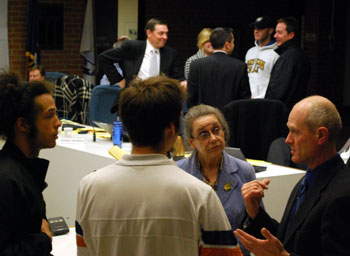
Left to right: Brian Nord and Caleb Poirier (back to camera), who are both advocates for Camp Take Notice, a self-governed encampment of homeless people. Also Sabra Briere (Ward 1) and Mayor John Hieftje. (Photo by the writer.)

Ann Arbor City Council meeting (Nov. 5, 2009): Meeting on Thursday due to the elections, instead of in its usual Monday slot, Ann Arbor’s city council moved ahead on two major initiatives that will eventually have a significant impact on Ann Arbor residents.

The council approved a memorandum of understanding with the University of Michigan to move forward on joint development of the Fuller Road Station, which offers the university an alternative to construction of a parking deck on Wall Street. The first phase of the project is anticipated to be completed in mid-June 2012.

Also given a green light was a conversion to single-stream recycling – a single cart will be distributed to residents to replace the twin totes currently used for curbside pickup. The new carts will be rolled out in June 2010.

A more immediate impact will be made by a council decision to allocate a combined $159,500 to the Shelter Association of Washtenaw County and the Interfaith Hospitality Network – the funds will increase the sheltering capacity by 50 spots for individuals through the winter, starting Dec. 1, and provide housing vouchers for eight families for a year. [Full Story]

Sunday Funnies: Totter Toons

teeter totter cartoon about single stream recycling [Full Story]

Work Session: Trains, Trash and Taxes

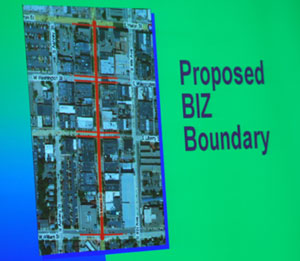
slide showing in red highlight the area of Main Street Ann Arbor that would be included in a business improvement zone

The proposed business improvement zone would include Ann Arbor's Main Street from William Street in the south to Huron Street in the north.

Ann Arbor City Council work session (Oct. 12, 2009): It’s a world where you can throw your newspapers, glass bottles and plastic tubs into one single recyclables cart and set it out for morning collection.

It’s a world where you can then board a bus that drops you off at the train station for your morning commute to Detroit.

It’s a world where during the work day you watch a foot of snow fall, but on your return home to Ann Arbor, you see that the snow hasn’t just been plowed on Main Street – it’s been completely removed – along with those handbills you’d noticed plastered on the lightpost.

It’s a world where later at home, you roll your empty recycling cart back to its place. Then you log on to the internet and see you’ve earned $250 worth of points tallied by the weight of the recyclables that the truck has been recording and crediting for the last year.

At its Monday night work session, Ann Arbor’s city council heard presentations on all the discrete elements of that world, which Ann Arbor could start to resemble in a couple of years. [Full Story]

» Text size:

larger text default text smaller text

Skyclock