The Ann Arbor Chronicle masthead
it's like being there

Stories indexed with the term ‘taxes’

County Budget Moves Toward Final Vote

Washtenaw County Board of Commissioners meeting (Nov. 18, 2009): The county’s administration and elected officials have been grappling with the 2010-2011 budget for nearly a year, and passed a milestone at Wednesday’s meeting with approval of the budget during the board’s Ways & Means Committee meeting. They’re expected to take a final vote at the Dec. 2 regular board meeting. Staff members who attended the meeting seemed visibly relieved.

The board also got an update on the 2009 budget, made appointments to more than a dozen commissions and committees, and approved emergency funding to help provide shelter for the homeless during the winter months. Details on these and other agenda items after the break. [Full Story]

Firefly Club Closed, Assets Seized

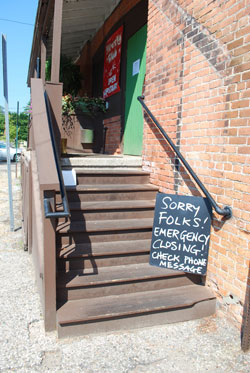
A sign at the entrance to the Firefly Club apologizes for the closing.

A handwritten sign at the entrance to the Firefly Club apologizes for the closing. (Photo by the writer.)

The Firefly Club, a jazz and blues nightclub at 637 S. Main, was closed down by the state last night and its assets seized for unpaid sales taxes. Owner Susan Chastain told The Chronicle that her bank account and other assets have been frozen as well, because she was unable to make full payments to the state over the past two months on a debt of $120,000 – an amount in arrears for assessed sales tax dating back several years.

“We’ve always struggled,” Chastain said. It’s historically been difficult for blues and jazz clubs, she added, but the economic downturn has made it even more difficult to keep up.

Chastain opened the Firefly nine years ago at 209 S. Ashley, where the Bird of Paradise, a now defunct jazz club, had been located. Recordkeeping problems – dating back to the club’s opening – caused the state to assess the Firefly’s sales tax, plus penalites and interest, at about $160,000 several years ago. Chastain said that about three years ago her current accountant negotiated a payment plan, and she started sending the state $2,000 each month to put toward the unpaid sales tax. [Full Story]

4-H Fans, Others Lobby County for Funds

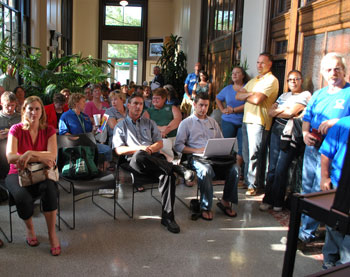
The overflow crowd in the lobby of the county administration building arrived too late for a seat in the boardroom.

An overflow crowd in the lobby of the county administration building arrived too late for a seat in the boardroom, and watched Wednesday's Washtenaw County Board of Commissioners meeting on TV. (Photo by the writer.)

Washtenaw County Board of Commissioners meeting (Aug. 5, 2009): As Washtenaw County grapples with a staggering budget deficit, 4-H supporters – including local farmers, teens and club leaders – packed Wednesday’s county Board of Commissioners meeting, urging commissioners not to cut funding for that program. They were joined by many others who use master gardening, financial counseling and other services of the county’s MSU Extension program, which could see dramatic funding cuts as the county tries to balance its budget.

As The Chronicle previously reported, the county faces a $30 million deficit over the next two years. Last week, county administrator Bob Guenzel released a list of options for cutting another $12 million out of the budget, and eliminating up to 181 jobs. Those options – which he stressed are not his recommendations at this point – target non-mandated services, ranging from Head Start to a variety of mental health programs. On Wednesday, Guenzel gave a formal presentation about the options to commissioners, who will be the final arbiters of any budget decisions. The discussion following Guenzel’s presentation could aptly be summarized by this statement from commissioner Conan Smith: “It sucks.” [Full Story]

Column: Limited Edition

Bill Lockyer, California State Treasurer, says that Winston T. Lee of Lafayette, Calif. owes his department $9,940,513.49 representing unfiled state income tax returns since 2002. One wonders, since both Bill and Winston agree that the returns were not filed, how Bill determined the delinquent income tax amount so precisely? At least you would think he could have rounded down on the 49 cents. (Google “California Delinquent Taxes.”)

“Not so,” Mr. Lee tells CNN on tax day. The assessment seemingly was set high enough in hopes of encouraging Mr. Lee to file his past-due returns and pay the correct tax with interest and penalties. “Won’t happen,” further retorts Mr. Lee. “I feel badly about the whole thing but I just can’t bring myself to figure out the complexities of the California income tax forms. I hope they will call me and we can agree on some number and I’ll just pay it.”

If Mr. Lee, a businessman with a few rental properties, is confused by the California returns, he is most fortunate not to be doing business in Michigan. The governor’s new Michigan Business Tax, with its mind-numbing complexities and inequities, sets the gold standard for costly tax attorneys and CPAs. Likely the governor’s  State Treasurer has already realized – or soon will – the significant free give-a-ways, tax credits, and subsidies that will be needed to get any prospective new business to buy into the MBT mess, a tax adopted at 2 in the morning by a sleep-deprived (brain dead?) legislature surrounded by dozens of well-paid and wide awake lobbyists. [Full Story]

Washtenaw County: Equalize This

Washtenaw County Board of Commissioners (April 15, 2009): A report that’s crucial in calculating how much the county can collect in property taxes this year was delivered to the board, one of several budget-related topics as commissioners and the administration grapple with declining revenues and a multimillion-dollar deficit in the coming years.

County administrator Bob Guenzel, left, talks with county clerk Larry Kestenbaum during a break at the April 15 meeting of the Washtenaw County Board of Commissioners.

County administrator Bob Guenzel, left, talks with county clerk Larry Kestenbaum during a break at the April 15 meeting of the Washtenaw County Board of Commissioners.

As county administrator Bob Guenzel had foreshadowed at the commissioners’ April 11 retreat, the 2009 taxable value of property in the county fell 2.16%. It was the first time in 50 years that Washtenaw County saw a decline in both taxable value and assessed value – but it almost assuredly won’t be the last.

The board also took time to honor public health official Ellen Clement, who’s leaving the county staff after nearly 25 years, and to recognize Guenzel for his 35 years of service. He’ll be sticking around. [Full Story]

Is DDA District a Disproportionate Burden?

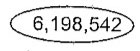
Six-million-dollar oval.

The bottom line according to a 2005 city of Ann arbor analysis of DDA costs versus payments. (The circle means "negative") The DDA sees it differently.

On Monday evening, March 23, several Ann Arbor residents took advantage of an entire city council session devoted to public comment on the recent A2D2 zoning revisions. The  zoning revisions apply to an area that  coincides almost exactly with the Downtown Development Authority district. We thus take the opportunity to focus on this district, and how taxes are collected in this geographic area, in light of recent community discussion on the topic.

The Chronicle has previously reported a remark by made by Mayor John Hieftje at a recent Sunday night caucus, in which he stated that the parking agreement between the DDA and the city was renegotiated in 2005 due in part to the fact that the DDA area represented a disproportionately greater burden on city services. Also previously reported, Kyle Mazurek, vice president of government affairs for the Ann Arbor Area Chamber of Commerce, posed several questions to the DDA board at its meeting on March 4, including one about the possibility of disproportionate use of city services in the DDA district: [Full Story]

» Text size:

larger text default text smaller text

Skyclock