Stories indexed with the term ‘technology’

AAPS to Float February Tech Millage

Ann Arbor Public Schools board of education meeting (August 10, 2011): AAPS board of education trustees approved a resolution at their Aug. 10 meeting to ask voters to fund $45.8 million in technology improvements across the district.

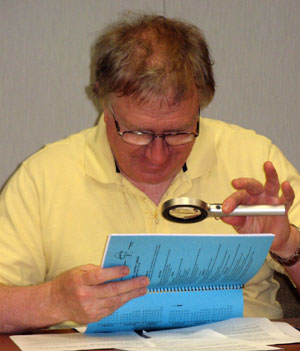
Andy-Thomas-magnifying-glass

Trustee Andy Thomas uses a magnifying glass to review the amortization table presented as part of the bond proposal during an Aug. 9 special meeting. (Photo by the writer.)

The request to the voters will take the form of a tax to be paid by property owners over the next 13 years at an average rate of around .51 mills to support the sale of bonds. The rate will vary because the bonds will be issued in series in order to ensure that the equipment purchased with the bonds has a useful life longer than it takes to pay off the bonds used to purchase it. [A rate of .51 mills is $0.51 for every $1,000 of a property's taxable value.]

Trustees plan to place the measure on the Feb. 28, 2012 ballot – the fourth Tuesday of the month. Previously, the board had discussed the possibility of placing it on the Nov. 8, 2011 ballot.

If approved, the millage would pay for a bond that would fund upgrades to equipment previously purchased with a 2004 bond, including student, teacher, and administrative computers, as well as upgrade infrastructure such as switches, servers, and the district’s wireless “backbone.”

The new bond would also include support for new classroom technologies and administrative software.

The Aug. 10 decision to place the technology millage on the February 2012 ballot came after discussion at a special board meeting on Aug. 9, which was called to allow for trustees to share feedback they had received from the community since directing administration to prepare for a tech bond at a study session on July 13.

The Aug. 10 meeting also included trustees’ unanimous vote supporting a new DVD recommended by the district’s Sexual Health Education Advisory Committee (SHEAC). [Full Story]

Ann Arbor OKs Interagency Agreements

At its May 2, 2011 meeting, the Ann Arbor city council approved several interagency agreements on use of technology with: (1) Washtenaw County and the Ann Arbor Transportation Authority; (2) Washtenaw County for data storage services; and (3) Washtenaw County for backup services.

The AATA board had discussed the AATA collaboration at its April 21 meeting. The data storage services to be provided by the county will cost $73,632 for four years. The backup services to be provided by the county will entail an annual service cost of $102,607 for four years.

This brief was filed from the city council’s chambers on the second floor of city hall, located at 301 E. Huron. A more detailed report will follow: [link] [Full Story]

Public Hearing Set for Sakti3 Abatement

At its May 2, 2011 meeting, the Ann Arbor city council voted to set a public hearing on the granting of a tax abatement to Sakti3, a University of Michigan battery technology spinoff from the University of Michigan. Sakti3 is led by UM professor Ann Marie Sastry. The public hearing will be held as a part of the city council’s June 6, 2011 meeting, which starts at 7 p.m.

Sakti3 is requesting an abatement on $200,000 of real property improvements (electrical construction work) and $2.2 million of personal property (battery cycling equipment, thermal chambers, machine shop equipment, server system).

If granted, the abatement would reduce Sakti3′s annual tax bill for the new improvements by about $17,000 for each year of the abatement. According to city staff, the new real and personal property investments would generate about $22,500 in property taxes each year.

Previously, the council voted on March 21 to set a public hearing on the establishment of the industrial development district under which Sakti3 is applying for an abatement. And on April 4, the city council approved the establishment of the district.

This brief was filed from the city council’s chambers on the second floor of city hall, located at 301 E. Huron. A more detailed report will follow: [link] [Full Story]

Ann Arbor Library Frames Tech Issues

Ann Arbor District Library board meeting (March 21, 2011): Monday’s meeting of the AADL board included an animated discussion about how digital books are transforming the publishing industry, and the impact those changes are having on public libraries.

Eli Neiburger's avatar

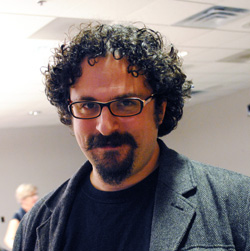
Eli Neiburger's avatar – or click the photo to see how he looks in real life. Neiburger has been named by Library Journal as one of its 2011 Movers & Shakers.

The topic stemmed from a report by AADL director Josie Parker, who described her experience at a recent working group meeting for the Digital Public Library of America. At that invitation-only event, Parker framed the discussion among industry leaders regarding the future of public access to information, from the perspective of public libraries.

It’s an issue highlighted by the decision of two major publishers – Macmillan and Simon & Schuster – not to sell eBooks to public libraries, making more than 25% of the eBook market unavailable to library patrons. More recently, HarperCollins announced restrictions on how libraries can circulate eBooks that it publishes.

Eli Neiburger, AADL’s associate director of IT and product development, gave a talk on the impact of eBooks at a national summit last fall called “ebooks: Libraries at the Tipping Point” – his presentation can be viewed online. At Monday’s meeting, Parker congratulated him for being named by Library Journal as one of its 2011 Movers & Shakers, in the category of tech leaders.

In another technology-related update, Parker told the board she’s been invited to serve on the Bill & Melinda Gates Foundation‘s public access technology benchmarks program. That workgroup will be developing benchmarks that libraries can use to determine the kind of technology infrastructure they need to deliver services to their communities.

Parker also briefed the board on new standards imposed by the Library of Michigan, which changed how public libraries qualify for state aid. Those standards – originally proposed as rules – are the subject of a lawsuit against the state library, filed by the Herrick District Library in Holland. The AADL has filed an amicus curiae – or “friend of the court” – brief in support of the Herrick library’s position, which charges that the state library has no authority to set these rules, and is taking away local control from district libraries.

Aside from updates made by Parker, the board dispatched with the rest of its business quickly. No one spoke during the time available for public commentary. [Full Story]

In the Archives: Forgotten Phones

Editor’s note: Owners of new phones nowadays are as likely to think about the first photograph they’ll take with it as they are to contemplate the first words they’ll say into it. But Laura Bien’s local history column this week serves as a reminder that sometimes first words spoken into a phone get remembered in the historical archives. Given what she’s unearthed from the archives this time, it’s not clear why Chicago is known as the “city of broad shoulders” instead of the “city of big-footed girls.”

Illustration of Webster Gillett's four-point telephone

Webster Gillett invented a telephone with four needles tuned to the speaking diaphragm.

Quiz a friend or two about who popularized the type of electricity we use today – go ahead, get your geek on – and a few would correctly name Nikola Tesla. Then ask who invented long-distance telephony.

Probably no one would answer correctly.

It wasn’t Alexander Graham Bell, Thomas Edison, or any other celebrated name from the late 19th century’s feverish and fertile age of invention.

Like his renowned contemporary, Tesla, the inventor of long-distance telephony was an electrical engineer. Unlike Tesla’s numerous, sophisticated, and lasting inventions, his were few, crude, and transient.

But they worked – and brought him temporary fame.

Just as Tesla’s brilliance and legacy weren’t fully appreciated until long after his death, so too should be remembered the legacy of his humbler brother inventor whose name once graced the New York Times: Ypsilanti engineer Webster Gillett. [Full Story]

Ann Arbor MiniMaker Faire Draws 1,000+

MiniMaker Faire Ann Arbor 2009

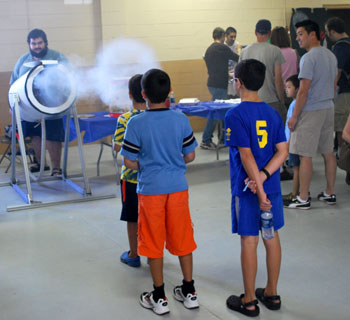
Andros Lee with his Vortex Doomsday Cannon at the Ann Arbor 2009 MiniMaker Faire. (Photo by the writer.)

Two-wheeling it southward down Ann Arbor-Saline road early Saturday afternoon, The Chronicle was passed by a car with a “Biodiesel” logo.

The sort of person who drives a car fueled with biodiesel, we figured, would be the same sort who’d be interested in robots, lasers, air cannons, and all manner of other gadgetry. So we figured a little ways down the road, that driver would be turning left into the Washtenaw Farm Council Grounds for the MiniMaker Faire.

Anyway, that’s where The Chronicle was headed – and on arrival at the parking lot, we confirmed it: Our biodiesel driver was at the MiniMaker Faire.

The “mini” in the title of the event did not refer to Andros Lee’s giant vortex cannon or Matt Switlik’s standable brush bot – more on those in a bit. Rather, it reflected the scale of the event as compared to the non-mini Maker Faires, which began in San Mateo, Calif. in 2006. That led to the second Maker Faire in Austin, which attracted 20,000 visitors in 2007. Returning to San Mateo earlier this year, Maker Faire numbers grew to an estimated 80,000 people.

As an exhibitor – even at the smaller Ann Arbor MiniMaker Faire on Saturday – standing out in a crowd of over 1,000 people can be a challenge. But Yitah Wu met that challenge by taking dead aim at folks in that crowd, including The Chronicle, with a pistol-style vortex cannon.  [Full Story]