Stories indexed with the term ‘town gown’
E. Stadium Bridges Project Gets Council OK
At its April 4, 2011 meeting, the Ann Arbor city council approved four items related to its East Stadium bridges replacement project: a road right-of-way easement from the University of Michigan for $563,400; two utilities easements from UM totaling $426,650; and an unrecorded water utilities easement.
The city was able to get the TIGER II federal funds formally “obligated” for that first right-of-way phase of the project – city council held a special meeting on March 16, 2011 to sign the necessary agreement.
The approval of the easements at the April 4 meeting will allow the city to proceed with getting $13.1 million of TIGER II grant funds obligated that have already been awarded for the second phase of the bridge replacement project. A continuing federal budget resolution passed by the U.S. Congress – which would preserve the TIGER II funding – expires on April 8. Previous proposals by House Republicans have included cuts that would have eliminated the TIGER II funding.
The council is acting with some urgency to get the funds obligated before the program is eliminated – if, in fact, it is eliminated.
This brief was filed from the city council’s chambers on the second floor of city hall, located at 100 N. Fifth Ave. A more detailed report will follow: [link] [Full Story]
Stadium Bridge Contract Signed with Feds
Ann Arbor city council special meeting (March 16, 2011): At a special meeting that had been announced at a city council work session two days earlier, the Ann Arbor city council voted to authorize signing a contract with the U.S. Department of Transportation related to a $13.9 million TIGER (Transportation Investment Generating Economic Recovery) II grant.

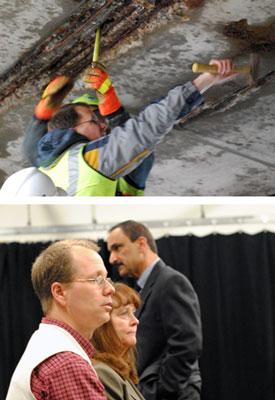
Top: File photo from March 2009 of city engineer Mike Nearing as he gives the East Stadium bridge a hammer sounding test. Bottom: At a March 16, 2011 special meeting, Nearing and other city staff were on hand to answer questions. To Nearing's left is Sue McCormick, public services area administrator. Standing is Homayoon Pirooz, head of project management. (Photos by the writer.)
Announcement of the grant’s award to the city for the reconstruction of the East Stadium Boulevard bridges had come in October 2010. The bridge over State Street is in such poor condition that its southern two lanes were intentionally demolished in November 2009.
The council’s special session reflected an urgency to complete the contract. The council has a regular meeting scheduled next Monday, March 21 – just five calendar days after the special session – when the council could also have taken the necessary vote on the contract.
The urgency stemmed from the March 18 expiration of a continuing resolution (CR) passed by Congress and signed into law by President Barack Obama on March 2. A CR is a mechanism for keeping the federal government operating, based on the previous fiscal year’s budget assumptions, until formal appropriations bills are passed by Congress. The federal budget procedure is essentially a two-step process in which the budget levels for each department are first set and signed into law, followed by appropriations bills that authorize spending the budgeted amounts.
Based on proposals brought forward in February by U.S. House Republicans, but ultimately not enacted, the current two-week CR would have eliminated TIGER II grants. And based on the political posturing that took place over the current CR, the Ann Arbor city council was taking the step of signing the contract as soon as it could, to allow the U.S. Federal Highway Administration to “obligate” the TIGER II grant funds for the bridges project under the current CR – as a hedge against the possibility that a subsequent CR might cut TIGER II funding.
Although the grant had previously been awarded, the funds are not secured until they are actually obligated, a process that includes various requirements – among them, signing the contract that the council authorized at its special session.
The council’s action enabled obligation of TIGER II funds only for the right-of-way phase of the project – which amounts to around $800,000. According to Congressman John Dingell’s office staff, they’d been informed by the Dept. of Transportation on March 15 that the $800,000 for the initial phase had just been obligated.
Based on the city of Ann Arbor’s timeline, obligation of the $13.1 million in TIGER II funds for the construction phase is expected in May. Construction on the project, which is estimated to cost a total of $23 million, is tentatively scheduled for October 2011.
A public information meeting on the status of the project is scheduled for Wednesday, March 23 from 6:30-8 p.m. at the Pioneer High School cafeteria. Pioneer is located at 601 W. Stadium – just down the street from the bridges. [Full Story]
Packing Pyramids: UM and Ann Arbor
Ann Arbor is home to the University of Michigan, which makes it different from other similar-sized Midwestern cities lacking a world-class research institution. You can’t swing a dead Greek philosopher without hitting someone in this town who can tell you how significant the connection is between Ann Arbor and UM.
In that way, at least, Ann Arbor is densely packed.
This is a story about that town-gown connection. It’s a story that connects a recent UM mathematics PhD thesis defense to the Ann Arbor planning commission – and takes a continuous path though topics like Klingons, grocery bags, affordable housing, yard waste collection and Valentine’s Day.
We begin with Elizabeth Chen, who successfully defended her PhD dissertation last Friday in East Hall on the UM campus. Her presentation included several hands-on assignments for those in the audience of around 30 people – several of whom assured The Chronicle that hers was an “unconventional” thesis defense.
Chen exhorted the assembled mathematicians to paste together plastic pyramid shapes with gummi putty to help them get an intuitive feel for the shapes: “It’s not so scary!” she admonished them. After half an hour, one member of her thesis committee prodded her to get to the mathematics part – he really had “better things to do.” The Chronicle, however, did not. [Full Story]
Regents Get Update on Town-Gown Relations

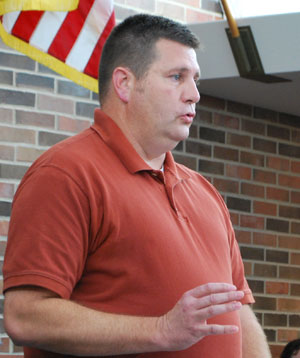
Matt Schroeder, president of the Ann Arbor firefighters Local 693, spoke to UM regents at their Sept. 17 board meeting about how possible firefighter layoffs could affect campus safety. (Photo by the writer.)
University of Michigan Board of Regents (Sept. 17, 2009): UM regents heard two presentations at their Thursday board meeting that closely linked the university and the community of Ann Arbor. Jim Kosteva, UM director of community relations, gave an update on the ways that the university is involved with the city, including payments as well as partnerships. And Matt Schroeder, president of the Ann Arbor firefighters Local 693, spoke during public comment on the possibility of additional layoffs among city firefighters and the potential impact it would have on the university.
Regents also heard several other reports and updates: from the director of the Life Sciences Institute; an architect working on the new basketball practice facility at Crisler Arena; and two alumni who hope to get the university more involved in an effort called Patriot Week.
And during her report on the board’s personnel, compensation and governance committee, regent Andrea Fischer Newman said that UM president Mary Sue Coleman had requested – and the committee agreed – not to raise Coleman’s salary this year.
We’ll begin with the issues most directly related to the Ann Arbor community: Kosteva’s report, and Schroeder’s public commentary. [Full Story]
UM Plans Research Hub at Former Pfizer Site
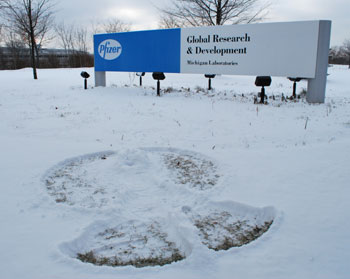
Word about the University of Michigan’s plans to buy the former Pfizer research site had leaked out much earlier in the day, but UM regents waited until the end of their regular Thursday afternoon meeting before making it formal: The university will spend $108 million to buy the roughly 174-acre Plymouth Road complex, with plans to transform it into a major medical and scientific research hub. In the long term, university officials hope to add 2,000 jobs to the local economy over 10 years. But in the short term, the deal will take millions of dollars off the tax rolls for local governments at a time when they’re already anticipating budget shortfalls. [Full Story]
Neighbors Weigh In Again on Wall St. Project

Eliana Moya-Raggio, a Wall Street resident and former UM faculty member, explains her objections to UM's proposed parking structure. She spoke at a Tuesday evening meeting held at the Kellogg Eye Center.
There were two distinctly different agendas on view at Tuesday’s Wall Street neighborhood meeting, hosted by University of Michigan staff. University representatives, led by Jim Kosteva, were there to deliver information about environmental and safety issues related to the proposed UM expansion in that area. The neighbors wanted answers to questions they’d been asking for many months – and their frustration was palpable.
UM Purchases Pfizer Site
Details are scant, but UM has scheduled a major announcement to be made at this afternoon’s regents meeting: UM will purchase the former Pfizer site.
Reaction to the news from Ward 5 councilmember Carsten Hohnke was unambiguous: “The impact of removing $1.5 million from our tax rolls can not be overstated. I’m extremely disappointed that the University could not find a way to be a more creative and equitable partner with the city in this.”
Meeting Watch: DDA (1 Oct 2008)
The DDA board met at its regularly scheduled time on the first Wednesday of the month. Topics of discussion ranged from new developments to the DDA on TV. [Full Story]
Meeting Watch: City Council (22 Sept 2008)
Public Commentary
Tom Partridge. Partridge makes clear who he’s talking to: “Members of the public at large, representatives of the media, I am Tom Partridge.” Media. That’s us, The Chronicle. When people speak directly to us, we listen. Partridge stressed the importance of electing Democrats in November, saying, “We need to support candidates who stand for progress – true progress.”
John Floyd. Floyd did not coin the phrase Charm Zone – he heard it at a recent planning commission working session – but he has embraced this term for the part of Ann Arbor built before World War II. He contends it’s what makes Ann Arbor different from Royal Oak or Novi and what gives Ann Arbor … [Full Story]
A2: Visitors
Ever wonder what our community leaders tell visitors to Ann Arbor about the city’s town gown relations? @orangepolitics is Twittering live the remarks of A2 and UM luminaries. Highlights: “Jim Kosteva, UofM: ‘town-gown relations are like a marriage wher divorce is not an option.’ Then he hands the city councilwmn some flowers!” Councilwoman in question is Briere. [Source]