


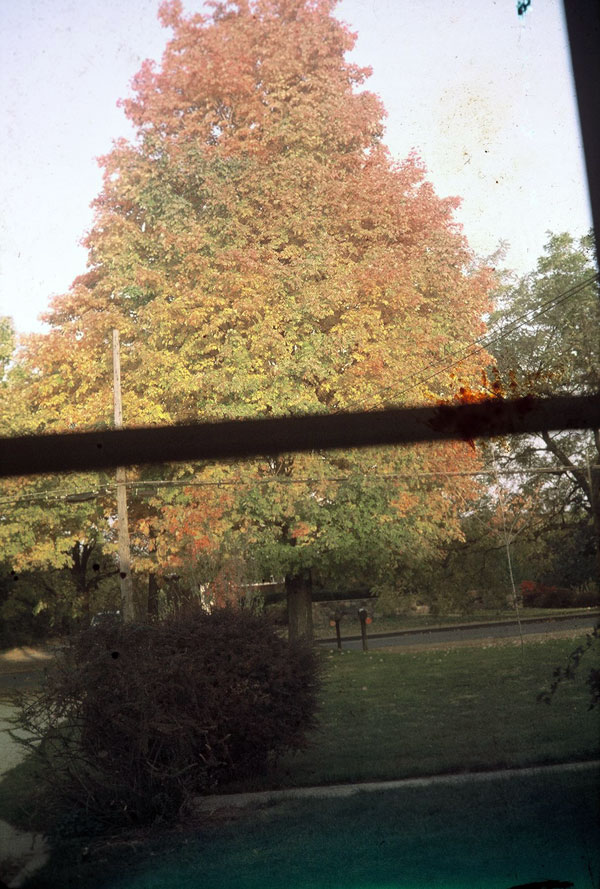
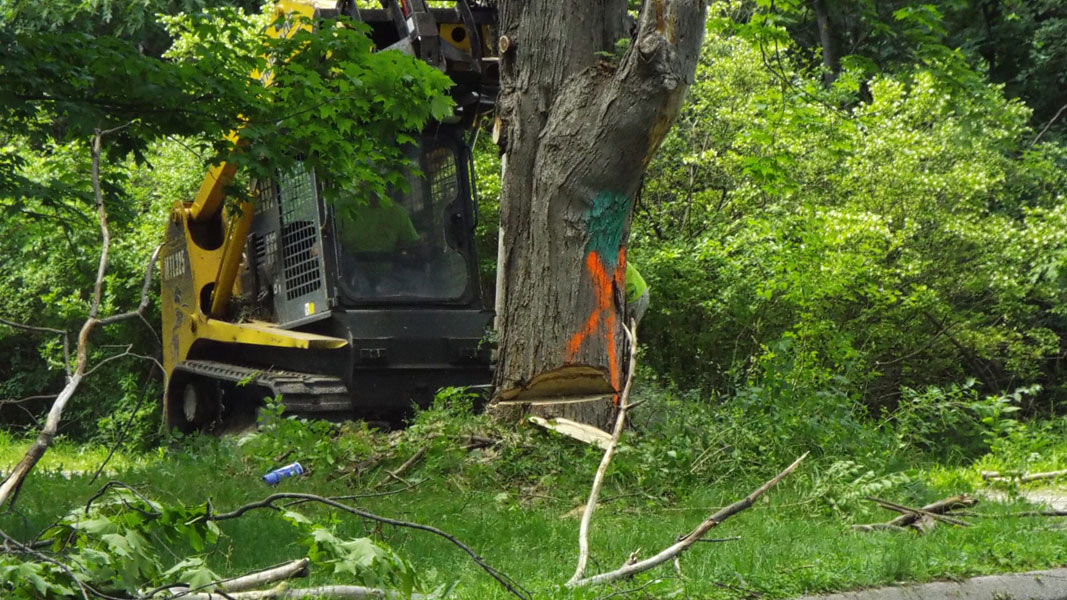
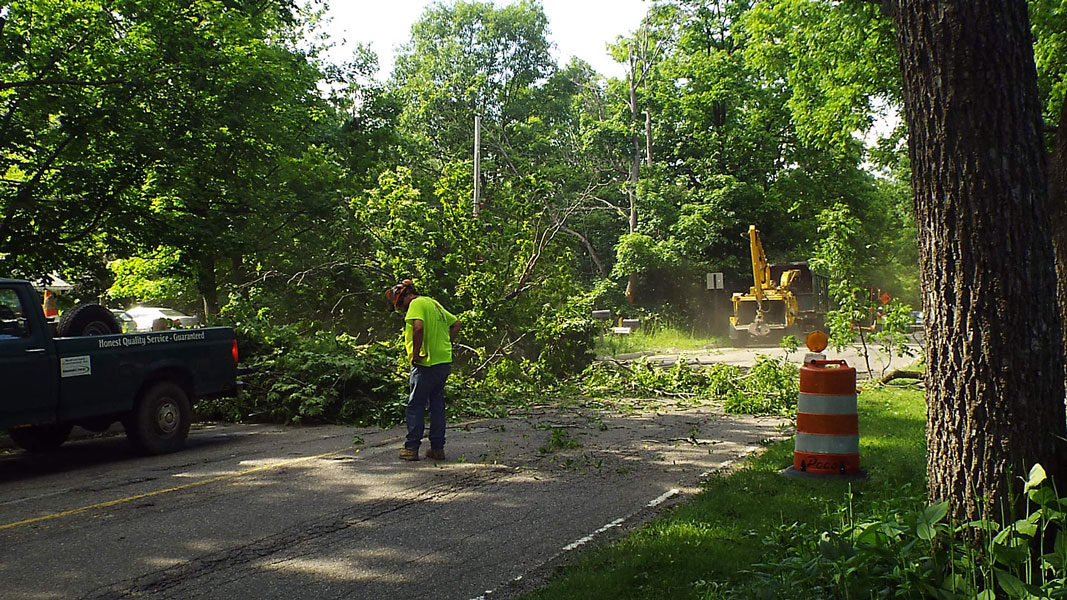
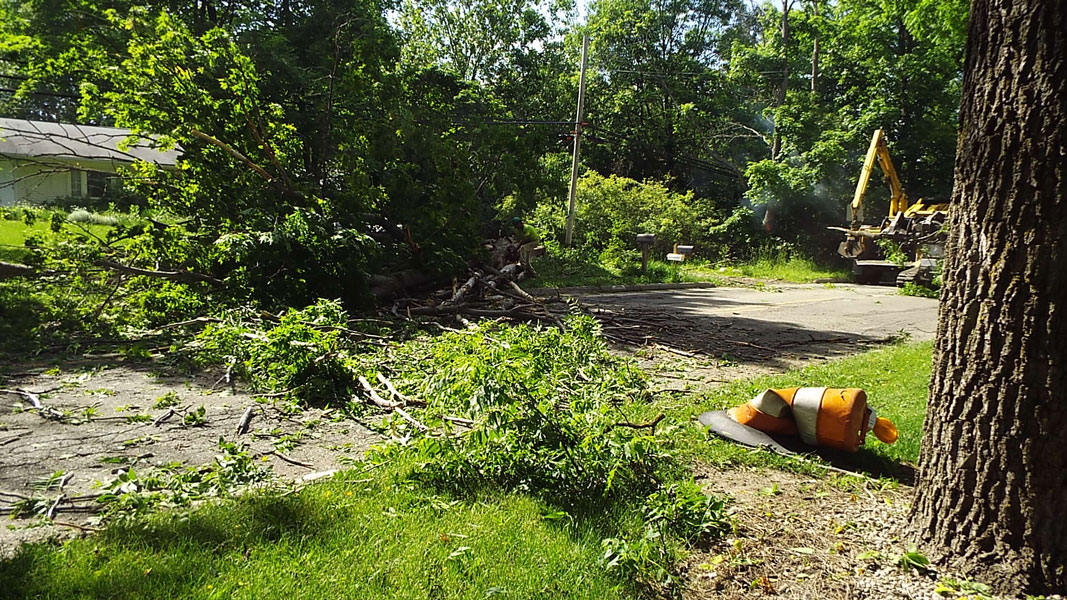
A giant of Newport Road in the early 1970s. [photo 1] The very top had mostly broken off as it died so it was much shorter in the end. [photo 2 ] With a shove [photo 3] late in the afternoon [photo 4] [photo 5 ], it made a mighty mess, taking part of the tree across the road with it [photo 6]. We’re still working on an exact age, but a neighbor identified the black lines as spalting [photo 7].
Stories indexed with the term ‘trees’



Newport Road at Riverwood
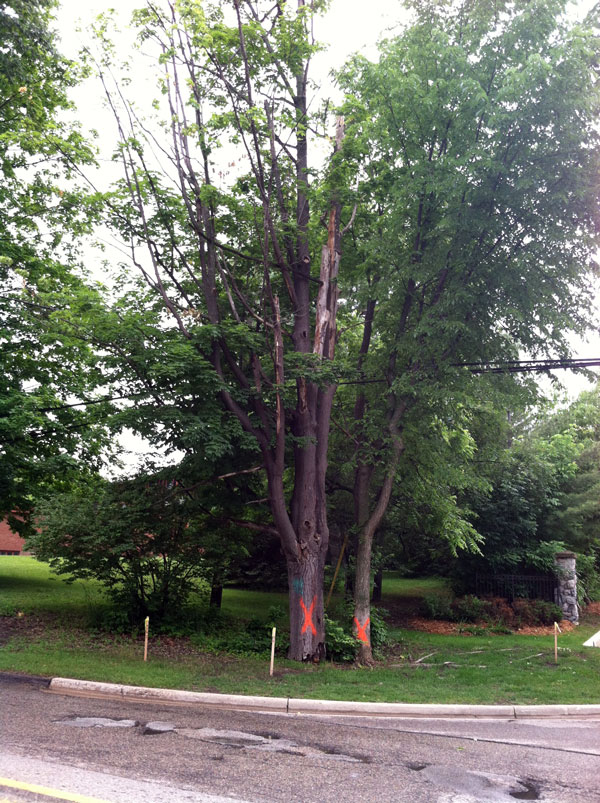
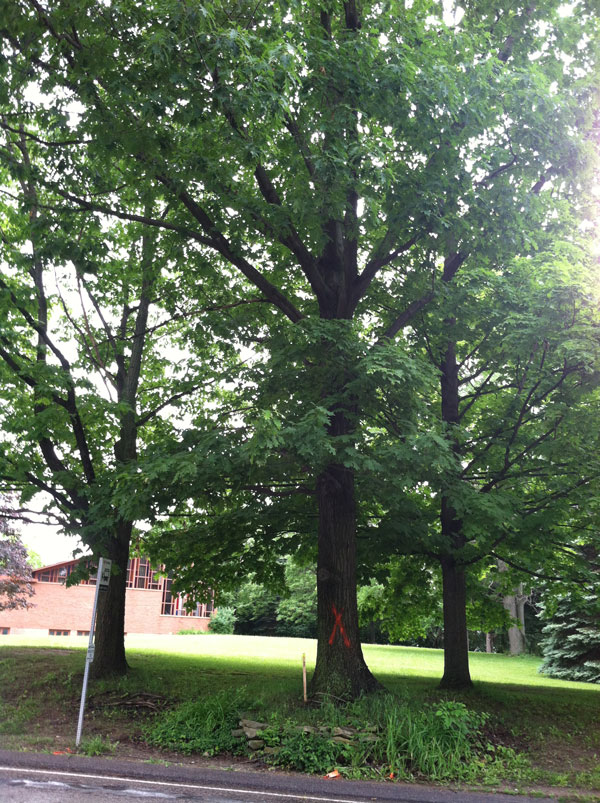
Critically needed roadwork is slowly starting as the “sidewalk gap” gets filled first. Trees previously flagged for removal in green have new red X’s today. [photo 1] Several previously unmarked trees have red X’s as the sidewalk area gets flagged, including an otherwise healthy tree that provides shade and seating at the bus stop. [photo 2] Yet no red or green could be found on the tree held up by phone lines. [photo 3]
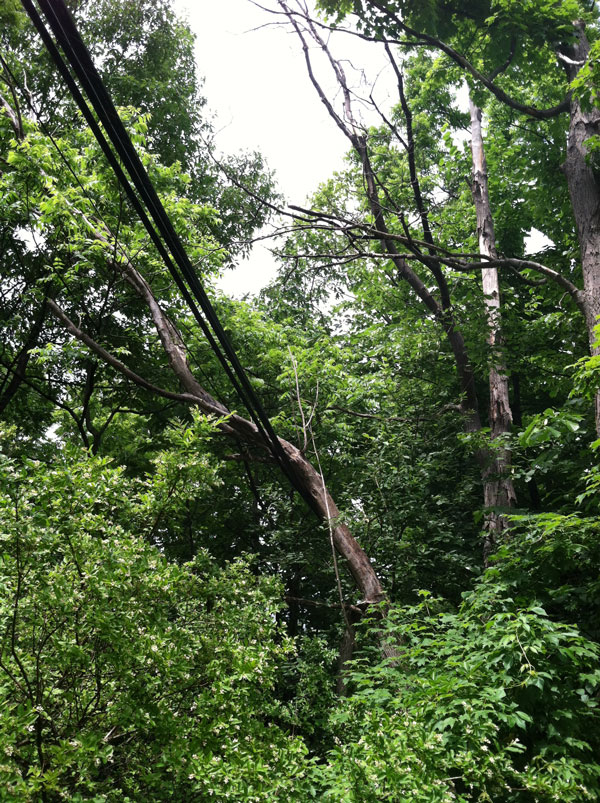
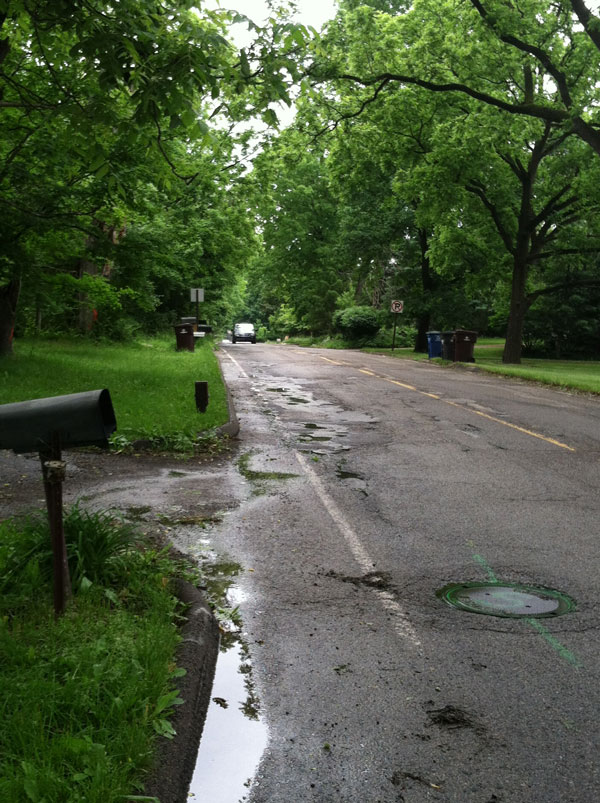
[photo 4] is looking north on Newport at corner of Riverwood. Drainage from Riverwood to Alexandria is almost non-existent as the road levels out. We have not gotten any word as to what will be done to improve that when the sidewalks will add more impervious area uphill. We also have gotten no information on when the actual roadwork will start. The tree held up by phone lines is right over the edge of our property line at 2053 Newport. We think it may have started as a city tree but now leans back far enough to not look like it is.
Jackson & Dexter
The traffic light is out and Dexter is closed. Arbana is bumper to bumper. Avoid going west!
Esch
“Tree Town” Gets $50K USDA Grant for Pruning
At least 100 large trees in Ann Arbor’s public right-of-way will be pruned with a $50,000 grant from the USDA Forestry Service. The city council authorized the receipt of the grant at its Dec. 16, 2013 meeting
The pruning program would target those trees in the public right-of-way that are most in need of pruning (Priority 1). The initiative is also focused on the larger of the city’s street trees – those bigger than 20 inches in diameter. Those are the trees that have the greatest impact on the mitigation of stormwater.
According to the staff memo accompanying the resolution, the city of Ann Arbor has over 46,600 street trees, counting street trees and those in parks. According to the staff memo: … [Full Story]
Dean Tree Fund Committee Changed
At its June 4, 2012 meeting, the Ann Arbor city council voted officially to eliminate the city council appointee to the Elizabeth Dean Tree Fund committee. The committee was established in 1975 to oversee the use of the investment earnings from a nearly $2 million bequest made to the city by Elizabeth Dean. According to a Nov. 10, 1974 Ann Arbor News article, the bequest was made in the early 1960s to “repair, maintain and replace trees on city property.” The principal amount remains intact.
The formal elimination of the city council committee member leaves the committee with seven voting members and one non-voting member – the city’s urban forestry & natural resources planning coordinator. The city’s description of the committee indicates … [Full Story]
Powers Gets Admin Nod; Recycling Revisited
Ann Arbor city council meeting (July 18, 2011): Councilmembers completed their first two significant tasks in under an hour on Monday evening.
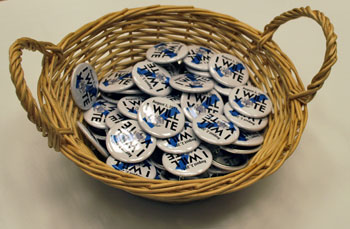
The speaker’s podium at Monday’s meeting was graced with a basket full of buttons stating: I WILL VOTE. The city’s primary election is Tuesday, Aug. 2. The buttons are part of a city clerk’s office effort to increase participation in the elections. (Photos by the writer.)
During the time reserved for council communications at the start of the meeting, councilmembers decided to reconsider a 5-4 vote they’d taken on July 5. That vote, which failed to achieve a six-vote majority, had the outcome of rejecting an increase to Recycle Ann Arbor‘s contract to provide curbside recycling service in the city. After agreeing to reconsider the vote, the issue was again fresh before the council.
Councilmembers then unanimously agreed to postpone action on the contract until the next meeting, which falls on Aug. 4 – after the Aug. 2 city council primary elections. Based on remarks from Carsten Hohnke (Ward 5), it appears likely that the council may discontinue a contract with RecycleBank (an incentive program provider) in order to free up funds to supplement Recycle Ann Arbor’s contract.
Next up was a resolution that had been moved forward on the council’s agenda to a spot before all the consent agenda items. After brief deliberations, the council agreed to offer its open city administrator position to Steve Powers. The decision for Powers over another finalist, Ellie Oppenheim, came after two rounds of interviews on July 12-13, including a televised session on the morning of July 13. [Previous Chronicle coverage: "Search Concluding for Ann Arbor City Admin"]
Although Monday’s meeting was brief, the council ticked through a raft of significant votes after those two main business items. The expected start of the East Stadium bridges reconstruction project was reflected in the approval of stormwater control projects near the construction site, and in the approval of a deal to use land as a construction staging area. For a property just down State Street from the bridge, but unrelated to the project, the council approved a sanitary sewer hookup at the location where Biercamp Artisan Sausage and Jerky has opened for business.
Related to the city’s emphasis on the natural environment, the council approved a contract that will allow the planting of 1,200 trees in city rights of way, and added 110 acres of land to the city’s greenbelt program.
The city renewed its membership in the Urban County, a consortium of local governmental entities that allows the city to receive federal funds through a variety of federal U.S. Housing and Urban Development (HUD) programs. The council also appointed Tony Derezinski (Ward 2) as a hearing officer for liquor license revocation recommendations. Initial approval was also given to two ordinance changes related to employee benefits – one of them for union employee retirement benefits, the other for non-union retiree health benefits.
Only three people addressed the council during public commentary at the start of the meeting. Two of them were the owners of businesses – Earthen Jar and Jerusalem Garden – adjacent to the construction site of the underground parking structure along Fifth Avenue. They reiterated the same theme they’d conveyed to the board of the Ann Arbor Downtown Development Authority (DDA) at that body’s July 6 meeting – their business is suffering due to the construction.
And related to the DDA, Stephen Kunselman (Ward 3) continued a pattern of using his council communications slot to update his colleagues on his campaign to press the DDA to provide more information about its budget. It’s a highlight of his re-election campaign in Ward 3, where he’s contesting a three-way primary on Aug. 2. [Full Story]
Ann Arbor to Plant More Trees
At its July 18, 2011 meeting, the Ann Arbor city council approved a $301,475 contract with Marine City Nursery Company to plant 1,200 trees in the right-of-way of streets in the Malletts Creek, Allen Creek, Traver Creek and Swift Run Drainage Districts. [.pdf of map showing areas to be targeted for tree planting]
The money for the tree planting will come from the stormwater fund’s capital budget. The Washtenaw County water resources commissioner has obtained a low-interest loan on behalf of the city through the state’s revolving fund loan and will reimburse the stormwater fund for part of the project. The rationale for use of stormwater funds to plant trees is based on the idea that trees have a positive impact on the volume and quality of stormwater flow.
The city received only two bids for the tree-planting contract, and only the bid from Marine City Nursery Company was determined to be a responsible bid.
This brief was filed from the city council’s chambers on the second floor of city hall, located at 301 E. Huron. A more detailed report will follow: [link] [Full Story]
Talking Trees, Leafing Through Archives
[Editor's Note: HD, a.k.a. Dave Askins, editor of The Ann Arbor Chronicle, is also publisher of an online series of interviews on a teeter totter. Introductions to new Teeter Talks also appear on The Chronicle's website.]
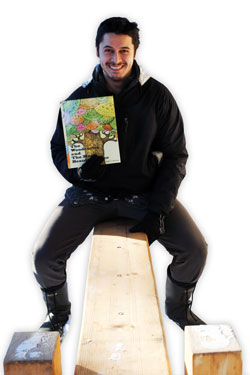
Last week, Robb Johnston rode the AATA bus from Ypsilanti into Ann Arbor and walked from downtown to my front porch take his turn on the teeter totter. [Robb Johnston's Talk]
Johnston has written and illustrated a self-published children’s book called “The Woodcutter and The Most Beautiful Tree.” And whenever anyone pitches me Chronicle coverage of a project they’re proud of, my first thought is: “Can I get a teeter totter ride out of this?”
Before Johnston’s ride, I test-read his children’s book the best way I could think of, given that my wife Mary and I do not have children: I read the book aloud to her, and did my best to pretend that she was four years old. It was my own first read through the book, so I was satisfied when I did not stumble too badly over the part of the woodcutter’s refrain that goes, “Thwickety THWAK, Thwickety THWAK.”
Oscar Wilde’s “The Happy Prince” notwithstanding, I think it’s fair to expect that a children’s book with a title like “The Woodcutter and The Most Beautiful Tree” will end well and leave everyone with smiles all around. And it does. So it’s not like I was truly surprised when I turned that one page near the end that reveals exactly how the final encounter between The Most Beautiful Tree and the Woodcutter ends.
But the book’s text and its illustrations pull the reader along to that point, and suggest so unmistakably a dark and dreadful ending, that when I did turn that page, I gulped a genuine breath of relief that she did not wind up getting milled into lumber at the end. [The tree in Johnston's book is female.] Well, yes, you might conclude that I am just that dopey. Or more generously, you might try sometime reading aloud a book you’ve never seen before.
But speaking of things we’ve seen before, some Chronicle readers might be thinking: Haven’t we seen this guy Robb Johnston before? Why yes, you have. [Full Story]
Environmental Indicators: Trees
Editor’s Note: This is the fourth in a series of Chronicle pieces on the environmental indicators used by the city of Ann Arbor in its State of Our Environment Report. The report is developed by the city’s Environmental Commission and designed as a citizen’s reference tool on environmental issues and as an atlas of the management strategies underway that are intended to conserve and protect our environment. The report is organized around 10 Environmental Goals developed by the Environmental Commission and adopted by city council in 2007.
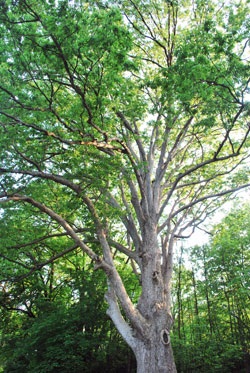
This is one of Ann Arbor's more significant trees. Some readers will undoubtedly recognize it and will know its location, type, and age – which they're invited to leave in the comment section.
This month’s report is also an invitation to all readers to participate in the development of Ann Arbor’s first comprehensive Urban Forest Management Plan. A public workshop to help kick off the planning effort is being held on June 1, 2010 from 7-9 p.m. at Forsythe Middle School, 1655 Newport Road.
This spring has been exceptional with both beautiful weather and ample rain. The trees seemed to have noticed, with their early bud break in April and full canopies by mid-May. While we worried for those tender emerging leaves when the temperature dipped below freezing, the trees handled the dips in temperatures just fine and are now flourishing.
That’s good news because the city receives exceptional benefits from our trees. A recent analysis of the publicly managed trees (i.e., trees along streets and mowed areas of parks) estimated that they provide $4.6 million in benefits each year. When you factor in the cost for management, the city receives $2.68 in benefits for every $1 it spends on the municipal forestry program. We think that’s a pretty good rate of return.
What are these benefits and how were they calculated? [Full Story]
Council Caucus: Near North PUD
Ann Arbor City Council caucus (Aug. 5, 2009): The city council caucus, which typically falls on the Sunday before council’s regular Monday meeting, was rescheduled for Wednesday this week to match the rescheduling of the council’s regular meeting to Thursday. That schedule change had been prompted by the Democratic primary elections held on Tuesday.
Four council members attended caucus – John Hieftje (mayor), Sandi Smith (Ward 1), Sabra Briere (Ward 1) and Mike Anglin (Ward 5). They heard from residents on a variety of issues, from a complaint about thaw-and-bake products at the farmers market, to the Near North PUD proposal that is on council’s agenda for Thursday night, to questions about the constitution of the council’s budget and labor committee.
Also on council’s agenda is a moratorium on new development in districts zoned R4C (multi-family dwelling), and councilmembers heard from one resident at caucus in support of that moratorium, which was postponed from council’s last meeting.
Rounding out caucus topics were two plant-related issues. There’s an oak tree in Wurster Park that councilmembers were advised could have its life prolonged considerably. Finally, a resident framed problems with foliage obscuring sight lines for vehicles as a bicyclist safety issue. [Full Story]
Meeting Watch: DDA (1 Oct 2008)
The DDA board met at its regularly scheduled time on the first Wednesday of the month. Topics of discussion ranged from new developments to the DDA on TV. [Full Story]
How Downtown Ann Arbor Trees Get Watered
The newly-planted trees at the surface parking lot created in place of the old YMCA building, which was demolished earlier this year, sport green bags at the base of their trunks. Most casual observers might guess the bags are used for watering. In this case, a guess based on a casual observation is … exactly right.
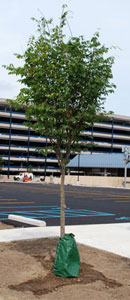
Tree at 5th and William St. next to the surface parking lot at the site of the old YMCA building.
What’s not as easily guessed is that these Treegator® slow release watering … [Full Story]