Stories indexed with the term ‘University of Michigan football’

Column: UM Football Policy A Bad Bet

John U. Bacon

John U. Bacon

For decades, students at Michigan football games were assigned seats, with the seniors getting the best ones. But last year, according to the Michigan athletic department, roughly a quarter of the 22,000 people in the student section were no-shows. So, athletic director Dave Brandon decided to switch the student section from assigned seating to general admission – first come, first seated – to get them to show up on time. Or, at all.

In fairness, growing student apathy is not unique to Michigan, nor is the move to general admission seating. And not all top programs allow every student who wants season tickets to get them, as Michigan always has.

Nonetheless, the students, who were accustomed to starting in the end zone as freshmen, then moving year by year toward mid-field, went ballistic. They gathered more than 2,000 signatures for a petition, and 1,500 “likes” for their movement on a Facebook page, just three hours after the announcement. In an admittedly unscientific poll conducted by The Michigan Daily, 85 people said they “love it” while 497 said they “hate it.”

Yes, some students can display a breathtaking sense of entitlement. And they won’t get much sympathy from the average fans, who have to pay two or three times more for their tickets, plus pay out a Personal Seat Donation – and that’s only after they get off a wait list, which costs another $500 just to get on it.

But before we bash the students too much, perhaps we should ask why they’re not showing up. Getting mad at your paying customers for not liking your product as much as you think they should, then punishing them for it, is probably not something they teach at Michigan’s Ross School of Business. [Full Story]

Column: Bo’s ‘Sons’ Face Off in Super Bowl

John U. Bacon

John U. Bacon

Even those who don’t follow sports probably know the Super Bowl is a week from Sunday.  And, for the first time ever, in any major American sport, the opposing head coaches are brothers. More important for Michiganders, they are the Harbaugh brothers, John and Jim, who went to Ann Arbor Pioneer High School. So, you’ll probably start to hear lots of stories from the folks who met them along the way.

Well, count me in.

Their dad, Jack, coached under Michigan’s Bo Schembechler in the ’70s. His oldest son John played football at Pioneer High and Miami of Ohio, then worked his way up the ladder until he became the head coach of the Baltimore Ravens in 2008. He told the Washington Post he’s based his coaching philosophy on Bo’s coaching philosophy.

John’s younger brother Jim has had a complicated relationship with Michigan, but not with Bo. Jim is my age, and when we were 12 he was Michigan’s ball boy – which made all of us envious. I played against him in baseball, and with him in hockey. That was my best sport, and I was just barely better than he was – that’s my claim, anyway – and hockey was his fourth sport, which he played on the side during basketball season. Guess which one of us became a sports writer? [Full Story]

Column: Taylor Lewan Leads the Band

John U. Bacon

John U. Bacon

With the college football season finally behind us, I wanted to write a sweet little story about a very good guy who plays football for Michigan. But every time I tried, some bad news got in the way.

The first obstacle was Lance Armstrong. In case you missed it – perhaps you live on Mars – it turns out the man who came back from cancer to win a record seven Tours de France and write two bestselling books about his inspirational story is a complete fraud. He was taking performance-enhancing drugs during his entire reign, and whenever someone tried to tell the truth about his drug use – even if they had been forced to – he went out of his way to ruin their careers, their finances, and occasionally their lives.

It appears Lance Armstrong is a genuinely bad person. So, that’s all the time I want to give him.

Now, back to college football. On Monday, January 7th – six days after New Year’s, when the college football season always ended in the old days – I stayed up until midnight to watch the national championship game between Alabama and Notre Dame. I don’t know why I stayed up that late. It was over after Alabama ran up an insurmountable 28-0 lead in the first half. But I did learn Alabama head coach Nick Saban, who already makes more than $5 million a year, earned an additional $400,000 that night. His players – who, as you might recall, actually played the game – received $500 of souvenirs. Think anything’s wrong with this?

I was heartened, at least, to see the head coaches at Penn State, Notre Dame and Oregon all turn down bigger salaries from the NFL to stay with their schools. Until, that is, Chip Kelly, the head coach at Nike University – er, the University of Oregon – changed his mind, took the money, and ran. But that’s barely news.

Okay, now can I get to my favorite story, about Michigan’s Taylor Lewan? No? There’s some bizarre story coming out of Notre Dame I’ve got to talk about first? [Full Story]

Ann Arbor: More Front-Yard Event Parking

A slightly more flexible local ordinance regulating the ability of residents to park cars in their front yards has been given final approval by the Ann Arbor city council. The vote came at the council’s Jan. 7, 2013 meeting.

The change in local law allows the city council to establish “special event dates” for temporary front open space parking. The ordinance had already allowed people to use their front yards for parking for University of Michigan football games. The ordinance change includes a provision explicitly to include “scrimmages,” which will accommodate the UM’s annual intra-squad spring football game.

The ordinance change was motivated part by the possibility that University of Michigan football stadium events might in the future not necessarily be restricted … [Full Story]

Column: The True Cost of Football Tickets

John U. Bacon

John U. Bacon

This week, the University of Michigan announced an increase in the cost of “seat licenses” for football season ticket holders.

Before I dive into what all this means, let me explain what a “seat license” is, because, if you’re a normal person, it won’t make much sense.

A “seat license” is a fee that teams make their fans pay just to reserve the right to buy the actual tickets. They call it a donation – which is a stretch, since every fan apparently decided to donate exactly the same amount, or lose our tickets. But that allows us to claim it as a gift to a state university, and a tax deduction.

It’s hard to call that honest. Thanks to the latest hike, it’s hard to call it cheap, either.

In fairness, Michigan was the last of the top 20 programs, ranked by attendance, to adopt a seat license program, in 2005 – even though Michigan always finishes first in attendance. And the seat licenses started gradually: $250 for the best seats the first year, then $500 the second. They were nice enough to spare the folks in the endzone.

But this week Michigan pushed the seat license for the top ticket up to $600 each, and even the folks in the endzone will have to pay $150 per ticket, just for the right to buy them. In the past decade, the total cost of my two tickets on the ten-yard line has more than tripled, to over $1,700. But my seats are no better, and the schedule keeps getting worse.

It makes you wonder how we got here. [Full Story]

Column: Brady Hoke’s Sophomore Slump

John U. Bacon

John U. Bacon

Exactly one year ago, Brady Hoke was the darling of Michigan football fans.

He’d charmed even the doubters at his first press conference – where he coined his now famous phrase, “This is Michigan, for God’s sake!” – then led a team that had averaged just five wins a season over the previous three years to a 10-2 regular-season record, including thrilling wins over Notre Dame, Nebraska and arch-rival Ohio State. Then he capped it all off with an overtime upset of Virginia Tech in the prestigious Sugar Bowl – Michigan’s first BCS bowl victory since a young man named Tom Brady beat Alabama on Jan. 1, 2000.

The man could do no wrong. When Hoke started referring to injuries as “boo-boos” and Ohio State as “Ohio,” fans did not think he was an ignoramus who knew nothing about the greatest rivalry in sports – as they surely would have if Rich Rodriguez had said the same things – but a motivational genius, who understood exactly what the duel was all about.

When fans noticed Hoke did not wear a headset during games – unlike just about every other coach in the country – they did not conclude he was an out-of-touch, glorified cheerleader, but a master delegator and teacher, trusting the play calling to his assistants while he focused on coaching his players.

When you’re winning, everything’s cool. But when you start losing, the same people who patted you on the back start questioning your quirks. [Full Story]

Photo Essay: Documenting Game Day

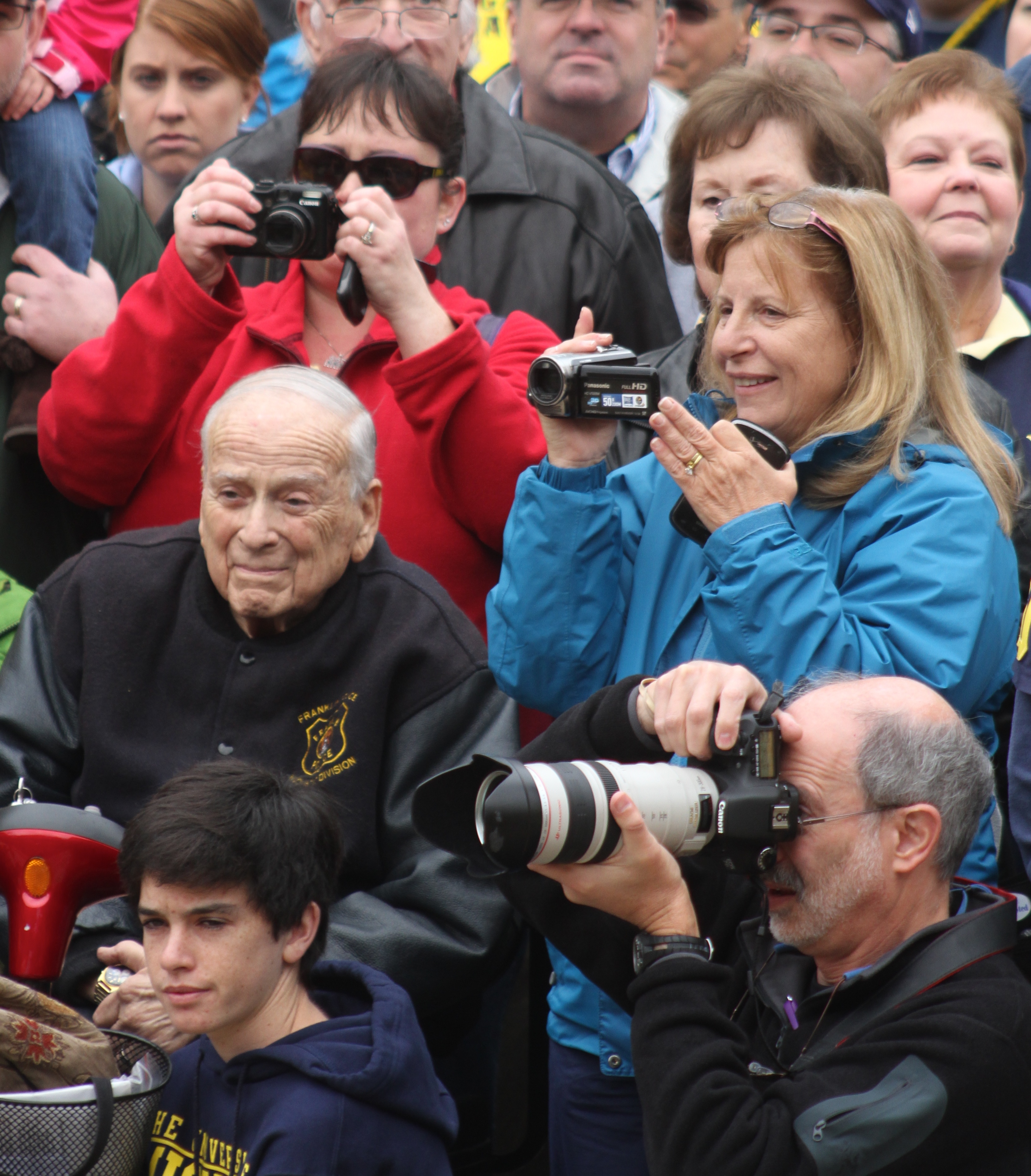
The public address announcer at University of Michigan football games always reminds the fans that they are part of the largest crowd watching a college game anywhere in America. What he could also brag about these days is that those same 112,000 or so people sitting in Michigan Stadium are making the game the most photographed event anywhere in America that day.

At the Nov. 10 University of Michigan game against Northwestern, local journalist Lynn Monson documented that no matter where you look on Game Day, someone has a camera raised. Here’s a small selection of the people who decided to freeze moments in time before, during and after the game won by UM in overtime, 38-31.

Michigan Marching Band, University of Michigan, photographer, Revelli Hall, Ann Arbor, The Ann Arbor Chronicle

These three photographers were among many gathered in a large crowd watching the Michigan Marching Band drum line perform in front of Revelli Hall before the Nov. 10 game.

[Full Story]

Column: Notre Dame Sells Out Rivalry, Fans

John U. Bacon

John U. Bacon

The only constant is change.

Yeah, yeah. We know that – and in case we didn’t, there’s always some office blowhard too eager to say it, as if it’s the most profound truth of the universe.

But that’s why, the more things change, the more we appreciate things that don’t. When Carole King sang, “Doesn’t anybody stay in one place any more?” she probably wasn’t talking about NFL franchises, but she could’ve been. From 1982 to 1995, seven NFL teams moved – about a quarter of the league – which is just one more reason I’ve always preferred college football: universities don’t move.

During that same stretch, Michigan played Notre Dame in the first or second weekend of the season every year, and the games were so good Sports Illustrated gave the game four of ten cover stories, and four features – eclipsing the NFL’s opening weekend, and tennis’s U.S. Open.

The rivalry had almost everything going for it, including history. In 1887, the men from Michigan were traveling to play a game against Northwestern. When they found out, en route, that Northwestern had canceled, they got off in South Bend – and literally taught those boys how to play the game. It remains the oldest rivalry among major college powers. [Full Story]

Column: Enjoy Denard Robinson’s Time at UM

John U. Bacon

John U. Bacon

Last week, the University of Michigan football team beat up University of Massachusetts, 63-13. Okay, U-Mass was pretty bad. Even the lowly Indiana Hoosiers crushed them the week before. But the Wolverines did exactly what they were supposed to do, and they did it very well.

Many Michigan fans complained anyway. This is not uncommon, or even unexpected. A few years ago, Michigan blew out 15th-ranked Notre Dame team 38-0, the first time Michigan shut out over the Irish in over a century. The next day, I challenged listeners on a sports talk show to find something to complain about. I thought I was joking. They did not, and had no trouble filling two hours with a steady stream of original complaints.

Michigan backers are intensely loyal, and they do not believe in winning at all costs, but some act more like opera critics than fans, less interested in cheering the team on than pointing out where the coaches and players could have done better. They are not happy unless they are not happy.

So, the day after Michigan slaughtered U-Mass, I was not surprised to hear fans complain about quarterback Denard Robinson’s performance. Mind you, Denard ran for over 100 yards and a touchdown, and passed for almost 300 yards, and three touchdowns.

And that, to one caller, was the problem: “I’m tired of living and dying with Denard.” In other words, Robinson was too good for that fan’s taste. [Full Story]

Column: Remembering Bob Chappuis

John U. Bacon

John U. Bacon

You can read about Bob Chappuis’s heroics as a World War II tailgunner, or as a Michigan Wolverines tailback, just about anywhere – from his Time magazine cover story back in 1947, right up to his obituary in the New York Times last week. But my favorite stories are the ones he told his granddaughters.

I met Chappuis in 2000, while writing a story about his famous 1947 Michigan football team. But I really got to know him when I coached his grandson Bobby’s high school hockey team a couple months later. When Bobby went to Culver Academies for a post-grad year, I joined the family to see him graduate in 2004.

We were all relaxing in a hotel suite, eating and drinking, when Chappuis’s teenage granddaughters, Amy and Jenny, goaded him to tell some of his stories. He could not refuse them, but he shared the stories you couldn’t find in the magazines, like when his father told him he could go to any school he wanted – except Ohio State.

Chappuis skipped the part about leaving college to volunteer for the Army, where he served as an aerial gunner on a B-25. But his son Rob interjected to explain how their granddad’s plane was shot down over northern Italy, forcing the crew to parachute behind enemy lines.

Chappuis waved it off. “Everybody says we’re heroes. But what kind of idiot wouldn’t jump from a burning plane?” [Full Story]

Column: Rite of Passage in UM’s Weight Room

John U. Bacon

John U. Bacon

While I was writing “Three and Out,” the Michigan football players challenged me to join their workouts in the weight room. They were surprised when I was actually game – one of the dumbest decisions of my life.

I’d heard so much about these modern gladiators and their weight room heroics that I wanted to find out for myself just how much harder it really is compared to what the average weekend warrior puts himself through just to avoid buying “relaxed fit” jeans.

The plan was simple: I would work out with these guys three times a week, for six weeks – “if you last that long,” said Mike Barwis, Michigan’s former strength coach, in his famously raspy voice. But before I even started, there were four signs that I shouldn’t be doing this.

When I asked Barwis if I should prepare by lifting weights, he said, “No, it’s too late for that!” Well, that’s one sign.

“Okay,” I asked, “what’s it NOT too late for?”

“Running.”

“Why running? We’re not going to run.”

“Because your heart is going to give out before your muscles do.” [Full Story]

Column: When Ward, Ford Played Ball for UM

John U. Bacon

John U. Bacon

The University of Michigan can boast 19 highly ranked schools and colleges, a couple dozen nationally recognized teams and countless famous graduates. And on matters of social justice, Michigan has often led the nation, not followed it.

But one Saturday, 78 years ago, Michigan took a sad step backward.

When Ann Arbor’s own George Jewett – who has a street named after him in his home town – earned his third varsity letter on Michigan’s football team in 1892, he could not have imagined it would take four decades for another African-American player to follow him.

The biggest reason was Michigan’s head coach from 1901 to 1926, Fielding H. Yost. He invented the no-huddle offense and the position of linebacker and popularized the forward pass. He built Yost Fieldhouse, the Intramural Building and the Big House. He had boundless energy, ambition and ego, and six national titles to back it all up.

You could argue that most of Yost’s faults were benign flaws, maybe even necessary evils. But one of Yost’s blind spots had no redeeming qualities: He was a racist. [Full Story]

Column: Signing Day Insanity

John U. Bacon

John U. Bacon

The most important day of the year for a college football coach is not the home opener, the big rivalry game or even a bowl game. It’s national signing day, which falls on the first Wednesday in February.

On signing day, the end zone is not grass or Astroturf, but a fax machine tray. Only when a signed National Letter of Intent breaks the plane of that tray does it count.

Sounds pretty simple, right? A couple years ago I got a chance to see the sausage get made at close range – and it’s a lot crazier than you imagined.

The coaches start by collecting information on more than a thousand players years in advance. Then they watch hundreds of hours of film, and make dozens of trips across the country – from Pasadena to Pahokee – to meet with hundreds of high school players, their parents and their coaches. They follow that up with thousands of calls, emails and text messages – all in the hopes of getting the 25 players they think will help them win a title a few years later.

That’s bad enough, but now, thanks to ESPN and the Internet, recruiting has become a full-blown season in its own right. It lasts all year – and it’s harder on the coaches than the actual football season is. [Full Story]

Column: Redemption at the Sugar Bowl

John U. Bacon

John U. Bacon

The Big Ten is still considered one of the nation’s top leagues, despite its frequent belly flops in bowl games. This year, the Big Ten placed a record 10 teams in bowl games – then watched them drop, one by one. And not just in the storied Rose Bowl, but in games like the Taxslayer.com Gator Bowl, the Meineke Car Care Bowl of Texas, and the Insight Bowl. When Iowa got whipped 31-14, I wonder just how much insight they had gained.

Until Monday, Big Ten teams had managed to win only two games: the Little Caesars Pizza Bowl in Detroit, over Western Michigan, and the Kraft Fight Hunger Bowl, over a team that had a losing record and no coach. In non-food based bowls, the Big Ten had no luck at all.

Then, Michigan State came to the rescue. The Spartans beat Michigan during the regular season, they won their division, and they seemed poised to win the Big Ten’s first conference championship game until one of their players was called for “roughing the punter.” This is on a par with giving the class nerd noogies– and about as serious. But it cost them the game.

Their reward for all this? An invitation to a less prestigious bowl game than Michigan received. The Spartans were ticked off – and rightly so.

After Georgia jumped out to a 16-0 lead at the half, the Spartans came back to tie the game in the final seconds. And that’s when things got really nutty. In the first overtime, the Georgia kicker missed a chance at a game-winning field goal. Then, in the third overtime, the Spartans blocked his kick to win. Small wonder college coaches knock back Rolaids like Chiclets.

Michigan’s road to redemption was even crazier – and far longer. [Full Story]

Column: An Important Win for Michigan

John U. Bacon

John U. Bacon

Just a few years ago, ESPN’s viewers called the Michigan-Ohio State rivalry the best. Not just in college football, or all football. But in all sports. Period.

Everyone knew this year’s game wouldn’t go down as one of the best. Michigan entered the game with a 9-2 record and a No. 17 ranking, but the Buckeyes hobbled into their annual finale dragging a 6-5 record behind them, their worst record since the 1990s.

But that just made the stakes for Michigan that much higher.

The Wolverines hadn’t beaten the Buckeyes since 2003, but the Buckeyes entered last week’s game reeling from just about every problem a major program can have – from an ongoing NCAA investigation, to coach Jim Tressel being fired last spring in disgrace, to their star quarterback Terrelle Pryor departing a year early for the NFL.

This Buckeye team was led by a freshman quarterback, Braxton Miller, and an interim coach named Luke Fickell. Making matters worse for the Buckeyes, just days before the game, reports surfaced that Urban Meyer would be named the permanent head coach after the game – which he was.

All this only put more pressure on the Wolverines. If they couldn’t beat the Buckeyes at their baddest, when could they? [Full Story]

Column: Tribute to One of Michigan’s Finest

John U. Bacon

John U. Bacon

Michigan football has produced a lot of big name coaches and players, but one of the finest men who played and coached for Michigan deserves to be a little bigger.

At last week’s homecoming game, Michigan had planned to honor one of its great alums, a man named Chalmers Elliott – which might explain why he goes by “Bump.” He was an All-American football player and a Big Ten champion coach, but earned greater fame as the athletic director at Iowa, Michigan’s opponent this weekend. Pneumonia kept the 86-year old legend from making it, however, so I’m going to honor him today.

He was born in Detroit in 1925, and served in the Marines during World War II. He returned to star for Michigan as a halfback alongside his younger brother Pete, who played quarterback. Their offense was so dazzling, seven players could touch the ball on a single play. That earned them the nickname, the Mad Magicians, plus the national title in 1947 – the same year the conference named Bump Elliott the MVP. [Full Story]

Column: Taking Stock of “Three and Out”

John U. Bacon

John U. Bacon

In the summer of 2008, Rich Rodriguez granted me unfettered access to the Michigan football program so I could write a book. Three years later the book is finished, and like just about everybody else connected to Michigan football the past three years, I had no idea what I was getting into.

During my three years following the Michigan football team, the working title of the book changed from “All or Nothing,” to “All In,” to “Third and Long,” before Rodriguez’s last season, and after he was fired, to “Three and Out.”

At first, I thought I was watching the football version of “Coal Miner’s Daughter.” Then, maybe “Shawshank Redemption.” Guy gets dumped on, but comes through. Then, I finally realized I was watching “Titanic.” The unsinkable ship goes down. The hottest coach in America takes over the winningest program in the nation – and the marriage seemingly made in heaven ends in an ugly divorce. [Full Story]

Column: Rodriguez and The Michigan Man

Editor’s note: Columnist John U. Bacon has been answering questions from Michigan fans on MGoBlog about his upcoming book, “Three and Out: Rich Rodriguez and the Michigan Wolverines in the Crucible of College Football” (FSG, $28, out October 25, 2011). Last week, he described how he gained access to UM’s football program, and how his book deal emerged. This week, he talks about the early days of the Rodriguez regime, what it means to be a “Michigan Man,” and what his future plans are following publication of this book.

John U. Bacon

John U. Bacon

One of the central questions that comes up in various forms about Rich Rodriguez is the “Fit, or Lack Thereof” with Michigan’s program. I’ll start to answer that question by working backward, from the final seconds of Rodriguez’s regime.

On January 5, 2011, the assistant coaches, staffers, and yours truly were all sitting in the coaches’ meeting room, when Rodriguez walked in, laid a file down on the table, and said, “Well, as expected, they fired me.” He later added, “It was a bad fit here from the start.”

And in many ways it was. But I’m not certain it had to be.

People who were living in Ann Arbor in 1968 can tell you about the last outsider to take the reins: Bo Schembechler. His predecessor, Bump Elliott, was a former Michigan All-American who was smart and humble, with an urbane, conservative manner. He didn’t yell at his players, he rarely swore, and if you said you were hurt, that was enough for him.

When Schembechler’s crew arrived with their wives sporting beehive hairdos and stiletto heels, some Michigan insiders took to calling them “The Ohio Mafia.” The players quickly learned the new guy yelled, swore, grabbed your facemask and literally kicked you in the ass. If you were merely hurt, not injured, but didn’t want to practice, you got left behind when the team plane took off.

Instead of turning his back on the new regime, however, Elliott embraced them, hosting parties for their families and introducing them to important people around town. He did not allow players to come to his office in the Athletic Department to complain about the new guy, either. And when Schembechler delivered what today would be an unforgivable comment about changing “Michigan’s silly helmets,” Elliott, Don Canham, Fritz Crisler and Bob Ufer quietly taught him Michigan tradition.

And, to Schembechler’s credit, he was wise enough to listen, and even seek out their help.

When Michigan upset Ohio State that year, they gave Bump Elliott the game ball, and there was not a dry eye in the room.

That’s Michigan at its best. The last three years were not. [Full Story]

Column: “Three and Out” A Complex Saga

Editor’s note: Earlier this week, columnist John U. Bacon started answering questions from Michigan fans on MGoBlog about his upcoming book, “Three and Out: Rich Rodriguez and the Michigan Wolverines in the Crucible of College Football” (FSG, $28, out October 25, 2011). This column is adapted from that conversation.

John U. Bacon

John U. Bacon

Q: So let’s talk about how this book came about. You had total unfettered access to Rich Rodriguez? How does that come about? Why would anyone agree to such a thing? What was his motivation?

This book came about largely by dumb luck – and it was luck, of all kinds, that reshaped it several times before I finished this summer.

With my degree in history (“pre-unemployment”) in my pocket, I got my first job out of Michigan teaching U.S. history and coaching hockey at Culver Academies in Indiana. One of my best students, Greg Farrall, went on to become an All-Big Ten defensive end, and then a successful financial adviser.

We’ve stayed in touch, and in early 2008, he asked for some signed copies of “Bo’s Lasting Lessons,” including one for his former coach at Indiana, Bill Mallory, and another to his boss at the time, Mike Wilcox – who just happened to be Rich Rodriguez’s financial adviser. In fact, when Rodriguez first met with Bill Martin and Mary Sue Coleman in December 2007, they did so at Wilcox’s Toledo office. [Martin was UM's athletic director at the time. Coleman is president of the university.]

One thing led to another, and in July 2008 Wilcox asked me if I’d be interested in getting complete access to Rodriguez’s first Michigan team. I thought about it for a week or so, before concluding I’d be crazy not to jump at this chance. [Full Story]

Column: Michigan Delivers Big in Big House

John U. Bacon

John U. Bacon

Last weekend, for the first time in the history of Michigan football, they scheduled a night game, and invited Notre Dame to join the party.

But what if you had a night game, and nobody came? Well, that wasn’t the problem. The game attracted more than 114,000 people, another NCAA record.

To commemorate the event, Michigan wore “throwback jerseys” – which went back all the way to September 10, 2011. (Ask your grandparents.) Michigan’s jerseys have never had stripes – and when you saw them Saturday night, you appreciated just how wise Michigan’s founders had been. It was less about tradition than it was about trade.

But what if you invited the entire nation to watch your big game, and you laid an egg? In the first half, Michigan couldn’t have looked worse, trailing Notre Dame in first downs, 15-3. The only stat that was even close was the only one that mattered: the score. Notre Dame had completely dominated the Wolverines, but led only 17-7.

If lightning had been sighted near the end of the third quarter, with Notre Dame ahead 24-7, you could make a case for calling this game early, too. [Full Story]

Main Street to Close Near Football Stadium

On Saturday, Sept. 10, Main Street in Ann Arbor will be closed between Pauline and Stadium Boulevard from 5 p.m. until the conclusion of the football game at Michigan Stadium. A press release issued Friday morning by the city of Ann Arbor cited security concerns due to the 10th anniversary of the Sept. 11 terrorist attacks coinciding with the University of Michigan’s first night football game, to be played against Notre Dame.

Starting at 5 p.m. on Saturday, northbound Main Street traffic will be detoured from Stadium Boulevard to 7th Street, and from 7th to Pauline, then back to Main. Southbound Main Street traffic will be detoured from Pauline to 7th Street, and 7th to Stadium, then back to Main. Main Street … [Full Story]

Column: Michigan Football Brings Us Together

John U. Bacon

John U. Bacon

Editor’s note: On the eve of the first night game in the 132-year history of University of Michigan football – to be played Saturday against Notre Dame – columnist John U. Bacon reflects on the game’s history and continuing hold on college campuses.

George Will recently wrote that when archeologists excavate American ruins centuries from now, they may be mystified by the Big House in Ann Arbor. “How did this huge football emporium come to be connected to an institution of higher education? Or was the connection the other way?”

It’s a fair question, one I’ve pondered myself many times. When I try to explain to foreigners why an esteemed university owns the largest stadium in the country, their expressions tell me it’s – well, a truly a foreign concept.

Ken Burns said our national parks are “America’s best idea.” If so, then our state universities must be a close second. They’re why we have more college graduates per capita than any nation in the world. And also why we have college towns rising out of cornfields – another uniquely American phenomenon. But when you put thousands of young men in one place, all that testosterone has to go somewhere. That’s why football grew not in the cities like baseball or in the YMCAs like basketball, but on college campuses.

The students loved it as much as the presidents hated it – and almost as much as they hated the binge drinking that was turning Ann Arbor into a “place of revelry and intoxication,” as one president complained, back in 1871.

University officials hoped football would give the students something else to do. And that’s why there’s no drinking on campuses today. Can you imagine what college would be like if football hadn’t ended drinking on campus? I shudder at the thought. [Full Story]

Ann Arbor to UM: Football Traffic Controls?

At its Aug. 15, 2011 meeting, the Ann Arbor city council approved a resolution stating that no traffic controls for University of Michigan home football games will be provided starting this season, unless the university reimburses the city for costs associated with erecting barricades and changing traffic signals to facilitate efficient movement of traffic. The cost of providing these signs and signal services is around $100,000 per year. The university already reimburses the city for police and fire services associated with home football games.

From the resolution: “Resolved that the City Administrator shall not provide Signs and Signals services to UM for Special UM Events unless: UM and the City execute a contract prior to August 26, 2011, that provides for the full reimbursement to the City of all direct and allocable costs associated with the provision of Signs and Signals services to UM for Special UM Events.”

Michigan’s home opener this year, against Western Michigan, falls on Sept. 3.

The issue is a persistent point of frustration on the city council, because traffic control for football games is a dollar cost to the city, but the city has limited leverage with the university to extract payment. That’s due in part to the fact that traffic control is seen not as merely a matter of convenience, but rather of public safety.

From a March 2010 city council budget work session report: “Christopher Taylor (Ward 3) asked how much of [football traffic control] was an issue of convenience versus public safety. Chief of police Barnett Jones stated that it was all safety-related. Without the combination of cars, barricades and signals, he said, ‘it would be a major malfunction.’”

From a January 2011 city council budget retreat report: “Some councilmembers seemed to suggest that concessions from the university could be won by withholding city consent when the university wanted something from the city. The university’s desire to include Monroe Street as part of the UM Law School campus was cited as a specific example. [City administrator Roger] Fraser, though, counseled that each situation should be evaluated unto itself. He pointed to the planned Fuller Road Station as an example of the importance of that principle.”

From a March 2011 city council budget work session report: “Responding to councilmember questions, [public services area administrator Sue] McCormick said the city did not send the university invoices for the regular home football games, because the university has made it clear that it will not pay. McCormick said when she’d notified UM of the city’s intention of invoicing for the Big Chill, the response she gotten was, ‘We really don’t know how we’ll fund that.’ There was little recourse for the city to take, she said, and in the end the city would have to write it off.”

This brief was filed from the city council’s chambers on the second floor of city hall, located at 301 E. Huron. A more detailed report will follow: [link] [Full Story]

Column: Desmond Howard’s Unlikely Legacy

John U. Bacon

John U. Bacon

Desmond Howard stands about 5-foot-8 – I don’t care what the program said. When Bo Schembechler moved the Cleveland native from tailback to receiver, it virtually eliminated any chance Howard had to win the Heisman Trophy. In its first 55 years, only one receiver had ever taken it home.

But then, just playing at Michigan practically knocked Howard out of the running in the first place. Only one Wolverine, Tom Harmon, had ever won the award – and that was back in 1940.

Schembechler never promoted any player for any award – Heisman or otherwise. Because, as he often said, “Nothing comes before The Team, The Team, The Team.” When Bo stepped down in 1990, Gary Moeller took over, and followed the exact same policy.

In the modern era – when Notre Dame’s Joe Theismann started pronouncing his name as Theismann to rhyme with Heisman, and Oregon paid big money to put a huge poster of Joey Harrington on the side of a Manhattan building – Michigan’s policy was positively anachronistic.

Bo didn’t care. “That is not how a Michigan man earns his hardware.” After all, he promised, “Those Who Stay Will Be Champions,” not, “Those Who Stay Will Get Their Faces Painted On New York City Skyscrapers.” [Full Story]

Column: Remembering Jim Mandich

John U. Bacon

John U. Bacon

On Tuesday, the Michigan football family lost another beloved son, Jim Mandich, who died of cancer at age 62.

Regular readers of this space know I’ve had to write a few elegies already this year, and I’m not sure if we can bear another one right now.

I’m not sure Mandich would want any more, either, beyond his funeral. As he told Angelique Chengelis of The Detroit News last fall, after he was diagnosed with cancer, “I said to myself, ‘No whining, no complaining, no bitching. You’ve lived a damned good life. You’ve got a lot to be thankful for.’”

And he did, including a great NFL career and three grown sons – good guys, good friends. But I’m sure he’d like to be remembered – don’t we all? – and I thought you might enjoy a story or two about an unusually talented and charismatic man. [Full Story]

Column: A Life Lived Fully

John U. Bacon

John U. Bacon

If you’re not a Michigan football fan, you probably haven’t heard of Vada Murray, but you might have seen his picture. It’s one of those iconic images of Michigan football, along with Tom Harmon standing in his mud-soaked, torn-apart jersey, and Desmond Howard diving to catch a touchdown pass against Notre Dame.

But the photo I’m talking about shows Vada Murray and Tripp Welborne soaring skyward to block a field goal. They were a kicker’s nightmare. But even when they got a hand on the ball, it simply denied their opponent three points. That’s not the kind of thing that wins you a Heisman Trophy or an NFL contract. They don’t even keep records of those things.

But more than two decades later, something about that photo still resonates. Maybe it’s because it captures their effort, their intensity, their passion – all of it spent just to give their teammates a slightly better chance for success. There is something noble in that. And we recognize it – which is why they’ve been selling that photo at the frame store on Ann Arbor’s Main Street for years, right along side the legendary poses of Harmon and Howard. [Full Story]

Column: A Banner Tradition

John U. Bacon

John U. Bacon

Whenever you see a TV spot promoting college football, you can be sure they’ll include a shot of the Wolverines running out of the Michigan Stadium tunnel to jump up and touch the “M Go Blue” banner. It’s one of the sport’s truly iconic images.

But like most traditions – most of the good ones, anyway – this one started organically and quietly before becoming a public pillar of Michigan football.

Fifty years ago, Michigan’s head coach was a guy named Chalmers Elliott – which might explain why his friends called him “Bump.” As a player, he’d been an All-American and national champion, but coaching was tougher.

In 1962, the Wolverines lost five of their first six games, including four straight Big Ten losses – three of them, shutouts.

The head hockey coach, Al Renfrew, had been a classmate of Elliott’s, and the two had remained good friends. So Renfrew and his wife Marjorie decided to do something to help boost the football team’s morale. Marjorie went to work in her sewing room, stitching a yellow block “M” on a blue sheet, about six feet across. [Full Story]

Column: A Real Michigan Man

John U. Bacon

John U. Bacon

The University of Michigan’s athletic department just completed its $226 million renovation, on time and on budget. To celebrate, last Saturday Michigan rededicated its iconic stadium in grand style, including fancy receptions, programs, pins and not one but two flyovers, all followed by a big win over Connecticut.

But the show-stopper wasn’t a world-class pilot or an All-American athlete – just some guy who walked out to mid-field.

In 2007, on Christmas Eve, 23-year-old Brock Mealer was riding home from their cousin’s house with his family and his brother’s girlfriend. It was a wonderful evening, full of appreciation and promise.

Brock’s brother Elliott had just accepted a scholarship to play football at Michigan, and Elliot and his girlfriend seemed headed for the altar.

But on the way home, a 90-year-old driver named H. Edward Johnson ran a stop sign and struck the Mealers’ SUV. Elliott’s girlfriend Hollis Richer and the Mealers’ father, Dave, were killed instantly. Brock was paralyzed from the waist down. [Full Story]

Column: The Rivalry

John U. Bacon

John U. Bacon

Ten years ago, ESPN viewers voted the Michigan-Ohio State football game the best rivalry in the nation. Not just in college football, or football in general, but in all sports. Since 1935, it’s held a privileged spot as the last game of the Big Ten season. More college football fans have seen this rivalry, in person and on TV, than any other.

HBO has produced dozens of sports documentaries, but only one on college football: the Michigan-Ohio State game. They titled it simply, “The Rivalry.” They did not feel they had to explain it.

But when the Big Ten added Nebraska, everything seemed up in the air, including the Michigan-Ohio State game. Next fall the Big Ten will have 12 teams, playing in two divisions, culminating in a title game – all new.

So that raised a few possibilities – not to mention plenty of rumors and fears. [Full Story]

Column: Only in America

John U. Bacon

John U. Bacon

The wonderfully named Zoltan Mesko was born and raised in Timisoara, Romania, right on the Hungarian border. Like his parents, Mihai and Elizabeta, Zoltan speaks both languages fluently.

When the Berlin Wall came down in 1989, life improved dramatically for most people living behind the Iron Curtain – but not much for Romanians. His parents, both engineers, could not leave the country until they won Romania’s Green Card lottery – yes, they had one – in 1997, when Zoltan was ten.

They quickly discovered Hollywood’s depiction of America didn’t quite match their apartment in Queens. It was dirty and cramped – even for just three people – and too expensive, so they moved to Twinsburg, Ohio, right outside Cleveland.

Zoltan learned English in about two months. His parents took two years, but understanding American culture took a little longer. [Full Story]