Stories indexed with the term ‘Urban County’

County Board OKs Urban County Renewal

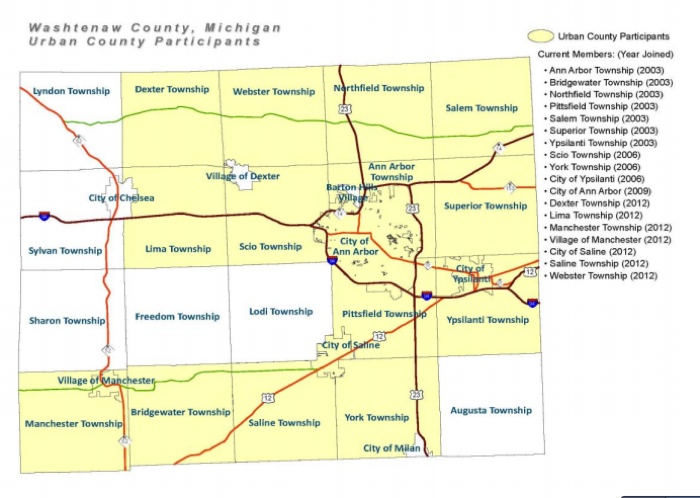
At its Sept. 7, 2011 meeting, the Washtenaw County board of commissioners gave final approval to continue the county’s participation in the Washtenaw Urban County program – from July 1, 2012 to June 30, 2015 – and to expand the program to include six additional jurisdictions.

“Urban County” is a designation of the U.S. Dept. of Housing and Urban Development, identifying a county with more than 200,000 people. With that designation, individual governments within the Urban County can become members, making them entitled to an allotment of funding through a variety of HUD programs, including the Community Development Block Grant (CDBG) and HOME Investment Partnerships. Those two programs provide funding for projects to benefit low- and moderate-income residents, focused on … [Full Story]

Washtenaw County Board Gets Budget Update

Washtenaw County board of commissioners meeting (Aug. 3, 2011): A second-quarter budget update and final approval of a major multi-department consolidation were highlights of Wednesday’s meeting.

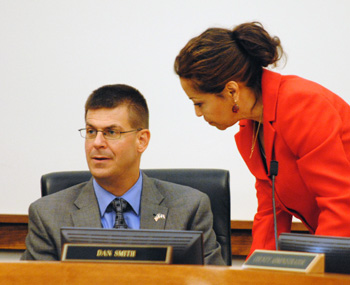
Dan Smith, Verna McDaniel

Washtenaw County commissioner Dan Smith (R-District 2) and county administrator Verna McDaniel. Smith is vice chair of the board's ways & means committee, and led the meeting in the absence of the committee chair, Rolland Sizemore Jr. (D-District 5). (Photos by the writer.)

The budget update showed the impact of higher-than-anticipated property tax revenues, which had first been announced in April. Because of higher revenues than originally projected, the county now expects to use only $2.9 million from its fund balance during 2011 – previously, the budget called for drawing $5.3 million from the fund balance to cover a shortfall between revenues and expenditures.

Without the $2.9 million transfer from the fund balance, however, there would be a projected $2.5 million deficit for the year, on a general fund budget of roughly $100 million. Among several shortfalls on the expenditure side, about $1.034 million in anticipated non-departmental lump sum reductions have not materialized.

Expenses for attorney fees are higher than budgeted, but the county’s corporation counsel Curtis Hedger noted that there’s at least one case that won’t be costing the county in the future. It was an allusion to the end of a 2006 lawsuit against the county over the cost of police services. Hedger later told The Chronicle that the two townships still involved in the case – Ypsilanti Township and Augusta Township – paid the county this week the nearly $750,000 recommended by a court-ordered facilitator.

There was little discussion about most of the action items that the board approved. Most notably, a final OK was given to creating a new office of community & economic development – the result of merging three county departments. The new unit, to be led by Mary Jo Callan, will employ about 31 full-time workers, compared to 40 that are now employed in the three separate departments: the office of community development (OCD); the economic development & energy department; and the employment training and community services (ETCS) department. Other jobs within the county government have been identified for all but one employee so far. The consolidation will take effect in 2012.

Commissioners also set public hearings for their Sept. 7 meeting to get input on two millages: one levied under the Veterans Relief Fund Act, and another collected under Public Act 88 to be used for economic development purposes. Because Act 88 and the veterans relief act predate the state’s Headlee Amendment, they can be approved by the board without a voter referendum.

The Act 88 millage of 0.05 mill would be an increase from the 0.043 mills currently levied. It would generate an estimated $688,913 annually. In previous years, it has been used to fund several entities, including Ann Arbor SPARK. The veterans relief millage of 1/40th of a mill does not represent an increase, and is estimated to bring in $344,486 to provide services for indigent veterans in Washtenaw County through the county’s department of veterans affairs.

Republicans Dan Smith and Alicia Ping led the back-to-back ways & means committee and regular board meetings on Wednesday – as vice chairs of those respective bodies, they were filling in for chairs Rolland Sizemore Jr. and Conan Smith. Both Democrats were out of town. [Full Story]

Initial OK to Continue, Expand Urban County

At their Aug. 3, 2011 meeting, Washtenaw County commissioners gave initial approval to continue the county’s participation in the Urban County program – from July 1, 2012 to June 30, 2015 – and to expand the program to include six additional jurisdictions. A final vote is expected on Sept. 7.

“Urban County” is a designation of the U.S. Dept. of Housing and Urban Development, identifying a county with more than 200,000 people. With that designation, individual governments within the Urban County can become members, making them entitled to an allotment of funding through a variety of HUD programs, including the Community Development Block Grant (CDBG) and HOME Investment Partnerships. Those two programs provide funding for projects to benefit low- and moderate-income … [Full Story]

Ann Arbor Renews Urban County

At its July 18, 2011 meeting, the Ann Arbor city council authorized joining the Urban County for a second three-year period from July 2012 through June 2015.

“Urban County” is a designation of the U.S. Dept. of Housing and Urban Development, identifying a county with more than 200,000 people. With that designation, individual governments within the Urban County can become members, making them entitled to an allotment of funding through a variety of HUD programs, including the Community Development Block Grant (CDBG) and HOME Investment Partnerships. Those two programs provide funding for projects to benefit low- and moderate-income residents, focused on housing, human services and other community development efforts.

Washtenaw County and the townships of Ann Arbor, Ypsilanti, Pittsfield, Superior, Northfield, Salem, and Bridgewater got the Urban County designation in 2002. Later, the city of Ypsilanti and Scio Township joined, and in 2009 the city of Ann Arbor – which previously received HUD funding directly – joined as well, roughly doubling the amount of money available in the Urban County’s funding pool.

The renewal application needs to be submitted to the Detroit HUD Field Office by July 15, 2011 from all participating jurisdictions.

This brief was filed from the city council’s chambers on the second floor of city hall, located at 301 E. Huron. A more detailed report will follow: [link[Full Story]

Final OK for Urban County Annual Plan

At its June 1, 2011 meeting, the Washtenaw County board of commissioners gave final approval to the Washtenaw Urban County annual plan from July 1, 2011 through June 30, 2012.

The plan must be submitted to the U.S. Dept. of Housing and Urban Development (HUD), outlining specific projects and programs that the Washtenaw Urban County will undertake with HUD funding from several sources: the federal Community Development Block Grant (CDBG) program; HOME grants; and Emergency Shelter Grants (ESG). The county is expected to receive $3,602,480 from these programs during the coming fiscal year. A $448,920 in-kind county match is required. [.pdf of fiscal year 2011 Washtenaw Urban County plan]

The Urban County is a consortium of 11 local governments that receive federal funding for programs that serve low-income residents and neighborhoods.

This brief was filed from the boardroom of the county administration building at 220 N. Main St. in Ann Arbor. A more detailed report will follow: [link] [Full Story]

Urban County Plan Gets Initial OK

At its May 18, 2011 meeting, the Washtenaw County board of commissioners gave initial approval to the Washtenaw Urban County annual plan from July 1, 2011 through June 30, 2012. The plan must be submitted to the U.S. Dept. of Housing and Urban Development (HUD), outlining specific projects and programs that the Washtenaw Urban County will undertake with HUD funding from the federal Community Development Block Grant (CDBG) program, HOME grants and Emergency Shelter Grants (ESG).

The Urban County is a consortium of 11 local governments that receive federal funding for programs that serve low-income residents and neighborhoods.

The county is expected to receive $3,602,480 from these programs during the coming fiscal year. A $448,920 in-kind county match is required.

Final approval is … [Full Story]

Urban County Gets Grim Funding Update

Washtenaw Urban County executive committee meeting (Feb. 22, 2011): Leaders of local municipalities got a grim update on Tuesday about looming federal funding cuts that will likely affect projects in many of the county’s low-income neighborhoods.

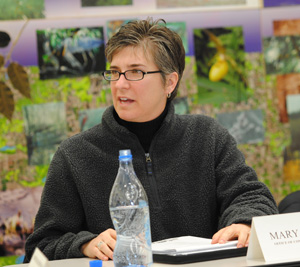
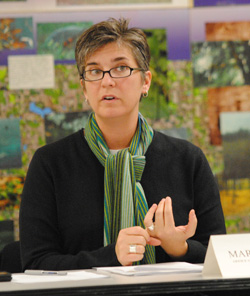
Mary Jo Callan

Mary Jo Callan, director of the Washtenaw County/city of Ann Arbor office of community development, at Tuesday's meeting of the Washtenaw Urban County. (Photo by the writer.)

“I am bringing you some troubling news,” said Mary Jo Callan, director of the Washtenaw County/city of Ann Arbor office of community development. “Do you want to start with the bad news, or the worst news?”

Callan reported that the two major programs that fund projects for low-income neighborhoods – the Community Development Block Grant and HOME Investment Partnership programs, both operated by the U.S. Dept. of Housing and Urban Development (HUD) – have been targeted by Congress and President Obama for significant cuts in both the current fiscal year and in 2012. Washtenaw County communities receive about $2.4 million annually from the CDBG program alone.

Though at this point it’s unclear exactly what the final federal budget will include, Callan said it’s nearly certain that some funding cuts will occur – her staff is planning for a 10% reduction in grants from those two programs for fiscal 2012. “It’s pretty bleak,” she said. [Full Story]

Urban County: Nonprofit Funding Update

Washtenaw Urban County executive committee meeting (Jan. 25, 2011): Urban County members – a group representing 11 municipalities in Washtenaw County – got an update on a new effort to coordinate the funding of local nonprofits.

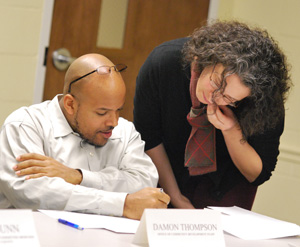
Damon Thompson, Teresa Gillotti

Damon Thompson, operations manager for the Washtenaw County/city of Ann Arbor office of community development, talks with Ypsilanti city planner Teresa Gillotti after the Jan. 25 Urban County meeting.

Nonprofits are vying for funds from the city of Ann Arbor, Washtenaw County, the Urban County, and Washtenaw United Way. Nearly 60 nonprofits applied to the first phase of the process, in which they were asked to supply basic financial and governance documents. Of that group, 51 were qualified to respond to a request for proposals (RFP) that was issued Jan. 28.

It’s still unclear how much funding will be available, but it could be less than the nearly $5 million that was awarded from these groups last year. Budgets for Ann Arbor and the Urban County haven’t been finalized, and the 2011 county budget is facing about $1 million in as-yet-undetermined cuts.

At last week’s meeting, three members of the Urban County’s executive committee – Pittsfield Township deputy supervisor Barb Fuller, Ypsilanti mayor Paul Schreiber and Ann Arbor city councilmember Margie Teal – were appointed to review applications for the coordinated funding process. All governing boards of the four entities involved in this cycle’s funding will appoint members to a review committee. The fifth partner – the Ann Arbor Area Community Foundation – will fund capacity-building grants to nonprofits identified as needing help with internal operations, like infrastructure and staff development.

Also at last week’s meeting, Urban County members got an update on an annual plan being developed for the U.S. Dept. of Housing & Urban Development (HUD), which provides funding for low-income housing and neighborhood projects. The plan will include a list of proposed projects located within the Urban County area that would be eligible for HUD funding. To gather more input, a needs assessment public hearing is set for the Feb. 22 meetings of both the Ann Arbor city council and the Urban County.

Two people spoke during public commentary, both criticizing Avalon Housing for its handling of two low-income housing projects: 1500 Pauline, and Near North. The nonprofit was defended by Leah Gunn, who chairs the Urban County executive committee – she called Avalon one of the “stars of community development.” [Full Story]

Urban County Finalizes Funding Model

Washtenaw Urban County executive committee meeting (Nov. 16, 2010): The final piece of a coordinated funding model that’s been in the works for more than a year fell into place on Tuesday, when the Washtenaw Urban County’s executive committee voted unanimously to join the effort.

Mary Jo Callan

At the Nov. 16 meeting of the Urban County, Mary Jo Callan, director of the city of Ann Arbor/Washtenaw County office of community development, reviewed key points of the coordinated model for funding human services. (Photo by the writer.)

Two people – Steve Dobson, past chair of the local United Way board, and community activist Lily Au – spoke to the group during public commentary, taking opposite sides of the issue. But there was little discussion among committee members before the vote. Mary Jo Callan, head of the county/city of Ann Arbor office of community development, briefly recapped a detailed presentation she’d given in September, outlining how Ann Arbor, Washtenaw County and the Urban County would join with the Ann Arbor Area Community Foundation and Washtenaw United Way to coordinate their funding to local nonprofits.

The coordinated funding, managed by Callan’s staff, will give priority to programs and services addressing six key areas: housing/homelessness, aging, school-aged youth, children from birth to six, “safety net” health and food/hunger relief. In total, the five funding entities provide about $5 million annually for local human services nonprofits. The Urban County – a consortium of 11 local governments – contributes roughly $350,000 of that amount.

The committee also voted on three items related to affordable housing efforts: 1) implementing “green” construction standards for builders funded with federal HUD dollars, 2) approving a draft budget and annual request for proposals (RFP) for developers of affordable houses funded through the Urban County, and 3) making changes to the budget tracking for the Urban County’s homebuyer program. All votes were unanimous. [Full Story]

Coordinated Funding for Nonprofits Planned

A strategy for coordinating major funders of nonprofits in Washtenaw County has been in the works for more than a year, and is now being rolled out to governing boards for approval.

Mary Jo Callan

Mary Jo Callan, director of the Washtenaw County/city of Ann Arbor office of community development, described a proposed coordinated funding strategy by local governments, United Way of Washtenaw County and the Ann Arbor Area Community Foundation at the Sept. 28 meeting of the Washtenaw Urban County. (Photos by the writer.)

At Tuesday’s meeting of the Washtenaw Urban County executive committee, members were briefed on the proposal, which involves the Washtenaw United Way, Ann Arbor Area Community Foundation, Washtenaw County, city of Ann Arbor and the Urban County. Together, these entities provide about $5 million annually for local human services nonprofits.

Mary Jo Callan, director of the Washtenaw County/city of Ann Arbor office of community development, told Urban County members that the public/private model would focus funding on six priorities that have been identified for the entire county: housing/homelessness, aging, school-aged youth, children from birth to six, health and food.

The two-year pilot project is grounded in previous coordination between the city of Ann Arbor, Washtenaw County and the Urban County, a consortium of 11 local governments. The office of community development (OCD), which Callan leads, already manages nonprofit funding for those three entities.

Callan also said this could be a national model for communities that are trying to do a better job of delivering human services with constrained resources.

Some members of the Urban County executive committee, while expressing general support, also raised questions and concerns. How do individual nonprofit agencies fit into the funding model, especially if they don’t provide services in the areas identified as priorities? Will small or new nonprofits be able to compete successfully for funding, or will larger, well-established nonprofits have an overwhelming advantage? How well will the different cultures of United Way, the community foundation and local governments work together, and what roles will they play?

Callan acknowledged these challenges, but noted that many of these same concerns exist under the current, more fragmented funding model. Coordinated funding is the best approach to providing needed services to people in the county, she said.

The Urban County is expected to vote on the proposal at its Oct. 26 meeting. The other groups – including Ann Arbor’s city council – are expected to vote at meetings in late October and early November. Callan will also be making a presentation about the initiative to the county board of commissioners at their Oct. 7 working session. [Full Story]

Urban County Reallocates Housing Funds

Washtenaw Urban County executive committee meeting (Aug. 24, 2010): At just past 1 p.m., Leah Gunn told the gathered group, “We’re waiting for a quorum because we have important business to conduct – and I’m told the cats have been herded!”

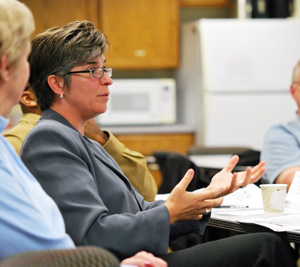
Jennifer Hall

Jennifer L. Hall, far left, describes a request to reallocate federal funding at the Aug. 24 Urban County executive committee meeting. Hall is housing manager for the Office of Community Development, a joint Ann Arbor/Washtenaw County unit. To the right are Teresa Gillotti, Paul Schreiber and Andrea Plevek. (Photos by the writer.)

A few minutes later more voting members of the Urban County‘s executive committee, which Gunn chairs, arrived. The group is a consortium of Washtenaw County, Ann Arbor, Ypsilanti and nine townships, responsible for allocating federal funding for low-income housing and other community development projects. The funds are managed by staff of the joint county/city of Ann Arbor Office of Community Development.

On Tuesday, the business they conducted included approval to reallocate federal funds for local housing programs, in an effort to identify how the money will be spent before a Sept. 18 deadline.

The group also got an update on state and federal emergency housing funds for the county, which have been cut by nearly 30%. In response to upcoming changes mandated by state and federal housing agencies, the Urban County executive committee approved several recommendations, including selecting the nonprofit SOS Community Services to coordinate housing crisis management in the county.

Those changes led to a discussion of the homeless situation in Washtenaw County, and the challenges of dealing with a spectrum of housing needs, from people seeking emergency shelter to those ready to buy a home. [Full Story]

County Board Says Farewell to Guenzel

Washtenaw County Board of Commissioners meeting (May 5, 2010): At his last board meeting before retiring later this month, Washtenaw County administrator Bob Guenzel received an extended standing ovation from commissioners, staff and others in attendance, including his wife, Pam Guenzel.

Bob Guenzel

On Wednesday, Washtenaw County administrator Bob Guenzel attended the last board of commissioners meeting of his 37-year career with the county. (Photos by the writer.)

The board’s tribute to the outgoing leader came at the end of a meeting that included a first-quarter budget update with news both good and bad. Though the county’s general fund budget is on track to show a surplus, it’s not as much as needed to carry over into 2011 – which means the budget could be tighter next year. And Guenzel cautioned that 2012 and 2013 could be even more challenging.

Also during the meeting, two finalists for the job of deputy county administrator were introduced: Bill Reynolds, who leads the Chippewa County (Wisc.) government and is former chief of staff for Sen. Arlen Specter, and Jose Reyes, CEO of a Southfield management consulting firm. They had been interviewing all day for the position now held by Verna McDaniel, who’ll be the next county administrator.

And what was expected to be a relatively short meeting was lengthened by a discussion about the Washtenaw Urban County‘s annual plan, which commissioners were being asked to approve. Despite some apparent confusion on the part of one commissioner over funding sources in the plan, it ultimately received unanimous support.

After the meeting, commissioners and staff headed over to Argiero’s to give Guenzel a send-off. A larger farewell party is planned later this month at The Ark, where he is a long-time board member. [Full Story]

Washtenaw Gets More Housing Funds

More than $400,000 in unanticipated federal funding – including a $250,000 “green” grant for Avalon Housing‘s Near North in Ann Arbor – allowed board members of the Washtenaw Urban County to boost funding for several low-income housing and community development projects at their April 27 meeting.

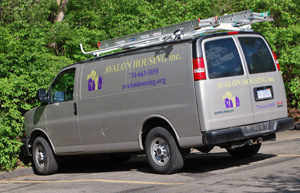
Van for Avalon Housing

A van for Avalon Housing, parked at the nonprofit's headquarters in the Northern Brewery building on Jones Drive. Avalon recently received a $250,000 federal "green" grant for its Near North affordable housing development on North Main.

In addition to the grant for Near North – a proposed 39-unit affordable housing development on Main Street just north of downtown – the Urban County also received nearly $180,000 more than anticipated in federal funding through the Community Development Block Grant program for the coming fiscal year.

The board voted to divvy up those additional funds to projects in the Urban County’s three largest jurisdictions – Ann Arbor, Ypsilanti and Ypsilanti Township. They also approved setting aside nearly $27,000 for as-yet-unspecified human services support, in light of possible cuts in city of Ann Arbor funding to local nonprofits.

The focus on allocations at Tuesday’s meeting prompted this comment from Ypsilanti mayor Paul Schreiber: “It’s a pleasure to sit on a board that has money to spend!” [Full Story]

“Urban County” Allocates Housing Funds

At their March 23 meeting, members of the Washtenaw Urban County – a consortium of 11 local municipalities that handles federal grants for low-income housing and other projects – approved over $2.6 million in allocations for the Ann Arbor/Ypsilanti area.

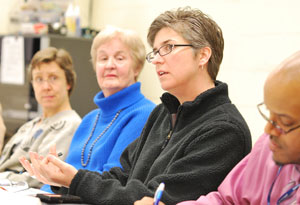
Margie Teall, Leah Gunn, Mary Jo Callan, Damon Thompson

Mary Jo Callan, director of the Office of Community Development, discusses proposed funding for housing projects at the Washtenaw Urban County meeting on Tuesday. At left are Ann Arbor city councilmember Margie Teall and county commissioner Leah Gunn, who chairs the Urban County executive committee. At right is Damon Thompson, OCD's operations manager. (Photos by the writer.)

The group also had a frank discussion about problems with struggling Gateway Apartments in Ypsilanti Township – the complex is operating at a loss and is putting strains on the nonprofit Avalon Housing, which took over management from the nearly-defunct Washtenaw Affordable Housing Corp.

In addition, Urban County members reallocated federal funds that had previously been earmarked to support a county land bank. The county’s board of commissioners voted to dissolve the land bank earlier this month.

Also approved during Tuesday’s meeting was the draft of an annual plan for July 1, 2010 through June 30, 2011. The plan outlines projects and a nearly $4 million budget from two federal programs for low-income neighborhoods. Avalon Housing’s Near North apartment complex, the Delonis Center homeless shelter, and an owner-occupied housing rehab program are among the projects being funded.

Staff of the Office of Community Development, a joint county/city of Ann Arbor department which among other things manages the Urban County projects, also reported on efforts to recruit more local governments to join the Urban County. OCD director Mary Jo Callan joked that there were two perception problems in marketing the Urban County: urban and county. [Full Story]

Greenbelt Explores Support for Small Farms

The main topic of discussion for the Ann Arbor Greenbelt Advisory Commission’s November meeting could be distilled into this: How can the greenbelt program support the development of small farms, and ensure that farm properties remain farms, even when the property changes ownership?

It’s an unlikely resource that might actually be able to help answer those questions: the federal housing programs administered by the Office of Community Development, a joint county/city department.

Jennifer Hall, OCD housing program coordinator, attended the Nov. 4 meeting of the greenbelt group and floated some ideas for how federal funding might provide resources to retain land for the farming community.

The commission also heard from the managing organization of the greenbelt program, The Conservation Fund, about strategies for preserving small farms. [Full Story]