Stories indexed with the term ‘WALLY’

AATA on WALLY Rail: Forward with Caution

At its Sept. 15, 2011 meeting, the Ann Arbor Transportation Authority board passed a resolution that expresses general support for the idea of continuing to work with surrounding communities to move forward with the Washtenaw and Livingston Line (WALLY) project. WALLY would provide commuter rail service on a 26-mile route between Ann Arbor and Howell. Relevant entities identified in the resolution include the state of Michigan, Livingston County, the city of Howell and the Ann Arbor Railroad.

However, the one “resolved” clause requires that funds allocated for WALLY in the 2012 budget ($50,000) cannot be spent, except with the explicit consent of the AATA board.

At the meeting, the board received a status report on the WALLY project from Michael Benham, a special assistant for strategic planning at AATA. Benham was hired in 2009 to handle the WALLY project. Since then, he’s become responsible for directing the development of the countywide transit master plan, which the AATA has developed over the course of the last year.

Highlights from Benham’s report included the fact that starting in 2008, AATA has spent a total of $102,853 on the WALLY project, while other partners have spent a total of $225,000. That money has been spent primarily on a study and public education efforts. As a part of the AATA FY 2012 budget, the AATA has included another $50,000 for the project, which requires the explicit approval of the board before it is spent. That money would be put towards station design.

Benham’s report identifies $16 million already invested by the Michigan Dept. of Transportation in track improvements, with $19 million worth of work still needed. Another $6 million in optional capital improvements is also identified.

Benham’s report projects that after the necessary capital improvements are completed to operate the commuter service, annual operating costs would amount to $5.4 million. Fares would be expected to cover $2.1 million of that, with another $1.4 million coming from the state’s Comprehensive Transportation Fund. That would leave another $1.9 million of local funding still to be identified.

[.pdf of WALLY status report (to reduce file size, does not include scans of letters of support)]

This brief was filed from the downtown location of the Ann Arbor District Library, where the AATA board holds its meetings. A more detailed report will follow: [link] [Full Story]

AATA Targets Specific Short-Term Strategies

Ann Arbor Transportation Authority board meeting (Aug. 10, 2010): The AATA is currently engaged in a public outreach process to gauge the consensus view of what kind of public transportation county residents would like to see in 30 years. The process is due to culminate early next year with the creation of a transportation master plan (TMP).

jesse-bernstein-webers-retreat

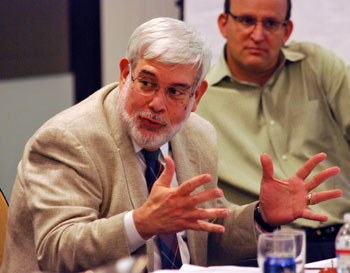
AATA board chair Jesse Bernstein at the board's four-hour retreat held on Aug. 10 at Weber's Inn. He was, at the time, stressing the importance of setting some kind of time frame for progress on the WALLY north-south commuter rail project. (Photos by the writer.)

But at a special board meeting and retreat held on Tuesday at Weber’s Inn on Jackson Road, the board discussed a variety of specific strategic initiatives that have a somewhat shorter time frame for implementation.

In a four-hour session stretching from 11 a.m. to 3 p.m., the board discussed and passed resolutions aimed to improve transportation between Ann Arbor and Ypsilanti, to the University of Michigan East Medical Center, and between the Detroit Metropolitan Airport and Ann Arbor.

In addition, the board authorized a lowering of the fare for the express commuter service between Canton and Ann Arbor. That fare change includes a decision to move the service in-house, instead of contracting the service out to Indian Trails. A similar change was made earlier this year for the Chelsea-Ann Arbor express bus service. [Chronicle coverage: "AATA on Chelsea Bus: Cut Fares, Add Wifi"]

Two resolutions that were not moved or voted on by the board – but which received animated discussion – involved the possible provision of vanpool services in the county by the AATA and the future of the Washtenaw-Livingston Line (WALLY) rail project.

In the area of capital improvements, the board also authorized a contract with DLZ Michigan to address a variety of infrastructure projects at the AATA headquarters on South Industrial Highway: installation and in-ground bus hoist; re-landscaping of the detention pond; expansion of the bus storage area; upgrades to the training room. The RFP for the contract also covered a potential park-and-ride lot at Glencoe Crossing Shopping Center on Washtenaw Avenue.

Board chair Jesse Bernstein also announced a Blake Transit Center advisory committee – which will include other community members – to provide input on the redesign and reconstruction of the downtown Ann Arbor transit center, located on Fourth Avenue south of Liberty. Bernstein will represent the board on the committee.

The various strategic initiatives will need to be explored in the context of the next budget year, which begins Oct. 1. So the board also received a budget overview at Tuesday’s meeting. They’ll sign off on the budget in September. [Full Story]

DDA to Tie $2 Million to Public Process

At their Wednesday morning meeting, the Ann Arbor Downtown Development Authority’s operations committee decided to recommend to the full board that the DDA pay the city of Ann Arbor $2 million. The payment is not legally required of the DDA under terms of an existing parking agreement that was struck in 2005.

A draft of the resolution with the recommendation was to be sent to all board members for review late Wednesday. If the full DDA board approves the resolution at its next meeting on May 5, city councilmembers who are up for re-election this year may not have to campaign under the shadow of police and firefighter layoffs. The $2 million from the DDA would allow the city council some flexibility in amending the FY 2011 city budget, before it is adopted at the council’s second meeting in May. That budget was formally introduced at the council’s April 19 meeting and showed a roughly $1.5 million deficit. It also included some police and firefighter layoffs.

But how much of the $2 million will be put towards avoiding layoffs versus offsetting the deficit is far from clear. Two city councilmembers attended the DDA operations committee meeting: Sandi Smith, who also serves on the DDA board; and Margie Teall, who serves on the council’s sub-committee appointed for the purpose of renegotiating the parking agreement between the city and the DDA. Last year, the city council and the DDA board each appointed a committee for the purpose of renegotiating that agreement.

At Wednesday’s meeting, Smith said it was not certain whether layoffs could be avoided with the $2 million payment or if so, how many could be avoided. Smith’s contention that there was no guarantee the $2 million would avert layoffs came in response to one of several sharp questions put to his fellow DDA board members by Newcombe Clark. Clark began the discussion by asking if the $2 million was tied to anything.

In the course of the discussion, it was made clear that the $2 million would be tied neither to a promise of no layoffs at the city, nor made contingent in any way on specific progress towards a renegotiation of the parking agreement between the DDA and the city.  It would also not be tied to the implementation of any part of a “term sheet” that will form the basis of the city-DDA discussions in the coming months.

Key aspects of that “term sheet” are the idea that regular payments will be made to the city, that the DDA will assume some responsibility for parking enforcement, and that the city will be “held harmless” in any revenue loss associated with cessation of its enforcement activities.

But by the end of the discussion, Clark had eked out a victory of sorts: a provision in the draft resolution that ties the $2 million to a public process, from this point forward, for the city-DDA negotiations. They have been going on a few months now out of public view. In that regard, the resolution can be fairly be analyzed as a fresh commitment to the committee structure, with its associated expectations of public process, that the two bodies had already adopted, but not implemented for discussing the parking agreement. [Full Story]

Transit Forum Critiques Fuller Road Station

Chris Leinberger was blunt in his assessment of the proposed Fuller Road Station: If the parking structure is built as proposed, in 20 years it will be torn down.

Fuller Road parking lot

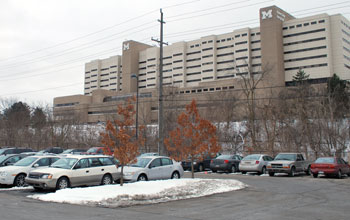
The city-owned Fuller Road parking lot, site of the proposed Fuller Road Station. To the south of the lot is the University of Michigan medical complex. (Photos by the writer.)

Speaking at a forum on transit-oriented development, Leinberger – a University of Michigan professor of practice in urban planning – said current plans for the joint UM/city of Ann Arbor project do a good job of incorporating different kinds of transit, from bikes and buses to perhaps, eventually, commuter rail.

But Leinberger criticized the project for taking some of Ann Arbor’s most valuable land and turning it into something that won’t generate revenue for the city. He told Eli Cooper, the city’s transportation program manager, that “whoever’s in your position 20 years from now will tear it down.”

Monday’s forum, held at the UM Art & Architecture building on north campus, was organized by members of the WALLY Coalition and the 208 Group, among others, to focus on local transit-oriented development efforts. Moderated by local developer Peter Allen, the event included presentations by Cooper, Richard Murphy of the city of Ypsilanti and Shea Charles, Howell’s city manager. [Full Story]

AATA Board to Mull Fare Increases

AATA Board (Dec. 17, 2008) Although the Ann Arbor Transportation Area board last month transitioned to a meeting format in which “there will not be discussion surrounding committee reports,” board member Ted Annis still gave the public what he calls the “headline news” from the planning and development committee, which he chairs. That included study of possible base fare increases over the next two years, first from $1 to $1.25 and then from $1.25 to $1.50. The possibility of completely eliminating fares for people with disabilities and for those over 65 years old is also being considered. Any changes will be preceded by public hearings with a board decision expected in April 2009.

In other board business, a bylaws change was passed to allow for public comment at the beginning of board meetings on any of the board’s agenda items. Board chair David Nacht described it as “an opportunity to make a pitch in advance of our actions,” and said that he thought it was “a really good idea.” A time limit of two minutes per individual will apply to the commentary at the beginning of the meetings. A time for public comment on any topic will still be available at the end of meetings. [Full Story]

Meeting Watch: AATA (15 Oct 2008)

At the Ann Arbor Transportation Authority board meeting on Wednesday night, more support was heard from many different quarters for the formation of an authority that would run WALLY – the proposed north-south commuter rail line from Howell to Ann Arbor – and for AATA to take the lead in forming that authority. [Full Story]

Meeting Watch: AATA (17 Sept 2008)

It was hard to find any bad news at the AATA board meeting held Wednesday night – unless it was the misfortune of board chair, David Nacht, being forced to call time on Tom Partridge’s public speaking turn just as Partridge was favorably comparing Nacht’s education and intellect to that of Governor Granholm’s. Even though with each agenda item, Nacht probed for signs of trouble, he was met time and again with positive reports: on ridership, on the fiscal year 2009 operating budget, on the fuel budget, and on his fellow board members’ willingness to take a small step towards helping make WALLY (Washtenaw and Livingston Line) a reality. [Full Story]

Track Straightening Work on Ann Arbor Railroad

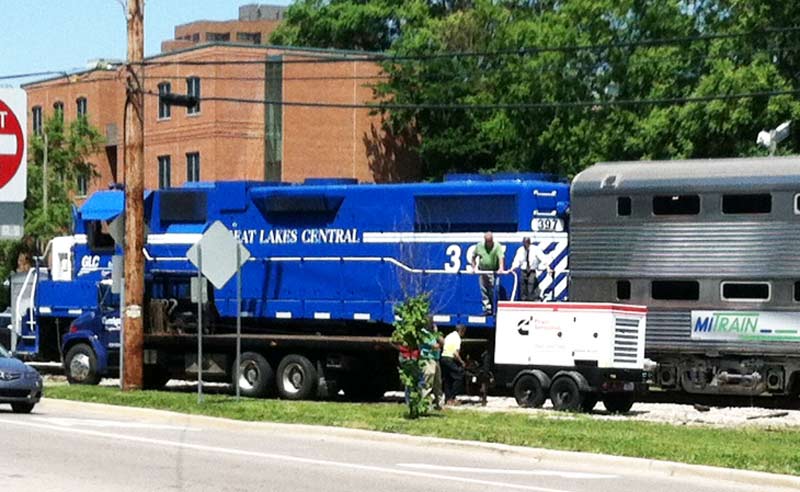
Let's get this straight: this is the Ann Arbor Railroad

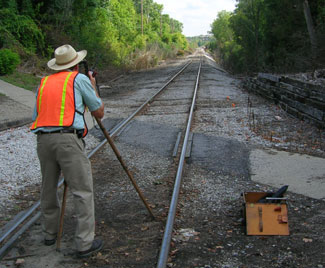
Let's get this straight. Ann Arbor Railroad track gets measured out for straightening work next week.

“Left, a skosh!” the guy behind the transit radioed his colleagues about a half mile away along the rails. He was sighting northward up the track from where it crosses Traver Road up to Barton Drive. The guys up the track were almost as invisible to the naked eye in real life as they are in The Chronicle’s photo accompanying this story.

The late morning temperatures were in the low 70s, but without a cloud in the sky, … [Full Story]