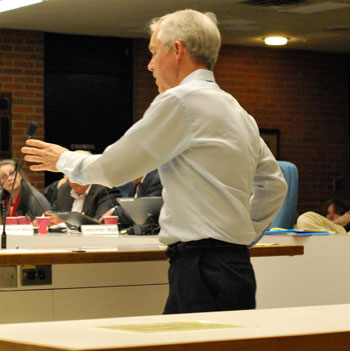
Ann Arbor park advisory commission meeting (Aug. 20, 2013): In a session that one member described as the “shortest meeting ever,” park commissioners heard presentations and updates, but had no action items on their agenda.
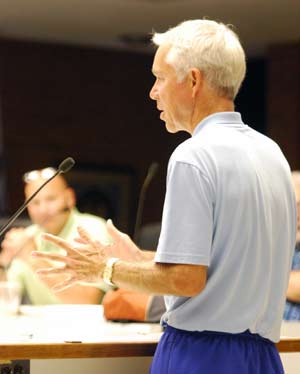
Larry Deck of the Washtenaw Bicycling and Walking Coalition gave a presentation to the Ann Arbor park advisory commission about the Border-to-Border trail. (Photos by the writer.)
The main presentation focused on the Border-to-Border trail connections in Ann Arbor. The trail runs roughly along the Huron River from Livingston County in the north to Wayne County in the east, using paved shared-use paths, unpaved paths and bike lanes.
Larry Deck from the Washtenaw Bicycling and Walking Coalition highlighted three areas that WBWC has identified as high priorities: (1) between Bandemer Park and Barton Park/Huron River Drive (the B2B trail ends at the north edge of Bandemer Park); (2) near the intersection of Fuller Road and Maiden Lane; and (3) near the Fuller Road bridge over the Huron River.
Another WBWC priority is to improve the bicycling connections between the University of Michigan’s central and north campuses.
Deck suggested that PAC consider a resolution recommending to city council that these projects be designed and funded, and in general renew the priority of the B2B trail along the Huron River greenway. It’s been a city priority for decades, he noted, but it’s good to have a reminder of that.
Discussion among commissioners focused on the challenges of crossing railroad tracks at various points along the B2B route, as well as interest in coordinating with other projects like the recommendations of the North Main Huron River corridor task force.
During the meeting, commissioners also got an annual update from George Taylor, president of the Cobblestone Farm Association, as well as briefings from PAC’s dog park and downtown park subcommittees. Results from surveys to solicit public input for both subcommittees are now available, and will be analyzed by commissioners and staff in preparation for upcoming public forums. [.pdf of 306-page dog park survey results] [.pdf of 110-page downtown park survey results]
Two public forums are scheduled for the downtown park project: On Monday, Sept. 9 in the basement of the downtown Ann Arbor District Library, 343 S. Fifth, from 6:30-8:30 p.m., and on Wednesday, Sept. 18 at city hall’s basement conference room, 301 E. Huron, from 6:30-8:30 p.m.
The dog park subcommittee – which is looking for a possible location for a third dog park – will hold a public forum on Wednesday, Sept. 11 at 7 p.m. at Cobblestone Farms, 2781 Packard. In noting the history of opposition to proposals for a dog park at West Park, Tim Berla wondered whether it would be possible to locate a dog park anywhere near a residential neighborhood. It’s a “classic Ann Arbor trap,” he said – everyone is in favor of it, until something specific is proposed and the neighbors say no.
In his manager’s report, Colin Smith highlighted several upcoming events. The annual season-closing “dog swim” at Buhr Park pool will be held on Sept. 4 and Sept. 5 from 3-8 p.m. On Sunday, Sept. 15 at 1 p.m. in Liberty Plaza – the downtown park at Division and Liberty – a grand opening will be held for the “sensory garden” there. It’s a project of the Ann Arbor commission on disability issues, in collaboration with the city’s adopt-a-park program and the University of Michigan Matthaei Botanical Gardens.
Smith also noted that the popularity of Argo Cascades has led to a shortage of parking in that area. As a result, beginning Labor Day weekend the staff will start using a portion of Longshore Park to park cars. It’s a short-term measure while the staff seeks longer-term solutions, he said. [Full Story]