Stories indexed with the term ‘Washtenaw County Parks & Recreation’

Ypsi Council To Be Briefed on Rec Center

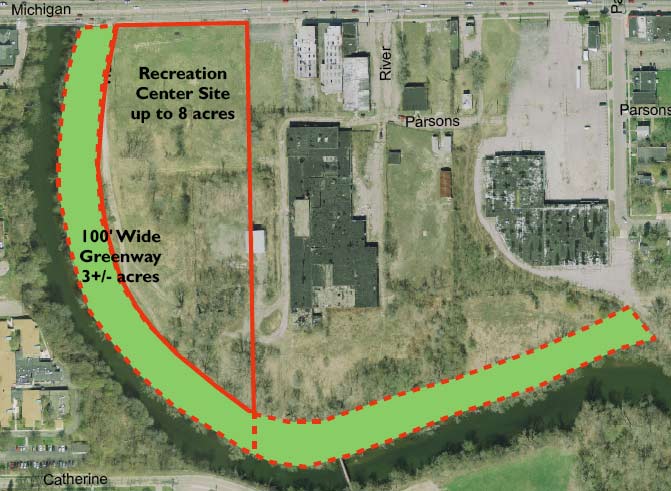
A proposal for a new county recreation center in Ypsilanti’s Water Street area is the focus of an Ypsilanti city council working session on Tuesday, Oct. 4, held prior to the council’s regular evening meeting. A memo from Bob Tetens, director of the Washtenaw County parks & recreation department, outlines the proposed East Side Recreation Center and is included in the council packet. [.pdf of memo from Tetens]

In the memo, Tetens states that the new center would be similar, both in size and characteristics, to the county’s Meri Lou Murray Recreation Center, located on Washtenaw Avenue at Platt Road. However, the programming and other features would be unique to the Ypsilanti area community. The MLM rec center has … [Full Story]

Greenbelt, County Look to Partner on Farms

Ann Arbor greenbelt advisory commission meeting (March 9, 2011): Changes to Washtenaw County’s natural areas preservation program (NAPP) now allow the county to buy development rights for farmland – a land preservation strategy also pursued by Ann Arbor’s greenbelt program.

Ginny Trocchio, Tom Freeman

Tom Freeman, deputy director of Washtenaw County parks & recreation, and Ginny Trocchio of The Conservation Fund distribute handouts to the Ann Arbor greenbelt advisory commission at GAC's March 9, 2011 meeting. (Photos by the writer.)

Tom Freeman, deputy director for the county’s parks & recreation department, gave commissioners an update on this new aspect of NAPP, which is funded by a 10-year millage that voters renewed in November 2010. He discussed with commissioners areas of overlap between the two programs, and the potential for future partnerships as NAPP’s farmland protection efforts ramp up.

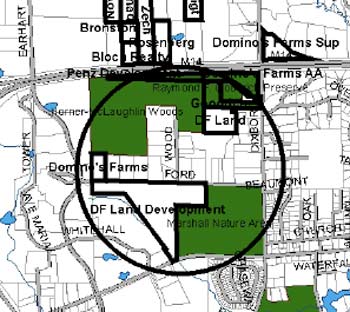
Prompted by a question from GAC chair Jennifer S. Hall, Freeman also updated commissioners about the county’s plans to apply for a grant from the Michigan Dept. of Natural Resources Trust Fund. The grant would help the county buy a parcel in Ann Arbor Township now owned by a subsidiary of Domino’s Farms. The land, which has water and sewer hookups that make it prime for development, is near three other parcels of already preserved property: the county’s Goodrich Preserve; the University of Michigan’s Horner-McLaughlin Woods; and the city-owned Marshall Nature Area. Freeman explained some complicating factors in the acquisition, including two widely divergent appraisals – for $1.9 million and $3.25 million – and the fact that the land is at the center of ongoing litigation between the township and the landowner.

When Hall floated the idea that the greenbelt commission could send a letter of support for the county’s application, Carsten Hohnke cautioned against it. Hohnke, who serves on both GAC and city council, said the city also plans to apply to the trust fund for two projects. [He didn't identify the projects during the meeting. In a follow-up email to The Chronicle, Colin Smith, the city's parks & recreation manager, reported that the applications would be for a skatepark and upgrades to the Gallup canoe livery and park.]

Hohnke felt the county’s application could dilute the city’s chances for success, though it was pointed out to him that the county and city would be applying to two separate pools of funding – the county plans to ask for a grant available for land acquisitions, while the city’s projects are in the category of project development grants. Ultimately, commissioners voted to recommend that the city council consider sending a letter of support for the county’s application. Councilmembers would need to act at their next regular meeting on March 21 – the deadline to apply is April 1.

Also at GAC’s March 9 meeting, commissioner Tom Bloomer – who owns Bur Oaks Farm in Webster Township – reported on a plan to eliminate state tax credits for farmers. It’s part of a broader budget proposal by Gov. Rick Snyder to cut many of the tax incentives currently offered by the state – the most high profile of which is for the film industry. Eliminating the credits for farming could make it unprofitable to farm in this area, Bloomer said. [Full Story]

Washtenaw County Treasurer Updates Board

Washtenaw County board of commissioners meeting (Feb. 16, 2011): The county board’s four-hour meeting on Wednesday evening was punctuated by a heated debate about whether some of their meetings are sufficiently in the public eye.

Bill Reynolds, Catherine McClary

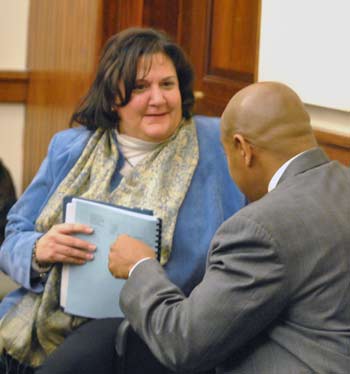
Washtenaw County treasurer Catherine McClary, right, talks with deputy county administrator Bill Reynolds before the start of the Feb. 16, 2011 board of commissioners meeting. McClary delivered her annual treasurer's report during the meeting. (Photos by the writer.)

Ronnie Peterson started that debate by advocating for holding the board’s budget retreats and administrative briefings at the boardroom table, where they can be televised. The meetings are open to the public, but are more informal and not available on Community Television Network or online webcasts. The ensuing discussion revealed different perspectives on what kind of environments are most conducive to deliberations. At one point, board chair Conan Smith – who opposed a change of venue – argued that deliberations aren’t subject to the state’s Open Meetings Act. The county’s attorney, Curtis Hedger, advised the board that, in fact, deliberations do need to occur in open meetings, with limited exceptions allowed in closed sessions.

After roughly 90 minutes of debate, the board voted – with Smith dissenting – to hold future budget retreats in the boardroom following their bi-weekly working sessions. The retreats will be televised. An effort to relocate and televise administrative briefings failed, however, with support only from Peterson, Kristin Judge and Wes Prater.

In other business, the board appointed three staff members to a review committee that’s part of a new coordinated effort for funding human services nonprofits in the county. During a presentation by Mary Jo Callan – head of the office of community development, which is overseeing this process – Peterson expressed concern that smaller, community-based nonprofits will be unable to compete in this new system. Callan assured him that she understood his concerns, but felt that this new model could actually be better for those nonprofits. She noted that the board would ultimately control funding decisions for county dollars.

Catherine McClary, the county treasurer, delivered her annual treasurer’s report, giving an update on the county’s investment portfolio, delinquent taxes and foreclosures. She reported that the amount of residential tax foreclosures appears to be stabilizing, but foreclosures of commercial property are on the rise, especially for parcels of vacant, undeveloped land. Separately, the board approved the treasurer’s annual request to borrow funds – up to $50 million this year – to temporarily cover delinquent taxes in the county’s 80 taxing jurisdictions. Last year, there was about $29 million in delinquent taxes, and McClary expects a small increase this year.

McClary also told commissioners that later this year she’ll be asking them to approve a civil infractions ordinance for dog licenses, as part of a stepped-up enforcement effort. Right now, not having a license is a criminal misdemeanor of 90 days in jail or a $500 fine.

During Wednesday’s meeting commissioners also delivered several liaison reports, including news that the Washtenaw County Parks & Recreation Commission had approved $600,000 for the Connecting Communities trail program. Part of those funds will support a project that will eventually link Saline and Ann Arbor through a non-motorized pathway. The commission also authorized $250,000 to build a boathouse and fishing dock at Ford Lake, in partnership with the state and Eastern Michigan University. [Full Story]

County Board Acts on Millages, Fees, Bonds

Washtenaw County Board of Commissioners meeting (Sept. 15, 2010): In a meeting remarkable mainly for its brevity – lasting less than 30 minutes – county commissioners on Wednesday passed several resolutions, ranging from approval of a millage that funds services for indigent veterans to new fees for remote-access online searching and copying of land records from the county register of deeds database.

Yousef Rabhi, Leah Gunn, Jim Dries

Yousef Rabhi, left, who won the District 11 Democratic primary for county commissioner, talks with commissioner Leah Gunn (District 9) and Jim Dries, chief deputy clerk, before the Sept. 15 county board meeting.

No one spoke during any of the four opportunities for public commentary, nor did anyone speak at a public hearing for the indigent veterans millage. The board set another public hearing for Oct. 6 to seek input on an economic development millage it plans to levy.

Also during Wednesday’s meeting, the board passed the five-year master plan for Washtenaw County Parks & Recreation, and gave initial approval to backing a bond for a $2.8 million Western Washtenaw Recycling Authority project. The project will include a facility upgrade to handle single-stream recycling.

The board also approved a $6.5 million first-quarter budget and personnel changes for the Community Support & Treatment Services (CSTS) department, which operates under a fiscal year that’s aligned with the state and begins on Oct. 1. CSTS is in the process of merging with the Washtenaw Community Health Organization (WCHO), a partnership between the county and the University of Michigan Health System. The board got an update on that merger at its Sept. 16 working session. [Full Story]

Column: Seeds & Stems

Marianne Rzepka

Marianne Rzepka

Gardeners spend a lot of time working in their own world – moving the perennials, planning their walkways or weeding their vegetables.

But for some gardeners, the Michigan Conservation Stewards program has ushered in a larger world outside their backyard landscapes.

“My garden is something I do for me, but the stewardship program is what I do for others and for the larger environment,” says Mary Duff-Silverman, who went through the course last year.

The stewardship program introduces participants to the plants, animals and forces of nature that defy outsiders’ attempts to impose order. Instead, the steward-in-training has to understand the rules of that larger environment, with its invasive plants, water aeration, ground water and other natural processes.

This spring is only the second year the course has been offered in Washtenaw County. It’s a series of 11 classes that range over a number of ecological topics, including the ecosystems of wetlands, forests, lakes and streams.

This year’s program begins Saturday, April 10. If you’re interested, get more information online – you can also download the three-page application form from that website. [Full Story]

County Offers $400K Match for Skatepark

On Tuesday night at their regular monthly meeting, the Washtenaw County parks and recreation commission unanimously authorized up to $400,000 in matching funds for a skatepark being developed by the Ann Arbor Skatepark Action Committee (AASAC). The future location of the skateboarding facility is planned for the northeast corner of Veterans Memorial Park on the city’s west side.

Washtenaw County Parks and Recreation Commission

Three of nine parks and recreation commission members for Washtenaw County, who attended Tuesday's meeting. Front to back: Jimmie Maggard, Patricia Scribner and Robert Marans. Obscured is Bob Tetens, director of Washtenaw County Parks and Recreation. (Photos by the writer.)

The county’s parks and recreation program is funded by two separate, dedicated countywide tax levies at 0.25 mill apiece – for capital improvements and maintenance, respectively. The millages are separate from the county’s general operating millage.

The offer of matching funds came with the clear expectation from commissioners at the meeting that the county will be given its due – in terms of signage and participation in the project as it moves forward.

Bob Tetens, director of Washtenaw County Parks and Recreation, spoke at the meeting about the ability of the county to leverage the fundraising efforts of AASAC to achieve an $800,000 skatepark, instead of a $400,000 skatepark. For AASAC’s part, the plan all along was to build an $800,000 skatepark – plus establish a $200,000 endowment for maintenance.

The promised funds from the county will allow AASAC to leverage the match as part of their fundraising efforts. From that point of view, the timing of the county’s decision worked out to AASAC’s advantage. This Saturday, March 13, from noon-6 p.m. Red Belly Boardshop will sponsor The Grinds of March, a benefit for the Ann Arbor Skatepark fund to be held in a warehouse located at 704 Airport Blvd.

The Grinds will feature a pro skating demonstration by Garold Vallie and Andy MacDonald. MacDonald spent his summers in Ann Arbor, growing up skating.

The city of Ann Arbor has so far not offered dollars in support of the skatepark, but has approved use of the site, and struck a memorandum of understanding with AASAC. Ten out of 11 councilmembers also signed a letter dated March 8, 2010, urging the county’s parks and recreation commission to support the skatepark. [Full Story]

Greenbelt Commission Backs County Tax

Ann Arbor Greenbelt Advisory Commission meeting (Feb. 10, 2010): Citing benefits to the city’s own greenbelt program, members of the greenbelt commission at their Wednesday meeting voiced support for a county land preservation millage, which is up for renewal this year.

The commission passed a resolution urging the city council formally to endorse the millage, though it’s up to the Washtenaw County Board of Commissioners to decide whether to put the millage on the ballot. It’s not yet clear the board will do that.

Greenbelt commissioners also discussed the implications of new, lower appraisals that had just been received on the Braun and Gould properties in Ann Arbor Township. The city already has binding purchase agreements with the owners based on older, higher appraised values, but recently learned that new appraisals will result in fewer federal matching funds for the acquisitions. The city could be on the hook for more money than was anticipated to close these deals.

Related to that, some commissioners raised concerns over information they’d received last month from the city attorney’s office, which appeared to be in conflict with what they were being told by staff at Wednesday’s meeting. [Full Story]

County Seeks Input on Parks Master Plan

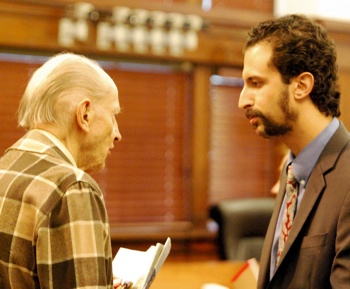
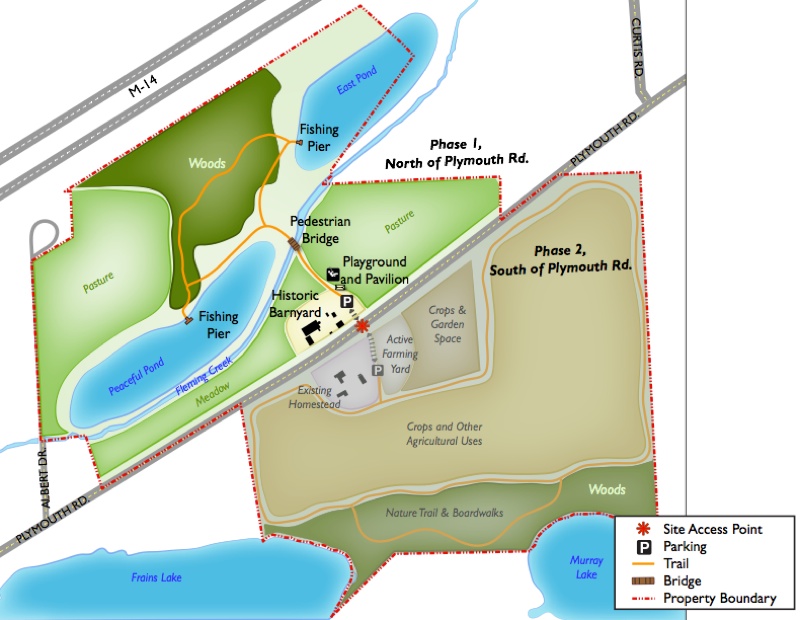
Donald Staebler was without question the oldest resident to show up at a Jan. 26 public meeting on the Washtenaw County Parks & Recreation master plan. And the 99-year-old farmer had a very specific reason why: He sold his farm to the county nearly 10 years ago, and he wants to see what they’re going to do with it.

The barn and out buidlings at Staebler Farm, on Plymouth Road in Superior Township. Washtenaw County Parks & Recreation bought the farm in 2001, will be developing master plan for the property in the coming years.

The barns and out buildings at Staebler Farm, on Plymouth Road in Superior Township. Washtenaw County Parks & Recreation bought the farm in 2001, and will be developing a master plan for the property in the coming years. (Photos by The Chronicle.)

“I’m open to suggestions,” Staebler told The Chronicle, “and willing to give up plenty of what I know.”

During their presentation about a five-year master plan for the parks system, county staff outlined plans for the Staebler Farm – a proposed $2.3 million investment – as well as for several other county parks, recreational facilities and preserves. It was one of three public meetings to get input on the master plan; the next meeting will be on Wednesday, Feb. 3, at the Dexter Library, starting at 7 p.m.

A draft of the master plan – which is also available online – includes items in an extensive capital improvement program that was approved last year by the county’s Parks & Recreation Commission. Several of the largest projects are planned for Rolling Hills Park, including the addition of a dog park, an expansion of the water park and construction of softball fields and an amphitheater. The county also plans to invest nearly $12 million in greenway and non-motorized trails over the next five years. [Full Story]

County Natural Areas Tax Up for Renewal

A resolution to hire Verna McDaniel as the next county administrator is on the Feb. 3 agenda for the Washtenaw County Board of Commissioners, and commissioners gave her a round of applause on Wednesday when that agenda item was announced at their administrative briefing.

But it was an item not on the agenda that yielded the most animated discussion on Wednesday: A countywide millage for Washtenaw County’s Natural Areas Preservation Program. The tax, which was first approved by voters in November of 2000 and took effect in 2002, will expire in 2011 and would need to go back to voters this year for renewal. Based on comments at Wednesday’s briefing, the millage renewal might face resistance from some commissioners. [Full Story]

Skatepark Rolls Towards Design

kid in red helmet with skateboard about to launch down a bowl

Ready to launch from the lip of the Riley Skatepark in Farmington Hills, Michigan. (Photo by the writer)

Last Saturday, the Ann Arbor Skatepark Action Committee loaded up the french-fry-oil fueled BTB Party Bus with as many local decision-makers as it could find and steered a course for Farmington Hills.

They wanted to show city councilmembers, park advisory commissioners and staff planners first hand what a free concrete skatepark looked like.

The field trip itself was meant in part as fuel for the imagination as the committee rolls towards an Oct. 18 skatepark design workshop, which starts at 2 p.m. at Slauson Middle School, located at 1019 W. Washington. It’s free and open to the public.

The planned location for the park is the northeast corner of Veterans Memorial Park at the intersection of Maple Road and Dexter Avenue, on Ann Arbor’s west side.

Almost a year ago, at its Dec. 1, 2008 meeting, the Ann Arbor city council passed a memorandum of intent to develop a skatepark at the Veterans Park location. Now the question facing skatepark supporters is: Where’s the money for building and maintaining the skatepark going to come from? [Full Story]