Washtenaw County board of commissioners meeting (Aug. 1, 2012): In a move that extends the approval process for a countywide public transportation system, commissioners amended the articles of incorporation for a new transit authority then ultimately approved that document and a related four-party agreement on a 6-4 vote.
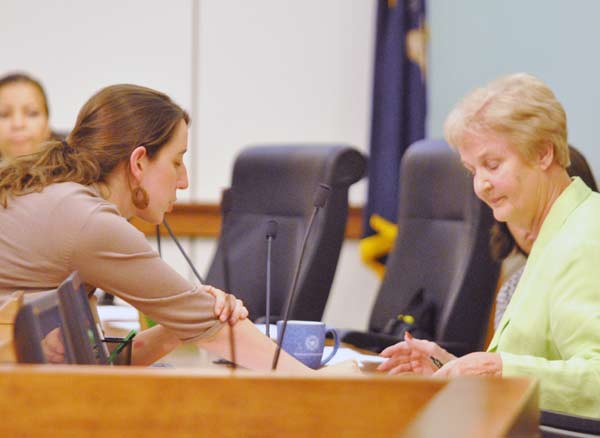
Sarah Pressprich Gryniewicz, left, talks with Washtenaw County commissioner Leah Gunn prior to the start of the Aug. 1, 2012 board of commissioners meeting. Gryniewicz is community outreach coordinator for the Ann Arbor Transportation Authority. (Photos by the writer.)
Because the articles were amended, they will need to be reconsidered by the other three parties in the agreement: the city councils of Ann Arbor and Ypsilanti, and the board of the Ann Arbor Transportation Authority, which is spearheading this effort. Those governing bodies are expected to take up the issue at meetings later this month. It will be on the Ann Arbor city council agenda for its Aug. 9 meeting.
Before the county board’s Aug. 1 vote, about a dozen people spoke during a public hearing on the issue, the majority of them in support of the agreement and of expanded public transit in general.
Although amendments had been considered and voted down at the board’s July 11 meeting, on Aug. 1 Rob Turner proposed a new amendment to the articles of incorporation. The original draft stipulated that a two-thirds majority of the new authority’s board would be required to amend the articles of incorporation. Turner’s amendment would have stipulated that a unanimous vote by the new authority’s board would be needed to make such changes. Leah Gunn offered a compromise – a four-fifths majority, or 12 of the new authority’s 15 board members. That amendment to Turner’s amendment passed on a 6-4 vote, with dissent from Turner, Conan Smith, Felicia Brabec and Wes Prater. The vote on the amended amendment itself – requiring the four-fifths majority – passed unanimously.
Turner felt his original amendment offered safeguards for smaller communities. It’s possible for communities to decide to join the new transit authority, only to have the articles of incorporation – the “rules of the game” – changed after they’ve joined, he said. If his amendment had been approved, Turner said he would have supported the four-party agreement and articles of incorporation. He said it no longer seemed like a countywide authority – it seemed like an Ann Arbor system that others could join. That saddened him, he said.
Joining Turner in his final vote against the overall agreement and articles of incorporation were Alicia Ping, Wes Prater and Dan Smith. Rolland Sizemore Jr. was absent.
A range of other items were on the Aug. 1 agenda. Commissioners suspended the county’s use of Construction Unity Board (CUB) agreements, responding to a change in state law. They also gave final approval to a change in the county’s accommodations ordinance, exempting bed & breakfasts, cottages and individuals who occasionally lease out rooms from the 5% accommodations tax. And addressing a need for veterans, the board authorized the county clerk to offer photo IDs that can be used to redeem discounts offered at local businesses.
On an 8-2 vote, commissioners also approved a brownfield financing plan for a $39 million residential development at 618 S. Main St. in Ann Arbor. Before the board’s vote, both Felicia Brabec and Yousef Rabhi praised the development, but said they were voting against it because of concerns about affordability. They did not feel that most young professionals would be able to afford living there, and stressed the importance of having more affordable housing in the downtown area.
The board also heard a report from the county treasurer, and got a second-quarter financial update from staff. Commissioners then approved a $1,263,994 mid-year adjustment to its 2012 general fund budget, bringing the 2012 general fund budget to $101,162,770.
In one of the least controversial items of the meeting, commissioners passed a resolution commending the Washtenaw Community Concert Band – formerly the Ypsilanti Community Band – on its 35th season. Dan Smith, who plays the trumpet, is a member of that group. [Full Story]