Stories indexed with the term ‘zoning’

Beyond Pot: Streets, Utilities, Design

Ann Arbor city council meeting (June 6, 2011, Part 1): While the largest chunk of time at the city council’s Monday meeting was devoted to consideration of ordinances regulating medical marijuana, the agenda was dense with other significant material.
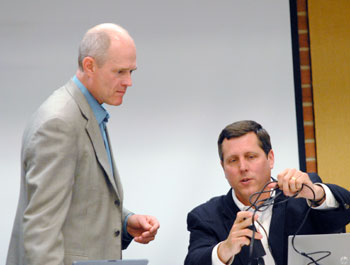
Tom Crawford John Hieftje

Mayor John Hieftje (standing) and interim city administrator Tom Crawford before the start of the city council's June 6 meeting.

For road users who head to the polls on Nov. 8, possibly the most important issue on the agenda was a brief presentation from the city’s project management manager, Homayoon Pirooz, on the city’s street repair tax, which would reach the end of its current five-year life this year, if not renewed by voters. The city council will convene a working session on June 13 to look at the issue in more detail.

Also related to infrastructure was the council’s initial action on setting rates for utilities (water, sewer, stormwater), voting unanimously to send the rate increases on to a second and final vote with a public hearing. The rate increases range from 3-4% more than customers are currently paying. All new and amended city ordinances require two votes by the council at separate meetings.

The council also approved an $800,000 agreement with the Michigan Dept. of Transportation for the initial, right-of-way portion of the East Stadium bridges replacement project. Construction on that public project is due to start later this fall.

For another public project, the council voted to add a previously budgeted $1.09 million to the construction manager contract for the new municipal center at Fifth and Huron.

In an action designed eventually to reduce employee benefits costs, the council passed a resolution – brought forward by its budget committee – that directs the city administrator to craft an ordinance revision that would alter the way non-union employee benefits are structured. What’s planned is a change from three to five years for the final average compensation (FAC) calculation, and a change from five to 10 years for vesting. In addition, retirees would receive an access-only health care benefit.

The city’s newest non-union employee is Chuck Hubbard, whose appointment as the new fire chief was approved by the city council on Monday night. Hubbard was previously assistant chief, which, unlike the chief’s job, is a union position. Hubbard has 25 years of fire protection experience, all of it in Ann Arbor.

Expected to begin construction this year – in late summer – is a private development on the First and Washington lot currently owned by the city. On that lot, Village Green is planning to build a 9-story, 99-foot-tall building featuring 156 dwelling units and a 244-space parking deck on the first two stories. After much discussion, the council approved a $100,000 reduction in the purchase price – from $3.3 million to $3.2 million – that Village Green will pay for the First and Washington parcel. The price break came in the context of water management and a decision to use a full “bathtub”-type design for the foundation. The unanimous vote came after two councilmembers had already left the meeting (which pushed nearly to midnight), but it seemed at one point to hang in the balance, with two of the remaining nine councilmembers expressing reservations. Because the resolution involved land purchase, it needed eight votes to pass.

Village Green’s project, a planned unit development (PUD) approved over two years ago, was not required to undergo the mandatory process of design review that is now part of the city’s code. The council gave final approval to that design review process on Monday night. The new ordinance sets up a seven-member design review board (DRB) to provide developers with feedback on their projects’ conformance to the design guidelines. While the DRB process is required, conformance with the recommendations of that body is voluntary.

Also receiving approval at first reading was a revision to the landscaping ordinance. Fuller Road Station also drew comment from the public and the council.

Final action on medical marijuana zoning and licensing is not expected until the council’s June 20 meeting. Council deliberations on medical marijuana will be covered in Part 2 of The Chronicle’s meeting report. [Full Story]

Ann Arbor Pauses Medical Pot Again

At its June 6, 2011 meeting, the Ann Arbor city council approved amendments to a proposed medical marijuana licensing program that were substantial enough that the program will require a second reading and approval before the council, together with a public hearing. The zoning ordinance, to which the council had previously given its initial approval, was also considered on June 6, but was postponed. That would allow the second and final approvals of both licensing and zoning ordinances to be enacted at the same meeting, on June 20.

Among the amendments to the licensing program was one that reduced a records retention requirement from one year to 30 days.

The medical marijuana zoning ordinance received its initial approval by the council at its Oct. 18, 2010 meeting. The delay since the initial Oct. 18, 2010 zoning vote stems from the city of Ann Arbor’s strategy in legislating zoning and licensing of medical marijuana businesses – that strategy has been to bring both licensing and zoning before the city council at the same time for a final vote.

The context for developing zoning regulations was set at the council’s Aug. 5, 2010 meeting, when councilmembers voted to impose a moratorium on the use of property in the city for medical marijuana dispensaries or cultivation facilities. The council also directed the city’s planning commission to develop zoning regulations for medical marijuana businesses.

Subsequently, the city attorney’s office began working on a licensing system. The council undertook several amendments to the licensing proposal at four of its meetings over the last three months: on Jan. 3Feb. 7,  March 7 and March 21. The council finally gave its first initial approval to the licensing proposal at its March 21 meeting.

At its May 2 meeting, the most significant amendment to the licensing proposal was to eliminate cultivation facilities from licensing requirements. [.pdf of Michigan Medical Marijuana Act]

This brief was filed from the city council’s chambers on the second floor of city hall, located at 301 E. Huron. A more detailed report will follow: [link] [Full Story]

Ann Arbor Design Guidelines: Final OK

At its June 6, 2011 meeting, the Ann Arbor city council gave final approval to an amendment of its land use control ordinance that will establish design guidelines for new projects in downtown Ann Arbor, and set up a seven-member design review board (DRB) to provide developers with feedback on their projects’ conformance to the design guidelines. It’s the final piece of the A2D2 rezoning initiative.

Review by the DRB will come before a developer’s meeting with nearby residents for each project – which is already required as part of the citizen participation ordinance. While the DRB process is required, conformance with the recommendations of that body is voluntary.

The city council had previously approved the design guideline review program at its Feb. 7, 2011 meeting. The city planning commission unanimously recommended the change to the city’s ordinance at its April 5, 2011 meeting. [Previous Chronicle coverage, which includes a detailed timeline of the design guidelines work, dating back to a work group formed in 2006: "Ann Arbor Hotel First to Get Design Review?"]

This brief was filed from the city council’s chambers on the second floor of city hall, located at 301 E. Huron. A more detailed report will follow: [link] [Full Story]

Design Guideline Law Gets Initial OK

At its May 16, 2011 meeting, the Ann Arbor city council gave initial approval to an amendment of its land use control ordinance that will establish design guidelines for new projects in downtown Ann Arbor, as well as a seven-member design review board (DRB) to provide developers with feedback on their projects’ conformance to the design guidelines.

All city of Ann Arbor ordinances require approval at an initial first reading before the council, a public hearing, and final approval at a meeting following the initial approval.

The timing of project review by the DRB will come before a meeting with nearby residents – which is already required as part of the citizen participation ordinance. While the DRB process is required, conformance with the recommendations of that body is voluntary.

The city council had previously approved the design guideline review program at its Feb. 7, 2011 meeting. The city planning commission unanimously recommended the change to the city’s ordinance at its April 5, 2011 meeting. [Previous Chronicle coverage, which includes a detailed timeline of the design guidelines work, dating back to a work group formed in 2006: "Ann Arbor Hotel First to Get Design Review?"]

This brief was filed from the city council’s chambers on the second floor of city hall at 301 E. Huron. A more detailed report will follow: [link] [Full Story]

Ann Arbor Schedules Final Pot Votes

At its March 21, 2011 meeting, the Ann Arbor city council scheduled the second and final votes on its medical marijuana business licensing scheme and its medical marijuana zoning ordinance for its April 19, 2011 meeting. The moratorium on the use of property in the city as a medical marijuana dispensary or a medical marijuana cultivation facility was extended from March 31, 2011 to June 30, 2011.

This brief was filed from the boardroom in the Washtenaw County administration building, where the council is meeting due to renovations in the city hall building. A more detailed report will follow: [link] [Full Story]

Parcel Annexed for Mill Creek Townhouses

A request to annex three parcels totaling about one acre on the east side of Stone School Road at Birch Hollow Drive was approved by the Ann Arbor planning commission at its March 15, 2011 meeting. The vacant land is located in Pittsfield Township, on the west end of the Mill Creek Townhouses, which was annexed into the city in 1976. The commission also approved zoning the land as R3 (townhouse dwelling use). City planning staff indicated that the request was made because the owner was tired of receiving tax bills from multiple jurisdictions.

This brief was filed from the boardroom in the Washtenaw County administration building, where the planning commission is meeting due to renovations in the city hall building. A more detailed report will follow. [Full Story]

Medical Marijuana Postponed Again

At its March 7, 2011 meeting, the Ann Arbor city council again delayed consideration of a set of licensing requirements for medical marijuana businesses. The council has now delayed its initial vote on the licensing requirements at five meetings, dating back to Dec. 6, 2010. The postponement was until March 21, 2011, the council’s next meeting.

At the March 7 meeting, the council undertook several additional amendments to the licensing proposal. But ultimately they elected to postpone in the face of several unresolved issues. Christopher Taylor (Ward 3) was the sole vote against the postponement to March 21.

The vote that was again postponed is the first of two votes the council must take on any new ordinance it enacts. At its meetings over the last few months, the council has heard extensive public commentary on medical marijuana, but that commentary does not constitute a formal public hearing, which will be held at the same meeting when the council votes on final approval of the licensing, provided it eventually gives initial approval to the licensing system.

At its Oct. 18, 2010 meeting, the  council gave its initial approval to a set of zoning regulations for medical marijuana businesses, but it has not yet given its final approval to those regulations. The council’s strategy is to bring licensing and zoning forward at the same time for a final vote.

The context for development of zoning regulations was set at the council’s Aug. 5, 2010 meeting, when councilmembers voted to impose a moratorium on the use of property in the city for medical marijuana dispensaries or cultivation facilities, and directed its planning commission to develop zoning regulations for medical marijuana businesses. Subsequently, the city attorney’s office also began working on a licensing system.

At its Jan. 3 meeting, the council heavily amended the licensing proposal, removing home occupation businesses from licensing requirements. At its Jan. 18 meeting, the council was poised to undertake further amendments to the licensing proposal, including many that concerned limiting the amount of information that is required to be divulged by those associated with license applications. However, the council did not amend the proposal further at that meeting. The council undertook additional amendments to the licensing proposal at its Feb. 7, 2011 meeting.

The moratorium on additional facilities in the city to be used as medical marijuana dispensaries and cultivation facilities was extended by the council at its Jan. 18 meeting to go through March 31, 2011. Extension of the moratorium will be addressed at the next council meeting on March 21.

This brief was filed from the boardroom in the Washtenaw County administration building, where the council is meeting due to renovations in the city hall building. A more detailed report will follow: [link] [Full Story]

Medical Marijuana Licensing Delayed Again

At its Feb. 22, 2011 meeting, the Ann Arbor city council again delayed its consideration of a set of licensing requirements for medical marijuana businesses. The council has now delayed its initial vote on the licensing requirements at five meetings, dating back to Dec. 6, 2010. The postponement was until March 7, 2011, the council’s next meeting.

The vote that was again postponed is the first of two votes the council must take on any new ordinance it enacts. At its meetings over the last few months, the council has heard extensive public commentary on medical marijuana, but that commentary does not constitute a formal public hearing, which will be held at the same meeting when the council votes on final approval of the licensing, provided it eventually gives initial approval to the licensing system.

At its Oct. 18, 2010 meeting, the  council gave its initial approval to a set of zoning regulations for medical marijuana businesses, but it has not yet given its final approval to those regulations. The council’s strategy is to bring licensing and zoning forward at the same time for a final vote.

The context for development of zoning regulations was set at the council’s Aug. 5, 2010 meeting, when councilmembers voted to impose a moratorium on the use of property in the city for medical marijuana dispensaries or cultivation facilities and directed its planning commission to develop zoning regulations for medical marijuana businesses. Subsequently, the city attorney’s office also began working on a licensing system.

At its Jan. 3 meeting, the council heavily amended the licensing proposal. At its Jan. 18 meeting, the council was poised to undertake further amendments to the licensing proposal, including many that concerned limiting the amount of information that is required to be divulged by those associated with license applications. However, the council did not amend the proposal further at that meeting. The council undertook additional amendments to the licensing proposal at its Feb. 7, 2011 meeting.

The moratorium on additional facilities in the city to be used as medical marijuana dispensaries and cultivation facilities was extended by the council at its Jan. 18 meeting to go through March 31, 2011.

This brief was filed from the boardroom in the Washtenaw County administration building, where the council is meeting due to renovations in the city hall building. A more detailed report will follow: [link] [Full Story]

Active Use of Work Space: Film Premiere

On Wednesday night at the Workantile Exchange – a membership-funded coworking space on Main Street, between Washington and Huron – local video producer and urban researcher Kirk Westphal premiered his two newest films.

Workantile Exchange Urban Planning Council Manager Form of Government

Pre-premiere socializing at the Workantile Exchange for films on urban planning and forms of local government. (Photos by the writer.)

The first film, “The Great Street Toolkit,” focuses on urban planning. The second, “The Council-Manager Form of Local Government,” is an introduction to how the council-manager system is different from a strong mayor system. The city of Ann Arbor uses a modified version of the council-manager form.

As Westphal himself noted lightheartedly, it was the “true wonks” in the audience who stayed for the second film – on council-manager government.

And it turns out that most of the 30 people in the audience were true wonks.

But linked indirectly to the evening in multiple ways was one person who was not in the audience at all –  local developer and downtown property owner, Ed Shaffran. [Full Story]

Ann Arbor Council Focuses on Land Issues

Ann Arbor City Council meeting (Dec. 6, 2010): Five different presentations, plus a full roster of public commentary, meant that two and a half hours into their meeting the Ann Arbor city council had not transacted any business – except for adopting its rules for the next year.

smith-afscme-rapundalo-rosencrans

Before the meeting started, Scott Rosencrans, right, knocks on wood in conversation with Stephen Rapundalo (Ward 2). Behind them are Sandi Smith (Ward 1) and Nicholas Nightwine, president of the city's AFSCME union Local 369. Nightwine was there to oppose the outsourcing of city composting operations. Rosencrans, former chair of the park advisory commission, attended as part of a presentation made by the Ann Arbor Skatepark. (Photos by the writer.)

Council rules factored prominently later in the meeting, when a motion to suspend them failed. Had the rules been suspended, it would have cleared the way for the council to reconsider their previous decision to reject a residential planned unit development (PUD) on Fifth Avenue – Heritage Row. The project, which began as a conditional rezoning proposal three years ago, went through iterations since 2007 that included a brownstone-style PUD and a matter-of-right proposal called City Place, which eventually did win approval from the council.

After their previous council meeting, which featured water as a prominent theme, the council focused much of its attention on land-related issues like Heritage Row. In another land-use related item, the council approved revisions to the city’s area, height and placement (AHP) zoning provisions in the city code. But amendments to the AHP resolution were substantive enough that the approval process was reset to the initial, first-reading step. The AHP changes – which, as amended, provide that height limits do not apply in so-called “employment districts,” unless they abut residential areas – will need approval at a second reading in order to be enacted.

A land-use item that was intended mostly as administrative housekeeping – several park areas previously designated as residential, office, and business districts were rezoned with the public land (PL) designation – generated substantial public commentary and council deliberations. Several public commenters expressed concern about whether the PL designations, which the council approved, afforded adequate protection for the continued use of the land as parks.

Although not strictly a land-use issue in a zoning sense, a proposed contract with WeCare Organics to operate the city’s compost facility was linked to terra firma by acreage owned by the city where the facility is located, plus the fact that it processes yard waste generated from residents’ property. The council approved the WeCare contract after extended questioning of city staff and a representative from WeCare.

Also tangentially related to land use was an item that introduced a licensing scheme for medical marijuana dispensaries and cultivation facilities in the city. After questioning the city attorney about several provisions of his proposed licensing requirements, councilmembers decided to postpone the issue until their Jan. 3, 2011 meeting. The new zoning regulations regarding where medical marijuana dispensaries and cultivation facilities can be located, which were scheduled to be heard at second reading on Dec. 20, were rescheduled for Jan. 18.

A land travel-related agenda item the adoption of the Michigan Vehicle Code (MVC) as part of the city’s traffic ordinances. Two years ago, the city had adopted the MVC but excluded portions of that state law relating to the setting of speed limits. The adoption of the full MVC came in response to a possible class-action lawsuit against the city.

As heavily land-centric as the agenda was, Ann Arbor city council also dealt with $9 million worth of water issues. It approved petitions of the Washtenaw County Water Resources Commissioner (WCWRC) office for five different projects in drainage districts that lie at least partly inside the city of Ann Arbor. The total cost of all the projects, including the non-city share, is a bit over $9 million. They qualify for low-interest state-revolving fund loans, up to 50% of which may be forgiven by the state. The payments on the loans will come from the city’s stormwater fund. [Full Story]

City Council Mulls Zoning: Marijuana, Height

Ann Arbor City Council meeting (Oct. 18, 2010): On Monday night, the council gave an initial approval to a set of zoning laws that are intended to regulate medical marijuana use in the city. It also gave the city attorney direction to pursue the development of a license for medical marijuana facilities. All ordinances require an initial approval – a first reading – followed by a second and final reading at a later meeting.

higgins-mccormick

Before the meeting, Marcia (spelling corrected) Higgins (Ward 4) chats with Sue McCormick (seated), the city's public services area administrator. McCormick is filling in for city administrator Roger Fraser, who is ill. (Photos by the writer.)

Also related to zoning was the council’s second-reading consideration of changes in the city’s zoning code for areas outside the downtown, across most of the city’s zoning classifications. The changes affect area, height and placement (AHP). The final approval of the AHP zoning overhaul had been postponed from council’s first meeting of the month, on Oct. 5, at the request of Marcia Higgins (Ward 4).

At Monday’s meeting, Higgins brought forth amendments that confined a height cap on buildings to areas adjacent to residential areas. The amendments would allow taller buildings in some non-residential areas, like Briarwood Mall. After some deliberation on the merits of the amendments, Higgins withdrew them, and the council elected to postpone the measure. With Higgins’ amendments, the proposal would be substantively different from the proposal that had already received council approval at first reading, and would thus require an additional reading before final adoption.

In other matters before the council, it was also Higgins who provided much of the impetus for conversation. Two items involved modification to the city’s budget by drawing upon the general fund reserve. One involved a $153,116 expenditure for the city’s planning department to fund corridor planning, and the other was a $160,000 item to purchase furniture for the 15th District Court, which will soon take up residence in the new municipal center at Fifth and Huron. The planning department money was approved over Higgins’ dissent, while the court’s expenditure was postponed, pending the production of an itemized list of what’s being purchased. The two items prompted discussion of the projected budget deficit for FY 2012, which the city’s CFO had estimated in May to be $5 million.

In other business, the council took the final step to enact a special assessment of property owners along Washtenaw Avenue to fund a portion of a new non-motorized path. The council also approved its part of a two-year extension to the consent agreement with Glen Ann Place, which gave site-plan approval for a project at the corner of Glen and Ann streets. Council also gave initial approval to stricter stormwater management rules for impervious surfaces in residential zoning districts.

Council chambers were filled at the start of the meeting with many members of the community who came to hear a proclamation and watch councilmembers vote on a resolution giving council’s support to a similar Michigan Civil Rights Commission resolution. The MCRC condemned the conduct of assistant attorney general Andrew Shirvell, who has written blog posts targeting Chris Armstrong, an openly gay University of Michigan student leader. The Ann Arbor city council’s resolution also calls upon the state legislature to pass a proposed comprehensive hate crime bill and a school anti-bullying law currently before the state Senate. [Full Story]

Medical Marijuana Zoning Heads to Council

Ann Arbor Planning Commission meeting (Oct. 5, 2010): Zoning for medical marijuana businesses was the main agenda item for the commission’s Oct. 5 meeting. The issue drew more than a dozen people to council chambers, and six people spoke at a public hearing on the topic.

Jill Thacher, Bonnie Bona

Jill Thacher, left, of the city of Ann Arbor's planning staff, has been the point person in drafting a zoning ordinance to address medical marijuana businesses. She outlined changes to the draft ordinance at the Oct. 5 planning commission meeting. Next to Thacher is planning commissioner Bonnie Bona. (Photos by the writer.)

The draft ordinance that was ultimately approved unanimously, and forwarded to the city council, contained several changes from the version that the commission considered at its Sept. 21 meeting. During the Oct. 5 deliberations, commissioners also approved three out of four proposed amendments, some of them in response to input from the public.

In a separate vote, the commission approved a motion to recommend that the city council institute a medical marijuana business license. Eric Mahler cast the lone vote of dissent. There was little discussion and no details about what the license would entail, aside from a general intent “to address issues that fall outside the scope of the zoning ordinance, such as building security and code compliance for electrical use, fire suppression, and ingress/egress.”

Commissioner Jean Carlberg questioned Kristen Larcom of the city attorney’s office about whether the license would only apply to dispensaries, or if it would be required of cultivation facilities and “home occupation” businesses as well. In reply, Larcom said she didn’t know – they hadn’t yet drafted it. Commissioner Kirk Westphal asked if the license might include a cap on the number of dispensaries in the city – Larcom said that it might.

In their final item of business, planning commissioners unanimously agreed to reconsider a petition they had rejected at their Sept. 21 meeting – to a special exception use that would allow for the expansion of Arbor Dog Daycare, a business located at 2856 S. Main St., near the corner of Eisenhower. They then immediately tabled action on the item until their Oct. 19 meeting. The owners spoke during public commentary urging commissioners to reconsider, but later in the meeting commissioner Jean Carlberg said she’d spent more than an hour in the neighborhood near the business, and was disturbed by the level of noise coming from barking dogs there. [Full Story]

Development Déjà Vu Dominates Council

Ann Arbor City Council meeting (June 21, 2010): Heritage Row is a proposed residential project that would have renovated seven older houses along South Fifth Avenue south of William Street, and constructed three new buildings behind the houses.

Alex de Parry

Developer Alex de Parry addresses the Ann Arbor city council in support of the Heritage Row project at council's June 21 meeting. (Photos by the writer.)

The number of houses to be renovated – called the “Seven Sisters” by some in the community who support their preservation – matched the number of votes the project received Monday night from the 11-member city council.

While that is a majority, the seven votes in favor of Heritage Row did not meet the eight-vote minimum that was required. The super-majority requirement came as a result of a protest petition that was successfully filed on the same day as the council’s last meeting, June 7. On that occasion, the council first considered this newest iteration of the project, but postponed it until their June 21 meeting.

The project rejected by the council on Monday in its 7-4 vote was a planned unit development (PUD), which would have required the city to amend its zoning. That leaves in play an already-approved earlier project at the same location, called City Place. City Place was authorized by the council last year as a “matter of right” (MOR) project – because it was judged to meet all applicable codes and zoning regulations.

The City Place (MOR) would demolish the seven houses and replace them with two apartment buildings separated by a parking lot. It’s a project that would be almost certainly denied by the city’s historic district commission – if a historic district were established in the area, as a study committee has recently recommended. The council is expected to make its final vote on the historic district at its July 6 meeting.

But the council gave its initial consideration to establishment of that historic district on Monday night. It’s more customary for councilmembers to vote for proposals on their first reading – to advance a proposal to a public hearing – even if they ultimately plan to vote against it. But Monday’s meeting saw three councilmembers already voting against establishing the district.

The council’s meeting also started off with the theme of historic preservation, as the city’s historic district commission presented its annual preservation awards.

In other business, the council gave a short extension to developer Village Green, which has an option-to-purchase agreement with the city for the city-owned parcel at First and Washington streets. The time for the extension is to be used to work with the city planning staff to put together milestones that need to be met. [Full Story]

Moving Ahead on Zaragon Place 2

Ann Arbor Planning Commission meeting (June 15, 2010): With only minor suggestions from planning commissioners, the 14-story Zaragon Place 2 apartment complex was unanimously approved by the commission, and will next be considered by the city council, likely at one of their August meetings.

Bonnie Bona

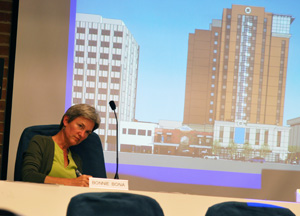
Bonnie Bona, chair of Ann Arbor's city planning commission, listens to a presentation about Zaragon Place 2. A rendering of the proposed project is on the screen in the background, viewed from the William Street perspective. (Photos by the writer.)

The project – to be located at the southeast corner of William and Thompson, next to Cottage Inn restaurant – drew support from two representatives of neighboring businesses, who said they were eager for new residents to arrive as potential customers. The site has been vacant and considered blighted for more than a decade.

Unlike recent proposals for two other residential developments – Heritage Row and The Moravian – Zaragon Place 2 does not require special zoning and has not faced opposition from neighborhood groups.

Some of the discussion by commissioners centered on the 40 parking spaces to be provided within the structure, as well as 40 spaces for bikes in a secured storage room. The ground level will include retail space fronting William. Also as part of the project, the city’s parks unit is asking the developer for $48,000 to help pay for new parks in the area, or to enhance existing parks.

In other business, the commission approved a special exemption use for Big Shot Fireworks to set up a tent in front of the Quarter Bistro, in the Westgate Shopping Center. Commissioners were schooled in fireworks-related legislation – anything that spins, explodes or leaves the ground can’t be sold in Michigan to the general public.

And a rezoning of a previously unzoned parcel on Jackson Avenue – site of the former Barnard Plating factory, next to Hillside Terrace Retirement Center – passed without discussion.

Finally, the commission discussed and passed a resolution that more formally outlines their plan to work with the city’s environmental and energy commissions toward the goal of building a sustainable Ann Arbor. It’s the outgrowth of a joint meeting the three commissions held in April, and was characterized by planning commission chair Bonnie Bona as the beginning of a community conversation about sustainability. [Full Story]

Better Deal Desired for Fuller Road Station

Two city commissions on Tuesday addressed two very different actions related to Fuller Road Station, a joint city of Ann Arbor/University of Michigan project that initially will entail a large parking structure and bus station, with possibly a train station for commuter rail years down the road.

Gwen Nystuen, David Barrett, Doug Chapman

Park advisory commissioners Gwen Nystuen, David Barrett and Doug Chapman at Tuesday's meeting of PAC's land acquisition committee, held at Cobblestone Farm. Nystuen has been pushing for more input into the Fuller Road Station project. (Photos by the writer.)

Spurred by concerns that Ann Arbor parks are being shortchanged, members of the city’s park advisory commission (PAC) discussed a resolution on Tuesday that would urge city council not to proceed with plans for Fuller Road Station at its proposed site on city-owned land that’s designated as parkland.

The draft resolution also states that if the city council does continue with the project, the city should renegotiate the deal to get additional revenues from the University of Michigan, with those funds being allocated to city parks. The resolution calls for an annual payment of $127,500 from the university – under the current agreement, UM would pay $19,379 per year, starting in 2012.

Park commissioners didn’t take any action, and plan to discuss the draft resolution further at their May 18 meeting.

But Tuesday evening, the city’s planning commission did take action related to Fuller Road Station. They voted unanimously to amend the list of permitted principal uses of public land – specifically, changing a “municipal airports” use to “transportation facilities.” During a public hearing on the issue, several speakers – including park commissioner Gwen Nystuen – objected to the change.

It’s expected that the project – located on the south side of Fuller Road, just east of East Medical Center Drive – will be submitted by the design team on May 17 for review by planning staff. It will likely come before the planning commission at its first meeting in July. A public meeting on the project is set for Thursday, May 6 at 7 p.m. in the second-floor city council chambers, 100 N. Fifth Ave. [Full Story]

Heritage Row Moves to City Council

Ann Arbor Planning Commission meeting (March 16, 2010): A proposed residential project that’s been in the works for more than two years got approval on Tuesday night from a majority of planning commissioners, by a 6-2 vote.

Alex de Parry

Alex de Parry checks messages on his cell phone before the start of the Ann Arbor planning commission meeting on Tuesday. (Photos by the writer.)

Alex de Parry, the developer of Heritage Row – a project on the east side of Fifth Avenue, south of William – will now seek approval from city council, though he still faces opposition from neighbors and others in the community.

Also at Tuesday’s meeting, the commission continued a broad effort to rezone parcels of city-owned parkland as “public land” – including one known as the “squarest “park in Ann Arbor. Commissioners also addressed concerns raised by residents living near two of the properties being rezoned: Arbor Hills Nature Area and Kilburn Park. Action on those two parcels was postponed.

Also postponed was a proposed site plan for expansion at Glacier Hills retirement community, which plans to construct a new skilled nursing care building within its complex on the city’s east side. Planning staff had some unresolved issue with the proposal, including the need to increase the amount of required bicycle parking. It was noted that residents there might not have a high demand for bike spaces. [Full Story]

Ann Arbor DDA Barely Passes Budget

Ann Arbor Downtown Development Authority board meeting (March 3, 2010): The DDA board approved its $25 million budget for 2010-11 on Wednesday, but just barely. Four dissenting voices, plus mayor John Hieftje’s absence from the meeting, meant that the budget received the bare minimum seven votes required for approval by the 12-member body.

Keith Orr Map Man

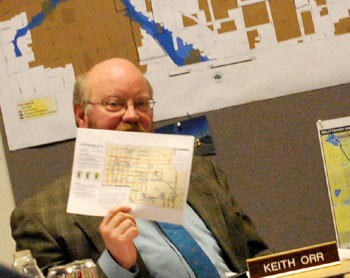
The DDA board talked about more than just the budget. Who was that map man? As the nameplate says, it's DDA board member Keith Orr, who was introducing a draft of a bicycle map that the DDA is working on. (Photos by the writer).

Deliberations covered a range of issues. First, the budget needs to accommodate two major DDA capital projects: the underground parking garage currently under construction; and the Fifth Avenue and Division Street improvements, which are also underway.

Second, there’s a contingency written into the budget for $2 million. The contingency is there in case renegotiation of the parking agreement between the city and the DDA results in a continuation of the $2 million payments made by the DDA to the city for each of the last five years. Continuation of the payments is not legally required under terms of the current agreement, which assigns responsibility for administration of the city’s parking system to the DDA through 2015.

Third, the fund balances of the DDA – which reflect the DDA’s reserves – face a dramatic reduction. That’s an issue that city of Ann Arbor CFO Tom Crawford flagged back in the spring of 2009 during discussions about the construction of the underground parking garage. The concern caused the city council to scale back the size of the garage by 100 parking spaces.

And finally, decisions made by the DDA board over the last year have resulted in re-direction of revenues from two surface parking lots – 415 W. Washington and the old YMCA lot at Fifth and William – to the city of Ann Arbor. That has resulted in the elimination of line items for DDA programs for next year that were in this year’s budget.

Besides the budget, the board also discussed a number of other topics, including development of the Library Lot and results from two parking surveys. [Full Story]

Heritage Row Gets Postponed

Ann Arbor Planning Commission meeting (Feb. 18, 2010): After a public hearing on the latest iteration of a controversial South Fifth Avenue housing project, planning commissioners voted to postpone action on a project now called Heritage Row.

A public hearing notice duct-taped to a tree

A public hearing notice duct-taped to a tree on Fifth Avenue, announcing the Feb. 18 public hearing of the proposed Heritage Row development. (Photos by the writer.)

Developer Alex de Parry is asking to rezone the seven-parcel site, with plans to restore the historic houses there and build three 3.5-story buildings behind them. Commissioners generally were favorable toward the project, citing benefits of restoring the older homes, among other things. A fair amount of  their discussion involved what color of brick to use on those new buildings.

The public hearing drew several neighbors who raised concerns they’d voiced over de Parry’s previous project in the same location, called City Place. Several mentioned the new buildings as being too large for the neighborhood. Another concern: An historic district study committee hasn’t finished its report, which could affect the project.

But before they considered Heritage Row, commissioners discussed proposed changes to Plymouth Green Crossings, a mixed use complex off of Plymouth, west of Green Road. The developers, represented by David Kwan, are asking to alter their original agreement with the city.

Economic conditions, including the departure of Pfizer, have slowed plans to complete the project, which was to include a total of three buildings and a standalone restaurant. Two buildings have been constructed – tenants include Sweetwaters and Olga’s – but a perceived lack of parking has stymied attempts to fill the retail space, Kwan said. He and his partners hope to put in a temporary parking lot on the land that originally was slated for the restaurant.

One commissioner wasn’t too excited by Kwan’s idea. Concerns were also raised about payments to the city’s affordable housing fund, which are being spread out over several years. [Full Story]

Downtown Design Guides: Must vs. Should

man sits at table with palms in up-turned gesture

Eric Mahler, city of Ann Arbor planning commissioner, questioned whether the downtown design guidelines, as currently drafted, would pass legal muster, if they were implemented in a mandatory-compliance system. (Photo by the writer.)

Almost every child learns in school that a haiku is a short poem with three lines – lines that adhere to a 5-7-5 syllable count pattern.
But only some children learn that not all poems conforming to that 5-7-5 rule are good haikus. For example:

I saw a tower/Looming, stretching really tall/
Is it ever high!

Many readers will recognize those lines as a generally failed poem. But what specifically makes it a bad haiku, even though it follows the rule? The first-person narrative, the lack of seasonal referent, the lack of any kind of “aha!” moment – there are any number of ways in which that poetic effort fails to meet basic haiku design guidelines.

Similarly, a proposed new downtown Ann Arbor building that follows a basic height rule of “180 feet maximum” – specified in the zoning regulations – might still be generally recognizable as a poorly-designed building.  [Full Story]

Demolition Moratorium for Two-Block Area

Ann Arbor City Council meeting (Aug. 6, 2009): Two kinds of moratoria were on council’s agenda for Thursday’s meeting – which had been rescheduled to accommodate the Aug. 4 Democratic primary elections in Wards 3 and 5. The first was a moratorium on new development in districts zoned with the classification of R4C (multi-family residential) or R2A (two-family residential). The second was a moratorium on demolition, attached to the creation of a study committee for a possible historic district in a two-block area just south of William Street on Fourth and Fifth avenues.

Council voted down the more general prohibition on new development in R4C/R2A residential districts, but approved the historic district study committee with its attached moratorium on demolition. It’s a case where the vote tally alone doesn’t tell the whole story – or even an accurate one: Counter to what one might expect, Mike Anglin (Ward 5) voted against the R4C/R2A moratorium, while Leigh Greden (Ward 3) voted for it.

A third major agenda item facing council was also related to new development: the Near North planned unit development (PUD) proposed for North Main Street just south of Summit Street, which is an affordable housing project that includes the nonprofit Avalon Housing as a partner. The council voted to move Near North on to a second reading, when a final decision will be made.

But probably the most important matter considered by council on Thursday appeared on the agenda as an “introduction” by the city’s chief financial officer, Tom Crawford, who spent around a half hour telling the city council why the city’s projected financial condition is worse now than it had been when the FY 2010 budget was adopted in the spring. Crawford’s presentation was characterized during commentary from the public later in the meeting as the “first salvo in a PR campaign” for a city income tax.

A bit of breaking news from Crawford’s report: bonds for the Fifth Avenue underground parking garage were issued on Aug. 5. [Full Story]

Zoning 101: Area, Height, Placement

contrast between pedestrian-oriented development and sprawl Ann Arbor public meeting

City planner Jeff Kahan shows a slide demonstrating the contrast between sprawl and pedestrian-oriented development – the top and bottom images are of the same corridor. (Photo by the writer.)

At Cobblestone Farm on Thursday evening, planning staff from the city of Ann Arbor presented proposed changes in the area, height, and placement specifications for various zoning districts throughout Ann Arbor.

The proposal is not a “rezoning” of all the area outside of Ann Arbor’s downtown – it’s a proposal to adjust the density, height, and setback requirements of existing zoning districts. There are no parcels designated for rezoning as a part of the AHP project. The project is thus different in character from the A2D2 project, which will result in a rezoning of the downtown.

The AHP proposal was actually intended to come before city council for approval in the fall of 2008, but on direction from the council, city planning staff were asked to get more community input.

About two dozen people attended Thursday’s meeting, the fifth in a series of at least seven public meetings to be held over the summer months – one meeting for each of five wards, bookended by community-wide meetings. Though divided by ward, anyone from any ward can attend any of the meetings, including the Ward 5 meeting to be held from 6:30-8 p.m. on July 30 at Forsythe Middle School Media Center.

So what is the AHP proposal? It’s not simply meant to clean up ordinance language in a way that has no material impact on future development. The proposal is meant to have an impact on how land gets used throughout Ann Arbor. What specifically is being proposed? What’s the zoning for where you live and work? What is zoning, anyhow? More after the break. [Full Story]

What’s Your Downtown Plan?

At its work session Tuesday night, the city of Ann Arbor’s planning commission got a preview of a new floodplain zoning ordinance that Jerry Hancock has been working on with other staff. Hancock is the stormwater and floodplain programs coordinator for the city.

For over an hour, planning commissioners discussed the floodplain ordinance with Hancock before tackling the issue that could result in a near-term flood of communication between city council and planning commission: revisions to the downtown plan. At planning commission’s next meeting on May 19, 2009, commissioners will likely focus on possible revisions to that planning document.

At that May 19 meeting, planning commission will weigh the downtown plan it adopted on Feb. 19, 2009 against the changes that city council made to the commission’s recommended zoning package at council’s April 6, 2009 meeting. And based on the discussion at the commission’s Tuesday work session, it’s not a forgone conclusion that planning commission will revise the downtown plan to accommodate the council’s ordinance changes.

So what’s  the big deal, if the downtown plan doesn’t match up with the zoning ordinances? And why doesn’t the city council just amend the downtown plan the same way it amended the proposed zoning ordinances and just “overrule” the planning commission?  Otherwise put, why is that planning commission meeting on May 19 going to be worth watching on CTN’s Channel 16 starting at 7 p.m.? [Full Story]

Council’s A2D2 Discussion Tips Off

Ann Arbor City Council Sunday caucus (April 5, 2009): Like the Michigan State Spartans basketball team practicing  a fast break, Ann Arbor city councilmembers quickly handled their caucus discussion of possible amendments to the planning commission’s A2D2 zoning recommendations, which could be brought forward at their Monday night meeting.

Sabra Briere (Ward 1) called for the ball to address a repaving contract on the agenda, as well as to float the idea of a parliamentary alternative to formal discussions –  ideas that are still rattling around the rim.

Mike Anglin (Ward 5) arrived just as the 20-minute session concluded; he was not asked to run punishment laps around council chambers. An informal shoot-around, in the form of conversational pods among some councilmembers and members of the public, persisted until nearly 8 p.m.

Council’s Monday meeting starts at 7 p.m. on CTN’s Channel 16, which allows at least 2 hours and 21 minutes of council viewing before the NCAA finals begin.

After the break, we provide viewers with a playbook of sorts to follow the action in council chambers. It’s a set of 12 possible amendments to the zoning recommendations passed by planning commission that have been compiled by city staff. [Full Story]

A2D2 Zoning in the Home Stretch

Huron Street Sketch looking east.

Sketch looking east of a possible result of the A2D2 zoning as it currently stands. Division Street, running north-south, is in the foreground. Ann Street (on the left) runs east-west, as does Huron Street (right). The currently proposed D1 zoning along Huron Street is to be mitigated by requirements that push buildings towards the street.

City council convened Monday night to hear public commentary on the downtown plan and A2D2 zoning revisions for the downtown area, which were approved by planning commission earlier this month, and which council had already begun contemplating at a working session two weeks ago. Nothing else was on the agenda.

About 30 residents took their 3-minute speaking turns on Monday, which did not preclude their participation at the public hearings when the amendments to the zoning ordinance are heard formally. The zoning ordinance’s first reading is planned for April 6 with a second reading on May 4. The  downtown plan will be heard April 20.

By 8:30 p.m. the Monday meeting had concluded, with many of the speakers and councilmembers mingling afterwards. [Full Story]

Council Begins Downtown Zoning Review

Maximum Diagonal

Illustration of the concept of a maximal diagonal. A maximum on this dimension is intended as a check on chunky buildings.

At Monday night’s city council work session councilmember Leigh Greden said that he wanted to see growth. Growth is what he could see (even if not the kind he was looking for) by turning his gaze to his immediate left at the council table to look at his colleague, Christopher Taylor’s upper lip, which is sprouting a mustache for charity. That kind of growth is no longer visible on city administrator Roger Fraser’s chin. Before the work session began, Fraser joked with the Ward 3 council contingent that he’d shorn his whiskers in order to appear as youthful as Greden.

So what kind of growth was Greden talking about?  [Full Story]

Planning Commission: 170 Feet for South U.

Ethel Potts raises her hand in opposition to the final vote to recommend to city council the on the A2D2 zoning

Ethel Potts raises her hand in opposition on the final vote to recommend the A2D2 zoning to city council .

Just before 11 p.m. on Tuesday evening, Ann Arbor’s planning commission, on an 8-1 vote, passed a recommendation on to city council to enact a series of zoning changes as a part of the A2D2 package. The set of proposed new zoning regulations had undergone some revision in response to additional community feedback on the first version that had been recommended by the commission. That feedback had been collected through the fall of 2008 in a series of public workshops.

Our goal in this article is not to lay out the complete set of revisions to the zoning recommendations. So the discussion of why there will be no adult entertainment district in downtown Ann Arbor will be put off until another day. Instead, we write for an audience of one – a South University area resident who we imagine will read the headline of this article with a disbelieving sense of déjà vu. She’s a resident who attended city council’s most recent Sunday night caucus, and who also attended planning commission’s meeting last night, leaving “early” when she likely believed a vote of particular interest to her was done. [Full Story]

Near North Nears Next Review

Near North Avalon Housing affordable housing Ann Arbor

Damian Farrell, architect for Near North. Farrell rotated and panned across the proposed building from various angles to show neighbors the current state of the design.

The gathering on Wednesday evening at the Ann Arbor Community Center to discuss a proposed affordable housing development had been publicized as a 2-hour long “community design charrette.” But the 35 or more immediate neighbors and other interested parties who attended the meeting filled a bit more than the first hour asking questions that addressed the topic of the developer’s motives, the projects’ consistency with the mission of the non-profit partner on the proposal (Avalon Housing) and the conformance of the project to the city’s various planning documents.

Architect Damian Farrell was eventually given the chance to project live images from his design software onto the wall, and manipulate them to illustrate changes that had been made as a result of the previous two charrettes. But the ensuing conversation on design elements was also interspersed with concerns about topics from the first hour.

Two and a half hours into the meeting, a man stood and said: “I am homeless.” He’d heard people pick at the project, he said, but he hadn’t heard anyone ask this question about it: “What can we do to help?” It was more than three and a half hours after the meeting started when the last of the post-charrette conversational pods headed out the door.

By Jan. 21, the project team hopes to be able to submit responses to any of the city planning staff’s concerns expressed after the project’s initial review, which began after the project was submitted in December. Near North could come before the city’s planning commission as early as Feb. 19. [Full Story]

Council Focuses on Development Issues

Ann Arbor City Council Sunday caucus (Jan. 4, 2009): Sunday night’s regular caucus focused on development issues: (i) a proposed PUD, City Place, to be built along Fifth Avenue, and (ii) redevelopment proposals for the city-owned property at 415 W. Washington. The caucus was bookended by remarks from representatives from two of the design teams for the 415 W. Washington, Peter Allen and Peter Pollack. [Full Story]

Feedback Wanted: Downtown Zoning Revisions

City of Ann Arbor systems planner Wendy Rampson responds to a question from Ed Walsh, a citizen who attended Monday's A2D2 briefing in city council chambers.

At a work session sometime in January 2009, city council is expected to discuss proposed zoning changes to downtown Ann Arbor, which have emerged from a process involving consultants, staff, and the public over more than two years. But before that, the A2D2 steering committee, which consists of Roger Hewitt (DDA), Marcia Higgins (city council) and Evan Pratt (planning commission), will meet in the Larcom Building’s sixth-floor conference room on Wednesday, Dec. 3 at 6 p.m. to review comments and feedback accumulated to date. (That is a public meeting, but there is no public participation component.) [Full Story]