Govt. Section

Park Updates: Roof, Rain Garden, Parking Lot

Ann Arbor park advisory commission meeting (May 21, 2013): The meeting featured a briefing on a project to install rain gardens at Arbor Oaks Park, part of a broader effort to address drainage and flooding problems in the Bryant neighborhood in southeast Ann Arbor.

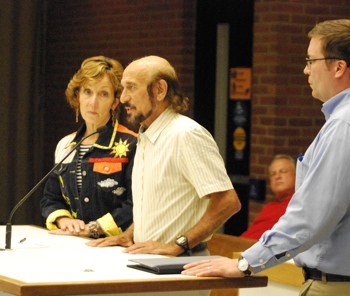
Bob Galardi, Ann Arbor park advisory commission, The Ann Arbor Chronicle

Bob Galardi was elected chair of the budget & finance committee for the Ann Arbor park advisory commission at PAC’s May 21, 2013 meeting. (Photos by the writer.)

Jerry Hancock, the city’s stormwater and floodplain programs coordinator, described the project, which is being paid for out of the city’s stormwater utility fund – not the parks and recreation budget. It will involve regrading the perimeter of the park in the fall, then putting in native plants next spring. Soil excavated to create the rain gardens will be used to elevate the park’s central lawn area, which often has standing water following heavy rains. The work will be done prior to improvements planned for the park’s playground next year.

Later in the meeting, commissioners voted to recommend awarding a contract for roof replacement at the Mack indoor pool, located within the Ann Arbor Open school near the corner of Miller and Brooks. The recommendation is to select Pranam GlobalTech Inc., which put in the low bid of $193,000. A 10% construction contingency brings the project’s budget to $212,300, with a portion of that amount to be paid for by the public schools.

Also recommended was using $8,280 from the public market fund to upgrade a surface parking lot – known as the “sand lot” – on the Fourth Avenue side of the farmers market. The paving is viewed as a short-term solution, pending longer-term improvements expected at the market in a few years.

Commissioners also elected Bob Galardi as chair of PAC’s budget & finance committee. He replaces Tim Doyle as committee chair, following the end of Doyle’s term on PAC earlier this month. Jen Geer – Doyle’s replacement on PAC – was confirmed by the city council the previous evening but did not attend PAC’s May 21 meeting. Geer has worked with Galardi and councilmember Christopher Taylor – an ex-officio member of PAC – in another capacity, in the performing arts. Most recently, she was executive producer for the Ann Arbor in Concert production of Ragtime, performed at Michigan Theater on May 18. Both Taylor and Galardi were lead performers in that show.

Updates during PAC’s May 21 meeting covered a range of topics, including news that bids for construction of the new skatepark came in a little higher than anticipated. Parks staff and skatepark designer Wally Hollyday will be reviewing the bids to see what options are available. Parks and recreation manager Colin Smith reported that at PAC’s June 18 meeting, commissioners will be presented with a resolution to award a construction contract, as well as an agreement between the city and the Friends of the Ann Arbor Skatepark related to operating the skatepark.

Other updates from Smith included the fact that parks staff is gearing up for Memorial Day weekend, with the opening of the city’s outdoor pools. He also highlighted the completed renovations of ball fields at Veterans Memorial Park, West Park and Southeast Area Park, and improvements made at Liberty Plaza. In addition to removing some bushes there, he said, “we also removed all sorts of things that were in the bushes, which are no longer there – and I’m glad they’re not.”

Other brief reports were given regarding work of PAC’s dog park and downtown park subcommittees, and public forums for the North Main-Huron River task force. Public commentary focused on input from the Library Green Conservancy, which is advocating for a park or public space atop the city’s Library Lane parking structure. [Full Story]

County Budget, Bonding Decisions Loom

Washtenaw County board of commissioners meeting (May 15, 2013): A presentation that county commissioners called “daunting” and “sobering” was among several budget-related items on the May 15 agenda.

Young Women Making Washtenaw Better, Washtenaw County sheriff, Washtenaw County board of commissioners, The Ann Arbor Chronicle

From left: Princess Logan and Monique Franklin, students at Ypsilanti High School, are part of the Young Women Making Washtenaw Better program. Seated behind them is Natalia Harris,community outreach coordinator for the Washtenaw County sheriff’s office, which sponsors YWMWB. (Photos by the writer.)

In her state-of-the-county address, county administrator Verna McDaniel set a goal of identifying $6.99 million in structural reductions for the 2014 budget. The approach to addressing this $6.99 million target depends on whether the county moves ahead with a major bond proposal, which would cover the county’s pension and retiree healthcare obligations. [See Chronicle coverage: "County Board Debates $345M Bond Proposal."]

If the board decides not to bond for those obligations, McDaniel said that most of the $6.99 million would need to come from a reduction in operating costs, as well as $100,000 in cuts to outside agency funding. Finding the $6.99 million in cuts would be very challenging, she added, given the amount of reductions that have already occurred in the past few years. Serviceability levels and major programs would be affected.

Action related to the bonding proposal – for up to $345 million, the largest ever issued by the county – was originally on the May 15 agenda. But early in the meeting, board chair Yousef Rabhi announced a decision to push back the process until the board’s July 10 meeting. He cited the need for more time for public input and additional information – including updated actuarial reports that are due in late June. Public hearings on the proposal are set for June 5 and July 10, with a board working session on the issue scheduled for June 6.

The board also voted to hold a special meeting on July 24, to allow for additional bond-related votes and public commentary, if needed. Rabhi also announced a series of informal meetings at coffee shops in Ann Arbor to discuss the bond proposal with residents. The first “Bonding Over Coffee” will be held on Tuesday, May 28 from 4-6 p.m. in the basement of Elixir Vitae (formerly Café Ambrosia) at 326 Maynard St. in Ann Arbor.

Among the several items that the board is expected to vote on at its July 10 meeting is a “notice of intent” to issue the bonds. This is a standard initial step in the bonding process, letting residents know that they have 45 days during which they can circulate petitions to require a vote of the people before any bonds are issued. Ronnie Peterson reminded commissioners that just a few years ago, a citizens group had gathered enough signatures to force another bond proposal – for expansion of the county jail – onto the ballot, where it was defeated by voters. For the current bond proposal, about 15,000 signatures would be required to force a voter referendum.

In another budget-related item on the May 15 agenda, the board received a first-quarter 2013 briefing. The county’s financial staff is now projecting a $818,999 shortfall for the year – the difference between $102,364,815 in projected general fund revenues and $103,183,814 in projected expenditures. That shortfall is lower than the $3.03 million shortfall that was originally projected for 2013.

The board continued its budget discussion at a retreat on May 16, where they worked to hone priorities for the next four years. This Chronicle report includes a summary of that two-hour session.

In other May 15 action, the board gave initial approval to set the 2013 county general operating millage rate at 4.5493 mills – unchanged from the current rate. Several other county millages are levied separately: emergency communications (0.2000 mills), the Huron Clinton Metroparks Authority (0.2146 mills), two for county parks and recreation (0.2353 mills and 0.2367 mills) and for the natural areas preservation program (0.2409 mills). That brings the total county millage rate to 5.6768 mills, a rate that’s also unchanged from 2012. A final vote and public hearing is expected on June 5.

The board also passed a resolution expressing support for the state of Michigan to expand the federal Medicaid program, as part of the Affordable Care Act – a measure currently being debated in the state legislature. During deliberations, Dan Smith (R-District 2) voiced his objection to the county weighing in on state issues, but he left the room prior to the vote.

A range of other issues were raised as items of communication by commissioners or during public commentary. Topics included: (1) a corridor improvement authority planned by Pittsfield Township for a section of State Street; and (2) the possibility of renewing the county’s membership in the Michigan Association of Counties. [Full Story]

May 20, 2013 Ann Arbor Council: In Progress

The main event of the May 20, 2013 Ann Arbor city council meeting will be the council’s approval of the FY 2014 budget. The city’s fiscal year starts July 1. Under terms of the city charter, the council is required to amend and approve the city administrator’s proposed budget by its second meeting in May – which this year falls on May 20. The Chronicle will be filing live updates from city council chambers during the meeting, published “below the fold.”

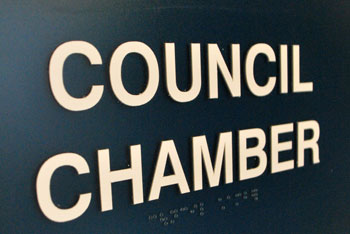
Door to Ann Arbor city council chambers

Door to the Ann Arbor city council chamber.

If the council fails to act, then the city administrator’s budget, which Steve Powers presented formally to the council on April 15, 2013, would automatically be adopted. It’s been described as essentially a “status quo” budget, with no major changes to personnel levels or basic approaches to service delivery. The council has held work sessions on various aspects of the budget starting in February.

For the general fund, the status quo budget translates to $82,893,312 in total expenditures, which will require tapping the general fund balance for $260,514. That would leave the general fund with $13.8 million in reserves or 17% of operating expenses.

But it’s possible that the council will undertake amendments to that budget. Among the amendments that might be proposed are some that would change the budget of the Ann Arbor Downtown Development Authority. Other amendments that might be put forward provide funding for an increase in the number of police officers. One strategy for increasing funding for police officers is to take money out of the 15th District Court budget. Another strategy that could be brought forward for funding police officers is to re-allocate the salary for retiring assistant city attorney Bob West.

Affordable housing and human services funding will likely be the topic of some amendments. It’s possible to change the budget later in the year, after the May 20 meeting, but that would require an eight-vote majority. Amendments to the main budget resolution of the year – this year on the May 20 agenda – require only a six-vote majority. [Full Story]

Green Light for 413 E. Huron

Ann Arbor city council meeting (May 6, 2013 – May 13 session): In the session’s main business, the council voted 6-5 to approve a controversial 14-story residential project at 413 E. Huron. The vote came at around 9 p.m., about two hours into the session.

View looking north east at Division and Huron. A chain link fence around the construction site has been in stalled in anticipation of construction of the 413 E. Huron project.

View looking northeast at Division and Huron. A chain link fence around the construction site has been installed in anticipation of construction for the 413 E. Huron project. (Photos by the writer.)

While there’d been some speculation earlier in the day that Christopher Taylor (Ward 3) would not be able to attend the May 13 session – which was a continuation of the meeting that began on May 6 – he was present for the meeting. And his support of the project was crucial in providing the six-vote majority it needed. Taylor was joined in the vote by mayor John Hieftje, Marcia Higgins (Ward 4), Margie Teall (Ward 4), Chuck Warpehoski (Ward 5) and Sally Petersen (Ward 2).

A decision on the site plan for the project, which will offer more than 200 apartments with more than 500 bedrooms, had been previously postponed on April 15, 2013, April 1, 2013 and March 18, 2013. The council recessed its May 6 meeting at around 11:30 p.m. just as it reached the 413 E. Huron site plan. So when the meeting resumed on May 13, the site plan was first on the council’s agenda.

Councilmembers who voted against site plan approval for 413 E. Huron gave pointedly specific reasons for voting no – citing traffic safety issues or failure to comply with aspects of the East Huron character district, or other aspects of the city code. It was a clear contrast to the approach a previous council had taken nearly 40 years ago in 1975, when then-councilmember Bob Faber explained his vote to deny approval of a site plan this way: “Finally, I will vote against this and I will move that the attorney and the planning director tell us why we voted no because obviously we don’t know yet and see what he can do with that in the court …” That decision had led to a losing lawsuit.

It was fear of losing a lawsuit that councilmembers cited in voting to approve the 413 E. Huron project.

After voting on the 413 E. Huron project, the council finished off the substantial number of remaining items on its agenda.

The council gave initial approval to changes to the city’s public art ordinance. The proposal includes removing the requirement that 1% of all capital project budgets be set aside for public art. Drawing some discussion from councilmembers was an additional change to which they gave preliminary approval. The additional change allows the council the flexibility to return money to its fund of origin, which might be set aside for public art in the FY 2014 budget. The council takes up the ordinance changes for final approval on June 3.

Another ordinance change to which the council gave initial approval is a change to utility improvement charges for undeveloped property. That will also appear on the council’s June 3 agenda for final approval.

In addition to initial approval of changes to those two ordinances, the council gave initial approval to rezoning of two different parcels – a property at 490 Huron Parkway and on South State Street. The property on Huron Parkway is proposed to be rezoned from R3 (townhouse district) to R1B (single-family dwelling) and would allow the currently vacant 1.22-acre site, located north of Ruthven Park, to be divided into three separate lots.

The State Street Center project is located adjacent to a new Tim Hortons restaurant, which opened last year near the intersection of State and Ellsworth. The rezoning request is from O (office) to C3 (fringe commercial). It would make the actual zoning consistent with the city’s official zoning map, which had been mislabeled. The site plan calls for demolishing a vacant 840-square-foot house and building a one-story, 1,700-square-foot building with a drive-thru Jimmy John’s restaurant facing South State Street.

An expansion to the Theta Delta Chi house on State Street near the University of Michigan campus was given quick approval after first appearing on the April 15 agenda and getting bumped to the May 6 agenda, when the council postponed all remaining items due to the late hour. The council didn’t reach the Theta Delta Chi item until the May 13 session.

And the council gave approval to two items affecting the Ann Arbor fire department – one to accept a federal grant that will pay for exhaust fume removal systems at fire stations, and another to appropriate funds to replace protective gear worn by firefighters.

The University of Michigan appeared in connection with two different agenda items. One resolution authorized a contract for the city worth more than $600,000 in connection with a vehicle-to-vehicle study – for which the UM Transportation Research Institute (UMTRI) won a $14 million federal grant. That won quick approval from the council.

The other item related to UM involved a right-of-way agreement for placing electrical conduit under Tappan Street – so that an emergency generator can serve a law school dorm. The resolution reflected a disagreement between the city and the university about whether the agreement was a transfer of land interest. The university insisted the council treat it as such a transfer, with an eight-vote majority requirement. The resolution received only seven votes, and thus failed.

Councilmembers passed two resolutions necessary to impose a special assessment on property owners along Miller Avenue, to help pay for construction of new sidewalks. And the council authorized a contract with Coca-Cola as the vendor for Ann Arbor’s city parks – but not without concern expressed by some councilmembers about the company’s human rights record and the nutritive value of soft drinks.

Receiving more discussion than they typically do were confirmations of mayoral appointments, in particular that of Eric Mahler to the board of the Ann Arbor Transportation Authority. Four councilmembers voted against Mahler, though that was still not enough to derail his appointment. Dissenters argued in part that it’s important to expand the total pool of people who are appointed to boards and commissions. Mahler has served two terms on the city planning commission. Dissenters also cited an alternate candidate, unnamed at the meeting, who was thought to be preferable to Mahler – because she would be able to represent the disability community better. The alternate candidate was LuAnne Bullington. [Full Story]

Ypsilanti a Topic for AATA Planning Retreat

Ann Arbor Transportation Authority board meeting (May 16, 2013): Possible membership for the city of Ypsilanti in the AATA was a main theme of the board’s monthly meeting.

Ypsilanti mayor Paul Schreiber addressed the board at its May 16 meeting.

Ypsilanti mayor Paul Schreiber addressed the AATA board at its May 16 meeting. (Photos by the writer.)

Ypsilanti mayor Paul Schreiber attended the meeting in support of the city’s request for membership, and the board unanimously passed a resolution acknowledging the request. The resolution also directed staff to prepare for a detailed discussion on the issue at the board’s planning retreat, scheduled for May 22. Board members were positively inclined toward the request, but wanted to be sure that due diligence is done to ensure all the implications are understood.

Because the addition of the city of Ypsilanti would require revision to the AATA’s articles of incorporation, there’s some interest by some board members in approaching the changes in a way that could accommodate the addition of more members than just the city of Ypsilanti. It’s possible that Ypsilanti Township, Pittsfield Township or other jurisdictions might request membership in the near future. A more comprehensive approach to revising the articles, or delaying until all jurisdictions are admitted to the AATA at one time, could eliminate the need to revise the articles multiple times in quick succession.

The possible membership of Ypsilanti in the AATA is part of an effort to continue working with “urban core” communities in the immediate Ann Arbor area – after a more ambitious effort to extend AATA governance and services countywide in the summer of 2012 failed to gain traction.

A revision to the articles of incorporation would likely include a change in the AATA board membership structure. Ann Arbor mayor John Hieftje had indicated he’d support adding two seats to the current seven-member board, with one of the two additional seats to be appointed by the city of Ypsilanti.

Related to board membership, the May 16 meeting included a resolution of appreciation for the service of Jesse Bernstein on the board. He concluded a five-year term of service in April. Susan Baskett, currently an AAPS trustee, has been nominated as his replacement on the board. If she’s confirmed at the Ann Arbor city council’s May 20 meeting, she’ll join Eric Mahler as another new appointment. Mahler’s appointment to replace David Nacht was subjected to political wrangling at the council’s May 13 session, but he was confirmed on a 7-4 vote. [Full Story]

County Gives More Support to Rutherford Pool

Washtenaw County parks and recreation commission (May 14, 2013): At their most recent meeting, county parks & rec commissioners voted to grant $150,000 to the city of Ypsilanti to help complete the Rutherford Pool project. The Friends of Rutherford Pool is trying to raise about $1 million to rebuild the community pool, located on the eastern end of Recreation Park at 975 North Congress Street.

Recreation Park, Ypsilanti, Rutherford Pool, Washtenaw County parks & recreation commission, The Ann Arbor Chronicle

The entrance to Recreation Park in Ypsilanti, where Rutherford Pool is located. (Photos by the writer.)

Commissioners also took steps that could lead to spending over $1.713 million on natural areas preservation. They voted to move forward with the acquisition of three deals for the county’s natural areas preservation program: 17 acres in Scio Township ($55,000); about 245 acres in Northfield Township (about $1.4 million); and 65 acres in Freedom Township ($420,000). The latter two purchases were approved contingent on completing due diligence assessments, followed by final approval from the commission.

In addition, WCPARC approved an initial step in replacing the HVAC system at the Meri Lou Murray Recreation Center on Washtenaw Avenue, and heard reports on upgrades at several other facilities. Those include the nearly-completed major improvements and expansion of water parks at Rolling Hills and Independence Lake parks. Both are set to open Memorial Day weekend, kicking off WCPARC’s summer season.

In other news related to Ypsilanti projects, WCPARC director Bob Tetens reported that the Ypsilanti city council had recently passed a resolution reaffirming support for the east county recreation center project, proposed in the Water Street site near the Huron River. Tetens also presented a report on WCPARC’s marketing and communications program, which staff have expanded into new venues – including AATA buses. The effort is partly in preparation for a millage renewal coming in 2014.

Commissioners also discussed the desire to add another off-leash dog park in addition to Swift Run, which the county runs in partnership with the city of Ann Arbor. Interest is especially keen in light of Ann Arbor’s difficulty in finding a new dog park location. Some commissioners want to include a water element where dogs could play. Jan Anschuetz put it this way: “We’ve done so much to provide water recreation for people – now let’s do it for the dogs.” [Full Story]

May 13, 2013 Ann Arbor Council: In Progress

The Ann Arbor city council’s May 13, 2013 session of its May 6 meeting will begin with consideration of the site plan for 413 E. Huron St. – a 14-story residential building proposed for the northeast corner of Division and Huron streets in downtown Ann Arbor. Live updates will be filed from the meeting, and published “below the fold.”

Door to Ann Arbor city council chambers

Door to the Ann Arbor city council chamber.

The May 13 session – scheduled to start at 7 p.m. – will begin immediately with the agenda item on the 413 E. Huron site plan, unless the agenda is re-opened and amended in some fashion. None of the routine elements associated with the start of meetings, like public commentary reserved time, will be included. Those items were already dispatched on May 6.

It was around 11:30 p.m. on May 6 when the council decided to recess the meeting, and to resume it on May 13. At that point the council had completed eight public hearings and voted on a number of other items, before reaching the 413 E. Huron site plan.

While the 413 E. Huron site plan will be the first item that the council confronts, several other significant items appear on the remainder of the council’s agenda.

The council is scheduled to hear a first reading of proposed changes to the city’s public art ordinance. The proposal includes removing the requirement that 1% of all capital project budgets be set aside for public art.

Another ordinance change to which the council will be asked to give initial approval is a change to utility connection charges for undeveloped property.

In addition to initial consideration of changes to those two ordinances, the council will be asked to give an initial approval to rezoning of two different parcels – a property at 490 Huron Parkway and on South State Street. The property on Huron Parkway is supposed to be rezoned from R3 (townhouse district) to R1B (single-family dwelling) and would allow the currently vacant 1.22-acre site, located north of Ruthven Park, to be divided into three separate lots.

The State Street Center project is located adjacent to a new Tim Hortons restaurant, which opened last year. The rezoning request is from O (office) to C3 (fringe commercial). It would make the actual zoning consistent with the city’s official zoning map, which had been mislabeled. The site plan calls for demolishing a vacant 840-square-foot house and building a one-story, 1,700-square-foot building with a drive-thru Jimmy John’s restaurant facing South State Street.

An expansion to the Theta Delta Chi house on State Street is also on the agenda for approval.

The Ann Arbor fire department shows up on two different items – one to accept a federal grant that will pay for exhaust fume removal systems for fire stations, and another to appropriate funds to replace protective gear worn by firefighters.

And the University of Michigan appears in two different agenda items. One item authorizes a contract for the city worth more than $600,000 in connection with the vehicle-to-vehicle study – for which the UM Transportation Research Institute (UMTRI) won a $14 million federal grant. The other item related to UM involves a right-of-way agreement for the placement of electrical conduit under Tappan Street, so that an emergency generator can serve a law school dorm.

Other agenda items include some resolutions necessary to impose a special assessment on property owners along Miller Avenue, to help pay for construction of new sidewalks. And the council will be asked to choose Coke over Pepsi as the vendor for Ann Arbor’s city parks. [Full Story]

County Board Wrangles Over Budget Process

Washtenaw County board of commissioners meeting (May 1, 2013): The location and accessibility of a planned May 16 budget retreat drew some heated rhetoric from commissioner Ronnie Peterson, who argued strongly for all budget-related meetings to be held in the main county boardroom and to be televised, as the board’s regular meetings are.

Dan Smith, Washtenaw County board of commissioners, The Ann Arbor Chronicle

Washtenaw County commissioner Dan Smith (R-District 2) talks with residents who attended the county board’s May 1 meeting to highlight the deteriorating condition of North Territorial Road, which runs through Smith’s district. (Photos by the writer.)

The May 16 retreat is set for the county’s Learning Resource Center at 4135 Washtenaw Ave. – near the county jail complex – starting at 6 p.m. The meeting is open to the public and will be videotaped.

Peterson also questioned the content of the retreat. “If it’s a hug fest,” he said, “I don’t have to be there.” Board chair Yousef Rabhi told commissioners that the goal will be to set priorities for the upcoming budget. “It’s going to be work,” Rabhi said. “There aren’t going to be any hugs, unless somebody wants to give me a hug.”

Also at the May 1 meeting, the board gave final approval to authorize the development of a four-year budget planning cycle, a change from the current two-year cycle that’s been in place since 1994. The vote was 7-2 vote, with dissent from Peterson and Rolland Sizemore Jr. Peterson argued that developing a budget is the main job for commissioners. “So we owe the taxpayers a rebate. I hope we cut our salaries in half … because there’s really a lot less work to do.” Though the planning cycle would be longer, the board is still required by state law to approve its budget annually – so that process wouldn’t change.

The board will get a better sense of the county’s financial status at its May 15 meeting, when county administrator Verna McDaniel will give a first-quarter update and a “state-of-the-county” presentation. One major factor is a pending decision for the board on whether to issue a $345 million bond to cover the county’s pension and retiree healthcare obligations. The board discussed that topic at a May 2 working session. [See Chronicle coverage: "County Board Debates $350M Bond Proposal."]

One item not on the May 1 agenda was raised during public commentary: The deteriorating condition of North Territorial Road, specifically a section running through Northfield and Salem townships. Residents have collected about 600 signatures on a petition urging the road commission to repair that stretch, and asked the county board to help address the problem “before somebody gets hurt or comes in here shouting or raving.”

County commissioner Dan Smith, who represents the district that includes Northfield and Salem townships, pointed out that there are possible funding mechanisms available to the county, including the possibility of levying a tax under Act 283 of 1909. A 1 mill levy in Washtenaw County would bring in about $13.8 million, based on 2012 property values, he said. He also noted that there’s a similar law on the books that appears to allow townships in Michigan to levy up to 3 mills for roads. That could bring in another $24.9 million throughout the county, he said. In total, about $38 million could be raised in Washtenaw County to fix the roads.

In other action during the May 1 meeting, commissioners gave initial approval to the Washtenaw Urban County‘s five-year strategic plan through 2018 and its 2013-14 annual plan.

The board also declared May 12-18, 2013 as Police and Correction Officers Week, and May 15 as Peace Officers Memorial Day. Dieter Heren, police services commander with the Washtenaw County sheriff’s office, was on hand to accept the resolution on behalf of sheriff Jerry Clayton and all law enforcement agencies in the county. He reminded the board that on May 15 at 10 a.m. there will be a memorial service in the Washtenaw 100 Park in Ypsilanti to “honor the law enforcement officers who have fallen here in Washtenaw County while serving the community,” he said. The park is located at the corner of Michigan Avenue and Ballard Street. [Full Story]

City Council Sets Up for 413 E. Huron

Ann Arbor city council meeting (May 6, 2013 – May 6 session): Although the council did not take final action on many agenda items, it did complete eight public hearings and postponed some significant questions – before deciding to recess the meeting for a week. When the same meeting resumes on May 13, the first item to be confronted by the council is the site plan approval for the 413 E. Huron apartment project.

Fourth Avenue between Huron and Washington streets.

Recess of the Ann Arbor city council’s May 6 meeting around 11:30 p.m.  – after eight public hearings and action on a few business items – paved the way for the council to resume the same meeting on May 13, with the 413 E. Huron project as the first item to be considered at that time. This photo shows Fourth Avenue between Huron and Washington streets, which will be repaired in the summer of 2013 as the result of a contract approved at the council’s May 6 session. (Photos by the writer.)

The council decided to suspend the proceedings around 11:30 p.m. – a different strategy than the one taken at the council’s April 15 meeting. On that occasion, councilmembers let the meeting continue until about 3 a.m. before deciding to end the session, postponing all remaining items until the next regular meeting on May 6.

At its May 6 meeting, the council voted unanimously to postpone until Sept. 3 one of the most controversial items on the agenda – revisions to the ordinance governing the Ann Arbor Downtown Development Authority. The most significant revision would clarify language from the original 1982 ordinance, which caps tax increment finance (TIF) revenue to the DDA. The clarifications would not allow for the kind of interpretation the DDA has given the ordinance for the last two years, which has resulted in no return of excess TIF to jurisdictions that have their taxes captured by the DDA.

Stephen Kunselman (Ward 3) led off communications time early in the meeting by describing some further changes he was prepared to make to the DDA ordinance – which would earmark money to support affordable housing. During the public hearing on the ordinance changes, the council heard from speakers on both sides, including five members of the DDA board. A highlight was the apparent initial indication of a slightly moderated position by some opponents of the ordinance changes. The council’s relatively brief deliberations on postponement revealed only grudging support from some councilmembers for putting off the vote for four months. Margie Teall (Ward 4) and Christopher Taylor (Ward 3) made clear they did not support the proposed changes to the ordinance.

The council also postponed action on a revision to the city’s sign ordinance, which would allow only certain types of digital signs. The ordinance amendments would cap the total number of billboards in the city at 28 and allow them to remain in place as non-conforming signs. It would not allow for retrofitting any existing billboards with digital technology. The council has already given the ordinance initial approval, and will take up the issue again on June 17.

Another item postponed by the council was consideration of a video privacy ordinance, which has not yet been given initial approval. That will come back to the council’s May 20 meeting.

Receiving approval from the council was the site plan for Summit Townhomes, located on Ellsworth Road. The project has been working through the city’s review and approval process for more than a year.

The downtown section of Fourth Avenue was somewhat of a geographic highlight for the May 6 meeting. The council approved a $741,900 contract with E.T. MacKenzie Co. to make improvements on Fourth Avenue between Huron and Liberty streets this summer. And the council formally withdrew its objection to renewal of the liquor license for The Arena, a bar located at Washington and Fourth. The Arena finally paid back taxes, which led to the council’s vote – but not without complaint from some councilmembers.

Another highlight of the meeting was the general topic of appointments to city boards and commissions. A brief discussion of how appointments work was prompted by the observation during public commentary that none of the appointments are current for members of the downtown citizens advisory council. The city council put off voting to confirm Stephanie Buttrey’s appointment to the greenbelt advisory commission. And not reached on the agenda were nominations to replace Jesse Bernstein on the board of the Ann Arbor Transportation Authority and Eric Mahler on the city planning commission – with Susan Baskett and Paras Parekh, respectively. [Full Story]

Library OKs Budget, Tax Rate Unchanged

Ann Arbor District Library board meeting (May 6, 2013): Reversing a slight tax increase that had been proposed in the draft budget, the AADL board approved a $12.3 million budget for fiscal 2013-14 with an unchanged tax rate of 1.55 mills. The library’s fiscal year begins July 1.

Ann Arbor District Library, The Ann Arbor Chronicle

One of two video cameras used to record the May 6, 2013 AADL board meeting. (Photos by the writer.)

Nancy Kaplan, chair of the board’s budget & finance committee, said the committee met after the April 15, 2013 board meeting and discussed concerns that had been raised about the proposal to levy a slightly higher millage rate of 1.575 mills. She noted that administration had proposed cuts to allow the rate to remain unchanged.

The main reduction in expenses came from the materials line item, with nearly $100,000 saved by switching from RFID to bar code technology for handling circulation. AADL director Josie Parker stressed that the library is able to secure those savings without impacting the purchase of materials for its collection.

In addition to the budget, the board also approved a one-year extension on the space-use agreement with the nonprofit Friends of the Ann Arbor District Library, which operates a used bookstore in the lower level of AADL’s downtown branch at 343 S. Fifth Ave. Proceeds of the store are given to the library.

The board was briefed on a proposal that they’ll be voting on next month to upgrade the fiber-optic infrastructure for the Pittsfield branch. Eli Neiburger, AADL’s associate director of IT and production, described that location at 2359 Oak Valley Drive as a “bandwidth backwater,” with about 2% of the Internet connectivity speed compared to other AADL locations. The recommendation is to hire the nonprofit Merit Network to build and maintain a connection from the branch to Merit’s existing high-speed network. The contract includes a one-time cost of $112,150 and ongoing annual costs of $2,625.

The May 6 session also included two statements from board president Prue Rosenthal, which she read aloud during the meeting. One was a letter from the board to Parker, following her annual evaluation. The board praised Parker’s work over the past year, including the recognition and leadership of Parker and her staff at the state, national and international levels. At Parker’s request, her salary was unchanged for the fourth consecutive year.

Rosenthal’s second statement, read early in the meeting, was in response to issues raised at previous meetings during public commentary about the board’s compliance with Michigan’s Open Meetings Act. The board is scrupulous about adhering to the letter and spirit of the law, Rosenthal stated.

At the end of the meeting, resident David Diephuis responded to Rosenthal’s statement, urging the board to videotape its meetings and to allow the public to attend the board’s committee meetings. He noted that the board does meet the requirements of the OMA. “My question to you is what is allowed under the act,” he said. “I believe this community wants more than what’s required.”

The suggestion to videotape the monthly board meetings had been proposed two years ago by trustee Nancy Kaplan but had been supported by only one other board member, Barbara Murphy.

A videotaping of the meeting did occur for the first time on May 6, however. Skyline High junior David Kloiber set up two stationary cameras to record the proceedings. He had been hired by the Protect Our Libraries political action committee, which posted the video on YouTube. [Full Story]

County Board Debates $345M Bond Proposal

At a May 2 working session lasting more than 3.5 hours, Washtenaw County commissioners were briefed on a bond proposal to fund the county’s pension and retiree healthcare plans, and debated the merits and risks of issuing up to $345 million in bonds – by far the largest issue in the county’s history.

Conan Smith, Meredith Shanle, John Axe, Washtenaw County board of commissioners, The Ann Arbor Chronicle

From left: Washtenaw County commissioner Conan Smith, Meredith Shanle of Municipal Financial Consultants Inc., and bond attorney John Axe, Shanle’s father. (Photos by the writer.)

The bonding is made possible by Michigan’s Public Act 329 of 2012, which the state legislature passed in October of 2012. [.pdf of Public Act 329] The law enables municipalities to issue bonds to cover unfunded accrued pension and retiree healthcare liabilities, but has a sunset of Dec. 31, 2014. The county faces a $30 million contribution toward these obligations in 2014, and is looking for ways to manage that obligation.

The most recent estimates put the county’s maximum retirement obligations at $340.8 million. New actuarial reports are due in June, however, and estimates could change. The board was presented with calculations for borrowing $344 million at an assumed average interest rate of 4%. The county would pay $239 million in interest over the life of the 25-year bond, for a total of $583 million in combined interest and principal.

John Axe of Axe & Ecklund, a Grosse Pointe Farms attorney who has served as the county’s bond counsel for decades, helped craft the state legislation that permits this type of bonding. He was on hand at the working session to describe the proposal and answer questions. “If you don’t issue the bonds,” Axe said, “you’re going to have horrible budget problems.”

County administrator Verna McDaniel has advocated for this move, in part to make long-term budgeting easier by having predictable bond payments. She raised the proposal publicly for the first time at the board’s April 17, 2013 meeting. However, Axe told commissioners that he’d been asked by the county administration to start looking into this possibility in November of 2012. He also met earlier this year with the board in closed session, when labor negotiations were discussed.

During the May 2 working session, several commissioners referred to the fact that the new 10-year labor deals approved earlier this year had been key to moving forward with this bond proposal. Allusions to that connection have been made at previous board meetings, but not directly stated. The crucial point was closing the defined benefit plan to employees hired after Jan. 1, 2014. Unless the defined benefit plans were closed, the county would not have been allowed by law to proceed with this type of bonding.

Also a factor are the new accounting standards of GASB 68, which require that unfunded liabilities be included in an organization’s financial statements for fiscal years beginning after June 15, 2014.

Some commissioners expressed concern that the bonding process, now that it’s public, is being rushed. “If I’m borrowing $350 million, I think we should take our time to ask appropriate questions,” said commissioner Ronnie Peterson. “That’s a lot of money.” He felt it was important to see updated actuarial estimates, but noted that based on the board’s discussion, “it’s like we’ve already made up our minds.”

Dan Smith lobbied to explore more options, rather than just one proposal, and raised the possibility of putting this issue before voters. “What we’re really trying to do is to manage our cash flow,” he noted. Smith also expressed skepticism about projections that the bond proposal would result in more than $100 million in savings for the county over 25 years, compared to the amount that the county would pay for its retiree obligations without bonding.

But Conan Smith argued that the board “set the course” when it approved those labor contracts and voted to close the defined benefit plans earlier this year. He acknowledged concerns about the timing, “but in part it has to move so fast because this board closed the plan, and we’re looking at a $30 million payment in 2014 if we don’t do something. So it was a choice we made willfully and with full knowledge and now we’re designing a fiscal strategy to minimize the severity of the impact on our budget.”

That specific budget impact was not discussed publicly when the board voted on the new labor contracts.

Axe also urged the board to act quickly, saying that the proposal is interest-rate sensitive. The proposal assumes that the county would borrow at an average annual interest rate of 4%, then invest the bond proceeds to earn an average rate of return of 6.5% over the 25-year period.

The proposal calls for the board to take an initial vote at its next meeting, on May 15, followed by final approval to issue a “notice of intent” on June 5. The board would also need to approve a state-mandated comprehensive financial plan in July, setting the amount of the bond issue. The county would then submit an application to the state Dept. of Treasury, which must approve the bond issue.

Some commissioners hope to get more input from experts – faculty at the University of Michigan business school, for example, or the county treasurer – who don’t stand to benefit from this bond issue. Because of these concerns, the county is expected to hire a third-party consultant, Public Financial Management Inc., to review the proposal.

In response to a question from Dan Smith, Axe told the board his firm would earn $485,000 in fees from this bond issue, at his standard rate. The county is also using Municipal Financial Consultants Inc. (MFCI) as the financial consultant on this proposal. Axe & Ecklund provides a 15% discount on its fees if the county hires MFCI as the financial consultant. MFCI president Meredith Shanle attended the May 2 working session. Though it was not mentioned at the meeting, Shanle is Axe’s daughter.

Board chair Yousef Rabhi stressed the importance of community engagement, and outlined plans for getting input – including a public presentation and possibly extra meetings. “Regardless of the decision that we make,” he said, “it’s important that the community is involved in that process.” [Full Story]

May 6, 2013 Ann Arbor Council: In Progress

The Ann Arbor city council’s May 6, 2013 meeting agenda includes significant unfinished business – postponed from its meeting on April 15. Live updates on action taken at the May 6 meeting will be included in this article “below the fold.”

Door to Ann Arbor city council chambers

Door to the Ann Arbor city council chamber.

The April 15 meeting had lasted until 3 a.m. before the council decided to postpone all remaining items on its agenda until May 6. Two controversial issues left unfinished from April 15 – 413 E. Huron’s site plan and the Ann Arbor Downtown Development Authority ordinance – could themselves potentially take up enough time to extend the May 6 meeting into the early morning hours.

In addition to a significant amount of new business on the council’s agenda, the May 6 docket includes a total of eight public hearings, including one on the fiscal year 2014 budget. The council will need to make any amendments to the city administrator’s proposed budget by the end of its May 20 meeting.

Based on discussion by councilmembers after their special workshop held on April 29, and subsequent follow-up by The Chronicle, the council has a contingency plan for the May 6 meeting. If it lasts too long, councilmembers may decide at a certain point to recess the meeting until May 13. That is, on May 13, the May 6 meeting would continue. That’s a different strategy from the one used on April 15, when the council chose to end that meeting, but postponed all remaining items until May 6.

Recessing a meeting, to be resumed at a later time, is a strategy the council last used two years ago. The council began a meeting on May 16, 2011 – when it was supposed to adopt the FY 2012 budget – but recessed the meeting until May 23, 2011. Then on May 23 councilmembers immediately recessed the meeting again, and finally ended the meeting on May 31, 2011.

Readers can follow the live meeting proceedings on Channel 16, streamed online by Community Television Network. But even for interested residents, the proceedings might be difficult to follow – due to their sheer length.

So in this report, we’ll be filing live time-stamped updates from the meeting. At the end of the May 6 session, these updates will provide a record of what items received council action and which (if any) were left until later. [Full Story]

Greenbelt Commission Seeks New Members

Ann Arbor greenbelt advisory commission meeting (May 2, 2013): This month’s GAC meeting was highlighted by remarks from a likely new member – Stephanie Buttrey, an engineer and retired Chrysler executive. She’s being nominated to serve out the remainder of Liz Rother’s term through June 30, 2014, and is expected to be confirmed by the city council on May 6.

Christopher Taylor, Stephanie Buttrey, Ginny Trocchio, Ann Arbor greenbelt advisory commission, The Ann Arbor Chronicle

From left: Ann Arbor city councilmember Christopher Taylor, Stephanie Buttrey and Ginny Trocchio, who provides staff support for the Ann Arbor greenbelt advisory commission. Taylor serves on GAC, and Buttrey is being nominated to the commission. When asked by GAC chair Dan Ezekiel, Taylor and Buttrey reported that they did not coordinate their choice of pink shirts. (Photos by the writer.)

Buttrey told commissioners that she’s a 50-year Ann Arbor resident and University of Michigan graduate who’s interested in land preservation. Dan Ezekiel – GAC’s chair – said she’ll bring common sense, business acumen and knowledge to the commission.

Ezekiel also noted that there are other vacancies that need to be filled. GAC’s June 6 meeting will be the last one for him and two other term-limited commissioners – Tom Bloomer and Laura Rubin. “So all of you people watching us breathlessly on TV, please send in your applications,” he said. [.pdf of application form for city boards and commissions]

GAC’s May 2 meeting was also attended by Barry Lonik, a land conservation consultant who is representing Ann Arbor Township in a possible greenbelt deal. He was invited into the commission’s closed session to share communications about the property.

When commissioners emerged from the closed session, they unanimously voted to recommend that the city council pursue the purchase of development rights for two properties, including one in Ann Arbor Township. Before appearing on the city council’s agenda, details of proposed greenbelt acquisitions are not made public. Parcels are identified only by their application number.

At the end of the meeting, Ezekiel marked the recent death of Charles Braun, describing him as a very influential leader in the local farm community. Braun’s property – a 286-acre farm in Ann Arbor Township – has been preserved as part of the Ann Arbor greenbelt program. [Full Story]
DDA Parking Trends Continue

Ann Arbor Downtown Development Authority board meeting (May 1, 2013): The DDA board’s meeting, which lasted under a half hour, included only public commentary and some updates from the board’s committees. No voting items were on the agenda.

DDA board member Sandi Smith (Photos by the writer)

DDA board member Sandi Smith. (Photos by the writer)

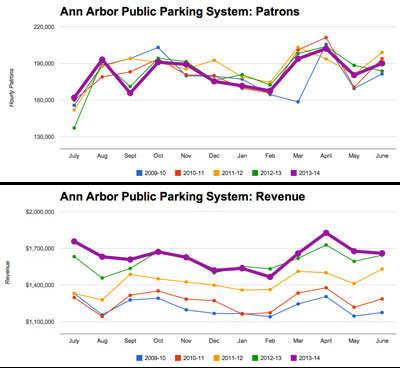
The meeting did not feature one of its typical highlights – discussion of the monthly parking report. However, the data was released to the public at the meeting, and it was mentioned that the data was now available to the public in draft form.

So this meeting report adds that provisional parking data to the data set that The Chronicle maintains – to chart the activity in Ann Arbor’s public parking system as the DDA measures it.

Highlights from public commentary included appreciation from representatives of the Neutral Zone for grants the organization has received from the DDA. The board also heard an update – during public commentary and in its committee reports – on a proposal to install an artificial ice rink on top of the new Library Lane underground parking garage.

Committee reports included updates on a possible economic development task force initiated by Ward 2 city councilmember Sally Petersen. Other updates included getDowntown’s commuter challenge, which takes place during the month of May, and the opening of the “Bike House” bicycle parking facility inside the Maynard parking structure.
[Full Story]

Ypsi Waits at Bus Stop, Other Riders Unclear

Two recent meetings of the “urban core” communities near the city of Ann Arbor have provided some quiet momentum toward possible improved public transportation services in the Ann Arbor area. The effort’s regional focus is reflected in the location of the meetings, which have taken place outside Ann Arbor – at Pittsfield Township hall and Saline city hall.

AATA Governance Expansion Options

AATA governance expansion options.

However, at the more recent meeting in Saline, which took place on April 25, 2013, Ypsilanti Township supervisor Brenda Stumbo stated her expectation that the city of Ann Arbor would provide the necessary leadership for better transportation. The meetings of elected officials, which have been coordinated by the Ann Arbor Transportation Authority, include representatives from the cities of Ann Arbor, Ypsilanti and Saline, the village of Dexter, as well as the townships of Pittsfield and Ypsilanti.

The effort to focus on improved transportation within a narrower geographic footprint near Ann Arbor – instead of the whole of Washtenaw County – has come after an attempt to establish a countywide transit authority unraveled in the fall of 2012. Of the communities in the more narrowly focused urban core, Ypsilanti has been the most assertive in pushing for action.

At the Ypsilanti city council’s April 23 meeting, councilmembers made a formal request to join the AATA under the transit authority’s existing enabling legislation – Act 55 of 1963. That request will now be considered by the AATA board. It also will require the cooperation of the Ann Arbor city council – to amend the AATA’s articles of incorporation.

For the city of Ypsilanti, joining the AATA represents a new way to generate more funding for transportation. Because the city already levies at the state constitutional limit of 20 mills, the city itself can’t add an additional tax burden. But the AATA could ask voters of all member jurisdictions to approve a levy of its own – something that it currently does not do. And that would not count against the 20-mill limit.

Ann Arbor city councilmembers who attended the April 25 urban core meeting expressed cautious support of the idea of adding Ypsilanti to the AATA. Stephen Kunselman (Ward 3) described himself as “tickled” to see the analysis and breakdown of governance and funding options in the meeting packet. Chuck Warpehoski (Ward 5) ventured that if the effort required a “coalition of the willing,” then he was willing. But he expressed some caution about the amount of additional tax money Ann Arbor voters might be willing to approve.

Ann Arbor mayor John Hieftje ventured that the Ann Arbor city council might be able to address the issue in June – after the fiscal year budget is approved in May. He suggested specifically an additional AATA board seat for Ypsilanti as well as one for Ann Arbor, which would bring the board to a total of nine. Hieftje indicated a possibility that the August deadline for placing a millage on the November ballot could be met. Sally Petersen (Ward 2) expressed her view that Ann Arbor voters would need a clearer idea of what the improvements would be, before they’d support an additional tax.

If a decision were not made until August to place a measure on the November ballot, that would result in a relatively aggressive timeline for a millage campaign. For the AATA’s part, board chair Charles Griffith reiterated at the April 25 meeting the same sentiments he’d expressed a week earlier at the board’s April 18, 2013 meeting – that the AATA would give Ypsilanti’s request full consideration. He also stressed that the AATA didn’t want to take an action that could preclude other approaches to governance.

Those other approaches to governance could include a range of possibilities, such as membership of additional jurisdictions in the AATA – like Pittsfield and Ypsilanti townships. But in terms of their readiness to see a millage put on the ballot, neither township seems as ready as the city of Ypsilanti.

Based on remarks made on April 25 by Stumbo and township clerk Karen Lovejoy Roe, Ypsilanti Township’s first priority is to get a fire and police services millage approved by voters – likely in August. After that, they’d turn their attention to transportation. At the earlier urban core meeting – which took place at Pittsfield Township hall on March 28 – Lovejoy Roe had expressed some enthusiasm for moving ahead more quickly with transportation in November. But recent minutes of the township board indicate a desire to keep November as a possibility for a re-ask, in case the fire and police services millage doesn’t pass in August.

For Pittsfield Township supervisor Mandy Grewal, it was the cost allocation in one of the proposed transit scenarios that appeared to give her some pause. On that scenario, the cost of services compared with the amount of revenue generated resulted in Pittsfield Township getting back $0.79 in services for every dollar that residents contributed – the least of any jurisdiction in the mix.

Saline mayor Brian Marl expressed solid support for some kind of expansion of services to include the city of Saline, but reserved comment on the details of any of the cost or governance proposals.

This report includes more details on the governance and cost proposals, as well as some of the commentary from elected officials at the April 25 urban core meeting.  [Full Story]

Public Art Group Faces “Interesting Times”

Ann Arbor public art commission meeting (April 24, 2013): Pushing ahead despite a somewhat uncertain future, public art commissioners took two actions tied to the city council’s pending overhaul of Ann Arbor’s public art program.

Bob Miller, Ann Arbor public art commission,The Ann Arbor Chronicle

Bob Miller, chair of the Ann Arbor public art commission, looks at a copy of Professional Quarterly Magazine, published by the Michigan Recreation & Park Association. The cover features a photo of Argo Cascades, for a feature story on Michigan’s unique recreational venues. A public art project for Argo Cascades is in the artist-selection stage. (Photos by the writer.)

AAPAC voted to change the submission date of its annual public art plan to the city council, making it synch more closely with the process of developing the city’s capital improvements plan (CIP). Rather than submitting the art plan by April 1, that date has been pushed up to Feb. 1 – a move that will allow the council to make budget decisions based on recommendations from AAPAC.

Shifting the date of the annual plan is linked to a major restructuring of the city’s public art program. A city council committee has been developing a proposal for revisions to the public art ordinance – including elimination of the Percent for Art funding mechanism. The proposal is expected to appear on the council’s May 6 agenda.

At its April 24 meeting, AAPAC also recommended one more ordinance change that they hope the council will consider: Adding up to two student commissioners to the nine-member body. The goal is to involve a younger demographic and to reach a segment of the community that’s not currently active in AAPAC. Commissioners approved a memo that will be sent to the city council to recommend this change.

During a discussion about these and other changes to the program – including a shift to more private fundraising and partnerships – AAPAC chair Bob Miller observed that there might be a couple of years during this transition when “we won’t be making public art.” John Kotarski ventured that AAPAC’s role is to be visionary and to act as an advisor, “as opposed to a cashier.” Ashlee Arder, one of the newest commissioners, suggested that AAPAC consider how to rebrand itself, as it becomes a more participatory entity. Craig Hupy, the city’s public services area administrator, noted: “I think you’re walking into interesting times.”

In other action at the April 24 meeting, commissioners heard updates on a wide range of projects, including the Ed Carpenter sculpture that will be installed at the Justice Center over Memorial Day weekend. Finalists for the East Stadium bridge artwork will be making formal presentations of their proposals on June 7, and the artist selected in March for artwork in the Kingsley & First rain garden will be coming to town sometime in May for a public meeting at the site. A project spearheaded by the Huron River Watershed Council – to raise awareness of how the city’s stormdrain system connects to the river – has extended its deadline for artist submissions to May 14.

The commission is also accepting nominations until May 21 for the annual Golden Paintbrush awards, recognizing contributions to public art.

AAPAC chair Bob Miller reported that Maureen Devine has been suggested to replace Wiltrud Simbuerger, who resigned in March. Devine’s name has been submitted to the mayor, who is responsible for making nominations to most of the city’s advisory boards and commissions. Devine is art coordinator for the University of Michigan’s North Campus Research Complex (NCRC).

The meeting started 30 minutes late for lack of a quorum, after it was clarified that commissioners had to be physically present in order to vote. Malverne Winborne participated in the meeting via conference call, but did not vote. [Full Story]

Parks Group Applauds “Status Quo” Budget

Ann Arbor park advisory commission meeting (April 16, 2013): After several years of cuts, the city’s parks system anticipates no significant budget changes in fiscal year 2014, which begins July 1, 2013.

Graffiti, Argo Pond, Ann Arbor parks & recreation, The Ann Arbor Chronicle

Graffiti at Argo Pond. Parks and recreation manager Colin Smith reported that there’s been an increase in graffiti in the parks system. (Photos by the writer.)

Park commissioners were briefed on budget details at their April meeting, and voted unanimously to recommend the budget for approval. The parks budget will be a component of the overall budget that the city council will vote on in mid-May. The public hearing on that budget will be held on May 6. “The message is status quo,” parks and recreation manager Colin Smith told commissioners.

In a separate vote, commissioners recommended raising fees – ranging between 4-9% – for rentals at the Gallup Park meeting room and Cobblestone Farm. It was the first fee increase at these facilities since 2007 and 2006, respectively.

In other action, commissioners unanimously recommended approval of a five-year contract with Coca-Cola Refreshments for cold beverage concessions. It will replace the 10-year contract with Pepsi that expires this summer. Pepsi was the only other bid received by the city for a new contract, but missed the deadline and was disqualified.

Commissioners also recommended that the city award a $535,000 contract to Pranam Global Tech Inc. to replace the nearly 40-year-old roof at Veterans Memorial Park Ice Arena. The project includes a 10% construction contingency of $53,500, bringing the total project budget to $588,500.

Public commentary included an update from advocates of an ice-skating rink at the city-owned Library Lane site, as well as a report from the Library Green Conservancy, which hopes to make the parking lot into a park. [.pdf of Library Green Conservancy report]

Updates from commissioners included ongoing efforts to find a new centrally located dog park, as well as more information-gathering work by the downtown parks subcommittee.

And in his manager’s report, Smith informed commissioners of an increase in spray-painted graffiti in the parks. The staff is collecting data on how much time they spend repairing areas that are hit with graffiti, “and it’s substantial,” he said. Even trees have been tagged, which is unusual, Smith reported. “There have been some rather inappropriate things painted on some very nice trees.” He added: “It’s extremely frustrating … We’re not in the business of providing spray-painting opportunities any more than we are in the business of providing apothecary options for people in the parks. I’ll leave it at that.” [Full Story]

Planning Commission Signs Off on R4C Draft

Ann Arbor planning commission meeting (April 16, 2013): Moving ahead on a project that’s been years in the works, planning commissioners took action at its meeting to adopt a set of changes to the city’s R4C/R2A residential zoning districts.

Commissioners unanimously recommended that the city council adopt the draft changes, and that the council direct the planning staff and commissioners to develop ordinance language that would implement these recommendations.

Wendy Woods, Matt Kowalski, Ann Arbor planning commission, The Ann Arbor Chronicle

Wendy Woods consults with city planner Matt Kowalski prior to the April 16 Ann Arbor planning commission meeting, which Woods chaired. The commission’s chair, Kirk Westphal, was absent. (Photos by the writer.)

Eight people spoke during a public hearing on the recommendations, including several who’d served on an R4C/R2A advisory committee. They raised a variety of concerns primarily related to lot combinations, parking requirements, and a proposed “group housing” district.

Related to lot combinations, several speakers urged commissioners to institute a maximum lot size of 6,525 square feet, equal to an allowable density of three units. This had been a recommendation of the advisory committee, in an effort to prevent future projects like the large City Place apartment buildings on South Fifth Avenue.

In contrast, the planning commission’s recommendations call for more flexibility in combining lots, but don’t yet provide much detail about how that approach would work. The approach would require planning commission approval of lot combinations as part of a project’s site plan review. Review standards would still need to be developed, as well as standards for design and massing – to ensure that any new development is compatible with the neighborhood.

The proposed group housing district was another point of concern for speakers during the public hearing, and was the focus for much of the commission’s deliberations. The recommendations designate a new zoning district, located south and west of the University of Michigan’s central campus. It would be roughly an area outlined in the city’s Central Area Plan, but with final boundaries to be determined. [.pdf of Central Area Plan] The idea is to address issues that are somewhat unique to neighborhoods with a large amount of student housing.

In general, the new district is intended to allow for flexibility by putting limits on density, but with premiums provided in exchange for community benefits such as pedestrian-friendly and architectural design standards. For example, parking might be based on a building’s total floor-area ratio (FAR), independent of the number of units in a structure. The recommendations call for details of this new district to be fleshed out in a second phase, after other ordinance changes are made that are seen as more straightforward.

Commissioners discussed the terminology for this proposed district, with some preferring the term “flexible housing” rather than “group housing,” which was the phrase used in the Central Area Plan. Commissioners appeared to reach consensus in directing Matt Kowalski – the city planner who’s taken the lead on this project – to clarify the group housing term as one that’s based on the Central Area Plan. Kowalski intends to make some other minor revisions to the draft report, based on feedback from commissioners, before forwarding it to the city council for consideration.

If the recommendations meet with council approval, the planning staff would then work with the city attorney’s office to develop specific ordinance revisions to implement the recommendations. Those ordinance changes would also be reviewed by the planning commission’s ordinance revisions committee before being voted on again by the full planning commission and then the city council.

Related to this R4C ordinance process, some commissioners are concerned about how that work flow would fit in with the ongoing ZORO (zoning ordinance reorganization) project. At a five-hour retreat on April 23, several commissioners expressed frustration that ZORO seems to be languishing in the city attorney’s office. The ZORO project, which started in 2009, is a comprehensive zoning code review aimed at streamlining the development-related city code, clarifying terminology, and eliminating inconsistencies and outdated material. The commission intends to convey its concerns to the city council, hoping to push the project toward completion.

In other action at their April 16 regular meeting, commissioners recommended approval of two residential annexations on the city’s northwest side, and moved forward a project to replace outdated electrical equipment at the Barton Pump Station. The station pumps raw water from Barton Pond to the city’s water treatment plant about two miles away.

Commissioners also recommended that the city council approve distribution of the city of Ann Arbor’s draft non-motorized plan for feedback from neighboring jurisdictions. [.pdf of staff report and draft non-motorized plan] This is an update of a plan that was initially approved in 2007. It makes policy recommendations as well as specific project proposals, primarily related to pedestrian and bicycle travel. [Full Story]

Late-Night Bitter Politics Set Stage for May 6

The Ann Arbor city council meeting that started on Monday evening, April 15, 2013 did not end until after 3 a.m. the following day. This was due in part to a stream of about 100 citizens who took the podium for general public commentary and two significant public hearings. The three-minute allocation of time per speaker translated into about five hours of public speaking time.

Mayor John Hieftje

Mayor John Hieftje at the April 15 Ann Arbor city council meeting. (Photos by the writer.)

Conversation amongst audience members at the meeting – as well as subsequently in the community – described the effort as a “citizens filibuster.” The result of all the commentary: Two significant items on the agenda were postponed until the council’s May 6 meeting.

One of those items was the site plan approval for 413 E. Huron. Postponement of a decision on that project was lumped in with the general motion to postpone all remaining action items on the agenda until May 6. It was not necessarily expected that the council would postpone the 413 E. Huron site plan that evening, even if it was hoped by opponents that councilmembers would put off the decision – for a third time.

But there was a reasonable expectation that another significant item would be postponed – the council’s final action on a proposed revision to the city ordinance governing the Ann Arbor Downtown Development Authority. It was during the often acrimonious debate on that decision that the council ultimately opted to postpone all of its remaining action items until May 6.

The acrimony stemmed in part from the fact that the stated intention of Stephen Kunselman (Ward 3) at the start of the meeting was to postpone a final decision – and that was the expected outcome. The fact that this expected outcome was called into question heightened the tension in an already emotional debate. The tension was heightened by the fact that deviation from the anticipated postponement was made possible mainly by the absence of two councilmembers – Marcia Higgins (Ward 4) and Sumi Kailasapathy (Ward 1).

By the time the council reached the DDA ordinance on its agenda, the hour was approaching 2 a.m. And by then Higgins and Kailasapathy had needed to leave the council meeting. Both of them had supported the ordinance changes in the 7-3 vote taken at the council’s April 1, 2013 meeting. But for the final reading on April 15, neither of them were at the table when the debate on the DDA ordinance began.

Kailasapathy described herself to The Chronicle as on the verge of physical exhaustion when she left – having had little sleep over the several days leading up to the meeting. She earns her livelihood as a certified public accountant, and tax season is a time of peak workload.

So apparently recognizing that the absence of Kailasapathy and Higgins would mean defeat for the ordinance change – if it were voted up or down, instead of being postponed – mayor John Hieftje led an effort to force an up-or-down vote on the issue. And councilmembers who were willing to put off the issue were not unified in their view about the parliamentary procedure to use to achieve that delay. So the council voted on two different options – postponing until a date certain (June 17) or tabling the issue. Sabra Briere (Ward 1) provided a crucial vote against postponement, but voted in favor of tabling.

Kunselman argued for the postponement by pointing out that because the sequence of the roll-call vote that evening allowed him to vote last, he could simply assess how the tally stood, and vote accordingly with the prevailing side. That would give him the right to bring back the vote for reconsideration at the council’s subsequent meeting. But Kunselman’s argument was not persuasive to a six-vote majority.

Without a six-vote majority in favor of either tabling or postponing, the council was left to deliberate on the actual ordinance amendments. As some attempted amendments failed – clearly due to the dynamic that had resulted from the absence of two councilmembers – Chuck Warpehoski (Ward 5) eventually proposed adjourning the meeting until the following Monday, when the meeting could continue. However, after a brief recess it was decided that the council would simply postpone all remaining voting items until its May 6 meeting, and put an end to the April 15 meeting.

After approving the motion to postpone the action items, councilmembers ticked through the remaining “housekeeping” items on the agenda, which largely included various reports and communications. Of those, one highlight worth noting was the nomination by Hieftje of Eric Mahler to replace David Nacht on the board of the Ann Arbor Transportation Authority.

The public commentary at the April 15 meeting exceeds The Chronicle’s capacity to report in its customary way. Still, some accounting of the meeting is important for the archives.

This report provides: (1) a summary of votes taken; and (2) a summary of actions that will now appear on the May 6 agenda as a result of the April 15 postponement. In addition, this report begins with details of the deliberations on the proposed DDA ordinance revisions. [Full Story]

AAPS Begins Superintendent Search

Ann Arbor Public Schools board of education study session (April 17, 2013) Editor’s note: Since this study session, the board has held an additional study session and a regular meeting, both on April 24. The Chronicle anticipates offering coverage of those meetings as well.

Ann Arbor Public School superintendent Patricia Green

Ann Arbor Public School superintendent Patricia Green

The board is now in the first stages of it has determined to be a “fast track” superintendent search. That’s because Ann Arbor Public Schools superintendent Patricia Green has turned in her resignation, after a little less than two years on the job. Her resignation takes effect in mid-July. In a brief letter to AAPS staff and families in the school system, Green said she intends to retire after 43 years in the profession. [.pdf of Green's letter]

The bulk of the board’s April 17 study session was spent discussing the first steps of a superintendent search. Led by board president Deb Mexicotte, the trustees discussed topics ranging from retaining a search firm, determining the superintendent profile, creating the search timeline, gathering community input, and naming an interim superintendent.

Also at the study session, Mexicotte also put out another call for trustees to indicate their interests for standing committee membership, as well as interest in chairing a committee. Appointments were to be made by the next regular meeting, which took place on April 24.

The dates and locations of the AAPS community budget forums were also announced. At the forums, the administration will review the budget for the 2013-14 school year.

The board also heard public commentary regarding potential budget cuts and the superintendent search. [Full Story]

Property Values Up, Budget Decisions Loom

Washtenaw County board of commissioners meeting (April 17, 2013): Major budget issues were the focus of the April 17 county board meeting, including news that tax revenues in 2013 will be higher than anticipated.

Raman Patel, Leila Bauer, Washtenaw County board of commissioners, The Ann Arbor Chronicle

From left: Raman Patel, Washtenaw County’s equalization director, greets Leila Bauer, chief deputy treasurer who is retiring after 41 years with the county. (Photos by the writer.)

After several years of reporting declining tax revenues, Raman Patel – the county’s equalization director – gave commissioners a report showing stronger signs of economic recovery, reflected in a 1.68% increase in taxable value. That translates into an estimated $2.327 million more in property tax revenues for county government than had been budgeted for 2013. [.pdf of Patel's presentation]

Also related to the budget, commissioners gave initial approval to a four-year budget planning cycle, a change from the current two-year cycle that’s been in place since 1994. Voting against the item was Ronnie Peterson (D-District 6). He and other commissioners expressed a range of concerns, including the fact that commissioners are elected every two years and therefore might not be able to contribute adequately to setting budget priorities. Although Peterson remained unconvinced, several commissioners observed that the annual budget affirmation process acted as a fail-safe, allowing the board to make adjustments based on changing priorities.

Another item that could have a dramatic impact on the county’s budget was only briefly mentioned: A proposal to issue up to $350 million in bonds to fully fund the county’s pension and retiree healthcare plans. It would be by far the largest bond issuance in the county’s history. County administrator Verna McDaniel plans to make a formal presentation about the proposal at the board’s May 2 working session. She distributed materials on April 17 to help commissioners prep for that meeting. [.pdf of bond proposal handout]

Commissioners also took a final vote officially to dissolve a countywide public transit authority known as the Washtenaw Ride. There was no discussion, but Conan Smith (D-District 9) – a vocal advocate for public transit – cast the sole vote against the resolution.

Other action handled by the board included a federal weatherization grant, a public hearing for the Urban County strategic plan, and resolutions honoring county employees and residents. Among them was Leila Bauer, the county’s chief deputy treasurer who is retiring after 41 years with the county. She received a standing ovation from the board. [Full Story]

Public Art Commission Seeks Student Input

Ann Arbor public art commission meeting (March 27, 2013): Public art commissioners hope to involve more students in their work – but no formal mechanism is yet in place to make that happen.

Connie Brown, John Kotarski, Ann Arbor public art commission, The Ann Arbor Chronicle

Ann Arbor public art commissioners Connie Brown and John Kotarski at AAPAC’s March 27, 2013 meeting. (Photos by the writer.)

At AAPAC’s most recent meeting, John Kotarski proposed adding three students to the nine-member commission as voting members. He suggested that the student commissioners be selected by: (1) the Ann Arbor Public Schools board of education; (2) the dean of the University of Michigan School of Art & Design; and (3) the Arts at Michigan program. Deb Mexicotte, president of the AAPS board, is also program coordinator for Arts at Michigan.

Ultimately, commissioners passed a resolution on a 5-1 vote asking that the city council consider adding students to the commission. Marsha Chamberlin dissented, saying she supported the concept of student involvement but didn’t like this approach. She’d rather handle it informally, perhaps by including students in the task forces that are set up for each project.

Chamberlin also noted that any change in AAPAC’s composition would require a revision to the city’s public art ordinance.

The city council committee that’s currently undertaking dramatic revisions to the public art ordinance has nearly completed its work, with plans to present recommendations to the full council on May 6. The recommendations include eliminating the Percent for Art funding mechanism and the concept of “pooled” funds from capital projects. Instead, the city council will designate specific capital projects to be “enhanced” with extra funding allocated for public art or architectural features, based on recommendations by AAPAC. [.pdf of draft ordinance revisions] [.pdf of most recent memo to city council regarding draft recommendations]

This Chronicle report includes a summary of the council committee’s April 18 meeting, which is probably the last one prior to presenting the recommendations – likely on May 6. The committee is suggesting that the council take a final vote on June 3, after soliciting public input through A2 Open City Hall.

In other action during the March 27 meeting, AAPAC approved its annual art plan. This year, because of uncertainty regarding the program’s future and a current moratorium on spending, the plan sets general goals rather than proposing new projects. Those goals are: (1) the creation of public art in more areas of the city and a commitment to balance the number of artworks throughout the city and its neighborhoods; (2) a focus on high use and visibility as locations for public art; and (3) an emphasis on putting public art in underserved neighborhoods.

AAPAC also selected Josh Wiener, an artist from Denver, to work with landscapers and incorporate public art into a new rain garden at the corner of Kingsley and First. The $27,000 project was one of several for which funding had already been approved, prior to the council’s decision to temporarily halt spending on public art.

Commissioners discussed a range of other ongoing projects, including public art at the East Stadium bridge, Argo Cascades and the Justice Center lobby. A project that doesn’t include city funding is the Detroit Institute of Arts’ Inside|Out program. Installation of that artwork in Ann Arbor took place two days after AAPAC’s March 27 meeting. Framed replicas of paintings from the DIA collection were mounted at several locations in the downtown area, and free docent walking tours will be offered on Saturdays and Sundays, starting on April 27. The tours will leave from the Ann Arbor Hands-On Museum every half-hour between noon and 3 p.m.

Looking ahead, Chamberlin reminded commissioners that it’s time to solicit nominations for the annual Golden Paintbrush awards, which recognize local contributions to public art. The award winners are selected by AAPAC, with a presentation at an Ann Arbor city council meeting in June.

March 27 was the first meeting for AAPAC’s two new commissioners, Ashlee Arder and Nick Zagar. Arder, who works for ArtServe Michigan, took action during the meeting to set up a Twitter account for the commission: @AAPublicArt. [Full Story]

AirRide Talks OK’d, Ypsilanti to Join AATA?

Ann Arbor Transportation Authority board meeting (April 18, 2013): Board member David Nacht’s final regular meeting after 10 years of service included action on a significant project he’d worked on during that time: bus service between downtown Ann Arbor and Detroit Metropolitan Airport.

AATA board member David Nacht

AATA board member David Nacht. (Photos by the writer.)

To provide the AirRide service, which was launched a year ago, the AATA is currently in negotiations with Michigan Flyer to revise terms of the second year of the contract. While the first year called for the AATA to pay Michigan Flyer an amount not to exceed $700,000 for the hourly service, the ridership – given the structure of the revenue-sharing deal – has resulted in a far lower cost.

So the board passed a resolution at its April 18 meeting reflecting the current status of negotiations, which are pointing toward a not-to-exceed amount of $300,000 for the contract’s second year. The board’s action rescinded a resolution it had passed at the previous month’s meeting, in favor of one that reflected the current status of negotiations between AATA and Michigan Flyer.

Besides the resolution on AirRide, the only other item requiring a vote was one honoring David Nacht’s decade of service on the board – which covered two full five-year terms. During his brief remarks, Nacht thanked the riders of the AATA’s service, the bus drivers and the mechanics. He also thanked his family – his two sons attended the meeting. In addition, Nacht thanked the Ann Arbor mayor and city council, which make the appointments to the AATA board. At the council’s April 15 meeting, mayor John Hieftje had announced the nomination of Eric Mahler, currently a city planning commissioner, to replace Nacht.

Discussion on non-voting items included the future of public transportation in the broader region – in two significant ways.

First, board members lamented the fact that no U.S. company, and more specifically no Michigan company, had bid on the AATA’s request for proposals to replace battery kits for its hybrid electric buses. But board sentiment was that a larger purchasing consortium for such kits might eventually be achieved through the newly-created southeast Michigan regional transit authority (RTA) – which includes the transit agencies in Washtenaw, Wayne, Macomb and Oakland Counties. And that larger consortium might make it worth the while of a Michigan company that’s a part of the state’s nascent battery industry to invest in the capability to produce bus battery kits.

Second, the board was paid a visit by Ypsilanti city councilmember Pete Murdock, who alerted the board to the likelihood that the city of Ypsilanti would make a formal request to join the AATA. The request would need approval from the AATA board and almost certainly the Ann Arbor city council, and could have implications for board membership. The goal of such a move would be to provide a more stable financial foundation for Ypsilanti bus service.

The city of Ypsilanti itself already levies its constitutional cap of 20 mills of property tax. If the AATA were to ask voters of member jurisdictions to approve a millage – an authority the AATA does not currently exercise – that additional amount would not count against Ypsilanti’s constitutional cap. [Full Story]

AADL Weighs Small Tax Hike in FY 2014

Ann Arbor District Library board meeting (April 15, 2013): Two main topics were discussed at the April AADL board meeting: The draft budget for fiscal 2013-14, and a proposal for an ice-skating rink on the city-owned Library Lane parking lot, adjacent to the downtown library on South Fifth Avenue.

Margaret Leary, Ed Surovell, Ann Arbor District Library, The Ann Arbor Chronicle

From left: Ann Arbor District Library trustees Margaret Leary and Ed Surovell. (Photos by the writer.)

The $12.475 million proposed budget calls for levying the AADL’s tax at a rate of 1.575-mill – a small increase from the current 1.55-mill rate, but still below the amount that AADL is authorized to levy. [.pdf of draft 2013-14 budget]

Ken Nieman – AADL’s associate director of finance, HR and operations – told the board that the budget includes a 3% increase in the merit raise pool for full-time employees and an increase in hourly base rates for part-time workers. The administration wanted to make sure that the library’s lower-paying jobs start at more than $9 per hour. “It will help us attract people and hopefully also keep people as we compete against other businesses out there,” he said.

The board is expected to vote on the budget and set the millage rate on May 6, but several trustees made comments about the draft budget during the April 15 meeting. Ed Surovell argued strongly against even a small tax increase, and said he wouldn’t be voting for a budget that includes any increase to the millage. It’s estimated that the additional 0.025 mills would increase the amount of the library tax for homeowners by $2.50 per year, for a home that has a taxable value of $100,000. The increase is estimated to result in an additional $185,000 in tax revenues, compared to a 1.55-mill rate.

The April 15 meeting also included a presentation by Stewart Gordon and Alan Haber, who are advocating to put a temporary, artificial ice-skating rink at the northwest corner of the Library Lane parking lot. They asked the board to designate a liaison from the library, to facilitate communications as the project unfolds – they hope to construct and open it by Oct. 15. Several commissioners board members expressed skepticism about the proposal, stressing concerns over financing and security issues.

The board also heard from five people during public commentary. Topics included concerns over the hiring of Allerton-Hill Consulting, and thanks for support the library’s support of the ArborWiki and Old News projects. [Full Story]

County Preps to Buy More Natural Areas

Washtenaw County parks and recreation commission meeting (April 9, 2013): The April meeting, which director Bob Tetens forecast would be “the long-promised very short meeting between our busy seasons,” saw WCPARC take the first step to acquire more properties in two locations for the county’s natural areas preservation program (NAPP). The group also heard a report from the Legacy Land Conservancy about a second round of farmland preservation through a NAPP program that the conservancy helps administer.

Fox Science Preserve, Washtenaw County parks and recreation commission, natural areas preservation program, The Ann Arbor Chronicle

The entrance to Fox Science Preserve in Scio Township. An additional four acres might be added to the county preserve, which is frequently used for environmental education and field study. (Photos by the writer.)

The first proposed acquisition for NAPP was the four-acre Jarskey property in Scio Township, which would become part of the Fox Science Preserve. That preserve lies east of Peters Road and north of Miller. Tom Freeman, retired deputy director of WCPARC and consultant on NAPP matters, briefed commissioners on the proposal. He highlighted two ponds on the property, and the popularity of the former gravel pit for educational purposes. Commissioners ultimately authorized preparation of a purchase offer at $14,285 an acre – or a total of $57,140.

The other NAPP proposal was for four wooded parcels totaling about 18 acres in Pittsfield Township, on the north side of Michigan Avenue roughly across from the Pittsfield Township offices. The value of this property, according to Freeman, is in the quality of the woods and the adjacency to the 535-acre Pittsfield Preserve. Commissioners authorized preparation of purchase offers of $390,000 for two of the properties, and $150,000 for the two other parcels – a total of $540,000.

Also at the April 9 meeting, Robin Burke – land protection coordinator for the Legacy Land Conservancy – briefed commissioners on the process used by the agricultural lands preservation advisory committee (ALPAC) to prioritize possible farmland preservation through the purchase of development rights. There were 72 applications for consideration, totaling 6,500 acres. This is the second round of potential deals that the county is weighing. The initial round was closed in March of 2013, protecting a total of 206 areas of farmland in the Bailo Family Partnership and Trust.

The commission also received reports on its finances, use of its facilities, and ongoing maintenance and improvement of WCPARC buildings and land. [Full Story]

Column: A TIF with A2Y Chamber

At its April 15, 2013 meeting, the Ann Arbor city council likely will take a final vote on changes to the local ordinance governing the Ann Arbor Downtown Development Authority. On April 1, by a 7-3 vote, the council gave initial approval to the changes.

A2Y Chamber Member Directory

Cover of the A2Y Chamber member directory. The Ann Arbor Chronicle is among the members listed.

In the interim, the city council has undoubtedly received communications lobbying for and against these changes. Among those communications was a letter sent on April 12 – with signatures from representatives of eight different entities that have significant specific interests in downtown Ann Arbor: “We write to oppose the proposed ordinance amendment … [P]aramount is the proposed change to the current ordinance procedure for calculating potential rebates of higher than anticipated TIF revenues back to taxing units …”

One of the eight signatories is unique – for two reasons.

First, the Ann Arbor/Ypsilanti Regional Chamber is the only one of which The Ann Arbor Chronicle is a member.

Second, the chamber is unique among the eight because it’s the one that has the legal and public policy resources to arrive at a position based on the legal and public policy merits of the issue. But in this case, the chamber has chosen a view that seems only half-informed by legal and public policy analysis.

With access to legal talent like Doug McClure, a recent candidate for 22nd Circuit Court judge who is chair of the chamber’s public policy committee, I’d expect this regional chamber to support the kind of clear, solid, forward-looking legal foundation that the proposed ordinance amendments would provide for us as a regional community. That’s especially true given that so many people – for and against the ordinance changes – agree that the current ordinance language lacks clarity.

And the idea that the chamber would support whatever interpretation the DDA chooses to give the ordinance – in the DDA’s sole judgment, with millions of regional tax dollars at stake – is bizarre from a public policy point of view. It’s especially bizarre given that this purportedly regional chamber has access to regional public policy talent like Andy LaBarre. He’s the chamber’s vice president of government relations who’s a former staffer for Congressman John Dingell. LaBarre is also an elected representative serving on a regional governing body that has tax dollars at stake in this debate – the Washtenaw County board of commissioners.

But the chamber chose to glance past the legal and public policy issues, opting instead to allow personal, petty mayoral politics to cloud its collective thinking.

What’s even more incredible is that the chamber has chosen wording for its letter – which it then recruited the other entities to sign – that would actually point an alert reader to the relevant legal and public policy issues. If the chamber itself had taken the words in its own letter more seriously, perhaps that would have guided the organization to take a position in favor of the ordinance changes.

In this column, I’ll lay out an analysis of the wording that the chamber has chosen – “… which the DDA calculates using its judgment within the standards set by the ordinance” – and explain why those words point the way to supporting the ordinance changes. [Full Story]

City Notifies Selma Cafe of Zoning Violation

The city of Ann Arbor has sent a notice of zoning violation to the popular Selma Cafe, a weekly home-based breakfast gathering that raises money for local farmers and farming activities.

Selma Cafe, Lisa Gottlieb, zoning, Ann Arbor planning, Food System Economic Partnership, The Ann Arbor Chronicle

A map posted earlier this year on the Selma Cafe website aimed to address parking and traffic concerns in the neighborhood.

The group has also received notice that the nonprofit Food System Economic Partnership (FSEP) has decided to end its fiscal sponsorship of Selma Cafe, citing “significant violations” of the terms in a memorandum of understanding between the two entities. The FSEP board voted to make the move in late March.

But it’s the zoning violations that could force a dramatic change in Selma Cafe, which often draws more than 200 people to the home of co-founder Lisa Gottlieb, located near Eberwhite Elementary School. The letter, dated April 3 from city planning manager Wendy Rampson, notes that home occupations are allowed in residential areas, but with certain restrictions. The letter states that Selma Cafe violates those restrictions in three ways: (1) more people are involved in the operation than are allowed under city code; (2) more than the permitted 10 vehicle trips per day are generated; and (3) the need for parking is not being met.

Reached by phone on Friday, Gottlieb said she plans to hand-deliver a response to the city on Monday. She believes the parking, traffic and congestion issues are resolved, and she is actively pursuing two other locations as possible venues for the weekly breakfasts. She disagrees with the city’s interpretation of the code, noting that Selma Cafe is not a business and the people who work there are volunteers, not employees. Although she hopes to continue holding the breakfasts, she said at this point it’s unclear how things will play out and whether that will be possible.

Gottlieb noted that one neighbor had criticized Selma Cafe for bringing thousands of people to the neighborhood since they started in 2009. Although the neighbor had cited that as a negative thing, Gottlieb said to her it seemed “pretty incredible” that the effort had been able to engage so many people in raising money for the local foodshed, keeping money in the community and helping local farmers.

Regarding the issues raised by FSEP, Gottlieb explained that she had withdrawn funds from the FSEP-managed bank account to transfer into a new account created as Selma Cafe transitions to become an independent 501(c)3 nonprofit. She had not first informed FSEP of the withdrawal, as required under terms of the memorandum of understanding. Even if that had not occurred, she added, “the fact is they wanted to be done with us.”

Obtaining the nonprofit status is taking longer than anticipated, so Selma Cafe is seeking another fiscal sponsor. Until that happens, the funds for Selma that remain in the FSEP-managed account – which total about $40,000 – are frozen. If no new fiscal sponsor is found and Selma does not obtain its 501(c)3 designation by May 31, FSEP could take the Selma assets permanently, under terms of the MOU. If that happened, FSEP would need to allocate those funds “in any manner consistent with applicable tax and charitable trust laws and other obligations.” [Full Story]

Column: Math Is Hard, But This Ain’t Math

Even in a smaller-sized city like Ann Arbor, governmental issues can be fairly complex. Still, our local issues are typically simple enough that they can be mastered even by an ordinary citizen who can read words on a page.

Bezonki is terrible at math, which could explain why stuff is always exploding.

This panel is from The Chronicle’s monthly comic, Bezonki, which is drawn by local artist Alvey Jones, a partner at the WSG Gallery. Bezonki is really terrible at math, which could explain why stuff is always exploding during his adventures. (This image links to a listing of all of the Bezonki panels.)

However, over the last several weeks, a significant issue has been brought forward for debate that’s been portrayed by some local officials as far more complex than that.

For now, let’s not even think about what the issue might be. It could be zoning. Or dog parks. Or parking rates. Or police staffing levels. Or public art. Or express bus service. Or outdoor signs. Or none of those. Call it Issue X.

As I’ve chronicled the workings of Ann Arbor’s local governance recently, I’ve watched as two local representatives – one elected and one appointed – have seemed to portray Issue X as too mathematically challenging to grasp. I chalk that up to politics: If the math can be set aside, then the conversation can more easily move to pure politics – the strong suit of elected and appointed officials.

To be clear, Issue X is fraught with politics. But I don’t think that focusing on the politics of Issue X serves the interests of Ann Arbor residents.

Issue X is also fraught with mathematical calculations. But not everyone is comfortable with equations.

So in this column I’ll sketch out an analogy that I think, on a purely conceptual level, accurately captures the essence of Issue X – in non-mathematical, non-political terms. [Full Story]

Deliberations on DDA Pave Way for Final Vote

Ann Arbor city council meeting (April 1, 2013): The council’s first meeting in April featured some progress on items that have appeared repeatedly on its agenda in the last several weeks.

From left: Jane Lumm (Ward 2), assistant city attorney Mary Fales and Stephen Kunselman (Ward 3).

From left: Jane Lumm (Ward 2), assistant city attorney Mary Fales and Stephen Kunselman (Ward 3). (Photos by the writer.)

After two postponements, the council gave initial approval to a set of changes to the ordinance that establishes the Ann Arbor Downtown Development Authority (DDA). The changes can be divided into those that affect board composition and those that relate to the computation of the DDA’s tax increment finance (TIF) capture.

The tax calculations have implications of roughly $1 million a year for the DDA and the taxing jurisdictions whose taxes are captured by the DDA. Those taxing jurisdictions include the city of Ann Arbor, Washtenaw County, Washtenaw Community College and the Ann Arbor District Library. The vote was 7-3, as mayor John Hieftje, Margie Teall (Ward 4) and Chuck Warpehoski (Ward 5) voted no. Christopher Taylor (Ward 3) was absent. The final vote will likely come at the council’s April 15 meeting. Councilmembers are not obligated to vote the same way the second time around.

The council also wrapped up an issue that has appeared on its agenda for several meetings. At its March 18 meeting, the council had finally decided not to enact a moratorium on site plan applications in D1 (downtown core) zoning districts. Instead, the council had directed the planning commission to conduct a review of D1 zoning. But councilmembers had left open the question of the exact scope of work and the timeframe for its completion by planning commissioners. At the April 1 meeting, the council allowed the commission six months, until Oct. 1, to review the following: the appropriateness of D1 zoning on the north side of Huron Street between Division and South State and the south side of William Street between South Main and Fourth Avenue; the residential premiums; the zoning for the University of Michigan Credit Union parking lot.

Other business was further delayed by the council. At the developer’s request, the council postponed for a second time the 413 E. Huron project, a proposed 14-story, 216-apartment building at the northeast corner of Huron and Division streets. That project will come back before the council at its April 15 meeting. A new public hearing on the 413 E. Huron site plan application was started on April 1 and will continue on April 15.

The council also postponed a second and final vote on changes to the city’s sign ordinance. The changes would prohibit any new billboards, and allow only a limited range of digital signs. That won’t come back before the council until May 6. Several people addressed the council during the public hearing. All of them worked for Adams Outdoor Advertising, and spoke in opposition to the changes. Because of the postponement, the council extended a moratorium on digital sign applications, which has now been in place for a year.

The council also extended a moratorium on spending of monies that have been set aside under the city’s Percent for Art ordinance. A revision to that ordinance, which would likely eliminate the public art set-aside but still allow for aesthetic elements to be built into a project, is expected to be brought forward in the next few weeks. The public art ordinance revisions are being crafted by a council committee that was tasked with that responsibility in December of 2012.

At its April 1 meeting, the council also approved contracts for renovations at the Gallup Park canoe livery, and the Argo and Geddes dams. In addition, the council approved a lease for additional parking in connection with the Argo Cascades.

Other business at the meeting included council approval of the notice to issue bonds for the city’s drinking water system. The council also authorized contracts in connection with street reconstruction and sidewalk repair work for the 2013 season. [Full Story]

R4C Draft Readied for Planning Commission

Changes to parking requirements, lot combinations, and creation of a possible new “group housing” zoning district are among the draft recommendations  that have been presented to Ann Arbor planning commissioners for the city’s R4c/R2A zoning districts. It’s a project that’s been years in the works. [.pdf of staff memo and proposed R4C/R2A draft recommendations]

R4C, Ann Arbor zoning, Ann Arbor planning commission, The Ann Arbor Chronicle

The dark red areas are those locations that are zoned R4C in the city of Ann Arbor. (Image links to Google Map)

An April 9, 2013 working session was a first chance for all commissioners to have a look at the recommendations, which will be formally presented at the commission’s April 16 regular meeting.

The commission’s ordinance revisions committee (ORC) has been working on draft recommendations since the summer of 2012. The committee’s work follows a report delivered in May 2012 by an R4C/R2A zoning district study advisory committee that had worked on the issue since December 2009. [.pdf of advisory committee report.

For more background on the issues leading up to this current study – which dates back several decades – see Chronicle coverage: "Planning Group Weighs R4C/R2A Report" and "Effort to Overhaul R4C Zoning Continues"] [Full Story]