The Ann Arbor Chronicle masthead
it's like being there

Neighborhoods Section

In the Archives: The Toad Survey of 1910

Editor’s note: Leslie Science and Nature Center is soon launching its frog and toad survey after holding a kick-off orientation meeting on Feb. 24. Other Leslie frog-related events include Frog Fest on May 15, 2010. Partly in that context, local history columnist Laura Bien takes a froggy look back.

Michigan’s inaugural 1996 Frog and Toad Survey started strong. “I have talked with coordinators in other states,” wrote state frog and toad survey coordinator Lori Sargent in the survey report, “and most are finding it difficult to find enough people to volunteer. Perhaps that says a lot about Michiganians – we care about our natural resources.”

Frog Island Ypsilanti

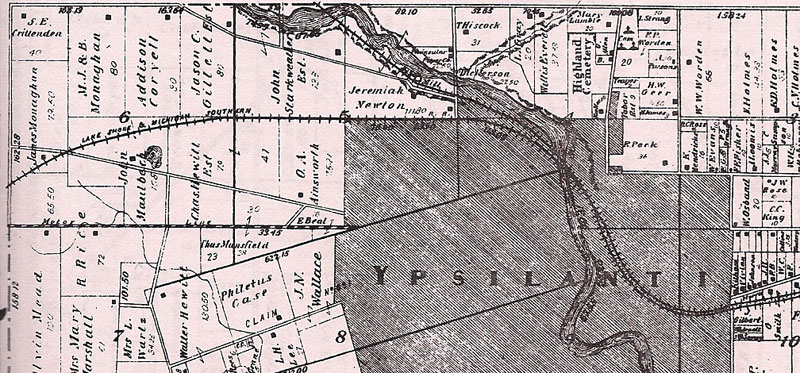
Ypsilanti's Frog Island, seen here looking north along the present-day eastern side of the running track, was the site in 1895 of Henry Scovill's lumber yard.

So much so that Ypsilantians have been surveying frogs and toads for over a century … off and on.

“Five years ago as we sat on our porch one summer evening a toad hopped out from around the corner to the concrete walk,” was the way one resident was quoted in the July 9, 1907 Ypsilanti Daily Press. “We watched it ‘walk’ down to the street sidewalk and within half an hour or so back it came.”

The Normal Park resident continued, “The next night as we were again sitting on the porch, one said, ‘I wonder whether our toad will be out tonight?’ It was but a few minutes when out it hopped and started down the walk. Within the hour it came back.” [Full Story]

In the Archives: Paper Pennies of Ypsi’s Past

Editor’s note: As a feasibility study on local currency gets underway in Ann Arbor, local history columnist Laura Bien takes a look at how local currencies were used in the past. Bien’s new book on local history, “Tales from the Ypsilanti Archives (MI): Tripe-Mongers, Parker’s Hair Balsam, The Underwear Club & More (American Chronicles)” can be ordered through Amazon.

Local currencies are nothing new to either Ypsilanti or Ann Arbor. In addition to 19th-century municipal banks, both cities created local currencies about 80 years ago. They weren’t created to boost local spending or civic pride. Ypsilanti created her local currency, called scrip, in the fall of 1931 because the city had no other money to pay municipal employees.

Ypsilanti Scrip Money

Ypsilanti "Time Scrip Money" was used to pay for municipal work. (Image links to higher resolution file.)

The currency included paper pennies.

“It was really just an IOU,” recalled Paul Ungrodt, in an April 15, 1975 Ypsilanti Press article, one of a Great Depression retrospective series. “[T]here was no money; hardly anyone could afford to pay taxes, so we made do with the scrip.” In the summer of 1929, Ungrodt was proud to have secured the prestigious job of Ypsilanti Chamber of Commerce secretary. A few months later, the stock market crashed. [Full Story]

Heritage Row Gets Postponed

Ann Arbor Planning Commission meeting (Feb. 18, 2010): After a public hearing on the latest iteration of a controversial South Fifth Avenue housing project, planning commissioners voted to postpone action on a project now called Heritage Row.

A public hearing notice duct-taped to a tree

A public hearing notice duct-taped to a tree on Fifth Avenue, announcing the Feb. 18 public hearing of the proposed Heritage Row development. (Photos by the writer.)

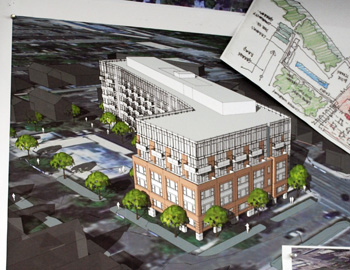
Developer Alex de Parry is asking to rezone the seven-parcel site, with plans to restore the historic houses there and build three 3.5-story buildings behind them. Commissioners generally were favorable toward the project, citing benefits of restoring the older homes, among other things. A fair amount of  their discussion involved what color of brick to use on those new buildings.

The public hearing drew several neighbors who raised concerns they’d voiced over de Parry’s previous project in the same location, called City Place. Several mentioned the new buildings as being too large for the neighborhood. Another concern: An historic district study committee hasn’t finished its report, which could affect the project.

But before they considered Heritage Row, commissioners discussed proposed changes to Plymouth Green Crossings, a mixed use complex off of Plymouth, west of Green Road. The developers, represented by David Kwan, are asking to alter their original agreement with the city.

Economic conditions, including the departure of Pfizer, have slowed plans to complete the project, which was to include a total of three buildings and a standalone restaurant. Two buildings have been constructed – tenants include Sweetwaters and Olga’s – but a perceived lack of parking has stymied attempts to fill the retail space, Kwan said. He and his partners hope to put in a temporary parking lot on the land that originally was slated for the restaurant.

One commissioner wasn’t too excited by Kwan’s idea. Concerns were also raised about payments to the city’s affordable housing fund, which are being spread out over several years. [Full Story]

Fleshing Out Fuller Road Station

At left: Architect John Mouat, a member of the Fuller Road Station design team, talks with Eli Cooper, the city's transportation manager, before the start of the Feb. 10 citizen participation forum. Moaut is a partner in the Ann Arbor firm of Mitchell and Mouat. (Photos by the writer.)

At left: Architect John Mouat, a member of the Fuller Road Station design team, talks with Eli Cooper, the city's transportation program manager, before the start of the Feb. 10 citizen participation forum. Mouat is a partner in the Ann Arbor firm of Mitchell and Mouat. (Photos by the writer.)

For Eli Cooper, the city of Ann Arbor’s transportation program manager, a project like the proposed Fuller Road Station happens “once in a lifetime” – an opportunity for the city, he says, to take a vision and make it reality in a fairly short time.

What it will take to reach that reality was the topic of a Feb. 10 public meeting on the Fuller Road Station, a joint University of Michigan/city of Ann Arbor project. Its first phase entails a parking structure with about 1,000 spaces – nearly 80% of them earmarked for UM use.

But much of the presentation by city staff and members of the design team focused on the broader goals for that site, which they hope will eventually include a train station for commuter rail. [Full Story]
In the Archives: Runway to the Future

Editor’s note: At a recent meeting of the Ann Arbor city council, an item in the city’s capital improvements plan to shift and extend the runway at Ann Arbor’s municipal airport generated much discussion.  This installment of “In the Archives” takes a look at Ypsilanti’s airport, which has faded from the landscape.

The delicate blue Waco 10 biplane roared 10 feet over the grass, past the crowd in the stands. Approaching trees at the airfield’s far end, its nose rose and it climbed, becoming smaller and smaller in view.

Waco 10 biplane

An photograph of a Waco 10 from the airshow program. Five aviators at the 1927 Ypsilanti air show competed in the cutting-edge biplane. (Photos courtesy of the Ypsi Archives.)

The gargling buzz of its 90-horsepower engine grew fainter, until the craft sounded like a distant housefly. Watchers from Detroit, Ypsilanti, and Ann Arbor under the 4 o’clock June sun shaded their eyes with their hands.

The buzz stopped: 1,500 feet in the air, the plane was without power.

The biplane arced to the left, trying to loop back towards the field. The crowd watched intently. The biplane curved again, losing altitude. A box of popcorn fell from the hand of a little boy watching, his mouth open. The plane’s wings wobbled. Airplane and crowd were quiet. On a nearby farm, a dog barked.

The plane dropped. Nearing the field, it slowed, its toylike wheels just a yard over the ground. The plane nearly stalled – and then landed as gently as a butterfly. It rolled to a stop. Its nose nearly touched a black and white checkered pylon. The crowd began clapping and cheering as two men ran to the plane and stretched a yellow measuring tape between the plane’s silver nose and the pylon. One yelled a number. The crowd grew louder, some people standing to cheer and whistle.

The pilot grinned and thrust both fists up. He’d won the “dead-stick” engine-off gliding and landing contest at the 1927 Ypsilanti Airport air show. [Full Story]
Spotlight on Burns Park Players

Tim McKay, Vic Strecher, Clinch Steward (as Nas icely-Nicely Johnson, Rusty Charlie, and Benny Southstreet) on stage

Tim McKay, Vic Strecher, Clinch Steward (as Nicely-Nicely Johnson, Rusty Charlie, and Benny Southstreet) on stage at Tappan Middle School during a rehearsal of "Guys & Dolls."

“You’re not with props, are you?” a woman whispers to The Chronicle, soon after we enter the darkened auditorium at Tappan Middle School.

As we’re telling her no, a disembodied male voice calls out over the speaker system: “Spots! You’re going to do a Venn diagram on all three of them.” Spotlights flick on, directed toward three actors clustered on stage.

They vamp. “Spots, you’re not picking up each of them equally,” intones the voice, which turns out to be coming from the director, Mike Mosallam. Someone else yells: “They’re farther apart than we were told!”

It’s Sunday afternoon – Tech Day for the Burns Park Players, the time when technical glitches like these are worked out before “Guys & Dolls” opens on Feb. 5. The crew arrived around 9 a.m., followed by the 40 or so actors at noon.

They were set to log several hours doing “cue-to-cue” – an abbreviated run-through focusing on transitions of lighting and set – with a full show rehearsal starting at 4 p.m.

The Chronicle dropped by for part of this controlled chaos, joining local photographer Myra Klarman, whose behind-the-scenes shots captured some of the day’s activity. Enjoy. [Full Story]

In the Archives: Bloomers and Bicycles

Editor’s note: At January’s meeting of the Ann Arbor Downtown Development Authority board, Ann Arbor’s mayor suggested that the DDA’s transportation committee bring a recommendation to the board to take a position on bicycling on Ann Arbor’s downtown sidewalks.

The fight to keep bikes off of Ann Arbor and Ypsilanti sidewalks dates back to the first appearance over a century ago of what many perceived to be “infernal machines.”

Thompson Bike

O.E. Thompson was Ypsilanti's leading seller of bicycles. (Images link to higher resolution files.)

The 1876 Ann Arbor city charter contains no mention of bicycles – it wouldn’t be until two years later that A. A. Pope manufactured the first bicycles in the U.S. The invention spread across the nation, threw city fathers into consternation as they scrambled for their city charters, and incited Ann Arbor’s “Bloomer War.”

It also inspired the creation of a nationwide organization of cyclists, the League of American Wheelmen. Its Michigan chapter’s 1897 edition of their “Road Book” recommended one 271.5-mile jaunt from Detroit to Chicago. Another route circled Lake Erie. The guidebook gave instructions for rides from Ann Arbor to Chelsea, Saline, Whitmore Lake, Pontiac, South Lyon and Dundee.

“Gravel roads will average as shown during entire riding season,” the book stated, “clay ones only in dry seasons.” The L.A.W. received a discount from 66 Michigan hotels ranging from Marquette to Coldwater. In Ann Arbor, the L.A.W.’s hotel was the American House (15% discount), and its Ypsilanti refuge was the Hawkins House (20%). [Full Story]
Water Main Project Set for Bryant Area

Jerry Hancock

Jerry Hancock, Ann Arbor's stormwater and floodplain programs coordinator, explains how soil composition in the Bryant neighborhood factors in the area's water problems. (Photos by the writer.)

A major project to replace water mains and resurface roads in the Bryant neighborhood will get under way this spring, part of a broader plan to address the area’s chronic drainage problems and other issues.

At a Jan. 14 neighborhood meeting, Ann Arbor city staff gave an overview of the project, which included an historical look at the subdivision off  Stone School Road, just south of I-94.

The meeting at the Bryant Community Center – organized by the nonprofit Community Action Network and attended by residents, city and county elected officials and staff, among others – is the latest in a series of efforts to deal with a wide range of challenges to one of the city’s predominantly low-income neighborhoods.

At the end of Thursday’s two-hour session, a question raised by one of the residents – “Is there a happy ending to all of this?” – might best be summarized by the answer, “It depends.” [Full Story]
In the Archives: Ypsilanti’s Waldorf-Astoria

Editor’s note: “In the Archives” is a biweekly series on local area history. In the coming week, on Jan. 19-20, the city of Ann Arbor will interview proposers of different projects for the top of a new underground parking garage at the Library Lot – including some developers who would like to build a hotel there. In this installment of her historical look back, Laura Bien offers a vignette of life just east of Ann Arbor, in Ypsilanti’s Huron Hotel, just after it had opened.

Eula Beardsley and Gladys Huston exited the front door of their Ypsilanti rooming house at Adams and Pearl one late December day in 1924.

Huron Hotel

The hotel opened in 1923, the year that residents celebrated the city's centennial. At left is the Washington Street entrance to the coffee shop and at right is the main Pearl Street entrance. (Image links to higher resolution file.)

“Colder than I thought,” said Gladys. Eula pulled shut the front door. “You’ll warm up at that big lunch today.” The pair walked one block east on Pearl Street, passing shiny rows of black cars in the Wiedman auto dealership to their left.

They crossed Washington, headed towards the door of the elegant new Huron Hotel on the northeast corner of Pearl and Washington.

Two years earlier, the only accommodations the city could offer guests were at the old-fashioned Hawkins House on Michigan Avenue between Washington and Adams. Built in the 19th century, the place had a worn-out and rustic atmosphere. The Ypsilanti Board of Commerce decided the city needed a modern, attractive hotel. It sold shares of stock to city residents, raised $200,000, and built the hotel in eight months, adding two additional floors two years later. [Full Story]
In the Archives: The Cigar Maker’s Son

Editor’s note: “In the Archives” is a biweekly series on local area history.

“The nature of my invention,” wrote Ypsilanti tinsmith Mathias Stein in his 1876 patent application, “consists in the construction and arrangement of a machine for heating sad irons and roasting coffee, either simultaneously or at different times, as will be hereinafter more fully set forth.”

schematic of combination coffee roaster iron heater

Figure 1 from the patent application of Mathias Stein for a combination flatiron heater and coffee roaster. (Image links to higher resolution file with of all six figures from the application.)

Mathias’s intricate 6-part invention, about the size of a large desktop printer, was a tabletop stove. Over a well of coals, it simultaneously roasted coffee and heated solid metal flatirons for ironing clothes, called “sad irons” – one old meaning of “sad” is dense or solid.

Mathias probably had high hopes for his two-in-one cast iron gadget. Shortly after his patent was granted, at age 31, he married the 28-year-old Josephine and the couple settled on Ballard Street just south of Washtenaw Avenue. [Full Story]

Heritage Row Redux: Process Clarified

At a neighborhood meeting held last Monday evening on the Heritage Row Apartments project (formerly City Place) on South Fifth Avenue, a question was raised concerning compliance with Ann Arbor’s citizen participation ordinance for new developments. [Chronicle coverage: "Fifth Avenue Project to Meet Historic Standards"]

That previous article left a possibly confusing impression about how Ann Arbor’s public participation ordinance now applies to the Heritage Row project. The Chronicle followed up by reviewing the history of the Heritage Row project against the specific language of the ordinance – which had been cited at the meeting by resident Tom Whitaker to support his contention that an additional meeting would be required under the ordinance.

That review establishes that no additional meeting is required for the project under the public participation ordinance. This conclusion was confirmed by Wendy Rampson, interim director of planning and development services for the city. [Full Story]

Task Force Tries to Save Senior Center

The Ann Arbor Senior Center is a projected $90,355 closer to bridging a $151,687 gap between revenues and expenses, according to an update given Wednesday. At a public meeting, city staff presented preliminary recommendations of a task force that’s been working on ways to generate revenue and cut expenses at the center.

The Ann Arbor Senior Center already offers bridge games, but a task force hopes to raise additional revenue by adding to the center's bridge programs.

The Ann Arbor Senior Center already offers bridge games, but a task force hopes to raise additional revenue by adding to the center's bridge programs. (Photo by the writer.)

Like Mack Pool, the senior center is slated to close on July 1, 2010 as part of the budget plan for FY 2011, which was presented to the city council earlier this year. Following protests from users of those facilities, the council appointed two task forces this summer to develop strategies that could potentially prevent the closures.

Recommendations for the senior center include expanding a trip program, putting a membership fee in place and using part of a bequest to cover operating expenses in the short-term, among other ideas.

During a Q&A following staff’s presentation, several of the 40 or so people attending the meeting pressed for more information and criticized the city in general for having misplaced spending priorities. “We are not blades of grass,” one woman said. “We’re not golf balls. We are human beings, and closing this center would have a devastating impact on people and their families.” [Full Story]

Fifth Ave. Project to Meet Historic Standards

Monday evening on the third floor of the downtown Ann Arbor District Library, developer Alex de Parry gave residents and neighbors an update on a project he’s been proposing in one form or another since early 2008.

Alex De Parry poining

Alex de Parry describes how the rear of the existing seven homes would in some cases be modified consistent with their period of historical significance. (Photo by the writer.)

The housing development would be located on the east side of Fifth Avenue, just south of William Street.

Previously known as “City Place,” the proposal has been newly baptized as “Heritage Row.” The new nomenclature reflects in part the expressed intent of de Parry’s development team to meet the Secretary of the Interior’s standards for historic preservation for a row of seven old houses. Behind the row of houses, three new buildings would be constructed. Underground parking would be constructed under the three new buildings.

Previous versions of the project would have either demolished the seven houses or preserved them only in part. Now, the plan is to rehabilitate those houses to historic district standards. [Full Story]

Task Force Floats Ways to Save Mack Pool

Keeping Mack Pool open is even a campaign issue for student council, based on this sign in the hallway.

Keeping Mack Pool open is even a campaign issue for student council, based on this sign in the hallway. The election is scheduled for Friday, Nov. 13.

There aren’t many meetings you can attend where some of the pre-meeting conversation goes like this: “I didn’t recognize you with your clothes on!”

Swimmers can get away with that kind of banter, and swimmers of all sorts showed up Thursday night to talk about what the city should do to keep Mack Pool open. The public meeting was held at the media center of the Open School @ Mack, just down the hall from the pool – but far enough away to smell only the faintest whiff of chlorine.

Closing Mack Pool, or turning it over to the Ann Arbor school system, was one of the options proposed by city administrator Roger Fraser at an April 13, 2009 council working session, as a way to help balance the city’s budget in the face of declining revenues projected for 2010 and 2011. There’s about a $100,000 shortfall between what it costs to run the pool each year and the revenues it takes in. Figuring out how to make up that difference is the goal of the Mack Pool Task Force, which hosted Thursday’s meeting. [Full Story]

Photo Essay: Halloween on Main Street

Editor’s note: In what has now officially become an annual Chronicle tradition, we’re delighted to document this year’s Main Street Halloween Treat Parade through the eyes and lens of Myra Klarman, a professional photographer who lives and works in Ann Arbor. Downtown merchants handed out treats to dozens of spooks, superheros, puppies and princesses. If there were tricks, we sure didn’t see any – other than a little rain. Happy Halloween.

Boy in a lion's costume

The Lion

[Full Story]

Seniors Weigh In On Fate of Center

Christopher Taylor, a city councilmember representing Ward 3

Christopher Taylor, right, a city councilmember representing Ward 3, is serving on the senior center task force, and attended Friday's meeting. (Photo by the writer.)

Shucking off raincoats and shaking rain off their umbrellas as they entered, about 50 people gathered Friday afternoon at the Ann Arbor Senior Center to get an update from city staff on the center’s fate, and to give feedback on ways to keep it open.

The meeting was the first of two scheduled by a city task force convened to address a budget crunch that had prompted city staff to recommend closing the center. The next public meeting is set for Tuesday, Oct. 27 from 6:30-8:30 p.m., also at the Burns Park facility, 1320 Baldwin Ave.

Closing the center seems a less certain scenario now, based on comments from staff and task force members. The focus is on finding ways to increase revenues, Colin Smith, the city’s parks and recreation services manager, told the group.

“The fact that so many people came out today shows how important the senior center is,” Smith said. [Full Story]

Traverwood Library to Close for 8 Days

The Ann Arbor District Library's Traverwood branch.

The Ann Arbor District Library's Traverwood branch will be closed starting Thursday, Aug. 20 and reopening on Friday, Aug. 28. (Photo by the writer.)

Ann Arbor District Library board meeting (Aug. 17, 2009): The Traverwood library branch will close Wednesday evening at 9 p.m. and remain closed until 9 a.m. on Friday, Aug. 28, the result of difficulties with a floor resealing project. It’s connected to a two-day closure earlier this month, when sealant incorrectly applied to the branch’s hardwood floors failed to dry.

Josie Parker, the library system’s director, announced the unanticipated closing at Monday night’s board meeting, but it was a different closing that stands to have a longer-term impact on the library: The recent closing of The Ann Arbor News. Parker and the board discussed plans by the owners of The News – Advance Publications – to give the library most of its archives. Though no formal agreement has been reached, the board authorized up to $63,000 to lease storage space for bound newspaper copies, newspaper clipping files and most photo negatives. Parker called the digitizing, organizing and use of the archives an exciting, major undertaking, with “huge implications” for the library.

At Monday’s meeting, Parker also told the board about a live webcast she’ll be making next week as part of an international library conference – a reflection of AADL’s growing reputation as a model for library programming and technology.

But of most immediate concern to library patrons will be the Traverwood closing, and that’s where we’ll start our report. [Full Story]

Venture Puts Chelsea’s Local News Online

The home page for Chelsea Update, a new online news site.

The home page for Chelsea Update, a new online local news site.

As a journalist, Heather Newman is perhaps best known for the technology column she wrote at the Detroit Free Press. Though she left that newspaper last year for a job at the University of Michigan, the Chelsea area resident has found another way to use her journalism skills. This month, she launched an online news site called Chelsea Update, focused on news and information in the town just west of Ann Arbor. In an email interview, we asked Newman to tell us about her new venture.

What got you started down this road? As you were thinking about the possibility of starting this venture, what were the pros and cons in weighing whether you’d actually do it?

I’d been writing for newspapers for almost 20 years when I left to join the marketing staff at the University of Michigan Press (its book publishing division) in December. Working here has been terrific, but I really felt that journalistic itch, so I was looking for something I could do in the evenings and on weekends to keep my hand in. I’ve lived in the Chelsea area for nine years, so I’m naturally nosy about what goes on there, and the only newspaper in the area is a weekly. It seemed like a great place to start. [Full Story]

A House of Support for Health Care Reform

Doug Kelley

Doug Kelley's wife made this shirt out of material that has pictures of all U.S. presidents, except for Obama. So Kelley wears his Obama T-shirt underneath. He was also selling the T-shirts at Saturday's meeting of the Obama Caucus of Ann Arbor. (Photo by the writer.)

The 16 people who gathered in Judy Dooley’s living room on Saturday came by different paths. Some had talked to Dooley or other volunteers with the Obama Caucus of Ann Arbor at a table they man each week at the Ann Arbor Farmers Market. Some had received a flyer about the event, distributed by volunteers who regularly canvas city neighborhoods. Three of the people there – Dooley, Gus Teschke and Daniela Gobetti – are coordinators for the local Obama group.

We’re pretty sure U.S. Rep. John Dingell didn’t hear about the meeting from a flyer in his door, but he showed up too. He’s using the August recess in Congress the same way other legislators are – returning to their districts to mobilize support or opposition to the health care reform bill that both the House and Senate will tackle in the fall.

The focus of Saturday’s small neighborhood gathering was President Barack Obama’s health care reform efforts, including legislation in the U.S. House of Representatives introduced by Dingell that proposes a public health insurance option. People attending the two-hour meeting raised a lot of questions about what the proposal entailed, and many shared their own experiences with problems they’ve encountered under the nation’s current health care system. [Full Story]

Friday Mornings @SELMA Finds a Home

Nametags from people whove attended Friday Mornings

Nametags from people who've attended Friday Mornings @SELMA await their return. The tags are stuck to cabinets in a laundry room/entryway. (Photo by the writer.)

The Chronicle recently reported an amicable resolution between local government officials and organizers of an event in an arguably unorthodox location: An art show in an industrial park.

Many of the same elements were a part of the saga of Friday Mornings @SELMA: An event in an unorthodox location, a spike of concern from local officials that raised the specter of shutting it down, compromise, and an ultimate resolution that satisfies regulatory issues while keeping this fundraising event alive.

“It’s always cool when the government does something that makes sense,” said Lisa Gottlieb, who runs Friday Mornings @SELMA with her husband, Jeff McCabe, and a corps of volunteers.

What exactly is Friday Mornings @SELMA? Why did the government get involved, and what did they do that “makes sense”? And how is all of this related to the local food movement? We tell the tale after the break. [Full Story]

Bryant Neighbors Dig Into Drainage

bryant neighbors

Neighbors gather at the Bryant Community Center to hear Joan Nassauer, a University of Michigan professor, talk about water drainage issues. (Photo by the writer.)

On The Chronicle’s first trip to the Bryant Community Center in December 2008, elected officials, the heads of local nonprofits, city and county staff outnumbered residents at a meeting for the southeast Ann Arbor neighborhood. The reverse was true last Thursday evening, when a room full of neighbors filled every seat, gathering to discuss the challenges they share.

Bryant is one of the few clusters of affordable housing in Ann Arbor. It’s also been hit hard by the mortgage crisis – a foreclosed property in the neighborhood at 2 Faust Court, vacant and boarded up, has been targeted as one of the first acquisitions for the county’s new land bank.

The land bank actually dovetails with a widespread problem that affects nearly all residents, which was the focus of Thursday’s meeting: Inadequate drainage and the chronic pooling of water in crawl spaces, basements, yards and streets. Joan Nassauer, a University of Michigan professor of landscape architecture, has remediated sites with similar problems in Flint, Chicago, St. Paul and other areas. She was on hand Thursday to talk about what Bryant residents might do to address their drainage issues. [Full Story]

Last Day Delivering The Ann Arbor News

last day of the Ann Arbor News a guy rolling papers

Cary Push rolls the last edition of The Ann Arbor News on Thursday and inserts it into plastic bags.

Late on Thursday afternoon, the last day of publication for The Ann Arbor News, Cary Push was waiting in his pickup truck at the corner of Eberwhite and Woodridge. The bundle drop hadn’t been made yet to his carrier route, which covers this west side neighborhood south of Liberty and west of Seventh Street.

When the bundled papers  finally arrived, and after Push had rolled them into their plastic bags, The Chronicle tagged along for a bit as he delivered the last day’s edition of The News.

We shadowed him as he walked through the neighborhood with a canvas bag loaded with newspapers. He stopped at some of the houses – but by no means all – and placed each paper in the spot where he’d learned over the last three years that subscribers on his route preferred to have their paper delivered.

Some of them  got placed right on the door mat. Others found a temporary home in the hooks under the mailbox. Some were tossed inside a screened-in porch.

None of them were simply flung from the sidewalk in the general direction of the house. That was something that one loyal subscriber and reader of The News was a little concerned about – because it won’t be Push who’ll be delivering the printed edition of AnnArbor.com to this neighborhood – that’s the publication intended to replace The Ann Arbor News, at least on Thursdays and Sundays. [Full Story]

Possible Farmers Market at Liberty Lofts

The commercial space next to Liberty Lofts.

Commercial space, in the foreground, abuts Liberty Lofts condominiums in the background. This shot is taken from West Liberty Street, looking south. (Photo by the writer.)

The cavernous commercial space next to the Liberty Lofts condo complex isn’t always empty –  as recently as May, The Chronicle documented a temporary architectural exhibit there. Mostly, though, passers-by can look through the floor-to-ceiling windows and see roughly 18,000 square feet of emptiness at the corner of Liberty and First.

But on Wednesday, July 8, the former factory space will have another temporary occupant: Karen Myers and Archie Welch are holding an open house from 3:30-7 p.m., hoping to garner support for a European-style indoor farmers market. [Full Story]

Bernstein to Leave Ann Arbor Chamber

Jesse Bernstein, Ann Arbor Area Chamber of Commerce president

Jesse Bernstein, Ann Arbor Area Chamber of Commerce president, has resigned his post. His last day in that job is June 30.

On a downtown street corner recently, The Chronicle had occasion to witness an informal idea pitch from Hal Davis to Jesse Bernstein,  president of the Ann Arbor Area Chamber of Commerce: Busker Week for downtown Ann Arbor – where independent musicians would explicitly be invited to come perform in Ann Arbor’s downtown. Bernstein’s reaction can fairly be described as positive.

But if Bernstein helps Busker Week to join Sonic Lunch on downtown Ann Arbor’s summer musical calendar, it won’t be as president of the chamber. Bernstein told staff at 4 p.m. Tuesday that his last day leading the organization will be June 30, 2009. It ends three year’s of Bernstein’s leadership of the area business organization. [Full Story]

The Battle of Ann Arbor: June 16-20, 1969

June 17, 1969: Officers confer as the crowd swarms on to South University. (Photo courtesy of Jay Cassidy.)

June 17, 1969: Officers confer as the crowd swarms on to South University. (Photo courtesy of Jay Cassidy.)

Ann Arbor, like many college towns, is usually a quiet place during the summer months. Most of the students are away on break, the university goes into hibernation, and a calm descends upon the city as residents sit back to enjoy a few months of peace and quiet.

During the turbulent 1960s the summer break was even more eagerly anticipated, offering as it did a brief respite from the regular succession of student-led sit-ins, protests, demonstrations, and strikes that occupied the fall and winter months. But the influx of large numbers of non-student “street people” (i.e., hippie youths) in the closing years of the decade made those last few summers of the ’60s decidedly less peaceful.

Forty years ago this week, the normally sleepy summertime streets of Ann Arbor were violently awoken by a series of violent and occasionally bloody clashes between police and a motley crowd of hippies, radicals, teenagers, university students, and town rowdies. Ostensibly at issue was the creation of a pedestrian mall, or “people’s park,” on South University Avenue – a four-block shopping district adjacent to the University of Michigan campus that caters primarily to a student clientele.

Even in those “interesting” times, the violence in Ann Arbor attracted national attention – including that of J. Edgar Hoover, head of the FBI. After the fighting was over, the national press lost interest and moved on to other, juicier topics. But on the local scene the repercussions of that summer would reverberate for years after.

The Detroit Free Press would refer to the four nights of conflict as “The Battle of Ann Arbor.” [Full Story]

Column: Adventures in Multicultural Living

Frances Wang

Frances Kai-Hwa Wang (photo courtesy of Mark Bialek)

Called my girlfriend Nina to see if she would play hooky with me one recent Sunday afternoon. Alas, she’s off with her latest beau somewhere, no time for me. So I sit on the sidewalk outside Sweetwaters café downtown, soaking in the sunshine on this glorious spring day. My laptop sits unopened at my side.

Instead, I steal my friend Rich’s New York Times and I guiltily and gleefully read the entire thing, from arts all the way down to business and even, ugg, politics (which I generally try to avoid). Just one day to stop. One day to sit in the sunshine. One day to visit with all the friends who walk by – Kenji-san with his big brown dog; Diane with her latest middle-aged man from Match.com; Arthur with yet another joke from his old Jewish uncle. There is nothing like the beginning of spring in the Midwest. [Full Story]

Washtenaw Dairy Turns 75

Washtenaw Dairy Ann Arbor Michigan

Washtenaw Dairy T-shirt with design drawn by Chris Frayne.

On Saturday, May 30, from 10 a.m. to 2 p.m. the Washtenaw Dairy will throw a 75th birthday party for itself.

Jim Smith, president of Washtenaw Dairy, didn’t send out any special invitations to people – everybody’s welcome to come enjoy the free hot dogs, 25-cent milkshakes, and entertainment from “Elvis Presley” and “Buddy Holly.” Not even Bill Martin – president of First Martin Corp. and athletic director of the University of Michigan – got a special invite.

So when Martin dropped by the dairy on Thursday, and a tableful of morning regulars wanted to know if he was coming to the party, Smith wasn’t buying the “Nobody invited me” excuse that Martin was selling. “We don’t send out invitations!” admonished Smith. “Well, you didn’t call!” replied Martin. Martin wound up saying he’d try to attend, asking, “About what time are you guys going to be there?”

The Chronicle didn’t hear anyone take advantage of the obvious opening for a wisecrack: “Are you asking so as to avoid us, or what?”  Missing that chance was a rare exception judged against the hour we spent on Thursday soaking up the atmosphere at the corner of First and Madison on the west side of Ann Arbor.  [Full Story]

Column: Communications to the Clerk

Correspondence sent to the Ann Arbor City Clerk gets stamped and filed as a official communication on the city's website.

Correspondence sent to the Ann Arbor City Clerk gets stamped and filed as a official communication on the city's website.

As we’ve reported previously here at The Chronicle, one of the cost-saving measures that’s been proposed in connection with the city’s budget for fiscal year 2010 is to eliminate publication of the city council agenda in the local newspaper. The move would save $15,000 per year. I imagine there are some citizens who rely on the newspaper publication of the council agenda to stay informed on civic matters, but would speculate that it’s not many – probably not enough to lobby successfully for its continued publication in the twice-weekly print edition of AnnArbor.com, which is to replace The Ann Arbor News.

One advantage of the city’s online publication of the council agenda is that it includes as attachments all the communications to the city clerk, whether they’re from boards and commission within the city, neighborhood associations, private citizens, or even anonymous sources.

Part of  my preparation to cover council meetings is to skim through those communications. For the May 4 meeting next Monday, the following item caught my eye: Illegal Restaurant & Chickens. [Full Story]

PAC Meeting Location Wrong

We previously reported an incorrect location for the next Park Advisory Committee meeting. It takes place on Tuesday, April 21, at 4 p.m. in county board of commissioners chambers at the County Administration Building, at 220 N. Main St. We note the error here and have corrected it in the original article.

Column: Adventures in Multicultural Living

Frances Wang

Frances Kai-Hwa Wang (photo courtesy of Mark Bialek)

“I’m not your ‘Mom!’” my girlfriend finally exploded at her kids.

The teenagers looked puzzled, “Then, whose mom are you?”

I know what she means, though. She does not want her children to call her the English word, “Mom,” but to call her by the Chinese term, “Ma Ma.” The dictionary may give the same meaning for both terms, but “Mom” does not have the same feel, the same nuance, as “Ma Ma.” My children are not allowed to call me “Mom,” either.

The question of how to address people often comes up in our family. I teach my children to always address adults as “Mr.” or “Mrs.,” “Auntie” or “Uncle” – never by their first names. In our local Asian American communities and in Hawaii, it is common to address one’s elders as “Auntie” or “Uncle,” even “Grandma” or “Grandpa.” It creates instant familiarity, instant respect, an instant family-style relationship where adults look out for children and children look up to adults. [Full Story]

» Text size:

larger text default text smaller text

Skyclock