Opinion Section

Column: Super Bowl Reflections

John U. Bacon

John U. Bacon

It’s been five days since the Super Bowl, just enough time to give us a little perspective on the whole thing. Was it a football game? A concert? A competition for the Clio Award? Or some bizarrely American combination of all three?

Let’s start with the least important: The football game. You might have caught bits of it, squeezed between the ads and the show. How could you tell when the game was on? Those were the people who ran really fast, and wore clothes.

For the Super Bowl’s first 30 years, most of the games were boring blowouts. I suspect even the players can’t recall the scores of those snoozers.

But the ads and the halftime shows were hard to forget, and often featured a member of the Jackson family having his hair ignited or her wardrobe mysteriously malfunction.

But lately, it’s been the other way around. Ten of the past 16 games have been barn burners – and the rest of the stuff is putting us to sleep. [Full Story]

Column: Signing Day Insanity

John U. Bacon

John U. Bacon

The most important day of the year for a college football coach is not the home opener, the big rivalry game or even a bowl game. It’s national signing day, which falls on the first Wednesday in February.

On signing day, the end zone is not grass or Astroturf, but a fax machine tray. Only when a signed National Letter of Intent breaks the plane of that tray does it count.

Sounds pretty simple, right? A couple years ago I got a chance to see the sausage get made at close range – and it’s a lot crazier than you imagined.

The coaches start by collecting information on more than a thousand players years in advance. Then they watch hundreds of hours of film, and make dozens of trips across the country – from Pasadena to Pahokee – to meet with hundreds of high school players, their parents and their coaches. They follow that up with thousands of calls, emails and text messages – all in the hopes of getting the 25 players they think will help them win a title a few years later.

That’s bad enough, but now, thanks to ESPN and the Internet, recruiting has become a full-blown season in its own right. It lasts all year – and it’s harder on the coaches than the actual football season is. [Full Story]

Monthly Milestone: Draggin’ Tail, Dragon Tale

Editor’s note: The monthly milestone column, which appears on the second day of each month – the anniversary of The Ann Arbor Chronicle’s Sept. 2, 2008 launch – is an opportunity for either the publisher or the editor of The Chronicle to touch base with readers on topics related to this publication. It’s also a time that we highlight, with gratitude, our local advertisers, and ask readers to consider subscribing voluntarily to The Chronicle to support our work.

The Ann Arbor Chronicle currently has no plans to implement a choice of "skins" for the website, especially not one that would allow readers to view the publication as if it were printed on dragon scales.

The Ann Arbor Chronicle currently has no plans to implement a choice of "skins" for the website, especially not one that would allow readers to view the publication as if it were printed on the scales of a dragon we slew.

Some eagle-eyed regular readers might have noticed that in the spot on the “masthead” where the current date used to sit are now four links: Civic News TickerStopped. Watched.CommentsEvents. We’re also expecting the sad grey box at the top of the left sidebar to be retired sometime soon.

This does not signal that a major design change is in the offing. We have no plans, for example, to implement a choice of “skins” for the website, especially not one that would allow readers to view the publication as if it were printed on the scales of a dragon we slew.

That initial change – swapping out the masthead date with links we’d like to highlight – was prompted by some confusion that resulted from the appearance of a current date … on the same page as an article originally published three years ago.

It’s actually somewhat encouraging that The Chronicle has now been around long enough that this kind of confusion could result.

What I’d like to share with readers this month is a little vignette from the city council’s last meeting, which concluded near midnight – so I was draggin’ tail. And the vignette itself is a little dragon tale. [Full Story]

In the Archives: Helping the Deserving Poor

Editor’s note: Laura Bien returns this month after a three-month hiatus from her In the Archives column for The Chronicle. Look for it in the future around the end of every month. For this column, she reviewed around 1,500 pages worth of meeting minutes from the Ypsilanti Home Association. 

Nellie Smith* heard someone coming up the stairs and sat up in bed. She could see her breath in the late-winter afternoon light. Perhaps he had left something behind. She glanced around the room. There was nothing on the table, the chair, or the stove with the broken leg propped on a brick.

Knocks sounded. Nellie stood, shook out her ragged nightgown, and opened the door an inch. The friendly gaze of a middle-aged woman in a trim winter coat and long dark skirts met Nellie’s cautious look.

gilbert-young-small

Harriet Gilbert as she looked around the time she was first elected Ypsilanti Home Association president in 1875, an office she held for over 30 years.

Lizzie Swaine introduced herself, apologized for the intrusion, and said there’d been word of a little difficulty at this Washington Street address. It felt cold here, she said – did Nellie have any fuel in the house? No, said Nellie, nor food either. Lizzie asked a few more questions, reassured her that help was coming, thanked her for her time, and left. Likely the women’s interaction was similar to this imagined scene.

What is a matter of record is that some days later Lizzie joined twelve other women for the May 1896 Ypsilanti Home Association meeting at Lovina Briggs’ Huron Street home. As Lizzie described Nellie’s plight, she may have noticed some raised eyebrows. The ladies discussed the case. Later, Association secretary Cleantha Dickinson paraphrased the talk in the 1896 meeting minutes logbook.

“Mrs. Swaine came to present the case of Mrs. Smith,” she wrote, “whom she found without a fire and about to be turned out of her rooms because she could not pay her rent.”

She continued, “Investigation among the ladies proved that the woman had a father and brother in comfortable circumstances who would not help the woman unless she behaved herself … it was found that she had been under arrest for keeping a disorderly house,” a euphemism referring at that time to prostitution.

She concluded, “The ladies decided they could not help her while she persisted in wrong doing.” Luckily, Nellie was an exception – the group helped most of those cases that came before it.  [Full Story]

Column: Finally, a Real Rivalry

John U. Bacon

John U. Bacon

The rivalry between Michigan and Ohio State in football is one of the best in the country. But it obscures the fact that, in just about every other sport, Michigan’s main rival is Michigan State.

In men’s basketball, there’s no team either school would rather beat than the other. The problem is, for a rivalry to really catch on, both sides need to be at the top of their game. Think of Bo versus Woody, Borg-McEnroe and, of course, Ali-Frazier, which required three death-defying fights just to determine that one of them might have been slightly better than the other.

The Michigan-Michigan State basketball rivalry, in contrast, usually consists of at least one lightweight. When Michigan got to the NCAA final in 1976, Michigan State had not been to the tournament in 17 years.

When Michigan State won the NCAA title in 1979, Michigan finished in the bottom half of the Big Ten.

When Michigan won back-to-back Big Ten titles in 1985 and ‘86, State wasn’t close. And when State rolled up four straight Big Ten titles under Tom Izzo, Michigan was headed for probation, and yet another coach.

Around that time, Izzo told me there was no reason, given the basketball talent in this state, that this rivalry could not be every bit as good as Duke and North Carolina. But for more than a decade, it was anything but. Izzo owned Michigan, winning 18 of 21 games through 2010.

But Michigan managed to sweep State last year for the first time in 13 years. And on Tuesday night, for only the fifth time in the rivalry’s long history, Michigan and Michigan State both entered their contest ranked in the top 20.

This was it. The rivalry finally looked like a rivalry. [Full Story]

In it for the Money: Going IMBY

Editor’s note: This column appears regularly in The Chronicle, roughly around the third Wednesday of the month. 

David Erik Nelson Column

David Erik Nelson

My first job out of college was teaching humanities at a Hippie School for Troubled Youth here in Ann Arbor. Soon after being hired, I attended a school mixer where the dean cornered me in the kitchen and explained that some trucks hauling radioactive waste were scheduled to cut through downtown Ann Arbor.

She suggested we go down and protest by lying down in Main Street and generally boondoggling things up and teaching those bastards a valuable lesson about hauling nuclear waste down our streets [1].

At the time I was lightly anti-nuke. I had been militantly opposed just a few years earlier – and even protested Fermi II in the early ‘90s, when it was in disrepair and operating with questionable regard for public safety – but had since calmed down and learned a bit more about the costs and benefits of various kinds of power generation [2]. Nonetheless, even in my decidedly less-nukes mindset, I was still struck with how backward this protest plan seemed.

It’s no secret that Ann Arbor is a sorta foot-draggy, NIMBY kind of town [3]. Most of us came here from somewhere else; we loved this quaint little town when we landed here in 1975, or ‘85, or ‘95, and we basically don’t want it to ever change (except for the streets getting cleaner, the stores better stocked, and the parking both cheaper and more plentiful – but for God’s sake don’t tear anything down or build anything tall to do it. Also, could you do something about those football games? So loud, and the crowds – UGH!). [Full Story]

Column: Who Wins with College Bowl Games?

John U. Bacon

John U. Bacon

The college football bowl season has always been a little crazy – but most of that used to be fun crazy. Lately, though, it’s been turning bad crazy – and fast. Here’s why.

Michigan played in the first ever bowl game against Stanford on New Year’s Day in 1902. The Wolverines won, 49-0 – but didn’t play another bowl game for 46 years.

Pasadena didn’t host another game until 1916, and no other bowl games even existed until 1935, when the Sugar Bowl, the Orange Bowl, and the Sun Bowl all started, followed two years later by the Cotton Bowl. But the games were just glorified exhibitions, created to reward a few teams with a nice trip, and promote southern cities.

That started to change in 1948, when Michigan’s Fritz Crisler played matchmaker between the current Big Ten and the Pac-12, who started sending their league champions to play each other at the Rose Bowl every New Year’s Day. If you were second place, you only got to play in a bowl if your league champion repeated, because the university presidents didn’t want their teams to go to a bowl game two years in a row.

Bowl games were considered so insignificant that Notre Dame didn’t bother to go to any bowl games from 1926 until 1970 – and still won seven national titles during that stretch.

But when Michigan’s undefeated, fourth-ranked 1973 team tied top-ranked Ohio State, and was denied a trip to Pasadena by a vote of athletic directors, the Big Ten ended its 25-year-old ban, and let any team in the league go to any bowl game that would have them. [Full Story]

Column: Redemption at the Sugar Bowl

John U. Bacon

John U. Bacon

The Big Ten is still considered one of the nation’s top leagues, despite its frequent belly flops in bowl games. This year, the Big Ten placed a record 10 teams in bowl games – then watched them drop, one by one. And not just in the storied Rose Bowl, but in games like the Taxslayer.com Gator Bowl, the Meineke Car Care Bowl of Texas, and the Insight Bowl. When Iowa got whipped 31-14, I wonder just how much insight they had gained.

Until Monday, Big Ten teams had managed to win only two games: the Little Caesars Pizza Bowl in Detroit, over Western Michigan, and the Kraft Fight Hunger Bowl, over a team that had a losing record and no coach. In non-food based bowls, the Big Ten had no luck at all.

Then, Michigan State came to the rescue. The Spartans beat Michigan during the regular season, they won their division, and they seemed poised to win the Big Ten’s first conference championship game until one of their players was called for “roughing the punter.” This is on a par with giving the class nerd noogies– and about as serious. But it cost them the game.

Their reward for all this? An invitation to a less prestigious bowl game than Michigan received. The Spartans were ticked off – and rightly so.

After Georgia jumped out to a 16-0 lead at the half, the Spartans came back to tie the game in the final seconds. And that’s when things got really nutty. In the first overtime, the Georgia kicker missed a chance at a game-winning field goal. Then, in the third overtime, the Spartans blocked his kick to win. Small wonder college coaches knock back Rolaids like Chiclets.

Michigan’s road to redemption was even crazier – and far longer. [Full Story]

Milestone: Starting Small, Thinking Big

Editor’s note: The monthly milestone column, which appears on the second day of each month – the anniversary of The Ann Arbor Chronicle’s Sept. 2, 2008 launch – is an opportunity for either the publisher or the editor of The Chronicle to touch base with readers on topics related to this publication. It’s also a time that we highlight, with gratitude, our local advertisers, and ask readers to consider subscribing voluntarily to The Chronicle to support our work.

Cross Hands

Not long after midnight, the Kerrytown neighborhood was treated to several tunes played by a group of folks Joe O'Neal had gathered up. Among the songs was "Danny Boy," performed by Chronicle editor Dave Askins. Joe's daughter, Heather O'Neal, guided performers by pointing to the notes as they played.

The Chronicle spent part of its New Year’s Eve – the midnight part – at a small gathering in Kerrytown Market & Shops. Owner Joe O’Neal credits Mary Cambruzzi, proprietor of FOUND Gallery, with the idea: Open up the building for a few people to toast the new year with champagne or sparkling juice, and give people a chance to ring in 2012 by playing the carillon.

We were able to join the small event, because earlier in the day on New Year’s Eve, I happened to run into Joe at the Ann Arbor farmers market.

As Joe and I chatted, he showed me a new alcove outside the building – with benches and a plaque – honoring Ginny Johansen, a former Ann Arbor city councilmember and farmers market supporter who died last year. We also talked about the success of this year’s KindleFest, which on one night in early December drew several thousand people to Kerrytown. The regular stores stayed open late, and the farmers market was filled with vendors – selling everything from holiday greenery to glühwein. The energy of the crowds was exhilarating, and made me wish for more events like that.

In that context, Joe mentioned the New Year’s Eve gathering later that night, and invited us to drop by and play the carillon. Though it’s been a small affair for the past couple of years, he sees the possibility for more. His vision 10 years from now is to draw 10,000 people to Kerrytown on New Year’s Eve. Maybe someone could build a sort of reverse Times Square ball, he said, that would shoot up instead of dropping down. There could be fireworks. And carillon-playing, of course.

His vision made me think of how some of the most special things in this town start small, with one or two people thinking just a little bit bigger. So in this month’s Chronicle milestone column, I’d like to share a few thoughts on that as we head into the new year. [Full Story]

Column: Depression’s Darkest Day

I last saw Greg O’Dell at the November meeting of the University of Michigan board of regents. At the time, he was UM’s police chief and head of the department of public safety, a job he’d taken in August.

Greg O'Dell

Greg O'Dell at the Nov. 17, 2011 University of Michigan regents board meeting, before his resignation as UM police chief.

We spoke only briefly, and he was polite and respectful – just as he’d been in all the other interactions I’d had with him. Though he seemed a bit more quiet and restrained that day, I thought nothing of it. After all, he’d taken on a significant high-profile responsibility, and was standing in a room full of his new bosses at a public meeting.

Just a few days later, I was surprised to learn that he had decided to resign from UM and return to a post he’d previously held at Eastern Michigan University. EMU had rehired Greg as police chief in late November, and his public statements indicated that he’d decided his position there was a better fit.

Less than a month after that, on the Friday before Christmas, Greg was found dead from a self-inflicted gunshot wound, an apparent suicide. He was 54. Shocking is the only way to describe the news – a sentiment I’ve heard expressed repeatedly over the last few days.

As a respected and well-liked leader in local law enforcement – he had spent the bulk of his career with the Ann Arbor police department – Greg was well known throughout the community. That fact was reflected in the hundreds of people who came to pay their respects on Wednesday night at the visitation held at the Nie Family Funeral Home, a diverse crowd of family, friends, colleagues and acquaintances.

He was smart and easy-going with a wry sense of humor, professional yet personable, confident and approachable. His death has stunned us, and even those of us who weren’t close to him will mourn the loss.

I’m sure I’m not alone in spending much of the past few days reflecting on Greg’s death. Not well-known outside a limited community was his struggle with depression. I don’t know the circumstances of his personal situation – and it’s not my business. But as the daughter of someone who suffered from chronic depression, that dark landscape is familiar to me.

This past summer, in the same regents boardroom where I last saw Greg, the director of UM’s Depression Center, John Greden, spoke to regents about the difficulty of fighting the stigma of this illness called depression. In the wake of Greg’s death, it’s worth pausing to reflect on the way that nearly all of us, at some point, grapple with our inner demons or unfathomable despair, and how those struggles can be even more profound for those who work in law enforcement. [Full Story]

Holiday Greetings from The Chronicle

This time of year, it’s a tradition in our house to play Christmas tunes on my great grandfather’s music box. We shared this video of the music box with Chronicle readers during our publication’s first holiday season four years ago, and wanted to revive that tradition this year. Whatever you celebrate – Christmas, Hanukkah, solstice or the coming of a new year – we hope your holidays bring you memories worth chronicling. [Full Story]

Column: FOIA Hazards, Christmas Gifts

Christmas came a little early for Ann Arbor’s fire department, as well as for the local news media. A report on Ann Arbor’s fire protection services arrived five days before Santa.

Fire Station 1

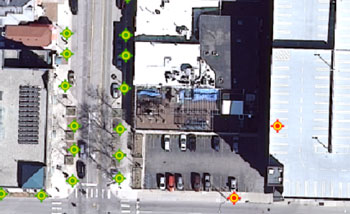
This does not depict Ann Arbor dressed in Christmas colors. Numbered locations are fire stations. This map pertains to Station #1. The green area is the area of the city reachable from Station #1 in four minutes. The red area corresponds to 10 minutes. (Image links to higher resolution file)

The report was a long time arriving, though. It was almost a year ago – on Feb. 7, 2011 – when the Ann Arbor city council authorized the expenditure of up to $54,000 for a contract with the International City/County Management Association to conduct the study.

It was a study that then-city administrator Roger Fraser had wanted, and it came in the context of a city council budget retreat a month earlier. At that retreat, councilmembers were briefed on various alternatives to the city’s current approach to staffing its fire protection – including an approach that uses a combination of paid on-call and full-time fire service professionals. At the same council meeting when the ICMA report was authorized, Stephen Rapundalo, who at the time was chair of the city council’s labor committee, criticized the city’s firefighters union for its reluctance to accept a benefits package similar to the one for non-union city workers.

So, how important was the ICMA fire protection study to the city?

Here’s one way of answering that. When Fraser announced his resignation, the city council’s search committee identified in April of this year a handful of top priority items for the interim administrator. The interim – Tom Crawford, the city’s CFO – was supposed to keep the place running, and make sure a small list of priority items didn’t fall through the cracks during the transition in the city’s top position. The ICMA fire protection study made the list.

The report was originally due in the spring, and then was delayed, and delayed again. The city was paying the ICMA for its work – a total of $38,000 in June 2011. I spoke with Crawford about the report this fall – he couldn’t offer much in the way of explanation, but indicated that the delay was on the ICMA’s end.

New city administrator Steve Powers started the job in mid-September. No ICMA report had materialized. Then in mid-November, the city paid an additional $400 to the ICMA. Shortly after that, word filtered through firefighter rank-and-file that a draft report had been released to the city by the ICMA.

At the time, The Chronicle had a Freedom of Information Act (FOIA) request pending with the city for a different set of records – maps depicting fire response-time boundary areas. Why? I’d seen one such map hanging in a public area on the second floor of city hall, that had – ahem – sparked a burning desire to see copies of all such maps.

When that request came back partly denied (no maps were produced), The Chronicle submitted a “clarification” of the original request, and added a request for the draft ICMA report. Other media had reported that their request for the draft report had been denied – but the city’s given reason for the denial was, to us, simply wrong. We figured that citing a specific prior court case might give us a shot.

We didn’t receive a denial. Instead, the city asserted its right to a 10-day time extension. And apparently this extension came on the very same day that the city turned down an appeal made by a different requester regarding the city’s denial of a similar request. It’s not entirely clear why the city denied an appeal made on one request, while on the same day claiming an extension for a similar request – from a different requester.

During the extension, I approached Powers, essentially outside the formal mechanism of the FOIA process. My pitch to Powers was not a legal argument. My pitch was based on the organizational interests of the city and the public interest of the community. We met on Friday, Dec. 16.

In that meeting, Powers assured me the draft report, the final report (which is still watermarked “draft”) and the maps would be released the following week. And the records were, in fact, released. We withdrew our FOIA request when we got the information we requested.

So Christmas did come early, right? But seriously, WTF? By the way, that does translate politely – as “Where’s the fire?”

We got what we wanted, and we should be happy about that.

Yet I still feel like the city wrapped up new socks and underwear in colored paper and called it a Christmas present. I want socks and underwear every time I yell FOIA in this democratic theater that we call Ann Arbor, not just at Christmas time. [Full Story]

In it for the Money: For Economy of Opinion

Editor’s note: This column appears regularly in The Chronicle, roughly around the third Wednesday of the month. 

David Erik Nelson Column

David Erik Nelson

Listen: Today I’m hoping to convince you that our opinions are largely a cost with no corresponding benefit, and that the vast bulk of these opinions are unaffordably expensive.

We’re in Ann Arbor, where any two folks seem to have at least three opinions on a given topic, so I don’t imagine this is going to go super well, but hear me through.

Before you rush to the comments, I wish to assure you that I am indeed aware of the irony of writing an opinion column about how opinions are maybe something that we shouldn’t reflexively whip out like Glocks in a cop film.

And, if that lil proviso doesn’t give you pause, maybe this should: The opinions I share today are the result of about 18 months of meditating on the underlying costs and benefits of sounding off; if you’ve likewise spent a year-and-a-half working through this, then please chime in.

If you’re jumping to the comments to put me in my place, I invite you to take a few minutes, maybe an hour, or maybe, I dunno, 550 days or so to stew on this before giving me a piece of your mind. I’m not coming to this lightly or flippantly, which is apropos, because it’s the way we rack up opinion debt with such spendthrift flippancy that’s costing us so dearly. [Full Story]

Column: Rounding Out the Year in Sports

John U. Bacon

John U. Bacon

Former Supreme Court Chief Justice Earl Warren said, “I always turn to the sports pages first, which records people’s accomplishments. The front page has nothing but man’s failures.”

But this year, the sports page had plenty of both. Sad to say, bad news tends to travel faster.

So let’s start with some good news. In men’s tennis, the rivalry between Roger Federer and Rafael Nadal, already one of the best in tennis history, was joined by a man named Novak Djokovic, who won three major titles this year on a gluten-free diet – no joke. We might be watching the sport’s greatest era. Even better, all three players are true sportsmen, resorting to none of the ranting and raving of past greats.

Today, the spoiled brats are on the first tee, led by Tiger Woods, whose petulant tantrums on the course were eclipsed by his behavior off it. Now he’s trying to reassemble his knee, his swing and his life all at once. His opponents don’t like him, but they have to pull for him to return, along with their big paychecks.

The Detroit Red Wings made the playoffs for their 20th consecutive year – an incredible accomplishment of consistency in the modern era of parity and free agency. If you’re in college, you cannot recall when they were so bad we called them the “Dead Things.” General manager Ken Holland is the best in sports. Period.

The Tigers, meanwhile, stretched their playoff streak to one. Justin Verlander starts the game throwing 95-miles per hour, and ends it throwing over 100. He is the most dominant Detroit pitcher in four decades. Take your kids to see him now, so years later they can tell their grandkids. [Full Story]

Monthly Milestone: Local Shopping Madness

Editor’s note: The monthly milestone column, which appears on the second day of each month – the anniversary of The Ann Arbor Chronicle’s Sept. 2, 2008 launch – is an opportunity for either the publisher or the editor of The Chronicle to touch base with readers on topics related to this publication. It’s also a time that we highlight, with gratitude, our local advertisers, and ask readers to consider subscribing voluntarily to The Chronicle to support our work.

Nina Juergens of Acme Mercantile

Nina Juergens of Acme Mercantile with a cake marking the downtown Ann Arbor store's 9th anniversary in November.

When I worked on the business desk at The Ann Arbor News, we were awash with press releases about various business anniversaries, awards and other achievements. In hindsight, it’s fair to say we did not treat these accomplishments with the respect that many of them deserved.

Perhaps it takes being closely connected to a small enterprise – whether it’s a business, nonprofit or independent professional, or a program you launched or service you’ve been providing  – to appreciate the milestones that might seem trivial to an outsider. If you understand that making it through the day without quitting your business can be a pretty significant achievement, it gives you a visceral connection to those announcements.

That’s one reason why here at The Chronicle, we’ve started allotting some of our monthly milestone columns to congratulating others who’ve reached some kind of marker. Generally, large institutions are more likely to log higher numbers and get more attention for that. The University of Michigan, for example, is gearing up to celebrate its 200th anniversary in 2017, and is already marshalling its considerable resources for that event.

But I have a soft spot for smaller, human-scale endeavors.

This month, we’re highlighting three such ventures: Local businesses – Acme Mercantile, Le Dog, and Anderson Paint – that all celebrated recent anniversaries, and whose owners have strong ties to this community.

And because tonight, Midnight Madness and Kerrytown Kindle Fest are launching many Ann Arbor shoppers into the holiday shopping season, with several downtown stores open late and offering special deals, I’d like to start by sharing a couple of thoughts about that, and by sharing a Twitter hashtag: #a2shoplocal.  [Full Story]

Column: An Important Win for Michigan

John U. Bacon

John U. Bacon

Just a few years ago, ESPN’s viewers called the Michigan-Ohio State rivalry the best. Not just in college football, or all football. But in all sports. Period.

Everyone knew this year’s game wouldn’t go down as one of the best. Michigan entered the game with a 9-2 record and a No. 17 ranking, but the Buckeyes hobbled into their annual finale dragging a 6-5 record behind them, their worst record since the 1990s.

But that just made the stakes for Michigan that much higher.

The Wolverines hadn’t beaten the Buckeyes since 2003, but the Buckeyes entered last week’s game reeling from just about every problem a major program can have – from an ongoing NCAA investigation, to coach Jim Tressel being fired last spring in disgrace, to their star quarterback Terrelle Pryor departing a year early for the NFL.

This Buckeye team was led by a freshman quarterback, Braxton Miller, and an interim coach named Luke Fickell. Making matters worse for the Buckeyes, just days before the game, reports surfaced that Urban Meyer would be named the permanent head coach after the game – which he was.

All this only put more pressure on the Wolverines. If they couldn’t beat the Buckeyes at their baddest, when could they? [Full Story]

Culture of Spending: JunketSleuth

By

Editor’s note: HD, a.k.a. Dave Askins, editor of The Ann Arbor Chronicle, is also publisher of an online series of interviews on a teeter totter. Introductions to new Teeter Talks, like this one, also appear on The Chronicle’s website.

Chris Carey Junket Sleuth Ann Arbor

Chris Carey of JunketSleuth.

Even if all you do is stare right into your own belly button, you can still wind up thinking about drinking too much Diet Coke out of a hotel minibar in Tel Aviv.

Let’s start close to home, at 618 S. Main St. in Ann Arbor, Mich. That’s where local developer Dan Ketelaar is currently planning a six-story residential project – it will consist of about 180 studio, one-bedroom and two-bedroom apartments.

It’s also the former location of Fox Tent & Awning.

Gazing into my navel, I think of Teeter Talk’s history with that business. Back in 2007, I pedaled my bicycle trailer, loaded with a wooden teeter totter, into Fox Tent & Awning. There, Lynda, Don, and Diane measured out and sewed together a custom canvas cover for the totter plus trailer rig. Teeter Talk was ready to leave my back yard. It was ready to travel.

That’s right, travel. Ever wonder how much the U.S. government spends on travel to Ann Arbor? Maybe you never wondered that because you figured the answer is hard to find.

Yet in about 15 minutes, using an online searchable repository of federal travel records available on JunketSleuth.com, here’s what I learned: For a roughly three-year period from 2008 to 2010, at least $847,970 in federal money from 11 different federal agencies was spent on 970 trips to Ann Arbor, Mich. [Google Spreadsheet with summary Ann Arbor JunketSleuth data]

Chris Carey is editor and president of BailoutSleuth.com, which operates JunketSleuth. And Carey lives in Ann Arbor, so it worked out that he was able to join me as a guest on the teeter totter back in mid-October.

Now, the financier of the enterprise, Mark Cuban, is to my knowledge not fascinated with a little college town like ours. So the point of the JunketSleuth enterprise is not to document federal spending on travel to Ann Arbor. JunketSleuth describes itself as an “independent Web-based news site aimed at exposing travel patterns of U.S. government employees.” So JunketSleuth.com is more interested in looking at the travel patterns of people – people like Securities and Exchange Commissioner Kathleen Casey, whose bill at a Tel Aviv Hilton Hotel included (for one day) $24 worth of Coke and Diet Coke.

canvas cover of teeter totter

Custom-made canvas cover for the teeter totter, sewn by Fox Tent & Awning (File photo.)

To summarize, traveling from my belly button to Tel Aviv cost you right around 350 words – a real bargain by Chronicle standards. For readers whose final destination is actually Carey’s complete Talk, thanks for flying with The Chronicle. At your final destination, you’ll find topics like the challenges facing journalists today, how Carey wound up in Ann Arbor, and what he has in common with Chronicle sports columnist John U. Bacon.

For those who are continuing with us here on The Chronicle, I’ve pulled one theme out of his Talk to highlight here: the culture of spending taxpayer money. [Full Story]

Column: Speaking Truth to Power

John U. Bacon

John U. Bacon

College football coaches are far from the richest people in sports, but they could be the most powerful. That might seem far-fetched, but not to the disciples of Bear Bryant, Woody Hayes, and Tom Osborne, to name just three, who rose to become almost spiritual leaders at their schools.

At University of Michigan president James Duderstadt’s retirement banquet in 1996, he said being president wasn’t easy, but it came with some nice perks. He even got to meet the man thousands of people considered God. “No,” he said, “not Bo Schembechler, but the Dalai Lama.”

It got a laugh, but it also revealed how much presidents both fear and resent their coaches’ power, which can eclipse almost everything else on campus. The best that schools can hope for is an enlightened despot, one who keeps things clean – while winning ten games a year and beating their arch-rival.

Michigan has been lucky. Its biggest icons – Fielding Yost, Fritz Crisler, and Bo Schembechler – were not just revered, they were restrained, refusing to resort to the dirty tactics their opponents used on and off the field.

No one in the history of Penn State stamped the school more than Joe Paterno did. He led the Nittany Lions to five perfect seasons, and did it the right way. He didn’t spend a dollar to expand his humble ranch home, instead donating more than $4 million to expand the university.

As Mark Twain said, once a man earns a reputation for hard work, he can sleep until noon. Likewise, Paterno’s image eventually took on a life of its own, one so powerful no mere mortal dared question it.

The acid test was his former top assistant, Jerry Sandusky, who received the first formal complaint about his questionable conduct from a boy’s mother back in 1998. This introduced a pattern of reports, with all of them systematically squelched by Paterno and Penn State. Having seen Michigan’s coaches spend 16-hour days together – which is typical at that level – I find it impossible to believe Penn State’s coaches weren’t all too aware of Sandusky’s behavior, and the danger it posed. [Full Story]

In it for the Money: Occupation

Editor’s note: This column appears regularly in The Chronicle, roughly around the third Wednesday of the month. 

David Erik Nelson Column

David Erik Nelson

Listen: Bank of America is a shitty neighbor.

To clarify, I have no beef with any specific retail banking location. The folks on Main Street (where I tread water on my mortgage each month) seem like basically good folks serving their clients in good faith. I have no gripe with them. I don’t even really have much of a gripe with Bank of America as an institution [1].

But I live next door to a house owned by Bank of America, and they are the worst neighbors I’ve ever had.

The previous owner, Mike, was a good guy; he occasionally had loud parties, but we were always invited and the food was great. Then, an hour or so after daylight savings time began in March of 2008, he was killed on the job while towing a drunk up out of a ditch along the side of an on-ramp. He had been single and had no will, so his house swiftly defaulted to the lender, Countrywide Financial (at that time the largest mortgage packager in the United States). Soon thereafter Countrywide collapsed, and the house was transferred to Bank of America [2].

More than three years later, that house is still empty. [Full Story]

Column: Occupy Giving

Editor’s note: On Nov. 5, 2011 the Ann Arbor branch of the NAACP held its annual Freedom Fund dinner to honor high-achieving black students. It was keynoted by Raymond Randolph Jr., who participated in the Freedom Rides during the summer of 1961.

99-percent-versus-1-percent

When represented as a pie chart, it's not as clear whether 1% is the top or the bottom. (Chart by The Chronicle)

Also addressing the audience was Ward 1 city councilmember Sabra Briere. Though The Chronicle did not attend the event, with Briere’s permission, we’re publishing the draft of her speech. We think it deserves a wider reading – as the calendar turns to the traditional season of giving, and as police in more than one city appear to be in a mood to move against Occupy demonstrators.

The official motto of the dinner was: “Building the Future on the Foundations of the Past” 

Tonight I’m filling in for the mayor of Ann Arbor, John Hieftje, and for the mayor pro tem, Marcia Higgins. It’s an honor to play your mayor this evening.

I’d like first to remind everyone that tonight we’re not just breaking bread together. We’re celebrating Ann Arbor’s NAACP day, the first Saturday in November. Each year we hold the dinner on this night to remind us of our need to work together.

There are several people in the audience tonight who currently hold office, who have held office in the past, or who would like to hold office in the near future.

If you are a current elected official, please stand. Those who’ve been elected in the past, please join them. And those who are running for office, could you stand too? Let’s applaud their willingness to serve.

I prepared a few remarks, and promise not to speak at length. Tonight’s topic indicates that we are building our future on the foundations of the past.

I take my texts from the speeches of Martin Luther King, Jr. [Full Story]

Column: Ann Arbor’s Lumps of Art

Editor’s note: On Nov. 14, 2011, the Ann Arbor city council held a working session on the subject of its public art ordinance – the Percent for Art program. On Nov. 21, the council will take up the issue of a revision to the public art ordinance, which was postponed from its Sept. 19 meeting. The proposed revisions to the ordinance include prohibiting the use of the street repair millage for public art, and a requirement that public art funds be spent within a certain time period.

alvey jones artist ann arbor

A painting by Alvey Jones, the same artist who draws the Bezonki cartoon for The Chronicle.

I am not a lunatic.

There.

Mostly, when you begin by asserting a lack of mental illness, you’ve already lost the argument. No matter what the argument is. Yet I remain steadfast.

I am not a lunatic.

It’s a testament, I think, to the political skill of Ann Arbor’s elected officials and supporters of public art that I have to begin that way. The majority of these officials and members of the arts community have so far been resistant to calls for revision to the city’s public art ordinance. That ordinance allocates 1% of all city capital improvement projects to fund public works of art.

The current conversation about the city’s public art ordinance is one that makes critics of the ordinance into lunatics.

We are lunatics, because we just don’t understand the value of art to society in general. We are lunatics, because we just don’t understand the importance of art to Ann Arbor’s heart and soul in particular. We are lunatics, because we don’t understand how little money the ordinance generates for art. We are lunatics, because we don’t understand how long it takes to bring a large work of art to fruition. And so on.

Actually, I do understand all of that. And more.

But to convince you I’m not a lunatic, I’d like to begin by sharing a vignette from a significant academic paper on semantics, written by Angelika Kratzer back in 1989. (No, seriously, I’m not a lunatic.) I’m picking Kratzer’s “Investigation into the Lumps of Thought” because it features a dialogue with a genuine, bona fide, authentic lunatic.

That guy, now he’s a lunatic.

By the end of this column, I hope to have convinced you that I’m nothing like that guy. [Full Story]

Column: Tribute to One of Michigan’s Finest

John U. Bacon

John U. Bacon

Michigan football has produced a lot of big name coaches and players, but one of the finest men who played and coached for Michigan deserves to be a little bigger.

At last week’s homecoming game, Michigan had planned to honor one of its great alums, a man named Chalmers Elliott – which might explain why he goes by “Bump.” He was an All-American football player and a Big Ten champion coach, but earned greater fame as the athletic director at Iowa, Michigan’s opponent this weekend. Pneumonia kept the 86-year old legend from making it, however, so I’m going to honor him today.

He was born in Detroit in 1925, and served in the Marines during World War II. He returned to star for Michigan as a halfback alongside his younger brother Pete, who played quarterback. Their offense was so dazzling, seven players could touch the ball on a single play. That earned them the nickname, the Mad Magicians, plus the national title in 1947 – the same year the conference named Bump Elliott the MVP. [Full Story]

Monthly Milestone: Sharing Milestones

Editor’s note: The monthly milestone column, which appears on the second day of each month – the anniversary of The Ann Arbor Chronicle’s launch – is an opportunity for either the publisher or the editor of The Chronicle to touch base with readers on topics related to this publication. It’s also a time that we highlight, with gratitude, our local advertisers, and ask readers to consider subscribing voluntarily to The Chronicle to support our work.

Jacobson's ad

A Jacobson's ad in a 1985 publication commemorating the 150th anniversary of The Ann Arbor News. Both institutions are now out of business. This page proof is hung on an office wall where the Ann Arbor District Library is storing The News' archives.

This fall when I visited the Green Road offices where the Ann Arbor District Library is keeping The Ann Arbor News archives, I was fascinated by the page proofs that lined the walls of the entryway.

The proofs are from a 1985 publication commemorating the 150th anniversary of The News. In addition to the usual hagiographic articles you’d expect to find, the pages also were full of ads from local businesses, many of them congratulating The News for its milestone anniversary, and noting their own longevity in the community.

There was so much optimism in those pages – and now, so many ghosts. The News, of course, was shut down by its owners in 2009. Many other advertisers in that publication – Jacobson’s department store, Bill Knapp’s restaurant, Schlenker Hardware, a menswear shop called Marty’s, Fox Tent & Awning – are now found only in places like AADL’s Old News, where articles from newspapers’ past are being archived in digital form.

One of my takeaways from that visit – and I’ll admit it’s no great insight – is to take nothing for granted. Having now run this publication for just over three years, I more fully appreciate just how much work, luck and support it takes to keep something afloat – whether it’s a business, nonprofit, religious institution, marriage or anything else that counts its longevity in years, decades or centuries.

That’s one reason why, as noted last month, we’ve decided to use The Chronicle’s monthly column to celebrate other people’s milestones, too. This month, we’ll share milestones from a church, a holistic health practitioner, a nonprofit and a business. We’d love to hear from you, too – what’s worth counting in your life? [Full Story]

Column: Taking Stock of “Three and Out”

John U. Bacon

John U. Bacon

In the summer of 2008, Rich Rodriguez granted me unfettered access to the Michigan football program so I could write a book. Three years later the book is finished, and like just about everybody else connected to Michigan football the past three years, I had no idea what I was getting into.

During my three years following the Michigan football team, the working title of the book changed from “All or Nothing,” to “All In,” to “Third and Long,” before Rodriguez’s last season, and after he was fired, to “Three and Out.”

At first, I thought I was watching the football version of “Coal Miner’s Daughter.” Then, maybe “Shawshank Redemption.” Guy gets dumped on, but comes through. Then, I finally realized I was watching “Titanic.” The unsinkable ship goes down. The hottest coach in America takes over the winningest program in the nation – and the marriage seemingly made in heaven ends in an ugly divorce. [Full Story]

Column: City Council as a Historic Body

By now, most Chronicle readers are likely weary of reading about the controversy involving Heritage Row versus City Place – two proposed developments for Fifth Avenue south of William Street. For my part, I am certainly weary of writing about it. [timeline]

By way of brief recap, Heritage Row was a planned unit development for the site, which would have preserved a row of seven houses to historic district standards (in the version presented to the city council in summer 2010) and constructed three apartment buildings behind them. City Place is a “matter-of-right” project that will likely start construction in the next few weeks. [Most recent Chronicle coverage: "Chapter Added to Fifth Ave. Historic Saga"]

Why will we likely see the demolition of those seven houses instead of their preservation in some form? At the city council’s Oct. 24 meeting, Christopher Taylor (Ward 3) called it a failure by the city council to reach a compromise – on something that was less than ideal, but still reasonable.

The functioning of the city council as a body is an issue that has emerged as part of the Ward 2 city council race this year, which is being contested between independent Jane Lumm and Democratic incumbent Stephen Rapundalo. Lumm served on the council in the mid-1990s and has faced criticism from Rapundalo for being part of a group that he contends was characterized by brinksmanship and an inability to work constructively despite disagreements.

The functioning of the city council as a body is one of the themes of a email message written earlier today to members of the city council by Larry Kestenbaum. As far as I’m aware, Kestenbaum is not involved in the campaign of either Ward 2 candidate – that’s not his home ward, and he is not listed as a supporter on either of the candidates’ websites. In any case, the specific point of his email message was about the demolition of the seven houses on Fifth Avenue.

Kestenbaum is known to many in the community as the Washtenaw County clerk, an elected position. But he was not writing to the council as the clerk. He’s also an attorney who has a degree in land use and historic preservation from Cornell University. He served on Ann Arbor’s historic district commission in the 1990s. Also in that decade, he taught a course in historic preservation law at Eastern Michigan University. He lives in Ann Arbor.

Though his message to the council comes now, after the decisions on the South Fifth Avenue development seem to have finally been made, Kestenbaum did not exactly come late to the party as far as expressing his views on that area of the city. Writing on the now defunct ArborUpdate in August 2008, Kestenbaum stated: “I’d redesignate all of the former individual historic properties that were left unprotected after that bad court decision on 9/11/2001. And I think the area immediately south of William Street, along Fifth and Hamilton for example, should be a [historic] district.”

I think Kestenbaum’s recent email is unlikely to persuade any member of the council to take the action he suggests. But in my view, it’s a particularly well-written exposition of the idea that a city council is fairly judged by what it accomplishes as a body, not by the individual actions of its members. I think it’s important to preserve that exposition in The Chronicle’s archives.

It’s also important to preserve in the archives if it turns out that Kestenbaum’s message does manage to convince the council to set a process in motion to establish a historic district for the area.

And that’s why we’re sharing it with readers. Kestenbaum’s message begins after the jump. [Full Story]

Column: Book Fare

The upcoming trifecta of other-worldly holidays – Halloween, All Saints’ Day, All Souls’ Day – are the perfect frame to showcase a pair of new literary treats from local authors. (A neat trick, no?)

Cover of "Ghost Writers"

Cover of "Ghost Writers"

“The Sin-Eater: A Breviary,” Thomas Lynch’s latest collection of poems from Paraclete Press, presents this world and the next according to Argyle, an insurance policy incarnate for unabsolved offenses and, Lynch writes, “the mouthpiece for my mixed religious feelings.”

“Ghost Writers: Us Haunting Them,” part of the Made in Michigan Writers Series from Wayne State University Press, serves up a dozen ghost stories – some fiction, some true in their own way – from some of the state’s finest writers, many of them from the Ann Arbor area. Laura Kasischke (“Space, In Chains” and “The Raising”) and Keith Taylor, whose next poetry collection, “Marginalia for a Natural History,” comes out next month, are the editors as well as contributors.

Taylor, who teaches English at the University of Michigan, and “Ghost Writers” contributor Elizabeth Kostova (“The Historian,” “The Swan Thieves”) will read from the collection at Zingerman’s Roadhouse on Wednesday, Oct. 26, at the sixth annual Vampires’ Ball, a benefit for Food Gatherers. (Hunger. In Washtenaw County. In America. Sin? Horror story? This theme is definitely hanging together here.) [Full Story]

Column: Rodriguez and The Michigan Man

Editor’s note: Columnist John U. Bacon has been answering questions from Michigan fans on MGoBlog about his upcoming book, “Three and Out: Rich Rodriguez and the Michigan Wolverines in the Crucible of College Football” (FSG, $28, out October 25, 2011). Last week, he described how he gained access to UM’s football program, and how his book deal emerged. This week, he talks about the early days of the Rodriguez regime, what it means to be a “Michigan Man,” and what his future plans are following publication of this book.

John U. Bacon

John U. Bacon

One of the central questions that comes up in various forms about Rich Rodriguez is the “Fit, or Lack Thereof” with Michigan’s program. I’ll start to answer that question by working backward, from the final seconds of Rodriguez’s regime.

On January 5, 2011, the assistant coaches, staffers, and yours truly were all sitting in the coaches’ meeting room, when Rodriguez walked in, laid a file down on the table, and said, “Well, as expected, they fired me.” He later added, “It was a bad fit here from the start.”

And in many ways it was. But I’m not certain it had to be.

People who were living in Ann Arbor in 1968 can tell you about the last outsider to take the reins: Bo Schembechler. His predecessor, Bump Elliott, was a former Michigan All-American who was smart and humble, with an urbane, conservative manner. He didn’t yell at his players, he rarely swore, and if you said you were hurt, that was enough for him.

When Schembechler’s crew arrived with their wives sporting beehive hairdos and stiletto heels, some Michigan insiders took to calling them “The Ohio Mafia.” The players quickly learned the new guy yelled, swore, grabbed your facemask and literally kicked you in the ass. If you were merely hurt, not injured, but didn’t want to practice, you got left behind when the team plane took off.

Instead of turning his back on the new regime, however, Elliott embraced them, hosting parties for their families and introducing them to important people around town. He did not allow players to come to his office in the Athletic Department to complain about the new guy, either. And when Schembechler delivered what today would be an unforgivable comment about changing “Michigan’s silly helmets,” Elliott, Don Canham, Fritz Crisler and Bob Ufer quietly taught him Michigan tradition.

And, to Schembechler’s credit, he was wise enough to listen, and even seek out their help.

When Michigan upset Ohio State that year, they gave Bump Elliott the game ball, and there was not a dry eye in the room.

That’s Michigan at its best. The last three years were not. [Full Story]

In it for the Money: $150 Cash

Editor’s note: This column will appear regularly in The Chronicle, roughly around the third Wednesday of the month. 

I’m gonna level with you: I’m writing this because I need $150 this month.

David Erik Nelson Column

David Erik Nelson

Here’s the situation: My Lovely Wife is a dirty rotten greedy school teacher. In order to teach her (and her cohort) a valuable lesson, the state – on your behalf – is giving no cost-of-living wage increases for the foreseeable future, moving no one up in seniority for at least two years [1] (thus stalling everyone’s progress toward tenure, which the legislature is hot on killing anyway), and forcing teachers to cover an additional ten percent of their healthcare costs.

In our case, as a family of three (with one more on the way – more on that below), this means that her pay is going down $150 per month and her benefits being decreased, even as her workload increases.

That’s because staff has been cut to the bone – example: last week she worked a 14-hour day with one brief break. That’s not “8 hours, plus commute, plus grading while sitting on the sofa at home, rounded up.” She worked 14 hours in the school building in almost constant contact with students, staff, or parents.

Fortunately for us, while my Better Portion has a fixed wage (she being on an annual contract), I’m a freelancer; if her salary takes a hit or our expenses pop up, I hustle for more work to close the gap. Over the past four years, almost all increases in our expenses have been covered by expansions in my hustle, because, you know, she’s a dirty rotten lazy school teacher and needs to be put in her place.

When presented with this $150 gap, I contacted the publishers of This Fair Periodical of Note. [Full Story]