Stories indexed with the term ‘Act 196’

4-Party Transit Accord on Ann Arbor Horizon

As part of the written report from Ann Arbor Transportation Authority CEO Michael Ford to the AATA board for their Nov. 17, 2011 meeting, Ford describes a four-party agreement that is anticipated to be reached by the AATA, Washtenaw County, the city of Ypsilanti and the city of Ann Arbor. The agreement would be a step towards establishing a countywide transit authority under Michigan’s Act 196 of 1986, because it would provide part of the mechanism for a transition from the AATA’s governance (under Act 55 of 1963) to a new transit authority based on Act 196.

The agreement would establish an arrangement for Washtenaw County to incorporate a new transit authority under Act 196 and for the two cities (Ann … [Full Story]

Countywide Transit Finance Group to Meet

CEO Michael Ford’s written report to the Ann Arbor Transportation Authority board for its Sept. 15, 2011 meeting included a partial list of members in the group tapped to review the funding options report for the countywide transit master plan. At the meeting, an updated list was circulated. They’ll meet for the first time on Friday, Sept. 16.

At the board’s August 2011 meeting, Ford had announced that McKinley Inc. CEO Albert Berriz and Bob Guenzel, retired Washtenaw County administrator, will be co-chairing the panel of financial and funding experts. They are tasked with reviewing the report on funding options and making recommendations that will form the basis of a countywide governance proposal.

That governance proposal is expected to come from … [Full Story]

More Steps for AATA Toward County Transit

Ann Arbor Transportation Authority special board meeting (July 19, 2011): The four members who attended Tuesday’s special meeting of the AATA board voted unanimously on a raft of resolutions, ranging from infrastructure projects to more action toward a countywide transit authority.

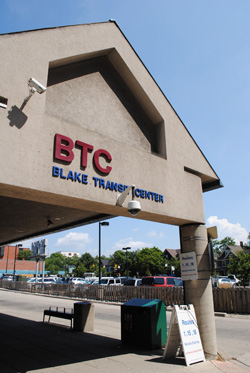
Blake Transit Center

The AATA's Blake Transit Center Fourth Avenue entry.

The latter item – authorizing AATA resources to support formation of an unincorporated Act 196 board (U196) – was approved without discussion. The resolution also authorized the board chair, Jesse Bernstein, to appoint three members to the U196 board.

In a related item, board members approved a $193,317 extension of AATA’s contract with Steer Davies Gleave (SDG), the London-based consultant hired last year to work on developing AATA’s transit master plan. SDG will work on implementing the plan – some board members indicated they’d like to see the consultant include more local resources as the process moves forward. The original contract with SDG was for $399,805. It was previously extended and increased at the AATA board’s Nov. 18, 2010 meeting by an amount not to exceed $32,500.

The infrastructure projects approved at the July 19 meeting include an expansion of AATA’s bus storage facility – in part to accommodate growth if a countywide transit entity is formed. Other projects entail replacement of bus hoists, a blanket contract for concrete work, and detention pond and landscaping improvements.

AATA board meetings are typically held on the third Thursday of the month, starting at 6:30 p.m. at the Ann Arbor District Library’s downtown boardroom, where the meetings are televised by Community Television Network (CTN). Tuesday’s special meeting, called in order to move ahead on some of these projects, began at 1 p.m. at the AATA headquarters on South Industrial, and was not videotaped. It was attended by more than a half-dozen AATA staff members, but not by CEO Michael Ford. Only four of the board’s seven members attended – it takes four members to make a quorum. [Full Story]

AATA OKs Support for Unincorporated 196

At a special meeting held on July 19, 2011, the Ann Arbor Transportation Authority board authorized appointment of three of its board members to serve on an unincorporated Act 196 board (U196), with the direction to move towards creation of an active Act 196 transit authority for countywide transportation. There was no discussion among board members on this item prior to their vote.

Act 196 of 1986 is a state statute that provides for creation of transit authorities that encompass wider geographic areas than just cities. It’s the legislation on which a countywide authority for Washtenaw County would likely be based. Under one proposal that has been presented by the AATA to various public bodies, a fully incorporated Act 196 board would have 15 members countywide, with seven of them coming from Ann Arbor.

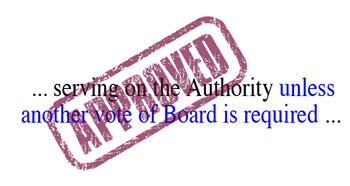
The rationale for appointing only three members of the current AATA board to the U196 board is to avoid the possibility that the actions of four or more members of the AATA board (a quorum of its members) as a part of the U196 would be understood as the action of the AATA board.

The same resolution authorized the AATA’s CEO to use AATA resources to support an unincorporated Act 196 board. The language of the resolution differed in a subtle but significant way from a draft resolution considered but not voted on by the AATA board at a meeting held on June 3 in a retreat-style format at Weber’s Inn. The draft language from that meeting read “… the AATA Chief Executive Officer shall use the resources of the Authority as needed and as appropriate …” The version of the resolution approved by the board at its July 19 meeting read “… the AATA Chief Executive Officer shall use the resources of the Authority as budgeted by the AATA Board.”

Recent Chronicle coverage: “AATA Finalizes Transit Plan for Washtenaw

This brief was filed shortly after the July 19 AATA board meeting, which took place at the AATA headquarters at 2700 South Industrial Highway. A more detailed report will follow: [link] [Full Story]

AATA Finalizes Transit Plan for Washtenaw

Ann Arbor Transportation Authority board meetings (June 3 and June 16, 2011): The AATA board met twice in June – first at a special morning retreat held at Weber’s Inn on  June 3 June 6, and again 10 days later for its regular monthly meeting.

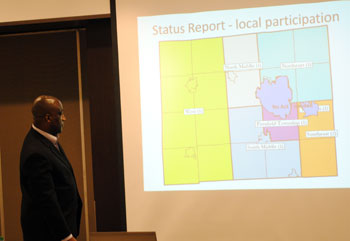
Michael Ford Slide Act 196 Local Participation

Michael Ford, CEO of the Ann Arbor Transportation Authority, presents a possible board configuration for a countywide transit authority at the board's June 3 meeting at Weber's Inn. (Photos by the writer.)

On both occasions, a significant focus was the AATA’s countywide transit master plan. At the June 16 meeting, the board approved the final version of the first two volumes of the plan, which had previously been released in draft form. The two volumes cover a vision and an implementation strategy. A third volume, on funding options, is not yet complete.

The plan is the culmination of over a year of work by AATA staff and a consulting firm to perform a technical analysis and gather public input. The goal was to create a document to guide transit planning in the county over the next 30 years. The timing of the next step – beginning to translate a neatly formatted document into reality – will depend in part on a third volume of the plan, which has not yet been finalized. The third volume will describe options for how to fund expanded transit service in the county. Countywide transit funding will ultimately be tied to the governance structure of some entity to administer transit throughout Washtenaw County.

And governance is a topic that’s ultimately reflected in the actual wording of the resolution that the board adopted at its June 16 meeting on the transit master plan. The resolution authorizes transmittal of the documents not just to the public, but also to an unincorporated board, described as an “ad hoc committee” that will work to incorporate a formal transit authority under Michigan’s Act 196 of 1986. [AATA is currently incorporated under Act 55 of 1963.]

For the last few months, CEO Michael Ford’s regular monthly reports to the AATA board about his activities have included his efforts to meet with individuals and representatives of government units throughout the county to discuss participation in the governance of a countywide transportation authority. June continued that trend. So wrapped into this combined report of the AATA board’s last two meetings is a description of the June 2 visit that Ford and board chair Jesse Bernstein made to the Washtenaw County board of commissioners.

At its June 3 retreat, the board also voted to shift some funding to the AATA staff’s work associated with the countywide transit master plan.

At its June 16 meeting, the board handled some business not specifically related to the transit master plan. The board adopted two policies that it has previously discussed: one on the rotation of auditors, and the other on a living wage for AATA vendors. They also received updates on the expansion of service to the University of Michigan’s East Ann Arbor Health Center and to the Detroit Metro airport.

Progress on those two fronts led board member David Nacht to suggest that the kind of movement and progress the AATA was demonstrating, even without additional money that could come from a countywide funding source, showed that the agency’s future plans deserved support from the community. [Full Story]

County Transit Governance Causes Concern

A tentative proposal for the governance structure of a countywide transit authority received strong disapproval from some Washtenaw County commissioners at their April 7, 2011 working session. A governance plan is being developed as part of a countywide master transit plan that’s been in the works for more than a year. [Chronicle coverage of AATA countywide planning to date: "'Smart Growth' to Fuel Countywide Transit"]

On Thursday, staff of the Ann Arbor Transportation Authority (AATA) and the Washtenaw Area Transportation Study (WATS) presented a possible transit authority board structure that would administer a countywide system. The proposed board would include 15 members, seven of them from Ann Arbor. [.pdf of proposed board seats] The assumption underpinning such a structure is that Ann Arbor and Ypsilanti would keep their current transportation millages, in addition to whatever countywide transit millage might be approved by county voters to fund an expanded transportation system. Before any countywide transportation millage would be put on the ballot, a countywide governance structure would first need to be established. It’s the countywide transportation authority board – likely to be incorporated under the state’s Act 196 – that would then place a countywide millage on the ballot.

Commissioner Wes Prater expressed serious reservations about the governance plan, and was “flabbergasted” that it had been developed to such an extent without input from the county board. One possible approach to creating a countywide transit authority would require the county board to ratify membership of a transit authority board, though the county would not be responsible for funding it or for putting a transit millage on the ballot. Commissioner Kristin Judge was concerned about putting too much of a financial burden on residents.

Terri Blackmore, WATS executive director, stressed that the plans were still in the early development stage and they were seeking feedback from elected officials in communities across the county. Another work session for county commissioners is scheduled on the topic on June 2.

This brief was filed soon after adjournment from the boardroom in the Washtenaw County administration building, 220 N. Main St., Ann Arbor. A more detailed report will follow: [link] [Full Story]

AATA Adopts “Smart Growth” as Plan Basis

At its March 17, 2011 meeting, the Ann Arbor Transportation Authority board voted unanimously to adopt a “Smart Growth” scenario as the basis of continued development of its transportation master plan (TMP). The Smart Growth scenario is the most ambitious of three scenarios the AATA has developed, which unfolded over the course of a planning and public engagement process that began in the summer of 2010.

Transit options in the three scenarios – which the AATA has labeled Lifeline Plus, Accessible County, and Smart Growth – are nested subsets, starting with Lifeline Plus as a base, which expands on existing services and focuses on services for seniors and disabled people. Accessible County extends services by adding fixed-route bus service to connect all the county’s urban centers. The Smart Growth scenario includes north-south and east-west commuter rail regional components, as well as high-capacity local transit options for corridors like Washtenaw Avenue and State-Plymouth.

Development of the TMP for countywide service has been identified by the AATA board as a necessary step to take before reorganizing the AATA as a transit authority for the entire county. In December 2009, the board held a special meeting to seek advice on various options for reorganization under Act 196 or Act 55. [Chronicle coverage "AATA Gets Advice on Countywide Transit"]

This brief was filed from the Ann Arbor District Library boardroom, where the AATA board holds its regular monthly meetings. A more detailed report will follow: [link] [Full Story]

AATA Gets Advice on Countywide Transit

Ann Arbor Transportation Authority special board meeting (Dec. 8, 2009): Late Tuesday afternoon at a special meeting, the AATA board heard from two consulting attorneys, as well as heads of three other Michigan transit authorities, on the subject of expanding the geographic scope of AATA service.

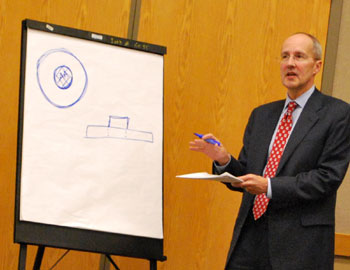
Jeff Ammons donut and layer cake

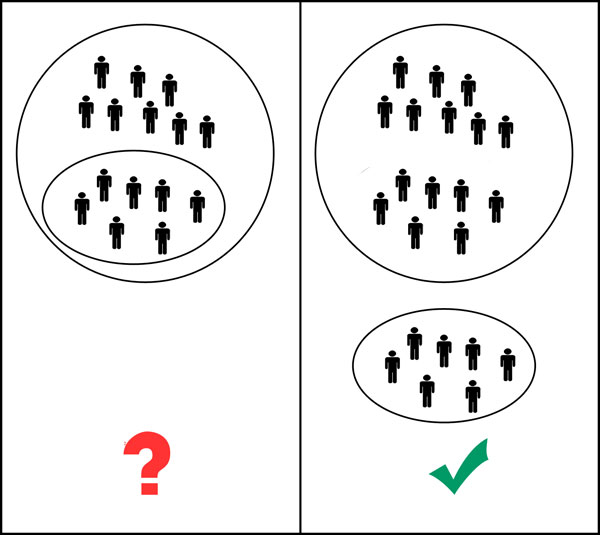
Jeff Ammons, a Grand Rapids area attorney who's been consulting for the Ann Arbor Transportation Authority, explains legal options for establishing an entity that could expand the geographic reach of AATA service. Millage options use the metaphor of "donut" (upper left) and "layer cake" (middle right). (Photo by the writer.)

The meeting of the full board, with their five guests, came on the heels of a planning and development committee meeting. At that committee meeting Chris White, AATA’s manager of service development, gave highlights from a recently completed survey of Washtenaw County voters on their attitudes towards a possible countywide transportation tax.

Those who said they would “definitely” or “probably” vote yes on a 1 mill countywide millage eked out a 51% majority countywide.

However, Bob Foy, general manager of Flint’s Mass Transit Authority, repeatedly reminded the full board at their meeting: To get a millage passed, you need a product you can sell. In Flint, which is a countywide authority, Foy reported that the last millage was approved with 68% of the vote.

What the expanded transportation product might look like for Washtenaw County is not yet clear. At the planning and development meeting, AATA CEO Michael Ford indicated that AATA would be bringing in a consultant to address that issue.

The message sent at the board meeting by the two consulting attorneys – Jerry Lax and Jeff Ammons – was that there’s a difference between (i) deciding on the legal authority to be formed, and (ii) deciding on the desired service that AATA wanted to offer. When the board knew what countywide service it wanted to provide and how it wanted to fund that service, they said, at that point it would make sense to decide on the legal mechanism for establishing an expanded authority.

That authority could be established legally under either of the state’s enabling acts: Act 55 or Act 196. [Full Story]

AATA Adopts Vision: Countywide Service

Ann Arbor Transportation Authority board meeting (Nov. 18, 2009): At its Wednesday meeting, the AATA board took the first of the steps that CEO Michael Ford had recommended at their meeting on Oct. 29: adopt a vision statement and start developing a plan for a countywide system. The board will continue to address Ford’s recommendations by holding  a special meeting on Dec. 8, at 5:30 p.m. at AATA headquarters to discuss formation of an Act 196 authority.

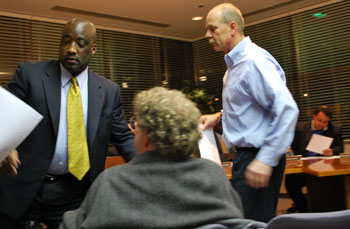
two men standing, one seated, papers getting passed out

Michael Ford, left, had extra copies made of the treasurer's report and distributed them to audience members. (Photo by the writer.)

The board’s resolutions were complemented by a treasurer’s report from Ted Annis that laid out a possible budget within which the countywide system could be designed. Presentation of that report revealed some conceptual differences among board members in their preferred approach to engaging an outside consultant to do the countywide system design: (i) Here’s a budget, now design the system; or  (ii) Design us a system, then tell us how much it would cost.

Key to the budget that Annis proposed was the assumed elimination of Ann Arbor’s transportation millage – on Annis’ assumption, Ann Arbor residents would pay the same countywide millage as other county residents if such a millage were approved.

In other business, the board approved service changes to Route #2 in northeast Ann Arbor.

Also generating discussion was the plan to repair, refurbish or reconstruct the Blake Transit Center in downtown Ann Arbor, which was described as “dilapidated.”

The board also received an explanation for the decreased ridership compared to last year, and a report on the move to different office space by the getDowntown program. [Full Story]

AATA Plans for Countywide System

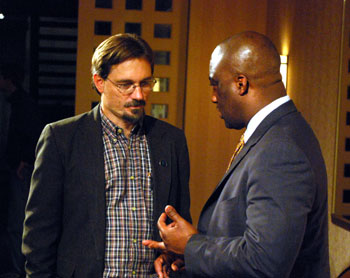
Charles Griffith and Michael Ford, two men standing together

Charles Griffith, AATA board member (left), and Michael Ford, CEO of the AATA, talk about Ford's presentation and the board's subsequent discussion after an Oct. 29 meeting. (Photo by the writer.)

Ann Arbor Transportation Authority board meeting (Oct. 29, 2009): At a special meeting of the AATA board held before dinner at Weber’s Inn, recently hired CEO Michael Ford gave board members a presentation that hammered home one basic point: The AATA needs to expand its current vision and mission by establishing a countywide transportation authority.

The AATA is currently funded by a millage levied at a rate of a little over 2 mill just in the city of Ann Arbor, with service to additional municipalities funded through purchase of service agreements (POSAs).

Board members were generally receptive to Ford’s presentation – David Nacht’s remarks reflected that this was essentially what they’d hired him to do. And to get things rolling towards an expanded, countywide mission for the AATA, Ford asked the board to adopt four specific resolutions in the coming few months. But when those resolutions are adopted, it’s not going to have an immediate impact on bus riders’ lives. As Nacht put it Thursday night, that’s simply “when the real work begins.”

And board member Rich Robben allowed that there were issues that he did not yet “feel that warm and fuzzy feeling about,” noting that ultimately the move to a countywide authority would need the support of the voting public.

After the jump, we take a look at the four specific steps Ford is asking the board to take, and summarize the board’s discussion on his proposal. [Full Story]

AATA Sets Meeting on Regional Authority

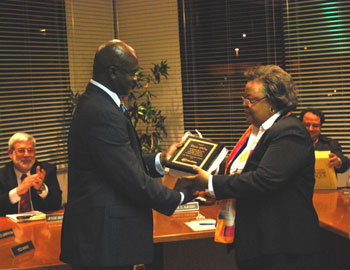
man giving plaque to woman

New AATA board chair Paul Ajegba presents a plaque of appreciation to Dawn Gabay, deputy CEO, who served for two years as interim director of the authority until Michael Ford was hired as CEO this past summer. In the background at left is board member Jesse Bernstein. To the right, opening a box containing his ceremonial gavel, is outgoing board chair, David Nacht. (Photo by the writer.)

Ann Arbor Transportation Authority board meeting (Oct 21, 2009): Some news of significance announced at the AATA‘s board meeting last Wednesday received relatively brief mention and discussion: There will be a special meeting of the AATA board at Weber’s Inn, on Thursday, Oct. 29, 2009 at 5 p.m. in the Varsity Room.

The topic of the meeting will be the possibility of reorganizing as a regional authority under Act 196. That meeting will be a precursor for the conversation about countywide service – and a countywide millage.

As far as the board’s business as reflected on Wednesday’s agenda, the item receiving by far the most discussion was one authorizing a contract for $171,704 for facility camera upgrades. Board member Rich Robben got an animated conversation rolling when he pointedly asked, “Was the bid spec written around a product line??” The board wound up authorizing the contract, with dissent from Robben and fellow board member David Nacht.

Putting a punctuation mark on the past year’s activity was the board’s new chair, Paul Ajegba, who presented the former chair, David Nacht, with a ceremonial gavel in appreciation of his service. Ajegba also presented deputy CEO Dawn Gabay with a plaque in appreciation for her service as interim director of the agency. [Full Story]