AAATA OKs Capital Program, Paratransit Deal
Ann Arbor Area Transportation Authority board meeting (Dec. 19, 2013): The last meeting of the year was attended by just five of the nine board members who are appointed and serving – and one needed to depart early. So to maintain a quorum, the meeting went by brisker than most. Even with a staff presentation on the capital and categorical grant program, the meeting concluded after about 45 minutes.

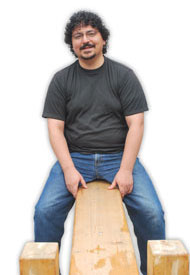
From left: Larry Krieg, Ann Arbor Area Transportation Authority’s newest board member, pending confirmation by the Ypsilanti Township board of trustees, and Eric Mahler, AAATA board member. (Photos by the writer.)
That capital and categorical grant program got a unanimous vote of approval at the Dec. 19 meeting. It’s a plan for spending about $45 million in federal funds over the next five years. According to the AAATA, this year’s plan does not include additional capital needs that would be associated with a five-year service improvement plan in the urban core, or any funding associated with rail initiatives. Having in place such a capital and categorical grant program – a set of allocations for specific categories of capital expenditures – is a requirement to be eligible for federal funding. [.pdf of 2014-2018 grant program]
The five-year service improvement plan could be implemented by the AAATA with funding that will likely be sought through an additional millage sometime in 2014. That would require approval of a majority of voters in the three jurisdictions making up the AAATA – the city of Ann Arbor, the city of Ypsilanti and Ypsilanti Township. The township became a member as a result of an Ann Arbor city council vote taken on Nov. 18, 2013.
The expected appointee to the AAATA board from Ypsilanti Township, Larry Krieg, attended the Dec. 19 meeting and sat at the table, although his appointment has not yet been confirmed by the township board of trustees. His confirmation did not appear on the township board’s Dec. 9, 2013 agenda. The next township board meeting is set for Jan. 21, 2014, which comes the week after the AAATA’s next regular meeting, on Jan. 16.
So Krieg did not participate in any of the votes taken on Dec. 19.
A significant vote taken by the board was to approve a nine-month extension of a contract with SelectRide through April 30, 2015, to provide paratransit service. The value of the contract for the extension period is $2.263 million. That’s essentially a pro-rated amount of SelectRide’s current contract, which ran through July 31, 2014.
The AAATA is currently preparing a request for proposals (RFP) with an eye to overhaul the concept of its paratransit service – which comes in the context of the possible five-year service improvement plan. Without a contract extension, that RFP would need to be ready for issuance in time to complete selection of a vendor by the time SelectRide’s current contract expires in July 2014. To avoid the possibility of an interruption in service, the AAATA board approved the SelectRide contract extension.
Other business items handled by the board included contracts for snow removal and janitorial services. [Full Story]