The Ann Arbor Chronicle masthead
it's like being there

Stories indexed with the term ‘Ann Arbor City Council’

Ann Arbor Cell Phone Ban Possibly Delayed

Ann Arbor City Council Sunday caucus (March 14, 2010): On the Ann Arbor city council agenda for Monday is the final vote on a proposed city ordinance banning cell phone use while driving. At a sparsely attended Sunday night caucus, Sabra Briere (Ward 1) and mayor John Hieftje indicated that a vote on the proposed cell phone ban would likely be postponed.

Other agenda items receiving some discussion were the public hearing scheduled on the Google Fiber initiative, plus a contract revision for Recycle Ann Arbor to perform single-stream curbside recycling using automated carts. [Full Story]

Budget Round 4: Lights, Streets, Grass

On March 8, the Ann Arbor city council held its fourth meeting since the start of the calendar year devoted to deliberations on the budget for FY 2011, which begins July 1, 2010. The council will make its final budget decision in mid-May after receiving a budget proposal from city administrator Roger Fraser in mid-April.

Sue McCormick

Sue McCormick, the city's public services area administrator, showed the city council a map of streetlights during Monday's meeting. (Photo by the writer.)

On Monday, Sue McCormick, public services area administrator, was front and center, describing for council how the public services budget “lives within the general fund.” The basis for the discussion was budget impact sheets prepared for the public services area, which she distributed.

Councilmembers had several questions for her about a possible special assessment district (SAD) to fund streetlighting, with much of the discussion centered around what it means for an area to be “overlit.” A streetlighting SAD would require property owners to pay for streetlights.

Also generating a fair amount of discussion among councilmembers was the $100,000 annual cost for traffic control on University of Michigan football game days and the city’s plan to reduce that cost through judicious rescheduling of personnel to avoid overtime expenses.

McCormick also pitched to the council the idea of relaxing the constraints of the “box” defining how the parks maintenance and capital improvements millage is administered. The proposal would have the council rescind the part of a previous resolution that requires millage funding for natural area preservation to increase by 3% every year. That savings, McCormick said, could be put towards hand-trimming of grass in the parks. Reduction of hand-trimming, she said, would have a negative visual impact on the parks – they’ll look “fuzzy.”

Also related to yard-waste type issues, McCormick briefed the council on the idea of eliminating collection of loose leaves in the fall, and moving to an approach requiring leaves to be put into containers. She also told them about  a proposal that would be coming before them in the next 30 days to transition the city’s composting facility to a merchant operation, similar to the city’s materials recovery facility (MRF) for recyclables. That proposal was met with strong criticism from Stephen Kunselman (Ward 3).

Councilmembers also heard from McCormick that residents will face a 3.88% increase in water rates, unless council directs that more budget cuts be made.

Towards the end of the meeting, city administrator Roger Fraser warned that accounting services manager Karen Lancaster and chief financial officer Tom Crawford would put them to sleep with an explication of how the city’s municipal service charge (MSC) works. However, Lancaster and Crawford were unable to make good on Fraser’s threat. [Full Story]

County Offers $400K Match for Skatepark

On Tuesday night at their regular monthly meeting, the Washtenaw County parks and recreation commission unanimously authorized up to $400,000 in matching funds for a skatepark being developed by the Ann Arbor Skatepark Action Committee (AASAC). The future location of the skateboarding facility is planned for the northeast corner of Veterans Memorial Park on the city’s west side.

Washtenaw County Parks and Recreation Commission

Three of nine parks and recreation commission members for Washtenaw County, who attended Tuesday's meeting. Front to back: Jimmie Maggard, Patricia Scribner and Robert Marans. Obscured is Bob Tetens, director of Washtenaw County Parks and Recreation. (Photos by the writer.)

The county’s parks and recreation program is funded by two separate, dedicated countywide tax levies at 0.25 mill apiece – for capital improvements and maintenance, respectively. The millages are separate from the county’s general operating millage.

The offer of matching funds came with the clear expectation from commissioners at the meeting that the county will be given its due – in terms of signage and participation in the project as it moves forward.

Bob Tetens, director of Washtenaw County Parks and Recreation, spoke at the meeting about the ability of the county to leverage the fundraising efforts of AASAC to achieve an $800,000 skatepark, instead of a $400,000 skatepark. For AASAC’s part, the plan all along was to build an $800,000 skatepark – plus establish a $200,000 endowment for maintenance.

The promised funds from the county will allow AASAC to leverage the match as part of their fundraising efforts. From that point of view, the timing of the county’s decision worked out to AASAC’s advantage. This Saturday, March 13, from noon-6 p.m. Red Belly Boardshop will sponsor The Grinds of March, a benefit for the Ann Arbor Skatepark fund to be held in a warehouse located at 704 Airport Blvd.

The Grinds will feature a pro skating demonstration by Garold Vallie and Andy MacDonald. MacDonald spent his summers in Ann Arbor, growing up skating.

The city of Ann Arbor has so far not offered dollars in support of the skatepark, but has approved use of the site, and struck a memorandum of understanding with AASAC. Ten out of 11 councilmembers also signed a letter dated March 8, 2010, urging the county’s parks and recreation commission to support the skatepark. [Full Story]

Ann Arbor DDA Barely Passes Budget

Ann Arbor Downtown Development Authority board meeting (March 3, 2010): The DDA board approved its $25 million budget for 2010-11 on Wednesday, but just barely. Four dissenting voices, plus mayor John Hieftje’s absence from the meeting, meant that the budget received the bare minimum seven votes required for approval by the 12-member body.

Keith Orr Map Man

The DDA board talked about more than just the budget. Who was that map man? As the nameplate says, it's DDA board member Keith Orr, who was introducing a draft of a bicycle map that the DDA is working on. (Photos by the writer).

Deliberations covered a range of issues. First, the budget needs to accommodate two major DDA capital projects: the underground parking garage currently under construction; and the Fifth Avenue and Division Street improvements, which are also underway.

Second, there’s a contingency written into the budget for $2 million. The contingency is there in case renegotiation of the parking agreement between the city and the DDA results in a continuation of the $2 million payments made by the DDA to the city for each of the last five years. Continuation of the payments is not legally required under terms of the current agreement, which assigns responsibility for administration of the city’s parking system to the DDA through 2015.

Third, the fund balances of the DDA – which reflect the DDA’s reserves – face a dramatic reduction. That’s an issue that city of Ann Arbor CFO Tom Crawford flagged back in the spring of 2009 during discussions about the construction of the underground parking garage. The concern caused the city council to scale back the size of the garage by 100 parking spaces.

And finally, decisions made by the DDA board over the last year have resulted in re-direction of revenues from two surface parking lots – 415 W. Washington and the old YMCA lot at Fifth and William – to the city of Ann Arbor. That has resulted in the elimination of line items for DDA programs for next year that were in this year’s budget.

Besides the budget, the board also discussed a number of other topics, including development of the Library Lot and results from two parking surveys. [Full Story]

To Do: Bicycle Registry, Transit Station

Ann Arbor City Council meeting (March 1, 2010) Part 2: Editor’s note: The major themes of the council meeting – the 3% budget directive, a ban on use of cell phones while driving, and a planned unit development called The Moravian – are covered in Part 1 of the March 1, 2010 meeting meeting report.

Larry Deck WBWC

Larry Deck, board member of the Washtenaw Bicycling and Walking Coalition, addressed the council during the public hearing on the repeal of the city's bicycle registration system. (Photos by the writer.)

The council scrapped the city’s existing bicycle registration program at its Monday night meeting, but gave an assurance to a representative of the Washtenaw Bicycling and Walking Coalition that it would soon be replaced with something better.

Mayor John Hieftje used his communications time to rebut criticism of the planned Fuller Road Station – both with respect to its funding and its siting. While he assured critics that funding for the project would not come from the general fund, he allowed that he did not know how the project would be paid for.

And Christopher Taylor (Ward 3) reiterated enthusiasm for Ann Arbor’s response to a request for information by Google about a local fiber-optic network. He had also introduced the topic at a recent council meeting focusing on the budget.

The city administrator’s report to the council included updates on construction projects.

The city also continued a monthly recognition of its parks volunteers with a mayoral proclamation honoring Praveena and Madhan Ramaswami for their efforts to improve Bromley Park by organizing biannual events to remove invasive plants, plant flowers, and clean up the park. [Full Story]

City Council’s Directive: 3% Cut for Workers

Ann Arbor City Council meeting (March 1, 2010) Part 1: Having postponed a resolution at its last meeting – which directed the city administrator to reduce wages of non-union workers by 3% – on Monday the council passed a revised version of it.

Tony Derezinski talking on a cell phone

Tony Derezinski (Ward 2), who co-sponsored a new ordinance banning use of cell phones while driving or bicycling. The ban does not apply to driving one's council chair before the meeting starts. (Photos by the writer.)

But it was approved without the support of the measure’s two sponsors, Marcia Higgins (Ward 4) and Stephen Rapundalo (Ward 2). The version adopted by council specified a 3% minimum cut in compensation packages, taken over the aggregate of non-union workers. By the time the resolution was passed, it had also shed a “whereas” clause that Christopher Taylor (Ward 3) called “self-laudatory.”

In development news, The Moravian – a planned unit development (PUD) proposed on East Madison Street – received unanimous council support at its first reading. Approval at two readings is required for final approval. But Stephen Kunselman (Ward 3) responded to a resident request made at the previous night’s caucus to give some clue at the first reading as to how councilmembers were thinking about the project: “I’ll be voting against it at second reading – so there’s no question in the community’s mind.”

Based on the Sunday caucus, The Moravian will face a protest petition, which raises the bar for approval from six to eight votes.

The council also wrangled through a proposed ban on cell phone use while driving and bicycling – at a level of detail unusual for a first reading. The measure had undergone enough revisions since it was approved at the council’s previous meeting that its status Monday was reset to a first reading. Dissent on the ban came from Sandi Smith (Ward 1), who questioned whether it should be undertaken at the local level – as opposed to the state. Marcia Higgins (Ward 4) also dissented, pointing to the fact that the ban did not include hands-free phones.

The council also transacted a variety of other business, including a repeal of the city’s bicycle registration program, which is to be replaced with a new system after further consultation with stakeholders. The bicycle registration program, as well as other business and announcements, will be wrapped up in Part 2 of this report. [Full Story]

The Moravian Goes Before City Council

Ann Arbor City Council Sunday night caucus (Feb. 28, 2010): The notion of a “first reading” permeated discussion in council chambers Sunday night among the five councilmembers and the half dozen residents who attended. Ordinances must be approved at two readings by the city council before they are enacted.

Tony Deresinski Stephen Kunselman Sabra Briere

At the Sunday Ann Arbor city council caucus, from left: Tony Derezinski (Ward 2), Stephen Kunselman (Ward 3) and Sabra Briere (Ward 1). Also attending the caucus from the city council were Mike Anglin (Ward 5) and John Hieftje (mayor). (Photo by the writer.)

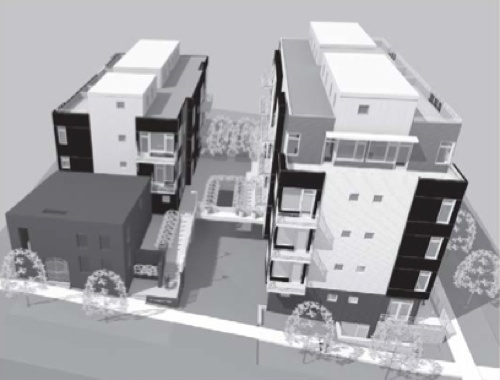
Due to receive its first reading on Monday night at the council’s regular meeting is The Moravian – a  five-story residential and work/live space planned unit development (PUD) along the 500 block of Fifth Avenue and the 200 block of East Madison. The project was given a recommendation for approval from the city’s planning commission on a 7-1 vote in January 2010. [Chronicle coverage: "Moravian Moves Forward Despite Protests"]

At Sunday’s caucus, some residents said they were keen to see a substantive discussion at The Moravian’s first reading, but councilmembers cautioned that the first reading was typically not the time when they argued a particular position. Residents indicated that they’d gathered enough signatures from surrounding land owners to meet a city code threshold that would force an 8-vote super-majority – out of 11 votes – at a second reading of the PUD proposal.

Also receiving a first reading on Monday will be a proposed ban on cell phone use while driving. The ban had already received approval on first reading at the council’s last meeting, but due to subsequent significant revisions to the ordinance language, it will be heard again Monday as a first reading. The council’s agenda indicates that the public hearing, generally held along with an ordinance’s second reading, has been canceled. That will be rescheduled to coincide with the second reading.

A budget directive – reducing all non-union staff salaries by 3% – had been postponed from the last council meeting and will be considered by the council on Monday in a slightly revised form. As a council resolution – as opposed to an ordinance – it will require just one reading. A key revision in the intervening postponement: It’s now a minimum 3% cut that’s specified, which leaves the door open for even greater cuts. [Full Story]

Budget Round 3: Where’s Your Emergency?

With limited success on Monday night, city administrator Roger Fraser prodded city councilmembers to confront the city’s budget impact statements. Each of the city’s service units had prepared the statements and made them available to the council a few weeks ago.

chief of police Ann Arbor Barnett Jones

Chronicle file photo from August 2009 of Barnett Jones, chief of police for the city of Ann Arbor. Jones was recounting for The Chronicle how the assigned budget exercise for FY 2010 – the current year – had begun with funding cuts that were equivalent to an elimination of 40 sworn officers. It didn't end that way – due to cost savings in other areas and an early-out retirement incentive. For FY 2011, the exercise began with funding cuts equivalent to 19 officers, which Jones says he's now been able to limit to 9-12 officers. (Photos by the writer.)

It was the third council meeting since the beginning of the year held to focus specifically on the budget, after the council’s budget retreat in December 2009.

In ballpark numbers, Ann Arbor faces a $5.2 million budget shortfall for FY 2011, which begins July 1, 2010. And even if every measure listed on the budget impact sheets is enacted, it would amount to $4.8 million in savings, leaving the city still almost $0.4 million short of balancing its budget.

The meeting did not include any discussion of possible other specific revenue sources, either in the form of payments from the Downtown Development Authority, a city income tax or a Headlee override. The Headlee option has been suggested in a recent “budget white paper” circulated by Sabra Briere (Ward 1), but only if certain conditions are met. Briere, along with Christopher Taylor (Ward 3) and Tony Derezinski (Ward 2), did not attend Monday’s meeting.

The meeting began with presentations on possible outsourcing of emergency management and IT functions at the city. Councilmembers as a group reflected the same lack of enthusiasm for outsourcing those functions as Barnett Jones, chief of police, and Dan Rainey, head of IT, had expressed in their respective presentations.

When mayor John Hieftje appeared ready to send everyone home without any discussion of the budget impact statements, Fraser reiterated a point he’d made earlier: His expectation was that council would discuss the budget impact statements – he had city staff on hand to answer any questions. The council indulged Fraser by quizzing Barnett Jones about the possible layoff of 9-12 sworn police officers. [Full Story]

Column: Chartering a Course Through Data

At the Ann Arbor city council’s Feb. 16 budget committee meeting, committee members were introduced to the city’s new data catalog. Even though it is only February, I think this will be the most significant project undertaken by the city in all of 2010.

Ann Arbor police service calls for Jan. 3, 2010. This map was built by The Chronicle in about 15 minutes using data from the city's online catalog. (Image links to fully interactive map hosted at http://www.batchgeocode.com)

At the same meeting, the budget committee also continued its discussion about the content of the monthly financial reports that the city charter requires the city administrator to provide to the council.

What ties these issues together is the idea that there’s information the city will be routinely pushing out, without anyone needing to make a special request for it.

In the case of the data catalog, it appears at first glance that the project is a kind of bonus for the citizens of Ann Arbor. That is, it could be thought of as something the city is not required by law to do, but which it’s doing anyway in the interest of transparent government.

That’s different from the monthly financial statement, which the charter explicitly requires. That issue came to the surface during the budget committee meeting, during a verbal exchange between Christopher Taylor (Ward 3) and the city’s chief financial officer, Tom Crawford. The exchange found Taylor appealing to an English word only rarely deployed as a verb: “I guess I’d stickle.” [Full Story]

Ann Arbor Council Delays Vote on Pay Cuts

Ann Arbor City Council meeting (Feb. 16, 2010): Looming budget decisions were a prominent part of the council’s meeting. Around a dozen speakers addressed the council during a public hearing on housing and human services needs – the input will be used by the office of community development in making recommendations for city general fund expenditures.

Jim Mogensen

Jim Mogensen, speaking about the University of Michigan shouldering a half-million-dollar cost for the Central Campus Transit Center that the city would ordinarily have paid: "Look, it's not free." (Photos by the writer.)

The approval of a contract extension for the city’s public art administrator generated a great deal of discussion – partly concerning the dollar amount of the contract – and was passed despite dissent from three councilmembers.

But the council postponed a resolution that would have cut the base salaries of the city administrator and the city attorney by 3%, and would have directed the administrator to cut the salaries of non-union employees by 3% as well.

Another prominent theme of the meeting was real estate and infrastructure. Council approved the acquisition of a property within the city limits – a portion of the Black Elk’s site on Sunset Road – using greenbelt millage funds. They also approved the capital improvements plan (CIP), modified to delete an item for the extension and shifting of a runway at the Ann Arbor municipal airport. [Full Story]

Budget Round 2: What’s the Big Idea?

On Monday night, the Ann Arbor City Council continued with the second in a series of extra meetings devoted exclusively to budget issues. Much of the discussion was a review of information that councilmembers had deliberated at their Jan. 25 meeting, when the focus was specifically on the community services area.

Tom Crawford and Roger Fraser

At left is Tom Crawford, the city's CFO. To the right is Roger Fraser, city administrator. (Photos by the writer.)

The community services area comprises the Ann Arbor Housing Commission, planning and development, human services, and parks/recreation. The council had chosen to focus on that area first, because of the community service area administrator’s imminent departure – Jayne Miller’s last day working for the city is Feb. 12, 2010.

But Miller’s new post as director of the Huron Clinton Metro Authority (HCMA) factored into some of the conversation on Monday, ranging from HCMA’s canoe rental fee structure, to the (remote) possibility that HCMA might take over some of the city of Ann Arbor’s parks. It was those larger scope issues the council was meant to address on Monday.

So at Monday’s meeting, city administrator Roger Fraser labeled the occasion as a time to talk about the “big ideas” the council had been presented at their December 2009 budget retreat. And councilmembers did eventually come around to start grinding through the list of ideas.

Rather than organize our account of the meeting based on that list, we’ve identified some themes that might provide an alternate framing of some of the budget challenges. We’ve formulated them as questions: (i) What are the basic philosophies? (ii) Should anything be held harmless? (iii) What do we do with our land? (iv) Is increasing revenue an option? [Full Story]

Column: Time to Take Down a Tree

Last week, city workers sawed down the last large street tree on our block – an old, rotting maple. I was unduly fond of it. I’ll miss its shade.

Chainsaw Guy

Chainsaw Guy

But it was time for that tree to come down.

The work took just a few hours – it seemed like a well-drilled crew. And because the tree is across the street from our home, I was able to watch.

I’ve written a lot of articles over the past year littered with words like “cut” or some unimaginative variation of it – “trimming costs” or “chopping expenses.” So I couldn’t help but see the dismemberment of this tree as a metaphor for what our local governments – our cities, the county, the schools – are going through.

It’s time for some trees to come down. [Full Story]

City Restarts 415 W. Washington Process

Ann Arbor City Council meeting (Feb. 1, 2010) Part II: In the first part of our report from Monday’s meeting, we covered the transportation and budget topics. This second part reports on land issues and other miscellaneous topics addressed at the meeting.

The vacant building on city-owned property at 415 W. Washington. This view is looking west – an entrance to a surface parking lot is in the foreground.

The vacant building on city-owned property at 415 W. Washington. This view is looking west – an entrance to a surface parking lot is in the foreground. (Photo by the writer.)

In its main land use business, the council approved a resolution to start a process for redeveloping the city-owned 415 W. Washington parcel. The resolution calls for the arts and greenway communities to lead fundraising and development of a vision for the parcel’s use. The site, across from the YMCA, is currently providing revenue to the city as a surface parking lot. It was previously the city’s maintenance yard.

Sandi Smith (Ward 1) convinced her colleagues to add language that would make any future use of the parcel cost-neutral with respect to the general fund. But a bid by Mike Anglin (Ward 5) to add a “citizens committee” to the mix was rejected.

And while council approved several deals under the city’s greenbelt program, it postponed consideration of another – in the area of the Bluffs park and the Black Elks lodge on Sunset. The postponement was prompted by concern from Marcia Higgins (Ward 4) that the property’s appraised value seemed too high.

The council also extended an emergency moratorium on demolition and other work in a historic district study area south of William along Fourth and Fifth avenues, and adjusted permissible on-street parking locations along Baldwin Avenue in the Burns Park neighborhood.

And the council took time to thank some volunteers for its Adopt-a-Park program. The volunteers who were recognized at the meeting helped out at Ann Arbor’s parks through CHS Group Inc. [Full Story]

Council Talks Transportation, Budget

Ann Arbor City Council meeting (Feb. 1, 2010) Part I: Transportation was a major theme woven throughout Monday’s city council meeting – in part due to a presentation the council heard from SEMCOG’s Carmine Polombo about the Detroit-Ann Arbor commuter rail project. Trains are supposed to begin rolling toward the end of 2010, but Polombo’s presentation made clear that early service would be very limited – day trips and special events – and there are a huge number of unknowns.

Ann Arbor municipal airport

Sol Castell was asked to the podium by Stephen Kunselman (Ward 3) to give an alternate view on the need for a runway extension at the Ann Arbor municipal airport. The topic came up during discussion of the city's capital improvements plan, which wound up being postponed. (Photos by the writer.)

But trains weren’t the only transit-related thread. The city’s bicycle ordinances were updated after having been postponed for a couple of meetings, and a revision to the city’s bicycle registration procedure was tabled and now appears to be on indefinite hold.

The council also approved on first reading a revision to its taxicab ordinance, designed to enforce expectations of larger cab companies.

Also related to transportation was discussion of an item in the capital improvements plan (CIP) for a runway extension at the Ann Arbor municipal airport. After Stephen Kunselman (Ward 3) got his colleagues’ support to amend the CIP to delete the item, the council then voted, with some grumbles of dissent, to postpone consideration of the CIP.

Times and dates for upcoming meetings on the budget were also reviewed, with city administrator Roger Fraser telling councilmembers that the list of possible areas for cuts that city staff had generated were not the only items that could be considered. He challenged councilmembers to come up with their own ideas as well. The council received specific recommendations for budget strategies for the senior center and Mack Pool.

In Part I of the report, we restrict our focus to transportation and budget issues. In Part II, we’ll cover land use issues – including the resolution on 415 W. Washington, which we previewed in our report on the Sunday night caucus, plus a postponement on a greenbelt acquisition. [Full Story]

Skepticism on 415 W. Washington Measure

Ann Arbor City Council Sunday caucus (Jan. 31, 2010): At its Sunday night caucus, four city councilmembers heard thoughts from residents on a range of topics. In attendance were John Hieftje (mayor), Sabra Briere (Ward 1), Stephen Kunselman (Ward 3) and Mike Anglin (Ward 5).

Much of the conversation focused on a resolution added to the council’s Monday agenda on Friday, which calls for restarting a process to develop a city-owned parcel at 415 W. Washington. The land is currently used as a surface parking lot – net revenues from that lot were recently adjusted so that they go to the city of Ann Arbor, not the Downtown Development Authority.

Caucus attendees were generally skeptical about the 415 W. Washington resolution on the council’s agenda. They said it was merely a diversionary tactic to distract attention from the Library Lot, another city-owned property where some are advocating for an urban park. Hieftje disavowed the idea that there was a trade-off – open space at 415 W. Washington, but no urban park at the Library Lot. Hieftje left the Library Lot decision as still open, saying that he “would bet” that none of the submitted proposals would be adopted by the council.

Caucus conversation covered a range of other topics, including: golf, historic districts, and design guidelines for new construction in downtown Ann Arbor. [Full Story]

Column: Getting Smarter About City Charter

Recently the committee charged with reviewing the responses to the city’s RFP for development of the Library Lot met to discuss two days’ worth of public interviews with proposers. The “news” out of that meeting was that the committee set aside three of the five proposals, leaving just two – both of which are concepts for a hotel/conference center.

Nearly escaping notice at that meeting was an exchange between Stephen Rapundalo, who chairs the committee, and senior assistant city attorney Kevin McDonald. The brief interaction came towards the end of the meeting’s work, as the next set of tasks for specific committee members was formulated. Rapundalo asked that McDonald provide a legal opinion. McDonald replied politely, but pointedly, that he’d provide advice, not an opinion.

Why does McDonald care about the difference between providing advice versus an opinion?

McDonald’s concern is based on a fundamental misunderstanding on the part of the city attorney’s office, led by Stephen Postema, about what Ann Arbor’s city charter requires of its city attorney.  [Full Story]

Budget Round 1: Community Services

In the first of a series of meetings on the budget, the Ann Arbor city council on Monday heard from community services area administrator Jayne Miller, who gave a presentation on her part of the city budget, based on information councilmembers had requested at the council’s Dec. 5, 2009 budget retreat.

Mary Jo Callan Jayne Miller

Mary Jo Callan, left, head of the city/county community development office, and Jayne Miller, the city of Ann Arbor's community service area administrator.

As to possible measures that could affect the FY 2011 budget, which begins July 1, 2010, Miller focused on several areas: (i) reorganizing the housing commission; (ii) reducing the scope for planning projects and outsourcing planning review and/or collaborating with other municipalities for construction inspection, (iii) cutting human services funding, (iv) reducing maintenance for specific parks and changing the parks maintenance/improvements millage resolution, which specifies how the millage money is allocated.

Some possibilities that were mentioned – but described as unlikely to have an impact on the FY 2011 budget – included allowing a private vendor to operate Huron Hills Golf Course as a combination driving range (where the front nine holes are currently located), plus a 9-hole golf course.

Specific parks were also identified in Miller’s report that would be recommended for sale – if parkland sale were to be used as a strategy. However, that too, said Miller, would be unlikely to have a short-term impact for two reasons: the sale of parkland requires a voter referendum, and the market for land is currently uncertain, given the overall economic climate.

The presentation also served as a bit of a tutorial on which parts of the city’s operations Miller administers, in a job she’ll be leaving on Feb. 11. Sumedh Bahl, unit manager of the water treatment plant, was also on hand Monday night – he’ll be filling in for Miller on an interim basis. [Full Story]

Hotel/Conference Center Ideas Go Forward

On Thursday evening, the city of Ann Arbor’s committee reviewing proposals for the Library Lot decided to continue consideration of only two of the five proposals remaining. A sixth proposer had formally withdrawn before the interviews.

Sam Offen Margie Teall

Sam Offen makes an argument for bringing along Dahlmann's park proposal to the next phase of consideration – he was not successful in convincing his colleagues to do so. At right is Ward 4 councilmember, Margie Teall. (Photos by the writer.)

After the meeting, eight people crammed into an elevator on the sixth floor of city hall, where the committee had met. The eight included The Chronicle, two councilmembers on the committee (Stephen Rapundalo and Margie Teall), along with Alan Haber – who had helped put forward the Community Commons, one of the proposals eliminated by the committee.

As the elevator doors closed us in for the trip down to the lobby, Haber mused that here in the elevator, we had, for a brief moment, a commons.

The committee’s decision had come after two days of public interviews earlier in the week when each proposer was given 30 minutes for a presentation, 30 minutes to respond to questions from the committee, and 30 minutes to respond to questions from the public. The interviews took place on Jan. 19-20 and were followed by a public open house on the evening of Jan. 20.

At the Thursday evening committee meeting, Stephen Rapundalo, the committee’s chair, reported that the request for qualifications sent out by the city to provide consulting services on the remaining proposals – the hotel/conference center proposals by Acquest and Valiant – had resulted in seven responses. The next meeting of the committee will take place on Feb. 16 from 10 a.m.- noon. Letters will be sent to the three proposers whose projects will not be given further consideration by the committee. [Full Story]

Council OKs Firefighter Deal, 911 Center

Ann Arbor City Council meeting (Jan. 19, 2010): The Ann Arbor city council approved an agreement with the local firefighters union that reduces pay by 3% to ensure that no firefighters will be laid off before June 30, 2010.

Pam Byrnes and Karen Sydney

State Rep. Pam Byrnes, left, and Karen Sidney talk before the start of the city council's meeting, which included a presentation at the start of the meeting from Byrnes. (Photos by the writer.)

And, in a move that some councilmembers described as leadership, mayor John Hieftje announced that he was writing a check for $1,273 as a contribution back to the city, because that’s the equivalent of 3% of his annual salary – the same percentage conceded by the firefighters union. It’s also the same percentage Hieftje has suggested that all employees citywide accept as a wage reduction. Some councilmembers indicated they’d be making similar gestures, which they allowed were only symbolic.

The city council also approved a budget increase for the 911 call center modification, a project to facilitate co-location of the city and county 911 centers – it’s expected to be a cost-savings measure.

Council also directed the city administrator, Roger Fraser, to plan an event to honor volunteer members of various boards, commissions and committees that do much of the work required to make the city run.

In other business, the council approved without discussion a University of Michigan project for the soccer complex on South Main Street.

State Rep. Pam Byrnes (D-District 52) gave a presentation to the council at the start of the meeting outlining exactly how bleak the economic outlook is in Michigan.

Many of the items on council’s agenda were postponed: revisions to bicycling and pedestrian ordinances (including bicycle registration); revisions to parking fines; and the capital improvements plan.

And two of the items were pulled from the agenda at the start of the meeting: a revision to the ordinance on signs and outdoor advertising to allow portable signs; and a resolution to approve the transfer of a liquor license to BW&R GoBlue LLC, located at 640 Packard Street. [Full Story]

Ann Arbor’s Budget Data to Go Online

Ann Arbor City Council Budget Committee (Jan. 19, 2010): Sometime within the next two months, Ann Arbor city councilmembers and Ann Arbor residents – or anyone, for that matter – can expect to start getting access to raw data files of all city financial transactions.

Budget Committee Posting

Posting of the budget committee's Tuesday meeting.

At a meeting of the Ann Arbor city council’s budget committee, the city’s chief financial officer, Tom Crawford, sketched a plan to start making available a wide range of raw data from the city, starting with numbers from the finance department. Crawford said he hopes to have a pilot in place by the end of February.

Budget committee members also discussed what the contents of a monthly statement should be that will now be provided to the committee and to the council as a body – such a report is required by the city’s charter.

The other main point addressed by the budget committee was raised by city administrator Roger Fraser, who suggested to councilmembers that they owed it to the community to put the question of a city income tax before the voters. Fraser said they had a responsibility to float the question, regardless of what their personal feelings were on the issue.

The meeting was also attended by Mayor John Hieftje, who is a member of the city council, but no longer part of the 5-member budget committee – the council reorganized its committee structure at its Dec. 21, 2009 meeting. Hieftje participated in deliberations on the question of when a city income tax ballot question might feasibly go on the ballot. [Full Story]

Library Board Gets Update on Library Lot

Ann Arbor District Library board meeting (Jan. 18, 2010): The Ann Arbor District Library doesn’t own the property known as the Library Lot, adjacent to its downtown building, but what’s happening there will have a direct impact on the library’s future.

Roger Fraser, speaking at Monday's meeting of the Ann Arbor District Library board. (Photos by the writer.)

Roger Fraser, speaking at Monday's meeting of the Ann Arbor District Library board. (Photos by the writer.)

So while the library board won’t be making decisions about the city’s quest for a development there, they had plenty of questions about how it’s proceeding. At Monday night’s library board meeting, city administrator Roger Fraser was on hand to answer those questions and give an update on the Library Lot RFP process – interviews for potential developers are being held this week.

The lot – where an underground parking structure is now being built – was also the topic addressed by the only speaker during public commentary, who urged the board to keep an open mind about the development that might be built on top of the site. The comment prompted board member Prue Rosenthal to respond: “You know that we’re not in charge of this, right?” [Full Story]

Initial Vote Set for Mack Pool, Senior Center

The entrance to Mack Pool, located at the Ann Arbor Open @ Mack school at the corner of Miller and Brooks.

The entrance to Mack Pool, located in the Ann Arbor Open @ Mack school at the corner of Miller and Brooks.

At its Tuesday meeting, the Ann Arbor Park Advisory Commission will consider recommendations that would cut costs and raise revenue for Mack Pool and the Ann Arbor Senior Center, with the goal of keeping both operations open. If approved by PAC, the recommendations would be forwarded to city council.

Last spring, city administrator Roger Fraser proposed closing both the pool and the senior center, as part of a larger effort to address the city’s general fund budget deficit. Both entities cost more to operate than they generate in revenues, and are subsidized by the general fund.

Council subsequently created task forces to look at how more revenues could be raised and expenses cut from those operations. City staff held public meetings in December to present the initial recommendations from the task forces. [See Chronicle coverage: "More Options for Ann Arbor's Mack Pool" and "Task Force Tries to Save Senior Center"]

At its Tuesday meeting – which begins at 4 p.m. and includes time for public commentary – park commissioners will discuss and possibly revise those recommendations, before voting on whether to send them on to city council. The meeting is held at the county administration building, 220 N. Main St. After the jump, we provide a summary of the proposals. [Full Story]

Fraser Acted Against Advice on Proposal

Ann Arbor City Council Sunday caucus (Jan. 17, 2010): Conversation among councilmembers and residents on Sunday night yielded some additional historical insight into development plans for the Library Lot above the underground parking garage, which is currently beginning construction.

Stephen Rapundalo (Ward 2) revealed that when city administrator Roger Fraser mentioned an unsolicited development proposal at the city council budget retreat in January 2009, he had acted against the advice of members of the council’s budget and labor committee. The committee had become aware of the proposal’s existence prior to the retreat, Rapundalo reported, and when they did, “We said that should be put away on a shelf somewhere. … (but) Roger chose to mention it at the retreat.” Rapundalo also added that while some councilmembers had seen the unsolicited proposal, he had not.

Sabra Briere (Ward 1) recalled a phase in the community conversation about the future of the city-owned Library Lot that predated the January 2009 budget retreat. It was a time when the discussion centered on leaving the top of the parking structure as a temporary surface parking lot while its eventual, more permanent fate was considered – still a possibility, based on Sunday’s caucus discussion.

Besides the Library Lot, residents who attended caucus touched on other issues – the city council’s role in city governance, and the capital improvements plan for the year, which is on the council’s Tuesday night meeting agenda. Council is meeting on Tuesday, rather than its usual Monday schedule, because of the Martin Luther King Jr. holiday. [Full Story]

Housing Commission Reorganizes

Ann Arbor City Council work session (Jan. 11, 2010): Ann Arbor city councilmembers were presented on Monday evening with an outline for the reorganization of the city’s housing commission, a plan that has in large part already been adopted by the commission and needs no further city council approval.

The housing commission is responsible for 355 public housing units spread over 18 sites – or around 50% of the affordable housing stock in the city – plus 1,300 Section 8 vouchers for a three-county area.

computer screen with housing commission slide show

Kerry Laycock, the consultant who gave the city council a presentation on the reorganization of the housing commission, gave a slide presentation from the podium using this laptop computer. (Photos by the writer.)

Keys to the reorganization are beefing up the Section 8 program with a dedicated financial analyst and a program manager, and redefining roles of the executive director and deputy director, as well as outsourcing maintenance of the housing units.

Outsourcing maintenance will reduce the housing commission staff by six people – two temporary employees plus four union workers.

Alan Levy, who chairs the housing commission board, told councilmembers that the reorganization had already been approved by a 3-2 vote of the housing commission’s board at a special meeting held on Jan. 6, 2010. [Full Story]

Library Lot Math: 6 – 2 + 2 = 6

At its Friday morning meeting, the committee responsible for evaluating development proposals for the Library Lot agreed to reconsider two of the proposals previously rejected.

Samm Offen Jayne Miller

Sam Offen reads a section of the Library Lot RFP that he interpreted to mean that financial considerations should come later in the process. At right is Jayne Miller, community services area administrator. (Photos by the writer.)

The suggestion for reconsideration had been brought to the committee by two of its members, Margie Teall and Stephen Rapundalo, who also serve on the city council.  Monday’s city council meeting had included conversation about the issue.

The committee will now re-include in the interview process the two proposals it had eliminated at its December meeting. Representatives for all six proposals to develop the top of the Fifth Avenue underground parking structure will be interviewed in a little less than two weeks. On Jan. 19, the two that had been dropped previously – proposals that call for predominantly open space in that area – will be interviewed, followed on Jan. 20 by interviews of the other four proposers.

Related to this process, at its Wednesday meeting the Downtown Development Authority had approved up to $50,000 for a consultant to assist with the review of proposals. So on Friday, the committee was also briefed on the request for qualifications (RFQ) for the consultant, which has now been released – and no candidates with operations in Washtenaw County will be considered. [Full Story]

Mixed Message from Council on Library Lot

Ann Arbor City Council meeting (Jan. 4, 2010): Ann Arbor’s city council rejected a resolution on Monday night that would have asked responders to the city’s request for proposals on the Library Lot to provide more information to the council, even if their proposals had been eliminated.

Rupundalo and Briere

Stephen Rapundalo (Ward 2) explains the work of the RFP review committee for the Library Lot proposals, as Sabra Briere (Ward 1) listens. (Photos by the writer.)

At the same time, the council’s representatives to the RFP committee – Stephen Rapundalo (Ward 2) and Margie Teall (Ward 4) – told their colleagues that they would bring to the committee the suggestion of re-including two already-eliminated proposals.

That idea will be floated to the committee when it next meets, on Friday, Jan. 8 at 9 a.m.

In other business, councilmembers grilled the city’s transportation program coordinator about revisions to the city’s bicycle and pedestrian ordinances to align with the Michigan Vehicle Code. Despite that, council sent the revisions on to the next step towards final approval.

The council also authorized a vote to be held among property owners to establish a business improvement zone (BIZ) on Main Street between William and Huron streets. That’s the next step in a multi-step process for establishing the BIZ, which allows property owners to levy an additional tax on themselves to use for specific services.

The council also heard a presentation on the city’s snow removal policy from Craig Hupy, who’s head of systems planning for the city. Councilmembers heard little enthusiasm from city administrator, Roger Fraser, for any deer removal program for Ann Arbor.

Fraser also announced that the city’s community services area administrator, Jayne Miller, would be leaving her city post to head up the Huron-Clinton Metropolitan Authority, which oversees regional metroparks, sometime in the next month. [Full Story]

Library Lot: Choice Between Apples, Pears?

Ann Arbor City Council Sunday caucus (Jan. 3, 2010): As construction gets started on the underground parking garage on the former surface parking lot next to the downtown library, the city of Ann Arbor is trying to answer the question: What goes on top?

Tangerine Tower is not an alternate proposal for the Library Lot development. But in providing art to accompany an article, sometimes you go to press with the fruit you have, not the fruit you wish you had.

Tangerine Tower is not an alternate proposal for the Library Lot development. But in providing an illustration to accompany an article, sometimes you go to press with the fruit you have, not the fruit you wish you had.

A committee appointed to review the proposals submitted for the city-owned parcel, known as the Library Lot, recently dropped two of those proposals from consideration. [Chronicle coverage: "Two Library Lot Proposals Eliminated"]

The two proposals – one from Ann Arbor residents Alan Haber and Alice Ralph, and the other from a local developer, Dahlmann Apartments Ltd. – both envision the top of the underground garage primarily as open space.

At Sunday’s city council caucus, seven supporters of an open-space use for the Library Lot outnumbered the four councilmembers who attended: Sabra Briere (Ward 1), Stephen Kunselman (Ward 3), Mike Anglin (Ward 5) and mayor John Hieftje.

Conversation at caucus was devoted almost exclusively to the RFP (request for proposals) process and dissatisfaction with its preliminary outcome. On the council’s Monday night agenda is a resolution sponsored by Briere that seeks – “delicately,” in Briere’s words – to address some of that dissatisfaction.

Briere likened the winnowing down of the alternatives in advance of public participation to asking someone if they’d like an apple or a pear – you might get a different answer, she said, if you ask, “What kind of fruit would you like?” Maybe, she said, people want grapefruit. [Full Story]

Budget Crunch Backdrop Drives Council

Ann Arbor City Council meeting (Dec. 21, 2009) Part II: In Part I of our report, we handled two meeting topics clearly related to the looming budget shortfall: public art expenditures and parking revenue.

members of firefighters local union

Members of International Association of Firefighters Local 693 waited past midnight until their president finally was able to take his turn at public commentary during unreserved time at the end of the meeting. (Photo by the writer.)

Two rows of firefighters from the International Association of Firefighters Local 693 – layoff notices have already been sent to some of them – sat in the audience through the whole meeting, which lasted until midnight.

Like the firefighters, sitting at least in the background of nearly every item on the agenda, were the looming budget issues that the city council faces.

When they came to the foreground, the concerns about the budget managed to connect topics as seemingly disparate as Verizon antennae and parking revenues.

Even a garden-variety contract with a consultant for the greenbelt provoked some brief discussion related to the budget shortfall.

The impetus behind the council’s committee reorganization was again … the budget. What was previously one budget and labor committee was split into two committees: (i) the budget committee, and (ii) the labor committee, which is now combined with the council administration committee. That reorganization was pitched as a way to allow representation from each ward on the five-member budget committee.

Councilmembers and the city administrator also made robust use of the communications section of the agenda to provide status updates on their recent work – much of it related to efforts to identify new revenue streams and ways to cut expenses as part of the effort to meet budget goals.

In other business, the purchase of carts for single-stream recycling was authorized, plus an energy grant totaling over $1 million was accepted. [Full Story]

Council: Art Key to Ann Arbor’s Identity

Ann Arbor City Council meeting (Dec. 21, 2009) Part I: Ann Arbor’s city council meeting lasted past midnight, as the council concluded the evening with a closed session on labor negotiations. The apparent focus of that closed session was the possibility that an agreement could yet be struck with the firefighter’s union that would prevent the layoff of firefighters who’ve already received letters of termination that would end their service to the city on Jan. 4, 2010.

public art line up for public hearings

Members of the public line up for the public hearing on the Percent for Art program. (Photos by the writer)

What pushed the council meeting into the wee hours, however, were the topics of art and parking.

Several members of council backed off their previous support for a reduction in public art funding. The Percent for Art program was left at its full funding level. The council also approved a contract for management services for the Dreiseitl art project to be installed as a part of the new municipal center – amid legal concerns raised by Stephen Kunselman (Ward 3).

Also, the council ultimately approved a heavily amended version of a resolution on parking that Sandi Smith (Ward 1) had added to the agenda on the previous Friday, which left the intent of two key “Resolved” clauses largely intact: (i) the city will get revenues from a surface parking lot, and (ii) the city’s plan to install its own meters has been braked indefinitely. A third clause that would have extended downtown meter enforcement to 10 p.m. was swapped out in favor of one that is less specific.

The council attended to a variety of other matters, including its new committee organization, authorization of purchases connected to single stream recycling, and acceptance of an energy grant. Councilmembers and the city administrator also made robust use of the communications section of the agenda to provide status updates on their recent work.

In Part I of our council report, we focus on art and parking. [Full Story]

Caucus Creatures Stir: Parking, Library Lot

Ann Arbor City Council Caucus (Dec. 20, 2009): On the night before council’s Monday meeting, it was a quiet caucus, attended by a perfect balance of three councilmembers and three residents. The meeting had more the flavor of a chat in someone’s living room.

But residents still stirred the pot – on the issue of extended hours of parking enforcement as well as development proposals for the Library Lot.

The parking issue is part of a more complex resolution that the council will consider on Monday night, but possibly postpone, based on comments at caucus made by Mayor John Hieftje. A separate, but related item on the agenda calls for the purchase of parking equipment for installation on Wall Street at a cost of $87,000.

Receiving no discussion at the caucus was the second reading of the resolution that would reduce the Percent For Art program to a Half-Percent for Art program for the next three years. The resolution passed on its first reading at the council’s previous meeting.

Also receiving no discussion was the first project to be funded through the city’s public art program – a sculpture by German artist Herbert Dreiseitl proposed for for installation outside the new municipal center currently under construction. Council had been expected to have the approval of the Dreiseitl project on its agenda in November, but that expectation then shifted to the Dec. 7 council meeting. It was further shifted to the meeting on Monday, Dec. 21. And now it appears that the Dreiseitl vote will not be taken until sometime in 2010. [Update: The Dreiseitl project was added to the agenda at just after 11 a.m. Dec. 21, 2009.] [Full Story]

» Text size:

larger text default text smaller text

Skyclock