Stories indexed with the term ‘audit’

2011: Ann Arbor $1.6M Better than Planned

Editor’s note: Before this article was finalized for publication, it was inadvertently posted for a brief time, then removed from the website. Between versions, some added material gave more precision to the planned expenditures and use of fund balance in the city of Ann Arbor’s FY 2011 budget.

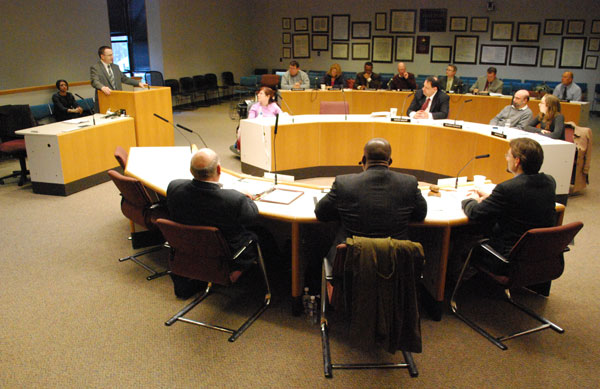
Ann Arbor city council audit committee 2011

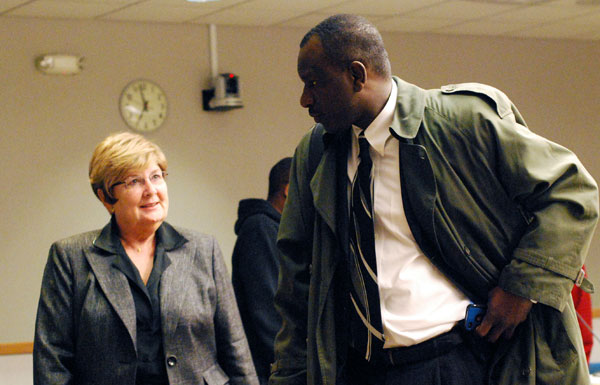
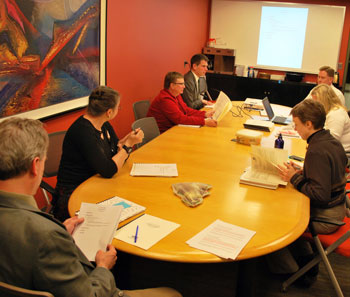
The Ann Arbor city council audit committee met on Dec. 19 to review the audit for FY 2011, which ended June 30, 2011. Clockwise, starting with Stephen Kunselman (Ward 3), with his back to the camera, are Sabra Briere (Ward 1), Sandi Smith (Ward 1), city administrator Steve Powers, auditor Alan Panter, accounting services manager Karen Lancaster, and Margie Teall (Ward 4). Carsten Hohnke (Ward 5) was absent. (Photo by the writer.)

In mid-December, the audit committee of the Ann Arbor city council received what could be considered good news from the final audit for the last fiscal year. It was clean. The city also managed to add incrementally to its fund balance, instead of using more than $1 million from that balance, which it had anticipated doing.

The council’s audit committee met on Monday, Dec. 19 at 6 p.m. just before the council’s last meeting of the year, which started at 7 p.m. Last year, the committee did not meet at all, a point of complaint made by committee member Stephen Kunselman (Ward 3) at a recent council meeting.

Alan Panter of the accounting firm Abraham & Gaffney, P.C. presented the audit committee with an overview of his findings for fiscal year 2011, which were summarized in the report as “an unqualified (‘clean’) opinion on the City of Ann Arbor financial statements for the year ended June 30, 2011.”

One finding that was not deemed a “material weakness” – but was nonetheless described as a “significant” deficiency in internal controls – involved adequate documentation of employee purchase card (P-Card) use. It’s an issue familiar to the city from previous audits.

In terms of the overall financial state of the city, as reflected in the audited numbers, the city added around $127,000 to its general fund balance.

That’s significant, because the city council-approved FY 2011 budget had anticipated drawing around $1.5 million from the fund balance reserve to help cover about $81.5 million in planned general fund expenditures. So on balance, the city appears to have done at least $1.6 million better than it had planned for FY 2011. No single factor was identified during the audit committee’s discussion to account for the better performance.

At the end of FY 2011, the city’s fund balance reserves stood at around 13.6% of expenditures – which is within the range of 12-15% that Panter said was recommended.

The audit committee’s discussion included the fact that the city’s audit is required by the city charter to be completed by Sept. 30 each year – within 90 days of the end of the fiscal year. This year’s audit was not completed until Dec. 9. Based on discussion among the audit committee members and accounting services manager Karen Lancaster, missing the charter’s deadline has become routine. Lancaster indicated that the first year she’d worked for the city, in the early 1990s, that deadline had been met.

In order for the city’s overall audit to be completed, the audits from the component units have to be done first. Lancaster attributed at least part of the now-routine delay to the fact that two such units – the Ann Arbor Downtown Development Authority and the city employees’ retirement system – have their own accounting staff. That was not the case when she first began working for the city. Because the auditor first works with those separate staff to complete their individual audits, the overall process is slower than it might otherwise be, she said.

The audit committee voted to recommend acceptance of the auditor’s report.

Based on its responsibilities described in the 2006 council resolution creating the committee, next up for committee members in 2012 will be working to come up with a recommendation on the selection of an auditing firm – the contract with Abraham & Gaffney expires with this year’s audit. [Full Story]

DDA Wraps Up Parking Rate Hearing, Audit

Ann Arbor Downtown Development Authority board meeting (Dec. 7, 2011): At its last monthly meeting of the year, the DDA board continued a public hearing on proposed parking rate changes that it had begun at its November meeting. Only two people appeared for the continued hearing on Wednesday – nine people had addressed the board for its Nov. 2, 2011 meeting.

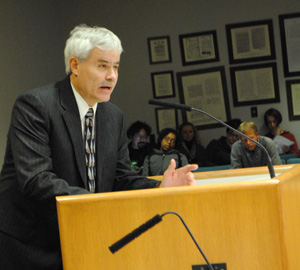
Nassif, Gunn, Hieftje

Front to back: Ann Arbor Downtown Development Authority board members Nader Nassif, Leah Gunn, John Hieftje. (Photos by the writer.)

The board will not vote on the rate increases until its Jan. 4, 2012 meeting. Some of the rate changes are scheduled for implementation in February 2012, but the increases affecting most downtown Ann Arbor parkers would not be implemented until September 2012. The September changes include an increase from $1.40 to $1.50 per hour for on-street metered spaces and an increase from $1.10 to $1.20 per hour for spaces in parking structures.

Some insight into the DDA’s interest in raising parking rates can be found in the DDA’s finances, as reflected in its annual audit. Acceptance of its annual audit report was the one action item on the agenda for Wednesday’s meeting. The board voted to accept its audit report done by the firm Abraham & Gaffney, P.C. for the fiscal year ending June 30, 2011.

Auditor Alan Panter had presented the report to a subset of DDA board members at a Nov. 30 meeting of the DDA’s operations committee.

The report notes an instance of expenditures exceeding the amount of funds appropriated that is inconsistent with Michigan’s Uniform Budgeting and Accounting Act (UBAA) of 1968. At Wednesday’s meeting, DDA board members characterized it as a “technical violation.” At the operations committee meeting, the $337,478 overage was attributed by DDA staff to the submission of a bill forwarded to the DDA in June by its construction management consultant (Park Avenue Consultants Inc.) – connected to the underground parking garage and streetscape improvement projects currently under construction.

For the fiscal year 2011, the DDA showed $18,806,765 in revenues against $20,796,665 in expenses, drawing $1,989,900 from the fund balance reserve. The planned draw on fund balance is related to the underground parking garage construction payments as well as a new contract, signed this year, under which the DDA operates the city’s public parking system. That contract assigns 17% of gross parking revenues to the city of Ann Arbor. At the Nov. 30 committee meeting, DDA board member Newcombe Clark was keen to confirm the inclusion of the new contract as a note in the audit.

In his presentation to the operations committee on Nov. 30, Panter highlighted the fund balance reserve for the parking fund as a concern, saying that the fund was near deficit – it shows a fund balance reserve of less than 1% of operating expenses. A recommended fund balance level, said Panter, is 15-20%.

Another still outstanding issue for the DDA’s finances is the correct interpretation of the city’s ordinance (Chapter 7) specifying how the DDA tax increment finance (TIF) capture works. At Wednesday’s meeting, the board held its third closed session on the topic since July, to discuss the written opinion of its legal counsel on the issue. Taxing authorities that have their taxes captured under the Ann Arbor DDA TIF district have questioned the DDA’s legal position – the DDA contends that Chapter 7 does not place limits on its TIF capture. Depending on how the issue is resolved, it could mean as much as $600,000 less per year in TIF capture, compared with the budget planning the DDA is currently doing.

Also at the Dec. 7 meeting, during the opportunity for public commentary, the DDA board heard from Jim Kosteva –University of Michigan director of community relations – about a request to eliminate two on-street parking spaces on Monroe Street. With the imminent opening of the newly constructed South Hall, on the south side of Monroe, it’s anticipated that students will attempt to cross mid-block. The elimination of the parking spaces would be intended to make students who are crossing mid-block more visible to motorists. Based on the verbal exchange with Kosteva at the podium, it appears possible, but not guaranteed, that some kind of arrangement could be reached before the start of the next semester. [Full Story]

DDA Accepts Audit, Violation Noted

At its Dec. 7, 2011 meeting, the board of the Ann Arbor Downtown Development Authority voted to accept its annual audit for the year ending June 30, 2011.

The report from the auditing firm Abraham & Gaffney, P.C. notes an instance of expenditures exceeding the amount of funds appropriated that is inconsistent with Michigan’s Uniform Budgeting and Accounting Act (UBAA) of 1968. Auditor Alan Panter presented the report to a subset of DDA board members at a Nov. 30 meeting of the DDA’s operations committee. At that meeting, the $337,478 overage was attributed by DDA staff to the submission of a bill forwarded to the DDA in June by its construction management consultant (Park Avenue Consultants Inc.) for the underground parking garage … [Full Story]

Library to Restart Downtown Facility Review

Ann Arbor District Library board meeting (Nov. 22, 2011): After pausing a project to redevelop the library’s downtown building three years ago, the AADL board voted at their November meeting to provide funds for consultants to help resume the process.

Ann Arbor District Library's downtown building

The Ann Arbor District Library's four-story downtown building, located on the northeast corner of Fifth and William. The crane on the left is part of the construction of the underground parking structure to the north of the library. (Photos by the writer.)

A transfer of $45,000 from the library’s fund balance to the administration’s consulting budget will be used to start the process for determining the future of the AADL’s downtown location, director Josie Parker told the board. In late 2008, economic conditions had prompted the board to call off plans to construct a new downtown building – a process that had been well underway. It’s time to start that discussion again, Parker said.

The downtown library is adjacent to several other projects that will impact its future, including the large underground parking structure – and whatever is eventually chosen to be built on top of it – being constructed immediately to the north of the library.

In other business, the board approved a one-year lease extension of the office space that houses the Ann Arbor News archives. The library took possession of the archives in January 2010. AADL is digitizing and posting the archives online, as part of the library’s Old News project.

The board also was briefed about an audit for its 2010-2011 fiscal year, which ended June 30. The auditor – Dave Fisher of the accounting firm Rehmann – described it as a clean audit. He suggested that the board consider implementing a fund balance policy in response to a new reporting standard issued by the Governmental Accounting Standards Board (GASB). The board’s finance committee plans to take on that issue.

In her director’s report, Parker noted that AADL had again received the Library Journal’s five-star rating. It’s the highest rating awarded to libraries, and AADL was the only library in Michigan to achieve five stars.

Later in the meeting, Eli Neiburger – AADL’s associate director of IT and product development – gave a presentation about the library’s popular summer game, which this year had added an online component and achieved an unprecedented level of participation. He noted that although the game is AADL’s version of the traditional summer reading program, the word “reading” isn’t used to promote it. Feedback from previous years indicated that reading seems too much like homework, and discourages participation. ”Take the word reading out of the game, and people will read a lot more,” he said. [Full Story]

AAPS Budget Planning Continues

Ann Arbor Public Schools board of education meeting (Nov. 16, 2011): The AAPS board of education heard updates on the district’s budget planning efforts, and received a favorable annual review from its financial auditor.

Randy Trent AAPS

Randy Trent, AAPS executive director of physical properties, gave the board an update on the technology bond millage and gave bid recommendations to the board. (Photos by the writer.)

Trustees approved moving the technology bond millage vote from February to May 2012, and passed a set of resolutions opposing pending state legislation.

A packed consent agenda passed unanimously.

Among other items on the consent agenda, one made official the board’s shift from maintaining two standing committees to meeting monthly as a committee of the whole.

Notable in light of the board’s organizational change was the increase in use of the agenda planning section of the Nov. 16 meeting.

The board’s meeting agenda is now set by the whole board – instead of by an executive committee consisting of the board chair and the committee chairs. [Full Story]

New Auditor for AATA

At its Sept. 15, 2011 meeting, the Ann Arbor Transportation Authority board authorized a one-year contract with Plante & Moran for auditing services.

A policy adopted by the AATA board on June 16, 2011 limits contracting with any one auditing firm to a total of eight years. That meant that the auditing firm that AATA had previously used, Rehmann Robson, was not eligible to provide auditing services.

The request for proposals (RFP) was sent to 19 public accounting firms. Plante & Moran’s proposal was judged to be the best of the three proposals received by the AATA.

This brief was filed from the downtown location of the Ann Arbor District Library, where the AATA board holds its meetings. A more detailed report will follow: [link] [Full Story]

Contract Approved for County Internal Audit

At its June 1, 2011 meeting, the Washtenaw County board of commissioners gave final approval to hire the professional services firm Experis (formerly known as Jefferson Wells) to perform internal auditing services for the county for one year, with the possibility of extending the contract over additional years. The board had authorized the county administration to issue requests for proposals for these services at its Dec. 1, 2010 meeting. The county received 10 responses, and a review team narrowed the selection and held interviews with three firms. The team’s recommendation for Experis was unanimous, according to a staff report.

The total cost for internal audit work in 2011 is $87,500. It would include: (1) overall internal control review and risk assessment; (2) more detailed internal control review for two county departments; (3) establishing a fraud hotline; and (4) eight hours of internal control training for county staff.

The contract was originally proposed for a five-year period. At their May 18 meeting, several commissioners raised concerns about the expenditure to an outside firm, and the resolution was amended to shorten the contract to one year.

This brief was filed from the boardroom of the county administration building at 220 N. Main St. in Ann Arbor. A more detailed report will follow: [link] [Full Story]

“Smart Growth” to Fuel Countywide Transit

Ann Arbor Transportation Authority board meeting (March 17, 2011): At its regular monthly meeting, the AATA board voted unanimously to adopt a “Smart Growth” scenario as the basis for a countywide transit master plan (TMP). The transit authority has been developing the TMP over the course of a planning and public engagement process that began in the summer of 2010.

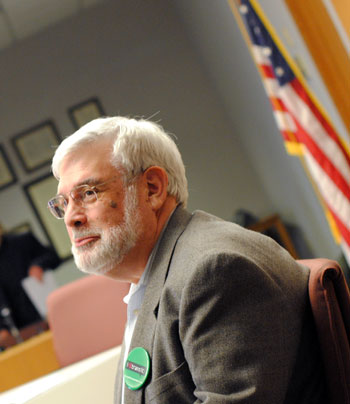
Jesse Bernstein

AATA board chair Jesse Bernstein's green button was not selected in honor of St. Patrick's Day. It reads: I <3 Transit, www.publictransportation.org (Photo by the writer.)

The final phase of that process included 20 public meetings in February, where three different scenarios were presented: Lifeline Plus, Accessible County, and Smart Growth. The three scenarios were nested subsets, starting with Lifeline Plus as a base, which would simply have expanded on existing services and focused on expanding services for seniors and disabled people throughout the county. Accessible County would have added fixed-route bus service to connect all the county’s urban centers. Smart Growth included all the features of Accessible County, as well as high-capacity transit along local corridors, plus regional commuter rail.

At Thursday’s meeting, board chair Jesse Bernstein characterized the TMP as a reflection of where the community wants to be 30 years from now. The entity that would be implementing the TMP, he stressed, would likely be organized under a different legal framework than the current AATA, which is an Act 55 transit authority, with a tax levied just in the city of Ann Arbor. The AATA board has actively discussed for at least the last two and a half years the idea of transforming the transit authority to a countywide funding source, possibly using Act 196.

The meeting included three other pieces of business: (1) approval of a contract for the AATA’s paratransit services; (2) acceptance of an auditor’s report on the AATA’s books from the previous fiscal year; and (3) approval of a contract for media services.

Also discussed, but not acted on, was a memorandum of understanding with the city of Ann Arbor for construction of a bus pull‐out on eastbound Washtenaw Avenue east of Pittsfield Boulevard. The bus pull-out is part of a larger project – a transfer center on the south side of Washtenaw Avenue at Pittsfield Boulevard, opposite Arborland mall – which will include a “super shelter.” The project is being funded with federal stimulus money granted to the AATA. The board was in favor of the agreement with the city, but was reluctant to vote on the memorandum absent a copy of the text of the memorandum itself. [Full Story]

AATA Accepts Auditor’s Report

At its March 17, 2011 meeting, the Ann Arbor Transportation Authority board voted to accept the auditor’s report for fiscal year 2010, which ended Sept. 30, 2010. The audit was performed by Rehmann Robson, which delivered a “clean opinion” on the AATA’s books.

Among the suggestions made by the auditor were: (1) to have the board sign off on a list of vendors/contracts greater than $25,000 – indicating that the AATA’s conflict of interest policy has been met – before the contract is executed; (2) that only the accounts payable accountant, or the controller – but not the payroll accountant – be able to distribute management and hourly paychecks; and (3) when a journal entry is made, it should be documented and reviewed by someone other than the person who prepared the journal entry.

The auditor also identified a need to make sure that Davis-Bacon Act compliance on construction contracts was systematically verified by AATA, even when that responsibility is delegated to a third party.

This brief was filed from the Ann Arbor District Library boardroom, where the AATA board holds its monthly meetings. A more detailed report will follow: [link] [Full Story]

Greenbelt Gets Mid-Year Financial Review

Ann Arbor Greenbelt Advisory Commission meeting (Feb. 9, 2011): The main event of the commission’s Wednesday meeting was a review of the second-quarter financial picture. The review was presented  by Ginny Trocchio, who works for The Conservation Fund, a consultant the city employs to assist with administering the greenbelt millage. Highlights of the presentation included the calculation of administrative overhead costs – including The Conservation Fund’s work – which are well below the legal maximum of 6%.

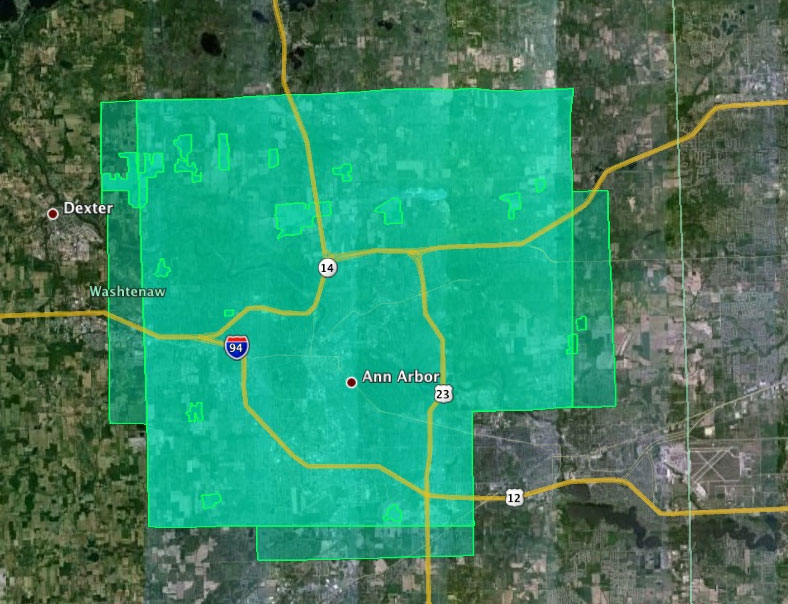
Ann Arbor Greenbelt Map, boundaries and property

Blobs inside the squarish boundaries represent properties or development rights acquired with greenbelt millage funds. The darker squarish area is the original area where millage funds could be spent. The lighter strips to the east, south, and west were added in 2007. (Image links to higher resolution file.)

Though not included explicitly in the millage language, the city approaches the administration of the millage as a one-third/two-thirds split between a portion for parks and a portion for the greenbelt program. So as part of the financial review, commissioners also looked at current fund balances as analyzed based on the one-third/two-third split between parks and greenbelt projects. Noting that the greenbelt fund balance might be on track to be drawn down before the parks portion is exhausted, commissioners seemed to agree that now is a good time to begin mulling what should happen if that scenario played out. The group discussed holding a joint meeting between the park and greenbelt advisory commissions – their last joint session was held in April 2010.

Also discussed on Wednesday was the scheduling of a first meeting of a commission subcommittee that will look at the question of changing greenbelt boundaries. The boundaries define the region where land or development rights on land might be acquired by the greenbelt program. Any change to those boundaries would ultimately require approval from the Ann Arbor city council. [Full Story]

Ann Arbor District Library Gets Clean Audit

Ann Arbor District Library board meeting (Nov. 15, 2010): Two financial issues drew much of the focus at Monday’s AADL board meeting.

Dave Fisher

Dave Fisher of the accounting firm Rehmann Robson delivered highlights of the Ann Arbor District Library's financial audit at the AADL board's Nov. 15 meeting. (Photo by the writer.)

Dave Fisher of the accounting firm Rehmann Robson was on hand to review the district’s financial audit for the fiscal year that ended June 30, 2010. He described the library as in solid financial shape, especially in relationship to other entities in Michigan that rely on property tax revenues. The library has no long-term debt and its fund balance is strong, he said. But he added a cautionary note that like other taxpayer-funded entities, the library would likely be grappling with a continued drop in property tax revenues in future years.

Property tax revenues emerged again in a discussion during the director’s report. AADL director Josie Parker drew attention to a Nov. 15 column published in The Ann Arbor Chronicle regarding the ongoing negotiations between the city of Ann Arbor and the Downtown Development Authority. The column pointed out an issue that Parker has been tracking as well: the potential for tax increment financing funds captured by the DDA from public entities, including the AADL, to be used to offset a parking fund deficit caused by striking a new parking deal with the city. The board ultimately passed a resolution at Monday’s meeting, directing Parker to seek legal counsel on the issue.

Board member Ed Surovell said he wanted to make sure the board was defending their right to collect taxes, and that they’re being as responsible as possible to the citizens of the district. “I think this is dead serious business,” he said. “The appropriation and misappropriation of tax revenues is the lifeblood not just of this library, but of a democracy.”

Also during her director’s report, Parker described the results of a site review by staff of the Michigan Commission for the Blind, which manages the federal program that the Washtenaw Library for the Blind and Physically Disabled @ AADL is part of. The review, conducted every two years, is the first one since the AADL took over management of the WLBPD from the county, a transition that occurred in early 2009. AADL received several commendations for its approach to providing WLBPD services.

At the end of the meeting, outgoing board member Carola Stearns – who lost her seat in the Nov. 2 election to challenger Nancy Kaplan – gave a poignant speech, thanking the library staff and her colleagues on the board. In connection with a possible downtown building project, she urged the board to explore alternative funding sources, beyond paying for the project solely with taxpayer funds. [Full Story]

County Board Gets Update From Sheriff

Washtenaw County Board of Commissioners (Feb. 17, 2010): In an extensive presentation to the board, sheriff Jerry Clayton laid out changes he’s made in his department since he took office just over a year ago, and discussed his goals and priorities for the coming years.

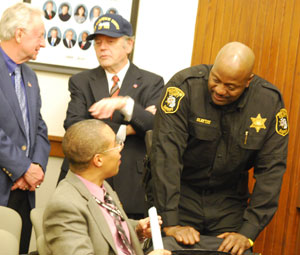
Gene DeRossett, Elmer White, Derrick Jackson, Jerry Clayton

Sheriff Jerry Clayton, right, talks with Derrick Jackson, director of community engagement for the sheriff's department, before the Feb. 17 county board of commissioners meeting. Behind them are Gene DeRossett, left, chief administrative officer for the 14-A District Court, and Elmer White, who gave an update on the USS Washtenaw exhibit. (Photo by the writer.)

One of the most significant changes was financial. In 2009, overtime hours dropped 36%, leading to nearly $1 million in savings during the year. The department also raised $1 million in new revenues, exceeding Clayton’s projections.

Beyond that, Clayton presented his broad philosophical approach to managing law enforcement in the county, and discussed some of the challenges he faces in light of the current economy.

Law enforcement also came up in a separate discussion during the board’s Wednesday meeting, as commissioner Wes Prater raised concerns over the county’s internal financial controls. Though he’s been agitating for action on this front for several months, his decision to ask the board to form a review committee was prompted by the recent arrest of a county employee charged with embezzling over $100,000.

Commissioners also spent considerable time on Wednesday debating the process of formally revising their priorities. The effort is aimed at adapting the priorities to reflect the county’s diminishing resources. While commissioners agreed that community input was crucial, there was no clear consensus about what the process for gathering that input should be, or how much time it will take.

Finally, the board got a brief update on the Wireless Washtenaw project, a coda to a report given at their Jan. 20 meeting. The firm that’s handling the project, 20/20 Communications, is partnering with Southfield-based Internet 123 and plans to submit a revised business plan for Wireless Washtenaw within 60 days. [Full Story]

AATA, CEO Candidate Start Talks

word cloud of Michael Ford's interview

Word cloud based on interview questions and answers from Michael Ford's third interview. The cloud was generated by www.wordle.net. (Image links to higher resolution file.)

AATA Board meeting (April 22, 2009): In their deliberations Wednesday evening, the AATA board assessed CEO candidate Michael Ford’s interview responses as “mushy” and not as “crisp” as they’d ideally prefer, with board chair David Nacht describing Ford’s communicative style as “modern management parlance.”

So often was the word “crisp” invoked that Thomas Partridge, who spoke at the conclusion of the meeting during public commentary, gave one of his standard talking points a little extra flourish: He asked the board to articulate a vision for expanded countywide service “in the same crisp language” that they expected from their next CEO.

In fact, it appears that the next CEO of the AATA will be Michael Ford. The board looked past a lack of crispness in his interview answers and voted unanimously to make him an offer and enter into negotiations. Assuming the two sides can reach an agreement, Ford might be able to take over the reigns of the AATA relatively quickly. Ford operates his own consulting firm, MG Ford Consulting, and there would be no coordination with a current employer to consider.

In other business, the board (i) heard a report from their auditor (who was roundly lambasted by board chair Nacht), (ii) got an update from their own financial staff (AATA is on course to keep its current year’s budget balanced), (iii) passed a resolution to charge the full cost of service for its purchase-of-service (POS) contracts, thus increasing the cost to municipalities like Ypsilanti by roughly 30% by 2012, and (iv) gave support only in concept for Ann Arbor’s Transportation Plan Update. [Full Story]

Awards, Audits and An Executive Session

Washtenaw County Board of Commissioners (April 1, 2009): A light agenda for the public part of Wednesday night’s board meeting was followed by nearly 90 minutes in executive session discussing labor relations related to budget talks. Before that, the meeting included the presentation of several awards for historic preservation and recognition of the University of Michigan chapter of Alpha Phi Alpha, an African-American fraternity celebrating its 100th anniversary. [Full Story]