


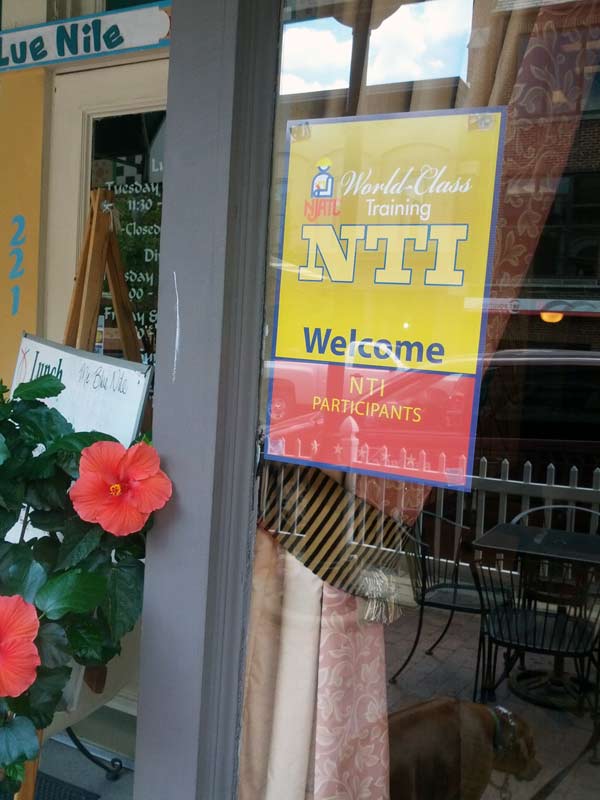
The electricians have started to arrive for their annual training event in Ann Arbor. Expect several thousand by Sunday followed by the plumbers & pipefitters. They bring millions of dollars to Ann Arbor during a slow period. Welcome back! [photo]
Stories indexed with the term ‘labor unions’
Ann Arbor Firefighters to Get New Gear
Ann Arbor firefighters will be equipped with $150,000 worth of firefighter gear, as the result of city council action taken on May 13, 2013 at a meeting that had started on May 6. The contract authorized by the council is with Phoenix Safety Outfitters.
According to the labor contract between the city and the International Association of Firefighters Local 693, the city is required to provide two sets of turnout gear for each firefighter – in accordance with National Fire Protection Association (NFPA) standards.
According to the staff memo, at least 20 sets of gear are due for scheduled replacement, and 14 more sets of gear are needed in order to equip seven new hires.
This brief was filed from the city council’s … [Full Story]
County Board Briefed on Audit, Financials
Washtenaw County board of commissioners meeting (April 3, 2013): With a third of the board absent, commissioners were briefed on the county’s 2012 audit – with a look toward changes that will impact future financial statements. The audit was clean.
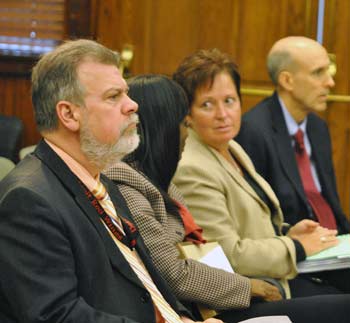
From left: Mark Kettner of the accounting firm Rehmann; Carla Sledge, Wayne County’s chief financial officer; Kelly Belknap, Washtenaw County’s finance director; and Pete Collinson, accounting manager for Washtenaw County. (Photos by the writer.)
The county’s finance staff, along with the auditor, Mark Kettner of Rehmann, highlighted several points, including a relatively dramatic increase in the general fund balance over the last few years – from $9.7 million in 2009 to $16.8 million at the end of 2012. Kettner also explained upcoming accounting changes that will require unfunded liabilities from the county’s pension and retirement healthcare plans – now totaling nearly $250 million – to be recorded in a different way, with more disclosure.
The new accounting changes – required by the Governmental Accounting Standards Board (GASB) – won’t begin until 2015, but commissioner Dan Smith (R-District 2) wondered whether the county could implement the changes sooner. It might be possible, Kettner replied, but “I don’t know why you’d want to do it.” He suggested that the board hold a working session to go over the upcoming changes in more detail.
Kettner also pointed out that the changes will affect government entities in different ways. For example, it’s likely that there will be more impact on the city of Ann Arbor, because of how its many “enterprise” funds might be affected and the implications that would have on outstanding bonds. At minimum, the changes will mean more work for finance staff.
Also at the April 3 meeting, commissioners voted to add 39 new jobs in the community support and treatment service (CSTS) department, which provides mental health and substance abuse services to county residents. The work is primarily funded by the Washtenaw Community Health Organization, a partnership between the county and the University of Michigan Health System. Most of the new jobs are union positions. Dan Smith expressed concern about adding to the county’s payroll, but supported the resolution along with other commissioners in a unanimous vote.
The board also took an initial vote to dissolve The Washtenaw Ride. That Act 196 authority is a remnant of a failed attempt to create a countywide transit system last year. Efforts to expand the current reach of the Ann Arbor Transportation Authority are still underway, but don’t require the structure that was put in place under Act 196.
The topic of public transportation was raised later in the meeting as well, as Ronnie Peterson (D-District 6) asked about the county’s role in the southeast regional transit authority (RTA). The RTA was formed by the state legislature last year to coordinate regional transit in the city of Detroit and counties of Wayne, Macomb, Oakland and Washtenaw. There was not uniform support for Washtenaw County to be part of this effort, and it’s not yet clear what the impact will be on the AATA.
In other discussion, Yousef Rabhi (D-District 8) highlighted a proposal in front of the Ann Arbor city council regarding possible ordinance changes governing the Ann Arbor Downtown Development Authority. Depending on what the council decides, there might be implications for the county, he said, so he wanted to put it on the board’s radar. For background on this issue, see Chronicle coverage: “DDA Tax Capture Change Gets Initial OK” and “DDA Ramps Up PR after First Council Vote.”
Also briefly mentioned was a discussion that occurred at a late March county pension commission meeting, raising questions about the new labor contracts that the board approved on March 20, 2013. At issue is whether the county complied with a state law requiring supplemental actuarial analysis before pension benefit changes are adopted. The county administration subsequently conferred with outside legal counsel, and confirmed their view that no new actuarial analysis was necessary.
And although it wasn’t discussed at the April 3 board meeting, the recent labor contracts resulted in another issue related to compliance with state law: Elimination of the county’s healthcare benefits for domestic partners. [Full Story]
UM: Union Contracts
The University of Michigan reports that five unions representing about 11,000 workers have ratified contracts, the longest ones running through June 30, 2018. The unions with new contracts are AFSCME, the Michigan Nurses Association, Graduate Employees’ Organization, Lecturers’ Employee Organization, and House Officers Association. The ratification has occurred prior to March 28, when the state’s right-to-work legislation takes effect. [Source]
New Labor Contracts Key to County Budget
Washtenaw County board of commissioners meeting (March 20, 2013): In its main action, the county board approved new long-term contracts with 15 of Washtenaw County government’s 17 bargaining units – including annual wage increases, a cap on employee healthcare contributions, and the elimination of “banked leave” days. The precedent-setting move aimed to protect unions before Michigan’s right-to-work law takes effect on March 28, and cut legacy costs for the county.
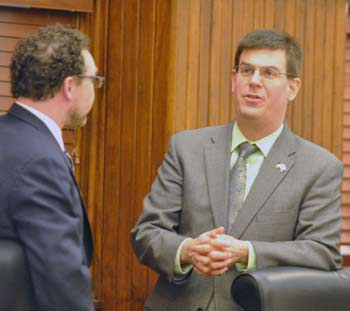
From left: Conan Smith (D-District 9) and Dan Smith (R-District 2) at the Washtenaw County board of commissioners meeting on March 20. Dan Smith cast the lone vote against new contracts with labor unions representing county employees, citing concerns over the length of the agreements. Most of the contracts run through Dec. 31, 2023. (Photos by the writer.)
About 85% of the nearly 1,300 county workers belong to a union. The board also approved similar wage and benefit changes for the county’s non-union employees.
The right-to-work law will make it illegal to require employees to support unions financially as a condition of their employment, but labor agreements in place prior to March 28 will not be affected until they expire. Most of the previous contracts with the county’s labor unions were set to expire on Dec. 31, 2013. All but one of the new deals will run for more than 10 years – through Dec. 31, 2023.
Dan Smith (R-District 2) cited the length of those contracts as a reason for casting his no vote – he was the only commissioner to vote against the union contracts, though he supported the agreement for non-union employees. The duration eliminates the flexibility to deal with different conditions that might face the county in the future, he said. There is no “re-opener” clause that would allow either side to renegotiate before 2023.
Despite his no vote, Smith praised the most significant changes that will impact employees hired after Jan. 1, 2014. Those employees will participate in a defined contribution retirement plan, instead of the current defined benefit plan – the Washtenaw County Employees’ Retirement System (WCERS). In defined benefit plans, retirees receive a set amount per month during their retirement. In defined contribution plans, employers pay a set amount into the retirement plan while a person is employed. The most common defined contribution plan is the 401(k). Similar changes in retiree healthcare plans will also affect new employees.
The shift in the county’s approach to retirement plans and retiree healthcare was a major concern for several other commissioners. While acknowledging the benefits of eliminating the county’s legacy costs, Conan Smith (D-District 9) cautioned that retirees could be put at risk without the predictable stability of a defined benefit plan. However, he also noted that the board can’t continue to put the institution at risk by “guaranteeing something that we don’t know we’re going to be able to afford in the long run.”
Those legacy costs were a factor alluded to during the March 20 discussion, linking to another major decision that is expected to come before the board: bonding to cover the county’s unfunded liabilities for employee pensions and retiree healthcare. The issue hasn’t been discussed directly at any of the board’s regular meetings, but commissioners have been informed that a proposal likely will be brought forward by administration.
Based on actuarial valuations at the end of 2011, the county had $101.27 million in unfunded liabilities for its defined benefit pension, and $148.46 million in unfunded liabilities for its retiree healthcare. Those amounts will be higher when the 2012 actuarial valuations are completed later this year. The new accounting standards of GASB 68 require that unfunded liabilities must be included in an organization’s financial statements for fiscal years beginning after June 15, 2014.
Commissioners also got a year-end 2012 financial update during the March 20 meeting – the final 2012 audit will be brought to the board in April. Total revenues exceeded total expenditures by $2.26 million. The county had planned for a surplus of $1.889 million to carry into 2013 – so the year ended with an excess of $327,607 above that targeted amount.
In other action items, the board voted to form a committee that will explore the feasibility of creating a land bank, and appointed three people to the committee: Commissioner Ronnie Peterson (D-District 6), county treasurer Catherine McClary, and Mary Jo Callan, director of the county’s office of community & economic development. The committee is directed to report back to the board by Aug. 7, 2013.
During communications from the board, Conan Smith reported that the southeast Michigan Regional Transit Authority board has now been fully appointed, and will convene on March 28 for an orientation meeting. He suggested that the two Washtenaw County representatives – Richard “Murph” Murphy and Liz Gerber – come talk to commissioners about what the county’s interests and priorities are. “The earlier we weigh in, the more systemic the impact of our comments are going to be,” he said. “If we don’t talk to them until they’ve already made decisions, then it’s going to be too late.” [Full Story]
New Washtenaw County Labor Deals Approved
Groundbreaking contracts with 15 of Washtenaw County’s 17 bargaining units were authorized by the county board of commissioners at its March 20, 2013 meeting. The deals, which take effect March 21, come a week before Michigan’s right-to-work law takes effect, and guarantee that employees will not be subject to the law until the contracts expire. The board also voted to approve comparable compensation and benefits for its non-union workers.
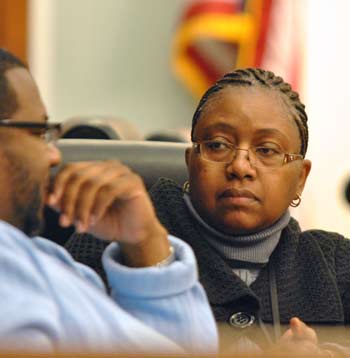
Caryette Fenner, president of AFSCME 2733, the county’s largest bargaining unit, at the Washtenaw County board’s March 7, 2013 budget retreat. Her union had reached a tentative agreement with administration earlier that day, which was ratified by union members on March 13 and approved by the county board on March 20.
The majority of contracts run through Dec. 31, 2023 and are the longest-term labor agreements ever authorized by the Washtenaw County government, which employs about 1,300 workers. One of the unions agreed to a shorter-term contract: The contract for AFSCME 3052 lasts five years, through Dec. 31, 2017.
Typically, such agreements last two to five years. About 85% of county workers belong to a union.
In broad strokes, the agreements provide for annual wage increases, a cap on employee healthcare contributions, and the elimination of “banked leave” days. Banked leave days have been used in recent years to help balance the budget by cutting labor costs. The days are unpaid, but don’t affect retirement calculations.
Some of the major changes relate to benefits for employees hired after Jan. 1, 2014. Those employees will participate in a defined contribution retirement plan, compared to the current defined benefit plan – the Washtenaw County Employees’ Retirement System (WCERS). In defined benefit plans, retirees receive a set amount per month during their retirement. In defined contribution plans, employers pay a set amount into the retirement plan while a person is employed. The most common of these defined contribution plans is the 401(k). [Full Story]
County Moves Closer to New Labor Deal
Washtenaw County board of commissioners meeting (March 6, 2013): Following a brief public portion of their meeting, commissioners held a two-hour closed session to discuss a new contract with the county’s labor unions, which has been negotiated over the past few weeks.
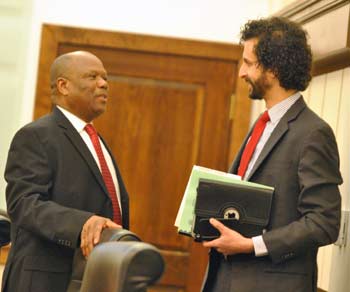
Washtenaw County commissioners Ronnie Peterson (D-District 6) and Yousef Rabhi (D-District 8), who serves as board chair, talk before the board’s March 6, 2013 meeting. (Photos by the writer.)
This was the third consecutive meeting that’s included a lengthy closed session on this topic, as the administration has been conducting accelerated negotiations with its union to reach a new contract before March 27. That’s the date when Michigan’s right-to-work legislation – enacted late last year – takes effect. At the board’s Feb. 20, 2013 meeting, commissioners gave final approval to a resolution opposing the legislation, with a clause that directed the county administration to renegotiate union contracts.
Several union leaders attended the March 6 meeting. However, they did not formally address the board, and left before commissioners ended the closed session.
The board took no action after emerging from the closed session. The new long-term agreements are expected to be brought forward for a vote at the board’s March 20 meeting, and would also need to be ratified by union membership.
A new union contract is likely to have a significant impact on the county’s budget, which will be the focus of a board retreat on Thursday, March 7. Board chair Yousef Rabhi briefed commissioners on the agenda for that retreat. The discussion will focus on six key areas: (1) labor force sustainability/internal equity; (2) environmental impact and mobility in Washtenaw County; (3) economic development; (4) human services/safety net; (5) mandated service provision/resources; and (6) long-term fiscal stability.
Also impacting county operations are automatic sequestration-related federal budget cuts that were activated on March 1. Rabhi read aloud a letter from the U.S. Dept. of Housing & Urban Development, which alerted the county to an anticipated 5% reduction in HUD funding during the current fiscal year for programs supporting low-income housing and emergency assistance to the homeless, among others. The full impact of federal cuts across all county departments – including public health and the office of community & economic development – is not yet known, according to the county’s finance director.
The light agenda on March 6 included three items related to public health: (1) a move toward setting a $75 fee for the county’s training course to certify drinking water operators; (2) giving initial approval to the county public health department’s plan of organization, as mandated by the state of Michigan; and (3) making two appointments to the Washtenaw Community Health Organization (WCHO) board.
Rabhi also reported that the county’s new food policy council, on which he serves, might make a funding request soon to hire a staff member, who would help carry out the council’s work. The council was formed in 2012 to support the local food economy. [Full Story]
County Board Continues Labor Strategy Talks
Washtenaw County board of commissioners meeting (Feb. 20, 2013): In a meeting with few new action items, the board gave final approval to a resolution protesting the state’s right-to-work law, and spent more than an hour in executive closed session to discuss collective bargaining strategies.
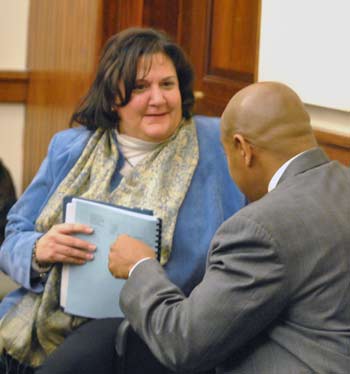
Diane Heidt, the county’s human resources and labor relations director, talks with Greg Dill, director of infrastructure management. (Photos by the writer.)
The resolution taking a stance against the state law was approved on a 6-2 vote, with dissent from the board’s two Republican commissioners – Dan Smith (District 2) and Alicia Ping (District 3). Felicia Brabec (D-District 4) was absent. Though Smith had stated his objections on Feb. 6, when an initial vote had been taken, there was no discussion on the item at the Feb. 20 meeting.
The resolution directed the administration to negotiate new four-year contracts “to protect and extend each bargaining unit’s union security provisions.” Current contracts with most of the 17 unions representing county employees expire at the end of 2013. New contracts, if completed before the right-to-work law takes effect in March, would not be required to comply with the new law, which makes it illegal to require employees to support unions financially as a condition of their employment.
Negotiations with the unions began earlier this month.
In other action at the Feb. 20 meeting, the board appointed Dan Smith to the Washtenaw County parks & recreation commission – the third county commissioner to be appointed to that 10-member board. Ronnie Peterson (D-District 6) raised concerns about having too many commissioners serve on that entity, noting that Smith was filling a slot designated for the general public.
Yousef Rabhi, who as board chair made the nomination, responded to Peterson’s comments, saying that he and Smith had discussed this issue – because Smith had the same concerns as Peterson. Rabhi assured Peterson that the commission will continue to provide opportunities for citizens to serve, and that the slot filled by Smith would remain designated as one for the general public for future appointments. Five members of the general public currently serve on the parks & rec commission.
In communications to the board, Rabhi noted that he planned to form a task force to explore establishing a county land bank. A land bank is a mechanism for the county to take temporary ownership of tax- or mortgage-foreclosed land while working to put it back into productive use. The board had previously voted to establish a land bank at its Sept. 1, 2010 meeting, but never took the next step of funding it or getting approval from the state. Only three commissioners from that period – Ronnie Peterson, Rolland Sizemore Jr. and Conan Smith – still currently serve on the board.
Among the other items handled at the Feb. 20 meeting included: Resolutions of appreciation for two Chelsea organizations – Purple Rose Theatre and Chelsea Lanes; a final vote to authorize borrowing up to $40 million against the amount of delinquent property taxes in all Washtenaw County jurisdictions; and final approval to add the Detroit Region Aerotropolis board to the list of boards, committees and commissions that are eligible for commissioners to receive stipend payments.
The Feb. 20 meeting was attended by several students, including nursing students from the University of Michigan who were observing the proceedings as part of a psychiatric nursing course. [Full Story]
AATA OKs 4-Year Deal with Bus Union
The Ann Arbor Transportation Authority has ratified a four-and-a-half-year contract with the Transport Workers Union Local 171 (TWU). The contract, which removes all language that deals with agency shop fees and dues, goes through June 30, 2017. Removal of the language is related to “right-to-work” legislation passed by the Michigan state legislature in late 2012.
The AATA and TWU are reaching an agreement separate from the labor contract that covers agency shop fees and dues – which runs for 10 years, through 2023. The contract resets the full wage for newly hired drivers after three years to $21.50 per hour. The wage for current drivers with at least three years of experience is $24.50 per hour. The contract calls for a … [Full Story]
County Board Weighs Right-to-Work Response
Washtenaw County board of commissioners special working session (Jan. 3, 2013): In a wide-ranging discussion – driven in large part by Ann Arbor Democrat Conan Smith – county commissioners addressed how the recent state right-to-work legislation might impact Washtenaw County’s economy as well as the employees of county government.
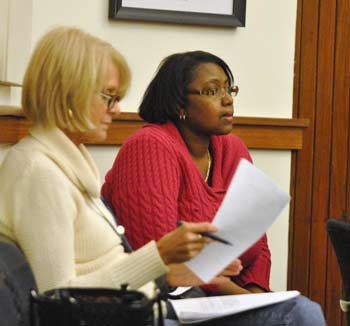
Nancy Heine, president of AFSCME Local 3052, Caryette Fenner, president of AFSCME Local 2733, the county government’s largest union. (Photos by the writer.)
The working session included presentations by one of the county’s Lansing lobbyists; labor attorney Paul Gallagher; and Mary Kerr – president of the Ann Arbor Convention & Visitors Bureau. Kerr told commissioners that Washtenaw County brings in an estimated $12 million annually from the training conferences held here by three major unions. She said the CVB – which is funded through an accommodations tax levied by the county – will work to ensure that the unions feel welcome, but she has not had any conversations yet to gauge their reactions to the new right-to-work law.
Gallagher was less circumspect, saying he’s concerned about the potential loss of business if unions decide to move their training to a state that doesn’t have right-to-work laws.
The Michigan legislation – supported by the Republican-controlled House and Senate and Republican Gov. Rick Snyder – made it illegal to require employees to support unions financially as a condition of their employment. It’s viewed by Democrats as a way to undercut support for labor organizations that have historically backed the Democratic Party. On the Washtenaw County board of commissioners, seven of the nine commissioners are Democrats.
The legislation, which will take effect in March of 2013, received national attention and followed a failed ballot initiative by labor to protect collective bargaining rights in the state Constitution. That effort – Proposal 12-2 – was not supported by a majority of voters in the Nov. 6 election.
At the Jan. 3 working session, Conan Smith questioned Gallagher about details of state and federal labor laws, exploring the latitude that the county might have in supporting unions that represent 85% of the 1,321 employees in county government. He floated several ideas that commissioners might consider pursuing.
For example, most current union contracts expire on Dec. 31, 2013. Because the right-to-work law doesn’t take effect until March of this year, the county has until then to work with the unions and possibly extend their contracts beyond the end of 2013. If that happens before March, then the unions could continue to collect “agency fees” from employees who don’t want to join the union but who are still part of the bargaining unit that the union represents. Though the practice would be illegal for future contracts, it could remain in place for the duration of the extended agreements.
Additionally, Smith said there are items in the union contracts that might set the stage for a division of employees into three distinct groups. Two of those groups exist now: (1) unionized employees, and (2) non-union management employees. There’s the potential for a third group, Smith said: Non-union, non-management workers who have made the choice to opt-out of the union and the benefits that the union provides, be it economic, social, protective or anything else. Those benefits, in his opinion, shouldn’t accrue “to those people who don’t pay to play.”
Smith told commissioners: “I hope we are comparatively aggressive in our stance of supporting our labor partners and finding innovative ways that we can test this new world.” He hopes to make sure that the benefits of union membership are clear before people make the decision about whether to join. The point is not to coerce them to join or discourage them from joining, he said, but just to make sure they understand very clearly what opportunities they have as union members.
Smith said there are a number of places in the current union contracts where the county can make that “imminently clear.” And there are a number of places in the county’s practices where they can make that clear, too, he said. “I think if we do that through practice, undoubtedly we’ll be challenged – and I for one am quite comfortable taking that challenge forward and being the test case to determine the extent to which this law applies to our public employees.”
Smith – who is married to state Sen. Rebekah Warren – does not believe the majority of legislators would be willing to amend the right-to-work law, and that lobbying them to do so would probably be a waste of time.
Commissioners also heard from two labor leaders on Jan. 3: Caryette Fenner, president of the American Federation of State, County and Municipal Employees, AFL-CIO (AFSCME) Local 2733, the county government’s largest union with about 700 members; and Nancy Heine, president of AFSCME Local 3052, which represents about 50 supervisors. Both Fenner and Heine expressed concerns amid an uncertain future. “What could potentially happen with this law is that it will render us useless,” Heine said. “We will have no resources to defend any of our members.”
It’s unclear how far the majority of commissioners would be willing to go in challenging the right-to-work law. At the Jan. 2 board meeting, the two Republican commissioners – Dan Smith and Alicia Ping – indicated they did not want to debate the issue. However, there was more clear support for sending a signal to the labor unions that do their training in Washtenaw County that they are welcome here. Andy LaBarre, who led his first meeting as chair of the working session, offered to draft a resolution to that effect for the board to consider. [Full Story]
County Board Suspends CUB Agreement
For the second time in the past 12 months, the Washtenaw County board of commissioners voted to suspend the county’s use of Construction Unity Board (CUB) agreements. The 8-2 vote was taken at the board’s Aug. 1, 2012 meeting, with dissent from Alicia Ping and Ronnie Peterson. Rolland Sizemore Jr. was absent.
CUB agreements are a type of project labor agreements, negotiated between local trade unions and contractors. CUB agreements require that contractors who sign the agreement abide by terms of collective bargaining agreements for the duration of the construction project. In return, the trade unions agree that they will not strike, engage in work slow-downs, set up separate work entrances at the job site or take any other adverse action against … [Full Story]
Ann Arbor OKs Fire, Police Contracts
At its March 19, 2012 meeting, the Ann Arbor city council approved new contracts with its firefighters as well as with its police command officers.
The contract with Local 693 of the International Association of Fire Fighters (IAFF) is retroactive to July 1, 2010 and runs through June 30, 2014. Ann Arbor’s firefighters have been working without a new contract since the previous agreement expired June 30, 2010. Features of the new contract include the restoration of pay to the 2008 level – the union had previously accepted a wage decrease of 3% in order temporarily to preserve jobs. The restoration to previous wage levels will take place over the course of two years, at 1.5% each year.
The contract reduces the … [Full Story]
GSRA Bill: UM Regents Debate Opposition
University of Michigan board of regents special meeting (Feb. 21, 2012): The board and UM president Mary Sue Coleman met via conference call on Tuesday morning in a brief but contentious meeting that focused on Senate Bill 971. It’s a bill that would make explicit that graduate student research assistants (GSRAs) are not entitled to collective bargaining rights under Michigan’s Act 336 of 1947.
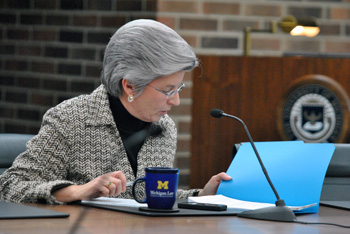
Suellyn Scarnecchia, UM's general counsel, was one of the few executives in the room at a Feb. 21 special meeting of the board of regents. All regents and UM president Mary Sue Coleman participated via conference call. Scarnecchia was asked by some regents to weigh in on the legality of the meeting, in the context of compliance with Michigan's Open Meetings Act.
Ultimately, the board voted 6-2 to formally oppose the bill, which was to be considered later that morning at a senate committee hearing in Lansing. [The committee later in the day voted to recommend the bill for passage by the full senate.]
The board’s two Republican regents – Andrea Fischer Newman and Andrew Richner – dissented. It was a vote along the same party lines as action taken at the regents’ May 19, 2011 meeting, when the Democratic majority of the board passed a resolution supporting the right of GSRAs to determine whether to organize. Coleman, who chairs the regents’ meeting but is not a voting member, had spoken against the resolution prior to the May vote. At subsequent regents’ meetings, several students and faculty have spoke during public commentary in opposition to the board’s action.
Much of the Feb. 21 special meeting focused on whether the meeting itself was legal. It was convened by invoking a rarely used bylaw that allows either the president or three regents to call a special meeting for emergency action. However, the meeting was apparently not publicly noticed 18 hours in advance, as required by the Michigan Open Meetings Act.
The university’s general counsel, Sue Scarnecchia, was asked by some of the regents to weigh in on the legality of the meeting. She stated that the meeting had been called legally, based on her reading of the regental bylaw. She did not comment explicitly on how compliance with the bylaw might relate to conformance with the OMA. [Full Story]
County Policy Issues: Salaries, Animals
Washtenaw County board of commissioners meeting (Feb. 15, 2012): Two major items – and underlying policy related to them – took up much of the Feb. 15 county board meeting.
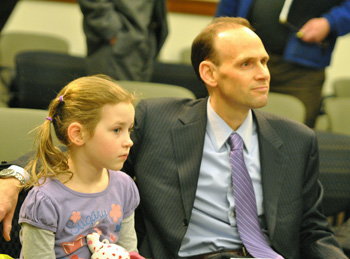
Mark Heusel, vice president of the board for the Humane Society of Huron Valley, with his daughter at the Feb. 15 Washtenaw County board of commissioners meeting. (Photos by the writer.)
After months of uncertainty and sometimes heated negotiations, the county approved an agreement with the Humane Society of Huron Valley through 2012, along with a strategy for a longer-term solution to the county’s animal control services.
A work group, led by the sheriff, is now tasked with determining the cost of animal control services. The work group will involve other jurisdictions in the county that have animal control ordinances – like the city of Ann Arbor and Ypsilanti Township – but do not currently make financial contributions to the county’s animal control services. The group will present a report to the board by Sept. 15 that recommends a final cost methodology and budget for 2013, based on an agreed-upon scope of services.
In an amendment to the resolution that was proposed from the floor, the board also created a separate task force to develop an animal control policy for the county. The policy will be used to guide the scope of services for a request-for-proposals (RFP). Meetings of the task force will be open to the public and to any commissioner who wants to participate. The task force will submit a preliminary report to the board by May 15, with a final report due by Oct. 15.
Following a lengthy discussion later in the meeting, the board also gave initial approval to an administrative restructuring proposal that included a net reduction of four positions, an estimated annual savings of $326,422, and creation of a new “cross-lateral” team of four current senior managers. The issue of pay increases – given as a result job reclassifications – prompted debate about whether the county’s current policy treats employees equitably at the low end of the pay scale.
Commissioner Ronnie Peterson voted against the restructuring. He objected to the 4% increase that will be given to the cross-lateral team, saying the raises aren’t justified in light of concessions that union employees gave in the most recent round of contract negotiations. A final vote on the proposal is expected at the board’s March 7 meeting.
In other board action, commissioners approved allocating $200,000 to the Ann Arbor and Ypsilanti convention and visitors bureaus (CVBs) as part of funding for a Pure Michigan campaign focused on the Ann Arbor area. The funding comes out of revenues from the county’s accommodations tax. The Michigan Economic Development Corp. (MEDC) is developing a Pure Michigan pilot program, entitled “Sense of Place,” to combine support for tourism and economic development. The Ann Arbor/Washtenaw County area has been chosen as the first region to be featured as a partner in this program, which will include a $1 million national TV ad campaign.
The board approved several other items during the Feb. 15 meeting, including: (1) labor agreements with the final four of 17 bargaining units representing county employees; (2) a change in board rules allowing commissioners to abstain from voting; and (3) a Whitmore Lake improvement project. [Full Story]
County’s AFSCME Contract Gets Final OK
At its Feb. 1, 2012 meeting, the Washtenaw County board of commissioners gave final approval to a two-year collective bargaining agreement with AFSCME Local 3052, representing 52 general supervisors. The agreement had been ratified by its membership, and had received initial approval from commissioners at their Jan. 18, 2012 meeting.
AFSCME Local 3052 was one of five bargaining units – out of 17 units representing county employees – that did not reach an agreement with the county by the end of 2011, when its previous contracts expired. Negotiations continue with the other four units – representing the prosecuting attorneys, the prosecuting attorney supervisors, attorneys in the public defenders office, supervisors of attorneys in the public defenders office.
The new agreement, which runs from … [Full Story]
Library Board OKs Labor Agreements
Ann Arbor District Library board special meeting (Dec. 8, 2011): A 10-minute meeting wrapped up more than 18 months of negotiations, as the AADL board unanimously approved contracts with its two labor bargaining units.
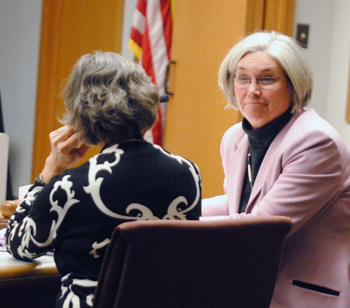
Josie Parker, right, director of the Ann Arbor District Library, talks with AADL board chair Margaret Leary at the board's Dec. 8 special meeting. (Photo by the writer.)
The board had called a special meeting for Thursday to vote on these contracts, which run from Jan. 1, 2012 through June 30, 2015. The agreements are with the Ann Arbor District Library Staff Associates, which represents 30 employees, and the Ann Arbor District Librarians Association, which represents 14 AADL librarians. All but two of these 44 workers are full-time employees with benefits. The library employs a staff of nearly 200 at its five location throughout the district, including about 100 full-time workers.
The previous contracts expired on June 30, 2010. The main difference between the old and new contracts relates to a change in health insurance providers, plans and employee contributions, according to AADL director Josie Parker. She said she appreciated the hard work that both sides of the negotiations had done to reach an agreement.
The two AADL bargaining units are part of the Michigan Education Association, dating back to the years prior to 1996 when the library was still part of the Ann Arbor public schools system. Paul Morrison, executive director of the Ann Arbor Education Association – the local MEA unit – participated in negotiations and described the outcome as “not great for labor” but reasonable, given the economic circumstances.
The board took two other actions at its meeting on Thursday: (1) a vote to cancel its Dec. 15 meeting, because there are no pressing agenda items; and (2) a vote to call an executive session for its Jan. 16, 2012 meeting, to discuss the written opinion of its legal counsel. [Full Story]
Ann Arbor Labor Benefits Get Initial OK
At its Oct. 17, 2011 meeting, the Ann Arbor city council gave initial approval to revisions to the ordinances that govern the retirement and health care plans for two of its unions: the Ann Arbor Police Officers Association (AAPOA) and the American Federation of State, County and Municipal Employees (AFSCME).
The revisions to the ordinances resulted from a collective bargaining agreement with AFSCME and a binding arbitration under Act 312 with AAPOA. The changes are similar to ordinance changes already enacted for non-union city workers.
The pension contribution for AAPOA and AFSCME workers will rise from 5% on a post-tax basis to 6% on a pre-tax basis. The vesting period for new hires will increase from 5 years to 10 years. Also for new hires, the final average compensation (FAC) calculation will be increased to a five-year period. The previous FAC was based on a three-year period.
On the health care side, the AFSCME and AAPOA employees would have the same access-only retiree health plan as non-union employees have. Like all ordinance changes, the city council will need to give these revisions a second and final approval no sooner than its next regular meeting.
This brief was filed from the city council’s chambers on the second floor of city hall, located at 301 E. Huron. A more detailed report will follow: [link] [Full Story]
Washtenaw Suspends CUB Agreements
At its Sept. 21, 2011 meeting, the Washtenaw County board of commissioners unanimously gave final approval to suspend the county’s use of Construction Unity Board (CUB) agreements, pending the outcome of litigation that’s challenging the validity of the state’s Public Act 98.
CUB agreements are negotiated between local trade unions and contractors, and require that contractors who sign the agreement abide by terms of collective bargaining agreements for the duration of the construction project. In return, the trade unions agree that they will not strike, engage in work slow-downs, set up separate work entrances at the job site or take any other adverse action against the contractor.
However, Act 98 of 2011 – which became effective July 19, 2011 – prohibits municipalities … [Full Story]
UM Regents Get Donor, Sustainability Updates
University of Michigan board of regents meeting (Sept. 15, 2011): At a meeting where regents awarded UM president Mary Sue Coleman a 2.75% raise – adding $15,678 to her salary of $570,105 – the board also heard from members of the nurses union who are angry over proposed cuts to their benefits.
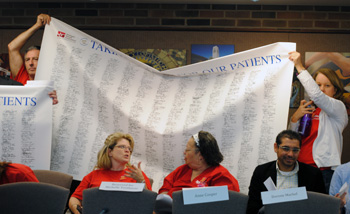
Members of the Michigan Nurses Association union held banners during the Sept. 15 regents meeting, showing signatures from their supporters. (Photos by the writer.)
The Michigan Nurses Association, which represents about 4,000 UM nurses, is negotiating a new contract. Members brought large banners with signatures from their supporters, and three people spoke about the issue during public commentary – including Brit Satchwell, head of the Ann Arbor teachers union. The nurses are concerned that weaker benefits will affect patient care by hurting the UM health system’s ability to retain and recruit high-quality nurses.
Ora Pescovitz – UM’s executive vice president for medical affairs – read a statement to the board, asserting her respect for the nurses but saying the health system needs an agreement that’s market- and cost-competitive.
Also during the meeting, regents got an overview of UM’s annual development report for fiscal 2011, which ended June 30. The university received $273.14 million in contributions during the year, up from $254.08 million the previous year – an increase of 7.5%. The previous two years had shown declines from the $342.05 million raised in FY 2008, which marked the end of the multi-year $3.2 billion Michigan Difference fundraising campaign.
As part of that report, a couple who’ve given considerable financial support to UM – Bill and Dee Brehm – spoke to the regents about the motivation for their donations. They provide support for UM’s Brehm Center for Diabetes Research and Brehm Scholars program, among other initiatives.
Regents also heard from students and staff about work toward environmental sustainability on campus and in coursework. More is in the works: On Sept. 27, Coleman is scheduled to make an address to campus, expanding UM’s sustainability goals for both academics and operations. Her remarks will be shown via a webcast, starting at 11 a.m.
A range of action items during the meeting received little discussion and were all passed unanimously. They included several construction-related projects, the creation of two medical school departments, and authorization to buy a parcel at 716 Oakland Ave. in Ann Arbor, between Monroe and Hill streets near the law school campus. This is the fourth Ann Arbor property that UM has purchased within the past year with an apartment building on the lot. [Full Story]
Ann Arbor to Vote on Police Union Contract
On the Ann Arbor city council’s agenda for its Monday, Sept. 19 meeting is an item to approve a new contract with the city’s police officers union, based on an agreement mandated by an arbitration panel’s award signed on Sept. 14, 2011.
The arbitration panel worked through the binding arbitration procedure for labor disputes in police and fire departments, which in Michigan is governed by Act 312 of 1969.
The new contract is retroactive for the period from July 1, 2009 to June 30, 2013. In an email to The Chronicle, Tom Crawford, the city’s CFO, wrote that the panel’s determination does not include any liability for the city dating back to the start of the contract.
Highlights of the new deal include … [Full Story]
AFSCME Deal Sets Stage for County Budget
Washtenaw County board of commissioners special meeting (Sept. 13, 2011): At a meeting called for the sole purpose of dealing with tentative labor deals, the county board approved new agreements with three unions representing county employees, including its largest employee union, AFSCME Local 2733.

Caryette Fenner, president of AFSCME Local 2733, the labor union representing the largest number of Washtenaw County government employees. (Photo by the writer.)
The deals affect 675 union employees, as well as 271 non-union, court non-union and elected officials – or nearly 70% of the county’s total 1,369 employees.
AFSCME Local 2733 represents about half of the county’s employees – 644 people. The Local 2733 agreement was ratified by a 2-to-1 vote earlier this week, but only 325 members voted. Caryette Fenner, president of Local 2733, described it as a typical turnout.
County administrator Verna McDaniel said these three agreements, coupled with those already approved, will yield $7.7 million in savings over 2012 and 2013. The county has a goal of gaining $8 million in labor concessions for that two-year period, to help overcome an estimated $17.5 million deficit.
McDaniel is expected to present a draft budget to the board at its Sept. 21 meeting.
There was no discussion before the board vote, which occurred after the board emerged from a 30-minute closed session to discuss labor negotiations. Commissioner Dan Smith (R-District 2) cast the lone vote against the agreements.
In a follow-up interview with The Chronicle, Smith cited concerns over health care provisions that would cost the county more than he had been led to expect, based on previous agreements already approved by the board for Michigan Nurses Association Units I and II.
And because of “me too” clauses in other union agreements, the more favorable terms negotiated by AFSCME Local 2733 will likely be applied to other union contracts as well.
In addition to the agreement with five bargaining units of AFSCME Local 2733, Tuesday’s approved agreements were with: (1) the two bargaining units of TPOAM (Technical, Professional and Officeworkers Association of Michigan); and (2) one of two bargaining units of AFSCME Local 3052. Also, the same benefits that AFSCME Local 2733 receives will be extended to the non-union, court non-union and elected officials.
The second bargaining unit of AFSCME Local 3052, representing 55 general supervisors, voted down its agreement this week. Nancy Heine, president of AFSCME Local 3052, told The Chronicle that union leaders would be polling their membership on Wednesday to determine what issues caused members to reject the tentative agreement.
In addition, agreements have not yet been reached with four other bargaining units: Two units with the Assistant Prosecutors Association, representing 24 employees; and two units with the Public Defenders Association, representing 13 employees.
Two other bargaining units – the Police Officers Association of Michigan (POAM) and the Command Officers Association of Michigan (COAM) – earlier this year reached agreements that aren’t part of the $8 million goal. The POAM and COAM deals are for a four-year period through 2014. [Full Story]
County Board OKs 3 Labor Agreements
At a special meeting on Tuesday, Sept. 13, 2011, the Washtenaw County board of commissioners approved new agreements with three unions representing county employees, including its largest employee union, AFSCME Local 2733. Commissioner Dan Smith (R-District 2) cast the lone vote against the agreements. The deals affect 675 employees, and will help the county reach its goal of gaining $8 million in labor concessions for 2012 and 2013. The county faces an estimated $17.5 million deficit over that two-year period.
In addition to the agreement with five bargaining units of AFSCME Local 2733, agreements were reached with: (1) the two bargaining units of TPOAM (Technical, Professional and Officeworkers Association of Michigan), representing 27 employees; and (2) one of two bargaining units of … [Full Story]
County to Suspend Union CUB Agreements
At its Sept. 7, 2011 meeting, the Washtenaw County board of commissioners – on a 6-4 vote – gave initial approval to suspend the county’s use of Construction Unity Board (CUB) agreements, pending the outcome of litigation that’s challenging the validity of the state’s Public Act 98. A final vote is expected at the board’s Sept. 21 meeting. Voting against the resolution were Kristin Judge, Alicia Ping, Dan Smith and Conan Smith. Ronnie Peterson was absent.
CUB agreements are negotiated between local trade unions and contractors, and require that contractors who sign the agreement abide by terms of collective bargaining agreements for the duration of the construction project. In return, the trade unions agree that they will not strike, engage in … [Full Story]
Ann Arbor Fire Chief’s Resignation Letter
In a letter to the city council dated March 18, 2011, fire chief Dominick Lanza makes clear that the personal reasons he gave earlier in announcing his resignation on Feb. 15, 2011 were not the only impetus behind his decision to leave the job: “Yes, I leave for personal reasons but had it not been for that it would be for the lack of support and the systematic destruction of your Fire Department.” Lanza started the job just last year on March 22.
In his letter, Lanza compares the city’s approach to fire protection to “playing baseball with a basketball team.” He specifically criticizes the possibility of transforming fire protection in Ann Arbor to a combined career firefighter and paid-on-call department, calling instead for regional cooperation as a way to be more cost effective.
By way of background, at a December 2010 city council budget retreat, the council discussed the possibility of moving to a combined paid-on-call department, and a fire protection services study was authorized by the council at its Feb. 7, 2011 meeting to explore that option. At the council’s most recent meeting, on March 7, 2011, the chair of the council’s labor committee, Stephen Rapundalo (Ward 2), asked the city attorney to explore the legalities involved with a recent move by Allen Park, Mich. – that community had decided to send layoff notices to nearly its entire fire department.
In his letter, Lanza also refers to a 3% reduction in pay the firefighters union accepted last January in order to preserve 14 firefighter positions that had been planned for elimination. He objects to the characterization of that concession as only lasting for six months: “Your firefighters … have taken permanent pay cuts of 3% not for six months as reported but in perpetuity as well as an additional 1% pension contribution.”
The contract under which the firefighters are working – which was revised to make the 3% salary cut – expired on June 30, 2010. So for now, firefighters continue to work for 3% less than they made in 2009 before making the concession. [Full Story]
County Board Briefed on Labor Issues
Washtenaw County board of commissioners working session (Feb. 17, 2011): County commissioners got an update last week on the county’s labor issues, as the county prepares for union contract negotiations later this year.
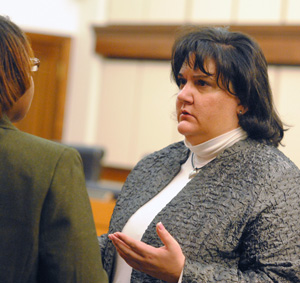
At right: Diane Heidt, Washtenaw County’s human resources and labor relations director, talks with Caryette Fenner, president of AFSCME Local 2733, the county government’s largest union. (Photos by the writer.)
The briefing was delivered by Diane Heidt, the county’s human resources and labor relations director. She told the board that they’d be discussing specific negotiation strategies at their March 3 working session – those talks will be held in a closed session, however. Heidt’s presentation last Thursday was meant to set the stage for commissioners, and to answer any general questions they had as the county prepares to negotiate with its 17 bargaining units.
Leaders of two unions attended Thursday’s working session, though they did not address the board during the meeting: Caryette Fenner, president of AFSCME Local 2733, the county government’s largest union, which represents 621 workers within its five units; and Nancy Heine, president of AFSCME Local 3052, with 56 members.
The county faces a two-year, $20.9 million deficit for its 2012 and 2013 budget years. In a “State of the County” report given to the board earlier this year, county administrator Verna McDaniel targeted $8.5 million in cuts to employee compensation and benefits as part of their strategy for tackling the projected shortfall. [Full Story]
UM Regents Hear from Grad Student Union
University of Michigan board of regents meeting (Feb. 17, 2011): About midway through Thursday’s meeting, dozens of graduate students quietly streamed into the boardroom, many of them carrying signs of protest and wearing brightly-colored T-shirts emblazoned with the Graduate Employees’ Organization logo.
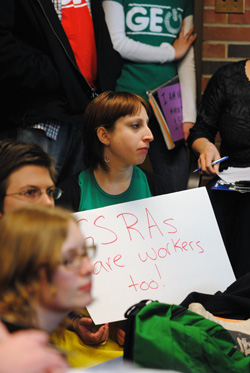
University of Michigan graduate student research assistants and members of the Graduate Employees' Organization (GEO) crowded the boardroom at Feb. 17, 2011 board of regents meeting. (Photos by the writer.)
They came to support four speakers during public commentary, who were advocating for better benefits and working conditions for graduate student employees. Also speaking during public commentary were five professors from the medical school, urging regents to support a flexible “tenure clock” that would give faculty more time to achieve that professional milestone.
The meeting’s main presentation focused on international aspects of the university – students from other countries who study at UM, and American students who study abroad. Mark Tessler, vice provost for international affairs, told regents that three-quarters of the UM students who study abroad are female – they’re trying to find out why male students aren’t as interested.
The presentation led to several questions from regents, who wanted clarification about why UM doesn’t offer an international program in Israel. They also cited the importance of finding incentives to keep international students in Michigan after graduation.
Regents also voted on several items, mostly without discussion, including: approving the next step in a major renovation of Alice Lloyd Hall; giving departmental status to the Center for Afroamerican and African Studies; and officially naming the new Law School commons in honor of Bob Aikens, a UM alumnus who donated $10 million to the project.
Another UM alum, Gov. Rick Snyder, had released his proposed state budget earlier in the day. Prior to the meeting, several university executives huddled with Cynthia Wilbanks, vice president for government relations, to get updated on the implications for their own budget – funding for higher education is among the many cuts Snyder has proposed. President Mary Sue Coleman also addressed that issue in her opening remarks. [Full Story]
“State of the County” Tackles $20M Deficit
Washtenaw County board of commissioners meeting (Jan. 19, 2011): Commissioners got a sober report from the county’s top administrator on Wednesday, providing a preliminary budget forecast for 2012 and 2013 that anticipates a $20.89 million deficit.
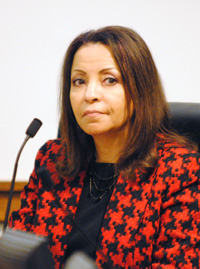
Verna McDaniel, Washtenaw County administrator, gave a State of the County address during the Jan. 19, 2011 meeting of the board of commissioners. (Photos by the writer.)
In her State of the County report, Verna McDaniel outlined areas to target in addressing the two-year shortfall: (1) $1 million in cuts to “outside agencies,” including nonprofits supported by the county; (2) $8.5 million in cuts to employee compensation and benefits; and (3) $8.5 million from organizational changes. She’s also looking to generate $2 million in additional revenue, in part by making sure fees charged by the county are set at “appropriate” levels.
Also related to the budget, commissioners approved agreements with two unions – the Police Officers Association of Michigan (POAM) and the Command Officers Association of Michigan (COAM) – that are expected to save a total of $5.6 million over a four-year period. Those savings are already factored in to the budget forecast, and do not serve to lower the projected deficit.
The board also got an update from Donald Shelton, chief judge of the Washtenew County Trial Court, who reviewed changes to the downtown Ann Arbor courthouse – including renovations to accommodate the county’s juvenile court, which is vacating its Platt Road facility later this year. The restructuring also entails merging all trial court clerk services into a “one-stop” operation at the courthouse. These changes come in the wake of the 15th District Court‘s move last weekend from the county courthouse to the city’s new municipal center at Huron and Fifth.
Court staff is working with the Ann Arbor Downtown Development Authority to address parking needs – DDA executive director Susan Pollay told The Chronicle that several options are being explored, including possible changes to the county-owned surface parking lot at Main and Ann streets.
After Shelton’s update, the board approved a renewed memorandum of understanding with the trial court, outlining the rights and responsibilities of each unit of government. The MOU calls for the county to fund the court through a “lump sum” agreement – the specific dollar amount hasn’t yet been determined. The MOU was approved unanimously with no discussion, though the topic had spurred debate at the board’s Jan. 12 administrative briefing. The debate stems in part from philosophical differences over how to fund the court.
In other business, commissioners approved a raft of committee appointments, and signed off on hiring a “cost recovery” firm who’ll review the county’s vendor contracts and suggest options for savings. And in an atypical occurrence, no one spoke during public commentary at Wednesday’s meeting. [Full Story]
Council Plows Ahead With Human Services
Ann Arbor City Council meeting (Nov. 4, 2010): At its first meeting of November – held on Thursday instead of the usual Monday to accommodate Tuesday elections – the Ann Arbor city council transacted a fair amount of business in its relatively short session.
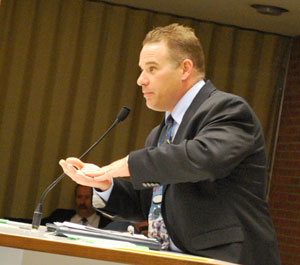
Russell Hanshue, with the city's IT services unit, describes how a sensor attached to a snowplow would record the plow's state as up or down. The city plans to purchase software to monitor remotely the on-board systems of its vehicles. (Photo by the writer.)
That business ranged from authorization of a coordinated human services funding approach to approval of new GIS software.
The coordinated funding approach to human services would extend the collaboration among the city of Ann Arbor, Washtenaw County and the Urban County to include two nonprofit funders – United Way of Washtenaw County and the Ann Arbor Area Community Foundation.
The GIS software will allow remote monitoring of engine and system performance on board the city’s vehicle fleet. The vehicle monitoring software has the ancillary benefit of allowing residents to view a real-time map of snowplow activity during a snowfall. At Thursday’s meeting, the council also authorized the purchase of $330,000 worth of road salt that city trucks will, if necessary, spread on the roads this winter.
In other business, the council gave final approval to a new stormwater code, which requires some kind of mitigation any time more than 200 square feet of impervious surface is added in residential areas.
The council again took no action on a $160,000 request from the 15th District Court to purchase furniture. The request had been postponed at the council’s previous meeting, pending production of a list of items to be purchased. The list was not ready, and the issue was again postponed.
The council received a presentation on the installation of a new HAWK pedestrian crossing signal at Chapin and Huron, which was in substance identical to one the board of the Ann Arbor Downtown Development Authority had received the day before.
A range of topics were addressed during comments from the public, perhaps most significantly remarks from Nicholas Nightwine, who spoke on behalf of the Local 369 AFSCME union on the issue of privatizing the city’s composting operation. The city council is due to hear a presentation at a Monday, Nov. 8 work session on the proposal, which they may vote on as early as Nov. 15. [Full Story]
Column: Limited Edition
In my favorite movie “Animal House,” John Belushi delivers a classic line: “Over? Nothing is over until we say it is. Was it over when the Germans bombed Pearl Harbor? Hell, no, and it ain’t over now!”
With the same level of determination and a lot more smarts, 700 members of AFSCME Local 2733 and members of six other smaller bargaining units gave back contract benefits totaling about $6.6 million to help reduce Washtenaw County’s projected 2010-11 budget deficit. I have lived in Ann Arbor 49 years and do not recall a similar circumstance. Were county services over? Were the jobs of up to 150 union members over? The Locals said “Hell, no.”
It was a big deal. [Full Story]
County Board Moves Ahead on Budget
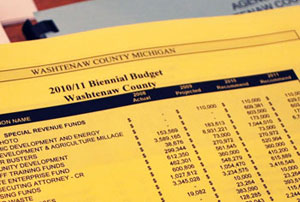
Washtenaw County's preliminary 2010-2011 budget.
Washtenaw County Board of Commissioners meeting (Oct. 7, 2009): Several people arrived early for Wednesday night’s county board meeting, expecting to face the kinds of crowds who’ve packed the county boardroom at recent meetings to plead that funding not be cut for the programs they support as the county battles a projected $30 million deficit.
But seats were plentiful – a comparably light turnout that perhaps reflected two developments: 1) The county’s largest group of unionized workers ratified a deal on Tuesday, giving concessions in 2010 and 2011 that will save the county millions over that two-year period; and 2) an amendment to the proposed budget would restore some of the previously anticipated cuts to human services nonprofits.
The board also gave initial approval – with two commissioners dissenting and a third giving only partial support – to a tax for economic development efforts, which includes support for programs focused on local agriculture. They approved a tax to raise funds for indigent veterans services. And they got an update from Jennifer Watson, the county’s budget manager, who walked commissioners through the roughly three-pound preliminary budget book for 2010-2011. Details on all of this, plus environmental awards and a report from the Huron River Watershed Council, after the jump. [Full Story]