Stories indexed with the term ‘local business’

Monthly Milestone: Local Shopping Madness

Editor’s note: The monthly milestone column, which appears on the second day of each month – the anniversary of The Ann Arbor Chronicle’s Sept. 2, 2008 launch – is an opportunity for either the publisher or the editor of The Chronicle to touch base with readers on topics related to this publication. It’s also a time that we highlight, with gratitude, our local advertisers, and ask readers to consider subscribing voluntarily to The Chronicle to support our work.

Nina Juergens of Acme Mercantile

Nina Juergens of Acme Mercantile with a cake marking the downtown Ann Arbor store's 9th anniversary in November.

When I worked on the business desk at The Ann Arbor News, we were awash with press releases about various business anniversaries, awards and other achievements. In hindsight, it’s fair to say we did not treat these accomplishments with the respect that many of them deserved.

Perhaps it takes being closely connected to a small enterprise – whether it’s a business, nonprofit or independent professional, or a program you launched or service you’ve been providing  – to appreciate the milestones that might seem trivial to an outsider. If you understand that making it through the day without quitting your business can be a pretty significant achievement, it gives you a visceral connection to those announcements.

That’s one reason why here at The Chronicle, we’ve started allotting some of our monthly milestone columns to congratulating others who’ve reached some kind of marker. Generally, large institutions are more likely to log higher numbers and get more attention for that. The University of Michigan, for example, is gearing up to celebrate its 200th anniversary in 2017, and is already marshalling its considerable resources for that event.

But I have a soft spot for smaller, human-scale endeavors.

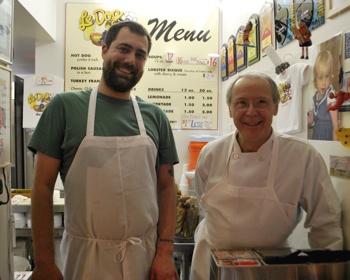
This month, we’re highlighting three such ventures: Local businesses – Acme Mercantile, Le Dog, and Anderson Paint – that all celebrated recent anniversaries, and whose owners have strong ties to this community.

And because tonight, Midnight Madness and Kerrytown Kindle Fest are launching many Ann Arbor shoppers into the holiday shopping season, with several downtown stores open late and offering special deals, I’d like to start by sharing a couple of thoughts about that, and by sharing a Twitter hashtag: #a2shoplocal.  [Full Story]

Monthly Milestone: Sharing Milestones

Editor’s note: The monthly milestone column, which appears on the second day of each month – the anniversary of The Ann Arbor Chronicle’s launch – is an opportunity for either the publisher or the editor of The Chronicle to touch base with readers on topics related to this publication. It’s also a time that we highlight, with gratitude, our local advertisers, and ask readers to consider subscribing voluntarily to The Chronicle to support our work.

Jacobson's ad

A Jacobson's ad in a 1985 publication commemorating the 150th anniversary of The Ann Arbor News. Both institutions are now out of business. This page proof is hung on an office wall where the Ann Arbor District Library is storing The News' archives.

This fall when I visited the Green Road offices where the Ann Arbor District Library is keeping The Ann Arbor News archives, I was fascinated by the page proofs that lined the walls of the entryway.

The proofs are from a 1985 publication commemorating the 150th anniversary of The News. In addition to the usual hagiographic articles you’d expect to find, the pages also were full of ads from local businesses, many of them congratulating The News for its milestone anniversary, and noting their own longevity in the community.

There was so much optimism in those pages – and now, so many ghosts. The News, of course, was shut down by its owners in 2009. Many other advertisers in that publication – Jacobson’s department store, Bill Knapp’s restaurant, Schlenker Hardware, a menswear shop called Marty’s, Fox Tent & Awning – are now found only in places like AADL’s Old News, where articles from newspapers’ past are being archived in digital form.

One of my takeaways from that visit – and I’ll admit it’s no great insight – is to take nothing for granted. Having now run this publication for just over three years, I more fully appreciate just how much work, luck and support it takes to keep something afloat – whether it’s a business, nonprofit, religious institution, marriage or anything else that counts its longevity in years, decades or centuries.

That’s one reason why, as noted last month, we’ve decided to use The Chronicle’s monthly column to celebrate other people’s milestones, too. This month, we’ll share milestones from a church, a holistic health practitioner, a nonprofit and a business. We’d love to hear from you, too – what’s worth counting in your life? [Full Story]

Arbor Networks Tax Abatement OK’d

At its Oct. 17, 2011 meeting, the Ann Arbor city council granted a tax abatement to Arbor Networks, a computer network security company. The abatement is on $883,527 of real property improvements and $7,790,454 of new personal property and equipment.

According to the staff memo accompanying the resolution, Arbor Networks was granted a tax abatement in 2008. The abatement agreement in 2008 required Arbor Networks to move 74 jobs to their Ann Arbor facility and add at least eight jobs. However, as of December of 2010 there were only 74 jobs at this location.

The staff memo on the current request for a tax abatement states that the digital information business is continually changing with new and faster technology. Arbor Networks needs new test equipment and digital equipment, and according to the memo, anticipates adding 20 new employees to the Ann Arbor facility.

This brief was filed from the city council’s chambers on the second floor of city hall, located at 301 E. Huron. A more detailed report will follow: [link] [Full Story]

Rezoning for Biercamp Parcel Voted Down

At its Sept. 8, 2011 meeting, the Ann Arbor planning commission voted unanimously against recommending a rezoning request for the property at 1643 and 1645 S. State St., south of Stimson and next to the Produce Station. The parcels currently house a new business – Biercamp Artisan Sausage and Jerky – as well as an auto repair shop and furniture manufacturer. The recommendation against approval will be forwarded to city council for final action.

Biercamp owners Walt Hansen and Hannah Cheadle want to rezone the property to C3 (fringe commercial district), which would allow their business to sell a wider variety of merchandise, including products not made on site.

The commission first considered this request at its Aug. 16, 2011 meeting, along with a … [Full Story]

Column: Book Fare

So after Borders, now what?

What will it take for another bookseller to open shop in the Borders/Shaman Drum neighborhood at State and Liberty, and operate a browseable place with content deep and wide? We’re talking about a books-and-mortar store a stone’s throw from the University of Michigan campus. A spot where you arrange to meet up with your husband after the two of you go your separate ways for an hour. Where you hang out until the movie starts at the Michigan Theater. Where you actually buy a book now and then – sometimes a title other than the one that got you in the real, live door.

The No. 1 Borders bookstore at Liberty & Maynard in Ann Arbor.

The No. 1 Borders bookstore at Liberty & Maynard in Ann Arbor.

Keith Taylor, the poet, UM creative writing teacher and veteran local bookseller, says “it will take idealism, a lot of 80-hour work weeks, a willingness to be constantly present.”

Check, check and check. This is Ann Arbor, after all.

And then there’s Taylor’s fourth condition: “A landlord willing to rent space for less than the going rate.”

“Rents in central Ann Arbor right now will not allow for an independent bookstore, or an independent anything,” he says, “until the business owner owns the building the store is in.”

Karl Pohrt concurs – and the owner of the former Shaman Drum Bookshop, but not the building that housed it, should know: “It’s essential to own the building. If they don’t, they’ll be vulnerable.”

“Rent,” replies Nicola Rooney flatly when the proprietor of Nicola’s Books is asked why she won’t consider a move from Westgate Shopping Center to the State Street area.

We knew that, really. This is downtown Ann Arbor, after all. The market apparently won’t bear an independent bookstore in that neighborhood – Shaman Drum, which was located on South State just around the corner from Borders, closed in 2009 after nearly 30 years in business. Its former storefront is now a burger joint.

So the real question is this: If the market won’t bear a full-blown downtown bookstore, how will the community respond? [Full Story]

Medical Marijuana Rezoning Request Denied

Ann Arbor planning commission meeting (Aug. 16, 2011): Two zoning-related requests on South State Street received mixed responses from planning commissioners, amid calls for a formal study of that corridor.

Treecity Health Collective

Treecity Health Collective, a medical marijuana dispensary on South State Street. (Photos by the writer.)

One request was the first tied to the city council’s recent approval of zoning regulations for medical marijuana dispensaries. The operator of Treecity Health Collective, a dispensary at 1712 S. State, asked that the location be rezoned from O (office) to C1 (local business). In June 2011, the council approved amendments to the city’s zoning ordinances that prevent medical marijuana dispensaries from operating in office zoning districts. Rather than relocate the dispensary, the operator was asking for the zoning change. The property is located on the west side of State, south of Stimson.

While expressing sympathy for the operator, commissioners recommended denying the rezoning request, noting that the master plan calls for an office district in that area. It will now be forwarded to the city council for final action.

The commission considered a separate request for nearby parcels on the opposite side of South State, where the new Biercamp Artisan Sausage and Jerky opened about a month ago. The property – 1643 and 1645 S. State St., south of the Produce Station – is in Ann Arbor Township, and requires both annexation and zoning. The commission recommended approval of annexing the land, but postponed a decision on zoning. Biercamp owners are hoping for commercial zoning, which would allow them to expand the retail component of their business. The city’s master plan currently calls for light industrial zoning in that section.

In discussions for both Treecity and Biercamp requests, some commissioners pointed to the need for a comprehensive study of the South State Street corridor. Such a study has been planned, but earlier this year the city council voted against funding a consultant to conduct the work.

In other action, commissioners recommended annexing several Scio Township parcels that are located in a recently expanded well prohibition zone related to the Pall/Gelman Sciences 1,4 dioxane underground plume. Pall is paying for the hook-ups to city water and sewer, according to city planning staff.

Commissioners also recommended approval of a site plan at 3590 Washtenaw Ave., at the southwest corner of Washtenaw Avenue and Yost Boulevard. The plan calls for building a 9,500-square-foot, single-story addition to the existing 15,769-square-foot retail building that currently houses the Dollar Tree. It’s in the spot where Frank’s Nursery formerly operated, along the same stretch that’s part of the Reimagining Washtenaw Avenue project.

Wendy Rampson, the city’s planning manager, gave several updates to the commission. Among them, she noted that four projects previously approved by the city council are now asking for two-year extensions on their site plans: (1) The Gallery planned unit development (PUD) on North Main, at the site of the former Greek Orthodox church; (2) the 42 North residential development at Maple and Pauline; (3) the Forest Cove office building on Miller; and (4) the Mallets View office building on Eisenhower. Those requests are being reviewed by city planning staff.

During his communications from city council, Tony Derezinski, who also represents Ward 2 on council, mentioned that a final meeting for the R4C/R2A advisory committee is tentatively set for Sept. 21. He noted that the 21st is also Saint Matthew’s Feast Day, which he quipped might help the group finish up the project.

One member of that advisory committee is former planning commissioner Jean Carlberg, who received a resolution of appreciation from the commission at the beginning of Tuesday’s meeting. Her term ended June 30 – she served on the commission for 16 years. [Full Story]

Site Plan for Former Frank’s Nursery OK’d

At its Aug. 16, 2011 meeting, the Ann Arbor planning commission recommended approval of the site plan for 3590 Washtenaw Ave., at the southwest corner of Washtenaw Avenue and Yost Boulevard. The plan calls for building a 9,500-square-foot, single-story addition to the existing 15,769-square-foot retail building that currently houses the Dollar Tree. The new space is designated for an additional tenant. The plan would require approval by the Ann Arbor city council.

The building addition would replace an existing unenclosed canopy area used by the former tenant, Frank’s Nursery. The site is part of a larger retail center along Washtenaw Avenue that consists of five parcels with the same owner. The site plan includes construction of a new public sidewalk in … [Full Story]

Column: Saying Goodbye to Borders

It’s tough for any sports writer to get a book published – but it was a lot easier with a friendly bookstore on your side, from start to finish.

John U. Bacon

John U. Bacon

It wasn’t that long ago that if you wanted to buy a book, there was no Kindle or Nook or Amazon.com – or the Internet. There weren’t even big-chain bookstores. You had to go to one of those narrow stores in mini-malls that sold paperback best-sellers and thrillers and romance novels.

But then the Borders brothers changed all that. They decided to go big, opening a two-story shop on State Street in Ann Arbor. They stocked almost everything, they gave customers room to relax and read, and they hired people who weren’t just clerks, but readers.

When I applied for a job there in college, they didn’t just hand me an application, but a test on literature – which I failed.

But if they wouldn’t let me sell books there, they still let me buy them, so perhaps it was just as well. I bought everything from Mark Twain’s “Innocents Abroad” to Kurt Vonnegut’s “Slaughterhouse Five.” Typically, I’d walk in for one book, and walk out with four – an hour later. I spent over a thousand dollars a year there, then a few hundred more on book shelves.

When Borders became a national chain, we Ann Arborites took an unearned pride in seeing the rest of the country love it as much as we did. [Full Story]

Column: Arbor Vinous

Joel Goldberg

Joel Goldberg

For over 40 years, Ann Arbor wine retailer Village Corner was a fixture on South University, near the University of Michigan’s Central Campus, until it closed last November to make way for a student high-rise at 601 S. Forest.

Dick Scheer, an iconic figure in Michigan wine circles, owned the store that entire time. When it closed, Scheer stashed his inventory in temporary quarters, took his Terminator turn – “I’ll be back!” – and pledged to reopen shortly in a venue with better parking, as he told Sandra Silfven of the Detroit News.

Then, nothing. Scheer went to ground, keeping his own counsel as he sought a new location, to the not-infrequent exasperation of long-time customers and members of the media alike.

Until last week, when the website of Michigan’s Liquor Control Commission (LCC) spilled the beans: on March 17, Village Corner applied to relocate its beverage licenses to another campus-adjacent address.

North Campus, that is.

The new location, at 1747 Plymouth Road in The Courtyard Shops, sits between No Thai! restaurant and Jet’s Pizza, in a storefront formerly occupied by Tanfastic tanning salon. [Full Story]

Column: History Repeats at AnnArbor.com

When we first heard about the layoffs at AnnArbor.com last Thursday – starting with cryptic comments on Facebook, quickly spreading through the Ann Arbor News diaspora and then the broader community – I had a sickening sense of déjà vu. It was two years ago this month that the out-of-state owners of our town’s daily newspaper announced their plans to close the business, tearing apart the lives of its workers, fraying some of the Ann Arbor community’s fabric, and drawing national attention for the decision’s fearlessness or folly, depending on your view.

AnnArbor.com layoff list

Redline highlights are those AnnArbor.com staff whose names have disappeared from the staff roster.

I wrote about their decision at the time from a personal perspective. Even though I had left the News the previous year to co-found The Chronicle, it was still a place that employed many friends and colleagues I respected. Watching that organization get dismantled was emotional, for many reasons.

Although we began to hear about the layoffs on Thursday last week, we decided not to write immediately about that news. In part, we reasoned that it should be AnnArbor.com’s story to tell first, and I held out hope that executives at AnnArbor.com would be straightforward in letting the community know about their decision, and the rationale behind it.

I also hoped they would wrap into their coverage the news that three other key staff members – news director Amalie Nash, higher education reporter David Jesse and point person for reader interaction Stefanie Murray – had all been hired by the Detroit Free Press. All three left at the end of February. All had previously worked for many years at The Ann Arbor News, and had been initial hires at AnnArbor.com.

Considered separately, either the set of layoffs or the three departures would have had a significant impact on the organization. But with both events taking place within two weeks, it counts as the most dramatic personnel change since AnnArbor.com’s launch. [Full Story]

Photo Essay: Fat Tuesday in Ann Arbor

Editor’s note: It’s Fat Tuesday, when thoughts turn to paczki – those dense but irresistible Polish pastries that mark the last hurrah before Lent. This year, for the first time in their 18-year history, Zingerman’s Bakehouse staff got up well before dawn to make their own version, and local photographer Anne Savage was there to catch the action. She’s sharing some of her work with Chronicle readers – you can find many more photos on her new food blog, The Savage Feast. Enjoy!

Nina Huey at Zingerman's Bakehouse

Nina Huey sprinkles powdered sugar on a tray of paczki at Zingerman's Bakehouse Tuesday morning. Ingredients for the dough include bit of Spiritus, a Polish grain alcohol.

[Full Story]

Column: Medical Marijuana – Drawing a Line

The Michigan Medical Marihuana Act (old-tyme spelling courtesy of the Michigan legislature) has been in effect since December 2008, but it wasn’t until last summer that seemingly every stationary object and alternative newspaper in Michigan was plastered with pot-leaf emblazoned ads for dispensaries, compassion centers, and doctors willing to recommend medical marijuana.

Photo illistration of a prescription bottle for medical marijuana

Would you want your medicine dispensed like this? (Photo-illustration by The Chronicle.)

As the business columnist for the Current, I dropped in on one such business, hoping to sit down with the good doctor and get a sense of just how all this worked. To ensure accuracy, I always record my interviews, something the subjects of those interviews usually appreciate: No one wants to be misquoted.

I was shocked when this doctor declined to be recorded. In four years of writing that column no one had ever asked that I not record: burlesque dancers, roadkill-eating geeks, foreign-born restaurateurs with unpopular social stances, even those involved in actual criminal enterprises had all been fine with a recorded interview.

But this medical doctor didn’t want me to record her talking about her medical practice, nor would she tell me her first name – although LinkedIn outed her the next day when it showed me her picture and suggested we connect as business contacts. [Full Story]

Arbor Dog Daycare Returns – and Prevails

Ann Arbor planning commission meeting (Dec. 21, 2010): More than a year after making their initial request, the owners of Arbor Dog Daycare were granted a special exception use on Tuesday, allowing the South Main Street business to expand.

Chris Cheng, Jon Svoboda

Chris Cheng, left, of the Ann Arbor planning staff talks with Jon Svoboda, co-owner of Arbor Dog Daycare. (Photos by the writer.)

Several conditions were added, including requirements related to the number of dogs allowed outside, and action to be taken if there’s continuous barking. Noise concerns had been a reason cited by commissioners who previously voted against the request.

Also at Tuesday’s meeting, the commission granted a special exception use and approved the site plan for Allen Creek Preschool, which plans to tear down an existing house and build a larger one at its Franklin Street location.

Commissioners also heard several updates and communications, including a request for feedback on a draft resolution regarding a proposed development agreement between the city and the Ann Arbor Downtown Development Authority. [Full Story]

Column: Benefits of The Local Call

Due to some unpleasantness in my gastro-intestinal tract, I spent this past Friday night in the University of Michigan Hospital.

The author's iPhone, clad in its new case: "I do have an iPhone, a wonderful gadget that can tell me what drug stores are near my house ..."

Happily, I was not sick enough to stay very long, so I was kicked to the curb on Saturday afternoon, clutching a prescription for oxycodone. [No, that’s not a typo – it’s the generic version of OxyContin.]

I need the stuff for my stomach pain, which – for reasons the UM docs could not quite explain – has lingered past any sign of inflammation that can be detected by a CT scan or in my bloodstream.

I asked the nurse who checked me out whether I could get the meds at any pharmacy, thinking that perhaps high-octane opiates are reserved for hospital dispensaries. “Well,” she said, “that’s why you have a prescription.”

Yes, but filling a prescription on a Saturday night is not so easy. There are no fewer than four stand-alone pharmacies within a mile radius of my house on the West Side – five if you count the one inside Kroger’s. I struck out at three of them. [Full Story]

University Bank Project Postponed

Ann Arbor planning commissioner meeting (Oct. 19, 2010): Three projects were considered at the Oct. 19 planning commission meeting, and commissioners voted to postpone two of them.

Hoover Mansion

The headquarters of University Bank, in the building known as the Hoover Mansion on Washtenaw Avenue. A request to increase parking on the site was postponed by the Ann Arbor planning commission at its Oct. 19 meeting. (Photos by the writer.)

One of those projects – related to an expansion of Arbor Dog Daycare – has already appeared before the commission multiple times. Most recently, the proposal was rejected by commissioners in September, primarily due to concerns about noise generated by dogs using the outdoor dog run. Owners Jon and Margaret Svoboda had asked that their request be reconsidered, and commissioners agreed to the reconsideration. But after an hour of discussion on Tuesday evening, commissioners voted to postpone again, asking staff to explore possible conditions – such as an annual review or written policy requirement – that could be added to the special exception use to address the problem of continuously barking dogs.

Also postponed was a request to add more parking to the site of the University Bank headquarters in the building known as the Hoover Mansion on Washtenaw Avenue, and to allow up to 10 additional employees to work at that location. The planning staff had recommended denial of the request, stating that the project impacts natural features and doesn’t offer an overall benefit to the city. However, commissioners asked planning staff to work with bank officials to come up with an alternative proposal for locating new parking.

During a public hearing on the project, bank president Stephen Ranzini told commissioners that if the bank can’t get the additional parking, it could trigger a decision to leave that location and expand elsewhere. He noted that the building, which he said sat vacant for nearly three years before being acquired by the bank, is extremely expensive to maintain, and described himself as a good steward for the property.

A third proposal considered by the planning commission on Oct. 19 – adding parking spots to the Briar Cove Apartments complex on the city’s southwest side – was approved unanimously. [Full Story]

Column: Arbor Vinous

Joel Goldberg

Joel Goldberg

In the far corner, wearing synthetic trunks: Steve Heimoff, west coast editor of Wine Enthusiast magazine. I pilfered part of the column title from him; fortunately, Steve’s pretty laid back about such things.

Unlike “natural, schmatural” wine, over which he turns apoplectic: “‘Greenwashing’ is the perfect way to describe a large part of the whole natural, green, sustainable, organic, biodynamic thing. Everybody wants to portray his practices as purer than the other guy’s practices. It’s a holier-than-thou world out there, and IMHO that goes for the whole greenie-natural crowd.”

And here in the near corner, Ann Arborites Stacey and Rob DeAngelis, dressed in the all-natural cloak of DeAngelis Cantina del Vino, whose tasting room opens later this month. It’s the only winery with an Ann Arbor mailing address, though you’ll find it deep in Scio Township.

Not for them, the typical 21st century winemaker’s arsenal of chemicals, sulfites, color enhancers and designer yeasts.

What’s in the wines? “Just the grapes,” says Stacey DeAngelis, whose picture appears on their label.

She’s not kidding. [Full Story]

Zingerman’s Expansion Moves Ahead

Ann Arbor Historic District Commission meeting (Sept. 9, 2010): The last-minute addition of a closed session – which lasted nearly an hour, just prior to deliberations on the Zingerman’s Deli expansion – added a bit of drama to Thursday’s meeting. But ultimately commissioners unanimously approved all projects on their agenda, with only a few concerns cited.

Members of the Ann Arbor Historic District Commission in back of the Zingerman's Deli Annex

Members of the Ann Arbor Historic District Commission talk with architect Ken Clein, right, in back of the Zingerman's Deli Annex on Sept. 7. Clein is with Quinn Evans Architects, which is handling the proposed expansion project. (Photos by the writer.)

The highest-profile of those projects, of course, was a plan to expand the Zingerman’s Deli operations at the corner of Detroit and Kingsley streets, in the Old Fourth Ward historic district. About a dozen representatives affiliated with Zingerman’s attended the meeting, including co-founder Paul Saginaw and managing partners Grace Singleton and Rick Strutz.

In 2008, commissioners rejected the company’s first attempt to gain HDC approval – in the form of a “certificate of appropriateness,” which included asking permission to tear down a small house on their property that had been gutted by fire. Since that initial rebuff by the HDC, Zingerman’s has been working on an alternative path, gaining approval from the city’s planning commission and city council, and returning to the HDC for a “notice to proceed.”

On Thursday, the commission granted the notice to proceed, which will allow the project to move forward. Several commissioners addressed concerns raised during public commentary about this project setting a precedent, saying that Zingerman’s is a unique business and this expansion is unique as well.

But commissioner Lesa Rozmarek, while noting that she would support the project and that overall Zingerman’s is an asset to the community, also said she wanted it on the record that she felt Zingerman’s had threatened the commission with the prospect of leaving the area if they didn’t get approval. The project sets a bad precedent, she said, adding that “it’s opening a big door that hopefully we can shut after this application.”

Later in the meeting Saginaw responded to Rozmarek’s comments, denying that anyone from Zingerman’s threatened to leave the city – though at one point they did consider moving out of that location to another site within Ann Arbor, he said. Saginaw said he believed the HDC was able to approve the project on its merits.

In other business, the commission issued certificates of appropriateness for three projects: 1) a solar panel installation at 217 S. Seventh St., 2) a request to add an exterior sign near the front door of 209-211 S. State St., where a CVS pharmacy is being constructed, and 3) a proposal for a 1.5-story addition on the back of 442 Second St.

The solar project is being installed on the home of Matt Grocoff, founder of Greenovation TV. Grocoff had attended last month’s HDC meeting, when two other solar panel installations were approved, including one at the historic Michigan Theater building on East Liberty. On Thursday, Grocoff told commissioners that when his solar panels are installed, his home will be the oldest in the nation to achieve net zero energy status, using only energy generated on-site. [Full Story]

Column: Seeds & Stems

Marianne Rzepka

Marianne Rzepka

The sky was full of fast-moving clouds – disappearing remnants of a morning’s rain – and temperatures were falling from a week of 90-degree weather into the 70s.

A breeze was the final touch to the perfect weather at Kirk Jones’ Good Scents Gardens in Ypsilanti Township.

“Being out here,” said Jones. “I like this.”

Good thing, because the flowers he grows there are his business. Jones uses the yarrow, zinnias, butterfly weed and agastache for bouquets he puts together and personally delivers to regular subscribers.

Jones explains it as a twist on the idea of community supported agriculture, or CSA, in which subscribers pay a set amount for one season of produce from a local farm. Instead of picking up a carton of vegetables once a week, Good Scents’ customers get a floral bouquet delivered to their home or business once a week.

Like a CSA, in which a subscriber’s take depends on what and how much the farmer raises over a season, Good Scents’ customers get what Jones chooses to plant and what comes up each year. No matter what, he said, they will get a bouquet of flowers each week over the 26-week season. [Full Story]

Column: Arbor Vinous

Joel Goldberg

Joel Goldberg

Imagine a restaurant that thrives and grows based on its friendly service, consistent products, strong marketing and support for and from its community.

But peek in the kitchen and you discover packaged mixes, pre-sliced produce, shortcut recipes and commercially-prepared dishes, straight from a central commissary or food-service supplier.

Its primarily pre-packed ingredients never spoil, but neither do they ever taste truly fresh. Menu items don’t vary from one visit to the next, thanks to consistent sourcing and preparation – but neither do they ever excite, or rise above the overall uniformity and mediocrity of their processed flavors.

Now imagine that this restaurant is, instead, a winery. And let’s consider the curious case of downtown Saline’s Spotted Dog, which just announced a capacity-tripling expansion accompanied by positive nods from some local media.

The affable John Olsen, a refugee from the world of corporate tech support, looks up from behind the tasting counter as you enter the Spotted Dog, a brick-walled, 1,600-square-foot storefront just off the corner of Michigan Avenue and Ann Arbor Street.

Olsen, who co-owns the winery with his wife, Jill, is tediously affixing labels to a batch of newly-filled bottles. Such is life at a micro-winery, where hand labor often stands in for expensive and space-consuming machines. [Full Story]

Column: Losing a Friend, and Community

John U. Bacon

John U. Bacon

It was a beautiful summer morning. I walked from my home in Ann Arbor, down State Street, to St. Thomas the Apostle Church. A crowd had already gathered outside, waiting to pay respects to our old friend, Mr. Brown.

No one told us to call him that. We just did.

In 1937, Mr. Brown’s father and grandfather opened a store called College Shoe Repair. Mr. Brown took over the business in 1951, the same year he married Dorothy – or Mrs. Brown, to us. They worked together every day. They had seven kids, and all of them worked at the store at some point.

When the shoe repair business slowed down in the ’70s, Mr. Brown started selling hockey equipment and sharpening skates. That’s how most of us got to know him. [Full Story]

Zingerman’s Project Seeks Brownfield Status

The major renovation and expansion in the works for Zingerman’s Deli cleared its most recent major hurdle in May, gaining site plan approval from the Ann Arbor planning commission. While the site plan now moves on to city council, the business is taking action on another front as well: Applying for support from the local and state brownfield program.

Grace Singleton

Grace Singleton, a managing partner with Zingerman's Deli, talks about plans to apply to the local and state brownfield program as part of the deli's renovation plans. The business hosted a public meeting about the plans on June 21. (Photos by the writer.)

On June 21, Zingerman’s hosted a public meeting to answer questions about their plans for the brownfield application. Matt Naud, the city’s environmental coordinator, was on hand as well, and distinguished between this project and those that are typically associated with the term “brownfield.” In the case of Zingerman’s Deli, “it’s economic development,” he said, “It’s not about environmental cleanup.”

Specifically, brownfield status would allow Zingerman’s to be eligible for tax increment financing (TIF), a mechanism that would let the business recoup certain qualified expenses related to the project – possibly as much as $817,000 over 15 years.

It’s a different approach than the brownfield application most recently approved by city council for the Near North affordable housing project on North Main. In that case, the site’s need for environmental cleanup qualifies it for a brownfield status. Zingerman’s application also differs from Near North’s in that Near North isn’t seeking reimbursement through TIF. Both projects plan to apply for Michigan Business Tax credits. [Full Story]

Column: Book Fare

Arthur Nusbaum raised the curtain on his second act – Third Mind Books – in January. With an inventory of more than 500 items, the online bookstore devoted to the work and legacy of the Beat Generation shares office space with Nusbaum’s once-primary gig: he’s president of Ann Arbor’s Steppingstone Properties Ltd.

Arthur Nusbaum

William S. Burroughs looms large for Arthur Nusbaum – in this case, literally. The portrait of this Beat Generation iconoclast hangs in the lobby of Nusbaum's Third Mind Books and Steppingstone Properties.

A real estate guy with a thing for William S. Burroughs, Jack Kerouac and the rest of that reckless crew? Incongruous, on the face of it. But a closer look reveals a certain ironic harmony.

“I used to be an activist,” says Nusbaum. No surprise there – this is a fellow whose dazzling energy will find an outlet.

Born in Detroit, he grew up in the suburbs, attended the University of Michigan and returned to Ann Arbor for good in the early 1990s as the concept of New Urbanism was gathering steam in Ann Arbor and across the country. Those principles resonated with him, and as he made the connection between his own business and the intensifying local efforts to rein in suburban sprawl, Nusbaum says, “real estate became more meaningful for me. And that’s reflected in buildings like this.”

He’s speaking from his second-floor suite of offices in Ashley Square, at 123 N. Ashley St. The building – Nusbaum believes it was an auto showroom in its original incarnation – was rehabbed in the 1980s and purchased in the late 1990s by Nusbaum, who relocated Steppingstone there in 2000.

“To make a long story short, that’s the direction I took for the last decade and a half in my business,’’ he says. [Full Story]

Zingerman’s Deli Expansion Moves Ahead

Ann Arbor Planning Commission meeting (May 18, 2010): Two items with ties to Zingerman’s received approval from planning commissioners at their most recent meeting: The site plan for expansion of Zingerman’s Deli, and a special exemption use for the Westside Farmers Market, located next to Zingerman’s Roadhouse.

Grace Singleton, Paul Saginaw

Grace Singleton, a managing partner of Zingerman's Deli, sits next to Zingerman's co-founder Paul Saginaw as the planning commission deliberates on a proposed expansion of the deli, which was ultimately approved. Behind Saginaw is Michael Quinn of Quinn Evans Architects, who is working on the project. (Photos by the writer.)

The farmers market has no further steps to take – it opens on June 3, from 3-7 p.m. But the approval process for the deli expansion is far from over. After seeking approval from city council for its plans, deli partners will need to circle back to the city’s historic district commission – the site is located in the Old Fourth Ward historic district. The Chronicle has previously reported on their earlier efforts down this path: “Zingerman’s: Making It Right for the HDC.”

Pending approvals, Zingerman’s hopes to break ground on the project early next year.

Also at last week’s meeting, commissioners reviewed the site plan for the Windsong affordable housing project off of Stone School Road, north of Ellsworth. They ultimately approved plans for building 32 townhomes financed in part by the Michigan State Housing Development Authority. But concerns were raised over problems that some residents in the site’s existing 12 townhomes are causing for their neighbors. Three of those neighbors spoke at a public hearing, saying they’d like a higher fence around the property, at the least, to deal better with harassment, fighting, graffiti and other issues. [Full Story]

Pleas for Human, Safety Services at Council

Ann Arbor City Council meeting (May 3, 2010): Several speakers addressed the city council at its Monday meeting asking for continued funding for human services and to avoid layoffs in the city’s police and fire departments.

Fire fighters informational picket

Firefighters held an informational demonstration Monday afternoon before the city council's meeting at Station 1, which is located across the street from city hall. Firefighters from Flint, Dearborn, Dearborn Heights, Ann Arbor Township, Ypsilanti, Battle Creek and Ann Arbor took part in the demonstration. (Photos by the writer.)

And Margie Teall (Ward 4), who faces two challengers in the August Democratic primary, announced a planned amendment to the city’s proposed budget that would maintain human services funding at FY 2010 levels. The amendment, which will be brought forward at the council’s May 17 meeting, would also avert as many layoffs in the police and fire departments as possible, she said.

The previous evening at the council’s Sunday night caucus, Mike Anglin (Ward 5) and Sabra Briere (Ward 1) had already indicated they would support using part of a possible $2 million payment from the Downtown Development Authority to avoid police and firefighter layoffs.

The council’s plan for funding the amendment, reported Teall, is to use a $2 million payment from the Downtown Development Authority that it hopes the DDA board will approve at its May 5 board meeting. Even if the DDA board approves the payment, which is very likely but not certain, not all safety services layoffs in the city administrator’s proposed budget could be covered. Averting the elimination of 35 positions across police and fire departments combined would require $3.6 million. The restoration of human services funding would require another $260,000. And that would still result in the city tapping its general fund reserves for $1.5 million.

In its business for the evening, the council passed a resolution added late Monday to the council agenda, which strikes an agreement between the city and the Michigan Dept. of Natural Resources and Environment for the future of the embankment along Argo Dam. It will allow the headrace to be re-opened by the end of this week.

The council also approved on first reading a revision to the city’s sidewalk occupancy permit system to include sandwich board signs. And the residential development now called Heritage Row – proposed along Fifth Avenue south of William Street – was approved at the council’s first reading with no discussion, but with dissent from Mike Anglin. Both of those measures will need to come back before the council for a second reading to gain approval.

The council also approved received the mayor’s nomination of the appointment of Anya Dale to the AATA board, replacing Paul Ajegba, whose term expired on May 1. Ajegba had been elected by his colleagues last fall to chair the board. Dale is a Washtenaw County planner. Her appointment will be presented for confirmation at the council’s May 17, 2010 meeting.

The council also approved some additional road closures for the June 6 Dexter-Ann Arbor Run. [Full Story]

Ann Arbor, Give Me a Sign

Vicki Honeyman, Doug Wathen

Vicki Honeyman gives Doug Wathen a haircut in her shop, Heavenly Metal, which shares space with her other business, Vicki’s Wash & Wear Haircuts. In the background to the left is a sandwich board sign for Heavenly Metal, tucked into the corner since Honeyman was notified that it's illegal to put it outside the store.

Vicki Honeyman’s Heavenly Metal is easy to miss. Not only is it the sole retail shop on East Ann, but the business is also set back from the street. Until recently, Honeyman relied on a portable sign she set up on the northeast corner of East Ann and Fourth Avenue to bring in business. But earlier this month, a city official told her she had to take her sign down. In Ann Arbor, it’s illegal.

Honeyman says that since the city made her take her sign down, she’s seen a significant drop in the number of customers coming into Heavenly Metal. Without the sign, people don’t know her business is there.

“It’s completely affected my business,” Honeyman said, describing it as “devastating” to her income.

The Ann Arbor city council considered a measure in February that would have amended the sign ordinance to make portable signs legal, allowing businesses to buy annual permits to use them. But when that resolution was voted down, city officials decided to step up enforcement of the existing sign ordinance. Business groups and retailers have protested – it’s likely that city staff will propose a new permitting system for council to consider next month, one that’s based on sidewalk occupancy permits. [Full Story]

No Secret: Sakti3 Wants Its Batteries in Cars

University of Michigan engineering professor Ann Marie Sastry – CEO and co-founder of a hot, new automotive battery development company – sits shivering in her overcoat in the cold Cobo basement at the Detroit auto show.

sakti3_3

Ann Marie Sastry, CEO and co-founder of Sakti3, at her company's booth at the Detroit auto show. (Photo by the writer.)

But Sastry and her company, Ann Arbor-based Sakti3, is far from “out in the cold.” They are in the auto business for the long haul and do not plan on being relegated to a basement booth forever. Eventually, if all goes well, her company’s battery technology will be powering the cars upstairs on the main show floor’s Electric Avenue.

What is it about the “Eureka moment” in her UM lab that prompted her to help found a company two years ago? What is it that turned the heads and opened the wallets of the Michigan Economic Development Corp. and cleantech venture capitalist Vinod Khosla, who chipped in $2 million out the gate? What exactly is her company’s battery technology? [Full Story]

John Leidy Shop to Close in Late February

The entrance to the John Leidy shop at 601 E. Liberty, adjacent to the Michigan Theater. (Photo by the writer.)

The entrance to the John Leidy shop at 601 E. Liberty, next to the Michigan Theater. (Photo by the writer.)

Just after noon on Sunday, several people had already assembled in the John Leidy gift shop on East Liberty: three generations of the family-owned business, and two self-described “Leidy Ladies” – long-time staff at the 58-year-old store.

A Chronicle reader had contacted us with news that the store planned to close. So we stopped by to talk with the Leidy family, who were gathering there after coming from church: John Leidy’s widow, Ann Leidy, their daughter Liz Arsenault, who manages the store, and son Peter Leidy, who’s acting as spokesman for the family.

Postcards were mailed to their customers over the last few days announcing plans to close at the end of February, when their lease is up. But on Sunday, Peter Leidy told The Chronicle that they weren’t yet ready for an interview. There’s a lot of emotion, he said, and gratitude to customers – but it’s a hard time for them. [Full Story]

Ann Arbor Main Street BIZ Clears Hurdle

Map of proposed BIZ district

Map of proposed BIZ area: Main Street from William Street in the south to Huron Street in the north. (Image links to complete .pdf file of the Main Street BIZ plan.)

On Wednesday, a cold and rainy evening, a group of downtown Ann Arbor property owners gathered in the city council chambers for a public meeting gaveled to order by the city clerk, Jackie Beaudry.

They were there not to discuss rain, but rather snow. At least in part.

On their agenda was consideration of a plan for a business improvement zone (BIZ) on Main Street – bounded by William Street to the south and Huron Street to the north – which would assess an extra tax on owners of property in the zone.

That plan for the BIZ includes snow removal as one of three main categories of services to be paid for through the BIZ. The other two categories of service in the plan are sidewalk cleaning and landscape plantings.

The plan was approved on a roll call vote of the property owners in attendance on Wednesday night, but not without some dissent. And the approval of the plan on Wednesday is not the final step before the BIZ can be implemented. Still ahead lies a formal public hearing by the city council, a vote by the city council, followed by another vote by property owners – this one by mail. [Full Story]

Column: Balanced Offense for Local Economy

A little over 13 years ago, I started work as a business reporter at The Ann Arbor News. And exactly 13 years ago today, as I hoisted myself out of a warm bed at four o’clock in the morning, I was beginning to grasp why the other business reporters might have welcomed me so warmly.

Best Buy

Best Buy on Lohr Road at 4:08 a.m. on Nov. 27, 2009. Doors opened at 5 a.m. (Photo not by the writer – she's not required to cover Black Friday morning stories at The Chronicle.)

They knew that as the newest hire, I’d be the one assigned to the morning-after-Thanksgiving Black Friday shopping story. Later that dark, frigid morning, I watched as a stream of cars disgorged expectant, even festive shoppers to stand in line waiting for the doors at Walmart to open.

My initial reaction: These people are slightly nuts.

Then: Downtown retailers would kill for this kind of crowd.

The dichotomy of large and small businesses is perhaps most visible on days like Black Friday, when more customers on a single morning might flow through Walmart than would shop at a Main Street merchant all year. But the tension between large and small is also reflected in our local public policy priorities for economic development. [Full Story]

Paul Saginaw: We Want to Change the World

Paul Saginaw, co-founder of Zingerman's, spoke about building a local "living economy" at Monday night's Think Local First annual meeting. (Photo by the writer.)

Paul Saginaw, co-founder of Zingerman's, spoke about building a local "living economy" at Monday night's Think Local First annual meeting. (Photo by the writer.)

Paul Saginaw joked that during his senior year of high school, he was voted Least Likely to Have a Positive Impact on Society. The remark drew a laugh from the crowd of more than 100 people attending Think Local First’s annual meeting on Monday night – most of them know the Zingerman’s co-founder is an advocate for socially responsible business, as well as a driving force behind the nonprofit Food Gatherers, which launched 21 years ago this week.

For many years, that high school description was “so true,” Saginaw said. “But for the second half of my life, I’ve been trying to prove them wrong.”

Saginaw, the evening’s featured speaker, talked passionately about the need for local economies built around “human-scale” enterprises, with businesses as a positive force for social change. He described several ways that the Business Alliance for Local Living Economies, a national group, is supporting the efforts of small, independent businesses. The goal? “What we want to do is change the world,” he said. [Full Story]