Stories indexed with the term ‘Open Meetings Act’

Commissioners Discuss County Road Tax

The Washtenaw County road commission plans to request a countywide millage to help pay for road repair. It’s a tax that the county board of commissioners could impose without seeking voter approval. Road commissioners say the millage is needed because the county is faced with diminished funding from the state, increased costs for labor and materials, and a growing number of deteriorating roads.

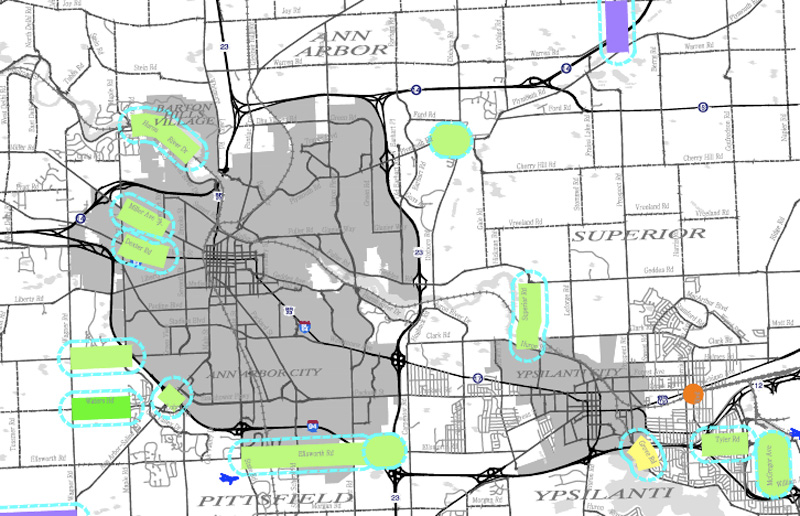
Map of road work proposed for Ann Arbor and Ypsilanti

Map of road work proposed by the Washtenaw County Road Commission for Ann Arbor and Ypsilanti. Other work is proposed throughout the county. The proposal asks the county board to levy a road millage to pay for the work. (Links to larger image.)

The topic emerged at a Sept. 8 working session of the county board of commissioners, which would need to authorize the millage before it could be levied. The issue was not on the agenda, and was discussed late in the meeting.

Wes Prater brought up the issue of a possible road millage during the time set aside for items for current or future discussion. He said he’d received an email indicating that the road commission planned to ask the board to levy an 0.6 mill tax, and he wanted more details. The millage, if authorized, would raise about $7 million for more than three dozen proposed road projects.

County administrator Verna McDaniel reported that she and Curtis Hedger, the county’s corporation counsel, had met with road commissioner Ken Schwartz and Roy Townsend, the road commission’s director of engineering, regarding a possible county millage. Road commissioners believe the millage could be levied under Public Act 283 of 1909. Because that act pre-dates the state’s Headlee Amendment, it could be levied by the board and would not require voter approval.

The staff and board of the road commission have been discussing this proposal at their public meetings as well as privately with elected and appointed officials throughout the county, including county commissioners. At least one of those private meetings may have violated the state’s Open Meetings Act.

It’s expected that Townsend and Schwartz – a former county commissioner, who was instrumental in finding this possible funding source – plan to make a presentation at the county board’s Sept. 21 meeting. The county currently levies two other taxes in this pre-Headlee category, though they are for considerably smaller amounts: (1) 0.05 mills to support economic development and agriculture; and (2) 0.025 mills to support services for indigent veterans. Both were also put forward by Schwartz when he served on the county board. A final vote on renewal of those two millages will occur at the Sept. 21 meeting.

McDaniel said she asked Hedger to seek advice on the road tax from the state’s attorney general. The county needs to look at the statute carefully, she said, to determine what the board’s rights are. [Full Story]

City Council OKs AFSCME Accord

Ann Arbor city council special meeting (Aug 29, 2011): In a 5:15 p.m. special session convened specifically for the purpose of ratifying a new agreement with the city’s largest union, the Ann Arbor city council approved a new contract for its American Federation of State, County and Municipal Employees (AFSCME) Local 369. It’s a roughly 2.5-year deal, lasting through Dec. 31, 2013.

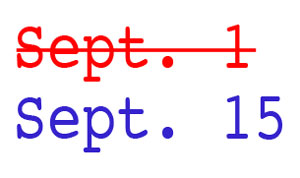
Sept. 1

The city of Ann Arbor held a special meeting on Aug. 29, before its next regularly scheduled meeting on Sept. 6. The urgency to hold a special meeting was based on a typo in a legislative staffer's early draft of a subsequently corrected memo, not based on the actual date in the state's new employment health care legislation. (Simulated correction "illustration" by The Ann Arbor Chronicle)

Key features of the agreement with the 230-member union include: no across-the-board pay increases for the duration of the agreement; employees will make greater contributions to their pension and health care plans; a 10-year vesting period for the pension plan; and an access-only style plan for retiree healthcare benefits.

Council deliberations were relatively brief, with remarks focusing on praise for the city and the union’s respective bargain teams and details of the agreement. Almost equal time was given to the manner in which the special meeting was noticed to the public.

Though questions were raised by The Chronicle through the day on Monday about whether the city had met its obligation to provide notice to the public under the Michigan Open Meetings Act, city attorney Stephen Postema relied on a recent unpublished court of appeals opinion, which is not binding on other courts and which included a strong minority dissent, to justify the city’s failure to meet a basic noticing standard set forth in an opinion from Michigan’s attorney general.

That AG’s opinion – which is also not binding on courts, but which has guided the conduct of public bodies in Michigan for over 30 years – requires public bodies to post physical notice of special meetings in a way that makes the notice publicly accessible for the 18 hours preceding the meeting.

The council’s urgency in approving the contract, reflected in the calling of the special session, was based on recently passed state legislation that limits the amount that public employers can contribute to employee health care costs. Ann Arbor’s contract with AFSCME does not conform to the limits set forth in the legislation. So the council was keen to approve the contract before the effective dates stipulated in the legislation, and did so with only seven of its 11 members able to attend the meeting.

The legislation itself specifies Sept. 15, 2011 as the relevant date; however, Ann Arbor city staff appeared to rely not on the legislation, but on an early draft of a memo drawn up by a legislative staff aide to state senator Mark Jansen, which contained a typo. Although the draft was corrected immediately after its limited initial distribution, the original draft’s stipulation of “Sept. 1″ instead of “Sept. 15″ spurred the city of Ann Arbor to convene the special meeting. The council’s next regularly scheduled meeting is on Tuesday, Sept. 6, 2011 – well before the actual Sept. 15 date in the legislation.  [Full Story]

Art Commission Votes Again on Mural Sites

Ann Arbor public art commission special meeting (April 13, 2011): Because a March 11 special meeting did not conform with noticing requirements under the state’s Open Meetings Act, AAPAC held another special meeting on Wednesday to vote again on the selection of two sites for a new mural program.

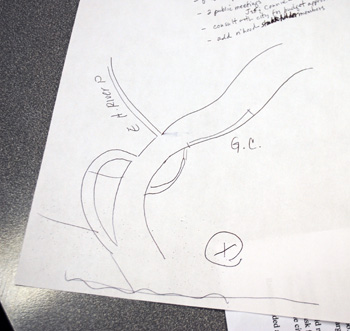
Drawing of location for a proposed mural along Huron Parkway

A sketch by Cathy Gendron of the location for a proposed mural along Huron Parkway, on Ann Arbor's east side. The mural site is indicated with a thin rectangle near the letters "G.C.", which mark the Huron Hills Golf Course.

At the March 11 meeting, which was covered by The Chronicle, AAPAC member Jeff Meyers had presented recommendations from a public mural task force he chairs. The two sites – a building at Allmendinger Park, and a retaining wall along Huron Parkway – will be the first for a pilot mural project spearheaded by Meyers.

At the previous special meeting, commissioners had held a lengthy discussion before voting to approve the sites. The meeting on Wednesday was far shorter, with Meyers giving a brief summary of the selection process. Two of the five members who attended Wednesday had not been present at the March 11 session, however, and they had some questions about the sites.

Meyers also reported that since March, city staff have advised him to make a presentation at the next meeting of the Ann Arbor park advisory commission, since the sites are near or within city parks. Two public meetings – one for each site – will also be scheduled, to get input from residents. [Full Story]

Column on Hoops: Basketball, Civics

On Tuesday, a capacity crowd packed a local Ann Arbor venue to watch a five-person team do its work. Part of the color commentary included talk of game-changing players, and speculation about who had the best center of all the conferences. Everyone knew that whichever team prevailed on Tuesday would not win the whole tournament – it would just advance to the next round.

Ann Arbor West Park basketball hoop

The basketball hoop on the south end of the court in Ann Arbor's newly renovated West Park. (Photo by the writer.)

Here’s a highlight reel of how events unfolded on Tuesday. Play opened with a disputed call, and one of the fans nearly got tossed out of the venue. There was a guy with a red sweater, reminiscent of those favored by Bob Knight when he coached the Indiana University squad, even though he was not the guy in danger of getting tossed. He was actually prepared to do the tossing.

Early on, the coach told the team about the “four corners” – which some older sports fans might recognize as a stalling style of basketball made popular by legendary University of North Carolina coach Dean Smith. And the team managed to hold the ball for one final shot, which it made. The cheerleaders cheered. The victors were valiant … hail, hail, etcetera.

The venue? It was the fourth floor meeting room of city hall. And the five-person team was the committee charged with evaluating proposals for use of the city-owned Library Lot. That’s the parcel atop the Fifth Avenue parking structure currently under construction.

Who says local civic affairs isn’t at least as interesting as NCAA basketball? Well, actually, most readers would say that, I’m guessing.

But here’s something I think we can all agree on: Fans at basketball games get to cheer or boo as loud as they like … within certain parameters. The parallel principle for public meetings, like the one on Tuesday, is that members of the public should be allowed to address the group during its meeting.

The city of Ann Arbor’s stated written policy on this is actually quite clear: Even entities that are not public bodies under the Open Meetings Act should, to the best of their abilities, conform with the spirit of the OMA – which includes a provision for public participation at meetings. [Full Story]

County Board to Eliminate Admin Briefings

Conan Smith, chair of the county board, began Wednesday’s meeting with an announcement: “This will be the last administrative briefing.”

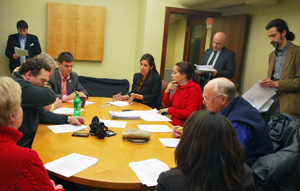
Washtenaw County commissioners and staff at the Feb. 23, 2011 administrative briefing

Washtenaw County commissioners and staff gather around a conference table at the Feb. 23 administrative briefing.

Administrative briefings have been held for about a decade, taking place a week before the board’s regular meetings, which are scheduled for the first and third Wednesday of each month. They are public but informal, held in a small conference room at the county’s downtown Ann Arbor administration building – not in the boardroom. The meetings, which usually last no longer than an hour, are focused on reviewing the upcoming agenda for the back-to-back Ways & Means Committee meeting and regular board meeting the following week.

Several commissioners say they benefit from the discussions that emerge at these briefings. But Ronnie Peterson, who has never attended because of his objections to the format, has been a vocal critic, calling them “backroom” meetings where deliberations occur that he believes are too far out of the public eye – even though they conform to the Open Meetings Act.

He raised the issue again at the Feb. 16 board meeting, which resulted in a lengthy debate about whether administrative briefings and the board’s budget retreats are sufficiently accessible to the public. The outcome of that debate was a vote at the Feb. 16 meeting to hold future retreats after the board’s regular working sessions – both would be televised. However, an attempt to relocate and televise administrative briefings failed, with support only from Peterson, Kristin Judge and Wes Prater.

On Wednesday, Smith – who on Feb. 16 argued for keeping the administrative briefings unchanged – said that after discussions with county administrator Verna McDaniel, they had decided to eliminate the briefings in favor of a weekly agenda-setting meeting with staff and just three commissioners: Smith, as board chair; Rolland Sizemore Jr., chair of the Ways & Means Committee; and Yousef Rabhi, chair of the working sessions. Because the meeting will not involve a quorum of commissioners, it will not be required to be open to the public. [Full Story]

AAPS Special Meeting Time Changed

An Ann Arbor Public Schools special board meeting previously scheduled for Tuesday, Aug. 24 has been changed to tonight, Monday, Aug. 23, at 6:30 p.m. The meeting will take place at the Balas administration building main conference room, 2555 S. State St.

The purpose of the meeting is to discuss a draft of a request for proposals (RFP) for search firms to assist with the hiring of a new superintendent to replace Todd Roberts, who recently announced his resignation. In November, Roberts is moving back to his hometown of Durham, N.C. to become chancellor of the North Carolina School for Science and Math. [Full Story]

Column: Getting Smarter About City Charter

Recently the committee charged with reviewing the responses to the city’s RFP for development of the Library Lot met to discuss two days’ worth of public interviews with proposers. The “news” out of that meeting was that the committee set aside three of the five proposals, leaving just two – both of which are concepts for a hotel/conference center.

Nearly escaping notice at that meeting was an exchange between Stephen Rapundalo, who chairs the committee, and senior assistant city attorney Kevin McDonald. The brief interaction came towards the end of the meeting’s work, as the next set of tasks for specific committee members was formulated. Rapundalo asked that McDonald provide a legal opinion. McDonald replied politely, but pointedly, that he’d provide advice, not an opinion.

Why does McDonald care about the difference between providing advice versus an opinion?

McDonald’s concern is based on a fundamental misunderstanding on the part of the city attorney’s office, led by Stephen Postema, about what Ann Arbor’s city charter requires of its city attorney.  [Full Story]

Indexed Video and the Open Meetings Act

Screen capture of video embedded in council agenda

Screen capture of item by item indexed video links embedded in council agenda.

Monday night’s meeting of the Ann Arbor city council was a test of stamina, with a public hearing and council deliberations on the A2D2 zoning ordinances pushing the meeting’s end time well past midnight.

The Chronicle’s meeting report will be presented in a separate article. [Spoiler: The A2D2 zoning ordinance was eventually passed – with an unaltered maximum building height limit of 150 feet in the D1 areas of South University.] In this piece, we highlight how readers who are interested in a blow-by-blow account of those deliberations will now more easily find the exact spot in the online video where those deliberations take place. [Video for the Nov. 16 meeting has not yet been uploaded.]

We then use the indexed video links to aid in our presentation of an uncorrected error in the Nov. 5 meeting minutes, which were accepted by the council last night – an error that in this case could amount to a violation of the Open Meetings Act. On a related issue, we use the embedded indexed video links to highlight an additional possible Open Meetings Act violation in the official noticing of a special meeting that immediately preceded the regular meeting of the city council on Nov. 5. [Full Story]

Council Gets Update on Stadium Bridges

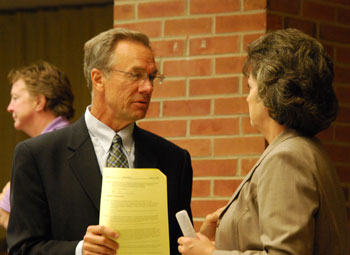
Jim Kosteva and Sue McCormick at Ann Arbor City Council Meeting

Jim Kosteva, UM director of community relations, and Sue McCormick, director of public services for the city of Ann Arbor. Council agendas like the one Kosteva is holding are always printed that color – i.e., there was no pandering to the university reflected in the use of maize-colored paper. (Photo by the writer.)

Ann Arbor City Council meeting (Aug. 17, 2009): When Jim Kosteva appears at an Ann Arbor city council meeting, it usually means that there’s a city-university issue before the body – Kosteva is the university’s director of community relations.

Was it the report from city staff on the status of the East Stadium Boulevard Bridge replacement that had brought Kosteva to council’s chambers? There’ll be easements required from the university to complete that $22 million project.

But no, Kosteva was not there to hand over a giant fake check symbolizing a university contribution to reconstruction of the bridges.

However, he was there to affirm the university’s support for a different project – called FITS. University support will come to the tune of $327,733 out of a total project budget of $541,717 – for the site investigation, project definition and development of conceptual plans for the Fuller Intermodal Transportation Station (FITS). The station will be nestled between Fuller Road and East Medical Center Drive, just east of Fuller & Maiden Lane, near the university’s massive medical campus.

In other business, the city council put a charter amendment on the November ballot that would relax current charter requirements regarding publication of ordinances passed by the council. The Chronicle’s coverage of that charter amendment takes the form of a column published earlier this week.

The council also revisited a resolution it had passed at its previous meeting to establish a historic district study committee, along with a moratorium on demolition within the district. That moratorium was expanded Monday night to include all “work.”

And finally, as had been suggested at the council’s Aug. 16 Sunday caucus, councilmembers indicated that they’d be considering rules changes at their Sept. 8 meeting. In connection with that discussion, Mike Anglin (Ward 5) indicated he’d be calling for the city to make available all city council emails dating back to the year 2000. [Full Story]

Parking Deck Pre-Tensioned with Lawsuit

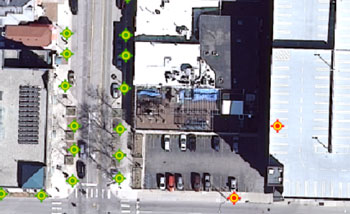
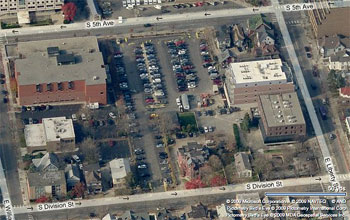
View of construction sight for proposed underground parking garage looking east to west. Herb David Guitar Studios and Jerusalem Garden are located in the upper right corner of the block.

View of construction site (Ed. note: corrected from "sight") for proposed underground parking garage looking east to west. Herb David Guitar Studios and Jerusalem Garden are located in the upper right corner of the block. (Image links to Microsoft's Bing Maps for full interactive display.)

As The Chronicle previously reported, at last week’s city council meeting, Ann Arbor CFO Tom Crawford announced that bonds for the 677-space South Fifth Avenue underground parking garage had been sold on Aug. 5.

And on Friday, Aug. 7, the Downtown Development Authority’s capital improvements committee conducted interviews with four candidate companies for the job of construction manager of the garage.

Then, by Wednesday morning of this week, references and financials for the Christman Company had checked out to the satisfaction of the DDA staff and Carl Walker – the design firm that’s been hired for the project. DDA executive director Susan Pollay is working out a time for a special meeting of the whole board to award the job to Christman.

But the day before, on Aug. 11, a lawsuit in connection with the parking garage project – which had previously been threatened by the Great Lakes Environmental Law Center – was actually filed. The complaint alleges violations of the Michigan Environmental Protection Act, the Michigan Open Meetings Act, as well as nuisance and trespass violations.  Herb David Guitar Studio and Jerusalem Garden restaurant are plaintiffs in the suit, along with GLELC. [Full Story]