


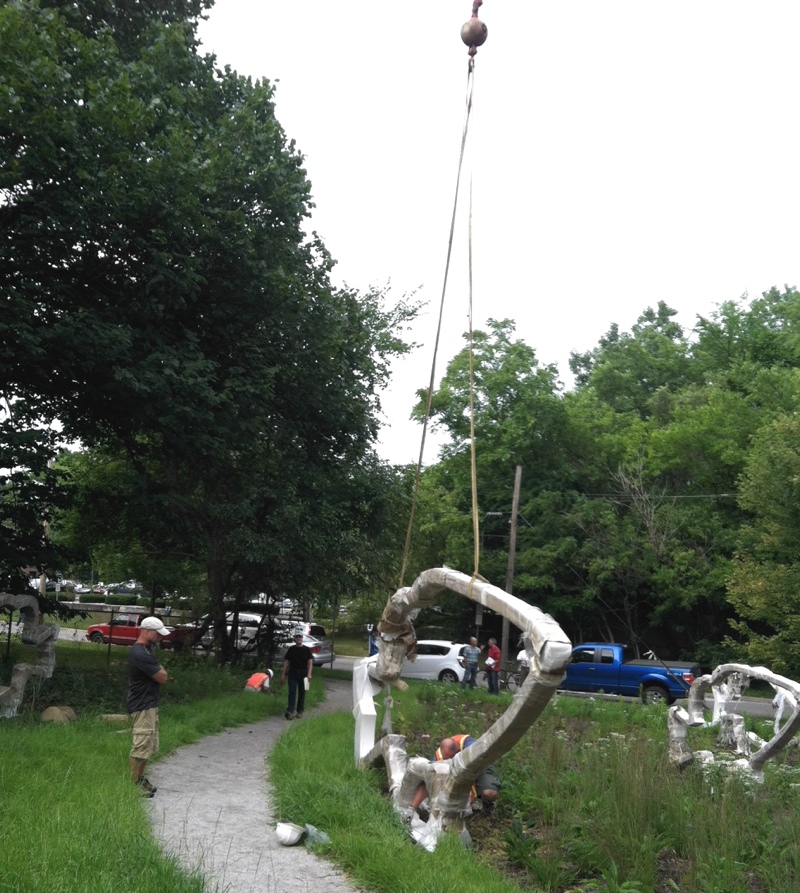
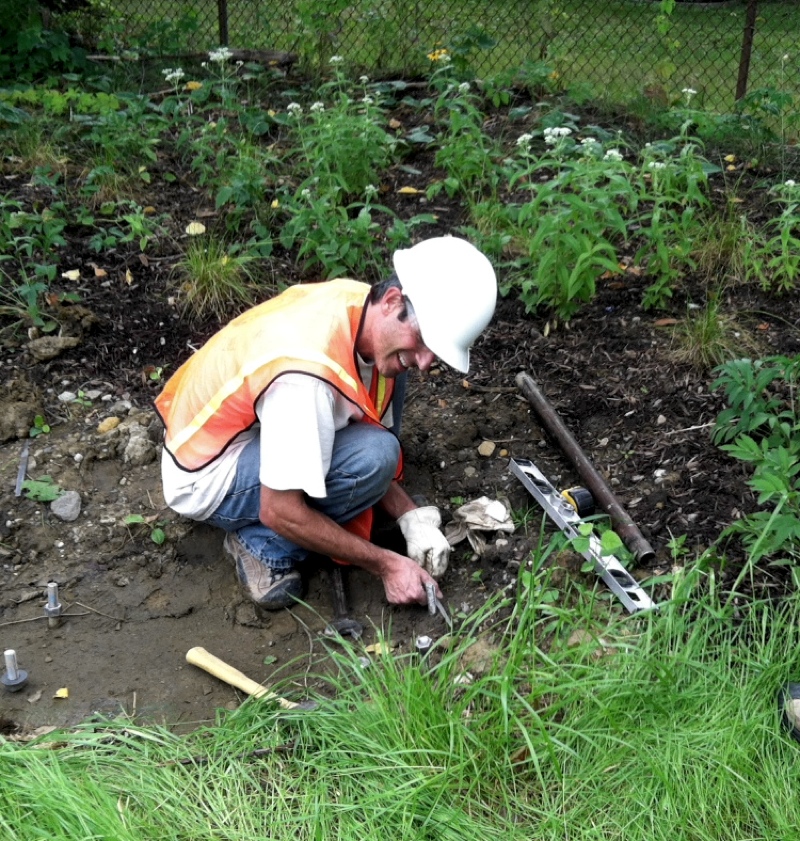
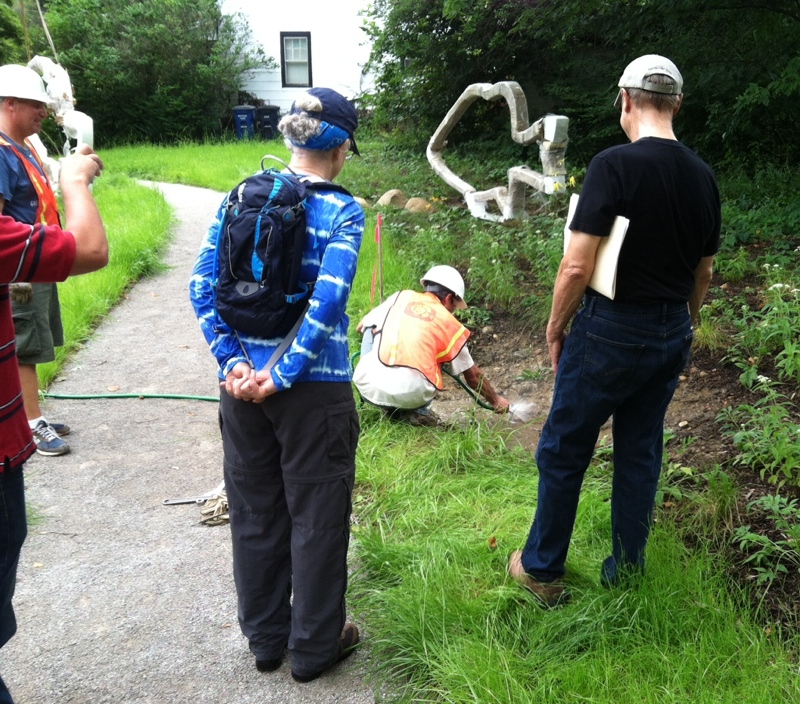
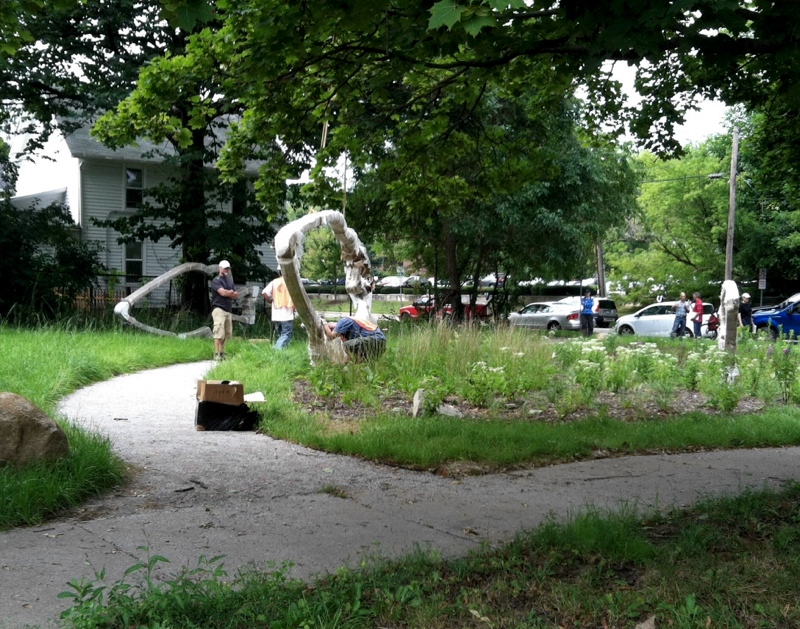
Installation underway for large fish sculptures in this city rain garden, a project paid for by the now defunct Percent for Art program. [photo] Sculpture Joshua Wiener is working on site. [photo] Also here are Bob Miller and John Kotarski of the city’s public art commission, WEMU reporter Andy Cluley, landscape architect Patrick Judd of Conservation Design Forum, and Jerry Hancock, the city’s stormwater and floodplain programs coordinator. [photo] [photo]
Stories indexed with the term ‘Percent for Art’
City Council Takes Action on Public Art
In three separate actions on public art policy, the Ann Arbor city council has: (1) directed the city administrator to establish a budget for public art administration for the next two years; (2) transferred money out of the public art fund; and (3) extended the contract for the city’s part-time public art administrator by six months. Action on those items came at the council’s March 3, 2014 meeting.
The transfer of $943,005 in Percent for Art money back to its funds of origin was made possible by an amendment to the city’s public art ordinance given final approval by the council on Feb. 18.
The $943,005 total is an amount that defunds the art project at Argo Cascades, but keeps funding for … [Full Story]
Ann Arbor’s Public Art Saga Continues
Four separate agenda items related to public art received action by the Ann Arbor city council at its Feb. 18, 2014 meeting – but three of those actions were to postpone. The end result was that no Percent for Art money was transferred from the public art fund back to its funds of origin.
Back on the council’s March 3 agenda will be two resolutions – or possibly just one – that would make such a fund transfer. Also back on March 3 will be a resolution extending the part-time public art administrator’s contract for six months and appropriating $18,500 for that purpose.
The council’s actions on Feb. 18 began with final approval to an amendment to the city’s public art ordinance. That … [Full Story]
Feb. 18, 2014 Council Meeting: Live Updates
Editor’s note: This “Live Updates” coverage of the Ann Arbor city council’s Feb. 18, 2014 meeting includes all the material from an earlier preview article published last week. We think that will facilitate easier navigation from the live updates section to background material already in the file.
The council’s Feb. 18, 2014 agenda is highlighted by public art policy issues leftover from its previous meeting, as well as several items related to acquiring various pieces of basic equipment – from a garbage truck to a wood chipper.
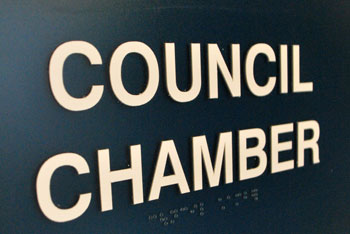
The sign on the door to the Ann Arbor city council chamber, installed in the summer of 2013, includes Braille.
The possible acquisition of land is also on the agenda, in the form of a resolution postponed from an earlier meeting. The resolution would exercise the city’s right of first refusal to purchase the 16.7-acre Edwards Brothers Malloy property on South State Street. This process began when the University of Michigan offered to buy the property. An item authorizing the $12.8 million purchase is on the Feb. 20 UM board of regents agenda, based on the assumption that the city won’t exercise its right of first refusal earlier in the week.
In other action, the council will consider an amendment to the city’s public art ordinance for a second and final vote on Feb. 18, having given initial approval to the item on Feb. 3. The ordinance amendment would allow the council to transfer money that accumulated in the public art fund through the (now demised) Percent for Art funding mechanism in previous years. The money would be transferred back to the funds from which it was originally drawn – but that transfer would require a separate council action. To be approved, the ordinance change will need a six-vote majority on the 11-member council. The enactment of an ordinance can be vetoed by the mayor, but a veto can be overridden by an eight-vote majority.
Dependent on the public art ordinance amendment are two competing resolutions that would return money from the public art fund to the funds from which that money was drawn. That includes funds like the sanitary sewer fund and the street millage fund. Based on the Feb. 3 council deliberations, the debate on such a resolution would likely center on the amount to be returned to funds of origin, not the question of returning at least some of the money. And that point of possible disagreement is reflected in the amounts specified in the two resolutions. A resolution sponsored by Jane Lumm (Ward 2), Jack Eaton (Ward 4) and Sumi Kailasapathy (Ward 1) would transfer $819,005 back to the funds of origin.
A resolution added later to the agenda is sponsored by Sabra Briere (Ward 1). Briere’s proposal would eliminate funding for the stalled Argo Cascades art project and would return $957,140 to the funds of origin. Briere’s resolution also directs the city administrator to establish a budget for public art administration for both the 2015 and 2016 fiscal years. [An initial list of requests from department heads for FY 2015, released by the city on Feb. 10, shows an $80,000 request for arts administration, which includes funds for a full-time art administrator.]
Either of the two proposed resolutions related to public art funds would require eight votes to pass.
Also expected back from the Feb. 3 agenda is a resolution that was defeated at that meeting – to extend the contract for the part-time public art administrator by six months and to appropriate funds to cover that $18,500 contract. It would need eight votes to pass. The result of the Feb. 3 council vote was that public art administrator Aaron Seagraves cannot currently be paid. The contract is supposed to be back on Feb. 18 for reconsideration – as part of the political bargain among councilmembers on the overall question of how the Percent for Art money that accumulated in the public art fund will be handled.
The council’s Feb. 18 agenda also features several pieces of equipment essential to core services. One of those core services is the repair of water main breaks, which have increased in frequency in recent weeks as the ground moves due to deeper and deeper penetration of frost. The council will be asked to approve the $441,535 purchase of a combination sewer truck, which is outfitted with a vacuum device – often used to control water in an excavation during the repair of a water main break. Also deployed when repairing water main breaks is a hydraulic excavator. So the council will be asked to approve the purchase of one for $176,472. Both of those authorizations are replacements of existing city equipment.
The council will also be asked to approve the purchase of a new garbage truck for $93,800. The purchase of two vans for a total of $50,320 is also on the council’s Feb. 18 agenda. The vans will be used by the parks and recreation staff to shuttle passengers when they start a river trip at one of the cities liveries on the Huron River. Rounding out equipment purchases is a $83,208 wood chipper.
Another piece of equipment shows up on the agenda in the form of a grant application the council is being asked to approve. The $334,140 grant application is being made to the 2013 Assistance to Firefighters Grant (AFG) program of the U.S. Department of Homeland Security – to acquire a mobile training facility to train firefighters. The 48-foot-long unit will allow live fire and tactical simulations.
In addition to the Edwards Brothers deal, several other real estate matters are on the Feb. 18 agenda. The council will be asked to approve the acquisition of development rights for two properties, using funds from the greenbelt millage. The first is a 24-acre parcel just north of the Huron River in Scio Township. The city of Ann Arbor will be contributing $25,200 to the total $84,000 cost of purchasing development rights, with the township contributing the difference. The second greenbelt property on the agenda is a 64-acre property on Zeeb Road, also in Scio Township. For that deal, the city is contributing $39,000 to the total purchase price of $130,335.
Related to land use, council will also be asked to give final approval to the zoning of the Hofmann property on South State Street – to C1 (local business district). The property houses Biercamp Artisan Sausage and Jerky.
On the consent agenda is a contract with MDOT for reimbursement to the city for a portion of the cost to install rectangular rapid flashing beacons at three locations: on Geddes Road at Gallup Park; Fuller Road 400 feet east of Cedar Bend Drive; and on South University Avenue at Tappan Avenue. The city’s cost for the $47,971 project would be $14,179.
This article includes a more detailed preview of many of these agenda items for the Feb. 18 meeting, which was shifted to Tuesday because of the Presidents Day holiday on Monday. More details on other agenda items are available on the city’s online Legistar system. The meeting proceedings can be followed Tuesday evening live on Channel 16, streamed online by Community Television Network.
The Chronicle will be filing live updates from city council chambers during the meeting, published in this article below the preview material. Click here to skip the preview section and go directly to the live updates. The meeting is scheduled to start at 7 p.m. [Full Story]
Feb. 18, 2014: Ann Arbor Council Preview
The council’s Feb. 18, 2014 agenda is highlighted by public art policy issues leftover from its previous meeting, as well as several items related to acquiring various pieces of basic equipment – from a garbage truck to a wood chipper.
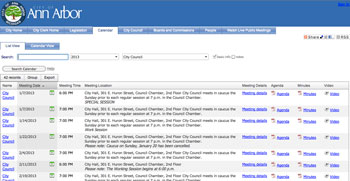
Screenshot of Legistar – the city of Ann Arbor’s online agenda management system. Image links to the Feb. 18, 2014 meeting agenda.
The possible acquisition of land is also on the agenda, in the form of a resolution postponed from an earlier meeting. The resolution would exercise the city’s right of first refusal to purchase the Edwards Brothers Malloy property on South State Street.
The meeting is shifted to Tuesday because of the Presidents Day holiday on Monday.
Having given initial approval to an amendment to the city’s public art ordinance at its Feb. 3 meeting, the council will consider the item for a second and final vote on Feb. 18. The ordinance amendment would allow the council to transfer money that accumulated in the public art fund through the (now demised) Percent for Art funding mechanism in previous years. The money would be transferred back to the funds from which it was originally drawn – but that transfer would require a separate council action. To be approved, the ordinance change will need a six-vote majority on the 11-member council. The enactment of an ordinance can be vetoed by the mayor, but a veto can be overridden by an eight-vote majority.
Dependent on the public art ordinance amendment is a resolution that would return $819,005 from the public art fund to the funds from which that money was drawn. That includes funds like the sanitary sewer fund and the street millage fund. That kind of resolution is typically analyzed as needing an eight-vote majority to pass, but it’s not yet indicated as an “eight-voter” on the online agenda. [Updated 1 p.m. Friday: It's now recorded as needing eight votes.] Based on the Feb. 3 council deliberations, the debate on such a resolution would likely center on the amount to be returned to funds of origin, not the question of returning at least some of the money.
Also expected back from the Feb. 3 agenda is a resolution that was defeated at that meeting – to extend the contract for the part-time public art administrator by six months and to appropriate funds to cover that $18,500 contract. It would need eight votes to pass. The result of that council vote was that public art administrator Aaron Seagraves cannot currently be paid. The contract is supposed be back on Feb. 18 for reconsideration – as part of the political bargain among councilmembers on the overall question of how the Percent for Art money that accumulated in the public art fund will be handled.
The council’s Feb. 18 agenda also features several pieces of equipment essential to core services. One of those core services is the repair of water main breaks, which have increased in frequency in recent weeks as the ground moves due to deeper and deeper penetration of frost. The council will be asked to approve the $441,535 purchase of a combination sewer truck, which is outfitted with a vacuum device – often used to control water in an excavation during the repair of a water main break. Also deployed when repairing water main breaks is a hydraulic excavator. So the council will be asked to approve the purchase of one for $176,472. Both of those authorizations are replacements of existing city equipment.
The council will also be asked to approve the purchase of a new garbage truck for $93,800. The purchase of two vans for a total of $50,320 is also on the council’s Feb. 18 agenda. The vans will be used by the parks and recreation department to shuttle passengers when they start a river trip at one of the cities liveries on the Huron River. Rounding out equipment purchases is a $83,208 wood chipper.
Another piece of equipment shows up on the agenda in the form of a grant application the council is being asked to approve. The $334,140 grant application is being made to the 2013 Assistance to Firefighters Grant (AFG) program of the U.S. Department of Homeland Security – to acquire a mobile training facility to train firefighters. The 48-foot-long unit will allow live fire and tactical simulations.
In real estate matters, the council will be asked to approve the acquisition of development rights for two properties, using funds from the greenbelt millage. The first is a 24-acre parcel just north of the Huron River in Scio Township. The city of Ann Arbor will be contributing $25,200 to the total $84,000 cost of purchasing development rights, with the township contributing the difference. The second greenbelt property on the agenda is a 64-acre property on Zeeb Road, also in Scio Township. For that deal, the city is contributing $39,000 to the total purchase price of $130,335.
Related to land use, council will also be asked to give final approval to the zoning of the Hofmann property on South State Street – to C1 (local business district). The property houses Biercamp Artisan Sausage and Jerky.
A bit south of Biercamp on State Street is the topic of the most significant land acquisition matter on the Feb. 18 agenda. A resolution postponed from the council’s Feb. 3 meeting would approve the city’s exercise of its right of first refusal on the 16.7-acre Edwards Brothers Malloy property. The University of Michigan has offered $12.8 million for the land.
On the consent agenda is a contract with MDOT for reimbursement to the city for a portion of the cost to install rectangular rapid flashing beacons at three locations: on Geddes Road at Gallup Park; Fuller Road 400 feet east of Cedar Bend Drive; and on South University Avenue at Tappan Avenue. The city’s cost for the $47,971 project would be $14,179.
This article includes a more detailed preview of many of these agenda items. More details on other agenda items are available on the city’s online Legistar system. The meeting proceedings can be followed Tuesday evening live on Channel 16, streamed online by Community Television Network starting at 7 p.m. [Full Story]
Art Money Back to Original Funds: Initial OK
Additional money set aside under the city of Ann Arbor’s Percent for Art program in previous years could eventually be returned to the money’s funds of origin, based on a first step the city council has taken. At its Feb. 3, 2014 meeting, the council gave initial approval to an amendment of the city’s public art ordinance that would allow the eventual return of art money to funds like the sanitary sewer fund, the stormwater fund, and the street millage fund.
Margie Teall (Ward 4) cast the sole vote of dissent on the ordinance amendment.
In other action related to public art, the council rejected approval of a six-month contract extension for Ann Arbor’s part-time public art administrator, Aaron Seagraves. The proposed … [Full Story]
Feb. 3, 2014 Ann Arbor Council: Live Updates
Editor’s note: This “Live Updates” coverage of the Ann Arbor city council’s Feb. 3, 2014 meeting includes all the material from an earlier preview article published last week. We think that will facilitate easier navigation from live-update material to background material already in the file.
The most significant item on the council’s Feb. 3, 2014 agenda is listed last – a resolution that would authorize the city administrator to exercise the city’s right of first refusal to purchase the 16.7-acre Edwards Brothers property on South State Street. The council could adjust the order of the items at the start of the meeting.
The sign on the door to the Ann Arbor city council chamber, installed in the summer of 2013, includes Braille.
Two new ordinances will also be given initial consideration at the Ann Arbor city council’s Feb. 3 meeting. One involves public art – which relates to leftover business from the council’s previous meeting. The second proposed new local law involves prohibitions against smoking in some public places.
Background on the possible acquisition of the Edwards Brothers property includes the fact that the University of Michigan has made an offer to Edwards Brothers to purchase the property for $12.8 million. But the city has a right of first refusal on the property as a condition of a tax abatement granted by the city council three years ago, on Jan. 18, 2011.
The resolution on tonight’s agenda approves the exercise of the city’s right of first refusal, appropriates necessary funds, and directs the city administrator to notify Edward Brothers Malloy about the exercise of the city’s right.
This effort began at the council’s Jan. 6, 2014 meeting, when councilmembers had directed the city administrator and the city attorney to explore options and gather information about the Edwards Brothers land. The due date for that gathering of information was specified in the council’s resolution as Jan. 30.
Public art is actually the topic of two separate items on the council’s agenda. One is a contract extension for the city’s part-time public art administrator, which had been on the council’s Jan. 21, 2014 agenda, but was postponed at that meeting.
The postponement took place in the context of a political horse trade offered by Jack Eaton (Ward 4) at the council table on Jan. 21. Eaton indicated he’d support the public art administrator’s contract extension at the council’s subsequent meeting – but only if the council would move toward returning as-yet-unallocated money set aside during the now defunct Percent for Art program to its funds of origin (e.g., sanitary sewer fund, street millage fund etc.).
Both elements of the horse trade are scheduled for the Feb. 3 meeting. The move toward returning money out of the public art fund takes the form of initial consideration of an amendment to the city’s public art ordinance. The ordinance amendment, sponsored by Jane Lumm (Ward 2), would allow the council to return money accumulated under the city’s former Percent for Art program to the funds from which that money was drawn. The ordinance change would need a second and final council vote at a subsequent meeting to be enacted. Any transfer of public art money would require separate council action after the potential ordinance change.
Also getting initial consideration on Feb. 3 will be a new ordinance that would prohibit smoking in specific outdoor public areas. Made punishable through a $50 civil fine would be smoking within 20 feet of: (1) bus stops; (2) entrances, windows and ventilation systems of the Blake Transit Center; and (3) entrances, windows and ventilation systems of any city-owned building. The ordinance amendment would also authorize the city administrator to have signs posted designating certain parks or portions of parks as off limits for outdoor smoking.
In another item on its Feb. 3 agenda, the council will consider approval of a $398,703 contract plus a $40,000 contingency with Hubbell Roth & Clark Inc. to reconstruct Geddes Avenue from Huntington to Huron Parkway. The project, which includes five components, is scheduled to start in the spring of 2015 and may continue through 2016. The five components of the project are: reconstruction of Geddes, sanitary sewer on Geddes, sanitary sewer on Dover Place and Riverview, storm sewer on Geddes, and water main on Dover Place and Riverview.
Also on the council’s Feb. 3 agenda is a proposed expansion for Germain Motors – an auto dealership on South State Street, formerly Howard Cooper Imports.
The council will also consider setting a hearing date for one establishments that could potentially be recommended for non-renewal of its liquor licenses for non-payment of taxes: Banfield’s Bar & Grill. Also originally on the list were The Arena, and Café Zola, but as of Monday morning, Feb. 3 they’d been removed. Those three businesses were also subject to the same scrutiny last year, and all eventually paid their taxes without having their licenses revoked.
This article includes a more detailed preview of many of these agenda items. More details on other agenda items are available on the city’s online Legistar system. The meeting proceedings can be followed Monday evening live on Channel 16, streamed online by Community Television Network starting at 7 p.m.
The Chronicle will be filing live updates from city council chambers during the meeting, published in this article below the preview material. Click here to skip the preview section and go directly to the live updates. The meeting is scheduled to start at 7 p.m. [Full Story]
Commission Works on Public Art Planning
Ann Arbor public art commission meeting (Jan. 29, 2014): In a three-hour session, the public art commission worked on prioritizing capital improvement projects that might be suitable for public art.
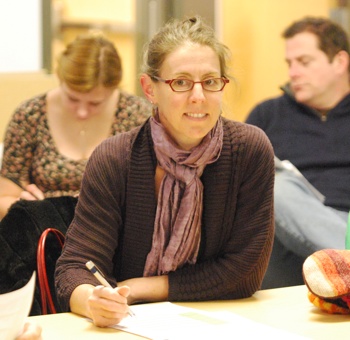
On Jan. 29, Kristin “KT” Tomey attended her first regular meeting of the Ann Arbor public art commission since being appointed by the city council on Jan. 6. (Photos by the writer.)
Some commissioners expressed frustration that they had insufficient information on which to base their evaluation. And after about two hours of discussion – using a scoring rubric with seven criteria – commissioners had evaluated only a few projects: artist-designed street access (manhole) covers, art for the Springwater subdivision, and art for the corridors of Main Street and Plymouth Road. Because there were still several other items on the agenda, they voted to postpone further evaluation of possible capital projects until their next meeting.
In other action, commissioners discussed and approved a draft annual public art plan that’s officially due to the city council on Feb. 1, for projects to be undertaken in the fiscal year that begins July 1. It includes projects that are underway – like artwork for East Stadium bridges and Argo Cascades – as well as a proposal to add some enhanced capital projects, like street access covers on resurfaced roads.
The draft annual plan had been prepared by Aaron Seagraves, the city’s public art administrator. Commissioners asked for some revisions and designated commissioner John Kotarski to work with Seagraves on a final version that will likely be presented to the council on Feb. 18. Kotarski praised the draft, saying “It has as much meat as anyone wants. It shows a lot of work. It shows an art commission that gets the message from an impatient city council.”
Commissioners also discussed a proposal from the Clean Energy Coalition to select and fund an artist who would help incorporate art into a new bike share program. They tabled action on this item, wanting additional information about the CEC’s expectations for funding.
This was AAPAC’s first regular meeting since Oct. 23, 2013, although they held a retreat in December and a planning session earlier in January. Throughout the evening, concerns were raised about the future of the public art program, in light of recent city council discussions. The council had postponed a requested six-month extension of Seagraves’ contract, and will be taking up that item on Feb. 3.
Also on the council’s Feb. 3 agenda is an amendment to the city’s public art ordinance. The amendment would allow the council to return about $800,000 accumulated under the city’s former Percent for Art program to the funds from which that money was drawn, such as the street millage or sanitary sewer fund. It’s the latest in an ongoing transition for the city’s public art program – a transition that’s been unsettling for public art commissioners.
The Jan. 29 meeting marked another transition for AAPAC, which has seen considerable turnover during the past year. It was the first regular monthly meeting for the newest commissioner, Kristin “KT” Tomey, who was appointed by the city council on Jan. 6. And it was the last meeting for Malverne Winborne, whose term ended on Dec. 31. He did not seek reappointment, and was serving until the position was filled. His replacement, Jim Simpson, is expected to be confirmed in a vote at the city council’s Feb. 3 meeting.
Winborne has served as vice chair of AAPAC – but the group held new officer elections on Jan. 29. Bob Miller was re-elected to another one-year term as chair, and John Kotarski was elected vice chair. There were no competing nominations, and both votes were unanimous.
Noting that the Jan. 29 meeting had been especially challenging, Miller thanked commissioners for their work. “This is probably the most belabored meeting I think we’ve ever gone through, aside from maybe one of the retreats,” he said. “I’m tapped out.” He jokingly cajoled commissioners: “Please do come back.”
Miller also encouraged students to return, as about two dozen students from Skyline High School – and some parents – attended the Jan. 29 meeting. “It’s the most amount of people we’ve ever had at any of our meetings,” Miller noted. One student pointed out that they were all from the same government class, facing a Jan. 31 deadline to attend a public meeting. [Full Story]
Feb. 3, 2014 Ann Arbor Council: Preview
Updated Friday, Jan. 31: An item authorizing the city’s right of first refusal to purchase the Edwards Brothers property on South State Street has been added to the agenda.
Two new ordinances will be given initial consideration at the Ann Arbor city council’s Feb. 3, 2014 meeting. One involves public art – which relates to leftover business from the council’s previous meeting. The second proposed new local law involves prohibitions against smoking in some public places.
Screenshot of Legistar – the city of Ann Arbor’s online agenda management system. Image links to the Feb. 3, 2014 meeting agenda.
Public art is actually the topic of two separate items on the council’s agenda. One is a contract extension for the city’s part-time public art administrator, which had been on the council’s Jan. 21, 2014 agenda, but was postponed at that meeting.
The postponement took place in the context of a political horse trade offered by Jack Eaton (Ward 4) at the council table on Jan. 21. Eaton indicated he’d support the public art administrator’s contract extension at the council’s subsequent meeting – but only if the council would move toward returning as-yet-unallocated money set aside during the now defunct Percent for Art program to its funds of origin (e.g., sanitary sewer fund, street millage fund etc.).
Both elements of the horse trade are scheduled for the Feb. 3 meeting. The move toward returning money out of the public art fund takes the form of initial consideration of an amendment to the city’s public art ordinance. The ordinance amendment, sponsored by Jane Lumm (Ward 2), would allow the council to return money accumulated under the city’s former Percent for Art program to the funds from which that money was drawn. The ordinance change would need a second and final council vote at a subsequent meeting to be enacted. Any transfer of public art money would require separate council action after the potential ordinance change.
A third public art item is expected to be on the agenda as an item of communication – the annual public art plan for fiscal 2015, which was approved by the Ann Arbor public art commission at its Jan. 29 meeting. It lists projects that are underway, as well as potential new projects for the coming year.
Also getting initial consideration on Feb. 3 will be a new ordinance that would prohibit smoking in specific outdoor public areas. Made punishable through a $50 civil fine would be smoking within 20 feet of: (1) bus stops; (2) entrances, windows and ventilation systems of the Blake Transit Center; and (3) entrances, windows and ventilation systems of any city-owned building. The ordinance amendment would also authorize the city administrator to have signs posted designating certain parks or portions of parks as off limits for outdoor smoking.
In another item on its Feb. 3 agenda, the council will consider approval of a $398,703 contract plus a $40,000 contingency with Hubbell Roth & Clark Inc. to reconstruct Geddes Avenue from Huntington to Huron Parkway. The project, which includes five components, is scheduled to start in the spring of 2015 and may continue through 2016. The five components of the project are: reconstruction of Geddes, sanitary sewer on Geddes, sanitary sewer on Dover Place and Riverview, storm sewer on Geddes, and water main on Dover Place and Riverview.
Also on the council’s Feb. 3 agenda is a proposed expansion for Germain Motors – an auto dealership on South State Street, formerly Howard Cooper Imports.
The council will also consider setting a hearing date for three establishments that could potentially be recommended for non-renewal of their liquor licenses for non-payment of taxes: The Arena, Banfield’s Bar & Grill, and Café Zola. The three businesses were also subject to the same scrutiny last year, and all eventually paid their taxes without having their licenses revoked.
This article includes a more detailed preview of many of these agenda items. More details on other agenda items are available on the city’s online Legistar system. The meeting proceedings can be followed Monday evening live on Channel 16, streamed online by Community Television Network starting at 7 p.m. [Full Story]
Art Commission Supports “PowerArt” Project
Ann Arbor public art commission meeting (Sept. 25, 2013): The main item on this month’s AAPAC agenda was a request to partner with the Ann Arbor Downtown Development Authority on a project called “PowerArt,” to be administered by the Arts Alliance.
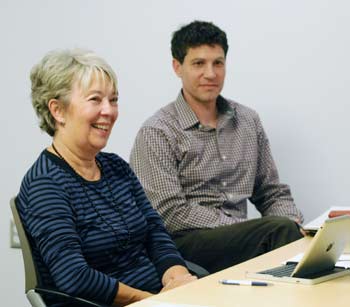
Ann Arbor public art commissioners Marsha Chamberlin and Devon Akmon. Akmon is AAPAC’s newest member, and was attending his first commission meeting on Sept. 25. Chamberlin is the longest-serving commissioner. (Photos by the writer.)
The project would involve wrapping about 40 traffic signal boxes in the DDA district with vinyl printed replicas of artwork. The initial pilot phase would focus on 14 boxes at a total cost of $41,000, to be split between the city and the DDA. That cost includes a 30% administrative fee paid to the Arts Alliance, which is based in Ann Arbor. Another $80,000 would be needed for the final phases.
Deb Polich, executive director for the Arts Alliance, told commissioners that the DDA board is expected to vote on the project at its Oct. 2 meeting.
Commissioners were supportive of the project, but concerned about how to approach the funding, given constraints tied to the remaining Percent for Art funds. “I want to make sure we don’t step in something that we then get slapped for,” Marsha Chamberlin said.
Ultimately, commissioners unanimously voted to approve participating in the PowerArt project, contingent on the city’s legal review of potential funding sources.
AAPAC also authorized allocations for other projects that have been discussed for several months. They approved $10,000 for a community project called Canoe Imagine Art, and $5,000 for a Coleman Jewett memorial at the Ann Arbor farmers market. Both of these projects will rely on grants and private fundraising for the majority of their budgets.
Action on three other projects was tabled, as commissioners wanted more detailed proposals before allocating funds. Those projects were: (1) artwork for a roundabout at State & Ellsworth; (2) a community art project at Arbor Oaks Park, adjacent to Bryant Elementary School; and (3) a proposal for enhancing the fence along the south side of Scio Church Road, between Maple and Delaware.
These projects prompted some discussion about broader issues, included the process that AAPAC uses to vet proposals. Ashlee Arder, one of the newer commissioners, advocated for continuing to develop a more structured approach. “I do think we need to have a larger conversation or retreat about who we are and what we’re trying to do here,” she said.
The commission has been grappling with a transition to a new funding model for public art, after the city council voted to eliminate the previous Percent for Art mechanism this summer. That model set aside 1% of the budget for each of the city’s capital projects for public art – up to a cap of $250,000. Because that money was taken from restricted funds – such as millage funds for parks or street improvements – a thematic link must exist between the funding source and the public art expenditure. About $840,000 in Percent for Art funds remain available for projects, but there will be no additional Percent for Art funding.
Instead, the city has adopted an approach in which city staff will work with AAPAC to determine whether a specific capital improvement should have enhanced design features “baked in” to the project – either enhanced architectural work or specific public art. The funding for any of the enhanced features would be included in the project’s budget and incorporated into the RFP (request for proposals) process for the capital project. There is also an increased focus on private fundraising and partnerships.
On Sept. 25, commissioners also received several updates from Aaron Seagraves, the city’s public art administrator. He reported that a reception is planned for Thursday, Oct. 10 at 6 p.m. to dedicate the hanging sculpture Radius, located in the Justice Center lobby next to city hall. Oregon artist Ed Carpenter is expected to attend.
And two finalists for artwork at Argo Cascades – Jann Rosen-Queralt of Maryland and Mags Harries & Lajos Heder of Cambridge, Mass. – will be coming to town on Oct. 17 to present their conceptual designs to the public. A task force will make a recommendation to AAPAC on which of the artists to select for the project.
The Sept. 25 meeting was the first one for AAPAC’s newest member, Devon Akmon. Appointed by the Ann Arbor city council on Sept. 3, 2013, Akmon is director of the Arab American National Museum in Dearborn. [Full Story]
Design Approved for Rain Garden Sculptures
Ann Arbor public art commission meeting (Aug. 28, 2013): The only major action item for public art commissioners was approval of Joshua Wiener’s design for artwork in a new rain garden at the southeast corner of First & Kingsley.

A drawing of Joshua Wiener’s proposed rain garden sculptures at First & Kingsley. (Image provided in the AAPAC Aug. 28, 2013 meeting packet.)
His proposal entails creating white metal images of five small mouth bass, in varying sizes, that appear to be emerging from the landscape and pointed toward the Huron River. Two of the sculptures will be large enough to serve as benches.
Because the artist’s contract of $23,380 is less than $25,000, it does not require city council approval. The sculptures would likely be installed during the spring of 2014.
Commissioners also received several updates during the meeting, and reviewed a new spreadsheet designed to track more effectively current and potential projects. [.xls file project tracker] Aaron Seagraves, the city’s public art administrator, reported that a selection panel picked Catherine Widgery of Cambridge, Mass., as the artist for a major public art project on the East Stadium bridges in Ann Arbor. However, the panel is asking Widgery to revise her proposal before presenting it to AAPAC and the city council for approval. The project has a $400,000 total budget.
Other updates covered projects at Argo Cascades, the city’s wastewater treatment plant, Arbor Oaks Park, a memorial for Coleman Jewett at the Ann Arbor Farmers Market, and the “Canoe Imagine Art” community project. Additional potential projects were mentioned, including possible artwork for the new bike share program and the public skatepark, which is now under construction at Veterans Memorial Park.
Commissioners also viewed a short video produced by Ashlee Arder, one of the newest members of AAPAC. The intent is to promote the commission and the city’s public art program. The video is already available on YouTube, and Arder plans to post it on the commission’s website, Facebook page and Twitter account, @AAPublicArt.
The meeting was attended by six of the seven commissioners, including Marsha Chamberlin, who participated via conference call. There are two vacancies on the nine-member commission. At the city council’s Aug. 19, 2013 meeting, Devon Akmon was nominated to fill one of the vacancies. Akmon is an Ann Arbor resident and the new director of the Arab American National Museum in Dearborn. At its Sept. 3 meeting, the city council is expected to vote on Akmon’s confirmation to AAPAC .
No name has been put forward publicly for the second vacancy. One of the two vacancies resulted when Tony Derezinski was not reappointed. The other stemmed from Wiltrud Simbuerger’s resignation earlier this year. Her term would have ended Dec. 31, 2013. [Full Story]
Ann Arbor Looks to Future: Housing, Transit
Ann Arbor city council meeting (June 3, 2013): At a meeting that lasted until nearly 1 a.m., the council took major steps that will affect the future of services in two core areas: housing and transportation.
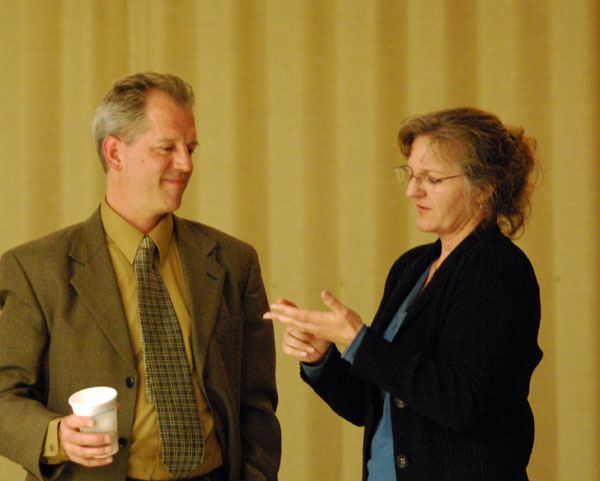
Stephen Kunselman (Ward 3) and Ann Arbor Housing Commission executive director Jennifer Hall. (Photos by the writer.)
On the housing side, a unanimous vote of the council approved the transfer of ownership for city properties managed by the Ann Arbor Housing Commission (AAHC) to the commission itself – an arrangement that’s actually more common across housing commissions in other cities. That step will allow conversion of the AAHC’s 355 public housing units to a project-based voucher system under HUD’s Rental Assistance Demonstration (RAD) program. AAHC will then be pursuing low-income housing tax credits through a ground lease of the properties to a private/public limited partnership. The tax credits are intended to fund several million dollars in needed capital improvements to the existing properties, as well as build 20-30 new units.
Other unanimous votes related to the AAHC’s plan included: a resolution to approve a payment in lieu of taxes (PILOT) for the properties now owned by AAHC – so that no property taxes will be owed; a resolution declaring that AAHC employees are and will remain city employees; and a $200,000 allocation from the city’s affordable housing trust fund to support improvements to Miller Manor.
On the transportation side, the council unanimously authorized membership of the city of Ypsilanti in the Ann Arbor Transportation Authority, by approving changes to the articles of incorporation for the AATA. The number of board seats is expanded from seven to nine, with one of the seats to be appointed by the city of Ypsilanti. The transportation authority will go by the name Ann Arbor Area Transportation Authority. The board of the AATA and the city of Ypsilanti also will need to formally approve the new articles, but are expected to do that in a straightforward fashion.
While the amendment of the articles of incorporation changes only the governance of the AAATA, the intent is to provide the potential for increased transportation funding. The AAATA could, with voter approval, levy a uniform millage on all member jurisdictions of the authority – now the cities of Ann Arbor and Ypsilanti. It’s a right the current AATA already has, but has never exercised. Each city itself already levies a transit millage, and transmits the proceeds of those taxes to the AATA. For Ypsilanti, the advantage of a transit authority millage is that it would not count against the state constitutional 20-mill cap that a city can levy – a cap that Ypsilanti has already reached.
Deliberations on those two agenda items – housing and transportation – did not begin until after 11 p.m.
Taking an hour of the council’s time before that was a debate on a change to the city’s public art ordinance. The council unanimously supported eliminating the requirement of an automatic 1% set-aside for public art in the budget for every capital project – known as Percent for Art. But lengthy deliberations unfolded about an additional change: A provision that would allow for the return of previous years’ public art allocations to their funds of origin.
The ordinance revision that had already been given initial approval by the council allowed for such a return just for the FY 2014 public art set-asides. In the end, the council opted for an ordinance change that did not provide for a return of previous years’ public art allocations. That leaves roughly $845,000 in funds that can be used for the public art program as defined in the revised ordinance – one that places the onus on city staff to identify capital improvement projects that might be suitable for incorporating public art.
Another significant item on the council’s June 3 agenda was a resolution encouraging the Ann Arbor Downtown Development Authority to allocate funding for three police officers. That resolution passed on an 8-2 vote. The council also gave final approval to utility rate increases (an annual item) and a reduction in utility improvement charges imposed on first-time connections.
Other business included final approval of rezoning requests for Parkway Place and State Street Center. The Parkway Place rezoning – at 490 Huron Parkway – was from R3 (townhouse dwelling district) to R1B (single-family dwelling district). The State Street Center rezoning, near the intersection of South State and Ellsworth, was from O (office district) to C3 (fringe commercial district).
In anticipation of the upcoming July 4 holiday, the council took initial action on an ordinance that would restrict use of fireworks to the hours of 8 a.m. to midnight.
During public commentary, the topic of Pizza in the Park was reprised as a theme from the council’s previous meeting. Advocates for the homeless community lobbied for a written commitment from the city that a parks and recreation fee would not be imposed on a church that distributes food and other aid at Liberty Plaza, a downtown city park. [Full Story]
Ann Arbor’s Percent for Art Funding Now History
The Ann Arbor city council has taken the final step toward changing the city’s public art ordinance, so that capital improvement projects are no longer required to set aside 1% of their budgets for public art. The action eliminating the Percent for Art approach came on June 3, 2013. The council had given initial approval to the ordinance change at its May 13, 2013 session.
In separate action, the council also voted to return to its funds of origin some of the money that had previously been set aside for public art.
The main change to the ordinance is to eliminate any reference to a specific percentage for art in a capital project budget. Also, art funds would not be pooled … [Full Story]
Council Takes Step to Remove 1% Art Funding
The Ann Arbor city council has taken the initial step toward changing the city’s public art ordinance, so that capital improvement projects are no longer required to set aside 1% of their budgets for public art – up to a maximum of $250,000 per project. The action came on May 13, 2013 at a meeting that had started on May 6.
If the ordinance change is given final approval by the city council at a subsequent meeting, the way that public art is funded in the city – through a Percent for Art approach – would fundamentally change.
The main change is to eliminate in the ordinance any reference to a specific percentage for art in a capital project budget. Also, art … [Full Story]
Public Art Commission Seeks Student Input
Ann Arbor public art commission meeting (March 27, 2013): Public art commissioners hope to involve more students in their work – but no formal mechanism is yet in place to make that happen.

Ann Arbor public art commissioners Connie Brown and John Kotarski at AAPAC’s March 27, 2013 meeting. (Photos by the writer.)
At AAPAC’s most recent meeting, John Kotarski proposed adding three students to the nine-member commission as voting members. He suggested that the student commissioners be selected by: (1) the Ann Arbor Public Schools board of education; (2) the dean of the University of Michigan School of Art & Design; and (3) the Arts at Michigan program. Deb Mexicotte, president of the AAPS board, is also program coordinator for Arts at Michigan.
Ultimately, commissioners passed a resolution on a 5-1 vote asking that the city council consider adding students to the commission. Marsha Chamberlin dissented, saying she supported the concept of student involvement but didn’t like this approach. She’d rather handle it informally, perhaps by including students in the task forces that are set up for each project.
Chamberlin also noted that any change in AAPAC’s composition would require a revision to the city’s public art ordinance.
The city council committee that’s currently undertaking dramatic revisions to the public art ordinance has nearly completed its work, with plans to present recommendations to the full council on May 6. The recommendations include eliminating the Percent for Art funding mechanism and the concept of “pooled” funds from capital projects. Instead, the city council will designate specific capital projects to be “enhanced” with extra funding allocated for public art or architectural features, based on recommendations by AAPAC. [.pdf of draft ordinance revisions] [.pdf of most recent memo to city council regarding draft recommendations]
This Chronicle report includes a summary of the council committee’s April 18 meeting, which is probably the last one prior to presenting the recommendations – likely on May 6. The committee is suggesting that the council take a final vote on June 3, after soliciting public input through A2 Open City Hall.
In other action during the March 27 meeting, AAPAC approved its annual art plan. This year, because of uncertainty regarding the program’s future and a current moratorium on spending, the plan sets general goals rather than proposing new projects. Those goals are: (1) the creation of public art in more areas of the city and a commitment to balance the number of artworks throughout the city and its neighborhoods; (2) a focus on high use and visibility as locations for public art; and (3) an emphasis on putting public art in underserved neighborhoods.
AAPAC also selected Josh Wiener, an artist from Denver, to work with landscapers and incorporate public art into a new rain garden at the corner of Kingsley and First. The $27,000 project was one of several for which funding had already been approved, prior to the council’s decision to temporarily halt spending on public art.
Commissioners discussed a range of other ongoing projects, including public art at the East Stadium bridge, Argo Cascades and the Justice Center lobby. A project that doesn’t include city funding is the Detroit Institute of Arts’ Inside|Out program. Installation of that artwork in Ann Arbor took place two days after AAPAC’s March 27 meeting. Framed replicas of paintings from the DIA collection were mounted at several locations in the downtown area, and free docent walking tours will be offered on Saturdays and Sundays, starting on April 27. The tours will leave from the Ann Arbor Hands-On Museum every half-hour between noon and 3 p.m.
Looking ahead, Chamberlin reminded commissioners that it’s time to solicit nominations for the annual Golden Paintbrush awards, which recognize local contributions to public art. The award winners are selected by AAPAC, with a presentation at an Ann Arbor city council meeting in June.
March 27 was the first meeting for AAPAC’s two new commissioners, Ashlee Arder and Nick Zagar. Arder, who works for ArtServe Michigan, took action during the meeting to set up a Twitter account for the commission: @AAPublicArt. [Full Story]
Public Art Spending Pause Extended
The Ann Arbor city council has extended a temporary halt to spending money set aside under its Percent for Art ordinance.
The city’s public art ordinance requires that 1% of all capital project budgets be set aside for public art. Originally set to run through April 1, 2013, the temporary halt on spending – except on projects already in the works – will now be extended until May 31. The extension was approved by the council at its April 1 meeting. The three projects currently in the works are installations for East Stadium Bridges, a rain garden on Kingsley Street, and Argo Cascades.
The council had originally enacted the moratorium on spending at its Dec. 3, 2012 meeting. The action came in … [Full Story]
Art Commission Updated on Program Revamp
Ann Arbor public art commission meeting (Feb. 27, 2013): Much of this month’s public art commission meeting was spent discussing the work of a city council committee that’s developing recommendations for changes to Ann Arbor’s public art program.
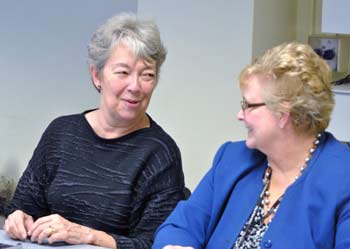
From left: Marsha Chamberlin, chair of the Ann Arbor public art commission, and Deb Gosselin, who handles the city’s capital improvements plan (CIP). Gosselin attended AAPAC’s Feb. 27 meeting to talk about the CIP process, which the commission is using as a planning tool for future public art projects. (Photos by the writer.)
Sabra Briere, who’s one of five city councilmembers on the committee, updated AAPAC on possible revisions to the city’s public art ordinance, as well as more general recommendations that are being prepared for the full council. Those proposed changes are likely to include eliminating the Percent for Art funding mechanism, creating a structure to solicit private donations and grants to support public art, directing staff to “bake in” artwork and architectural enhancements as part of overall city capital projects, and providing more administrative support – perhaps by contracting out those services.
AAPAC members had questions about the possible new approach, including questions about the commission’s own role. Briere advised them to continue working on existing projects that are funded through the Percent for Art approach, but noted that they should focus on future opportunities that don’t rely on Percent for Art funds.
The council committee continues to meet, and will eventually deliver recommendations and draft ordinance changes to the full council. This Chronicle report includes highlights from the committee’s most recent meeting on March 1. The committee next meets on March 15, before the council’s March 18 meeting. A moratorium on spending unallocated Percent for Art dollars expires on April 1.
In other action at AAPAC’s February meeting, commissioners heard from Jason Frenzel, stewardship coordinator for the Huron River Watershed Council, about a project that would raise awareness of how the city’s stormdrain system connects to the river. The project is proposed in two stages, starting with a chalk art contest at the June 14 Green Fair, during which artists would draw images and messaging around stormdrains on Main Street.
Commissioners also discussed how to move forward with a proposed memorial to Coleman Jewett – a bronze Adirondack chair at the Ann Arbor farmers market. A private donor has already committed $5,000 to the memorial, but details are still being worked out about how to manage the project. AAPAC chair Marsha Chamberlin indicated that she might call a special meeting in early March for commissioners to act on the proposal, which hasn’t formally been accepted by AAPAC. Update: The special meeting has been scheduled for Thursday, March 7 at 4:30 p.m. in the fifth-floor conference room at city hall, 301 E. Huron.
Other project updates were made via a written report from Aaron Seagraves, the city’s public art administrator. The report stated that a task force has selected four artists as finalists for artwork on the East Stadium bridges, and they have been invited to an April 1 site visit/open house. The finalists are: Volkan Alkanoglu, based in Atlanta, Georgia; Sheila Klein of Bow, Washington; Rebar Group of San Francisco; and Catherine Widgery of Cambridge, Mass. The project has a budget of $400,000.
Only four commissioners attended the Feb. 27 meeting, and when one commissioner left early, the meeting was adjourned for lack of a quorum – before all agenda items were addressed. In part because of attendance issues, officer elections – which AAPAC bylaws state should happen in January – have not yet occurred. Ballots were mailed to commissioners last week, and results will be announced at AAPAC’s March 27 meeting. It’s expected that vice chair Malverne Winborne will be elected chair.
And although it was not discussed at the meeting, Cathy Gendron resigned from AAPAC in late February. She had been reappointed to AAPAC at the city council’s Jan. 7, 2013 meeting for a term through Jan. 20, 2016, but had not attended the commission’s January or February meetings.
Responding to a Chronicle query, Gendron stated in an email that she had agreed to stay on the commission through March, but would be unable to attend AAPAC meetings and decided to resign. ”It’s time for someone else to take my place.” There are now three vacancies on the nine-member commission. [Full Story]
City To Seek Feedback On Public Art Program
Ann Arbor city council public art committee meeting (Jan. 7, 2013): The five councilmembers on a committee looking at the future of Ann Arbor’s public art program will likely seek feedback on public art funding using the city’s online A2 Open City Hall.
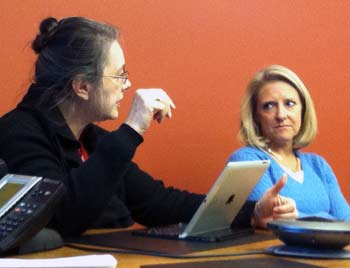
From left: Ann Arbor city councilmembers Sabra Briere (Ward 1) and Sally Petersen (Ward 2) at the Jan. 7, 2013 council public art committee meeting. (Photos by the writer.)
The group discussed this approach at its second meeting since being appointed by the full council on Dec. 3, 2012. Sally Petersen (Ward 2) had proposed a survey at the committee’s first meeting on Dec. 11, but the idea had gained no traction then. She reintroduced the proposal on Jan. 7, saying she felt the committee needed better direction about public art and the types of funding residents might support.
A2 Open City Hall allows users to give open-ended responses to questions, to select priorities, and to give votes of support to comments left by others. It’s a relatively new system, and committee members talked about the need to promote it so that more people will participate. They plan to invite Lisa Wondrash, the city’s communications manager, to come to the next committee meeting and give advice on crafting questions for Open City Hall, as well as ways to publicize it. The Open City Hall system wouldn’t be the only way to get input, Petersen stressed.
Committee members include Peterson, Sabra Briere (Ward 1), Stephen Kunselman (Ward 3), Margie Teall (Ward 4) and Christopher Taylor (Ward 3). At this point, the consensus of the committee appears to be for a continued public art program that would not rely exclusively on the current Percent for Art funding model. That approach sets aside 1% of the budget for each of the city’s capital projects – up to a cap of $250,000 – for public art. The ordinance was enacted in 2007, but has been controversial for a variety of reasons. [.pdf of public art ordinance] It is now being evaluating in light of a public art millage that was rejected by 56% of voters on Nov. 6, 2012.
The council has asked this committee to make recommendations about the city’s public art program by Feb. 15, 2013. The group is exploring several options, including possible public/private partnerships and hiring a full-time administrator. There seems to be general agreement that if a Percent for Art approach is kept in place, it should be modified and only provide a portion of funding for public art. Tom Crawford, the city’s chief financial officer, attended the Jan. 7 meeting and reported that the accounting for Percent for Art is “very detailed and very difficult. It’s very administratively heavy.”
Moving away from Percent for Art funding would also give the city more flexibility on the types of public art it can pursue. Currently, because funding comes from capital projects, the artwork must be permanent and linked thematically to the fund paying for the project. That means that temporary installations, or events like the annual FestiFools parade, can’t be funded in this way.
Taylor wasn’t confident that the committee could craft a new plan by its February deadline. Instead, he suggested that the committee could provide concrete direction, but perhaps the city should hire a consultant or ask city staff to review the current program and make further recommendations.
During the Jan. 7 meeting, Kunselman gave a brief update on his plan to make a request of the state attorney general’s office for an opinion about the legality of Ann Arbor’s current Percent for Art program. The request must come from a state legislator, and Kunselman said that state Rep. Jeff Irwin – a Democrat from Ann Arbor representing District 53 – has “reluctantly” agreed to help if the council passes a resolution to seek the AG opinion.
Also at the meeting, committee members heard from four people during public commentary, who gave suggestions on how to proceed: Marsha Chamberlin and John Kotarski of the Ann Arbor public art commission; former AAPAC chair Margaret Parker; and Sarah Gay, an arts administrator who grew up in Ann Arbor. Kotarski, Parker and Gay all recommended hiring a full-time administrator for Ann Arbor’s public art program.
The committee’s next meeting is set for Monday, Jan. 14 at 5:30 p.m. in the first-floor conference room at city hall, 301 E. Huron. These meetings are open to the public. This Chronicle report also provides links to online resources that are being used by the committee, including information about public art programs in other cities nationwide. [Full Story]
Art Commission Contends with Limbo Status
Ann Arbor public art commission meeting (Dec. 19, 2012): Just over two weeks after the Ann Arbor city council voted to halt spending on the Percent for Art program, public art commissioners held their regular monthly meeting and discussed implications of that council decision. The moratorium on spending lasts until April 1, 2013.
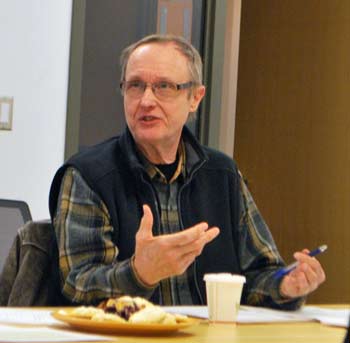
Ann Arbor public art commissioner John Kotarski at the group’s Dec. 19, 2012 meeting.
Marsha Chamberlin, AAPAC’s chair, briefed commissioners on a Dec. 11 meeting of the city council committee that will be making recommendations on the future of Ann Arbor’s public art program. The committee’s work comes in the wake of a failed public art millage that voters rejected on Nov. 6. That committee includes councilmember Sabra Briere, who attended AAPAC’s Dec. 19 meeting as well.
At the meeting, Briere participated in a discussion with commissioners about the source of funding for a hanging sculpture to be installed in the lobby of the Justice Center. AAPAC and city councilmembers have been under the impression that the $150,000 project – called “Radius,” by Ed Carpenter – was part of the city’s Percent for Art budget. However, it now seems that’s not the case, based on communications from the city’s chief financial officer. The news stunned commissioners, who noted that the project appears in the budget summaries they regularly receive – including one provided in the Dec. 19 meeting packet – as a line item, under “Court/PD Facility.” [.pdf of December 2012 budget summary]
By way of background, during the May 7, 2012 city council meeting when the Radius project was ultimately approved, councilmembers debated the issue for about an hour. Specifically, Jane Lumm (Ward 2) had proposed an amendment that would have canceled Carpenter’s project and appropriated the art project funds to investments in the city hall building. Her amendment failed, with several councilmembers – and assistant city attorney Mary Fales – arguing that the public art ordinance prohibits the transfer of public art funds to other funds.
A new, different understanding that seems to have emerged is the following: The money for public art in the Justice Center building budget was not set aside as an application of the public art ordinance, but rather was set aside administratively – in February 2009, well after the building fund had been established. The building fund had been established prior to 2007, when the public art ordinance was enacted. So the 2009 set-aside was made in the spirit of the 2007 public art ordinance, applied in some sense retroactively. In a phone interview, Briere told The Chronicle that this is the understanding she has of the situation. And in response to an emailed query from The Chronicle, Stephen Kunselman (Ward 3) – who also serves on the council’s public art review committee – confirmed he had the same understanding. That understanding has implications for use of the balance of the $250,000 that was set aside for Justice Center art.
In other action at the Dec. 19 meeting, commissioner John Kotarski expressed concern about AAPAC’s task force process, after attending a recent session for the East Stadium bridges project. He didn’t feel the task force is getting sufficient administrative support as it works to select up to five finalists from a set of 36 submissions. To help, he proposed allocating $5,000 to hire a consultant who would serve as a curator to conduct an initial vetting of the artists. The suggestion did not gain much traction among other commissioners, at least for this project, though the idea of a facilitator seemed well-received.
Kotarski updated commissioners on a course that Roland Graf, an assistant professor at the University of Michigan’s School of Art & Design, will be teaching this coming semester called “Public Art and Urban Intervention.” Graf intends to make assignments related to public art in Ann Arbor and on the UM campus, and it’s expected that students will eventually make presentations of their projects to AAPAC.
Kotarski also was the catalyst for a review of AAPAC’s long-term strategic plan for fiscal 2013-2016, prompting commissioners to identify the status of each objective. Several objectives are on hold, pending the outcome of the city council’s review of the overall Percent for Art program.
The council’s pending action also has resulted in some uncertainty regarding AAPAC appointments. Terms for Cathy Gendron and Connie Brown expire on Dec. 31, 2012. They’ve agreed to continue serving until the council makes a decision about the Percent for Art program. The vacancy left by the resignation of Theresa Reid in November remains unfilled. Nominations to AAPAC are made by the mayor and confirmed by city council. [Full Story]
Council’s Public Art Committee Begins Work
Ann Arbor city council public art committee meeting (Dec. 11, 2012): The city council committee tasked with making recommendations on the future of Ann Arbor’s public art program met for the first time this month. Committee members began exploring the question of continued city funding for public art. They’re starting to think about ways for the city to fund art that are different from the current mechanism.
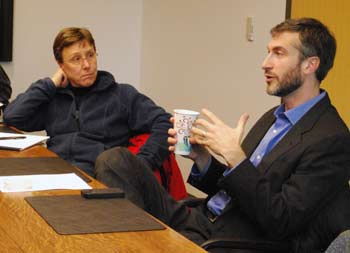
From left: Ann Arbor city councilmembers Margie Teall (Ward 4) and Christopher Taylor (Ward 3) at the first meeting of the council’s public art committee on Dec. 11. Other members are Sabra Briere (Ward 1), Sally Petersen (Ward 2) and Stephen Kunselman (Ward 3). (Photos by the writer.)
The group consists of councilmembers Sally Petersen (Ward 2), Sabra Briere (Ward 1), Stephen Kunselman (Ward 3), Margie Teall (Ward 4) and Christopher Taylor (Ward 3). They’d been appointed at the city council’s Dec. 3 meeting, when the council also voted to halt the spending of funds accumulated through Ann Arbor’s Percent for Art program – except for projects that are already underway. The moratorium on spending lasts until April 1, 2013.
The committee was asked to recommend amendments to the city’s public art program, and make those recommendations to the council by Feb. 15, 2013. Among the possibilities the task force is expected to consider is a complete repeal of the current program, perhaps to be replaced with an alternative.
Peterson – the newest councilmember on the committee, who was elected on Nov. 6 – brought to the Dec. 11 meeting a draft survey for residents, to help clarify public sentiment about using city funds for public art. She noted that the outcome of a public art millage, which was defeated by about 56% of voters on Nov. 6, didn’t directly measure how people felt about the public funding of art. The four-year millage would have temporarily replaced the current Percent for Art program, which sets aside 1% of each city capital project to use for public art.
But other committee members – particularly Teall and Kunselman – expressed little enthusiasm for a survey, although the group agreed to bring back other ideas for public outreach to their next meeting.
Much of the committee’s discussion focused on exploring other funding options. Taylor suggested the possibility of a new nonprofit, which could help secure more private funding. He said he’s already been communicating with the city attorney’s office about this option. It was Taylor who had brought forward the millage proposal this summer, to the surprise of many in the local arts community. The arts community was unsuccessful in its efforts to urge the city council not to put the proposal on the Nov. 6 ballot.
The committee set its next meeting for Monday, Jan. 7 at 5:30 p.m. – before to the 7 p.m. city council meeting. Before then, committee members agreed to work on several tasks, including gathering information about how other communities handle funding for public art. And Kunselman plans to draft a resolution for the council to make a request of the state attorney general’s office – likely via state Rep. Jeff Irwin – for an opinion about the legality of Ann Arbor’s current approach.
The Dec. 11 meeting also was attended by two members of the Ann Arbor public art commission – Marsha Chamberlin, AAPAC’s chair, and John Kotarski – as well as Aaron Seagraves, the city’s part-time public art administrator. [For a report on the most recent meeting of the public art commission, see: “Public Art Commission Eyes Uncertain Future.”]
This report begins with some background on Ann Arbor Percent for Art program, then summarizes the wide-ranging Dec. 11 committee discussion and possible next steps. [Full Story]
Ann Arbor Public Art Funding Suspended
Except for projects already in the works, spending of funds accumulated through Ann Arbor’s Percent for Art program has been suspended until April 1, 2013. The city’s public art ordinance requires that 1% of all capital project budgets be set aside for public art. The vote – taken at the council’s Dec. 3, 2012 meeting – was 10-1, with Margie Teall (Ward 4) dissenting.
A committee consisting of Sally Petersen (Ward 2), Sabra Briere (Ward 1), Stephen Kunselman (Ward 3), Margie Teall (Ward 4) and Christopher Taylor (Ward 3) has been appointed to recommend amendments to the city’s public art program. The committee is charged with making a recommendation to the council by Feb. 15, 2013.
The city council took the action on … [Full Story]
Public Art Commission Eyes Uncertain Future
Ann Arbor public art commission meeting (Nov. 28, 2012): In their first meeting after the Nov. 6 defeat of a public art millage proposal, AAPAC members discussed the Percent for Art program’s future in the context of city council proposals that could reduce funding or eliminate the program entirely.
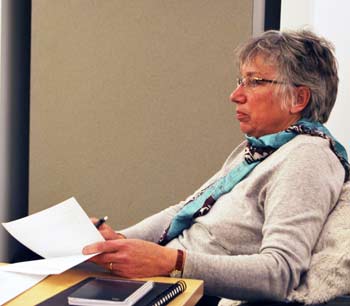
Margaret Parker, former chair of the Ann Arbor public art commission, attended AAPAC’s Nov. 28 meeting and volunteered to help with outreach and promotion. (Photos by the writer.)
Aaron Seagraves, the city’s part-time public art administrator, highlighted several projects that have been in the pipeline and that will likely be completed in 2013: a $150,000 hanging glass sculpture by Ed Carpenter, to be installed in the Justice Center lobby this spring; artwork for a new rain garden being built at Kingsley & First next spring; and public art for the East Stadium bridges, with a $400,000 budget. Artists haven’t yet been selected for those last two projects, but it’s hoped that the work will be finished by the end of 2013.
Much of the conversation among commissioners focused on how to improve promotion and coordination of the work they’ve done to date, and to explain their vision for public art in Ann Arbor.
“We’ve got a fair amount of work to do in the next few months,” said Marsha Chamberlin, AAPAC’s chair.
Two members of the arts community – former AAPAC chair Margaret Parker and Deb Polich, executive director of the Arts Alliance and president of Artrain, who had also co-chaired the “B for Art” millage campaign committee – attended the meeting. During public commentary, Parker volunteered to help with outreach efforts, and gave commissioners a list of suggestions for promoting the city’s public art program.
Also attending the Nov. 28 meeting was city councilmember Sabra Briere (Ward 1). She has proposed changing the public art ordinance to narrow the type of projects that could be tapped for public art funding. The effect would be to dramatically cut the amount of funds available for public art. A second proposal, by Jane Lumm (Ward 2), would simply eliminate the program. Both of those proposals were tabled by the council on Nov. 19. But at its Dec. 3 meeting, the city council is expected to act on yet another proposal – made by Marcia Higgins (Ward 4) – to appoint a committee to study the city’s approach to public art. Her proposal would also suspend the expenditure of funds, with several exceptions, that have accumulated for public art.
Update: At their Dec. 3 meeting, the city council voted to suspend the spending of funds accumulated through Ann Arbor’s Percent for Art program until April 1, 2013 – except for projects that are already underway. A committee consisting of Sally Petersen (Ward 2), Sabra Briere (Ward 1), Stephen Kunselman (Ward 3), Margie Teall (Ward 4) and Christopher Taylor (Ward 3) has been appointed to recommend amendments to the city’s public art program. The committee is charged with making a recommendation to the council by Feb. 15, 2013.
AAPAC faces other changes as well. At the Nov. 28 meeting, Chamberlin noted that Theresa Reid has resigned from the commission. Reid, who is executive director of the ArtsEngine at the University of Michigan, had been appointed to AAPAC in February 2012. In response to an email query from The Chronicle, Reid cited time commitments for work and family, and said her resignation was not related to the Nov. 6 defeat of the public art millage.
During the Nov. 28 meeting, Chamberlin urged commissioners to solicit potential candidates for a replacement. An appointment will be made with a nomination by the mayor and confirmation by the full city council. An application for all city boards and commissions is available on the city clerk’s website. [Full Story]
Pre-Thanksgiving Council Pre-Heats Oven
Ann Arbor city council meeting (Nov. 19, 2012): The first meeting of the council’s new edition featured delaying action on two main agenda items – revisions to the Ann Arbor living wage ordinance, and two competing proposals about the city’s public art ordinance.
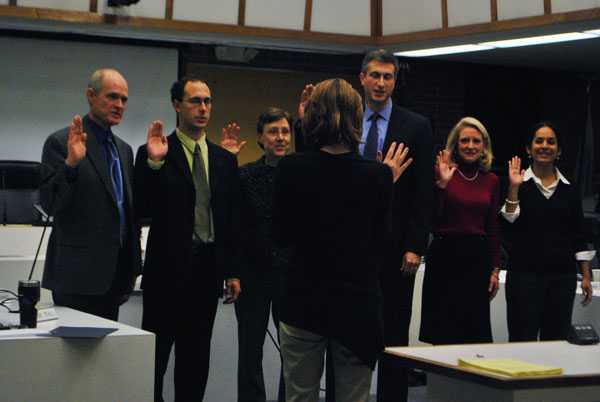
The newly elected members of council are sworn in by city clerk Jackie Beaudry (back to camera). From left: mayor John Hieftje, Chuck Warpehoski (Ward 5), Margie Teall (Ward 4), Christopher Taylor (Ward 3), Sally Petersen (Ward 2) and Sumi Kailasapathy (Ward 1). (Photos by the writer.)
Legislative activity on the public art ordinance resulted from the Nov. 6 rejection by voters of an alternate means of funding public art – a 0.1 mill tax that would have generated roughly $450,000 annually. At the Nov. 19 meeting, Jane Lumm (Ward 2) proposed ending the existing public art program, which requires that 1% of the budget for all capital projects in the city be allocated for public art – with a limit of $250,000 per project. A competing proposal, from Sabra Briere (Ward 1), would narrow the type of capital project from which Percent for Art funds could be allocated. Briere’s proposal would have the practical effect of reducing – by about 90% – the amount of public art funds generated by the existing program. In the last two years the program has generated over $300,000 a year, and more in previous years.
The council wound up tabling both proposals, a parliamentary move that means there’s no particular time in the future when the council must consider them. The proposals will expire, if the council does not take them up off the table in six months. However, the council’s strategy will likely be to appoint a committee to study the matter and to suspend temporarily the existing program. A resolution to that effect was added to the council’s agenda during the meeting, after the tabling of the other proposals – but that third resolution was then postponed until the council’s Dec. 3 meeting.
Also postponed was a set of revisions to the city’s living wage ordinance. The main change would be to exempt those nonprofits from the ordinance that receive funding through the city’s human services allocation, which has totaled roughly $1.2 million each year for the last several years. The ordinance currently has a waiver provision, requiring a city-council-approved plan for compliance with the living wage ordinance within three years. Only one such waiver has been sought since the living wage ordinance was enacted in 2001. That came at the council’s meeting earlier this month, on Nov. 8, 2012.
Based on council deliberations at the Nov. 19 meeting, the living wage revisions in their current form seem likely to be approved only with great difficulty. Some councilmembers seemed more interested in pursuing exemptions for categories of workers – temporary or seasonal – instead of exempting categories of organizations. The living wage ordinance revisions were postponed until Feb. 19.
Getting initial approval were changes to two other city ordinances – on noise and the storage of cars on streets.
The changes to the noise ordinance were prompted by the impact that recent construction of the Landmark building at 601 S. Forest had on neighbors. If given final approval by the council, the changes would make clear that holidays are to be treated like Sundays and that supervisors can be cited under the ordinance, not just a worker who’s operating a piece of equipment.
The revision to the towing ordinance would make it easier to prevent people from storing inoperable vehicles on city streets. Like all changes to city ordinances, it will need a second vote by the council, after a public hearing.
In other business, the council authorized a $15,000 budget for analyzing alternatives for installing a sidewalk along a section of Scio Church Road. Residents in the area have petitioned the city for a sidewalk.
And Stephen Kunselman (Ward 3) used his communications time toward the end of the meeting as an occasion to deliver harsh criticism of the Ann Arbor Transportation Authority and mayor John Hieftje.
In the first meeting for newly elected councilmembers, the council also chose Marcia Higgins (Ward 4) to serve as mayor pro tem, as she has for the last three years. The order of succession to the mayor, based on seniority lines, was also set. [Full Story]
Proposed Revisions to Public Art Law Postponed
Two separate proposals about Ann Arbor’s Percent for Art program were tabled by the city council at its Nov. 19, 2012 meeting. One proposal would have terminated the program, while the other would have narrowed the range of eligible projects.
The council also postponed a resolution added to the agenda during the meeting to appoint a task force of five councilmembers to study the issue and to suspend the expenditure of funds – with several exceptions – currently allocated for public art. The resolution on the task force and temporary suspension, which was brought forward by Marcia Higgins (Ward 4), was postponed until Dec. 3. The timeframe for a recommendation on how to move ahead with either revision or termination of the Percent … [Full Story]
Changes Floated for Public Art Program
The Ann Arbor city council’s post-election Nov. 8, 2012 session was its last meeting before new councilmembers are ceremonially sworn in on Nov. 19. And current city councilmembers used the occasion to announce some issues that the new edition of the council will be asked to consider.
At the Nov. 19 meeting, two proposals will be brought forward on the city’s public art ordinance. The changes stem from the fact that a proposed public art millage failed at the polls on Nov. 6 by a 10-point margin (55.8% opposed and 44.14% in favor).
So at the Nov. 8 meeting, two different proposals were floated on the city’s existing public art ordinance – based on possibly differing interpretations of the expressed voter sentiment. … [Full Story]
Ann Arbor Voters Reject Public Art Millage
A more flexible funding mechanism for public art in Ann Arbor was defeated by voters on Nov. 6. The 0.1 mill tax – which was expected to generate around $450,000 annually – was rejected by 28,166 voters (55.86%), with support from 22,254 voters (44.14%).
The proposal won a majority of votes in just 13 out of 59 precincts with the most support coming from Ward 5, Precinct 4 where 60.5% of voters supported the public art millage. Ward 5 had six of the 13 precincts where the proposal achieved a majority. And the proposal finished in a dead heat in Ward 5, Precinct 5 with 471 voting for and against it. Opposition among in-person voters was strongest in Ward 1, Precinct 9, … [Full Story]
Art Group Reviews Public Outreach Effort
Ann Arbor public art commission meeting (Oct. 24, 2012): After three public forums held earlier this month as part of a new community outreach effort, AAPAC members got an update on those meetings and talked about how to increase participation.
From left: Public art commissioners Bob Miller and Marsha Chamberlin. (Photos by the writer.)
Turnout was lower than hoped – as only one resident attended the meeting held on Oct. 22 at Clague Middle School, though about 10 people came to a forum at Bryant Community Center the previous week. A fourth event will be held on Tuesday, Oct. 30 from 6:30-8:30 p.m. at the Ann Arbor Open @Mack cafeteria, 920 Miller Ave.
John Kotarski, who had attended all the forums, felt the events had achieved their purpose of achieving a presence in the community, and introducing residents to different kinds of public art. Bob Miller advocated adding an online element for soliciting more input. Commissioners discussed the possibility of using the city’s new A2 Open City Hall, a blog-type feature that allows people to get information and give feedback on specific projects.
Commissioners took action on other projects, voting to approve a $910 budget for the dedication of a new mural at Allmendinger Park – an event to take place on Sunday, Oct. 28 from 2-4 p.m. The mural was designed by Mary Thiefels of TreeTown Murals, incorporating artwork and found objects from the community.
Also approved was the location of a sign for the Herbert Dreiseitl water sculpture in front of city hall, though there was concern about the placement of a fence there. The city has decided to put the mesh metal fence on a section of the pedestrian bridge overlooking the sculpture. Some commissioners are frustrated that this safety issue wasn’t raised earlier, when it might have been addressed by the sculptor as part of the site design. Marsha Chamberlin, AAPAC’s chair, noted that Dreiseitl intended people to interact with the water that runs down from the fountain. “What’s driving this process – the aesthetics of the piece or risk management?” she asked. She ultimately abstained from the vote, stating ”I want to go on the record of being ornery about this.” It was approved by all other commissioners present at the meeting.
Commissioners were also updated on a range of other projects that are in various stages of development. The process has begun for soliciting artists for work at the East Stadium bridge and for an ongoing mural program. The deadlines for submitting statements of qualifications (SOQs) are in November. Aaron Seagraves, the city’s public art administrator, expects to post another SOQ – for artwork at Argo Cascades – next month. And legal staff is reviewing a request for proposals (RFP) for art at a rain garden being built at Kingsley and First.
Seagraves also reported that installation of a $150,000 hanging glass sculpture at the Justice Center lobby will be delayed a few months, until March or April of 2013. Fabricators selected by the artist Ed Carpenter aren’t available to do the work as soon as expected.
Another potential project emerged during the meeting. Chamberlin noted that the city has about 100 old aluminum canoes that it’s planning to get rid of. She said that Cheryl Saam, facilities supervisor for the city’s canoe liveries, had raised the possibility of using the canoes for some kind of community art project. After getting feedback from other commissioners that this is an idea worth pursuing, Chamberlin said she’d work up a more formal proposal for consideration at a future meeting.
As part of the Oct. 24 meeting packet, AAPAC got a budget update of Percent for Art funds, showing a balance of $1.533 million. Of that, $847,104 has been earmarked for previously approved projects, leaving about $686,000 unallocated. [.pdf of budget summary]
One notable topic was not discussed at the meeting – a public art millage that’s on the Nov. 6 ballot. Several commissioners are involved in advocating for the millage, but have taken a conservative approach to dealing with it during their regular business, and AAPAC meetings have not included discussion on the topic since the August 28, 2012 meeting. That approach stands in contrast to a recent park advisory commission meeting, when one of the park commissioners spoke during public commentary to urge support for the parks millage renewal. [Full Story]
Art Commission Explores “Street Art” Program
Ann Arbor public art commission meeting (Sept. 26, 2012): In this month’s main action item, public art commissioners formed a task force to explore the possibility of starting a street art program.
Connie Rizzolo Brown shows her colleagues on the Ann Arbor public art commission a printout of AAPAC’s redesigned website. (Photos by the writer.)
John Kotarski made the proposal, explaining that street art could include anything from pedestrian benches to artistic manhole covers – similar to those that have been created in Japanese cities. The effort could involve schools and service clubs, he said, and might evolve into something as popular as the fairy doors found throughout Ann Arbor. Commissioners seemed generally supportive of the idea. The task force will do more research and make a formal proposal to AAPAC at a later date.
Commissioners also moved ahead on a new approach to getting more people involved in the selection of public art. Task forces will be formed in four quadrants of the city, using quadrants that are designated in the city master plan’s “land use elements” section: west, central, south and northeast. [.pdf map of quadrants]
Kickoff meetings for each quadrant are scheduled for October. Connie Rizzolo Brown, who’s spearheading this effort, described the goal of the first meetings as ”very gentle fact-finding missions,” as well as recruitment for potential task force members.
Also in October – on Sunday, Oct. 28 – a dedication is planned for the new mural being completed at Allmendinger Park. The work is by Ann Arbor muralist Mary Thiefels of TreeTown Murals, incorporating artwork and found objects from students and neighbors. Images from the work-in-progress are currently featured on AAPAC’s website.
Commissioners also discussed concerns about a descriptive sign planned for the Dreiseitl sculpture in front of city hall. Some commissioners feel that the proposed location for the sign detracts from the ability to enjoy the sculpture, while others expressed frustration that AAPAC had not been consulted about the sign’s location.
The meeting also included a variety of updates about projects that are underway. One major item that was not discussed was the public art millage that will be on the Nov. 6 ballot – Proposal B. Although it was alluded to on several occasions, AAPAC chair Marsha Chamberlin cautioned commissioners that they could not discuss it at the meeting. However, several commissioners are involved individually in the campaign to support the millage – B for Art. Chamberlin, for example, is hosting a dinner for the campaign in October.
At an Aug. 15 special meeting, the commission had voted to recommend that the city council place a millage on the ballot, despite voicing a range of concerns. The millage had been proposed by councilmember Christopher Taylor (Ward 3), who did not consult the arts community or AAPAC before bringing the idea forward. The ballot proposal calls for a 0.1 mill tax for four years to support public art, temporarily replacing the current Percent for Art program. For additional background, see Chronicle coverage: “Art Commission Strategizes as Millage Looms.” [Full Story]
Pro-Art Millage Campaign Launched
A campaign committee to advocate for the proposed public art millage has been formed. Citizens for Art in Public Places filed its statement of organization with the state bureau of elections, stating its formation date as Aug. 28, 2012. Jeremy Peters is listed as the group’s treasurer, and the address listed on the statement corresponds with the Arts Alliance office at the NEW Center, 1100 N. Main.
Deb Polich, the alliance’s executive director, attended the Aug. 22, 2012 meeting of the Ann Arbor Public Art Commission, where she and AAPAC chair Marsha Chamberlin indicated they would help lead the effort to pass the millage. [See Chronicle coverage: "Art Commission Strategizes as Millage Looms."]
Column: How Many Daves of the Condor?
“I’m smarter than you.”
That’s an idea that defines the character of Ann Arbor better than anything you might read in a brochure, or see in a Pure Michigan video.

Photo by Ward 2 Ann Arbor councilmember Jane Lumm, taken in summer 2012. She reports that a ranger at the Grand Canyon identified the bird as a condor. The plausibility of this being a condor has also been checked by a guy I know who is way smarter about birds than I am.
If you didn’t already know that, well, I guess that makes me … an Ann Arbor resident.
Besides writing op-ed pieces adorned with footnotes [1], another way Ann Arbor residents prove they are smarter than you is to deploy extraordinary words you’ve never heard before, possibly from a dead language – with an ever-so-slightly aggressive nonchalance, calculated to elicit from their listeners some kind of concession like “I’m sorry, but I’m not familiar with that term.” [Alternatively, super-long, syntacticky sentences.]
And then the conversation may continue along the lines of, “Oh, I’m sorry – I thought that expression was so common. But there I go again, just assuming that everyone is as … much a resident of Ann Arbor as I am.”
And those of us who observe these interactions, which depend on a carefully scripted casualness, wonder smugly to ourselves, “Does he not realize everyone can see exactly what he’s doing? I mean, it’s like he thinks he’s the only … person who lives in Ann Arbor!”
Many elected officials in Ann Arbor have a variant on this gambit, which involves not extraordinary bits of vocabulary, but perfectly regular words – to which some special technical sense is given, outside of any reasonable expectation. By way of example, the word “regular” itself has (apparently) a technical sense that can transform a special meeting of the city council into a “regular meeting.” That technical sense of “regular meeting” can be paraphrased roughly as: Any meeting the city council chooses to label as “regular” by voting to label it as such in a formal resolution. [2]
Given that we all live here in Ann Arbor – i.e., we are all smarter than each other – local governance leads to arguments about the meaning of words, even those that are perfectly ordinary. By way of additional examples (beyond “regular” and “special”) these pairs might sound familiar to some readers: “sell” versus “lease”; “opinion” versus “memo” [3]; “committee” versus “work group” [4].
But at the most recent meeting of the city council, on Aug. 20, 2012, part of the argument at the council table depended crucially on the meaning of the word “many.” I’m not making that up. Carsten Hohnke (Ward 5) disputed a contention made by Jane Lumm (Ward 2) that began “Many Ann Arbor residents believe …” The nature of their disagreement can, I think, be analyzed in terms of a numerical understanding of “many” compared to a proportional one.
It’s actually a standard puzzle from the sub-field of linguistics called semantics, which I have studied at an institution of higher learning. Otherwise put, I live here in Ann Arbor even more than you do. And the standard example sentence used by semanticists to illustrate the meaning of “many” involves condors.
So let’s begin with a treatise on condors. The bird with the Latin name Gymnogyps californianus … Heh. I’m kidding.
By “kidding” I mean “not actually totally kidding.” See, you need to understand something about condors before you can understand the example. One thing you probably already know is that condors don’t live in Ann Arbor. [Full Story]