


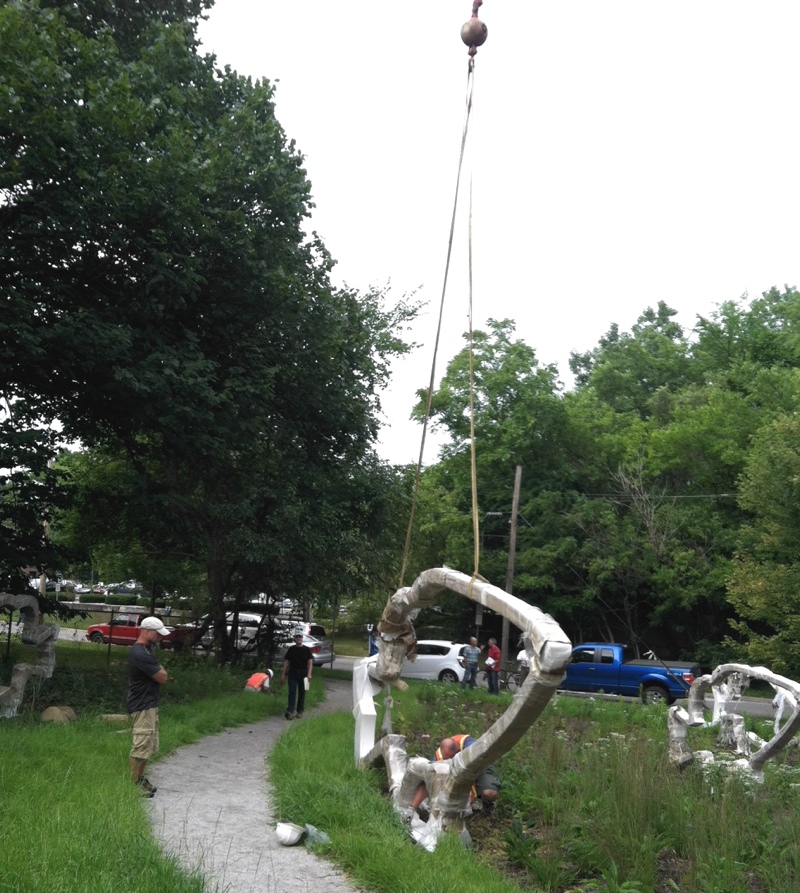
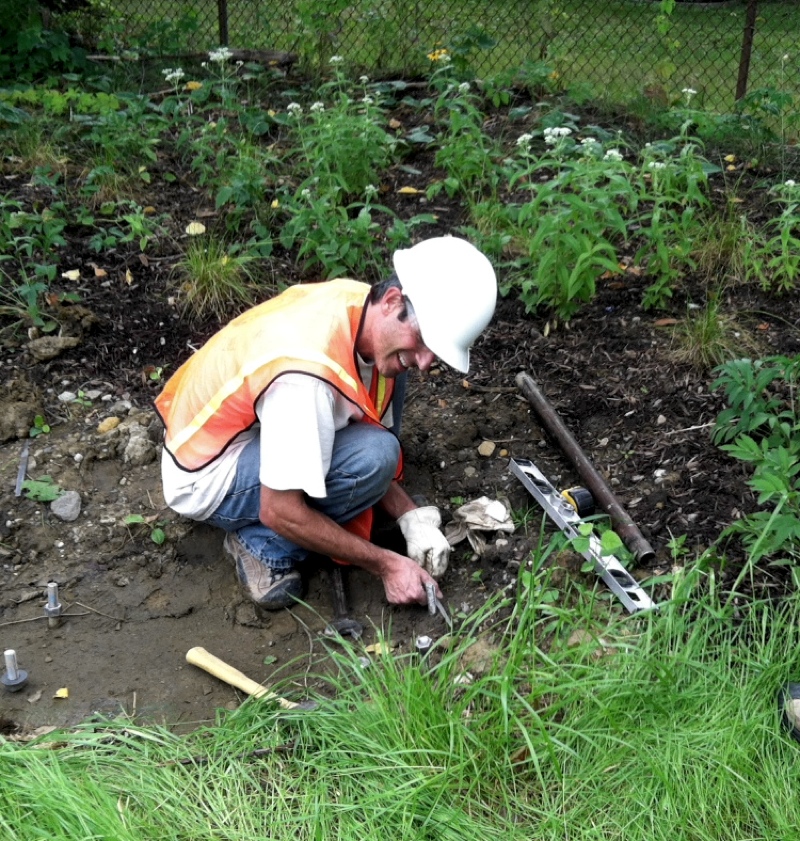
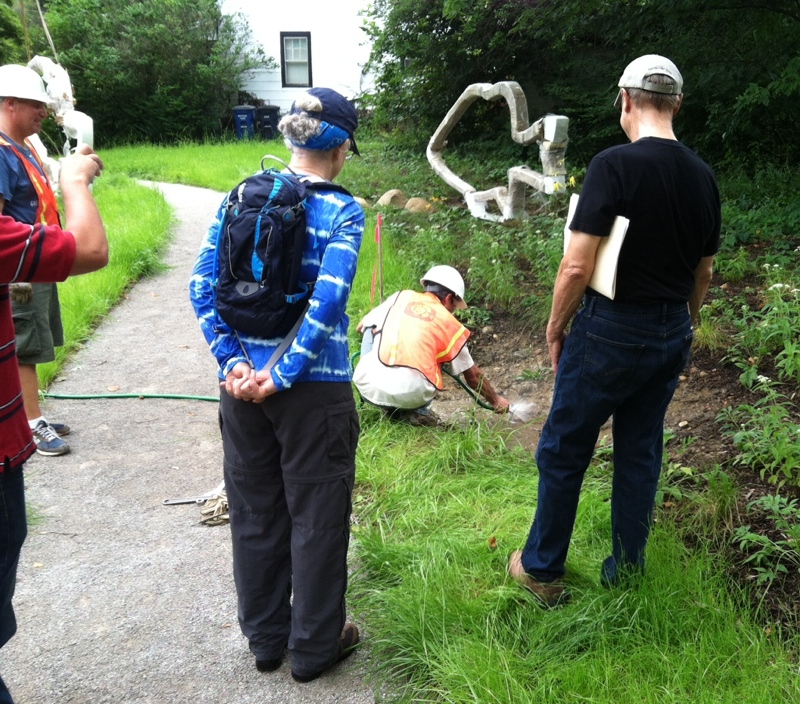
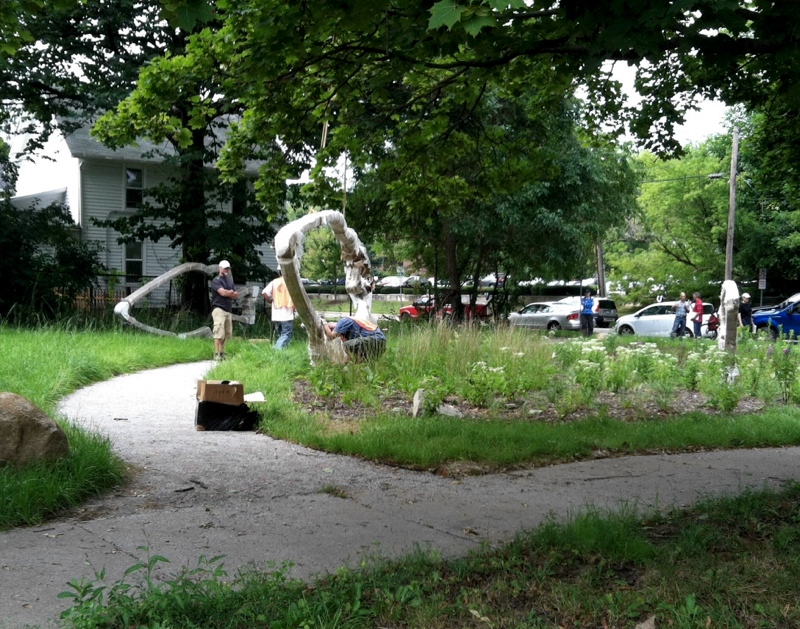
Installation underway for large fish sculptures in this city rain garden, a project paid for by the now defunct Percent for Art program. [photo] Sculpture Joshua Wiener is working on site. [photo] Also here are Bob Miller and John Kotarski of the city’s public art commission, WEMU reporter Andy Cluley, landscape architect Patrick Judd of Conservation Design Forum, and Jerry Hancock, the city’s stormwater and floodplain programs coordinator. [photo] [photo]
Stories indexed with the term ‘public art’
Local Candidates Sketch Views on the Arts
Editor’s note: The candidate forum was moderated by the writer, Chronicle publisher Mary Morgan.
Twenty candidates for political office attended a forum hosted by the Arts Alliance on July 23, held at the Michigan Theater in downtown Ann Arbor and focused on the creative sector.
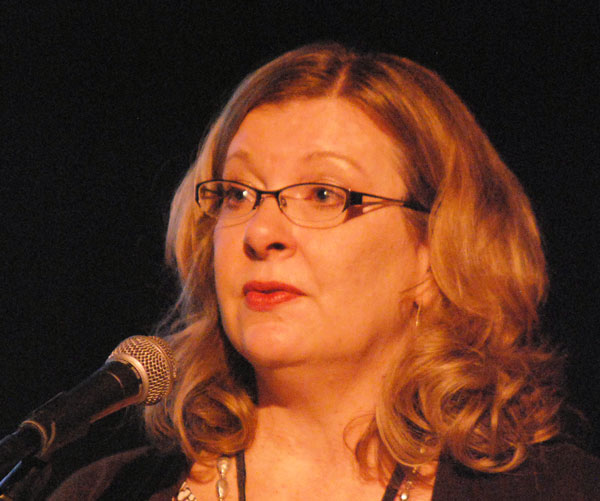
Arts Alliance executive director Deb Polich. (Photos by Dave Askins.)
The event included presentations by each candidate as well as opportunities for questions from the audience, and drew out policy positions related to the arts.
County-level candidates shared their thoughts on the possibility of a countywide arts millage.
And mayoral candidate Sally Petersen took the occasion to float the idea of an Ann Arbor city income tax as an approach that would generate more revenue, at the same time shifting some of the burden of local government funding to those who work in Ann Arbor but do not live here.
Bryan Kelly, independent candidate for mayor of Ann Arbor in the Nov. 4 general election, made his first public appearance since qualifying for the ballot. “I can say firsthand that being an artist is the toughest damn job in the world. I’d rather run for mayor than keep writing novels,” he quipped.
Ypsilanti mayoral candidate Tyrone Bridges shared an example of his daughter’s artwork with forum attendees.
Favorite public art named by the candidates included the mosaic adorning the Fourth and Washington parking structure, as well as the half-mile of daffodils planted in The Arb.
And Ann Arbor Ward 5 incumbent Chuck Warpehoski delivered his opening statement in the form of a rap.
In her remarks at the end of the forum, Arts Alliance executive director Deb Polich urged candidates and elected officials to tap into the experts who know the creative sector. She encouraged candidates to touch base with ArtServe Michigan and the Arts Alliance to get accurate information. Ann Arbor is losing ground to other communities like Grand Rapids and Detroit, she said, and that’s why public funding and investment in the arts is important. “Private funding is absolutely here in this county, but it’s not enough – there’s not enough.”
It’s not just about funding, however. Polich stressed the importance of public policy to make the city a fertile ground for the creative sector.
Polich reported that the Arts Alliance will be holding a statewide conference called Creative Convergence on March 19, 2015. Thought leaders from across the country, state and Washtenaw County will be coming to speak about these issues, she said.
This report focuses on state and local candidates, including the Ann Arbor mayoral and city council races, Washtenaw County commissioners, and state legislators. It also includes responses to a candidate survey distributed by the Arts Alliance prior to the forum. Not included here are statements by the two Congressional candidates who attended the forum: Democrat Debbie Dingell, who’s running in the primary against Raymond Mullins of Ypsilanti for the District 12 seat in the U.S. House of Representatives; and Republican Douglas Radcliffe North, who’s running against incumbent Republican Tim Walberg for the District 7 seat in the U.S. House.
The outcomes of many of the local races will be determined in the Aug. 5, 2014 Democratic primary elections, if no Republicans or independent candidates are running. More information about candidates can be found on the Washtenaw County elections division website. Check the Michigan Votes website to find out your polling location and view a sample ballot. [Full Story]
Stadium Bridges Art Gets Council OK
A roughly $350,000 contract with Widgery Studio LLC – to fabricate and install public art at the East Stadium Boulevard bridges – has been given approval by the Ann Arbor city council. The city had already contracted with Widgery on May 20, 2014 for $8,248 to finalize the structural design of the artwork with an engineer.
This amendment to the contract, given approval by the council at its June 16, 2014 meeting, adds art fabrication and installation services to the existing agreement, bringing the total compensation to $353,552 for all services. The East Stadium bridges art was one of the projects for which the city council left funding in place, when it voted on March 3, 2014 … [Full Story]
June 16, 2014: Council Live Updates
Editor’s note: This “Live Updates” coverage of the Ann Arbor city council’s June 16, 2014 meeting includes all the material from an earlier preview article published last week. The intent is to facilitate easier navigation from the live updates section to background material already in this file. Outcomes of council votes are also available in the Civic News Ticker.
The city council’s last meeting of the 2014 fiscal year, on June 16, 2014, features an agenda packed with items related to the city’s physical infrastructure like bridges (including art), the sanitary sewer system and the stormwater system, as well as several resolutions related to construction of new sidewalks.
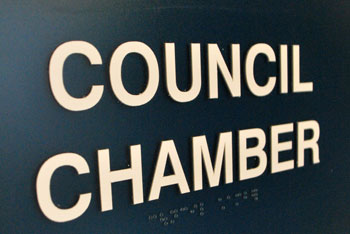
The sign on the door to the Ann Arbor city council chamber includes Braille.
Related to new sidewalk construction is a resolution that would authorize a $75,000 contract with the Greenway Collaborative, to support the work of a pedestrian safety and access task force established by the city council in late 2013. Part of the task force’s responsibility is to create a tool for setting priorities for funding and filling sidewalk gaps in the city.
The $75,000 cost for the pedestrian safety task force consultant is the same amount the council will be asked to allocate to support the work of Ann Arbor SPARK, a local economic development agency. The contract with SPARK is renewed annually, as is another contract on the June 16 agenda – for lobbying services from Governmental Consultant Services Inc. The GCSI contract is for $48,000.
Also on the council’s June 16 agenda are three items with a connection to the Ann Arbor Downtown Development Authority. One is the approval of an end-of-year budget adjustment that was already approved at the DDA board’s June 4, 2014 meeting. Another is approval of a $37,500 expenditure from the city’s affordable housing trust fund to help pay for an affordable housing needs assessment. At its June 4 meeting, the DDA board authorized a $37,500 grant for the same study.
In the final item with a DDA connection, the council will be asked to authorize $69,555 for the conversion of 223 mercury-vapor cobrahead streetlights to LED technology. This project would convert streetlights that are all outside the DDA district. The project is on the city council’s agenda because the DDA board recently declined to fund a similar LED conversion project – for streetlights inside the DDA tax capture district.
Several other June 16 agenda items relate to the downtown area, even if they don’t have an explicit DDA connection. Two of them involve changes to downtown zoning ordinances that have been recommended by the planning commission. The zoning question to be given initial consideration by the council is whether to downzone the southeast corner of William and Main streets from D1 to D2, but with a 100-foot height limit.
Other downtown items on the council’s June 16 agenda include site plan approvals for First Martin’s hotel project at Ashley and Huron, and the Bank of Ann Arbor expansion at Fifth Avenue and Washington Street.
A resolution to improve Liberty Plaza, a downtown park at the southwest corner of Division and Liberty streets, also appears on the agenda – sponsored by mayor John Hieftje and Christopher Taylor (Ward 3). Added as sponsors since its initial appearance on the agenda are Sabra Briere (Ward 1) and Margie Teall (Ward 4).
The council will be asked to approve four items related to supportive services for the criminal justice system: (1) a $76,242 contract with Washtenaw County Community Support & Treatment Services for mental health treatment services for the 15th District Court’s sobriety and mental health courts; (2) a $44,200 contract with the Washtenaw County sheriff’s office to provide drug abuse screening and monitoring services for the mental health court; (3) a $108,174 contract with Dawn Farm for drug abuse counseling and rehabilitative services; and (4) a $40,000 contract with Reiser and Frushour PLLC to provide legal representation as court-appointed counsel to indigent defendants.
Recycling is the final topic with multiple items on the June 16 agenda. The council will be asked to approve funds for a $95,694 contract with Recycle Ann Arbor to create a multi-family recycling incentive pilot program. The council will also be asked to approve $39,480 to reimburse the city’s operator of its materials recovery facility for repair of a conveyor that feeds the baler. And finally, the council will be asked to approve $35,000 for Recycle Ann Arbor to provide solid waste services associated with student move-out activity.
The June 16 council meeting will also feature the annual historic district commission awards and the introduction of one of the Ann Arbor police department’s K-9 units, who won highest honors at a recent national certification trials event. This article includes a more detailed preview of many of these agenda items.
More details on other agenda items are available on the city’s online Legistar system. The meeting proceedings can be followed Monday evening live on Channel 16, streamed online by Community Television Network starting at 7 p.m.
The Chronicle will be filing live updates from city council chambers during the meeting, published in this article below the preview material. Click here to skip the preview section and go directly to the live updates. The meeting is scheduled to start at 7 p.m. [Full Story]
June 16, 2014: City Council Meeting Preview
The city council’s last meeting of the 2014 fiscal year on June 16, 2014 features an agenda packed with items related to the city’s physical infrastructure like bridges (including art), the sanitary sewer system and the stormwater system, as well as several resolutions related to construction of new sidewalks.
Screenshot of Legistar – the city of Ann Arbor’s online agenda management system. Image links to the June 16, 2014 meeting agenda.
Related to new sidewalk construction is a resolution that would authorize a $75,000 contract with the Greenway Collaborative, to support the work of a pedestrian safety and access task force established by the city council in late 2013. Creating a tool for setting priorities for funding and filling sidewalk gaps in the city is part of task force’s responsibility.
The $75,000 cost for the pedestrian safety task force consultant is the same amount the council will be asked to allocate to support the work of Ann Arbor SPARK, a local economic development agency. The contract with SPARK is renewed annually, as is another contract on the June 16 agenda – for lobbying services from Governmental Consultant Services Inc. The GCSI contract is for $48,000.
Also on the council’s June 16 agenda are three items with a connection to the Ann Arbor Downtown Development Authority. One is the approval of an end-of-year budget adjustment that was already approved at the DDA board’s June 4, 2014 meeting. Another is approval of a $37,500 expenditure from the city’s affordable housing trust fund to help pay for an affordable housing needs assessment. At its June 4 meeting, the DDA board authorized a $37,500 grant for the same study.
In the final item with a DDA connection, the council will be asked to authorize $69,555 for the conversion of 223 mercury vapor cobrahead streetlights to LED technology. This project would convert streetlights that are all outside the DDA district. The project is on the city council’s agenda because the DDA board recently declined to fund a similar LED conversion project – for streetlights inside the DDA tax capture district.
Several other June 16 agenda items related to the downtown area, even if they don’t have an explicit DDA connection. Two of them involve changes to downtown zoning ordinances that have been recommended by the planning commission. The zoning question to be given initial consideration by the council is whether to downzone the southeast corner of William and Main streets from D1 to D2, but with a 100-foot height limit.
Other downtown items on the council’s June 16 agenda include site plan approvals for First Martin’s hotel project at Ashley and Huron, and the Bank of Ann Arbor expansion at Fifth Avenue and Washington Street.
A resolution to improve Liberty Plaza, a downtown park at the southwest corner of Division and Liberty streets, also appears on the agenda – sponsored by mayor John Hieftje and Christopher Taylor (Ward 3).
The council will be asked to approve four items related to supportive services for the criminal justice system: (1) a $76,242 contract with Washtenaw County Community Support & Treatment Services for mental health treatment services for the 15th District Court’s sobriety and mental health courts; (2) a $44,200 contract with the Washtenaw County sheriff’s office to provide drug abuse screening and monitoring services for the mental health court; (3) a $108,174 contract with Dawn Farm for drug abuse counseling and rehabilitative services; and (4) a $40,000 contract with Reiser and Frushour PLLC to provide legal representation as court-appointed counsel to indigent defendants.
Recycling is the final topic with multiple items on the June 16 agenda. The council will be asked to approve funds for a $95,694 contract with Recycle Ann Arbor to create a multi-family recycling incentive pilot program. The council will also be asked to approve $39,480 to reimburse the city’s operator of its materials recovery facility for repair of a conveyor that feeds the baler. And finally, the council will be asked to approve $35,000 for Recycle Ann Arbor to provide solid waste services associated with student move-out activity.
The June 16 council meeting will also feature the annual historic district commission awards and the introduction of one of the Ann Arbor police department’s K-9 units, who won highest honors at a recent national certification trials event.
This article includes a more detailed preview of many of these agenda items. More details on other agenda items are available on the city’s online Legistar system. The meeting proceedings can be followed Monday evening live on Channel 16, streamed online by Community Television Network starting at 7 p.m. [Full Story]
Fifth & Huron
There are parents with grads all over downtown today. None of them will be able to enjoy our famous fountain. Why isn’t it flowing? [photo]

Public Art Projects Move Forward
Ann Arbor public art commission meeting (April 23, 2014): A major public art project for East Stadium bridges will be moving to the city council for approval, following a recommendation made at this month’s Ann Arbor public art commission meeting.

KT Tomey is working on a project to develop maps for walking or running tours of public art in Ann Arbor. (Photos by the writer.)
“Arbor Winds” by Massachusetts artist Catherine Widgery features elevated, stand-alone louvered glass columns that are etched with images of trees – three on each end of the bridges, on the north side of Stadium Boulevard. The same type of louvered glass panels will also be used under the bridge along South State, affixed to the wall of the underpass – five sets on each side of South State Street. The overall project has a budget of $400,000 and has been in the works since 2011. If approved by council, it will likely be installed in 2015.
Commissioners also expressed enthusiasm for a new effort proposed by KT Tomey, who hopes to develop a mobile app for walking or running routes that highlight public art in Ann Arbor and on the University of Michigan campus. As a runner herself, she noted that people look for running routes when they visit new towns. So the app could be used to promote public art both to visitors and residents alike. Her first step is putting together .pdf maps that will be downloadable from AAPAC’s website.
Another new proposal prompted concerns about process. On the day of the meeting, John Kotarski – AAPAC’s vice chair – circulated an email to commissioners proposing that the city accept three pieces of donated art from Jim Pallas, an established Michigan artist and friend of Kotarski’s. The pieces are proposed to be located in the lobby of the Justice Center, in the atrium of city hall, and outside of city hall. Although commissioners seemed supportive of the idea, some expressed concern that the proposal wasn’t following AAPAC’s guidelines for accepting gifts of art, which include setting up a review committee.
Kotarski pointed out that Pallas is 75 years old. He noted that if artists donate artwork before they die, they can deduct the cost of materials from their taxes. But after they die, their estate is taxed on the market value of that artwork. “So these artists, at this point in their lives, have a financial incentive to find a good place for their artwork,” he said. “If we can make that process simple and easy for Jim – and pleasant – then I’m sure he’s willing to go to his friends” and encourage them to donate too.
He reported that the Ann Arbor Downtown Development Authority has offered a $500 honorarium to Pallas for each donated piece. Kotarski said the three pieces have a total estimated value of $100,000. He also mentioned that Pallas’ daughter, a law professor, knows city attorney Stephen Postema and that they’ve “made arrangement to resolve any legal issues necessary to facilitate this donation.”
Kotarski told commissioners that he’s tried to assure Pallas that this will work out, but “that’s why I’m a little nervous giving him these assurances, only to have this fall through at the last minute. That’s not going to be pleasant.”
Marsha Chamberlin said she recognized the benefits of encouraging Michigan artists to donate their work. “But we are a public body, and we have procedures. I just think it’s important that we observe those rules because we don’t want to make an exception for one thing, then hold someone’s feet to the fire for something else.”
Commissioners agreed that AAPAC chair Bob Miller would work with Aaron Seagraves, the city’s public art administrator, to set up a gift selection committee to review this proposal and make a recommendation to AAPAC.
In other action, the commission approved its annual art plan for fiscal 2015, which begins on July 1, 2014. The plan includes projects that are already underway, as well as proposed capital projects to be enhanced with public art. The ongoing projects are: (1) artwork for East Stadium bridges; (2) public art at Arbor Oaks Park; (3) Canoe Imagine Art; and (4) the Coleman Jewett memorial. The proposed enhanced capital projects are street and sidewalk stamping, painting or stenciling in four locations to be determined, for a total cost of $30,000. The city council would need to approve these projects before they would move forward.
Commissioners also approved applying for a $10,000 National Endowment for the Arts Challenge America Fast Track grant. The money, if awarded, would require matching funds in an equivalent amount from other sources for a public art project at Arbor Oaks Park in southeast Ann Arbor, located near Bryant Elementary School and the Bryant Community Center.
Fundraising continues for the Coleman Jewett memorial at the Ann Arbor farmers market, but Canoe Imagine Art has stalled. The community art project is intended as a temporary art display in downtown Ann Arbor using old canoes from the city that would be repurposed as public art. The city had hoped that the Ann Arbor Convention & Visitors Bureau would take administrative responsibility for the project, but the CVB has declined. Chamberlin, who’s taking the lead on this effort, said that if workarounds can’t be found for some of the administrative issues, “we have to kiss this project good-bye.” [Full Story]
Art Commission OKs Stadium Bridges Art
The Ann Arbor public art commission has recommended approval of “Arbor Winds” artwork for East Stadium bridges, designed by Massachusetts artist Catherine Widgery. The action came at AAPAC’s April 23, 2014 meeting. The recommendation will be forwarded to the city council for consideration. [.pdf of proposal]
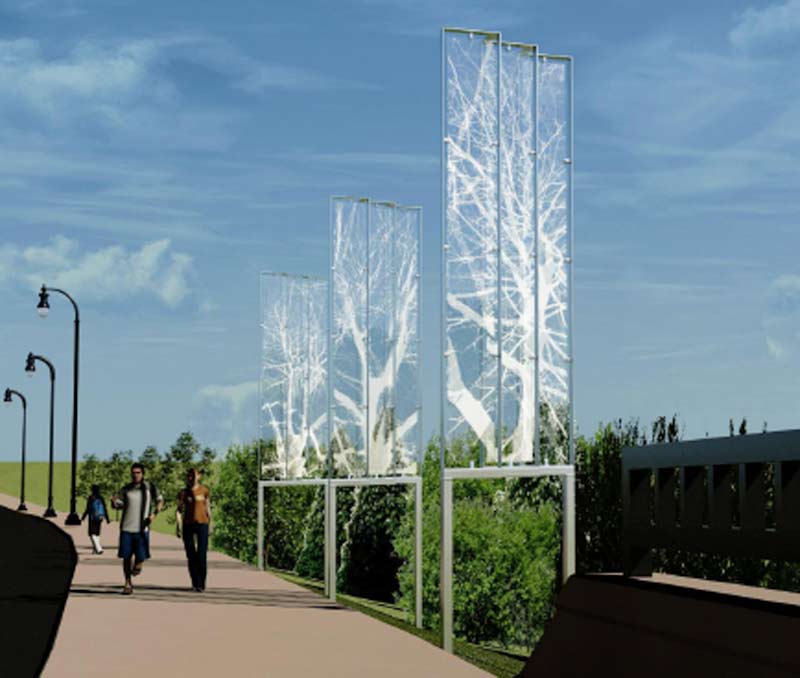
Catherine Widgery’s rendering of her proposed public artwork for East Stadium bridges. (Image provided in the April 23, 2014 AAPAC meeting packet.)
In early August of 2013, Catherine Widgery of Cambridge, Mass. was recommended as the artist for this project. She was picked by a selection panel from four finalists who had submitted proposals … [Full Story]
Art Commission Weighs Transitional Role
Ann Arbor public art commission meeting (March 26, 2014): At its first meeting since the city council transferred most of the money out of the public art fund, public art commissioners discussed their role as the city transitions to a new model for managing public art. The former Percent for Art program had set aside 1% for art in capital project budgets, drawing on a range of different funds. The council’s March 3, 2014 action transferred that money back to its funds of origin.
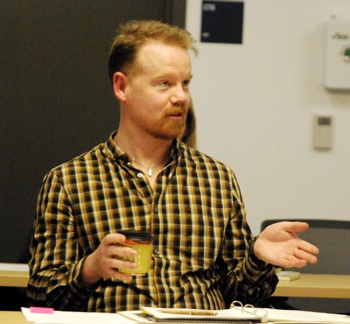
Jim Simpson, the newest member of the Ann Arbor public art commission, attended his first AAPAC meeting on March 26. (Photos by the writer.)
Before the council’s action on March 3, about $943,000 had been available for future public art projects. The council had halted the Percent for Art funding mechanism last year, and subsequently directed city staff to develop a transition plan for public art. The plan will be delivered to the council in October, and will likely include an emphasis on partners in the private sector and fundraising from the community. Meanwhile, future city public art will be “baked in” to selected capital projects and approved by council on a case-by-case basis.
The proposed 2015 budget – for the fiscal year beginning July 1, 2014 – includes $80,000 to cover transitional costs for public art administration. The contract for the current part-time public arts administrator, Aaron Seagraves, runs through June 30, 2014. At AAPAC’s March 26 meeting, Craig Hupy – a senior city staff member who’s drafting the transition plan – mentioned the need for a consultant to help guide this process.
Commissioners questioned what their role might be during this interim period, now that former Percent for Art funding is unavailable for future public art projects. After the discussion, AAPAC chair Bob Miller said he had initially considered suggesting that they just shut down the commission, but he’d heard input to the contrary from other commissioners. The consensus was to move forward with meetings, at least for now. AAPAC’s next meeting is on April 23 at city hall.
In other action, commissioners postponed adopting an annual public art plan, and directed Seagraves to make revisions to the draft he had proposed. They’ll consider a new version at their April meeting.
Updates about ongoing projects focused on efforts that had started before the city council pulled funding. The funds for those projects were not affected. Sculptures for a rain garden at Kingsley & First will be installed in May, and more contributions are being sought for a Coleman Jewett memorial at the Ann Arbor farmers market. A public forum to seek input on the final design for artwork at East Stadium bridges will be held on Monday, April 21 at 7 p.m. at the downtown library, 343 S. Fifth. And work on Canoe Imagine Art – a temporary art display in downtown Ann Arbor using old canoes from the city that would be repurposed as public art – continues to move forward.
It was the first meeting for Jim Simpson, who was appointed to AAPAC in February. He works for the Ann Arbor start-up Duo Security, and is an assistant at Baron Glassworks in Ypsilanti. [Full Story]
Planning Agenda: Art, Eats, Drive-Thrus
Ann Arbor planning commission meeting (April 1, 2014): Ordinance revisions, site plan approval and a look at proposed artwork for the East Stadium bridge filled the planning commission’s first meeting in April.
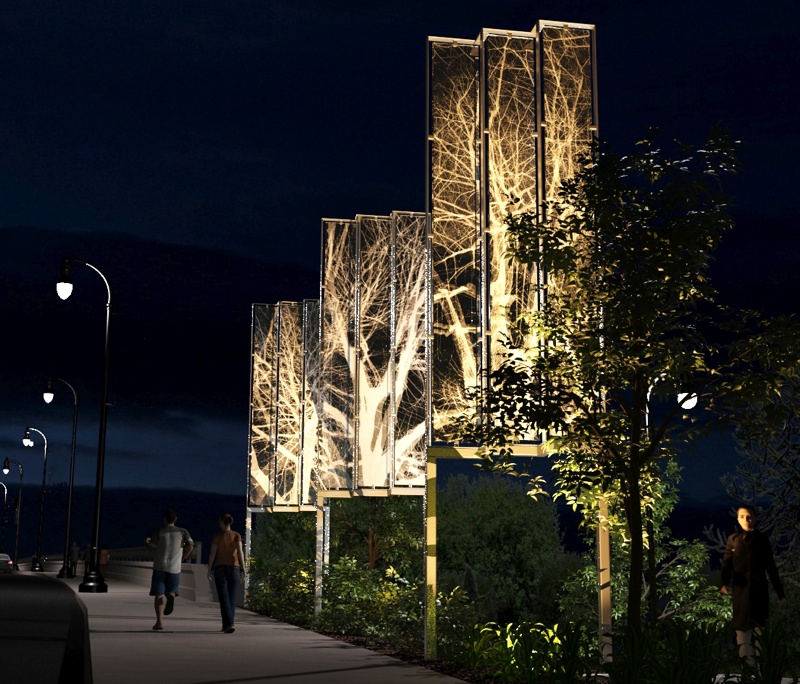
An image by artist Catherine Widgery for artwork on the East Stadium bridge. This night view shows how the structures would be lit from below, illuminating the images of trees that are etched into louvered glass panels.
John Kotarski and Bob Miller of the city’s public art commission presented images of a revised design for public art on the East Stadium bridge, a $400,000 project that includes columns of louvered glass panels on the bridge as well as underneath it, along South State Street. The artist – Catherine Widgery, who’s based in Massachusetts – had changed her original proposal at the request of a selection committee. The public art commission is seeking feedback on this new design, including at a public forum on Monday, April 21 at the downtown Ann Arbor District Library.
The public art commission likely will vote on a recommendation at its April 23 meeting. The proposal would then be forwarded to the city council for approval.
Also heading to city council is the site plan for a new Ruth’s Chris Steak House, which planning commissioners voted to recommend on April 1. The plan involves major renovations to the existing building at 314 S. Fourth Ave., which most recently housed the Dream Nite Club that closed in 2012. The renovations include adding a second-floor mezzanine level to the front of the building.
Part of the planning commission’s discussion focused on whether there might be outdoor dining in front of the restaurant. The project’s architect, Stephen Fry, indicated that at this point, outdoor seating wouldn’t be appropriate, in part because of bus traffic. The building is located near the Blake Transit Center, a hub for public transportation. “Ruth’s Chris is about a known and consistent dining experience,” Fry said, “and we just don’t feel we can control it out there.”
Fry also reported that the restaurant will likely be using valet parking, with valets positioned in front of the building. “So we’re going to activate the street with humans that are dressed up and looking good,” he said.
Commissioners also reviewed proposed ordinance revisions related to drive-thrus, and recommended that the city council approve the changes. The amendments would add a definition of a “drive-thru facility” to Chapter 55 of the city code. Currently, the term used throughout the code is “drive-in,” which is not explicitly defined in the code.
In addition, the changes would require that drive-thru projects obtain a special exception use from the planning commission, and would be allowed only in the O (office), C2B (business service) and C3 (fringe commercial) zoning districts. Basic layout requirements would also be added to the ordinance. Currently, drive-thrus are allowed in C3 districts without a special exception use. They are allowed as special exception uses in the C2B district.
The changes will give planning commissioners more discretion in approving drive-thru businesses, including restaurants, banks, pharmacies and other types of drive-thrus. [Full Story]
Council Ends Art Saga, Postpones Other Items
Ann Arbor city council meeting (March 3, 2014): The most recent wrangling over public art, which began on Jan. 21, has finally been wrapped up – at least for now – by council action on three separate items. But the council postponed final action on three issues fraught with their own controversies: a resolution on an urban park for the top of the Library Lane underground parking structure; a funding proposal for the work of a pedestrian safety task force; and an ordinance regulating smoking in some outdoor spaces.
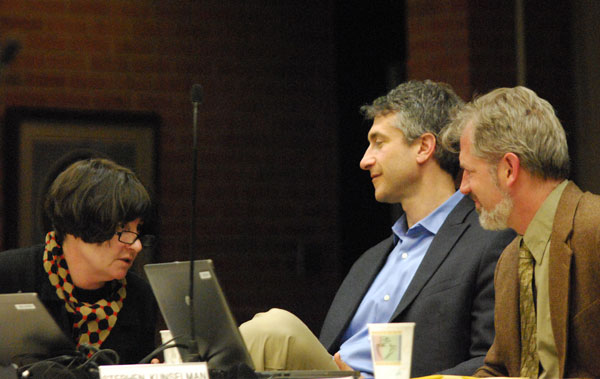
Jane Lumm (Ward 2) talked with Christopher Taylor (Ward 3) and Stephen Kunselman (ward 3) before the March 3 meeting started. (Photos by the writer.)
The delays allowed the council to wrap up a potentially long meeting relatively early, by around 10:30 p.m. As a part of the meeting, the council also approved a raft of routine items essential to keeping the city operational – like the purchase of 18 replacement vehicles.
In its three actions on public art policy, the council: (1) directed the city administrator to establish a budget for public art administration for the next two years; (2) transferred $943,005 out of the public art fund; and (3) extended the contract for the city’s part-time public art administrator by six months.
The transfer of Percent for Art money back to its funds of origin was made possible by an amendment to the city’s public art ordinance given final approval by the council on Feb. 18. The $943,005 total is an amount that defunds the art project at Argo Cascades, but keeps funding for the Coleman Jewett memorial and for a project called Canoe Imagine Art. The art projects at East Stadium bridges and at the Kingsley & First rain garden would also retain their funding. Because the resolution involves a transfer of funds, it required eight votes on the 11-member council to be approved. The vote on the question was 10-1 with Margie Teall (Ward 4) dissenting.
An additional resolution approved by the council focused exclusively on the transition to a new public art program. The resolution directed the city administrator to ask the staff to develop a transition plan, and to present that plan to the council by Oct. 6, 2014. The resolution also prohibits initiating additional projects using pooled Percent for Art funds, and directs the city administrator to establish a budget for public art administration for FY 2015 and FY 2016. Because it did not transfer any funds, the resolution on establishing a timeline and a budget did not require more than a simple six-vote majority. Dissenting on the vote were: Mike Anglin (Ward 5), Sumi Kailasapathy (Ward 1), Jane Lumm (Ward 2) and Jack Eaton (Ward 4).
The third public art resolution approved by the council on March 3 was one that extended the contract for the city’s part-time public art administrator by six months, appropriating $18,500 for that purpose – drawn from Percent for Art money. The item first appeared on the council’s Jan. 21 agenda.
A resolution that would have established an urban park on a portion of the surface of the Library Lane underground parking structure was delayed, amid the expressed intent by Stephen Kunselman (Ward 3) to bring forward a companion resolution to hire a broker to sell the rights to build on top of the parking structure. The urban park resolution, which was put forward by Jack Eaton (Ward 4), had resulted from his work with the Library Green Conservancy. It drew on recommendations on downtown parks made last year by the park advisory commission (PAC).
But the resolution drew criticism from both the current and former chair of PAC during public commentary at the meeting, as they said it flouted two of PAC’s eight recommendations: that additional parks not be established as a trade-off to maintenance of existing parks; and that open space on top of the Library Lane parking structure be designed in the context of adjacent development.
The consideration of the urban parks resolution spurred mayor John Hieftje to counter with an item he placed on the agenda the day of the March 3 council meeting: a slideshow he presented early in the meeting to argue for consideration of several open spaces downtown, including the surface lot on the northeast corner of Main & William. The council will take up the urban park resolution again on March 17.
In other parks-related business on March 3, the council also approved funding for the reconstruction of basketball and tennis courts at Clinton Park in the southern part of town. And the council approved applying for a grant from the Michigan Dept. of Natural Resources Grants Management to help pay for a universal access playground at Gallup Park. The Rotary Club of Ann Arbor has already pledged $250,000 toward that playground.
Delayed at the council’s March 3 meeting was a resolution that would have established funding for a pedestrian safety and access task force. Councilmembers had concerns about the amount of funding, which totaled $197,250. That amount includes approximate costs of the anticipated city staff effort for the project. Councilmembers also had concerns about the use of funds to hire an outside consultant as a facilitator. The council will take up the pedestrian task force funding issue again on April 7, by which time the task force is expected to have held its initial meeting.
Related to pedestrian issues at the March 3 meeting, the council approved funding for the design of two sidewalks – on Barton Drive and Scio Church Road – as well as funds to construct a section of sidewalk on Ann Arbor-Saline Road.
Also on March 3, police chief John Seto briefed the council on increased traffic enforcement activities conducted with a $125,000 allocation the council had made at its Dec. 16, 2013 meeting – in the same time frame as the pedestrian task force was created. Seto also briefed the council on year-end crime statistics for 2013.
Another item delayed until April 7 was an ordinance that would regulate smoking in certain outdoor locations, outside of building entrances and possibly in some areas of some public parks. Councilmembers had various concerns, ranging from the possible disparate impact on the homeless to the difficulty of enforcement. Chuck Warpehoski (Ward 5) expressed some frustration that he was just now hearing about these various concerns from his colleagues, even though he had brought the ordinance forward on Feb. 3 and asked for their comments and questions at that time.
The council did take action to direct the city administrator to develop a budget amendment that would allocate $600,000 from the city’s affordable housing trust fund to help the Ann Arbor Housing Commission pay for capital improvements. Approval of that amendment by the city council would be contingent on the upcoming closing of the sale of city-owned property at Fifth & William streets in downtown Ann Arbor – the former Y lot. Net proceeds of the sale, at around $1.4 million, are to be deposited in the affordable housing trust fund.
In routine business, the council approved the purchase of 18 replacement vehicles, most of which are used by the Ann Arbor police department. And finally, the council passed a resolution calling on state officials to find creative ways to provide full funding to a state program designed to give fire protection grants to municipalities that are home to state-owned institutions, like the University of Michigan. [Full Story]
City Council Takes Action on Public Art
In three separate actions on public art policy, the Ann Arbor city council has: (1) directed the city administrator to establish a budget for public art administration for the next two years; (2) transferred money out of the public art fund; and (3) extended the contract for the city’s part-time public art administrator by six months. Action on those items came at the council’s March 3, 2014 meeting.
The transfer of $943,005 in Percent for Art money back to its funds of origin was made possible by an amendment to the city’s public art ordinance given final approval by the council on Feb. 18.
The $943,005 total is an amount that defunds the art project at Argo Cascades, but keeps funding for … [Full Story]
March 3, 2014 Council Meeting: Live Updates
Editor’s note: This “Live Updates” coverage of the Ann Arbor city council’s March 3, 2014 meeting includes all the material from an earlier preview article published last week. The goal is to facilitate easier navigation from live-update material to background material already in the file.
The council’s first regular meeting in March will include several items of business leftover from previous meetings, including one resolution on affordable housing, an ordinance on outdoor smoking, and several matters related to public art.
The sign on the door to the Ann Arbor city council chamber, installed in the summer of 2013, includes Braille.
New to the agenda are several items related to non-motorized issues, most prominently a funding request to support the activity of an already-established task force on pedestrian safety and access.
The council will also be asked to fund requests related to city parks and other facilities like city hall and the airport. Eighteen new vehicles will also be added to the city’s fleet, contingent on council action on March 3.
The council will also consider a resolution that urges full funding of the state of Michigan’s fire protection grant program – for cities like Ann Arbor that host state-owned facilities like the University of Michigan.
In somewhat more detail, one public art issue, embodied in two different resolutions, was postponed from the council’s Feb. 18, 2014 meeting, when councilmembers could not agree on an approach to transferring money out of the public art fund back to the funds from which the money was originally drawn. The specific point dividing the council was not so much the transfer of money but rather a plan to fund the transition to a new approach to public art – after the council eliminated the Percent for Art funding mechanism last year.
Between council meetings, those issues have been separated out. The resolution ordered first on the agenda has been altered for consideration on March 3 so that it focuses exclusively on the public art program transition issue. The second resolution incorporates changes to reflect the council’s deliberations on Feb. 18: It transfers a total of $943,005 of Percent for Art money to its funds of origin, an amount that defunds the art project at Argo Cascades, but keeps funding for the Coleman Jewett memorial and for a project called Canoe Imagine Art. [public art resolution (1) for consideration on March 3, 2014] [public art resolution (2) for consideration on March 3, 2014]
That disagreement over funding of the new approach to public art – created by the council last summer when it eliminated the Percent for Art funding mechanism – is also related to another public art item on the agenda. That’s a six-month contract extension for the city’s part-time public art administrator. The item first appeared on the council’s Jan. 21 agenda, but the council postponed that vote until Feb. 3, when it was defeated. On Feb. 18 it was then brought back for reconsideration, but immediately postponed until the March 3 meeting.
Also postponed from Feb. 18 is an item that would direct the city administrator to prepare for the council’s approval a budget resolution regarding affordable housing. The resolution would allocate $600,000 from the city’s affordable housing trust fund to support the Ann Arbor housing commission’s plan to renovate its properties. That allocation would be contingent on the closing of the sale of the former Y lot to Dennis Dahlmann, as the net proceeds of that sale are to be deposited into the city’s affordable housing trust fund.
Postponed from the Feb. 3 meeting was the first reading of an ordinance that would regulate smoking outside of public buildings and also potentially in areas of some city parks. Chuck Warpehoski (Ward 5), sponsor of the new proposed local law, appeared before the park advisory commission at its Feb. 25 meeting to brief commissioners on the proposal and solicit feedback.
New items on the March 3 agenda include a funding proposal for the pedestrian safety and access task force established by the city council late last year, with members appointed in late January. The $122,250 item also includes a $77,500 contract for facilitation services from Project Innovations. That’s the same firm contracted for similar work in connection with the city’s sanitary sewer wet weather evaluation – which is expected to conclude in the summer of 2014. [The total amount being appropriated for the task force project budget in the item is $197,250. The stated “estimated $122,500” is the approximate cost of the anticipated staff effort for this project. The total project budget includes $77,400 for the professional services agreement with Project Innovations, Inc.]
Other issues on the March 3 agenda with a non-motorized connection are three stretches of sidewalk. In the context of sanitary sewer design work that Fishbeck, Thompson, Carr & Huber Inc. is being hired to do, two sidewalks are included: a stretch along Barton Drive, and a stretch along Scio Church Road. The council will also be asked to pay for the construction of a stretch of sidewalk along Ann Arbor-Saline Road near the I-94 bridge – as part of a road reconstruction project that the Michigan Dept. of Transportation is handling.
Another new item is a resolution that Jack Eaton (Ward 4) had announced at the council’s Feb. 18 meeting that he’d be bringing forward. It would waive the attorney-client privilege on a staff memo about laws governing the assessment of homes. The resolution indicates that the memo addresses the effect that reducing the assessment for one year would have on the property tax assessment for the subsequent year, based on action by the Board of Review and/or the Michigan Tax Tribunal.
In other action, the council will be asked on March 3 to approve the purchase from Signature Ford of 18 new vehicles – most of them for use by the Ann Arbor police department. Total cost of the purchase is $457,393.
City parks factor into three agenda items: (1) a resolution to establish an urban park on part of the surface level of the Library Lane underground parking structure; (2) a paving contract for the replacement of basketball and tennis courts at Clinton Park; and (3) a grant application to the Michigan Dept. of Natural Resources Grants Management to support a universal access playground at Gallup Park. The Rotary Club of Ann Arbor has already pledged $250,000 toward such a playground.
The city hall (Larcom Building) is featured in two agenda items – to pay $160,923 for a secondary chiller unit and $28,469 for new light fixtures. An amendment to an agreement with MDOT for an already-completed fence project at the Ann Arbor municipal airport also appears on the agenda, and will cost the city $425.
After authorizing significant equipment purchases to support water main repair activity at its Feb. 18 meeting, the council will be asked to approve two additional items related to water main repair. One item is a $44,702 emergency purchase order to buy more aggregate material used for backfilling water main repairs. A second item authorizes an emergency purchase order for repairing and making a new connection for the water main at 1214 S. University. In both cases, the emergency purchase orders were authorized by the city administrator, and the work was done.
Street closures for two events are on the council’s March 3 agenda: Take Back the Night and the Monroe Street Fair.
Also on the agenda is a resolution that would encourage Gov. Rick Snyder, state senator Rebekah Warren, and state representatives Jeff Irwin and Adam Zemke to explore creative ways to fund the state’s fire protection grant program for municipalities like Ann Arbor, which host state institutions. In the last three years, the program has been only 40-55% funded.
This article includes a more detailed preview of many of these agenda items. More details on other agenda items are available on the city’s online Legistar system. The meeting proceedings can be followed Monday evening live on Channel 16, streamed online by Community Television Network starting at 7 p.m.
The Chronicle will be filing live updates from city council chambers during the meeting, published in this article below the preview material. Click here to skip the preview section and go directly to the live updates. The meeting is scheduled to start at 7 p.m. [Full Story]
March 3, 2014: Ann Arbor Council Preview
The council’s first regular meeting in March will include several items of business leftover from previous meetings, including one resolution on affordable housing, an ordinance on outdoor smoking, and several matters related to public art.
Screenshot of Legistar – the city of Ann Arbor’s online agenda management system. Image links to the March 3, 2014 meeting agenda.
New to the agenda are several items related to non-motorized issues, most prominently a funding request to support the activity of an already-established task force on pedestrian safety and access.
The council will also be asked to fund requests related to city parks and other city facilities like city hall and the airport. Eighteen new vehicles will also be added to the city’s fleet, contingent on council action on March 3.
The council will also consider a resolution that urges full funding of the state of Michigan’s fire protection grant program – for cities like Ann Arbor that host state-owned facilities like the University of Michigan.
In somewhat more detail, one public art issue, embodied in two different resolutions, was postponed from the council’s Feb. 18, 2014 meeting, when councilmembers could not agree on an approach to transferring money out of the public art fund back to the funds from which the money was originally drawn. The specific point dividing the council was not so much the transfer of money but rather a plan to fund the new approach to public art – after the council eliminated the Percent for Art funding mechanism last year.
Updated March 1, 2014: The first resolution has been altered for consideration on March 3 so that it focuses exclusively on the public art program transition issue. The second resolution incorporates changes to reflect the council’s deliberations on Feb. 18: It transfers a total of $943,005 of Percent for Art money to its funds of origin, an amount that defunds the art project at Argo Cascades, but keeps funding for the Coleman Jewett memorial and for a project called Canoe Imagine Art. [public art resolution (1) for consideration on March 3, 2014] [public art resolution (2) for consideration on March 3, 2014]
That disagreement over funding of the newly created program is also related to another public art item on the agenda – a six-month contract extension for the city’s part-time public art administrator. The item first appeared on the council’s Jan. 21 agenda, but the council postponed that vote until Feb. 3, when it was defeated. On Feb. 18 it was then brought back for reconsideration, but immediately postponed until the March 3 meeting.
Also postponed from Feb. 18 is an item that would direct the city administrator to prepare for the council’s approval a budget resolution regarding affordable housing. The resolution would allocate $600,000 from the city’s affordable housing trust fund to support the Ann Arbor housing commission’s plan to renovate its properties. That allocation would be contingent on the closing of the sale of the former Y lot to Dennis Dahlmann, as the net proceeds of that sale are to be deposited into the city’s affordable housing trust fund.
Postponed from the Feb. 3 meeting was the first reading of an ordinance that would regulate smoking outside of public buildings and also potentially in areas of some city parks. Chuck Warpehoski (Ward 5), sponsor of the new proposed local law, appeared before the park advisory commission at its Feb. 25 meeting to brief commissioners on the proposal and solicit feedback.
New items on the March 3 agenda include a funding proposal for the pedestrian safety and access task force established by the city council late last year, with members appointed in late January. The $122,250 item includes a $77,500 contract for facilitation services from Project Innovations. That’s the same firm contracted for similar work in connection with the city’s sanitary sewer wet weather evaluation – which is expected to conclude in the summer of 2014.
Other issues on the March 3 agenda with a non-motorized connection are three stretches of sidewalk. In the context of sanitary sewer design work that Fishbeck, Thompson, Carr & Huber Inc. is being hired to do, two sidewalks are included: a stretch along Barton Drive, and a stretch along Scio Church Road. The council will also be asked to pay for the construction of a stretch of sidewalk along Ann Arbor-Saline Road near the I-94 bridge – as part of a road reconstruction project that the Michigan Dept. of Transportation is handling.
Another new item is a resolution that Jack Eaton (Ward 4) had announced at the council’s Feb. 18 meeting that he’d be bringing forward. It would waive the attorney-client privilege on a staff memo about laws governing the assessment of homes. The resolution indicates that the memo addresses the effect that reducing the assessment for one year would have on the property tax assessment for the subsequent year, based on action by the Board of Review and/or the Michigan Tax Tribunal.
In other action, the council will be asked on March 3 to approve the purchase from Signature Ford of 18 new vehicles – most of them for use by the Ann Arbor police department. Total cost of the purchase is $457,393.
City parks factor into three agenda items: (1) a resolution to establish an urban park on part of the surface level of the Library Lane underground parking structure; (2) a paving contract for the replacement of basketball and tennis courts at Clinton Park; and (3) a grant application to the Michigan Dept. of Natural Resources Grants Management (MDNRGM) to support a universal access playground at Gallup Park. The Rotary Club has already pledged $250,000 toward such a playground.
The city hall (Larcom Building) is featured in two agenda items – to pay $160,923 for a secondary chiller unit and $28,469 for new light fixtures. An amendment to an agreement with MDOT for an already-completed fence project at the Ann Arbor municipal airport also appears on the agenda, and will cost the city $425.
After authorizing significant equipment purchases to support water main repair activity at its Feb. 18 meeting, the council will be asked to approve two additional items related to water main repair. One item is a $44,702 emergency purchase order to buy more aggregate material used for backfilling water main repairs. A second item authorizes an emergency purchase order for repairing and making a new connection for the water main at 1214 S. University. In both cases, the emergency purchase orders were authorized by the city administrator, and the work was done.
Street closures for two events are on the council’s March 3 agenda: Take Back the Night and the Monroe Street Fair.
Also on the agenda is a resolution that would encourage Gov. Rick Snyder, state senator Rebekah Warren, and state representatives Jeff Irwin and Adam Zemke to explore creative ways to fund the state’s fire protection grant program for municipalities like Ann Arbor, which host state institutions. In the last three years, the program has been only 40-55% funded.
This article includes a more detailed preview of many of these agenda items. More details on other agenda items are available on the city’s online Legistar system. The meeting proceedings can be followed Monday evening live on Channel 16, streamed online by Community Television Network starting at 7 p.m. [Full Story]
Ann Arbor’s Public Art Saga Continues
Four separate agenda items related to public art received action by the Ann Arbor city council at its Feb. 18, 2014 meeting – but three of those actions were to postpone. The end result was that no Percent for Art money was transferred from the public art fund back to its funds of origin.
Back on the council’s March 3 agenda will be two resolutions – or possibly just one – that would make such a fund transfer. Also back on March 3 will be a resolution extending the part-time public art administrator’s contract for six months and appropriating $18,500 for that purpose.
The council’s actions on Feb. 18 began with final approval to an amendment to the city’s public art ordinance. That … [Full Story]
Feb. 18, 2014 Council Meeting: Live Updates
Editor’s note: This “Live Updates” coverage of the Ann Arbor city council’s Feb. 18, 2014 meeting includes all the material from an earlier preview article published last week. We think that will facilitate easier navigation from the live updates section to background material already in the file.
The council’s Feb. 18, 2014 agenda is highlighted by public art policy issues leftover from its previous meeting, as well as several items related to acquiring various pieces of basic equipment – from a garbage truck to a wood chipper.
The sign on the door to the Ann Arbor city council chamber, installed in the summer of 2013, includes Braille.
The possible acquisition of land is also on the agenda, in the form of a resolution postponed from an earlier meeting. The resolution would exercise the city’s right of first refusal to purchase the 16.7-acre Edwards Brothers Malloy property on South State Street. This process began when the University of Michigan offered to buy the property. An item authorizing the $12.8 million purchase is on the Feb. 20 UM board of regents agenda, based on the assumption that the city won’t exercise its right of first refusal earlier in the week.
In other action, the council will consider an amendment to the city’s public art ordinance for a second and final vote on Feb. 18, having given initial approval to the item on Feb. 3. The ordinance amendment would allow the council to transfer money that accumulated in the public art fund through the (now demised) Percent for Art funding mechanism in previous years. The money would be transferred back to the funds from which it was originally drawn – but that transfer would require a separate council action. To be approved, the ordinance change will need a six-vote majority on the 11-member council. The enactment of an ordinance can be vetoed by the mayor, but a veto can be overridden by an eight-vote majority.
Dependent on the public art ordinance amendment are two competing resolutions that would return money from the public art fund to the funds from which that money was drawn. That includes funds like the sanitary sewer fund and the street millage fund. Based on the Feb. 3 council deliberations, the debate on such a resolution would likely center on the amount to be returned to funds of origin, not the question of returning at least some of the money. And that point of possible disagreement is reflected in the amounts specified in the two resolutions. A resolution sponsored by Jane Lumm (Ward 2), Jack Eaton (Ward 4) and Sumi Kailasapathy (Ward 1) would transfer $819,005 back to the funds of origin.
A resolution added later to the agenda is sponsored by Sabra Briere (Ward 1). Briere’s proposal would eliminate funding for the stalled Argo Cascades art project and would return $957,140 to the funds of origin. Briere’s resolution also directs the city administrator to establish a budget for public art administration for both the 2015 and 2016 fiscal years. [An initial list of requests from department heads for FY 2015, released by the city on Feb. 10, shows an $80,000 request for arts administration, which includes funds for a full-time art administrator.]
Either of the two proposed resolutions related to public art funds would require eight votes to pass.
Also expected back from the Feb. 3 agenda is a resolution that was defeated at that meeting – to extend the contract for the part-time public art administrator by six months and to appropriate funds to cover that $18,500 contract. It would need eight votes to pass. The result of the Feb. 3 council vote was that public art administrator Aaron Seagraves cannot currently be paid. The contract is supposed to be back on Feb. 18 for reconsideration – as part of the political bargain among councilmembers on the overall question of how the Percent for Art money that accumulated in the public art fund will be handled.
The council’s Feb. 18 agenda also features several pieces of equipment essential to core services. One of those core services is the repair of water main breaks, which have increased in frequency in recent weeks as the ground moves due to deeper and deeper penetration of frost. The council will be asked to approve the $441,535 purchase of a combination sewer truck, which is outfitted with a vacuum device – often used to control water in an excavation during the repair of a water main break. Also deployed when repairing water main breaks is a hydraulic excavator. So the council will be asked to approve the purchase of one for $176,472. Both of those authorizations are replacements of existing city equipment.
The council will also be asked to approve the purchase of a new garbage truck for $93,800. The purchase of two vans for a total of $50,320 is also on the council’s Feb. 18 agenda. The vans will be used by the parks and recreation staff to shuttle passengers when they start a river trip at one of the cities liveries on the Huron River. Rounding out equipment purchases is a $83,208 wood chipper.
Another piece of equipment shows up on the agenda in the form of a grant application the council is being asked to approve. The $334,140 grant application is being made to the 2013 Assistance to Firefighters Grant (AFG) program of the U.S. Department of Homeland Security – to acquire a mobile training facility to train firefighters. The 48-foot-long unit will allow live fire and tactical simulations.
In addition to the Edwards Brothers deal, several other real estate matters are on the Feb. 18 agenda. The council will be asked to approve the acquisition of development rights for two properties, using funds from the greenbelt millage. The first is a 24-acre parcel just north of the Huron River in Scio Township. The city of Ann Arbor will be contributing $25,200 to the total $84,000 cost of purchasing development rights, with the township contributing the difference. The second greenbelt property on the agenda is a 64-acre property on Zeeb Road, also in Scio Township. For that deal, the city is contributing $39,000 to the total purchase price of $130,335.
Related to land use, council will also be asked to give final approval to the zoning of the Hofmann property on South State Street – to C1 (local business district). The property houses Biercamp Artisan Sausage and Jerky.
On the consent agenda is a contract with MDOT for reimbursement to the city for a portion of the cost to install rectangular rapid flashing beacons at three locations: on Geddes Road at Gallup Park; Fuller Road 400 feet east of Cedar Bend Drive; and on South University Avenue at Tappan Avenue. The city’s cost for the $47,971 project would be $14,179.
This article includes a more detailed preview of many of these agenda items for the Feb. 18 meeting, which was shifted to Tuesday because of the Presidents Day holiday on Monday. More details on other agenda items are available on the city’s online Legistar system. The meeting proceedings can be followed Tuesday evening live on Channel 16, streamed online by Community Television Network.
The Chronicle will be filing live updates from city council chambers during the meeting, published in this article below the preview material. Click here to skip the preview section and go directly to the live updates. The meeting is scheduled to start at 7 p.m. [Full Story]
Feb. 18, 2014: Ann Arbor Council Preview
The council’s Feb. 18, 2014 agenda is highlighted by public art policy issues leftover from its previous meeting, as well as several items related to acquiring various pieces of basic equipment – from a garbage truck to a wood chipper.
Screenshot of Legistar – the city of Ann Arbor’s online agenda management system. Image links to the Feb. 18, 2014 meeting agenda.
The possible acquisition of land is also on the agenda, in the form of a resolution postponed from an earlier meeting. The resolution would exercise the city’s right of first refusal to purchase the Edwards Brothers Malloy property on South State Street.
The meeting is shifted to Tuesday because of the Presidents Day holiday on Monday.
Having given initial approval to an amendment to the city’s public art ordinance at its Feb. 3 meeting, the council will consider the item for a second and final vote on Feb. 18. The ordinance amendment would allow the council to transfer money that accumulated in the public art fund through the (now demised) Percent for Art funding mechanism in previous years. The money would be transferred back to the funds from which it was originally drawn – but that transfer would require a separate council action. To be approved, the ordinance change will need a six-vote majority on the 11-member council. The enactment of an ordinance can be vetoed by the mayor, but a veto can be overridden by an eight-vote majority.
Dependent on the public art ordinance amendment is a resolution that would return $819,005 from the public art fund to the funds from which that money was drawn. That includes funds like the sanitary sewer fund and the street millage fund. That kind of resolution is typically analyzed as needing an eight-vote majority to pass, but it’s not yet indicated as an “eight-voter” on the online agenda. [Updated 1 p.m. Friday: It's now recorded as needing eight votes.] Based on the Feb. 3 council deliberations, the debate on such a resolution would likely center on the amount to be returned to funds of origin, not the question of returning at least some of the money.
Also expected back from the Feb. 3 agenda is a resolution that was defeated at that meeting – to extend the contract for the part-time public art administrator by six months and to appropriate funds to cover that $18,500 contract. It would need eight votes to pass. The result of that council vote was that public art administrator Aaron Seagraves cannot currently be paid. The contract is supposed be back on Feb. 18 for reconsideration – as part of the political bargain among councilmembers on the overall question of how the Percent for Art money that accumulated in the public art fund will be handled.
The council’s Feb. 18 agenda also features several pieces of equipment essential to core services. One of those core services is the repair of water main breaks, which have increased in frequency in recent weeks as the ground moves due to deeper and deeper penetration of frost. The council will be asked to approve the $441,535 purchase of a combination sewer truck, which is outfitted with a vacuum device – often used to control water in an excavation during the repair of a water main break. Also deployed when repairing water main breaks is a hydraulic excavator. So the council will be asked to approve the purchase of one for $176,472. Both of those authorizations are replacements of existing city equipment.
The council will also be asked to approve the purchase of a new garbage truck for $93,800. The purchase of two vans for a total of $50,320 is also on the council’s Feb. 18 agenda. The vans will be used by the parks and recreation department to shuttle passengers when they start a river trip at one of the cities liveries on the Huron River. Rounding out equipment purchases is a $83,208 wood chipper.
Another piece of equipment shows up on the agenda in the form of a grant application the council is being asked to approve. The $334,140 grant application is being made to the 2013 Assistance to Firefighters Grant (AFG) program of the U.S. Department of Homeland Security – to acquire a mobile training facility to train firefighters. The 48-foot-long unit will allow live fire and tactical simulations.
In real estate matters, the council will be asked to approve the acquisition of development rights for two properties, using funds from the greenbelt millage. The first is a 24-acre parcel just north of the Huron River in Scio Township. The city of Ann Arbor will be contributing $25,200 to the total $84,000 cost of purchasing development rights, with the township contributing the difference. The second greenbelt property on the agenda is a 64-acre property on Zeeb Road, also in Scio Township. For that deal, the city is contributing $39,000 to the total purchase price of $130,335.
Related to land use, council will also be asked to give final approval to the zoning of the Hofmann property on South State Street – to C1 (local business district). The property houses Biercamp Artisan Sausage and Jerky.
A bit south of Biercamp on State Street is the topic of the most significant land acquisition matter on the Feb. 18 agenda. A resolution postponed from the council’s Feb. 3 meeting would approve the city’s exercise of its right of first refusal on the 16.7-acre Edwards Brothers Malloy property. The University of Michigan has offered $12.8 million for the land.
On the consent agenda is a contract with MDOT for reimbursement to the city for a portion of the cost to install rectangular rapid flashing beacons at three locations: on Geddes Road at Gallup Park; Fuller Road 400 feet east of Cedar Bend Drive; and on South University Avenue at Tappan Avenue. The city’s cost for the $47,971 project would be $14,179.
This article includes a more detailed preview of many of these agenda items. More details on other agenda items are available on the city’s online Legistar system. The meeting proceedings can be followed Tuesday evening live on Channel 16, streamed online by Community Television Network starting at 7 p.m. [Full Story]
Art Money Back to Original Funds: Initial OK
Additional money set aside under the city of Ann Arbor’s Percent for Art program in previous years could eventually be returned to the money’s funds of origin, based on a first step the city council has taken. At its Feb. 3, 2014 meeting, the council gave initial approval to an amendment of the city’s public art ordinance that would allow the eventual return of art money to funds like the sanitary sewer fund, the stormwater fund, and the street millage fund.
Margie Teall (Ward 4) cast the sole vote of dissent on the ordinance amendment.
In other action related to public art, the council rejected approval of a six-month contract extension for Ann Arbor’s part-time public art administrator, Aaron Seagraves. The proposed … [Full Story]
Feb. 3, 2014 Ann Arbor Council: Live Updates
Editor’s note: This “Live Updates” coverage of the Ann Arbor city council’s Feb. 3, 2014 meeting includes all the material from an earlier preview article published last week. We think that will facilitate easier navigation from live-update material to background material already in the file.
The most significant item on the council’s Feb. 3, 2014 agenda is listed last – a resolution that would authorize the city administrator to exercise the city’s right of first refusal to purchase the 16.7-acre Edwards Brothers property on South State Street. The council could adjust the order of the items at the start of the meeting.
The sign on the door to the Ann Arbor city council chamber, installed in the summer of 2013, includes Braille.
Two new ordinances will also be given initial consideration at the Ann Arbor city council’s Feb. 3 meeting. One involves public art – which relates to leftover business from the council’s previous meeting. The second proposed new local law involves prohibitions against smoking in some public places.
Background on the possible acquisition of the Edwards Brothers property includes the fact that the University of Michigan has made an offer to Edwards Brothers to purchase the property for $12.8 million. But the city has a right of first refusal on the property as a condition of a tax abatement granted by the city council three years ago, on Jan. 18, 2011.
The resolution on tonight’s agenda approves the exercise of the city’s right of first refusal, appropriates necessary funds, and directs the city administrator to notify Edward Brothers Malloy about the exercise of the city’s right.
This effort began at the council’s Jan. 6, 2014 meeting, when councilmembers had directed the city administrator and the city attorney to explore options and gather information about the Edwards Brothers land. The due date for that gathering of information was specified in the council’s resolution as Jan. 30.
Public art is actually the topic of two separate items on the council’s agenda. One is a contract extension for the city’s part-time public art administrator, which had been on the council’s Jan. 21, 2014 agenda, but was postponed at that meeting.
The postponement took place in the context of a political horse trade offered by Jack Eaton (Ward 4) at the council table on Jan. 21. Eaton indicated he’d support the public art administrator’s contract extension at the council’s subsequent meeting – but only if the council would move toward returning as-yet-unallocated money set aside during the now defunct Percent for Art program to its funds of origin (e.g., sanitary sewer fund, street millage fund etc.).
Both elements of the horse trade are scheduled for the Feb. 3 meeting. The move toward returning money out of the public art fund takes the form of initial consideration of an amendment to the city’s public art ordinance. The ordinance amendment, sponsored by Jane Lumm (Ward 2), would allow the council to return money accumulated under the city’s former Percent for Art program to the funds from which that money was drawn. The ordinance change would need a second and final council vote at a subsequent meeting to be enacted. Any transfer of public art money would require separate council action after the potential ordinance change.
Also getting initial consideration on Feb. 3 will be a new ordinance that would prohibit smoking in specific outdoor public areas. Made punishable through a $50 civil fine would be smoking within 20 feet of: (1) bus stops; (2) entrances, windows and ventilation systems of the Blake Transit Center; and (3) entrances, windows and ventilation systems of any city-owned building. The ordinance amendment would also authorize the city administrator to have signs posted designating certain parks or portions of parks as off limits for outdoor smoking.
In another item on its Feb. 3 agenda, the council will consider approval of a $398,703 contract plus a $40,000 contingency with Hubbell Roth & Clark Inc. to reconstruct Geddes Avenue from Huntington to Huron Parkway. The project, which includes five components, is scheduled to start in the spring of 2015 and may continue through 2016. The five components of the project are: reconstruction of Geddes, sanitary sewer on Geddes, sanitary sewer on Dover Place and Riverview, storm sewer on Geddes, and water main on Dover Place and Riverview.
Also on the council’s Feb. 3 agenda is a proposed expansion for Germain Motors – an auto dealership on South State Street, formerly Howard Cooper Imports.
The council will also consider setting a hearing date for one establishments that could potentially be recommended for non-renewal of its liquor licenses for non-payment of taxes: Banfield’s Bar & Grill. Also originally on the list were The Arena, and Café Zola, but as of Monday morning, Feb. 3 they’d been removed. Those three businesses were also subject to the same scrutiny last year, and all eventually paid their taxes without having their licenses revoked.
This article includes a more detailed preview of many of these agenda items. More details on other agenda items are available on the city’s online Legistar system. The meeting proceedings can be followed Monday evening live on Channel 16, streamed online by Community Television Network starting at 7 p.m.
The Chronicle will be filing live updates from city council chambers during the meeting, published in this article below the preview material. Click here to skip the preview section and go directly to the live updates. The meeting is scheduled to start at 7 p.m. [Full Story]
Commission Works on Public Art Planning
Ann Arbor public art commission meeting (Jan. 29, 2014): In a three-hour session, the public art commission worked on prioritizing capital improvement projects that might be suitable for public art.
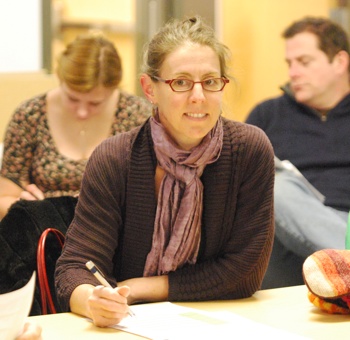
On Jan. 29, Kristin “KT” Tomey attended her first regular meeting of the Ann Arbor public art commission since being appointed by the city council on Jan. 6. (Photos by the writer.)
Some commissioners expressed frustration that they had insufficient information on which to base their evaluation. And after about two hours of discussion – using a scoring rubric with seven criteria – commissioners had evaluated only a few projects: artist-designed street access (manhole) covers, art for the Springwater subdivision, and art for the corridors of Main Street and Plymouth Road. Because there were still several other items on the agenda, they voted to postpone further evaluation of possible capital projects until their next meeting.
In other action, commissioners discussed and approved a draft annual public art plan that’s officially due to the city council on Feb. 1, for projects to be undertaken in the fiscal year that begins July 1. It includes projects that are underway – like artwork for East Stadium bridges and Argo Cascades – as well as a proposal to add some enhanced capital projects, like street access covers on resurfaced roads.
The draft annual plan had been prepared by Aaron Seagraves, the city’s public art administrator. Commissioners asked for some revisions and designated commissioner John Kotarski to work with Seagraves on a final version that will likely be presented to the council on Feb. 18. Kotarski praised the draft, saying “It has as much meat as anyone wants. It shows a lot of work. It shows an art commission that gets the message from an impatient city council.”
Commissioners also discussed a proposal from the Clean Energy Coalition to select and fund an artist who would help incorporate art into a new bike share program. They tabled action on this item, wanting additional information about the CEC’s expectations for funding.
This was AAPAC’s first regular meeting since Oct. 23, 2013, although they held a retreat in December and a planning session earlier in January. Throughout the evening, concerns were raised about the future of the public art program, in light of recent city council discussions. The council had postponed a requested six-month extension of Seagraves’ contract, and will be taking up that item on Feb. 3.
Also on the council’s Feb. 3 agenda is an amendment to the city’s public art ordinance. The amendment would allow the council to return about $800,000 accumulated under the city’s former Percent for Art program to the funds from which that money was drawn, such as the street millage or sanitary sewer fund. It’s the latest in an ongoing transition for the city’s public art program – a transition that’s been unsettling for public art commissioners.
The Jan. 29 meeting marked another transition for AAPAC, which has seen considerable turnover during the past year. It was the first regular monthly meeting for the newest commissioner, Kristin “KT” Tomey, who was appointed by the city council on Jan. 6. And it was the last meeting for Malverne Winborne, whose term ended on Dec. 31. He did not seek reappointment, and was serving until the position was filled. His replacement, Jim Simpson, is expected to be confirmed in a vote at the city council’s Feb. 3 meeting.
Winborne has served as vice chair of AAPAC – but the group held new officer elections on Jan. 29. Bob Miller was re-elected to another one-year term as chair, and John Kotarski was elected vice chair. There were no competing nominations, and both votes were unanimous.
Noting that the Jan. 29 meeting had been especially challenging, Miller thanked commissioners for their work. “This is probably the most belabored meeting I think we’ve ever gone through, aside from maybe one of the retreats,” he said. “I’m tapped out.” He jokingly cajoled commissioners: “Please do come back.”
Miller also encouraged students to return, as about two dozen students from Skyline High School – and some parents – attended the Jan. 29 meeting. “It’s the most amount of people we’ve ever had at any of our meetings,” Miller noted. One student pointed out that they were all from the same government class, facing a Jan. 31 deadline to attend a public meeting. [Full Story]
Feb. 3, 2014 Ann Arbor Council: Preview
Updated Friday, Jan. 31: An item authorizing the city’s right of first refusal to purchase the Edwards Brothers property on South State Street has been added to the agenda.
Two new ordinances will be given initial consideration at the Ann Arbor city council’s Feb. 3, 2014 meeting. One involves public art – which relates to leftover business from the council’s previous meeting. The second proposed new local law involves prohibitions against smoking in some public places.
Screenshot of Legistar – the city of Ann Arbor’s online agenda management system. Image links to the Feb. 3, 2014 meeting agenda.
Public art is actually the topic of two separate items on the council’s agenda. One is a contract extension for the city’s part-time public art administrator, which had been on the council’s Jan. 21, 2014 agenda, but was postponed at that meeting.
The postponement took place in the context of a political horse trade offered by Jack Eaton (Ward 4) at the council table on Jan. 21. Eaton indicated he’d support the public art administrator’s contract extension at the council’s subsequent meeting – but only if the council would move toward returning as-yet-unallocated money set aside during the now defunct Percent for Art program to its funds of origin (e.g., sanitary sewer fund, street millage fund etc.).
Both elements of the horse trade are scheduled for the Feb. 3 meeting. The move toward returning money out of the public art fund takes the form of initial consideration of an amendment to the city’s public art ordinance. The ordinance amendment, sponsored by Jane Lumm (Ward 2), would allow the council to return money accumulated under the city’s former Percent for Art program to the funds from which that money was drawn. The ordinance change would need a second and final council vote at a subsequent meeting to be enacted. Any transfer of public art money would require separate council action after the potential ordinance change.
A third public art item is expected to be on the agenda as an item of communication – the annual public art plan for fiscal 2015, which was approved by the Ann Arbor public art commission at its Jan. 29 meeting. It lists projects that are underway, as well as potential new projects for the coming year.
Also getting initial consideration on Feb. 3 will be a new ordinance that would prohibit smoking in specific outdoor public areas. Made punishable through a $50 civil fine would be smoking within 20 feet of: (1) bus stops; (2) entrances, windows and ventilation systems of the Blake Transit Center; and (3) entrances, windows and ventilation systems of any city-owned building. The ordinance amendment would also authorize the city administrator to have signs posted designating certain parks or portions of parks as off limits for outdoor smoking.
In another item on its Feb. 3 agenda, the council will consider approval of a $398,703 contract plus a $40,000 contingency with Hubbell Roth & Clark Inc. to reconstruct Geddes Avenue from Huntington to Huron Parkway. The project, which includes five components, is scheduled to start in the spring of 2015 and may continue through 2016. The five components of the project are: reconstruction of Geddes, sanitary sewer on Geddes, sanitary sewer on Dover Place and Riverview, storm sewer on Geddes, and water main on Dover Place and Riverview.
Also on the council’s Feb. 3 agenda is a proposed expansion for Germain Motors – an auto dealership on South State Street, formerly Howard Cooper Imports.
The council will also consider setting a hearing date for three establishments that could potentially be recommended for non-renewal of their liquor licenses for non-payment of taxes: The Arena, Banfield’s Bar & Grill, and Café Zola. The three businesses were also subject to the same scrutiny last year, and all eventually paid their taxes without having their licenses revoked.
This article includes a more detailed preview of many of these agenda items. More details on other agenda items are available on the city’s online Legistar system. The meeting proceedings can be followed Monday evening live on Channel 16, streamed online by Community Television Network starting at 7 p.m. [Full Story]
Downtown Items OK’d, Public Art Delayed
Ann Arbor city council meeting (Jan. 21, 2014): Council communications at the start of the meeting highlighted an already-established pedestrian safety task force – and signaled that the evening could be contentious. It proved to be a night featuring some political friction, with the meeting extending past 1 a.m.
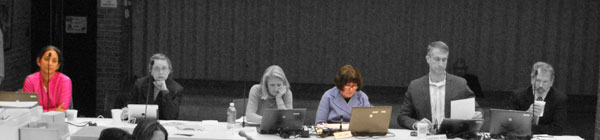
From left: Sumi Kailasapathy and Sabra Briere (Ward 1); Sally Petersen and Jane Lumm (Ward 2); Christopher Taylor and Stephen Kunselman (Ward 3). In color are the only two councilmembers on that side of the table who are not running for mayor. (Photo art by The Chronicle.)
The pedestrian safety and access task force appeared on the agenda because confirmation of its nine members was a question before the council. As part of that vote, as well as during council communications, Stephen Kunselman (Ward 3) revived the recent controversy over an attempted repeal of the city’s crosswalk ordinance – an effort that mayor John Hieftje ultimately vetoed. The task force was appointed at Tuesday’s meeting, after Kunselman established that he was still interested in revising the city’s crosswalk ordinance so that motorists would be required to stop for pedestrians only if they could “do so safely.”
In other business, the council approved the site plan for a revised, expanded version of the 624 Church St. project, located in the block just south of South University Avenue. The revised plan is for a 14-story, 116,167-square-foot building with 123 units and about 230 bedrooms. The approval came after an hour and a half of debate on the site plan, focusing on the way the project is satisfying a zoning requirement to provide parking spaces – through the city’s contribution-in-lieu (CIL) program. The Ann Arbor Downtown Development Authority had approved three five-year extensions for the CIL monthly permits – beyond the standard CIL term of 15 years. When Kunselman’s bid to eliminate the extended term failed – a move that would have jeopardized the project’s financing – he told Sean Spellman, representing the developer: “I’m sorry if I scared you …”
Also related to downtown development, the council moved along a process to revise downtown zoning regulations. The council accepted the planning commission’s recommendations, and in turn tasked the planning commission to develop ordinance language to implement the recommendations. In general, the planning commission’s recommendations were intended to create more of a buffer between downtown development and adjacent or nearby residential neighborhoods. Several other recommendations focused on the issue of “premiums” – certain features that a developer can provide in exchange for additional by-right floor area ratio (FAR).
During its Tuesday meeting, the council added some direction of its own: (1) consider rezoning Huron Street from Division to Fourth Avenue to conform with the East Huron 1 character district, and consider incorporating 25-foot minimum side setbacks and 10-foot front setbacks where feasible in the East Huron 1 character district; and (2) consider whether other D1-zoned areas that do not have buffering from adjacent residential neighborhoods, including some areas of South University and Thayer Street, should be rezoned to D2. A date certain was also added by which the planning commission is to report to the council on all its work on this issue – Oct. 20, 2014.
In other zoning action at its Jan. 21 meeting, the council gave initial approval for the zoning of two unzoned properties on South State Street – 1643 and 1645 S. State. They are proposed to be zoned C1 (local business district). One of those properties houses Biercamp Artisan Sausage and Jerky.
In another item related to South State Street property, the council approved with no discussion a $25,550 contract with Atwell LLC for environmental site assessment services to evaluate 2500 S. State St. That’s the Edwards Brothers Malloy property for which the council is currently exploring options to purchase. The item was added to the agenda on Friday, Jan. 17, after the initial publication of the agenda.
Delayed by the council was a six-month extension of the contract with the city’s public art administrator, Aaron Seagraves, and a proposal to add $18,500 to his compensation to cover the added term. The postponement was made amid concern about the remaining $839,507 unallocated balance in the now-defunct Percent for Art fund. The political horse-trade made at the council table was to postpone the contract extension, with the expectation that it would be supported at the council’s next meeting – but at the same time, a process would start to return the better part of the $839,507 to the various funds from which that money was drawn.
The city’s new public art program relies on the idea of integrated or “baked-in” art for capital projects. It was developed by a five-member council committee, which included all four of the councilmembers who have announced that they’re running for mayor in 2014 – Sabra Briere (Ward 1), Sally Petersen (Ward 2), Christopher Taylor (Ward 3) and Stephen Kunselman (Ward 3). The fifth member of that committee was Margie Teall (Ward 4), who cast the only vote against postponing the contract extension for Seagraves – as she wanted to approve it at Tuesday’s meeting.
Also at its Jan. 21 meeting, the council approved $6,818 of general fund money to build a sidewalk from the northeast corner of Penberton Court and Waldenwood northward – to connect to a path leading the rest of the way to King Elementary School. The item, which has a history of at least four years, drew about 15 minutes of discussion.
Taking a half hour of council deliberations was another sidewalk-related item. The council approved the first of four steps in the process to impose a special assessment on property owners for a sidewalk on the east side of Pontiac Trail, between Skydale and Dhu Varren Road. Debate centered on a proposal from Kunselman to ask the city administrator to consider city funding for 80% of the project.
The council dispatched quickly two liquor-license related items: recommendation of a special downtown development liquor license for The Lunch Room at 407 N. Fifth Avenue, and a change in the classification of Silvio’s Organic Pizza license from a Tavern License to a Class C License.
Public commentary was highlighted by concerns about fracking. [Full Story]
Contract Extension Delayed for Art Administrator
City of Ann Arbor public art administrator Aaron Seagraves will need to wait another two weeks to see if the city council will extend his contract by six months – through June 30, 2014. The council action to postpone approval of the additional $18,500 to cover the added term came at its Jan. 21, 2014 meeting. Indications are that it will likely be approved at the council’s next meeting, on Feb. 3.
The budget expenditure would have needed an eight-vote majority on the 11-member council, and it did not necessarily appear to have sufficient support. That lack of support was based on dissatisfaction with the status of funds leftover from the former Percent for Art program. The proposal to postpone came … [Full Story]
Fifth & William
Display in the main lobby of the downtown library shows two finalists for public art at the new Blake Transit Center – Daniel Roache of Petoskey, Mich., and Robert Delgado of Los Angeles – and asks for public feedback. The proposals will be up through Feb. 3.
Public Art Commission Plans for Future
Ann Arbor public art commission meeting (Oct. 23, 2013): The most recent AAPAC meeting focused on an ongoing transition for Ann Arbor’s public art program.
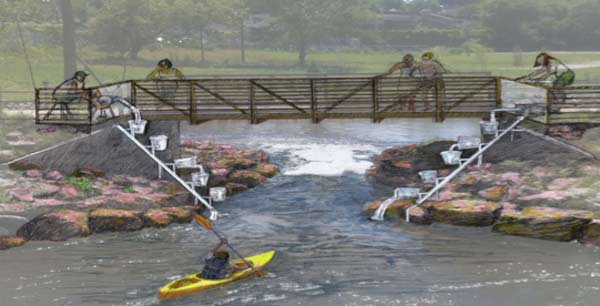
Rendering of “Bucket Cascade” proposal by Mags Harries and Lajos Heder. It’s one of two finalists for public art at the city’s Argo Cascades.
Commissioners were briefed about the city’s capital improvements plan (CIP), which will now be integral to the public art program. AAPAC and city staff will identify projects in the CIP that might be candidates for public art “enhancements” – if the council agrees and provides additional funding for that purpose. It’s a change from the previous Percent for Art program, which the city council eliminated earlier this year.
Deb Gosselin, who oversees the CIP process, attended AAPAC’s meeting and described a decision-making matrix that’s used to help city staff prioritize capital projects. AAPAC plans to use that matrix as a model for developing its own method of prioritizing potential public art projects.
Commissioners also briefly discussed four possible capital projects that might include public art enhancements, including an enclosure of the farmers market, and a retaining wall to be built as part of a Stadium Boulevard reconstruction.
Some of these issues will likely be picked up during a retreat that’s set for Nov. 20. The idea of a retreat was proposed by one of the newer commissioners, Ashlee Arder, as a way to get to know each other better, as well as to discuss the creation of AAPAC’s annual plan, which is due to the council in early 2014. Arder also hopes to assemble a “curated team” from different sectors of the community, to help AAPAC develop ideas for fostering public art as well as the broader creative sector.
Also at their most recent meeting, commissioners acted on a specific project that’s already underway. They authorized applying for a $40,000 grant from the Community Foundation of Southeast Michigan to fund a public art project in the Arbor Oaks/Bryant neighborhood on Ann Arbor’s southeast side. But they tabled another proposal – for artwork at the roundabout on South State and Ellsworth – until their February 2014 meeting, allowing time for commissioners to see how it might fit into an overall public art plan.
Updates were provided during the meeting on several other projects, including the Coleman Jewett memorial at the farmers market, finalists for artwork at Argo Cascades, and a plan to add an artistic element to the city’s new bike share program. [Full Story]
Fifth & Washington
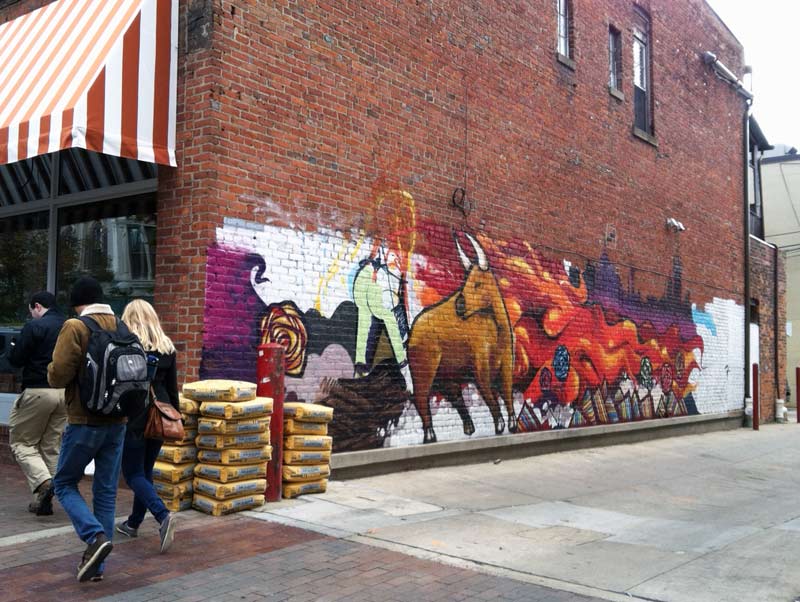
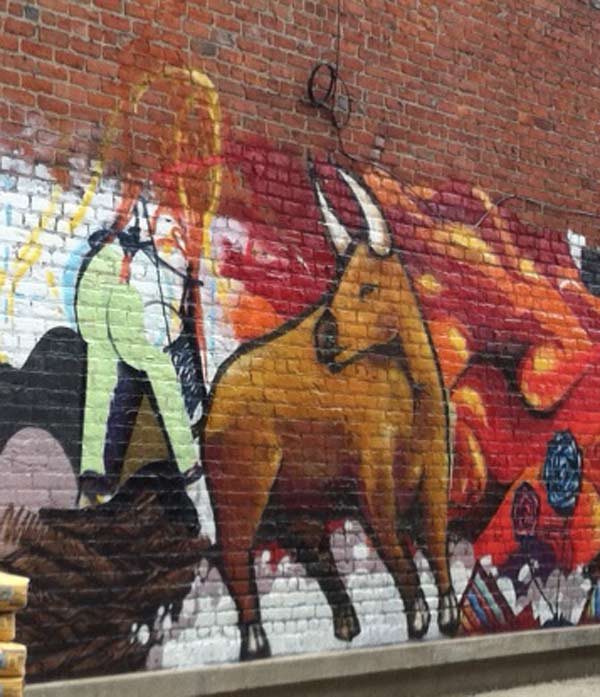
Ann Arbor DDA Embraces Vinyl Art Wraps
Ann Arbor Downtown Development Authority board meeting (Oct. 2, 2013): In its one piece of voting business, the board approved a $20,500 grant to the Arts Alliance to implement a pilot project that would wrap 14 traffic signal electrical boxes in downtown Ann Arbor with vinyl that’s imprinted with artwork.

Al McWilliams, newest member of the Ann Arbor Downtown Development Authority board. (Photos by the writer.)
Called PowerArt, the project is proposed as a way to beautify downtown as well as deter graffiti. The proposal was developed by the DDA – working with the Ann Arbor-based Arts Alliance and the Ann Arbor public art commission. The art commission had voted at its Sept. 25, 2013 meeting to support this first phase of the project with the same amount as the DDA – $20,500. While the first phase of the project would wrap 14 traffic signal boxes, the Arts Alliance is proposing two more phases, for a total of 42 wrapped boxes, and a total cost of $121,000.
The Arts Alliance will administer the project, taking an administrative fee of 30% for the first phase and 25% for the second two phases, if the first phase is judged to be successful. The $41,000 cost of the pilot includes the 30% administrative fee for the Arts Alliance. [.pdf of PowerArt proposal]
The relatively brief board meeting featured an introduction of new board member Al McWilliams as he participated in his first meeting after winning confirmation for service from the city council on a 6-5 vote.
The board also heard various updates from its two standing committees on topics that included the bike share program, the streetscape framework planning project, the connector study, parking structure repairs, and National Hockey League-related events on New Years Eve and New Year’s Day. [Full Story]
Sidewalks: Repair, Build, Shovel
Local government doesn’t get more pedestrian than sidewalks.

Top: Example of a cross-lot walkway, leading from street to school. Middle: Sidewalk that was cut flush funded by the city’s sidewalk repair millage. Bottom: Recommended detention ponds in Eisenhower Park near the proposed Scio Church sidewalk.
Yet these existing and future slabs of concrete are themselves a constant topic of confusion and controversy: Who’s responsible for repairing the busted slab in front my house? Who’s supposed to shovel snow off the sidewalk in the winter?
Sidewalks also connect up to other equally important if also dull components of local governance – like stormwater management and public art.
So here’s a quick rundown of some specific sidewalk-related issues that the Ann Arbor city council will be considering.
The council’s agenda for Monday, Oct. 7, includes an item on the definition of sidewalks. If an existing walkway meets the definition of a “sidewalk,” then the city bears responsibility for its repair for the duration of the sidewalk repair millage. All other things being equal, the adjacent property owner would be responsible for snow removal in the winter.
The Oct. 7 agenda item focuses on walkways that aren’t really on the “side” of anything – walkways that connect a street to a park or school, or that connect two parallel streets. The city calls them “cross-lot” walkways. If such walkways were added into the definition of “sidewalk” – as the city council is contemplating – then the city would be responsible for repair. That’s a result welcomed by property owners. But it would put the burden for snow removal on those property owners – a less welcome result. That was the sentiment that led the council to postpone final consideration of a change to the definition of “sidewalk” three months ago, on July 1, 2013.
So on Oct. 7, the council will be asked to consider a different approach to that definitional change – one that would allow the so-called “cross-lot” paved pathways to qualify as sidewalks under the city’s ordinance, but not trigger a winter maintenance requirement for adjacent property owners.
The fresh look would mean that the council’s possible action on Oct. 7 would be considered only an initial approval of the ordinance change. Final enactment of the change would require a second vote at a subsequent council meeting. If approved, the ordinance would allow cross-lot paths to be repaired under the city’s sidewalk repair program – funded through the five-year millage approved by Ann Arbor voters in November 2011. That program is noticeable to residents in the form of pink markings that appear on sidewalk slabs – an “R” for replace and a “C” for cutting an out-of-alignment section so that it lines up flush with the next slab.
The millage can pay for repair or replacement of existing slabs of sidewalks, but not for the construction of new sidewalks. So that millage money isn’t available to build a new stretch of sidewalk along the south side of Scio Church Road (or to fill in a smaller gap on the north side) – a section of sidewalk that residents have petitioned the city to build. The petition for a sidewalk there is based on several considerations, including a desire to connect to amenities west of I-94, like the Ice Cube, Wide World of Sports and the Ann Arbor District Library’s Pittsfield branch. It’s also seen as a pedestrian safety issue, because the lack of a sidewalk on one side of the road could induce pedestrians to cross the road at places where motorists don’t expect pedestrians to cross.
The city council authorized $15,000 of general fund money for the study of alternatives along that stretch – alternatives that were presented at a meeting held on Sept. 18 at Lawton Elementary School and attended by about two dozen people. Next up for the city council, likely on Oct. 21, will be a request for a design budget, so that costs of the project can be estimated with more precision.
Among the alternatives that were considered, but not pursued in much detail, was construction of a pathway through Eisenhower Park. That’s where the Washtenaw County water resources commissioner is now recommending that a pair of detention ponds be constructed – to help mitigate overland flooding in the area. That recommendation was presented to a group of about 80 neighbors on Sept. 30 – also held at Lawton Elementary School.
And a fence that that might need to be constructed along the proposed Scio Church sidewalk – to prevent people from falling down the steep incline – received a glancing mention at a recent meeting of the Ann Arbor public art commission. A proposal to fund a public art project that would be integrated into the fence was tabled by the commission at its Sept. 25, 2013 meeting. [Full Story]
Fifth & Huron
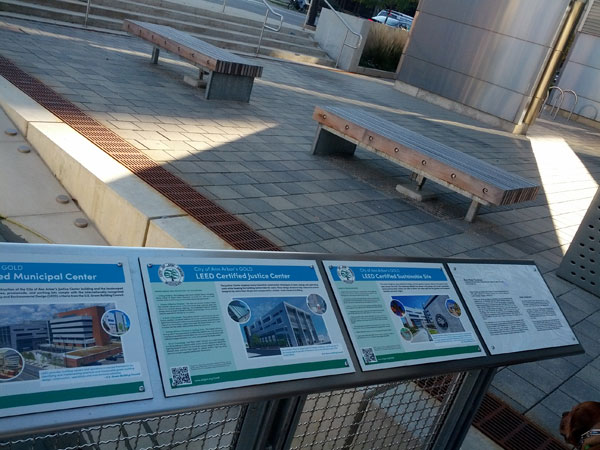
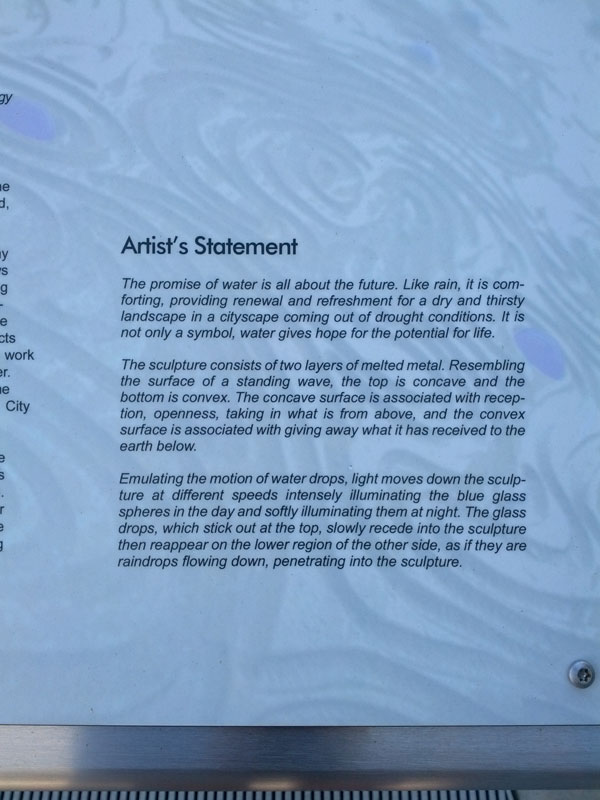
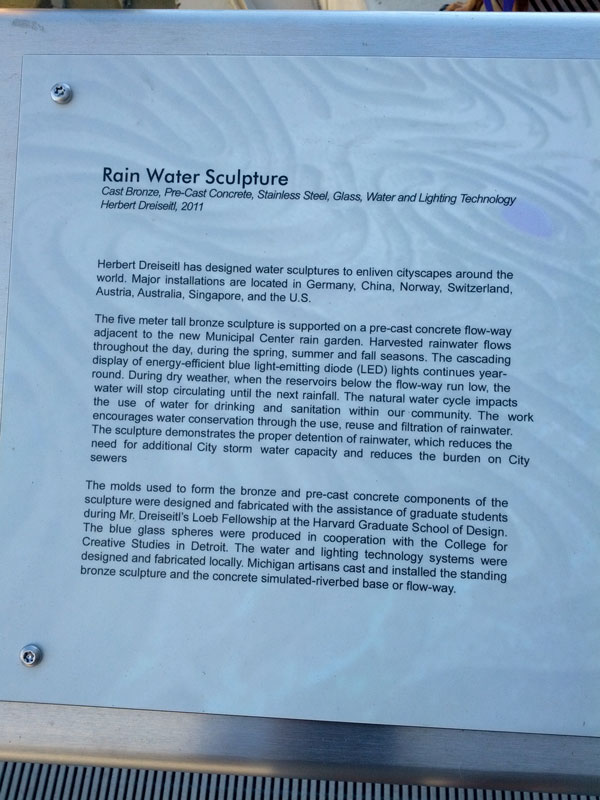
Ann Arbor DDA OKs Art Wraps
A proposal to wrap downtown Ann Arbor traffic signal electrical boxes with vinyl imprinted with artwork has received $20,500 of support from the Ann Arbor Development Authority.
Corrected after initial publication: Not an example of a vinyl-wrapped traffic box with artwork by David Spear. This image was included in the Arts Alliance proposal for the PowerArt project. This image was actually hand-painted by Spear.
The proposal was developed by the DDA – working with the Ann Arbor Arts Alliance and the Ann Arbor public art commission. The DDA board action came at its Oct. 2, 2013 meeting.
The art commission voted at its Sept. 25, 2013 meeting to support this first phase of the project with the same amount as the DDA – $20,500. While the first phase of the project would wrap 14 traffic signal boxes, the Arts Alliance is proposing two more phases, for a total of 42 wrapped boxes, and a total cost of $121,000.
The Arts Alliance will administer the project, taking an administrative fee of 30% for the first phase and 25% for the second two phases, if the first phase is judged to be successful. The $41,000 cost of the pilot includes the 30% administrative fee for the Arts Alliance. [.pdf of PowerArt proposal]
Deb Polich, executive director for the Arts Alliance, is married to Russ Collins, a member of the DDA board. Collins did not attend the Oct. 2 DDA board meeting.
The PowerArt proposal from the Arts Alliance indicates that the program was modeled on one that has been implemented in Boise, Idaho, where city officials there contend that vinyl art wraps have helped deter graffiti, even on traffic signal boxes that are not wrapped with art. [Full Story]