Stories indexed with the term ‘PUD’

Final OK for Hoover Mansion Rezoning

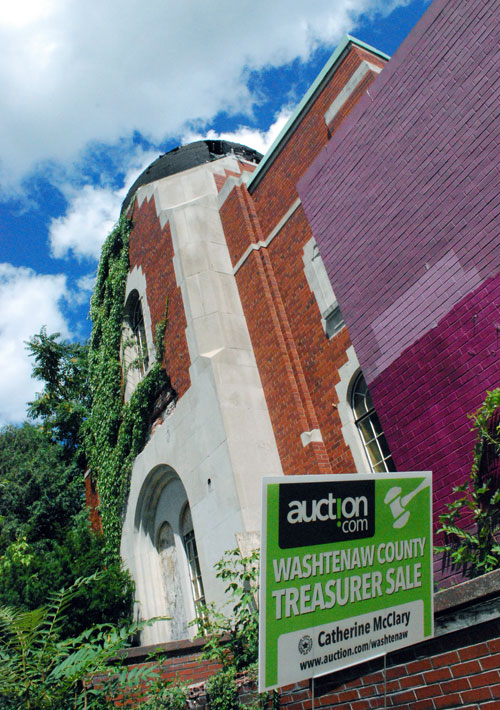
At its Dec. 19, 2011 meeting, the Ann Arbor city council gave final approval to altering the University Bank PUD and the site plan for the bank’s property at 2015 Washtenaw Ave., known as the Hoover Mansion. The bank wanted the revision to the existing planned unit development (PUD) for the site – originally approved in 1978 – to allow for an increase in the total number of employees and parking spaces permitted on the parcel. The site serves as the bank’s headquarters.

The change will allow University Bank to build 13 new parking spaces on the east side – behind the main building – for a total of 52 spaces on the site. The city planning commission unanimously recommended approval of the change at its Oct. 4, 2011 meeting, after the proposal had been submitted to the city at least a year earlier. The council gave its initial approval to the change in the PUD at its Nov. 21, 2011 meeting.

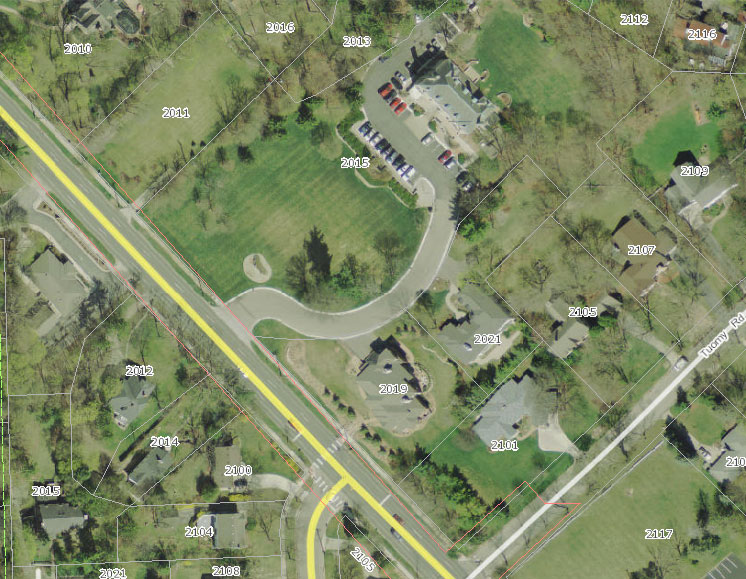
The long approval process could in part be attributed to opposition from immediate neighbors to specific elements of the plan, which was to some degree modified in response. A letter of opposition, attached to the council’s Dec. 19 agenda packet, made a more general objection to “the likelihood of further commercialization of the residential neighborhood.” [.pdf of letter of opposition][.jpg of aerial view with parcels]

Because the proposal was a change to the city’s zoning, it was a change to the city’s ordinances – a process that required a second approval by the council at a separate meeting, preceded by a public hearing.

This brief was filed from the city council’s chambers on the second floor of city hall, located at 301 E. Huron. A more detailed report will follow: [link] [Full Story]

Changes to Arlington Square OK’d

At its Dec. 6, 2011 meeting, the Ann Arbor planning commission unanimously recommended approving changes to the supplemental regulations of a planned unit development (PUD) for Arlington Square. The two-story, 51,285-square-foot retail and office complex is located at 3250 Washtenaw Ave. – the southeast corner of Washtenaw Avenue and Huron Parkway. An 8,000-square-foot space in the complex, where Hollywood Video was formerly located, is vacant, and the owner would like to have the option of leasing the space to a restaurant or urgent care facility.

The current PUD zoning, which was approved in 1989, allows for certain C3 (fringe commercial) uses, but due to an increased need for parking that would be created, it does not allow for (1) restaurants with seating, (2) barber/beauty … [Full Story]

University Bank Site Modifications OK’d

Following postponement at its Sept. 8, 2011 meeting, the Ann Arbor planning commission recommended approval of changes to a University Bank site plan for property at 2015 Washtenaw Ave., known as the Hoover Mansion. The proposal will now be forwarded to city council for approval.

The proposal would increase the number of allowable employees from 50 to 59 at the bank’s headquarters and add a new parking lot on the site, with a setback of 24 feet from the eastern property line. A continuous six-foot-high wall is proposed along the eastern and southeastern property lines, to screen the parking lot from 2021 Washtenaw Ave. and 2107-2109 Tuomy. The changes require amending the supplemental regulations of the site’s planned unit development (PUD) … [Full Story]

Heritage Row Has Glimmer of Hope

At its Oct. 3, 2011 meeting, the Ann Arbor city council reconsidered the Heritage Row planned unit development (PUD) for South Fifth Avenue, after declining to do so almost a year ago – on Dec. 6, 2010. This time around the council successfully suspended the council rules to allow for the reconsideration, and voted unanimously to reconsider the project and then to postone it until the council’s Oct. 17 meeting.

At that Oct. 17 meeting, the city staff will have worked with the developer to incorporate the developer’s various requests into the site plan and zoning for the project. The last version of Heritage Row considered by the council would preserve the seven houses and construct three new apartment buildings behind … [Full Story]

University Bank Project Tabled Again

At its Sept. 8, 2011 meeting, the Ann Arbor planning commission voted to postpone approval of a University Bank proposal to increase the number of allowable employees from 50 to 59 at its headquarters on Washtenaw Avenue and to add 14 parking spaces to a new lot on the site. The headquarters is located in what’s known as the Hoover Mansion.

Although a consensus appeared to have been reached – among planning staff, neighbors and bank officials – the commission was reluctant to make a recommendation, because the final site plan had not yet been submitted. The consensus had been achieved only a week ago, last Thursday, Sept. 1. The vote to postpone, likely until the commission’s next meeting on Sept. … [Full Story]

Council Reduces Fee for Heritage Row

At its Feb. 7, 2011 meeting, the Ann Arbor city council voted to reduce the application fee to $2,000 from almost $5,000, if the developer of the Heritage Row project resubmits the planned unit development (PUD) within 90 days. Dissenting from the proposal, which was brought forward by Sandi Smith (Ward 1) and Tony Derezinski (Ward 2), were Stephen Kunselman (Ward 3) and Mike Anglin (Ward 5). Dissenting views held by the public included a letter to the city from nearby property owner Tom Whitaker.

To qualify for the fee waiver, the project would also need to include the same revisions that had been reviewed by city staff – after the project had been rejected, and then rejected again upon reconsideration by the city council in the summer of 2010. The resolution notes that to date, the developer of the project, Alex de Parry, has paid the city over $30,000 in review fees.

The residential project, located on the east side of South Fifth Avenue, would renovate seven houses and construct three new 3.5-story apartment buildings behind those houses, with an underground parking garage. The council initially rejected Heritage Row on June 21, 2010, with a 7-4 vote in favor. It required an 8-vote majority for approval, due to a petition filed by adjoining property owners. The city council then reconsidered the project at its July 6, 2010 meeting, and it failed again, on a 7-3 vote. Then at the council’s Dec. 6, 2010 meeting, some councilmembers seemed poised to suspend council rules to allow another reconsideration, but the vote to suspend council rules failed.

The last proposal reviewed by the city includes the following revisions: (1) the top floor of the new south building would be removed from the design; (2) the density would be reduced from 79 units to 76 units and the number of bedrooms would be reduced from 154 to 147; (3) the project would include five affordable units at the 50% AMI (average median income) level, in addition to six affordable units at the 80% AMI level; and (4) the three new buildings would be LEED certified.

This brief was filed from the boardroom in the Washtenaw County administration building, where the council is meeting due to renovations in the city hall building. A more detailed report will follow: [link] [Full Story]

Development Déjà Vu Dominates Council

Ann Arbor City Council meeting (June 21, 2010): Heritage Row is a proposed residential project that would have renovated seven older houses along South Fifth Avenue south of William Street, and constructed three new buildings behind the houses.

Alex de Parry

Developer Alex de Parry addresses the Ann Arbor city council in support of the Heritage Row project at council's June 21 meeting. (Photos by the writer.)

The number of houses to be renovated – called the “Seven Sisters” by some in the community who support their preservation – matched the number of votes the project received Monday night from the 11-member city council.

While that is a majority, the seven votes in favor of Heritage Row did not meet the eight-vote minimum that was required. The super-majority requirement came as a result of a protest petition that was successfully filed on the same day as the council’s last meeting, June 7. On that occasion, the council first considered this newest iteration of the project, but postponed it until their June 21 meeting.

The project rejected by the council on Monday in its 7-4 vote was a planned unit development (PUD), which would have required the city to amend its zoning. That leaves in play an already-approved earlier project at the same location, called City Place. City Place was authorized by the council last year as a “matter of right” (MOR) project – because it was judged to meet all applicable codes and zoning regulations.

The City Place (MOR) would demolish the seven houses and replace them with two apartment buildings separated by a parking lot. It’s a project that would be almost certainly denied by the city’s historic district commission – if a historic district were established in the area, as a study committee has recently recommended. The council is expected to make its final vote on the historic district at its July 6 meeting.

But the council gave its initial consideration to establishment of that historic district on Monday night. It’s more customary for councilmembers to vote for proposals on their first reading – to advance a proposal to a public hearing – even if they ultimately plan to vote against it. But Monday’s meeting saw three councilmembers already voting against establishing the district.

The council’s meeting also started off with the theme of historic preservation, as the city’s historic district commission presented its annual preservation awards.

In other business, the council gave a short extension to developer Village Green, which has an option-to-purchase agreement with the city for the city-owned parcel at First and Washington streets. The time for the extension is to be used to work with the city planning staff to put together milestones that need to be met. [Full Story]

Six-Vote Majority Leaves The Moravian Short

Ann Arbor City Council meeting (April 5, 2010) Part 1: In a six-to-four vote on Monday night, the Ann Arbor city council did not give The Moravian development the required 8-vote super-majority it needed for approval. A petition signed by greater than 20% of adjoining property owners meant that the project needed eight instead of the six votes it actually received to win the council’s endorsement.

The pen of Tom Luczak

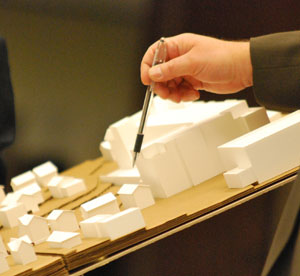
On an architect's scale model of the neighborhood, Tom Luczak points to a house on Fourth Avenue, next to the proposed project, The Moravian. The view is roughly from the northwest. Luczak spoke in opposition to the project. (Photos by the writer.)

The five-story, 62-unit building proposed for the section of East Madison Street between Fourth and Fifth avenues near downtown Ann Arbor had come before the council with the recommendation of the city’s planning staff and a 7-1 vote recommendation from the city’s planning commission.

The public hearing on The Moravian included remarks from around 90 people on both sides of the issue. The Moravian alone – counting the public hearing, plus the deliberations by the council – took up over four hours of the meeting, which lasted well past 1 a.m.

Besides The Moravian, the council’s business included an item that would have reconsidered its recent decision to replace the entire Ann Arbor housing commission board. The motion for reconsideration was voted down, with no support, not even from its two sponsors – Stephen Kunselman (Ward 3) and Mike Anglin (Ward 5). Kunselman cited the late hour as part of the reason for his lack of enthusiasm for pursuing the matter.

The council also tabled a proposed city ordinance that would ban cell phone use while driving. The council had postponed the measure to a specific date a few times previously. The tabling means that the ordinance can be brought back for consideration by the council, but by council rule it will die unless it is brought back within six months.

Also receiving brief discussion was a possible council rule on email that the council is now forced to  consider publicly at its next meeting under terms of a recent lawsuit settlement.

In Part 1 of this report, we focus exclusively on The Moravian. [Full Story]

City Council’s Directive: 3% Cut for Workers

Ann Arbor City Council meeting (March 1, 2010) Part 1: Having postponed a resolution at its last meeting – which directed the city administrator to reduce wages of non-union workers by 3% – on Monday the council passed a revised version of it.

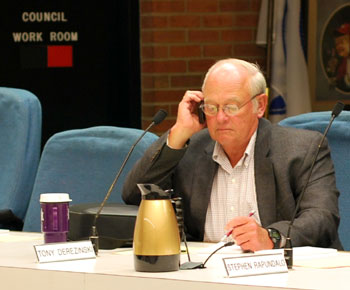
Tony Derezinski talking on a cell phone

Tony Derezinski (Ward 2), who co-sponsored a new ordinance banning use of cell phones while driving or bicycling. The ban does not apply to driving one's council chair before the meeting starts. (Photos by the writer.)

But it was approved without the support of the measure’s two sponsors, Marcia Higgins (Ward 4) and Stephen Rapundalo (Ward 2). The version adopted by council specified a 3% minimum cut in compensation packages, taken over the aggregate of non-union workers. By the time the resolution was passed, it had also shed a “whereas” clause that Christopher Taylor (Ward 3) called “self-laudatory.”

In development news, The Moravian – a planned unit development (PUD) proposed on East Madison Street – received unanimous council support at its first reading. Approval at two readings is required for final approval. But Stephen Kunselman (Ward 3) responded to a resident request made at the previous night’s caucus to give some clue at the first reading as to how councilmembers were thinking about the project: “I’ll be voting against it at second reading – so there’s no question in the community’s mind.”

Based on the Sunday caucus, The Moravian will face a protest petition, which raises the bar for approval from six to eight votes.

The council also wrangled through a proposed ban on cell phone use while driving and bicycling – at a level of detail unusual for a first reading. The measure had undergone enough revisions since it was approved at the council’s previous meeting that its status Monday was reset to a first reading. Dissent on the ban came from Sandi Smith (Ward 1), who questioned whether it should be undertaken at the local level – as opposed to the state. Marcia Higgins (Ward 4) also dissented, pointing to the fact that the ban did not include hands-free phones.

The council also transacted a variety of other business, including a repeal of the city’s bicycle registration program, which is to be replaced with a new system after further consultation with stakeholders. The bicycle registration program, as well as other business and announcements, will be wrapped up in Part 2 of this report. [Full Story]

The Moravian Goes Before City Council

Ann Arbor City Council Sunday night caucus (Feb. 28, 2010): The notion of a “first reading” permeated discussion in council chambers Sunday night among the five councilmembers and the half dozen residents who attended. Ordinances must be approved at two readings by the city council before they are enacted.

Tony Derezinski Stephen Kunselman Sabra Briere

At the Sunday Ann Arbor city council caucus, from left: Tony Derezinski (Ward 2), Stephen Kunselman (Ward 3) and Sabra Briere (Ward 1). Also attending the caucus from the city council were Mike Anglin (Ward 5) and John Hieftje (mayor). (Photo by the writer.)

Due to receive its first reading on Monday night at the council’s regular meeting is The Moravian – a  five-story residential and work/live space planned unit development (PUD) along the 500 block of Fifth Avenue and the 200 block of East Madison. The project was given a recommendation for approval from the city’s planning commission on a 7-1 vote in January 2010. [Chronicle coverage: "Moravian Moves Forward Despite Protests"]

At Sunday’s caucus, some residents said they were keen to see a substantive discussion at The Moravian’s first reading, but councilmembers cautioned that the first reading was typically not the time when they argued a particular position. Residents indicated that they’d gathered enough signatures from surrounding land owners to meet a city code threshold that would force an 8-vote super-majority – out of 11 votes – at a second reading of the PUD proposal.

Also receiving a first reading on Monday will be a proposed ban on cell phone use while driving. The ban had already received approval on first reading at the council’s last meeting, but due to subsequent significant revisions to the ordinance language, it will be heard again Monday as a first reading. The council’s agenda indicates that the public hearing, generally held along with an ordinance’s second reading, has been canceled. That will be rescheduled to coincide with the second reading.

A budget directive – reducing all non-union staff salaries by 3% – had been postponed from the last council meeting and will be considered by the council on Monday in a slightly revised form. As a council resolution – as opposed to an ordinance – it will require just one reading. A key revision in the intervening postponement: It’s now a minimum 3% cut that’s specified, which leaves the door open for even greater cuts. [Full Story]

Moravian Moves Forward, Despite Protests

Ann Arbor Planning Commission meeting (Jan. 5, 2010): During a four-hour meeting that ended with some residents shouting in anger, the Ann Arbor planning commission approved the site plan and special zoning for The Moravian, a proposed housing complex at East Madison, between Fourth and Fifth avenues.

Developer Jeff Helminski speaks to Ann Arbor planning commissioners about his project, The Moravian. In the background are commissioners Wendy Woods and Diane Giannola. (Photos by the writer.)

Developer Jeff Helminski speaks to Ann Arbor planning commissioners about his project, The Moravian. In the background are commissioners Wendy Woods and Diane Giannola. (Photos by the writer.)

About two dozen residents attended the meeting. All but one of the 16 people who spoke during time for public commentary opposed the project, some vehemently.

Opponents’ main concern is that the five-story, 62-unit building is out of scale and out of character with the neighborhood, which has older homes, but is not protected by an historic district. [The neighborhood also is on the edge of an industrial area – The Moravian is planned on a lot across the street from the Fingerle Lumber complex.]

But in approving the requested planned unit development (PUD) zoning, commissioners cited a range of public benefits, including the 12 units of affordable housing within the building – a benefit that neighbors dispute. The project will now be considered by city council at an upcoming meeting.

Residents vow to continue fighting it. “We’re going to redouble our efforts,” Beverly Strassmann, president of the Germantown Neighborhood Association, told commissioners after their vote.

Separately, planning commissioners approved a rezoning request for a gas station on Packard Road, with some stipulations. [Full Story]

Near North Nears Next Review

Near North Avalon Housing affordable housing Ann Arbor

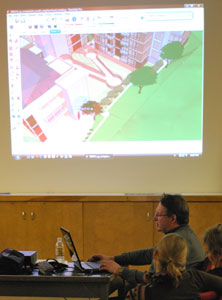
Damian Farrell, architect for Near North. Farrell rotated and panned across the proposed building from various angles to show neighbors the current state of the design.

The gathering on Wednesday evening at the Ann Arbor Community Center to discuss a proposed affordable housing development had been publicized as a 2-hour long “community design charrette.” But the 35 or more immediate neighbors and other interested parties who attended the meeting filled a bit more than the first hour asking questions that addressed the topic of the developer’s motives, the projects’ consistency with the mission of the non-profit partner on the proposal (Avalon Housing) and the conformance of the project to the city’s various planning documents.

Architect Damian Farrell was eventually given the chance to project live images from his design software onto the wall, and manipulate them to illustrate changes that had been made as a result of the previous two charrettes. But the ensuing conversation on design elements was also interspersed with concerns about topics from the first hour.

Two and a half hours into the meeting, a man stood and said: “I am homeless.” He’d heard people pick at the project, he said, but he hadn’t heard anyone ask this question about it: “What can we do to help?” It was more than three and a half hours after the meeting started when the last of the post-charrette conversational pods headed out the door.

By Jan. 21, the project team hopes to be able to submit responses to any of the city planning staff’s concerns expressed after the project’s initial review, which began after the project was submitted in December. Near North could come before the city’s planning commission as early as Feb. 19. [Full Story]

Residents Organize to Defeat City Place

Kevin McDonald in the city attorney's office explains how the petition was handled

Kevin McDonald, from the city attorney's office, explains how the protest petition was vetted, which forced the requirement of an 8-vote majority on the City Place PUD.

City Council Meeting (Jan. 5, 2009, Part I) At a meeting where dozens of citizens have gathered to take a turn speaking their piece at a public hearing, it is somewhat odd to hear an elected public official declare: “The problem is the speaker.”

In context, though, that made perfect sense Monday night, because the speaker in question was the one spewing static in the council chamber’s sound system, used by CTN to record the proceedings.

As previously reported in The Chronicle, Monday’s council meeting resulted in a 0-10 vote for the City Place planned unit development (PUD) application. The public hearing on the matter, plus deliberations on a possible postponement, followed by discussion of the substantive issues, took up the majority of the meeting, which lasted until around 11:30 p.m [Full Story]

Downtown Apartments to Have Public Hearing

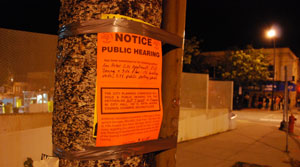
Notice of public hearing on Oct. 7 held by the planning commission. In the background, fans of State Radio with Bongo Love in line at the Blind Pig

Notice of public hearing on Oct. 7 held by the planning commission. In the background, fans of State Radio with Bongo Love in line at the Blind Pig

Here at The Chronicle, we enjoy gleaning information off ratty telephone poles, whether it’s a flyer about an upcoming show played by Tokyo Sex Whale or something a bit more staid – like an announcement of a planning commission public hearing. The planning commission’s notices are easy to spot: bright orange poster board strapped to a nearby vertical object with gray duct tape. This public hearing concerns the Ann Arbor City Apartments project, which is coming before planning commission proposed as a Planned Unit Development (PUD). [Full Story]

Ann Arbor City, Place for Knitting

caption here

A dishrag knitted up in less than the time it took for planning commission to meet.

At the Sept. 4 planning commission meeting, the resolution to recommend City Place project – proposed along South Fifth Avenue as a PUD by Alex de Parry – failed with only two votes for it.

Under-reported generally, and specifically about that meeting, is the volume of knitted material that is produced during Ann Arbor public meetings by folks in the audience. And knitting is a great metaphor for framing some of the general issues laid out at the planning commission meeting with respect to the specific project. [Full Story]