Stories indexed with the term ‘TIF’

DDA Letter: “No funds should be returned…”

On request from The Chronicle, the Ann Arbor Downtown Development Authority has provided the text of a letter sent by its executive director, Susan Pollay, to the taxing authorities in its tax increment finance (TIF) district, explaining the DDA’s position on the issue of redistributing TIF revenue. From the letter text: “There can be no doubt that as long as the DDA is spending its TIF monies according to its plan, no funds should be returned to the taxing units. All of the DDA TIF is now committed to debt service for the existing downtown development projects and the administration ofthose projects.”

Earlier this year, in May – after city of Ann Arbor staff pointed out a provision in Chapter 7 … [Full Story]

Column: Taxing Math Needs a Closer Look

A bit more than a month ago, the Ann Arbor Downtown Development Authority board was poised to ratify a new contract with the city of Ann Arbor, under which it would continue to manage the city’s public parking system. But at noon on May 2, when board members met, they were greeted with some news that caused them to postpone their vote on that 11-year deal, which called for 17% of gross parking revenues to be transfered to the city of Ann Arbor.

Excess TIF Capture

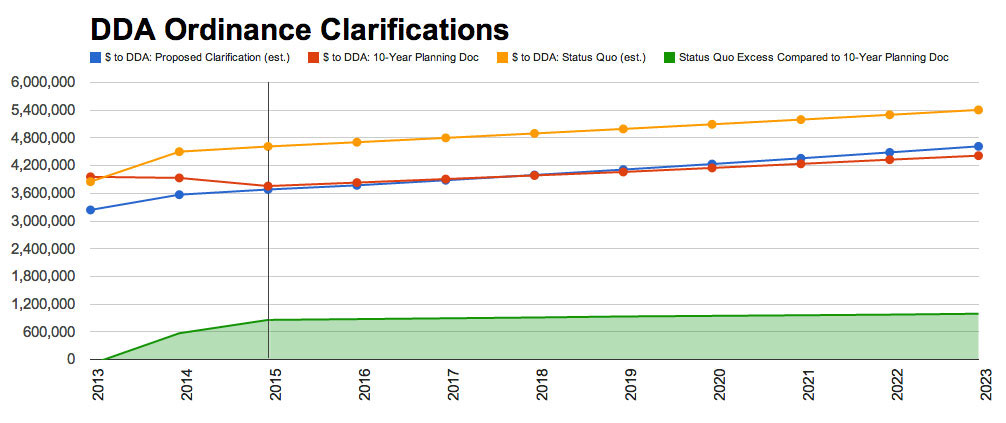
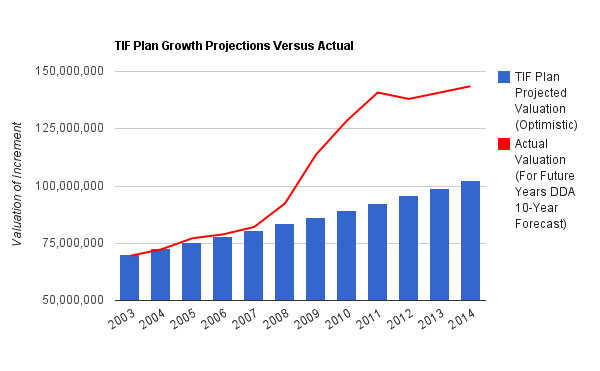
Blue bars represent the "optimistic" projections of the increment valuation in the Ann Arbor DDA's TIF plan. The red line represents actual valuation of the increment on which taxes have been captured. For 2013-2014, the valuation is based on estimates in the DDA's 10-year planning document.

That news had been conveyed to DDA staff by the city of Ann Arbor’s finance department just that morning: Some of the taxes captured in the DDA’s tax increment finance (TIF) district since 2003 might be owed to local taxing units, including the city. With an uncertain financial obligation to return TIF monies that had already been captured from taxing units in the district, the DDA board understandably balked at approving the new parking contract on May 2.

The postponement of the DDA’s vote on that contract ultimately led to a delay in the Ann Arbor city council’s adoption of the city’s fiscal year 2012 budget – as the council stretched its May 16 meeting to May 23 and then on to May 31. But by the end of May, the issue of excess TIF capture had been settled to the DDA board’s satisfaction, and the parking contract was ratified – first by the DDA, and then by the city council.

The Ann Arbor city council was also content with the DDA’s proposed solution to the excess TIF capture. That solution included returning a total of roughly $473,000 to the Ann Arbor District Library, the Washtenaw Community College and Washtenaw County. The city of Ann Arbor chose to waive its $712,000 share of the calculated excess.

Those three other taxing units no doubt welcomed the news that their budgets would get an unexpected boost. But the governing bodies of those taxing units should take a closer look at how the excess TIF was calculated. If they do, they will discover that the amount actually due to be returned to them (and divided proportionately as required under the city’s of Ann Arbor’s DDA ordinance) may not be $473,000, but more than twice that: $1.27 million. In ballpark numbers, for the Ann Arbor District Library that translates to the difference between about $75,000 and $200,000. For Washtenaw County, it’s the difference between $242,000 and $648,000. And for Washtenaw Community College, it’s the difference between $157,000 and $419,000. [Full Story]

To Be Continued: Ann Arbor Council

The gathering of Ann Arbor city council members tonight – May 23 – counts not as a separate meeting, but rather as a continuation of the same meeting the council began on May 16. Because of issues that could remain unresolved, councilmembers are likely to recess tonight’s meeting as well, to be continued on Tuesday, May 31 – after the Memorial Day holiday.

This is a preview of the council’s continued meeting, which starts at 7 p.m. in council chambers at city hall. Topics that council might address include excess TIF (tax increment finance) capture in the Ann Arbor Downtown Development Authority district, a new parking contract with the DDA, and possible amendments to the FY 2012 budget. Factors that might play a role in council’s deliberations include alternative calculations of the excess TIF capture, and issues of control regarding components of the proposed parking contract – such as giving the DDA sole authority to set parking rates. [Full Story]

DDA: Parking, Excess Taxes Still Not Done

Ann Arbor Downtown Development Authority special board meeting (May 20, 2011): A special meeting held by the board of the DDA on Friday was meant to give some final resolution to the DDA’s side of a new contract under which it would continue to operate the city’s public parking system.

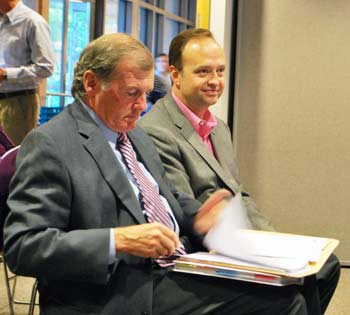
Bob Guenzel, John Mouat, Sandi Smith, Russ Collins, DDA special board meeting

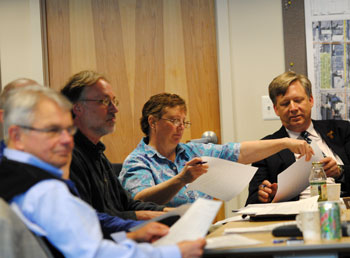
Left to right: DDA board members Bob Guenzel, John Mouat, Sandi Smith, and Russ Collins at the May 20 DDA special board meeting. Obscured from view between Guenzel and Mouat is John Hieftje. They were distributing the paper handouts with calculations of excess TIF revenues. (Photos by the writer.)

It was also intended to settle the matter of excess capture of TIF (tax increment finance) revenue in the DDA district – an issue raised by the city of Ann Arbor just before the DDA board had originally planned to vote on the new parking contract on May 2.

The board did vote on Friday to affirm a calculation by DDA staff that roughly $473,000 of excess TIF capture since 2004 would be divided among the following taxing authorities, which have a portion of their tax revenues captured in the DDA TIF district: Washtenaw County; Washtenaw Community College; and the Ann Arbor District Library.

Based on a representation at the special meeting by mayor John Hieftje – who has a statutory seat on the DDA board – the city of Ann Arbor is likely to agree to “forgive” the $711,767 in excess TIF capture that would be due to the city. More than that amount has effectively already been returned to the city, in the form of a roughly $0.5 million annual grant to the city to help make bond payments on its new municipal center, and a $1 million expenditure to demolish the old YMCA building, as well as other grants. In total, around $7.5 million has gone to the city, according to the DDA.

At Friday’s special meeting, the DDA board also voted to ratify its side of a new contract under which it would continue to operate the city’s public parking system. Among other features, the new contract would obligate the city of Ann Arbor to report regularly on how it is using public parking system revenues for street repair in the downtown, and how it is enforcing parking regulations downtown.

More controversially, the new contract would allow the DDA to set parking rates. Currently, the DDA forwards proposed rate changes to the city council, which can then veto the DDA’s proposal if it acts within 60 days. If the council does not act to block the rate change, the change is enacted. Although Hieftje said at the DDA board meeting he felt there was adequate support on the council to approve such a contract, there are currently at least five likely no votes on the 11-member council.

Also controversial is the exact percentage of gross revenues the city would receive from the public parking system. Before the issue of the excess TIF capture arose, the DDA board was poised to ratify a parking contract that would transfer 17% of gross parking revenues to the city of Ann Arbor’s general fund. At Friday’s special meeting, the resolution before the board dropped that number to 16%. Hieftje proposed an amendment to raise the figure to 17%. That amendment was attached to a contingency that the city council would provide a plan amendable to the DDA in which the city would “underwrite” the DDA’s fund balances. It was the 17% with a contingency that the DDA board passed.

So the special DDA board meeting did not settle with finality either the issue of the excess TIF capture or the DDA’s side of the parking contract. For the TIF capture issue, the relevant taxing authorities – especially the city of Ann Arbor – will need to affirm the solution that the DDA board approved.

For the parking contract issue, the DDA’s contingency means that the city council’s Monday, May 23 meeting – which is a continuation of its May 16 meeting, when it was supposed to approve the FY 2012 budget – will likely be recessed and continued again on May 31.

One possibility for how events would unfold is this: (1) May 23 – the city council ratifies the city’s side of the parking contract and provides the plan for underwriting DDA fund balances; city council also deliberates and amends FY 2012 budget but does not take a final vote on it; (2) May 24-27 – DDA schedules a special meeting to accept the parking contract contingency; and (3) May 31 – city council resumes the meeting started May 16 and previously continued on May 23, and approves FY 2012 budget. [.pdf of draft parking contract] [Full Story]

Ann Arbor DDA to Return $473K in Taxes

At a special meeting held at noon on Friday, May 20, the board of the Ann Arbor Downtown Development Authority voted to return $473,365 in taxes previously captured as part of the DDA’s tax increment finance (TIF) district. The money will be divided among three taxing authorities: Washtenaw County ($242,179); Washtenaw Community College ($156,520); and the Ann Arbor District Library ($74,666).

The decision was prompted by questions raised on Friday, April 29 by the city of Ann Arbor about the implementation of the city’s ordinance governing TIF capture for the DDA district. The ordinance includes a clause stipulating that if the growth rate in the TIF capture exceeds what is anticipated in the formal TIF plan, at least half of the excess must be divided proportionately among the taxing authorities that had some of their taxes captured in the TIF district.

The total amount of excess TIF capture that has accumulated since 2004 in the Ann Arbor DDA district is $1,185,132. The difference between that total and the combined $473,365 to be paid to Washtenaw County, WCC and AADL is $711,767. That difference is the proportionate share that would be due to the city of Ann Arbor (including the Ann Arbor Transportation Authority), which also has some of its taxes captured in the DDA TIF district. In fact, around 60% of the taxes captured in the TIF district are due to city of Ann Arbor millages.

However, Friday’s resolution included a “whereas” clause indicating that the city of Ann Arbor is likely to recognize that the $711,767 in excess TIF capture has effectively already been returned to the city, in the form of (1) a roughly $0.5 million annual grant to the city to help make bond payments on its new municipal center, and (2) a $1 million expenditure to demolish the old YMCA building, as well as other grants.

The determination of the excess was based on: (1) the “optimistic” projections in the TIF plan; (2) the combined real and personal property valuations in the district; and (3) excess growth calculated by comparing the actual growth rate between successive years against the forecast growth rate in the TIF plan between those years.

The payments to the other three taxing entities are planned to be made before June 30, making them a part of the 2011 fiscal year, which ends June 30. That will require the board to amend the FY 2011 budget.

The financial impact of the payments on the DDA led the board on Friday to review the financial component to the new contract currently being negotiated with the city under which the DDA operates Ann Arbor’s public parking system.

Before the excess TIF issue came to light, the DDA board had been prepared on May 2 to agree to a contract that would have transferred 17% of gross parking revenues to the city each year. Gross parking revenues are projected to be around $16 million in the next year.

At Friday’s meeting, the DDA board ratified its side of an agreement that would transfer 17% of gross parking revenues to the city, but added a contingency that would require the city of Ann Arbor to formalize a plan proposed by mayor John Hieftje to backstop fund balances for the DDA.

The contingency means that the city council’s May 16 budget meeting, which is continuing on May 23, will likely continue past that Monday to resume again on Tuesday, May 31. Hieftje, who also sits on the DDA board, said he felt there would be sufficient support on the council on May 23 to ratify the parking contract and formalize the backstopping plan.

The DDA will need to schedule another special meeting the week of May 23 after the council meets to resolve the contingency. The council would then be able to finalize its budget on May 31.

This brief was filed from the DDA’s offices at 150 S. Fifth Ave., where the special meeting took place. A more detailed report will follow: [link] [Full Story]

DDA Delays Parking Vote Amid TIF Questions

Ann Arbor Downtown Development Authority board meeting (May 2, 2011): At its Monday meeting, the DDA board was expected to ratify its side of a new contract under which the DDA would continue to operate the city of Ann Arbor’s public parking system.

John Hieftje Roger Hewitt

Mayor John Hieftje (left) and DDA board member Roger Hewitt (right) head to their seats to start the DDA's board meeting. (Photos by the writer.)

Instead, the board received this news from the chair of its bricks and money committee: The city has raised the possibility that the DDA might need to return money to various taxing entities – including the city of Ann Arbor – from the taxes captured through the DDA’s tax increment finance district. The city communicated its concern to the DDA on Monday morning, the day of the noon meeting.

The issue concerns the DDA’s TIF plan, which was renewed in 2003, and language in the city’s ordinance establishing the DDA under the state’s enabling legislation. The TIF plan contains projections for the growth in taxable value of property (both real and personal) in the district. The city’s ordinance stipulates that if the actual “captured assessed valuation” grows at a rate faster than the expectation expressed in the TIF plan, then at least 50% of the additional amount must be returned proportionately to the taxing authorities from which the taxes were captured.

The vagueness of the ordinance language leaves several open questions that will require further review by the city attorney’s office and the DDA’s own legal counsel, as well as the financial staff from both organizations.

Those questions include: (1) What’s the relevant time period? (2) Which set of TIF plan estimates are applicable – the one labeled pessimistic, optimistic or realistic? (3) Who is the responsible party for adherence to the ordinance? (4) Does the ordinance language refer to real property only or also to personal property? (5) Do payments already made by the DDA to the city of Ann Arbor out of the TIF for the new municipal center count towards any sum that might need to be returned?

After hearing the news, the board decided to table the resolution on its agenda that would have ratified the DDA’s side of a new parking contract under which it would continue to manage the city’s parking system. [Previous Chronicle coverage: "Column: Ann Arbor Parking – Share THIS!"]

Board members recognized that it would likely be necessary to convene a special meeting of the board, given the city’s need to approve its budget on May 16. Later the same day, on the evening of May 2, the city council struck from its agenda the item that would have ratified the city’s side of the new parking contract. The city council has not yet weighed in on the text of the contract, but did express its view on the financial terms at its April 19 meeting.

As DDA board members absorbed the news about the TIF question, they heard their usual set of reports from their committees and wrapped up the meeting is less than an hour – they had no further business to transact. Board member Russ Collins, who was prepared to call in to the meeting from Detroit, where he’d been summoned for federal jury duty, did not need to do that.  [Full Story]

DDA Delays Parking Contract Vote

At its May 2, 2011 meeting, the Ann Arbor Downtown Development Authority board delayed voting on the new parking contract under which the DDA would continue to operate the city’s public parking system.

An issue identified by the city of Ann Arbor late Friday raised questions about whether some of the tax increment financing (TIF) revenue captured since 2002 by the DDA should, in fact, be returned to the taxing authorities from which it was collected. So the board wanted additional time to clarify the issue before voting on the contract.

Added information after original publication: [At issue is the proper interpretation of the following paragraph of the city's ordinance establishing the DDA: "If the captured assessed valuation derived from new construction, and increase in value of property newly constructed or existing property improved subsequent thereto, grows at a rate faster than that anticipated in the tax increment plan, at least 50% of such additional amounts shall be divided among the taxing units in relation to their proportion of the current tax levies. If the captured assessed valuation derived from new construction grows at a rate of over twice that anticipated in the plan, all of such excess amounts over twice that anticipated shall be divided among the taxing units. Only after approval of the governmental units may these restrictions be removed."] [.pdf of Ann Arbor city ordinance establishing DDA]

The resolution to ratify the contract with the city was tabled by the board, and board members recognized that it would likely be necessary to convene a special meeting of the board, given the city’s need to approve its budget on May 16. [Previous Chronicle coverage: "Column: Ann Arbor Parking – Share THIS!"]

This brief was filed from the DDA offices at 150 S. Fifth Ave., where the board meets. A more detailed report will follow: [link] [Full Story]

Parking Money for City Budget Still Unclear

On Jan. 5, the Ann Arbor Downtown Development Authority board held a retreat to discuss current negotiations with the city of Ann Arbor about the agreement under which the DDA manages the city’s parking system. And this past Monday, the respective “mutually beneficial” committees of the city council and the DDA board met to continue their conversation on the parking contract – a dialogue that has taken place in public view since June 2010.

Newcombe Clark, Sabra Briere

Left to right: Teddy Bear (on screen); DDA board member Newcombe Clark; Ward 1 city council representative Sabra Briere. Clark and Briere were chatting during the break between the regular DDA board meeting and the DDA board retreat. Briere did not take part in the meetings – she was there as a member of the public. The teddy bear was featured in a video short that was meant to kick off the retreat with a bit of humor. (Photos by the writer.)

Two days later, at Wednesday’s meeting of the DDA partnerships committee, board member Gary Boren reported back to his colleagues about the conversation that had taken place at Monday’s mutually beneficial committee meeting. Boren was frank in his assessment that the city’s team appeared intransigent.

To Boren, it appeared that city representatives had staked out their position, and they saw anything less than that position as meaning the city was not receiving what it is properly owed. For his part, Boren considers the DDA to be in the driver’s seat, because the current contract runs through 2015, and would not require the additional payments the city is seeking for that period.

At the partnerships committee meeting, Susan Pollay – executive director of the DDA – drew attention to the fact that there will be an increasing sense of urgency to firm up the contract as both the city and the DDA put together their respective budgets for the next fiscal year. The city administrator will need firm numbers by March, she suggested.

In this report, we put Boren’s comments and the ensuing discussion by the DDA’s partnerships committee in the context of the DDA’s board retreat last week, when board chair Joan Lowenstein noted, “We’re not a savings bank. We’re supposed to spend money.”

The retreat included a discussion of the kinds of projects the DDA would like to undertake over the next 10 years, some of which would need to be deferred, depending on the amount of parking revenue the DDA passes through to the city. The DDA also appears ready to defer some of its scheduled maintenance to the parking decks, if the maintenance activity is of a more aesthetic or cosmetic nature.

It emerged during the retreat that the politics of parking contract negotiations include the city’s ability to fund public safety – firefighters and police. The speculation was floated at the retreat that it might actually help the city’s negotiating stance with its labor unions, if the DDA took a firmer approach to the parking contract. [Full Story]

Ann Arbor District Library Gets Clean Audit

Ann Arbor District Library board meeting (Nov. 15, 2010): Two financial issues drew much of the focus at Monday’s AADL board meeting.

Dave Fisher

Dave Fisher of the accounting firm Rehmann Robson delivered highlights of the Ann Arbor District Library's financial audit at the AADL board's Nov. 15 meeting. (Photo by the writer.)

Dave Fisher of the accounting firm Rehmann Robson was on hand to review the district’s financial audit for the fiscal year that ended June 30, 2010. He described the library as in solid financial shape, especially in relationship to other entities in Michigan that rely on property tax revenues. The library has no long-term debt and its fund balance is strong, he said. But he added a cautionary note that like other taxpayer-funded entities, the library would likely be grappling with a continued drop in property tax revenues in future years.

Property tax revenues emerged again in a discussion during the director’s report. AADL director Josie Parker drew attention to a Nov. 15 column published in The Ann Arbor Chronicle regarding the ongoing negotiations between the city of Ann Arbor and the Downtown Development Authority. The column pointed out an issue that Parker has been tracking as well: the potential for tax increment financing funds captured by the DDA from public entities, including the AADL, to be used to offset a parking fund deficit caused by striking a new parking deal with the city. The board ultimately passed a resolution at Monday’s meeting, directing Parker to seek legal counsel on the issue.

Board member Ed Surovell said he wanted to make sure the board was defending their right to collect taxes, and that they’re being as responsible as possible to the citizens of the district. “I think this is dead serious business,” he said. “The appropriation and misappropriation of tax revenues is the lifeblood not just of this library, but of a democracy.”

Also during her director’s report, Parker described the results of a site review by staff of the Michigan Commission for the Blind, which manages the federal program that the Washtenaw Library for the Blind and Physically Disabled @ AADL is part of. The review, conducted every two years, is the first one since the AADL took over management of the WLBPD from the county, a transition that occurred in early 2009. AADL received several commendations for its approach to providing WLBPD services.

At the end of the meeting, outgoing board member Carola Stearns – who lost her seat in the Nov. 2 election to challenger Nancy Kaplan – gave a poignant speech, thanking the library staff and her colleagues on the board. In connection with a possible downtown building project, she urged the board to explore alternative funding sources, beyond paying for the project solely with taxpayer funds. [Full Story]

Column: Impact of DDA-City Parking Deal

Just before their Thursday post-election meeting on Nov. 4, Ann Arbor city councilmembers heard a work session presentation from the Ann Arbor Downtown Development Authority. The hour-long work session covered the DDA’s proposal for a process to develop city-owned downtown surface parking lots. It’s a process in which the DDA would play a leading role. The DDA’s proposal has evolved in the course of ongoing discussions between the city and the DDA since early summer.

The DDA will make  another work session presentation before the city council’s meeting on Monday, Nov. 15 – this one about the parking contract under which the DDA uses city-owned assets like decks, lots, and streets to manage the city’s parking system. The current $10-million contract runs through 2015. But the DDA has already paid the city $12 million on that contract, and the city wants an even better deal. Although it won’t be part of the parking contract language, the DDA sees the ability to take more leadership in the development of city-owned surface lots as part of the benefit it would get from a renegotiated parking deal with the city.

For the city, the parking deal is crucial for its budget planning for FY 2012. Already at its mid-October meeting, some city councilmembers began to raise questions about projections for FY 2012. The council must approve the FY 2012 budget this coming May. [The city's fiscal year begins on July 1 each year – the current budget year is FY 2011.] This past May, the city’s projected budget deficit for FY 2012 was $5 million, which already assumed an additional $2 million payment from the DDA.

There are likely enough votes on the 12-member DDA board to approve the new deal. And based on the most recent city-DDA discussions, the new arrangement is likely to take the form of a percentage-of-gross arrangement – 17.5% of gross parking revenues would be paid to the city.

But here’s a different way to describe the arrangement: The city of Ann Arbor would impose a 17.5% parking tax on downtown motorists. That is, downtown parking patrons will pay exactly 17.5% more to park than is actually required for the public parking system to sustain itself, in order that general fund revenues for the city of Ann Arbor can be supplemented.

And to derive support for the city of Ann Arbor general fund from the parking system, the DDA’s parking fund will operate at a greater deficit for the next few years than it would if the city honored the current parking contract. During that period, the DDA’s tax increment finance revenues – the amount it captures from other taxing authorities besides the city of Ann Arbor – will need to remain uninvested on behalf of the broader community. The unspent TIF fund balance will be able to offset the parking fund deficit, leaving the DDA still solvent, but barely so.

Two important questions have been ignored in the course of the city-DDA negotiations: (1) Is it appropriate to use non-city TIF funds – from the county, Ann Arbor District Library, Washtenaw Community College and Ann Arbor Transportation Authority – to offset the parking fund deficit caused by striking a new parking deal with the city? and (2) If the city’s public parking system generates more revenue than is required to operate and maintain it, what investment of that excess revenue would yield the greatest and best return for the community? [Full Story]

DDA Board Retreat to Focus on City Talks

Ann Arbor Downtown Development Authority board meeting (Sept. 1, 2010): On its surface, the first regular meeting of the DDA board after its July election of new officers seemed to be a relatively uneventful gathering. Two topics that could have prompted extended deliberations were handled in short order.

5th-Avenue-DDA-block

Washington & Fifth Avenue, looking northwest. The concrete mixer is parked directly in front of the DDA offices. The entry for the board's Sept. 1 meeting was through the alley and the garage, which makes up part of the ground floor of the Fifth Avenue Building. (Photos by the writer.)

The first issue, handled with relatively little comment, was the report out from the DDA’s “mutually beneficial” committee, given by Roger Hewitt. The committee has been meeting over the course of the summer with a corresponding committee from the Ann Arbor city council to renegotiate the parking agreement under which the DDA manages the city’s parking system.

While board members Newcombe Clark and Russ Collins commented in a general way on the status of the conversations, it did not lead to any specific directive to the DDA’s committee for its next meeting, which will take place on Sept. 13 at 8:30 a.m.

However, at the suggestion of DDA executive director Susan Pollay, the board will schedule a retreat between now and its monthly board meeting in October – but likely after Sept. 13 – to focus on the “mutually beneficial” issue. In the meantime, the DDA’s committee will request of its city council counterparts that they provide their own assessment of the status of the negotiations. The Sept. 13 meeting of the two committees will also be the occasion when Pollay provides a detailed version of the outline, which she’d provided at the last committee meeting on Aug. 23, for a possible role for the DDA in the development of city-owned surface lots.

The second issue dispatched by the board with little overt controversy was a resolution that Newcombe Clark had brought through the operations committee last Wednesday to allocate $50,000 for support of skatepark facilities. Clark himself suggested that the resolution be tabled, alluding to the “prism through which everything is looked at this time of year.” DDA board members went along with that suggestion.

The prism to which Clark alluded is a political one. Clark is running an independent campaign for the Ward 5 city council seat currently held by Democrat Carsten Hohnke. Hohnke has positioned himself as a champion of the skating community’s efforts to construct a skateboarding facility at Veterans Memorial Park, which is in Ward 5.

At Wednesday’s meeting, the newest member of the board, former Washtenaw County administrator Bob Guenzel, and the member he replaced, Jennifer S. Hall, were acknowledged by chair Joan Lowenstein – but neither was present. The board passed a resolution of appreciation for Hall’s service, and Lowenstein welcomed Guenzel “in absentia.”

Other business at Wednesday’s meeting included the usual updates from the board’s committees. Notable from the transportation committee was an effort to collaborate with the Ann Arbor Transportation Authority to enhance bus service between Ann Arbor and Ypsilanti. And from the partnerships committee came a summary of a presentation they’d received from the chief of police – there’s a difference between being statistically safe and the perception of safety. [Full Story]

Zingerman’s Project Seeks Brownfield Status

The major renovation and expansion in the works for Zingerman’s Deli cleared its most recent major hurdle in May, gaining site plan approval from the Ann Arbor planning commission. While the site plan now moves on to city council, the business is taking action on another front as well: Applying for support from the local and state brownfield program.

Grace Singleton

Grace Singleton, a managing partner with Zingerman's Deli, talks about plans to apply to the local and state brownfield program as part of the deli's renovation plans. The business hosted a public meeting about the plans on June 21. (Photos by the writer.)

On June 21, Zingerman’s hosted a public meeting to answer questions about their plans for the brownfield application. Matt Naud, the city’s environmental coordinator, was on hand as well, and distinguished between this project and those that are typically associated with the term “brownfield.” In the case of Zingerman’s Deli, “it’s economic development,” he said, “It’s not about environmental cleanup.”

Specifically, brownfield status would allow Zingerman’s to be eligible for tax increment financing (TIF), a mechanism that would let the business recoup certain qualified expenses related to the project – possibly as much as $817,000 over 15 years.

It’s a different approach than the brownfield application most recently approved by city council for the Near North affordable housing project on North Main. In that case, the site’s need for environmental cleanup qualifies it for a brownfield status. Zingerman’s application also differs from Near North’s in that Near North isn’t seeking reimbursement through TIF. Both projects plan to apply for Michigan Business Tax credits. [Full Story]

Budget Round 5: Economic Development

Last Monday night, the Ann Arbor city council held its fifth and possibly final meeting devoted exclusively to the city’s financial planning, before it adopts the city’s FY 2011 budget on May 17, 2010. The budget will be formally presented to the city council by city administrator Roger Fraser at its Monday, April 19 meeting.

Stephen Rapundalo (Ward 2) sets up his presentation on the LDFA.

Stephen Rapundalo (Ward 2) sets up his presentation on the Local Development Finance Authority (LDFA) before the start of the April 12 council budget meeting. Rapundalo sits on the LDFA board as the Ann Arbor city council's representative, and currently chairs the board.

At the April 12 budget meeting, the council heard presentations on two related entities: the Local Development Finance Authority (LDFA) and Ann Arbor SPARK. The LDFA contracts with Ann Arbor SPARK for various business development services.

The two key themes that emerged from the LDFA presentation were consistent with the overall topic of the city’s budget: (i) Where does the LDFA get its money? and (ii) What does the LDFA spend its money on?

Part of the LDFA’s revenue goes towards economic development activities – a business accelerator – for which it contracts with Ann Arbor SPARK. The presentation to the council from SPARK’s CEO, Michael Finney, was followed by testimonials of companies who said they had benefited from SPARK’s efforts.

Development activities are just one kind of investment that the LDFA could make under its TIF (tax-increment financing) plan. It could also make investments in physical infrastructure. During question time, Sandi Smith (Ward 1) drew out from Stephen Rapundalo (Ward 2) the possibility that the LDFA could contemplate an investment in a fiber-optic network. Rapundalo, who serves on the LDFA board, indicated that such an LDFA investment might be possible, even if Google does not select Ann Arbor as a test community for its current fiber-optic initiative.

The council also heard from the economic development community about how the name “Ann Arbor” is perceived in the rest of the world.

The part of the council’s meeting dedicated to deliberations on its own budget was comparatively brief. Councilmembers were keen to portray in a positive light a couple of different issues, among them a potential increase in the city’s debt load resulting from a failure to complete a $3 million sale of property at First & Washington, as well as proposed increases in water rates. [Full Story]

DDA Discusses Payments to City

Downtown Development Authority board meeting (March 4, 2009): At Wednesday’s monthly board meeting of the Downtown Development Authority, Rene Greff asked the rhetorical question: “Do you want to hook that cart to a controversial horse?” And she was not talking about a new transportation option for downtown. But the “cart” was the idea of transportation demand management. The “horse” was city council’s recent request that the DDA increase its revenues to assure adequate reserve fund balances. [Full Story]