Stories indexed with the term ‘zoning’

490 Huron Parkway Rezoning: Initial OK

A rezoning request for 490 Huron Parkway from R3 (townhouse district) to R1B (single-family dwelling) has received initial approval from the Ann Arbor city council. The action came on May 13, 2103 at a meeting that had started on May 6.

490 Huron Parkway, Johnson Building Group, Ann Arbor planning commission, The Ann Arbor Chronicle

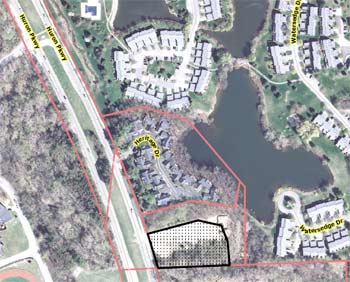
Aerial view of 490 Huron Parkway, outlined in black. The major road running west of the site is Huron Parkway. The land on the far west of this image is the site of Huron High School.

If given final approval at a subsequent council meeting, following a public hearing, the … [Full Story]

Summit Townhomes Project Gets Final OK

The necessary approvals for the Summit Townhomes project – zoning and site plan – have now been given final approval by the Ann Arbor city council. The approval of the site plan came at the council’s May 6, 2013 meeting. Approval of the new R3 (townhouse) zoning had come at the council’s April 15, 2013 meeting.

Both the site plan and the new zoning for the parcel, located at 2081 E. Ellsworth Road, had appeared on the council’s April 15 meeting agenda. The council approved the R3 zoning at that meeting. But as the hour grew late, at around 3 a.m. the council postponed all remaining items, including the Summit Townhomes site plan, until May 6.

Both the site plan and zoning request had … [Full Story]

Council to Commission: Review D1 by Oct. 1

Following a decision made at its March 18, 2013 meeting to give direction to the city’s planning commission to review zoning in the D1 (downtown core) zoning district, the Ann Arbor city council has now enumerated the areas of inquiry the commission is supposed to pursue:
RESOLVED, That City Council requests the City Planning Commission to specifically address these issues:
(i) whether D1 zoning is appropriately located on the north side of Huron Street between Division and S. State and the south side of William Street between S. Main and Fourth Avenue;
(ii) whether the D1 residential FAR premiums effectively encourage a diverse downtown population; and
(iii) consider a parcel on the south side of Ann St. adjacent to north of city … [Full Story]

No Downtown Ann Arbor Moratorium

The Ann Arbor city council has given direction to the planning commission to review downtown zoning – without imposing a moratorium on approval of site plans for downtown Ann Arbor. A moratorium had been contemplated in the council’s original resolution. The action took place at the council’s March 18, 2013 meeting.

[Full Story]

Council’s Meeting Dominated by Downtown

Ann Arbor city council meeting (March 4, 2013): The council had five items on its agenda related geographically to downtown Ann Arbor – but delayed voting on two of them.

Architect Brad Moore (left) talks with resident Ray Detter. Moore is architect for two projects that were on the council's March 4 agenda – Blue Heron Pond and 624 Church St. The councils approval of both site plans indicates the council is not contemplating imposing a Moore-atorium on site plans.

Architect Brad Moore (left) talks with resident Ray Detter. Moore is architect for two projects that were on the council’s March 4 agenda – Blue Heron Pond and 624 Church St. The council’s approval of both projects indicates the governing body is not contemplating a Moore-atorium on site plans. (Photos by the writer.)

On one of those items, the council voted to postpone its initial consideration of changes to Chapter 7 of the city code, which governs the way the tax increment finance (TIF) capture is calculated for Ann Arbor’s downtown development authority. The revisions to Chapter 7 would also affect the composition of the DDA board, excluding elected officials from service.

The council also postponed until its next meeting, on March 18, a possible moratorium on site plan review for projects in the downtown. The possible moratorium previously had been postponed from the council’s Feb. 19 meeting. After hearing extensive public commentary on the topic on March 4 – from residents and representatives of the developer of a proposed 14-story residential project at 413 E. Huron – the council went into closed session.

On emerging from the closed session, the council voted, without deliberation, to postpone the item. The wording in the resolution provides an exemption from the moratorium for site plans that already have a recommendation for approval from the city planning commission. If enacted, the moratorium as worded would still apply to the 413 E. Huron project, because the planning commission’s 5-3 vote for approval fell short of the six it needed for a positive recommendation. The 413 E. Huron site plan is now expected to be on the same March 18 meeting agenda when the moratorium will be re-visited.

Eluding the impact of the proposed moratorium’s wording was another downtown project, which appeared on the March 4 meeting agenda. The site plan for a 14-story apartment building at 624 Church St. was approved at the council’s meeting – but that project would not have been impacted by the moratorium as it’s currently proposed. That’s because it had received a recommendation of approval from the city planning commission.

The council also voted to reconstitute a task force to re-evaluate the downtown design guidelines, which supplement the city’s zoning regulations.

In the final downtown-related item, the council voted to direct the city administrator to issue a request for proposals for brokerage services to possibly sell the city-owned parcel at Fifth and William streets – the location of the former Y building. It’s currently used as a surface parking lot in the city’s public parking system.

While the city is contemplating the sale of that site, which it purchased for $3.5 million, the council voted to buy a much less expensive parcel outside the downtown, near the Bluffs Nature Area. The council approved a purchase price of $115,000 for the parcel, which is located off Orkney Street.

The council also approved two other site plans for projects not in the downtown – although the four-unit project at 515 N. Fifth is near the downtown. The council also approved the Blue Heron Pond development, a 64-unit project on the western side of town, located at Liberty and Maple.

In other business, the council approved receipt of a federal grant to demolish two of the buildings on the city-owned property at 721 N. Main. The buildings are in the floodway. A third building, in the flood fringe, is being studied by the city for possible reuse.

The property at 721 N. Main is a former maintenance yard. So none of the 44 vehicles authorized for purchase by the council at the March 4 meeting will be maintained there. Total cost of the vehicles was $928,499.

None of the vehicles authorized for purchase was a plug-in electric vehicle. However, the council passed a resolution in support of preparing city infrastructure for plug-in vehicles. Two-other energy-related agenda items included one supporting the city’s participation in Earth Hour, and another one supporting use of the city’s energy fund for energy improvements in connection with community projects.

An item that drew considerable discussion before approval related to street closings associated with the June 9, 2013 Ann Arbor marathon. [Full Story]

Planners: Same Answer on Ellsworth Zoning

Ann Arbor planning commission meeting (Feb. 21, 2013): Acting under the direction of the city council, Ann Arbor planning commissioners reconsidered the zoning they had previously recommended for a parcel on Ellsworth Road, east of Stone School. Commissioners came to the same conclusion – that it should be zoned R3 (townhouse district).

University of Michigan, Beyond the Diag, Ann Arbor planning commission, The Ann Arbor Chronicle

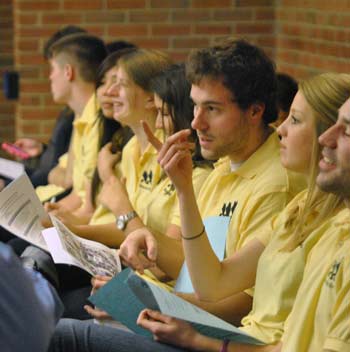
University of Michigan students with Beyond the Diag, a neighborhood outreach program. They attended the Feb. 21, 2013 meeting of the Ann Arbor planning commission, which included a brief presentation about the program. (Photos by the writer.)

The vacant lot at 2081 E. Ellsworth Road is the location for the proposed Summit Townhomes project, where the developer wants to build 24 attached residential units in four separate buildings. Because it’s being annexed into the city from Pittsfield Township, the parcel needs to be given a zoning designation. Planning commissioners had recommended R3 zoning (townhouse district) at their Nov. 20, 2012 meeting.

The zoning request was on the council’s Feb. 4, 2013 agenda for final approval, but during a public hearing on the item, several people raised concerns related to increased density in that part of town. So councilmembers voted unanimously to refer the zoning issue back to planning commissioners for another look.

At the commission’s Feb. 21 meeting, planning staff reviewed two other zoning options that would fit with the city’s master plan for that area. But even those options with lower density – for single-family homes – would result in more driveways accessing Ellsworth, causing more traffic concerns. Nor would stormwater management be improved with the other options. So planning staff again recommended the R3 zoning.

Three people spoke to commissioners during a public hearing on the zoning reconsideration, including two residents who live at the nearby Forest Hills Cooperative. They expressed concern about broader issues with the area – including crime and a lack of recreational facilities – as well as the specific proposed zoning and project for that site. Planning manager Wendy Rampson indicated that based on the council’s discussion, city administrator Steve Powers is asking the city’s parks and police staff to look into concerns raised about that area. There is also the opportunity for input on the city’s master plan, she said, when the planning commission holds a public hearing on that topic each May.

In other action at the Feb. 21 meeting, commissioners recommended that the city council approve a site plan for an expansion of the Theta Delta Chi house at 700 S. State St. The historic structure, built in 1922, is located at the southwest corner of State and Monroe, across from the University of Michigan law school. The building had been leased to another fraternity after the Theta Delta Chi chapter at UM became inactive in 1997. The chapter “recolonized” a few years ago, then took possession of the building again in May of 2012. The local architecture firm HopkinsBurns Design Studio has been hired to handle the expansion. It includes making a rear addition to the building, although there are no plans to increase the current occupancy of 33 residents.

The Feb. 21 meeting included another UM connection. Commissioners heard a presentation about Beyond the Diag, a relatively new neighborhood outreach program. It’s a student-initiated effort to build community among students and non-students, and to raise safety awareness on campus and near-campus neighborhoods. One of the program assistants – Matt Lonnerstater, a graduate student in urban and regional planning – also works as an intern with the city’s planning staff. [Full Story]

Planners Reconfirm Ellsworth Zoning

Zoning for property at 2081 E. Ellsworth Road – where the Summit Townhomes project is proposed – was back on the Ann Arbor planning commission’s agenda for another look, following a city council directive to reconsider zoning for the residential project. At their Feb. 21, 2013 meeting, planning commissioners voted again to recommend that the site be zoned R3 (townhouse district) – the same zoning they had previously recommended at their Nov. 20, 2012 meeting.

The developer wants to build 24 attached residential units in four separate buildings, with each building between 80 to 160 feet in length. Each of the 24 units would have a floor area of about 1,300 square feet, and an attached one-car garage. The plan … [Full Story]

Possible Moratorium To Delay 413 E. Huron?

According to city council sources, a resolution calling for a moratorium on development in downtown Ann Arbor will be placed on the Feb. 19, 2013 meeting agenda. As of Feb. 14, the item had not yet been added.

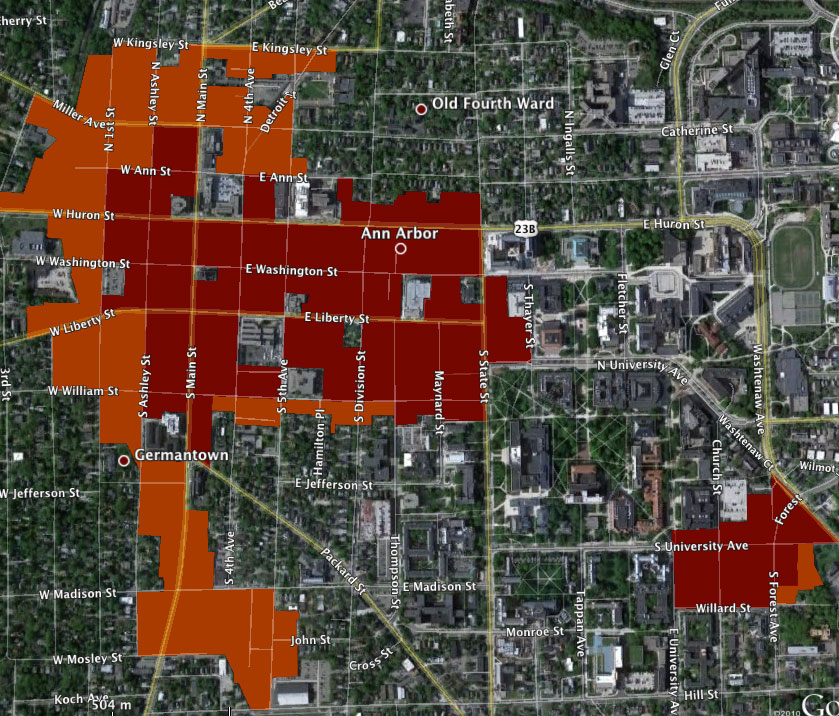
Ann Arbor zoning. Darker red areas are zoned D1. Lighter brownish areas are zoned D2.

Ann Arbor zoning. Darker red areas are zoned D1. Lighter brownish areas are zoned D2.

If the moratorium were enacted – a pause that might last up to a year – it would delay a controversial proposed residential project at 413 E. Huron. During the proposed moratorium, the planning commission would be directed to review the zoning designations for the D1 (downtown core) and D2 (interface), and make recommendations to the city council for possible zoning changes. During the moratorium, projects for D1 and D2 areas that do not already have a planning commission recommendation of approval could not be considered by the city council. The D1 and D2 zoning is relatively young, having been enacted on Nov. 16, 2009 – as the result of the Ann Arbor Discovering Downtown (A2D2) process.

Results of the planning commission’s review of D1 and D2 zoning, according to the Feb. 19 draft resolution, would be due to the city council by the end of August 2013. The maximum length of the moratorium would be a year from the date of enactment. If the council were to change the zoning designation, and if that decision survived any legal challenge, that could ultimately stop the 413 E. Huron project from ever being built.

That project calls for a 14-story, 271,855-square-foot apartment building with 533 bedrooms, marketed primarily to university students. The parcel is zoned D1 – the highest allowable density in the city. The northern edge of the site is adjacent to the Old Fourth Ward Historic District, including historic single-family homes along North Division. [Full Story]

413 E. Huron Highlights A2D2 Concerns

Ann Arbor planning commission meeting (Feb. 5, 2013): The contentious debate about zoning for the north side of East Huron Street – which had appeared to be settled with the 2009 A2D2 (Ann Arbor Discovering Downtown) zoning project – emerged again as the planning commission deliberated the proposed 413 E. Huron development this month.

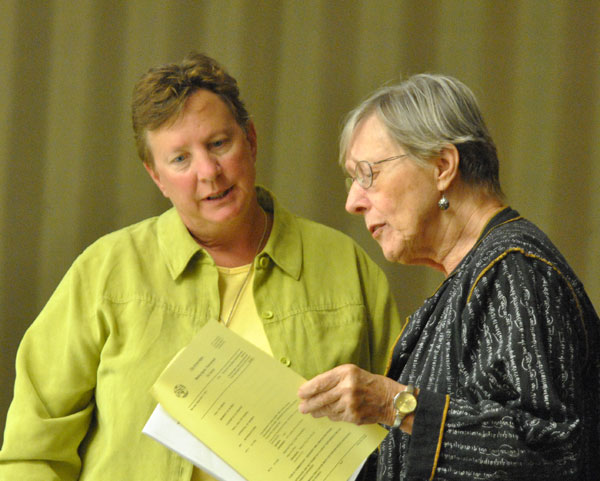
Ilene Tyler, Ethel Potts, Eleanor Pollack, Ann Arbor planning commission, The Ann Arbor Chronicle

From left: Ilene Tyler, Ethel “Eppie” Potts and Eleanor Pollack at the Feb. 5 meeting of the Ann Arbor planning commission. All three residents spoke against the 413 E. Huron project at a public hearing that lasted nearly two hours. (Photos by the writer.)

Following a lengthy discussion and public hearing that drew 33 speakers, commissioners voted 5-3 to recommend approval of the site plan and development agreement for the residential project at the northeast corner of Huron and Division. However, because a recommendation of approval for site plans requires at least six votes, the project will be forwarded to city council with a technical denial.

Voting against the project were Sabra Briere, Ken Clein and Wendy Woods. Voting to recommend the project were Diane Giannola, Bonnie Bona, Tony Derezinski, Kirk Westphal and Eleanore Adenekan. Eric Mahler was absent.

The action at the commission’s Feb. 5 meeting followed an earlier decision on Jan. 15, 2013 to postpone a recommendation, pending input from the Michigan Dept. of Transportation. That meeting also included an extensive public hearing.

The proposal calls for a 14-story, 271,855-square-foot apartment building with 533 bedrooms, marketed primarily to university students. The parcel is zoned D1 – the highest allowable density in the city. The northern edge of the site is adjacent to the Old Fourth Ward Historic District, including historic single-family homes along North Division.

Most speakers during the public hearing were harshly critical of the project, as were most planning commissioners – even those who eventually voted to recommend approval. Diane Giannola, describing herself as a very “design tolerant” person, said that even for her, the building’s design isn’t attractive. Clein, a commissioner who is a principal with Quinn Evans Architects, noted that the building’s design has been dubbed “Death Star Moderne” for its dark, looming style.

Many of the objections related to the design’s insensitivity to the adjacent neighborhood. However, Scott Reed – one of the few speakers who supported the project – argued that if context is an issue, then the context of the surrounding neighborhood should be changed. “Bulldoze it if you have to,” he said. Also supporting the project was Adam Lowenstein – owner of BTB Burrito, Good Time Charley’s and LIVE – who said that downtown business owners welcome the influx of new residents.

Several planning commissioners advocated for starting a review of the A2D2 zoning and of the city’s design review process – echoing the sentiments of several speakers at the public hearing, too. Although the city council had directed such a review to occur one year after the new zoning and design guidelines were approved in 2009, there have been few projects completed during that time and a review has not yet taken place. The planning commission and staff are expected to take up the issue.

At the end of the Feb. 5 meeting, commissioners dealt with another project, voting to postpone action on a proposal to build 19 single-family houses on Hideaway Lane off Traver Road – near the city’s Leslie Park Golf Course. Commissioners were following a staff recommendation that cited the need to resolve several outstanding issues. [Full Story]

City Council Puts Off Townhouse Zoning

Ann Arbor city council meeting (Feb. 4, 2013): Two significant land use items were included in the council’s agenda, but councilmembers moved ahead on just one of them. A request to zone a recently annexed piece of property as R3 (townhouse district) prompted long deliberations by the council, and ultimately a referral of the item back to the planning commission for further review.

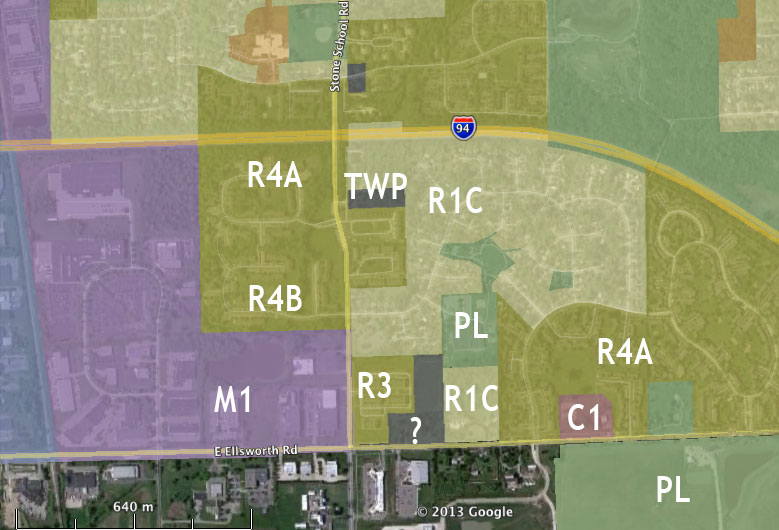
Current zoning of properties surrounding the parcel requested to be zoned at R3 (townhouse dwelling district).

Current zoning of properties surrounding the parcel at 2081 E. Ellsworth Road – denoted with a “?” Owners are requesting the parcel to be zoned as R3 (townhouse dwelling district). (Map labeled by The Chronicle.)

Dependent on the R3 zoning is Summit Townhomes – a proposed project for the 2081 E. Ellsworth Road site, located in the southern part of the city just east of Stone School Road. The townhouse project’s site plan is expected to come before the council for approval later this month. The planning commission has already recommended that the Summit Townhomes project be approved, and previously recommended the R3 zoning. The council itself had already given the zoning its initial approval at a previous meeting.

But during the public hearing about the zoning on Feb. 4, the council heard from several people who spoke against the zoning and the project, reprising many of the same objections that had been raised more than seven months ago at the June 19, 2012 meeting of the planning commission. Concerns included overcrowding and congestion in the area, and a lack of adequate city services. Also weighing in with general support for zoning that fits with the desires of residents was Washtenaw County commissioner Andy LaBarre, who represents the county district where the site is located.

Another item related to future land use was council action to authorize the distribution of the draft South State Street corridor plan to neighboring jurisdictions and other stakeholders, such as the University of Michigan, the Ann Arbor Public Schools, and the Ann Arbor Transportation Authority. After a mandated comment period, the city planning commission will have the opportunity to make revisions to the plan, before the commission and the city council make a decision to adopt it.

A major infrastructure study, with a roughly $1 million budget, was also authorized by the council – to give the city a clearer understanding of how flows behave in the sanitary sewer system, especially during rainy periods. The study is prompted by a desire to measure the impact of a footing drain disconnection program that the city has implemented for over a decade. In the last year, the program has generated strong protest from the Glen Leven neighborhood. The footing drain disconnection program was created in part to remedy the backup of raw sewage in basements during heavy rains.

The city council also authorized revisions to two existing technology agreements. One was an agreement between the city of Ann Arbor, Washtenaw County and the Ann Arbor Transportation Authority to act as a purchasing consortium. The modification to the agreement will allow other participants to be added to the consortium in a streamlined way. The second agreement was the extension of a contract with the city of Chelsea to provide various IT services.

The council put off a decision on issuing bonds to support energy improvements for its property assessed clean energy (PACE) program. The item had been added late to the agenda, and several councilmembers had questions they wanted answered before voting on it.

Although the agenda itself was light, several significant communications were included, either as written attachments or conveyed verbally. The written reports attached to the agenda included a revised auditor’s letter and a report on how the street resurfacing millage money was spent during the 2012 season.

Conveyed verbally was a report from the council’s budget committee chair, Marcia Higgins (Ward 4), who alerted councilmembers that on Feb. 11 and Feb. 25 the council would hold budget work sessions starting at 6 p.m., with each meeting consisting of two 2-hour sessions with a break.

Stephen Kunselman (Ward 3), chair of the city’s taxicab board, called for enforcement of the city ordinance that is meant to prevent the operation of “rogue limousines” – in the context of a reported sexual assault of a University of Michigan student by the driver of either a taxicab or limousine.

Kunselman also called for a number of revisions to the city ordinance that establishes the Ann Arbor Downtown Development Authority, including stricter regulations on membership of the board, but more significantly a limitation on the way the DDA’s tax increment finance (TIF) capture is calculated. [Full Story]

Final OK for Plymouth Green Crossing Revision

Several changes to the PUD (planned unit development) supplemental regulations for Plymouth Green Crossings – a mixed-use complex off of Plymouth Road, west of Green Road – were given final approval at the Ann Arbor city council’s Nov. 8, 2012 meeting. At the meeting, the council also approved corresponding changes to the site plan for the complex.

The city planning commission had given its recommendation to approve the change at its Aug. 21, 2012 meeting. Six major changes were proposed: (1) adding parking or flexible space for special events as permitted uses in the ground floor of a proposed three-story mixed-use building, on the site’s northeast corner; (2) increasing the use of potential restaurant space within the site from 7,000 square feet to … [Full Story]

City Council Punts on Several Agenda Items

Ann Arbor city council meeting (Sept. 17, 2012): The council’s initial agenda, released on Wednesday before the Monday meeting, was relatively light. But by the time the council had approved that agenda to start the meeting, it had grown considerably heavier.

Left to right: Sandi Smith (Ward 1) and former councilmember and planning commissioner Jean Carlberg.

Left to right: Sandi Smith (Ward 1) and former councilmember and planning commissioner Jean Carlberg. (Photos by the writer.)

Five significant items had been added: (1) a proposal to suspend temporarily the footing drain disconnection program in one area of the city; (2) a proposal to waive temporarily the city’s living wage requirement for certain nonprofits; (3) a proposal to establish a sidewalk gap elimination program; (4) a resolution on dealing with proceeds of city-owned land sales that competed with one already on the agenda; and (5) reconsideration of allocating $60,000 for a transit study – funding that the council had rejected at its previous meeting.

The first two items were added on Friday, Sept. 14. The second two were added the day of the meeting (Sept. 17), with the fifth item added at the council table. Of the added items, the council approved only one – to suspend temporarily the footing drain disconnect program. The rest were  postponed, withdrawn or voted down.

Postponed was the resolution added by Mike Anglin (Ward 5) to establish a committee of city officials and 10 residents – two from each ward, to be selected by councilmembers for respective wards – to address the issue of city-owned parcels in downtown Ann Arbor. The citizen committee to be established by Anglin’s resolution would study the available options for use of proceeds from the sale of downtown city properties.

Also postponed was the resolution that Anglin’s proposal was essentially challenging, which was brought forward by Sandi Smith (Ward 1). Smith wants to direct the proceeds from city-owned land sales to the city’s affordable housing trust fund. Her idea – which she first floated to her council colleagues in an email written in late August – enjoyed the support of nonprofits, as well as the Ann Arbor Downtown Development Authority board and the Washtenaw County board of commissioners.

While Anglin’s resolution was postponed until Oct. 1, Smith’s was referred to the council’s budget committee and postponed until the council’s Oct. 15 meeting.

Also postponed was a requested $60,000 contribution to fund further study of a transportation connector – for the corridor running from US-23 and Plymouth southward along Plymouth to State Street and farther south to I-94. The outcome of this phase is to identify a preferred choice of technology (e.g., bus rapid transit, light rail, etc.) and the location of stations and stops. The council had voted down the proposal at its Sept. 4 meeting, but it was brought back for reconsideration on Sept. 17, only to be postponed until Oct. 15. The $60,000 is meant to be the city’s share of a $300,000 local match for a $1.2 million federal grant that has already been awarded.

Withdrawn was the proposal to waive a requirement of the city’s living wage ordinance for those nonprofits that receive funding from the city to deliver human services. The ordinance has a provision for a hardship waiver, but states that a nonprofit must submit a plan for eventual compliance within three years. No nonprofits had submitted such plans, meaning that the council’s resolution would have amounted to an attempt by the council to amend the living wage ordinance through a simple resolution, which it cannot do. When the council reached the item on the agenda, it was withdrawn, with an indication that an ordinance revision would be brought forward to a future meeting.

Also at the Sept. 17 meeting, the council heard about an item related to nonprofit funding for human services that will be brought forward on Oct. 1: a request to continue the two-year pilot program for coordinated funding. That news came during a presentation from Mary Jo Callan, head of the city/county office of community and economic development.

Voted down was a plan to initiate a 5-year program to eliminate sidewalk gaps in the city. Councilmembers voting against the resolution pointed to the fact that the city’s non-motorized transportation plan takes a comprehensive approach to identifying such gaps. They feared that people might mistakenly believe that certain gaps would necessarily be filled through this program, and raised concerns about equity. The resolution sought to identify independent funding sources to pay for such projects – the city’s strategy in the past has been to levy special assessments on owners of property adjoining the sidewalks.

The footing drain disconnect program was the only one of the late additions to the agenda on which the council took final action. In the general vicinity of the Lansdowne neighborhood, where some houses have already had sump pumps installed as part of the disconnect program, residents have reported that during heavy rains, the overland stormwater flows and the sheer volume of water in the city’s stormwater system prevent sump pumps from being effective. At an Aug. 22 neighborhood meeting, residents had called for a moratorium on the program. That’s essentially what the council’s resolution did.

Flooding was also a topic included in other council business that had been placed on the agenda through the regular agenda-setting process. The council approved an update to the city’s hazard mitigation plan. It will allow the city to receive already-approved federal funds for demolishing two out-buildings located in the floodway at the city-owned 721 N. Main property.

Also related to emergency preparedness, the city council authorized the purchase of a light rescue vehicle that can be used by firefighters to respond to medical calls. Because its staffing requirement is just two firefighters instead of three, the use of the vehicle would allow response to medical calls without diminishing as much of the department’s response capability for fire calls.

The council also gave final approval to rezoning of an Eden Court property to public land. [Full Story]

Rezoning Process for N. Main Site on Agenda

Several additions to the Ann Arbor city council’s Aug. 20 meeting agenda came on Friday, after the initial Wednesday publication.

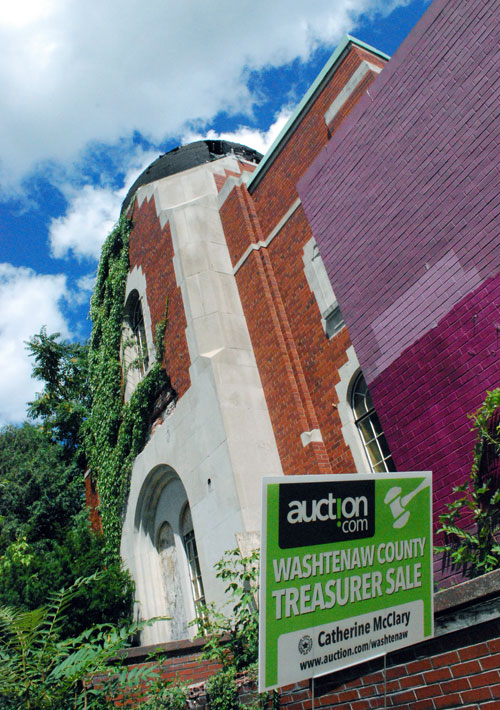
St. Nicholas Church foreclosure

Former St. Nicholas Church at 414 N. Main in downtown Ann Arbor. It will be offered at public auction on Sept. 6.

And two of those items involve city ownership of land parcels – at opposite edges of downtown Ann Arbor. One of the properties is already owned by the city of  Ann Arbor – the parcel at 350 S. Fifth. Situated on the southern edge of downtown, it’s also known as the Fifth and William parking lot (because it’s currently used as a surface parking lot in the city’s public parking system) or the Old Y Lot (because it’s the location of the former YMCA building).

The resolution would direct the city administrator to evaluate the parcel for possible public or corporate use; and if none is found, to report back to the city council with a timeline for the disposition of the property – based on state and city laws and policies. The resolution, sponsored by Stephen Kunselman (Ward 3), is somewhat unlikely to gain much traction with the council. That’s because it explicitly indicates that the city administrator’s efforts are to be independent of the Ann Arbor Downtown Development Authority’s Connecting William Street planning effort, which includes the 350 S. Fifth parcel.

The Connecting William Street project was undertaken by the DDA based on a directive from the city council, on a unanimous vote, given at its April 4, 2011 meeting. Kunselman voted for that planning effort to take place – but was also vocal at the time, as well as before, about his view that the Old Y lot should simply be put up for sale one way or another.

A second piece of property on the council’s Aug. 20 agenda is located on the northern edge of downtown at 414 N. Main St., near Beakes Street – the site of the old St. Nicholas Church. In 2006, owners of the site received approval for a planned unit development (PUD) zoning designation from the city council. The PUD would allow construction of The Gallery, an 11-story building (158 feet tall) that would include 224 parking spaces and 123 units of residential housing, 18 of which would meet the definition of affordable housing derived by a formula based on area median incomes.

That 414 N. Main property does not belong to the city. But the result of a foreclosure process has put it in the hands of another public entity – the Washtenaw County treasurer’s office. It’s being offered at public auction (on auction.com) starting Sept. 6 through Sept. 11, at a price of $365,051. County treasurer Catherine McClary told The Chronicle in a phone interview that the price includes the demolition costs – and that she’s selected a demolition firm to start the work. Asbestos abatement is already underway, and the demolition itself is expected to begin before the auction, though it will likely not be complete by then, as it will take 15 days.

What would the council’s resolution on the 414 N. Main property actually do? It would start the process to change the PUD zoning to that of the surrounding property, which is D2 (downtown interface) – allowing a maximum building height of 60 feet. The resolution, also sponsored by Kunselman, gives as part of its rationale the fact that the original developer is no longer pursuing the project.

If the property doesn’t sell at the Sept. 6 auction, it will be offered at a second auction. If it doesn’t sell at the second auction, the property would revert to the city. The city could exercise a right of first refusal and acquire the property for the minimum $365,051 bid – but that would require the city to make the purchase for a “public purpose.”

After the jump, we provide a bit more detail on the 414 N. Main property. [Full Story]

Council Meeting: Floods, Fires, Demolition

Ann Arbor city council meeting (Aug. 9, 2012) Part 2: Ballot initiatives for the Nov. 6, 2012 election – two about parks and one on public art – were the dominant theme of the council’s meeting. Those are covered in Part 1 of the meeting report.

Mayor John Hieftje and city administrator Steve Powers

From left: Mayor John Hieftje and city administrator Steve Powers before the start of the Aug. 9, 2012 council meeting.

But the council transacted several other pieces of business as well, some of which could be grouped into the general thematic pattern of land and property use. Most obviously connected to land use was the council’s initial approval of a rezoning request in connection with an expansion proposal from Knight’s Market, at the corner of Miller and Spring streets. The rezoning would allow a house to be converted into a bakery. It would also allow for eventual approval of a site plan to build a 1,200-square-foot addition to the existing grocery store and to expand, reconfigure, and improve the existing parking lot.

The council also passed a resolution to deal with an issue stemming, in part, from land use decisions made decades ago that resulted in residential development in the area of the Malletts Creek drainage district. Recently, residents in the area have been faced with severe localized flooding. The council’s resolution directed staff to start negotiations with the Washtenaw County water resources commissioner to identify “opportunities for stormwater conveyance and stormwater quality improvement in the area of the Malletts Creek drainage district.”

Related at least tangentially to land use at the level of a specific parcel was a resolution the council passed establishing the property at 317 Maynard in downtown Ann Arbor as an industrial development district. The move sets the stage for an expected application from the future tenant of the space, owned by First Martin Corp., for a tax abatement that would be worth around $85,000. The tenant is Barracuda Networks.

And the council took another step in implementing a strategy to eliminate blight. The city had previously set aside funds that could be used to demolish blighted buildings – if the city is unsuccessful in getting property owners to demolish them. The council’s action last Thursday authorized the city to sign contracts with four different companies to do such demolition work on an as-needed basis. It was announced at the meeting that the houses on North Main – at the site of the planned Near North affordable housing project – will likely be among the first to be demolished under the contracts authorized by the council.

To the extent that transportation systems have an impact on future land use, another item related to land use was a reapproval of the articles of incorporation for a possible new countywide transportation authority. The articles of incorporation are part of a four-party agreement to establish a framework for possibly expanding the governance and service area of the Ann Arbor Transportation Authority.

The four-party agreement is between the cities of Ann Arbor and Ypsilanti, Washtenaw County and the AATA. The Ann Arbor council changed the minimum threshold of votes required on the proposed new 15-member transit authority board, an action that brought the council in line with a version that the Washtenaw County board of commissioners had approved earlier this month. That threshold was increased from a 2/3 majority (10 votes) to a 4/5 majority (12 votes).

In other business, the council authorized the hiring of three additional firefighters for the next two years, using a federal grant. It also authorized the purchase of a new aerial fire truck.

Nominations to city boards and commissions made at the meeting included reappointment of Sandi Smith, Roger Hewitt and Keith Orr to the board of the Ann Arbor Downtown Development Authority. And Sally Petersen, who won the Ward 2 Democratic primary on Aug. 7, was nominated for the city’s commission on disability issues.

The council also heard public commentary on a range of topics, including smart meters and the idea of corporations as people.  [Full Story]

Council Takes Medical Marijuana Off Agenda

Now removed from the Ann Arbor city council’s June 4, 2012 agenda is an item regarding a change in the city’s zoning regulations that relate to medical marijuana dispensaries and cultivation facilities.

The ordinance change that the council would have considered would have eliminated from the zoning ordinance one sentence: “Medical marijuana dispensaries and medical marijuana cultivation facilities shall be operated in compliance with the MMMA (Michigan Medical Marijuana Act).” [.pdf of the recommended zoning ordinance change.

The recommendation for the change in the ordinance language had originally come from the city's medical marijuana licensing board. At its April 2, 2012 meeting, the city council then directed the city planning commission to consider the licensing board's recommendation. The planning commission then reviewed and considered the recommendation ... [Full Story]

City Council Expands North Main Task Force

Ann Arbor city council meeting (May 21, 2012) Part 1: Although the council’s meeting did not conclude until around 1:30 a.m., the late hour was not attributable to the relatively heavy agenda. It was due to the extensive deliberations on the fiscal year 2013 budget, which the council finally approved over dissent from two of its members. A breakdown of amendments to the budget is included in The Chronicle’s report filed from the meeting. Deliberations on those budget amendments are covered in the forthcoming Part 2 of this meeting report.

Left is Sandi Smith (Ward 1). Right is Sabra Briere (Ward 1). The two had co-sponsored a resolution establishing a task force to study the North Main Street and Huron River corridor.

From left: Councilmembers Sandi Smith (Ward 1) and Sabra Briere (Ward 1). The two had co-sponsored a resolution establishing a task force to study the North Main Street and Huron River corridor. (Photos by the writer.)

In addition to the budget, the council efficiently dispatched with a fairly packed agenda of regular items, which are covered in this part of the meeting report. The item generating the most discussion was a follow-up to action taken at the council’s previous meeting on May 7, to establish a task force to study the North Main Street and Huron River corridor.

That resolution had provided for nine task force members representing different constituencies. At the May 21 meeting, a resolution was brought forward to add three members. A debate unfolded about whether to add a fourth member – from the Ann Arbor public art commission – to the mix. Ultimately that addition was approved narrowly on a 6-5 vote on the 11-member council.

While the North Main task force is meant to develop a vision for future land use in the corridor, the council took action on several current land use items too. Winning easy approval were a site plan for Allen Creek Preschool on Miller Avenue, and a rezoning and site plan for Michigan AAA on South Main Street. The council also quickly approved six routine rezoning requests associated with annexation from a township into the city of Ann Arbor.  And councilmembers gave initial approval to revisions of the planned unit development regulations for a Shell service station on Ann Arbor-Saline and West Eisenhower Parkway.

Associated with these land use items were a total of 10 separate public hearings. However, no one addressed the council during any of those hearings.

The city’s park system made it onto the agenda in a few different ways. First, a consent agenda item was pulled out for separate consideration to highlight the fact that renovations to South University Park were being funded with a $50,000 gift that had been made by a couple – Leslie and Michael Morris – who previously lived next to the park. The council also approved the lease of a 40-space parking lot near Argo Canoe liveries to meet additional demand for river trips that has been generated by construction of the Argo Cascades bypass around the dam.

Related to open space outside the city were the reappointments of two members of the greenbelt advisory commission – Peter Allen and Catherine Riseng. The commission overseas a portion of the city’s open space and parkland preservation millage.

Financial issues considered by the council included initial approval to increase water, sewer and stormwater rates that will together generate an additional $1.7 million in annual revenue. The council also approved a tax abatement for Sakti3, a battery technology company in Ann Arbor that is looking to expand its operation here.

Other items on the agenda included receipt of a federal grant to develop a strategy for improved energy efficiency in rental housing, as well as a grant administered for laptop computers to be used as electronic pollbooks. The computers are used for election record-keeping, not for casting ballots. The council also gave initial approval to an ordinance revision that relieves homeowners of responsibility for maintaining sidewalks adjacent to their property for the duration of the sidewalk-repair millage, which voters approved in November 2011. [Full Story]

City Council Acts on Zoning, Airport, Streets

Ann Arbor city council meeting (April 16, 2012): The most significant item on the council’s agenda was the introduction of the city’s proposed fiscal year 2013 budget by city administrator Steve Powers.

Andrew Cluley interviews Steve Powers after the council meeting.

WEMU's Andrew Cluley had questions about the budget for Ann Arbor city administrator Steve Powers after the April 16 council meeting. Image links to Cluley's report. (Photos by the writer.)

But Powers led off the presentation by explaining that Monday evening would not be a time for detailed discussion and questions about the budget. For details of that presentation, see Chronicle coverage: “Ann Arbor Council Gets Draft 2013 Budget.”

The budget presentation occurred Monday night because of a city charter requirement. It was Powers’ first such presentation – as he was hired by the council last year, and started the job in September. The city council will have until May 21, its second meeting in May, to modify and adopt the budget.

In terms of the sheer number of agenda items, the topic of zoning and land use was a main focus of the meeting. The council unanimously rejected a proposed conditional rezoning of 1320 S. University to a higher density than its current D2 (downtown interface) designation. But winning unanimous approval was a site plan for a Tim Hortons on South State Street, near Ellsworth. The council also gave initial approval to AAA Michigan for a rezoning request involving a parcel on South Main, which the auto club would like to have designated as P (parking). A half dozen different rezoning requests for parcels that had recently been annexed into the city also received initial approval.

Prompting considerable discussion among councilmembers were four resolutions concerning an environmental study on a possible extension of a runway at the Ann Arbor municipal airport. The resolutions all passed, but the main grant funding went through on just a 7-4 vote. The city was being asked for an additional $1,125 in matching funds to wrap up the final stages of an environmental assessment being done by the Michigan Dept. of Transportation, which was already mostly completed two years ago.

Also related to transportation, the council authorized over $6 million in contracts related to street resurfacing projects. That included a second set of local streets (after having approved funding for the first set at its previous meeting) as well as the section of East Stadium Boulevard between Packard and Washtenaw. In connection with those infrastructure projects, the council also authorized contracts for materials testing.

In other action related to infrastructure, the council approved a $93,438 item for construction of unisex bathrooms in city hall – but not without questions about the scope of the overall municipal center renovation work.

On personnel-related items, the council gave final approval to legislation that incorporates provisions of the collectively bargained labor contracts with police command officers and firefighters into the city’s set of ordinances on retirement and health care.

As a result of other council action on Monday night, Ann Arbor police officers will be able to arrest and charge “super drunk” drivers who have more than 0.17 blood alcohol content – because the council modified the city’s ordinances to conform with recent changes in state law.

In other business, the council also authorized a contract with a new auditor, The Rehmann Group, set a hearing on a tax abatement for Sakti3, and imposed a temporary ban on digital billboards.

Highlights of public commentary included concerns about new DTE “smart meters” and localized flooding incidents in the city. The flooding was attributed by residents to the city’s layering of new asphalt onto an adjacent street, and to the city’s sanitary sewer disconnection program. [Full Story]

AAA Gets Initial OK for Parking Zoning

At its April 16, 2012 meeting, the Ann Arbor city council gave initial approval to a proposal from AAA Michigan to rezone half of a parcel located at 1200 S. Main to P (parking). To take effect, the initial approval from the city council will need to be followed by a second and final approval following a public hearing at a subsequent meeting.

The rezoning to P (parking) is part of a two-parcel site plan proposal – for which the city planning commission provided a positive recommendation at its March 6, 2012 meeting. At that meeting, the commission took two votes on the 1200 S. Main parcel – the site plan and the rezoning proposal. And on both votes, the … [Full Story]

Tension Grows in Medical Marijuana Debate

Ann Arbor city council meeting (April 2, 2012) Part 1: At a meeting that lasted until midnight, the Ann Arbor city council dealt with a full agenda, including several medical marijuana issues.

Sabra Briere (Ward 1) Tony Derezinski (Ward 2)

Ann Arbor city councilmembers Sabra Briere (Ward 1) and Tony Derezinski (Ward 2). (Photo by the writer.)

Part 1 of this meeting report focuses just on the medical marijuana-related items. In a separate article, The Chronicle has analyzed some of the key issues at stake: “Ann Arbor Marijuana Licenses: Who Decides?

In front of the council for its consideration were three separate agenda items involving medical marijuana: (1) revisions to the city’s medical marijuana licensing ordinance as recommended by the licensing board; (2) direction to the city planning commission to make a recommendation on revisions to the city’s medical marijuana zoning ordinance; and (3) direction to the city attorney to delay enforcement action against dispensaries.

The council unanimously postponed consideration of the licensing ordinance revisions until June 18 – the council’s second meeting that month. During deliberations on the licensing ordinance, several councilmembers expressed concerns about the board-recommended revisions, in particular one that would allow the city council to waive requirements of the licensing ordinance for a dispensary.  In postponing, councilmembers wanted to give the planning commission enough time to act on its direction to review the medical marijuana zoning ordinance and give a recommendation to the city council. The intent is to bring forward any changes to the licensing and zoning at the same time.

The direction to the planning commission passed on a 9-1 vote, with dissent from the Tony Derezinski (Ward 2), who is the city council’s representative to the planning commission. [Marcia Higgins (Ward 4) was absent, leaving the 11-member council with 10 members present.]

The council tabled the resolution directing the city attorney to delay enforcement activities. The tabling was achieved on a 6-4 vote. Voting against the tabling were mayor John Hieftje, Sabra Briere (Ward 1), Margie Teall (Ward 4) and Mike Anglin (Ward 5). A tabled resolution will demise if it’s not brought back for consideration in six months.

The medical marijuana licensing board made recommendations on the award of licenses to 10 dispensaries at its  Jan. 31, 2012 meeting. Given remarks made at the council’s April 2 meeting by Sandi Smith (Ward 1), Carsten Hohnke (Ward 5) and Stephen Kunselman (Ward 3), there’s some sentiment in support of having the council go ahead and vote on those recommendations – before the council considers ordinance revisions in June. But it’s not clear whether the city attorney’s office would be prepared before June to provide advice on the license awards.

This report includes coverage of public commentary and council deliberations on the medical marijuana items, presented in detail. Other agenda items from the April 2 meeting will be included in a separate forthcoming report. [Full Story]

Ann Arbor Pauses on Marijuana Issues

At its April 2, 2012 meeting, the Ann Arbor city council considered three separate agenda items involving medical marijuana: (1) revisions to the city’s medical marijuana licensing ordinance; (2) direction to the city planning commission to make a recommendation on revisions to the city’s medical marijuana zoning ordinance; and (3) direction to the city attorney to delay enforcement action against those dispensaries for which the city’s medical marijuana licensing board has recommended licenses.

The council unanimously postponed consideration of the licensing ordinance revisions until the council’s second meeting in June – June 18.

The council approved the  resolution that gives direction to the planning commission to review the medical marijuana zoning ordinance, on a 9-1 vote.

The council tabled the resolution directing the … [Full Story]

Board Recommends 10 Marijuana Licenses

At its Jan. 31, 2012 meeting, Ann Arbor’s medical marijuana licensing board voted to recommend licenses for 10 medical marijuana dispensaries located in the city. A decision on the award of the licenses will now be considered by the Ann Arbor city council.

Businesses recommended for a license under Ann Arbor’s local ordinance are: (1) Green Planet, 700 Tappan St.; (2) Treecity Health Collective, 1712 S. State St.; (3) Ann Arbor Health Collective, 2350 E. Stadium Blvd.; (4) OM of Medicine, 112 S. Main St.; (5) People’s Choice, 2245 W. Liberty St.; (6) Greenbee Collective, 401 S. Maple St.; (7) Ann Arbor Wellness Collective, 321 E. Liberty St.; (8) MedMarx at Arborside, 1818 Packard St.; (9) Medical Grass Station, 325 W. … [Full Story]

ZBA Grants 1 of 2 Medical Marijuana Appeals

At its Jan. 25, 2012 meeting, Ann Arbor’s zoning board of appeals heard two appeals from representatives of medical marijuana dispensaries, who had been denied a zoning compliance permit by the city. The ZBA granted one appeal (from Green Planet), overturning the decision of city staff, and rejected the other (from Treecity).

Both businesses were  seeking such a permit in order to apply for a medical marijuana dispensary license. The licensing board is scheduled to meet on Jan. 31 to make recommendations on the award of dispensary licenses. The denial of the one appeal means that nine of 10 total applications will be considered by the licensing board.

The Ann Arbor city council enacted zoning and licensing requirements for medical marijuana businesses on June … [Full Story]

Arlington Square Gets Initial Council OK

At its Jan. 9, 2012 meeting, the Ann Arbor city council gave initial approval to changes to the supplemental regulations of a planned unit development (PUD) for Arlington Square. The changes to the PUD supplemental regulations would allow for urgent care and restaurant uses at the site, with no additional parking. No exterior changes are proposed.

The two-story, 51,285-square-foot retail and office complex is located at 3250 Washtenaw Ave. – the southeast corner of Washtenaw Avenue and Huron Parkway. An 8,000-square-foot space in the complex, where Hollywood Video was formerly located, is vacant, and the owner would like to have the option of leasing the space to a restaurant or urgent care facility.

The current PUD zoning, which was approved in 1989, allows for certain C3 (fringe commercial) uses, but due to an increased need for parking that would be created, the original regulations did not allow for (1) restaurants with seating, (2) barber/beauty shops on the first floor, or (3) office uses on the second floor, with the exception of medical/dental offices.

The site includes 200 parking spaces. To accommodate potential increased parking demand, the building’s owner – Nadim Ajlouny of Orchard Lake, Mich. – is offering to provide bus passes to all employees on the site and to provide an additional 14 enclosed bicycle parking spaces. Questions arose during council deliberations about the number of spaces that are actually on the site. Those questions are supposed to be addressed by the time the council considers the changes for final approval.

The city planning commission, at its meeting of Dec. 6, 2011, recommended approval of the request.

This brief was filed from the city council’s chambers on the second floor of city hall, located at 301 E. Huron. A more detailed report will follow: [link] [Full Story]

Ann Arbor Adds Flashers, Alters Traffic Law

Ann Arbor city council meeting (Dec. 19, 2011): At its last meeting of the year, the council ended the current round of discussion on the city’s pedestrian safety ordinance by finalizing changes that clarified conditions under which vehicles are required to stop for people who are trying to cross the street.

Jane Lumm crosswalk ordinance approaching air quotes

Jane Lumm (Ward 2) made air quotes around the word "approaching" as the council discussed the city's ordinance on crosswalks. (Photos by the writer.)

The current ordinance amendment maintains an existing requirement that motorists accommodate not just pedestrians who are “within” a crosswalk, but also those who are verging on entering a crosswalk. What’s different is the way the concept is expressed. In July 2010, the council chose to describe pedestrians who are about to enter a crosswalk as “approaching” the crosswalk. The version of the ordinance finalized on Dec. 19 requires motorists to accommodate “… a pedestrian stopped at the curb, curb line or ramp leading to a crosswalk and to every pedestrian within a crosswalk …”

As part of the previous amendments made in 2010, the council also had removed language that specified a half of the roadway where drivers needed to accommodate pedestrians. This time around, the council restored similar language, which reads, “… when the pedestrian is on the half of the roadway on which the vehicle is traveling or when the pedestrian is approaching so closely from the opposite half of the roadway as to be in danger.”

In other crosswalk-related business, the council approved an expenditure of $81,000 to install five rectangular rapid flashing beacons (RRFB) on existing pedestrian islands in the city. Four of the locations are along Plymouth Road, at Georgetown, Traver Village, Beal and Bishop. The fifth location is at Seventh and Washington.

Also at the Dec. 19 meeting, the council ended a long process of review by the city and negotiation with neighbors by approving a change to the zoning of the Hoover Mansion property on Washtenaw Avenue, which University Bank uses as its headquarters. The change will allow University Bank to build 13 new parking spaces on the east side – behind the main building, allowing the bank in accommodate expanded employment.

Towards the end of the council’s meeting, a relatively rare debate unfolded about a mayoral nomination to a city board. At issue was the nomination of a city employee – transportation program manager Eli Cooper – to the board of the Ann Arbor Transportation Authority. He’s replacing another city employee on the board, public services area administrator Sue McCormick, who left her position with the city in mid-December. In the end, Cooper’s nomination was confirmed with dissent from two councilmembers. A separate vote on a general policy opposing nominations of city employees to boards and commissions received only four votes of support.

The council considered two compensation-related issues – one for its city attorney, Stephen Postema, and another for election workers who staff the polls. After a closed session to discuss Postema’s performance review, the council voted with dissent from one councilmember to award Postema the ability to cash out 250 hours of banked time. The council delayed its vote on pay increases for election workers, on the possibility that their pay could be increased more than what’s proposed, to match the amount specified in the city’s living wage ordinance.

In other business, the council approved a bond re-funding, authorized reimbursement for a broken electromagnet at the materials recovery facility, accepted additional federal money for solar projects, and heard about a possible strategy for addressing vacant and dilapidated properties. [Full Story]

Council Takes Step to Alter Pedestrian Law

Ann Arbor city council meeting (Nov. 10, 2011): A further revision to the city’s pedestrian safety ordinance took up most of the council’s time at Thursday’s meeting.

Rapundalo signing student attendance sheets

Stephen Rapundalo (Ward 2) was first to arrive at the council’s meeting and was rewarded by a dozen or so requests from high school students who needed a signature to attest to their attendance for a class assignment. It was Rapundalo’s last meeting, having lost the Ward 2 election on Tuesday, Nov. 8, to Jane Lumm. (Photos by the writer.)

The council had made several revisions to the law in 2010, including a requirement that motorists accommodate not only pedestrians who are “within” a crosswalk, but also those who are “approaching” a crosswalk. Thursday’s initial revision amended out the “approaching” language in favor of the following wording: “… the driver of a vehicle shall stop before entering a crosswalk and yield the right-of-way to a pedestrian stopped at the curb or ramp leading to a crosswalk and to every pedestrian within a crosswalk.”

The second and final vote on the pedestrian ordinance change is expected to come after a council working session in December, and after a public hearing at the council meeting when the final vote is taken. Based on deliberations on the change at Thursday’s meeting, the outcome of that vote is not a foregone conclusion, and further revisions might be possible.

The council also took action at the Nov. 10 meeting that will allow two downtown residential projects to start construction. The council approved the site plan for The Varsity Ann Arbor, a “planned project” consisting of a 13-story apartment building with 181 units at 425 E. Washington, between 411 Lofts and the First Baptist Church.

And the final deal was approved with Village Green to purchase the city-owned parcel at First and Washington. On that site Village Green will build a 244-space parking deck as the first two stories of a 9-story building with 156 dwelling units – City Apartments.

The council gave final approval to a change in its taxicab ordinance, spelling out conditions under which licenses can be revoked or suspended.

The council also gave final approval to two ordinances that make retiree health care and pension benefits for two of the city’s larger unions parallel to benefits for non-union employees. The approvals gave Stephen Rapundalo (Ward 2) an opportunity to comment on the labor issues that had been a centerpiece of his re-election campaign, which concluded unsuccessfully on Tuesday.

It was due to the election held on Tuesday that the council’s meeting was shifted from its regular Monday meeting slot to Thursday. The shift is stipulated in the city charter. All council incumbents won their races except for Rapundalo, a Democrat defeated by Jane Lumm, who was running as an independent. Rapundalo began his final meeting by signing multiple attendance sheets for high school students who were attending the meeting on a class assignment, and ended it by hearing praise from his colleagues around the table. [Full Story]

State St. Annexation OK’d, Zoning Delayed

At its Aug. 16, 2011 meeting, the Ann Arbor planning commission recommended that two parcels located in Ann Arbor Township “islands” – 1643 and 1645 S. State St., south of Stimson and next to the Produce Station – be annexed into the city of Ann Arbor. The annexation request will now move forward to the city council for approval. A request to zone the properties as C3 (fringe commercial district) was postponed.

The parcels cover about 0.6 acres and include four non-residential buildings. A new business – Biercamp Artisan Sausage and Jerky – is located at 1643 S. State, along with an auto repair shop and furniture manufacturer. The building at 1645 S. State is used for storage. The only speakers … [Full Story]

No Consensus on Residential Zoning Changes

A committee that’s worked for a year and a half to develop recommendations for zoning changes in Ann Arbor’s near-downtown residential neighborhoods has been unable to reach agreement. So it’s now likely that the city’s planning commission will weigh in on the controversial issue. The outcome of changes – if approved by the city council – could affect the density of residential development in the city.

R4C City of Ann Arbor Zoning

The dark red areas are those areas zoned R4C in the city of Ann Arbor. (Image links to Google Map)

At a recent working session, planning commissioners were briefed on a draft report from the R4C/R2A advisory committee, which has been meeting since December 2009. Both kinds of zoning district were established in the 1960s: R4C allows for multiple-family residential dwellings, such as apartment buildings, while R2A zoning limits density to two-family residential structures. The committee was unable to reach consensus on its recommendations, nearly all of which relate to the R4C districts.

At the June 14 planning commission working session, two commissioners who serve on the committee – Jean Carlberg and Tony Derezinski – expressed frustration at the outcome. The draft recommendations don’t provide any guidance about where the city might encourage greater density, Carlberg said.

Derezinski, who is the city council’s representative to the planning commission, added that many committee members worked hard, but were interested in protecting what they’re used to, especially concerning density and parking in their neighborhoods. As it stands, he said, the report won’t be helpful to the city council. Derezinski supported the idea of having the planning commission study the issue and make its own recommendations.

Commissioner Evan Pratt suggested that the first question to ask is whether there should be greater density, and where – the answer to that would guide the recommendations.

In a follow-up phone interview with The Chronicle, Wendy Rampson – the city’s planning manager, who also attended the working session – said there are several possibilities that planning commissioners might pursue. They could discuss the report at one of their regular meetings and make their own recommendations or comments about it. Those recommendations and comments could be made either informally – communicated to the council via Derezinski – or through a formal resolution or memorandum.

Another option would be for the commission’s ordinance revisions committee to tackle it first, developing specific ordinance language that the full commission could then review and possibly recommend to the city council. Or commissioners could ask to hold a joint session with the council, she said, to talk through these issues directly.

Regardless of how the planning commission proceeds, Carlberg will no longer be at the table. The June 14 working session was her last meeting as a commissioner. Her term ends on June 30, and she did not seek reappointment. The former city councilmember served 16 years on the planning commission, overlapping with her 12 years (1994-2006) as a Democrat representing Ward 3 on the council. Eleanore Adenekan was nominated during the council’s June 20 meeting as a replacement for Carlberg – her nomination is expected to be confirmed at the council’s July 5 meeting. [Full Story]

Ann Arbor Cannabis Laws Done, For Now

Ann Arbor city council meeting (June 20, 2011): Two ordinances regulating medical marijuana businesses were finally approved by the council on Monday night, following more than a year of discussion in some form.

Sabra Briere, Carsten Hohnke, Christopher Taylor

Before the June 20 meeting started, Sabra Briere (Ward 1) handed out amendments she'd be proposing to the medical marijuana licensing ordinance. From left: Christopher Taylor (Ward 3) and Carsten Hohnke (Ward 5). (Photos by the writer.)

The first local law stipulates where medical marijuana businesses can be located in the city – it’s an addition to Ann Arbor’s zoning code. The second law establishes a licensing board for medical marijuana dispensaries and sets up an application process for the award of a maximum of 20 licenses to dispensaries in the first year of the program.

On Monday evening, the council undertook amendments to the licensing ordinance that were few compared to massive changes that have taken place at several council meetings dating back to January 2011. On Monday, the labeling requirements for marijuana packaging were changed so that dollar amounts are no longer required.

The council teetered on the edge of postponing the legislation, when city attorney Stephen Postema encouraged councilmembers to delay voting until the Michigan Court of Appeals issued an opinion on a case (Michigan v. McQueen) for which oral arguments were heard on June 7. Despite the support for postponement from mayor John Hieftje, an initial vote to postpone achieved only two other votes. A second vote achieved a total of five votes, leaving the postponement one vote short of the six-vote majority it required.

As some councilmembers observed that the council had invested a disproportionate amount of time on the medical marijuana legislation, Hieftje contended that it had not prevented the council from handling its other work.

On Monday, that other work included a collective bargaining agreement with its police service specialists union, which was an item added just that evening to the agenda. The council also heard public commentary critical of the recent budget approved on May 31 by the council, which includes the layoff of some firefighters and police officers. The meeting was preceded by a demonstration by the city’s public safety employees, at Fifth and Huron streets just outside city hall

The council  also approved two contracts in connection with the East Stadium Bridges replacement project and three purchase orders related to tree care. And the council gave final approval to sewer and water rate increases and a revision to its landscaping ordinance.

The council revised its debt/fund balance policy, and revised its budget to reflect the blending of its economic development fund back into the general fund. Also related to economic development, councilmembers approved the annual $75,000 funding for Ann Arbor SPARK and set a public hearing for a tax abatement for Picometrix.

The council established an affordable housing lien policy and gave initial approval to technical revisions to the city’s pension ordinance. They confirmed appointments to the new design review board, but postponed a vote on setting the design review fee. The council added a work session for July 11, which is likely to include an update on the planned Fuller Road Station.

The council also heard a presentation on a skatepark planned for Veterans Memorial Park. [Full Story]

Ann Arbor Finally OKs Medical Marijuana

At its June 20, 2011 meeting, the Ann Arbor city council gave final approval to two city ordinances that ensconce medical marijuana businesses with local regulations.

One ordinance concerns zoning – legislation that stipulates where medical marijuana dispensaries and cultivation facilities can set up business. And the second ordinance concerns licensing – a law that describes how a maximum of 20 licenses in the first year will be awarded, and how a licensing board will be set up to evaluate applications.

An effort led by Stephen Rapundalo (Ward 2), mayor John Hieftje and city attorney Stephen Postema to postpone the votes – in light of a future expected court ruling – failed on two separate votes. The first vote on postponement was 3-7. Joining Hieftje and Rapundalo in voting for postponement was Marcia Higgins (Ward 4). On the second vote to postpone, Stephen Kunselman (Ward 3) and Margie Teall (Ward 4) joined the side for postponement, but that left the measure with only five votes. Tony Derezinski (Ward 2) was absent from the meeting. Based on previous deliberations, he would likely have voted for the postponement.

The votes on both ordinances themselves were 8-2, with Higgins and Rapundalo dissenting.

Key features of the zoning ordinance include the requirement that medical marijuana dispensaries must be located in districts zoned as D (downtown), C (commercial), or M (manufacturing), or in PUD (planned unit development) districts where retail is permitted in the supplemental regulations. Medical marijuana cultivation facilities are only allowed in areas zoned as C (commercial), M (manufacturing), RE (research), or ORL (office/research/limited industrial). Medical marijuana businesses are prohibited in a 1000-foot buffer zone around schools.

Key features of the licensing ordinance include a limit of 20 total licenses for dispensaries in the first year – cultivation facilities are not licensed under the ordinance. The license applications will be processed by a five-member medical marijuana licensing board consisting of one member of the city council, one physician, and three other Ann Arbor residents. The license application requires proof of legal possession of the premises for which the license is sought. Licensed dispensaries are required to maintain records on patients for 30 days after marijuana is dispensed, and on cultivation sources for 60 days.

In an amendment to the licensing ordinance made by the council on June 20, a stipulation was eliminated that would have required dollar amounts to be included in medical marijuana package labeling. That amendment was not substantial enough to require the ordinance to undergo an additional reading and approval by the council.

The council’s work on the medical marijuana legislation dates at least as far back as June 7, 2011 2010, when it convened a closed session on the topic to discuss a city attorney’s memo dated May 28, 2010. The council convened another closed session on July 19, 2010, purportedly to discuss the same May 28, 2010 memo. The council did not publicly discuss the topic until Aug. 5, 2010, when it enacted a moratorium on the use of property in the city for medical marijuana businesses.

Dispensaries that were operating before the moratorium was enacted – and that were allowed under the moratorium to continue to operate – will  have a 60-day window within which they can apply for a license after the ordinance takes effect, which is 60 days from publication. Other dispensaries cannot apply until 75 days after the ordinance becomes effective.

This brief was filed from the city council’s chambers on the second floor of city hall, located at 301 E. Huron. A more detailed report will follow: [link] [Full Story]

Ann Arbor Cannabis Laws Ready for Final OK

Ann Arbor city council meeting (June 6, 2011, Part 2): At its first meeting in June, the council undertook amendments to both new medical marijuana ordinances, which it has been discussing in some form at least since June 7, 2010.

Christopher Taylor

The body language of Christopher Taylor (Ward 3), with Stephen Rapundalo (Ward 2) seated to his right, reflects that the council's evening on June 6 was a long one.

One ordinance concerns zoning – legislation that stipulates where medical marijuana dispensaries and cultivation facilities can set up business. And the second ordinance concerns licensing – a law that describes how a maximum of 20 licenses in the first year will be awarded, and how a licensing board will be set up to evaluate applications.

Both ordinances have already received the council’s initial approval. But all ordinances require two approvals by the council and a public hearing. If an ordinance is amended in a significant way after the first approval, it needs an additional approval to count as the initial reading and approval in front of the council.

Revisions to the zoning ordinance made on June 6 involved wording changes like including “part of a building” in the definition of a dispensary. They were deemed not substantial enough to re-set the legislation to its first reading. So the council did not take a vote on anything except a set of amendments. The council postponed the vote on the ordinance as a whole, because that would have been the second and final vote, which would have enacted the zoning legislation. The licensing legislation was not able to receive its final approval that evening – and the council would like the zoning and the licensing ordinances to be enacted together.

The licensing ordinance could not receive its final approval, because it underwent substantial changes. Those included eliminating a requirement that effectively made the landlord give written permission for use of any leased property as a medical marijuana dispensary or cultivation facility. Also altered were two record-keeping requirements. A requirement on storing patient records was changed from one year to 30 days, with access to the information limited to patients themselves. And a requirement on cultivation source record-keeping was changed from an indefinite period to 60 days.

At its June 20 meeting, the council may take its final vote on both pieces of legislation.

For a description of the council’s business on June 6, 2011 that was unrelated to medical marijuana, see Part 1 of the meeting report: “Beyond Pot: Streets, Utilities, Design.” [Full Story]