Civic News Ticker

Recent Tickers

Plan for Hampton Inn on Jackson Postponed

The Ann Arbor planning commission has postponed action on a proposed Hampton Inn at 2910 Jackson Ave., asking the developer to provide better alternatives for sidewalks on the site. The decision took place at the commission’s June 18, 2013 meeting. Commissioners had been asked to recommend approval of a “planned project” site plan, amended development agreement and modifications to the city’s landscaping requirements.

Hampton Inn, Ann Arbor planning commission, The Ann Arbor Chronicle

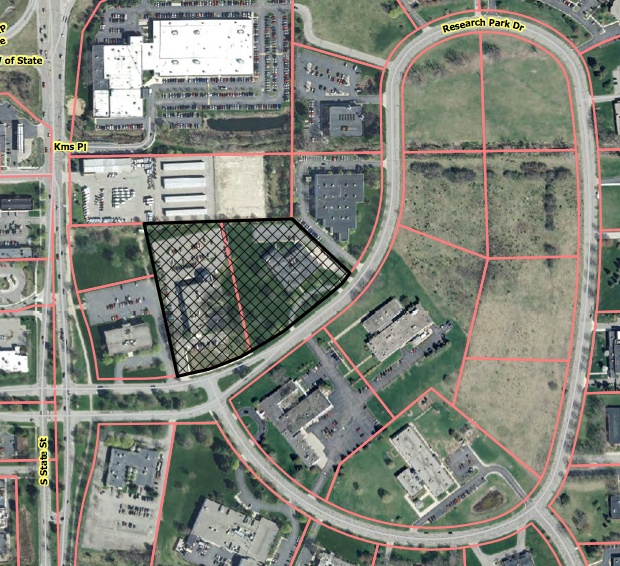
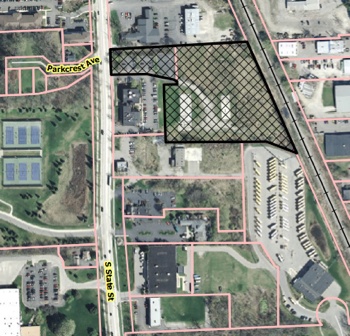
Aerial view of the proposed Hampton Inn site (outlined in black) on Jackson Avenue, adjacent to the eastbound I-94 entrance ramp.

The proposed four-story hotel, located on an 8.8-acre site north of Jackson and south of I-94, would include 100 bedrooms and 51,608 usable square feet. A 163-room Clarion Hotel is on the same site, east of the proposed new hotel. A driveway into the Hampton Inn would be across Jackson Road from the entrance to Weber’s Inn, which is located to the west. The Hampton Inn construction cost is estimated at $800,000.

A previous site plan for that location had been approved in 2008, and a Super 8 motel there was demolished. The foundation was laid for a new Hampton Inn, but the project was never completed and the building permits and site plan expired.

The development is seeking planned project status so that it can use the existing foundation. In 2008, no maximum front setback had been required. Now, however, a maximum front setback is required on at least one of the site’s three front property lines. A planned project status would allow that requirement to be waived.

According to a staff memo, a pedestrian crossing on Jackson Avenue is proposed from the Hampton Inn site to Hilltop Drive, which runs parallel to and south of Jackson and is separated by a landscaping island. The Ann Arbor Transportation Authority plans to relocate a bus stop on eastbound Jackson Avenue to be near this crossing.

Because Jackson Avenue is under the jurisdiction of the Michigan Dept. of Transportation, MDOT must review the plans for this development. The planning staff memo also states that footing drains of 10 homes must be disconnected to offset the project’s increased sanitary sewer flow.

The commission’s discussion primarily focused on sidewalk issues, with Bonnie Bona in particular criticizing the plan for not providing pedestrian access that made sense. Bona suggested that demand for pedestrian amenities will only increase in the future, and she couldn’t support this project unless the site plan addressed that design deficit. She proposed postponing the project so that modifications could be explored. The vote to postpone was unanimous.

This brief was filed from the second floor council chambers at city hall, 301 E. Huron. A more detailed report will follow.

Planning Commission Reviews Master Plan

At its June 18, 2013 meeting, the Ann Arbor planning commission unanimously adopted a master plan resolution and list of resource documents used to support the master plan. This is part of an annual evaluation of the master plan that’s required by the commission’s bylaws.

Seven documents constitute the city’s master plan: (1) sustainability framework, adopted in 2013; (2) parks and recreation open space (PROS) plan, as adopted in 2011; (3) land use element, as adopted in 2013 to add the South State corridor plan; (4) downtown plan, as adopted in 2009; (5) transportation plan update, as adopted in 2009; (6) non-motorized transportation plan, adopted in 2007; and (7) natural features master plan, adopted in 2004.

There is also a list of resource documents that are used to support the master plan. [.pdf of resource document list]

The commission had held a public hearing on suggestions related to the master plan on May 21, 2013. That hearing drew six speakers on a range of topics, including development in Lowertown, a park in downtown Ann Arbor, and adequate sidewalks, cleared of vegetation, so that kids can walk to school safely. On May 21 commissioners also discussed possible revisions, primarily related to supporting documents. However, on the advice of planning staff, commissioners postponed action until their June 18 meeting.

On June 18 the commission adopted a revised list of resource documents, with three new additions: (1) the Downtown Vision and Policy Framework (known as the Calthorpe study), adopted in 2006; (2) the Huron River Impoundment Management Plan (HRIMP), as adopted in 2009; and (3) the Allen Creek Greenway task force report, adopted in 2007. The greenway document was amended into the list during the June 18 meeting, at the suggestion of commissioner Bonnie Bona.

Earlier this year, on March 5, 2013, the planning commission had voted to add the Connecting William Street study to the list of resource documents – a move that generated some controversy.

This brief was filed from the second floor council chambers at city hall, 301 E. Huron. A more detailed report will follow.

Skatepark Construction Contract, Budget OK’d

A $1,224,311 budget for the Ann Arbor skatepark was recommended for approval by the Ann Arbor park advisory commission at its June 18, 2013 meeting. As part of that, a construction contract of $1,031,592 with Krull Construction of Ann Arbor was recommended. The project, which has been years in the works, will move to the city council for final approval, possibly at its July 15 meeting.

Ann Arbor skatepark, Wally Hollyday, Ann Arbor park advisory commission, Veterans Memorial Park, The Ann Arbor Chronicle

This conceptual design by Wally Hollyday for the Ann Arbor skatepark at the northwest corner of Veterans Memorial Park was approved by the city council on Jan. 7, 2013.

The originally approved budget for the project, to be located at the northwest corner of Veterans Memorial Park, was $800,000 – though the expectation was that the project would cost about $1 million. The total budget now – including the construction contract, 10% contingency and $89,560 design contract – is $1,224,311, or $424,311 higher than the originally budgeted $800,000.

Also on June 18, PAC recommended approval of the operating agreement between the city and the nonprofit Friends of the Ann Arbor Skatepark. Trevor Staples, FAAS president, was on hand at the meeting to field questions from commissioners. [.pdf of operating agreement]

The 11-page agreement outlines the responsibilities and scope of services to be provided by each entity. Regarding maintenance, for example, the agreement states:

Maintenance of the Ann Arbor Skatepark shall be provided by the City, a contracted service under the City’s control, or by volunteer groups that are programmed through the City’s volunteer program opportunities. City shall provide general oversight of the Skatepark infrastructure, such as making periodic inspections similar to neighborhood playground inspections. The City shall maintain records of staff costs, materials and supplies, and equipment costs related to the maintenance of the Ann Arbor Skatepark.

A later section on funding states: “The City, at its discretion, may decide to contribute to the payment of maintenance and operations for the Ann Arbor Skatepark.”

The skatepark will be guided by a new skatepark advisory committee, with members to be appointed by the city council and meetings held at least twice a year.

The city had issued a request for proposals (RFP) to build the skatepark earlier this year. Krull had originally turned in the lowest of three bids, at $1,191,738. Other bids were from Bernco Inc. ($1,251,104) and Gerace Construction ($1,275,273). Because all bids were considerably higher than the anticipated budget, parks staff negotiated with Krull to lower the amount by changing elements of the project. Those changes, according to a staff memo, include “replacing decorative ground cover with grass, plant plugs with seed, replacing rebar with structural fibers, and eliminating some decorative boulders.” In addition, “soil spoils” will be left on site to save on hauling costs. Krull also offered to cut $10,000 from its contract. All of these adjustments reduced the contract to $1,031,592.

Funds to pay for the skatepark include a $400,000 grant from the Washtenaw County parks & recreation commission, $300,000 from the Michigan Dept. of Natural Resources Trust Fund, and $100,00 raised by the Friends of the Ann Arbor Skatepark, which paid for the skatepark’s design. According to a staff memo provided to PAC, additional revenues for the project have now been identified from these sources:

  • $155,463.60 from uncommitted funds available in the parks maintenance and capital improvements millage fund balance. It represents about a quarter of the total $600,000 in the uncommitted fund balance.
  • $80,000 from the city’s stormwater capital budget for rain gardens, to be repaid as a loan to the State Revolving Fund (SRF). The city expects a 50% loan forgiveness on this amount.
  • $32,356 from the FY 2014 parks memorial and contributions fund (the Feldman Trust) for landscaping plantings.
  • $30,356 from the FY 2014 parks maintenance and capital improvements millage.
  • $22,977 from the FY 2014 parks and recreation services general fund operating budget – from the “parks fairness” funds resulting from other budget amendments made by the council.

In addition, up to $103,159.26 in uncommitted funds is available in the parks maintenance and capital improvements millage fund balance to cover a 10% construction contingency. Any unspent portion of this amount will be returned to the fund balance.

These recommendations will be forwarded to the city council for consideration. The council had approved the skatepark’s design at its Jan. 7, 2013 meeting. It was designed by Wally Hollyday whose firm, Wally Hollyday Skateparks, also has construction oversight of the skatepark.

This brief was filed from the second floor council chambers at city hall, where PAC holds its meetings. A more detailed report will follow.

Fee Waiver for Liberty Plaza Proposed

A recommendation to waive park rental fees for Liberty Plaza was unanimously approved by the Ann Arbor park advisory commission at its June 18, 2013 meeting. The waiver, which requires city council approval, would be enacted on a one-year trial basis through July 1, 2014.

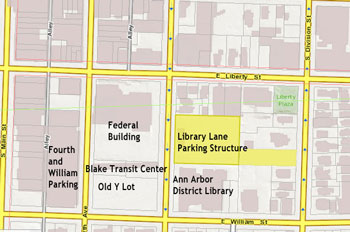
A staff memo accompanying the resolution describes Liberty Plaza – located on the southwest corner of Division and Liberty – as a problem park. The intent of waiving rental fees is to encourage activity there, such as the weekly Sonic Lunch series that’s sponsored by the Bank of Ann Arbor.  The memo states: “The waived rental fee can then be promoted with a goal of attracting additional musicians, performers, and other events at Liberty Plaza.”

The waiver also addresses a concern that has been raised regarding the “Pizza in the Park” event. At the May 20, 2013 Ann Arbor city council meeting, several people spoke to oppose the fee that was apparently charged to the Vineyard Church of Ann Arbor as part of its Friday evening homelessness ministry, which the church conducts at Liberty Plaza. At the council’s June 3 meeting, there was some follow-up during public commentary that included an interest in getting some kind of written commitment from the city that the fee would not be charged to the church.

The staff memo to PAC explicitly cites Pizza in the Park, noting that this waiver would assist that event and similar humanitarian efforts. The memo states that a waiver for all activities “would simultaneously remove the need for staff to determine which activities are worthy of waiving fees. Instead, any number of social, cultural, and recreational activities that are of benefit to the community could take advantage of the proposed fee waiver.”

This brief was filed from the second floor council chambers at city hall, where PAC holds its meetings. A more detailed report will follow.
Video Privacy Ordinance Delayed Again

Initial consideration of a new ordinance regulating the use of public surveillance cameras has been postponed yet again – this time until July 1. The Ann Arbor city council’s action came at its June 17, 2013 meeting. The council had previously postponed the item at its May 20, 2013 meeting. Before that the council had postponed the item at its April 15 meeting – due to the length of that meeting – and again on May 6. [.pdf of ordinance as presented to the council on April 15, 2013]

The proposed video privacy ordinance would not apply to CTN cameras like this one mounted in the Ann Arbor city council council chambers

The proposed video privacy ordinance would not apply to CTN cameras like this one mounted in the Ann Arbor city council chambers.

The new ordinance would apply only to a limited range of cameras – those used by the city of Ann Arbor “to monitor human activity without the physical presence of an operator, including cameras on remotely operated aerial vehicles.”

The ordinance would not apply to a range of city of Ann Arbor cameras, for example: cameras used to improve traffic design, security cameras operating in jails, prisons, water treatment facilities, public housing facilities, or the Ann Arbor Airport and other governmental facilities.

The new ordinance would allow for public surveillance cameras to be installed for 15 days or less at the discretion of the city administrator if the purpose is to address a specific criminal problem.

This brief was filed from the city council’s chambers on the second floor of city hall, located at 301 E. Huron. A more detailed report will follow.
Council OKs Appointments: Planning, Taxicab

Several appointments to boards and commissions were confirmed by the Ann Arbor city council at its June 17, 2013 meeting.

First, the council extended the appointment of the councilmember representative on the city planning commission. Sabra Briere (Ward 1), who’s served in that capacity since November 2012, had her term extended from June 30, 2013 through Nov. 7, 2013. At that point the membership on the new, post-election city council will be settled. Briere is unopposed in the Democratic primary. An independent candidate, Jaclyn Vresics, has taken out petitions for that seat but has not yet filed them with the city clerk’s office. The deadline for independent candidates to submit petitions is Aug. 7.

Also confirmed to the planning commission as a re-appointment was Bonnie Bona.

Although Tony Derezinski had appeared on the list distributed to the council at its June 3 meeting as a nomination to the city planning commission – and was reported (mistakenly) by The Chronicle as having been nominated – Derezinski’s name was not actually read aloud that evening. The Chronicle has now learned that there was pushback on the council about Derezinski’s nomination for re-appointment. He was filling out the remainder of Evan Pratt’s term – through June 30, 2013. Pratt was elected as Washtenaw County water resources commissioner in November 2012 and resigned from the planning commission at that time.

At the council’s Nov. 8, 2012 meeting, councilmembers had voted – over dissent from Jane Lumm (Ward 2) – to appoint Derezinski to that partial term. Up to that point, he’d served as the city council’s representative to the planning commission. However, he did not prevail in the August 2012 Democratic primary in his Ward 2 race against Sally Petersen.

On June 17, Jeremy Peters was nominated to replace Derezinski on the planning commission. Peters works in creative licensing and business affairs with Ghostly Songs. A council vote to confirm his appointment will occur on July 1.

Other appointments made on June 17 included members of the downtown area citizens advisory council. They had been re-nominated at the council’s June 3 meeting, having first appeared on the council’s May 13, 2013 meeting agenda for re-appointment. The names had not been presented to the council for confirmation on May 20. The terms of all the members had expired.

At the council’s June 17 meeting, LuAnne Bullington’s nomination to the taxicab board was confirmed, having been nominated on June 3. Bullington had submitted an application to serve on the board of the Ann Arbor Transportation Authority earlier this year, which resulted in a divided vote by the council on the nomination that was put forward by mayor John Hieftje – Eric Mahler. But Mahler was confirmed on a 7-4 vote as the AATA board appointment at the council’s May 13, 2013 meeting. He is currently ending service as a planning commissioner.

In the last few months, the council has taken an increased interest in mayoral appointments. That’s reflected in a change recommended by the council’s rules committee – to move the mayor’s communications time closer to the start of the meeting, instead of near the end. The mayor’s communications include nominations to boards and commissions and the council’s confirmation votes.

This brief was filed from the city council’s chambers on the second floor of city hall, located at 301 E. Huron. A more detailed report will follow.

Council OKs CIL Parking for The Varsity

A change to the development agreement between The Varsity – a 13-story, 177,180-square-foot apartment building containing 181 dwelling units (415 bedrooms) – has been given approval by the Ann Arbor city council. The council’s action – to confirm an Ann Arbor Downtown Development Authority decision to award the right to purchase a total of seven monthly permits, at a 20% premium cost – came at the council’s June 17, 2013 meeting.

The Varsity is located at 425 E. Washington St. in downtown Ann Arbor. Based on zoning requirements, 76 off-street parking spaces are required. Only 69 were provided onsite. The others were provided through the contribution in lieu (CIL) program. The seven spaces were approved by the Ann Arbor DDA at its June 5, 2013 meeting. It falls to the DDA to make a decision on the CIL spaces, because the DDA administers the city’s public parking system under a contract with the city of Ann Arbor.

This brief was filed from the city council’s chambers on the second floor of city hall, located at 301 E. Huron. A more detailed report will follow.

Plans OK’d: State Street, 544 Detroit, Packard Square

At its June 17, 2013 meeting, the Ann Arbor city council gave approvals in connection with three developments.

First, the council approved the site plan for the State Street Center, near the intersection of South State and Ellsworth. The project calls for demolishing a vacant 840-square-foot house on this site. In its place, the developer plans a one-story, 1,700-square-foot drive-thru Jimmy John’s restaurant facing South State Street. The rezoning of the parcel for this site plan was given final approval at the council’s June 3, 2013 meeting.

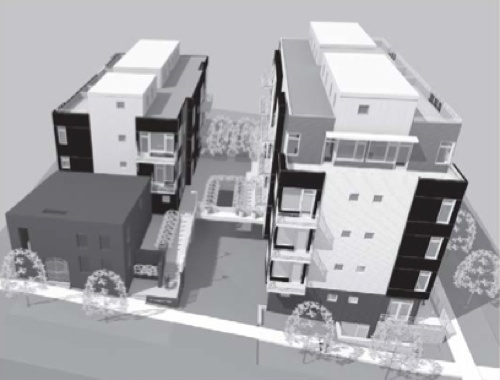
The council also gave approval for the 544 Detroit St. site plan. It’s planned to be a three-story building at 544 Detroit St. with offices on the first floor and residences on the upper two floors. It’s a “planned project” to allow an additional 3.5 feet of building height for a “decorative parapet” on the building’s north end and a stair enclosure to access a roof deck. [.jpg image of proposed design]

For the 544 Detroit St. project, the council also approved a brownfield plan. According to a staff memo, the brownfield component – which allows tax increment financing (TIF) to reimburse the developer for eligible costs – includes a total of $698,773 in eligible activities. Some of those eligible activities include soil remediation ($174,620), infrastructure improvements ($70,350), and vapor mitigation ($32,000).

The planning commission gave the 544 Detroit St. project a recommendation of approval at its Dec. 18, 2012 meeting.

And finally, the council approved an amendment to a previously-approved brownfield plan for Packard Square, at the former site of the Georgetown Mall. The amendment adds to the list of eligible activities – including underground parking and urban storm water management. The total cost of eligible activities is not changed. Demolition at the site began a few weeks ago.

This brief was filed from the city council’s chambers on the second floor of city hall, located at 301 E. Huron. A more detailed report will follow.
Ann Arbor OKs $382K for Housing Commission

The Ann Arbor Housing Commission has been provided $382,000 of operational support through action taken by the Ann Arbor city council at its June 17, 2013 meeting.

The resolution was held over from the council’s June 3, 2013 meeting. That’s when the council took several steps to move the Ann Arbor Housing Commission forward along a path to converting the properties it manages to project-based vouchers. A similar operations funding resolution had appeared on that meeting’s agenda, but was withdrawn.

The additional funding, according to a staff memo accompanying the resolution, is needed in order to mitigate against the impact of federal sequestration. The memo puts that impact at about $300,000 less for public housing and $50,000-$75,000 less for capital funding.

Of the total amount, $159,000 is appropriated from the city of Ann Arbor’s affordable housing trust fund, and $223,000 would be appropriated from the general fund. The housing and human services advisory board had voted to recommend the $159,000 be appropriated from the city’s affordable housing trust fund.

This brief was filed from the city council’s chambers on the second floor of city hall, located at 301 E. Huron. A more detailed report will follow.
Council Commits Up to $750,000 for 721 N. Main

A commitment of up to $750,000 from the city’s general fund – to undertake planned improvements to the city-owned property at 721 N. Main – has been made by the Ann Arbor city council in action taken at its June 17, 2013 meeting. The commitment is a requirement for a grant application that the city is making to the Michigan Natural Resources Trust Fund for $300,000.

If the city’s plan unfolds as it expects, then none of the $750,000 in general fund money would be needed.

The improvements to 721 N. Main have resulted from work done by a North Main corridor improvement task force that has been working at the direction of the city council since the summer of 2012 to make recommendations for the corridor.

Of the $1.2 million estimated cost for the planned trail and stormwater improvements to the site, the city plans to use $150,000 from the city’s stormwater fund. To cover part of the remaining $1.05 million, the city hopes to use $600,000 from a grant it it’s applied for from the Michigan Dept. of Transportation (MDOT) and the Southeast Michigan Council of Governments (SEMCOG) – through SEMCOG’s transportation alternatives program (TAP).

The council approved the application for the SEMCOG grant at its April 15, 2013 meeting. To cover the remaining $450,000, the city hopes to use $150,000 from a Washtenaw County Parks & Recreation Connecting Communities grant and $300,000 from the Michigan Natural Resources Trust Fund (MNRTF) grant. The council approved the application for those last two grants at its Dec. 17, 2012 meeting.

The council’s resolution passed on June 17 comes in response to an MNRTF grant requirement that the council commit the city to funding the other grants itself – from general fund money – if the grants fail to materialize. The $750,000 figure comes from adding the $600,000 SEMCOG grant to the $150,000 Washtenaw County Parks & Recreation grant.

This brief was filed from the city council’s chambers on the second floor of city hall, located at 301 E. Huron. A more detailed report will follow.
Ann Arbor Police Unions Get Wage Bump

The Ann Arbor city council has approved contracts with city police unions that award 2% and 1% wage increases.

Re-openers for the final year of their contracts resulted in new contracts with six police department unions, which the council approved on separate votes: Teamster Civilian Supervisors, Teamsters Local 214; Police Professional Assistants, Teamsters Local 214; Ann Arbor Police Officers Association – Police Service Specialists; Command Officers Association of Michigan; Ann Arbor Police Officers Association; and Deputy Chiefs, Teamsters Local 214.

Common to all the contracts are a 2% wage increase starting July 1, 2013 and a 1% increase starting Jan. 1, 2014.

Also common to the contracts is the acceptance of the change in pension board composition, which was approved by voters on Nov. 8, 2011 with a 68% majority. The change retained the body as a nine-member group but distributed the membership differently, as follows: (1) the city controller; (2) five citizens; (3) one from the general city employees; and (4) one each from police and fire employees. Eliminated from the mix was the city administrator.

This brief was filed from the city council’s chambers on the second floor of city hall, located at 301 E. Huron. A more detailed report will follow.
Ann Arbor Council Corrects Millage Rate

A .0031 error in the specification of the rate of the FY 2014 tax levy for the city’s park maintenance and capital improvements millage was corrected in action taken by the Ann Arbor city council at its June 17, 2013 meeting. The FY 2014 fiscal year begins on July 1.

The millage rate that was listed in the FY 2014 budget resolution – approved by the council at its May 20, 2013 meeting – was 1.0969 mills. The park maintenance and capital improvements millage should have been listed as 1.10 mills. The corresponding correction from the total millage rate was from 16.4470 to 16.4501 mills. Measured in dollars, the correction is estimated to bring in an additional $14,460 in revenue.

This brief was filed from the city council’s chambers on the second floor of city hall, located at 301 E. Huron. A more detailed report will follow.

Ann Arbor to SEMCOG on Highways: No Thanks

A resolution opposing the proposed expansion of I-94 in Detroit and I-75 in Oakland County has been passed by the Ann Arbor city council. The council’s symbolic action came at its June 17, 2013 meeting. The Washtenaw County board of commissioners passed a similar resolution at its June 5, 2013 meeting. The interstate highway expansion is a part of SEMCOG’s 2040 Regional Transportation Plan with an estimated cost of $4 billion.

This brief was filed from the city council’s chambers on the second floor of city hall, located at 301 E. Huron. A more detailed report will follow.
Ann Arbor Council Delays on Rule Changes

The Ann Arbor city council has delayed action on possible changes to its speaking rules, essentially choosing to follow its own existing meta-rule on rules changes – which requires that the council be notified about possible rules changes at one meeting, before taking action at a subsequent meeting. The council is considering changes that would add a period of public commentary to its work sessions, but reduce public speaking time per turn from three minutes to two minutes. [.pdf of draft rules changes] The action that the council took at its June 17, 2013 meeting was to postpone the item until its July 1 meeting.

The procedure for reserving one of the 10 reserved speaking slots at the start of the meeting is also proposed to be revised. Only people who did not address the council at its immediately previous meeting would be eligible to reserve a slot. And of the 10 slots, eight would be designated for those who want to address the council on agenda action items. Two slots would be provided for those who want to address the council on any topic.

Councilmember speaking time is also proposed to be reduced. Councilmembers are allowed two speaking turns per agenda item. Under the current rules, time limits for those speaking turns are five minutes for the first turn and three minutes for the second turn. Under the proposal, those times would be reduced to three minutes and two minutes, respectively.

The proposed addition of an opportunity for public commentary at council work sessions would ensure that councilmembers could freely deliberate toward public policy decisions at those sessions and still conform to Michigan’s Open Meetings Act.

The proposed rules changes would move mayoral communications from the end of the meeting to a spot closer to the start of the meeting. That would give nominations to boards and commissions – which are a part of those communications – somewhat greater prominence.

The council will vote on adoption of the rules at its July 1 meeting. [For previous Chronicle coverage, see: "Council Mulls Speaking Rule Changes."]

This brief was filed from the city council’s chambers on the second floor of city hall, located at 301 E. Huron. A more detailed report will follow.
Council OKs Annual Contracts: SPARK, Lobbyist

The Ann Arbor city council approved two annual contracts for services at its June 17, 2013 meeting. One was a $48,000 contract with Governmental Consultant Services Inc. (GCSI) for lobbying services with the state legislature. The council also approved a $75,000 contract with Ann Arbor SPARK for business support services.

The two items appeared on the council’s consent agenda and were approved as a part of it. Items on the consent agenda are considered routine, and include contracts for less than $100,000.

The contact with the economic development agency Ann Arbor SPARK is one that has been renewed annually since the Washtenaw Development Council and Ann Arbor SPARK merged in 2006. Previously, Ann Arbor had contracted with the WDC for the business support services for which it now contracts with SPARK. On June 20, 2005, the city council authorized that one-year contract with WDC for $40,000. The resolution authorizing the $75,000 contract with SPARK again this year describes the organization’s focus as “building our innovation-focused community through continual proactive support of entrepreneurs, regional businesses, university tech transfer offices, and networking organizations.”

Ann Arbor SPARK is also the contractor hired by the city’s local development finance authority (LDFA), to operate a business accelerator for the city’s SmartZone, one of 11 such districts established in the early 2000s by the Michigan Economic Development Corp. (MEDC). The SmartZone is funded by a tax increment finance (TIF) mechanism, for a TIF district consisting of the union of the Ann Arbor and Ypsilanti Downtown Development Authority districts.

Revenue is generated only in Ann Arbor’s district, and the LDFA is a component unit of the city’s budget. In the FY 2014 budget, the LDFA is expected to receive $1,655,647 in revenue. The specific taxes on which the increment since 2002 is captured are the school operating and state education taxes, which would otherwise be sent to the state and then redistributed back to local school districts.

GCSI’s Kirk Profit, a former member of the state House of Representatives, typically makes an annual presentation to the council with an update on state-level legislative issues relevant to the city’s budget situation. Written updates to councilmembers on legislative activity are sent on a weekly or daily basis.

This brief was filed from the city council’s chambers on the second floor of city hall, located at 301 E. Huron. A more detailed report will follow

15th District Court Drives City Budget Adjustment

The annual year-end budget adjustment has been approved by the Ann Arbor city council. The changes to the FY 2013 budget totaled $567,000 for the general fund, much of which stemmed from additional expenses incurred by the 15th District Court. [.pdf of proposed amendments]

The 15th District Court’s portion of that adjustment stemmed from $112,000 in salary increases based on an interest in retaining employees, $203,000 due to a “catch up” payment to the law firm that provides indigent representation, and a back-bill for security from Washtenaw County for two fiscal years for $110,000.

Related to the FY 2013 budget adjustment to account for 15th District Court indigent representation were two other agenda items regarding the law firm that provides that kind of representation. [The 15th District Court is required to provide representation to those who cannot afford an attorney, if a conviction would result in jail time.]

The council approved a $240,000 flat-fee contract for representation of indigent defendants – with Nassif and Reiser, P.L.L.C. (f/k/a Funkhouser and Nassif, P.L.L.C.), d/b/a Model Cities Legal Services (“MCLS”). The contract covers FY 2014.

The reason the contract was structured as a flat fee is that MCLS had customarily delayed billing for services until a defendant’s case was completely closed or additional court action was deemed unlikely. Even after a guilty verdict, defendants remain under court supervision and can be subject to other court orders. So for the previous year, the council was asked at its June 3 meeting to cover $203,000 of fees that accrued due to the delayed billing practice used by MCLS.

In addition to approving the city’s FY 2013 budget adjustment that included back-billing for security services, the council approved next year’s $160,000 contract with the Washtenaw County sheriff’s office for weapons screening at the Justice Center, which houses the 15th District Court. The estimated annual cost is based on $25.25 per hour per court security officer. The estimated maximum annual cost of $160,000 is $27,000 less than last year. The money comes from the 15th District Court’s budget.

Two other items related to the 15th District Court appeared initially on the council’s consent agenda, a group of items considered routine and voted on as a group. The council was asked to approved $30,000 for a Sobriety Court grant program contract with the Washtenaw Community Health Organization (WCHO) to provide mental health treatment to 15th District Court defendants. And the council was asked to approve $65,000 for a Sobriety Court grant program contract with Dawn Farm for in-patient and out-patient drug abuse counseling to 15th District Court defendants.

The Dawn Farm item was pulled out for separate consideration, because the item included a request for a waiver of the city’s living wage ordinance for Dawn Farm to provide its counseling services. According to the staff memo accompanying the resolution, Dawn Farm employs 70 people, including 15 employees who are paid less than $12.52 per hour with health care coverage, and 18 people who are compensated at rates less than $13.96 per hour without health care coverage. Those are the rates specified in the city’s living wage ordinance.

Last fall the council engaged in a vigorous discussion of a living wage ordinance waiver for Community Action Network (CAN), which ultimately resulted in the granting of a waiver at the council’s Nov. 8, 2012 meeting.

On June 17, the council ultimately voted to approve the Dawn Farm grant over dissent from Sabra Briere (Ward 1) – based on the living wage issue.

This brief was filed from the city council’s chambers on the second floor of city hall, located at 301 E. Huron. A more detailed report will follow.

Fireworks Timing Curtailed in Ann Arbor

Fireworks for the upcoming July 4 holiday will be limited in Ann Arbor to the time between 8 a.m. and midnight – assuming Gov. Rick Snyder signs bill passed by the Michigan House and Senate.

The revision to the city’s fireworks ordinance was given initial approval at the council’s June 3. 2013 meeting. The impact of the ordinance change is to restrict the use of fireworks on July 3-5 to the period between 8 a.m. and midnight on those days. The ordinance change applies to other national holidays as well.

The ordinance change is made possible by an anticipated change to state law, which previously did not allow local governments to regulate fireworks for the continuous 72-hour period for the day preceding a national holiday, the national holiday, and the day following the national holiday. The pending change to state law makes it possible for a local government to regulate the time of firework use around the time of national holidays. The bill has already been approved by the Michigan House and Senate, and is expected to be signed into law by July 4 this year.

This brief was filed from the city council’s chambers on the second floor of city hall, located at 301 E. Huron. A more detailed report will follow.

Library Board OKs Budget Adjustments

At its June 17, 2013 meeting, the Ann Arbor District Library board voted to make minor year-end adjustments to the budget for fiscal year 2012-13, which ends June 30. This is a standard action at the end of the fiscal year.

The adjustments entailed making the following transfers:

  • $18,000 from capital outlays to the supplies line item.
  • $15,000 from capital outlays to the utilities line item.
  • $12,000 from repairs & maintenance to the communications line item.
  • $4,000 from repairs & maintenance to the line item for other operating expenditures.
  • $10,000 from the fund balance/restricted funds to the programming line item.

This brief was filed from the library’s Traverwood branch at Traverwood Drive and Huron Parkway, where the board held its June meeting. A more detailed report will follow.

AADL OKs Contract for Pittsfield Internet

The Ann Arbor District Library board approved a $112,150 contract with the nonprofit Merit Network to build and maintain a connection from AADL’s Pittsfield branch to Merit’s existing high-speed network. The action took place at the board’s June 17, 2013 meeting.

The board had been briefed at its May 6, 2013 meeting by Eli Neiburger, AADL’s associate director of IT and production. He had described that location at 2359 Oak Valley Drive as a “bandwidth backwater,” with about 2% of the Internet connectivity speed compared to other AADL locations.

The resolution approved on June 17 included a transfer of $120,000 from the library’s fund balance to its communications line item in the FY 2013-14 budget. The board had passed its FY 2013-14 budget on May 6, for the fiscal year starting July 1, 2013. The arrangement with Merit is expected to include ongoing annual costs of $2,625.

This brief was filed from the library’s Traverwood branch at Traverwood Drive and Huron Parkway, where the board held its June meeting. A more detailed report will follow.

Judge: No Anti-Israel Ad on Bus for Now

After a four-month pause in court action on a lawsuit filed against the Ann Arbor Transportation Authority – for its refusal to place an anti-Israel ad on its buses – a ruling came earlier this week. Federal judge Mark Goldsmith did not agree with Blaine Coleman and the ACLU’s argument that the preliminary injunctive relief to which they were entitled should take the form of placing the ad on AATA buses.

On the general motion for a preliminary injunction made by the ACLU, Goldsmith had earlier ruled in the case that the AATA’s policy – under which the advertisement had originally been rejected – was unconstitutional. In light of that ruling, the AATA then changed its advertising policy to remove a “good taste” requirement and to add a clear prohibition against political ads in general, not just those for political candidates.

The AATA then reconsidered the original ad under its revised policy. The text of the proposed ad reads “Boycott ‘Israel’” and “Boycott Apartheid” and features an image of a spider-like creature with a skull for a head. [.pdf of image and text of proposed ad].

The AATA then rejected the ad under its new policy, which the court has found to be constitutional.

Goldsmith then entertained arguments from both sides on the question: Should further preliminary injunctive relief be granted, beyond the revision of the advertising policy and the ad’s reconsideration and rejection? The ACLU argued that it would be appropriate to grant injunctive relief by forcing the AATA to place the ad on its buses. The AATA argued that this kind of relief was not justified. And four months after the last briefs were submitted on that question, Goldsmith ruled that the ACLU had not met the criteria for injunctive relief in that form.

In Goldsmith’s ruling, he lays out the importance of establishing a clear argument on “viewpoint discrimination” – which he felt that the ACLU had not adequately developed within the frame of its request for preliminary injunctive relief. But the ruling seems to indicate  a willingness on Goldsmith’s part to entertain further arguments along the specific lines of “viewpoint discrimination” – if the ACLU is able to make them – as the case proceeds. [.pdf of June 4, 2013 ruling]

The next step is a June 12, 2013 status conference. The ACLU can at this point proceed to trial, where one result could be that the AATA is forced to place the ad. Or the ACLU could immediately appeal the ruling on the injunctive relief.

In an earlier ruling, Goldsmith found that Coleman’s proposed ad had originally been denied on both the “good taste” provision and the “scorn and ridicule” provision. The “good taste” provision itself was ruled unconstitutional. But based on Goldsmith’s June 4 ruling, a main issue at trial – if it were to proceed – will be whether the AATA applied the “scorn and ridicule” provision in a way that was constitutional.

If the AATA can defend its application of that provision as constitutional, then the AATA could argue: Coleman was not damaged by having his ad denied for an unconstitutional reason (“good taste”) – because there was some other, constitutional reason for denying the ad. So the ACLU will likely make an effort to establish that the denial of the ad was based on an application of the AATA’s “scorn and ridicule” provision that included viewpoint discrimination, and was thus also not constitutional.

The lawsuit was filed on Nov. 28, 2011.

County Board Debates Trial Court Funding

In a move that appeared to surprise many commissioners and staff, Washtenaw County commissioner Alicia Ping (R-District 3) formally proposed giving notice to eliminate a lump-sum budgeting approach for the Washtenaw County Trial Court. She made the proposal at the board’s June 5, 2013 meeting.

Alicia Ping, Washtenaw County board of commissioners, The Ann Arbor Chronicle

Washtenaw County commissioner Alicia Ping (R-District 3) at the board’s June 5, 2013 meeting.

After a lengthy and often heated debate, the board gave initial approval to give notice, but postponed final action until July 10. The approval was on a 5-4 vote.

Unlike other units of county government, which prepare line-item budgets authorized by the county board, the trial court operates under a memorandum of understanding with the board of commissioners. The board approved that MOU on Jan. 19, 2011, replacing one that had been in place since 1990. [.pdf of memorandum of understanding] As part of the agreement, the county pays for operations of the trial court in four “lump sums,” allocated separately to: (1) the 22nd Circuit Court [including circuit court administration, juvenile-general fund, friend of the court and community corrections]; (2) Probate Court [estates & mental health]; (3) 14-A District Court; and (4) the child care fund. The county does not have line-item budgeting authority, but the trial court agreed to submit a bi-annual line-item budget, and provide quarterly financial projections.

The proposal by Ping, the board’s vice chair, comes in the context of the administration’s goal of identifying $6.99 million in structural reductions for the 2014 budget. For several weeks, Ping has raised concerns that the court is treated differently than other county units in the budgeting process. At the board’s May 15, 2013 meeting, she asked to see the history of funding for the courts, saying she was curious about whether the courts had cut in the same way that other county units had cut. “I’d like to know that we’re all in the game together,” she said at the time. [.pdf of historical funding for public safety & justice operations]

On June 5, Ping noted that her goal isn’t necessarily to cut funding for the courts, but rather to be more transparent about where the money goes. The board could ultimately decide to leave the lump sum approach in place. Giving a notice to terminate the agreement simply gives the board the option to end it.

Conan Smith (D-District 9) supported the action, saying that the legislative branch has budgeting responsibility, and the board has abrogated that responsibility by agreeing to lump sum funding. With a line-item approach, the county board could indicate priorities for the court by allocating more funds to specific areas. Dan Smith (R-District 2) also argued in favor of the action, noting that the courts are funded with essentially no oversight.

No one from the trial court attended the June 5 meeting – the proposal had not been on the published agenda.

The process for ending the lump sum agreement is written into the MOU:

13. Modification and Duration – This Agreement may be modified by mutual consent of the parties. This Agreement shall continue indefinitely and may be terminated only upon one year’s written notification by a party to all other parties. The County agrees to include the Court in the modification process relative to any County policies covered by this Agreement.

However, during the board’s June 5 ways & means committee meeting – when Ping brought forward the proposal – the discussion was based on a faulty assumption that the MOU called for a six-month notification process. That assumption influenced the debate, with some commissioners arguing for urgency in order to end the agreement before voting on the next budget. The administration is preparing a new four-year budget from 2014-2017, which will require board approval before Dec. 31, 2013.

Ronnie Peterson (D-District 6) argued most strongly against Ping’s proposal, fearing it would damage the board’s relationship with the courts. [Though he was not mentioned by name, the trial court is led by chief judge Donald Shelton.] Rolland Sizemore Jr. (D-District 5) warned that the board might be starting a fire that they couldn’t put out. He noted that if the court decides to sue, the county would be required to pay the attorney fees.

Yousef Rabhi (D-District 8), the board’s chair, indicated that he didn’t know Ping would be making this proposal. He agreed with her reasons for making it, but was concerned about the process. He felt there hadn’t been sufficient thought given to the ramifications of this action.

After further debate during the ways & means committee meeting – including a failed attempt to postpone the item – the board voted 5-4 to give initial approval. Voting in favor were Ping, Conan Smith, Dan Smith, Andy LaBarre and Kent Martinez-Kratz. Voting against the proposal were Yousef Rabhi, Ronnie Peterson, Rolland Sizemore Jr. and Felicia Brabec.

Commissioners initially were set to take a final vote at the board meeting that same night – held immediately after the ways & means committee meeting. However, after a break between the two meetings, corporation counsel Curtis Hedger reported that the MOU actually required a full year of notice. This turned the opinion of some commissioners, who wanted to take more time to study the issue. Andy LaBarre (D-District 7), who chairs the board’s working session, offered to schedule the topic for a working session as soon as possible.

Rabhi lobbied for postponement, saying he didn’t want to create a confrontational atmosphere with the courts – although he acknowledged that the evening’s discussion might have already damaged that relationship. He proposed postponing final action until July 10.

The motion to postpone passed on a 6-3 vote, with dissent from Alicia Ping, Dan Smith and Kent Martinez-Kratz. The proposal will be on the board’s July 10 agenda. That meeting will also include action related to the county’s major bonding initiative.

This brief was filed from the boardroom of the county administration building at 220 N. Main St. in Ann Arbor. A more detailed report will follow: [link]

County Holds 1st Hearing on Bond Proposal

The Washtenaw County board of commissioners has held the first of two public hearings on a potential $345 million bond proposal, drawing four people who expressed caution about the possible action. The hearing was held at the board’s June 5, 2013 meeting. A second hearing is scheduled for July 10, when the board will likely take action on the proposal.

The proposed bond issue of up to $345 million, the largest in the county’s history, is intended to cover unfunded pension and retiree healthcare obligations from the Washtenaw County Employees’ Retirement System (WCERS) and Voluntary Employees Beneficiary Association (VEBA) – the defined benefit pension and retiree healthcare plans. Those plans will be closed to employees hired after Jan. 1, 2014.

The proposal had first been mentioned publicly in mid-April, though the administration has been working on it since November of 2012, and commissioners had discussed it in closed session earlier this year as part of the county’s negotiations for new labor contracts. For background, see Chronicle coverage: “County Board Debates $345M Bond Proposal” and “County Budget, Bonding Decisions Loom.”

The original plan called for taking an initial vote on May 15 authorizing the publication of a “notice of intent” for the bond issue, with final approval on June 5. Responding to concerns about the speed at which the process was moving – without the opportunity for sufficient public input – board chair Yousef Rabhi pushed back the timetable. Now, it’s expected that a resolution to issue the notice of intent will come before the board on July 10 for initial – and possibly final – approval. This is a standard step in the bonding process, letting residents know that they have 45 days during which they can circulate petitions to require a vote of the people before any bonds are issued.

The board is also holding a working session on June 6 focused on the bond proposal. Participating in the session will be: John Axe, the county’s bond counsel; Rowan Miranda, associate vice president for finance at the University of Michigan; Jens Stephan, accounting professor at Eastern Michigan University; and Larry Langer of Buck Consultants LLC. The working session begins at 6 p.m. in the boardroom of the county administration building, 220 N. Main in Ann Arbor.

In addition, other forums for public input are scheduled:

  • Saturday, June 15: 4-6 p.m. “Bonding over Coffee” with Yousef Rabhi at Espresso Royale, 214 S. Main St., Ann Arbor.
  • Wednesday, June 26: 4-6 p.m. “Bonding over Coffee” with Yousef Rabhi at Caribou Coffee, 1423 E. Stadium Blvd. (corner of Packard and Stadium).
  • Thursday, June 27: 4:30 p.m., public forum with county administrator Verna McDaniel at the Learning Resource Center, Room A, 4135 Washtenaw Ave., Ann Arbor.

This brief was filed from the boardroom of the county administration building at 220 N. Main St. in Ann Arbor. A more detailed report will follow: [link]

County Board Sets Millage Rates

Washtenaw County’s 2013 general operating millage rate has been set at 4.5493 mills – unchanged from the current rate. The county board took a final vote on the rate at its June 5, 2013 meeting, after giving initial approval on May 15.

Several other county millages were authorized and are levied separately: emergency communications (0.2000 mills), the Huron Clinton Metroparks Authority (0.2146 mills), two for county parks and recreation (0.2353 mills and 0.2367 mills) and for the natural areas preservation program (0.2409 mills). That brings the total county millage rate to 5.6768 mills, a rate that’s also unchanged from 2012.

This is an annual procedural action, not a vote to levy new taxes. With a few minor exceptions, the county board does not have authority to levy taxes independently. Millage increases, new millages or an action to reset a millage at its original rate (known as a Headlee override) would require voter approval.

The rates will be included on the July tax bills for property owners in Washtenaw County.

On June 5, the board also held a public hearing on the millage rates. The only speaker was Thomas Partridge.

This brief was filed from the boardroom of the county administration building at 220 N. Main St. in Ann Arbor. A more detailed report will follow: [link]

Jarvis Stone School Gets Historic Designation

Jarvis Stone School in Salem Township – a former one-room schoolhouse built in 1857 and located at 7991 North Territorial Road – will be designated as an historic district, following action at the June 5, 2013 meeting of the Washtenaw County board of commissioners. [.pdf of ordinance]

The board approved an ordinance that designates the 1.42-acre property as an historic district under the jurisdiction of the Washtenaw County Historic District Commission. The property is owned by the Salem Area Historical Society, which uses the school as its headquarters. It would be the second historic district in Salem Township. The first one is Conant Farm on Napier Road.

The Salem Township board had granted a request to consider the property as an historic district in 2011. And at its Oct. 19, 2011 meeting, the county board voted to establish a study committee regarding the request. That report was completed this year. [.pdf of study committee report]

This brief was filed from the boardroom of the county administration building at 220 N. Main St. in Ann Arbor. A more detailed report will follow: [link]

County Approves Community Corrections Plan

At its June 5, 2013 meeting, the Washtenaw County board of commissioners approved an annual community corrections plan with a $1,042,468 budget for FY 2013-14 – from Oct. 1, 2013 through Sept. 30, 2014. [.pdf of community corrections plan]

The community corrections division is a unit of the Washtenaw County sheriff’s office, with an emphasis on programs and services aimed at keeping people out of jail by providing sentencing options for the Washtenaw County Trial Court – including pre-trial services, drug testing, electronic monitoring, and social education. The funding comes from several sources: (1) $421,900 in state revenue; (2) $260,890 in program-generated fees; (3) $240,983 in appropriations from the county’s general fund; and (4) $118,703 from fund balance.

According to a staff memo, an estimated 99,365 jail bed days were saved in 2012, for an estimated savings of $8.446 million – based on an estimate of $85 per day for incarceration. [.pdf of staff memo]

This brief was filed from the boardroom of the county administration building at 220 N. Main St. in Ann Arbor. A more detailed report will follow: [link]

County Brownfield Hearings Set for July 10

Public hearings for two brownfield redevelopment projects in Ann Arbor – at Packard Square (the former Georgetown Mall), and 544 Detroit St. – will be held at the Washtenaw County board of commissioners meeting on July 10, 2013. The board set the hearings at its June 5 meeting in two separate votes. The board’s two Republican commissioners – Alicia Ping and Dan Smith – cast the only votes of dissent. They voted against the public hearing on the 544 Detroit St. proposal. They did not publicly state their reasons for voting against the hearing on that project.

Since the city of Ann Arbor joined the Washtenaw County Brownfield Redevelopment Authority (WCBRA) in 2002, brownfield projects located in the city must receive approval by the county board. The state’s brownfield program offers incentives for redevelopment of property that’s contaminated, blighted or “functionally obsolete.”

The 544 Detroit St. project is seeking brownfield status so that it will be eligible for brownfield tax increment financing. The site plan calls for a three-story “flatiron-style” building, located at the triangle tip of Detroit and North Division, just southwest of the Broadway bridge – the site of a long-abandoned gas station in the Old Fourth ward Historic District. The new building would include offices on the first floor and residences on the upper two floors. The project’s site plan received a recommendation for approval by the Ann Arbor planning commission on Dec. 18, 2012. Both the site plan and brownfield plan are expected to be on the council’s June 17 agenda, according to city planning manager Wendy Rampson.

For Packard Square, the July 10 hearing relates to a proposed amendment to the project’s original brownfield redevelopment plan, which the county board approved after much debate on May 18, 2011. At that same meeting, the board approved a $1 million grant application to the state Dept. of Environmental Quality for brownfield cleanup at the proposed $50 million development – that grant was later awarded to the project. Demolition is underway, with plans to build more than 200 apartments and 20,000 square feet of commercial space at 2502-2568 Packard Street.

The amendment to Packard Square’s brownfield plan would add eligible activities that qualify for brownfield tax increment financing, including underground parking and urban stormwater management infrastructure. Those activities are now eligible for TIF, following changes by the state legislature to the Brownfield Redevelopment Act 381 in December 2012.

In addition to the public hearings on July 10, the county board will likely take action on both brownfield items at that meeting.

This brief was filed from the boardroom of the county administration building at 220 N. Main St. in Ann Arbor. A more detailed report will follow: [link]

County Board Takes Stand Against Gun Violence

At its June 5, 2013 meeting, the Washtenaw County board of commissioners passed a resolution declaring June 2013 as Gun and Societal Violence Awareness Month.

The resolution states that the board “supports President Barack Obama’s continued efforts to reduce gun violence through enhanced background checks, restricted sales of some types of ammunition and high capacity magazines; and … further supports the reduction of societal violence through the development of proactive programs that will educate citizens on non-violent conflict resolution and allow physicians to prevent firearm and other violence related injuries through health screening, patient counseling, and referral to mental health services for those with behavioral or emotional medical conditions.”

According to county records, applications for concealed pistol licenses in Washtenaw County have increased dramatically so far this year. There were 1,510 applications for the first four months of 2013, compared to 717 applications during the same period in 2012. For the full 12-month period in 2012, the county received 2,153 applications – compared to 546 in 2007. [.pdf of application data from 2004-2013] [.pdf of approved licenses from 2008-2013]

The June 5 resolution was brought forward by board chair Yousef Rabhi and commissioner Conan Smith – both Democrats representing districts in Ann Arbor.

This brief was filed from the boardroom of the county administration building at 220 N. Main St. in Ann Arbor. A more detailed report will follow: [link]

Dexter Annexation Request in the Works

A public hearing is set for July 10, 2013 regarding the annexation of land from Scio Township into the village of Dexter. The hearing will take place at the July 10 meeting of the Washtenaw County board of commissioners, which must vote on the annexation. Commissioners set the hearing at their June 5 meeting.

According to the county’s corporation counsel, Curtis Hedger, the annexation of township property into a village is one of the few instances that requires county board approval. Generally, annexation is handled by the individual municipalities where the annexation occurs.

A letter to the county from Dexter village manager Donna Dettling states that the annexation request – for a 16.66-acre property – was made by the property owner, Dexter Fastener Technologies, known as Dextech. The land is adjacent to the Dexter Business & Research Park, where Dextech hopes to expand. The company is one of Dexter’s largest employers.

On May 13, 2013, the Dexter village council unanimously passed a resolution in support of the annexation. The resolution indicates that although the Scio Township board did not take formal action about the request, there was generally support for the action. [.pdf of communications from Dexter regarding the annexation]

This brief was filed from the boardroom of the county administration building at 220 N. Main St. in Ann Arbor. A more detailed report will follow: [link]

County Weighs $5M in Facilities Improvements

A range of infrastructure projects totaling about $5 million are being proposed for Washtenaw County government facilities, including redeveloping the Platt Road site where the old juvenile center was located. The county board of commissioners gave initial approval to the overall proposal – called the “strategic space plan” – at its June 5, 2013 meeting. A final vote is expected on July 10.

Projects include:

  • Demolish the former juvenile center and explore redeveloping the site at 2260 and 2270 Platt Road for affordable housing, alternative energy solutions, and county offices.
  • At 200 N. Main in Ann Arbor, consolidate the land records from the building’s lower level to the 1st floor, and remodel the lower level to accommodate administrative offices.
  • At 220 N. Main in Ann Arbor, repurpose space in the garden level, including redesigning conference room space.
  • At 110 N. Fourth in Ann Arbor (known as the Annex), relocate the Office of Community and Economic Development, Office of Infrastructure Management, and the Public Defender’s office to other leased and county-owned space.
  • At the county’s service center near Washtenaw and Hogback, redesign the Learning Resource Center (LRC) as a full conference center, providing county-owned space for large and small meetings. Also, make parking improvements, including adding 110 new spaces, rebuilding the lot between the LRC and the courthouse, and resurfacing the entry drive off of Hogback.
  • At a location to be determined, develop a specialty vehicle storage facility for the sheriff’s office and other departments.

According to Greg Dill, the county’s infrastructure management director, no general fund dollars will be used for the projects, which are estimated to cost about $5 million. Funding will come from several sources: (1) $1 million from the 1/8th mill fund balance; (2) $650,000 from the facilities operations & maintenance fund balance; (3) $650,000 from the Office of Community & Economic Development reserves; (4) $500,000 from the tech plan fund balance; and (5) $2.2 million from the county’s capital reserves. Dill had briefed commissioners on the plan at a March 20, 2013 working session.

In addition to the projects listed above, other changes will be made to accommodate the county’s Community Support and Treatment Services (CSTS) unit, which provides contract services to the Washtenaw Community Health Organization (WCHO). The WCHO will pay for that facilities work, including moving the entire Adult MI program staff to the Annex at 110 N. Fourth; repurposing vacated space at 2140 Ellsworth for Youth and Family Services; and relocating all “service delivery” units to the 1st floor of the Towner II building at 555 Towner Street in Ypsilanti.

This brief was filed from the boardroom of the county administration building at 220 N. Main St. in Ann Arbor. A more detailed report will follow: [link]

DDA OKs Council-Approved FY 2014 Budget

The Ann Arbor Downtown Development Authority board has re-adopted its FY 2014 budget, after it was approved, with changes, by the city council on May 20, 2013. The DDA board action came on June 5, 2013.

The decision came over dissent from two board members – John Mouat and Sandi Smith, who perceived the city council’s changes to the budget as arbitrary. They criticized the process – which is set forth by the state’s enabling legislation for downtown development authorities.

During the council’s debate on the city’s budget, of which the DDA is a component unit, councilmembers had argued about how to handle the additional tax increment finance (TIF) revenue that will be captured by the DDA this year. In the end, they modified the DDA’s budget by adding in the roughly $570,000 in additional TIF revenue – and by transferring $300,000 of that to the DDA’s housing fund. In its May 20 budget resolution, the council also recommended that the DDA spend $300,000 of TIF revenue on the replacement of light poles on Main Street.

Based on the DDA board’s discussion on June 5, little interest appears to exist on the DDA board for covering the difference between the $516,000 total estimated cost of the light pole replacement and the $268,000 left in the TIF fund after the $300,000 transfer to the housing fund. Based on the June 5 discussion, the DDA board feels that the city council should appropriate the difference out of the city’s general fund reserve.

Compared to the FY 2014 budget that the DDA originally submitted to the city, the TIF revenue now anticipated for FY 2014 is roughly $568,000 more – a total of $4,501,347. [.pdf of revised FY 2014 DDA budget]

At its meeting on June 3, 2013, the council passed a resolution encouraging the DDA board to consider allocating some of the discretionary funds in its FY 2014 budget to pay for three police officers to be assigned to the downtown area. Between the DDA’s TIF fund ($100,000) and the DDA’s parking fund ($300,000), the FY 2014 budget includes a total of $400,000 that’s labeled “discretionary.” The council’s resolution asked the DDA board consider that request for police funding at its “next regularly scheduled meeting” – which was June 5, 2013.

The board responded to the council’s request through a referral of the issue by board chair Leah Gunn to the DDA’s operations committee.

Also at its June 5 meeting, the DDA made final revisions to its current year’s budget to square it up with actual expenses and revenues to date. [.pdf of revised FY 2013 budget]

This brief was filed from the DDA offices at 150 S. Fifth Ave., Suite 301, where the DDA board holds its meetings. A more detailed report of the meeting will follow: [link]