Meeting Watch Section

Action on Countywide Transit Still Paused

Ann Arbor city council meeting (Feb. 6, 2012): As expected, the council postponed consideration of a four-party agreement that would establish a framework for transitioning the Ann Arbor Transportation Authority to a countywide system. The agreement would be between the city of Ann Arbor, the city of Ypsilanti, Washtenaw County and the Ann Arbor Transportation Authority.

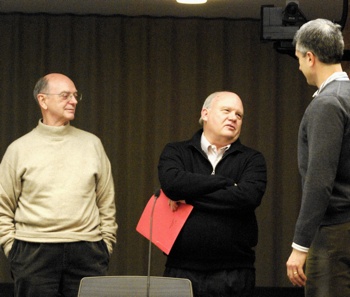
Christopher Taylor (Ward 3) and Stephen Kunselman (Ward 3)

Christopher Taylor (Ward 3) and Stephen Kunselman (Ward 3) sign agendas for students who attended the Feb. 6 meeting to complete a class assignment. (Photos by the writer.)

The AATA had requested the postponement until March 5. The council ultimately agreed to do that, but not before thoroughly debating the merits of March 5 versus March 19, or even some unspecified date in the future. In the end, the resolution to postpone included a stipulation that the mayor or city administrator could take the item off the March 5 agenda, if a funding recommendation and 5-year service plan are not provided to the council by the AATA in a timely way for the March 5 meeting. A meeting of a financial advisory group, co-chaired by McKinley Inc. CEO Albert Berriz and retired Washtenaw County administrator Bob Guenzel, is scheduled to take place on Feb. 29.

In other business, the council approved the tentative award of a $92,929,000 contract with Walsh Construction Company II to undertake a major renovation project at the city’s wastewater treatment plant. During public commentary, the council heard from Glenn Granger, whose company was one of two that had submitted lower bids than Walsh. City staff evaluating the bids did not agree with Granger’s contention that his company had comparable previous experience with a project of similar complexity.

The council gave final approval to a revision to the Arlington Square planned unit development, which grants the developer additional types of uses, without imposing additional parking requirements. The council also appointed a hearing officer for the coming year’s liquor license review process – councilmember Tony Derezinski (Ward 2), who also served last year in that capacity.

Highlights of public participation included commentary from a group that has been advocating for a warming center for the homeless. [Full Story]

County Preps for More Restructuring

Washtenaw County board of commissioners working session (Feb. 2, 2012): Commissioners got a preview from county administrator Verna McDaniel about plans for more restructuring of Washtenaw County operations, in the wake of 117 retirements at the end of 2011 and an ongoing need to cut costs.

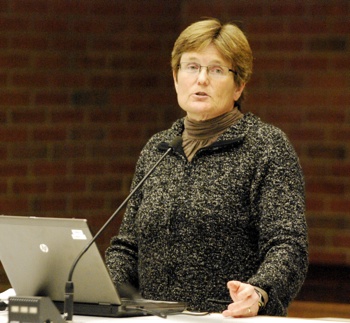
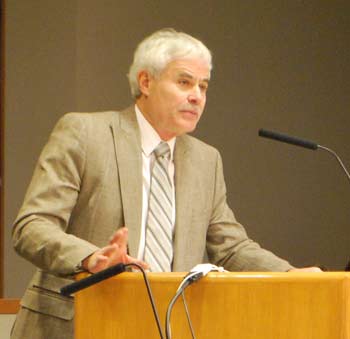
Verna McDaniel

Washtenaw County administrator Verna McDaniel. (Photos by the writer)

McDaniel is asking departments to explore a “continuum of opportunities,” from cooperation on one end of the spectrum, to consolidation on the other end. As an example, she noted that the recent 911 dispatch consolidation between the city of Ann Arbor and the Washtenaw County sheriff’s office – an agreement at the county board approved at its Jan. 18, 2012 meeting – began as cooperation, when county dispatchers co-located with Ann Arbor’s operations.

As an initial step, at the board’s Feb. 15 meeting McDaniel will be asking for approval to restructure support services in administration, finance, information technology and facilities management. The changes entail creating a new “cross-lateral” team of four current senior managers, and putting two positions – including the job of deputy county administrator – on “hold vacant” status. Another nine positions will be eliminated, while eight jobs will be created. The restructuring will result in a net reduction of three full-time jobs, and estimated annual savings of $326,422.

Commissioners were generally supportive of her proposal, though some cautioned against creating the expectation that the county can provide the same or a better level of services with reduced resources. The county is facing projected deficits of $11.6 million in 2014 and $14.7 million in 2015.

Also at the Feb. 2 working session, board chair Conan Smith gave an update on negotiations with the Humane Society of Huron Valley, saying he hopes to bring an agreement for board approval at their Feb. 15 meeting. The contract would cover animal control services for the remainder of 2012, with the intent of working toward a longer-term agreement for the coming years. The county plans to ask local municipalities that have animal control ordinances – including Ann Arbor and Ypsilanti Township – to help pay for services provided under contract with HSHV.

The board also got a brief update on the $1.3 million in renovations at the downtown county courthouse. The project, which started early last year when Ann Arbor’s 15th District Court vacated the courthouse to move to the city’s new Justice Center, will be wrapping up in mid-March.

The working session included an agenda briefing for the Feb. 15 meeting, but some commissioners expressed discontent at the new format, which had been implemented earlier this year. Wes Prater suggested that if the briefings do not include time for commissioners to ask questions, then the information might as well be emailed to them instead. “I believe all of us can read,” he said.

[Full Story]

DDA Reviews Mid-Year Financials, Parking

Ann Arbor Downtown Development Authority board meeting (Feb. 1, 2012): In the one agenda item that required formal action, the DDA board unanimously voted to award an annual management incentive to Republic Parking, the contractor that manages day-to-day operations of the city’s parking system.

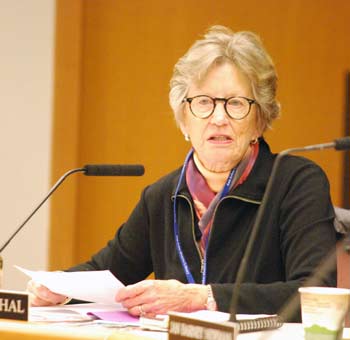
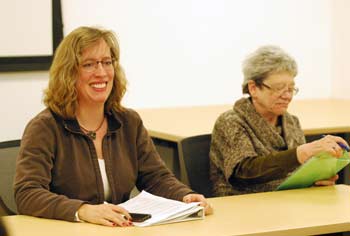
Sandi Smith

DDA Quiz: Board member Sandi Smith is illustrating: (a) the "increment" in "tax increment financing," (b) the amount of a parking rate increase, (c) building heights and flood plains, or (d) relative thickness of concrete slabs in parking structures. (Photos by the writer.)

The amount of the award was 90% of the total amount the board could have awarded –$45,000 of $50,000. It’s the same amount the board has awarded in each of the last three years. It’s based on a variety of criteria, including customer satisfaction surveys, independent inspections of the parking facilities, and financial performance.

February’s meeting also included a review of the DDA’s finances at the mid-point of the fiscal year – through Dec. 31, 2011. The DDA’s fiscal year runs from July 1 to June 30. Operations committee chair Roger Hewitt sketched out a picture that portrayed things unfolding pretty much as expected. Although parking revenues are currently about $125,000 under the year-to-date budgeted amount, parking revenues are projected to finish the year at around $672,536 over the budgeted amount. The gross parking revenue now anticipated for FY 2012 is around $16.8 million. But capital costs associated with the new Fifth Avenue parking garage construction are anticipated to put the parking fund expenses over budget.

Part of that parking system revenue will come from rate increases and changes in billing methods, which were approved by the board at its Jan. 4, 2012 meeting. Some of the changes will not be implemented until September 2012 – like hourly rates at parking structures and lots, which will climb from $1.10 per hour to $1.20 per hour.

But other changes were implemented starting Feb. 1, including a change in the billing method at parking structures and hourly lots – from half-hourly to hourly. The board heard criticism of the change during public commentary, from a resident who makes frequent but brief trips downtown as a patron of the downtown location of the Ann Arbor District Library. The billing change amounts to a “surcharge” on his library use of a couple hundred dollars a year, he said.

The board also heard a pitch from the developer of the 618 S. Main project, Dan Ketelaar, who is interested in financing certain elements of the project through the state’s Community Revitalization Program. That’s the successor to the state’s brownfield and historic preservation tax credit program.

The 618 S. Main project, which received a positive planning commission recommendation on Jan. 19, would be a 7-story, 153,133-square-foot apartment building with 190 units for 231 bedrooms. The idea would be for the DDA to forgo a portion of the taxes that it would ordinarily capture on the newly constructed 618 S. Main project. The DDA captures taxes from the increment in value due to new construction within its tax increment authority (TIF) district.

The board also heard a pitch from Jody Lanning, with Lanning Outdoor Advertising, for a way to finance murals on the city’s parking structures and other public buildings. The board also entertained its usual set of updates from boards and commissions. [Full Story]

More Transit Plan Challenges at County Board

Washtenaw County board of commissioners meeting (Feb. 1, 2012): A light agenda and three absent commissioners resulted in a brief 30-minute session at Wednesday’s county board meeting.

Stefani Carter Rolland Sizemore Jr.

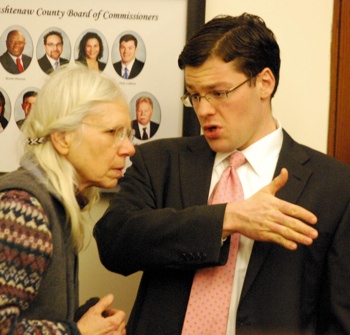
Local attorney Stefani Carter talks with Rolland Sizemore Jr., chair of the county board's ways & means committee, before the Feb. 1, 2012 meeting. Carter will be filling in for the county's corporation counsel, Curtis Hedger, who is taking a three-month medical leave. (Photos by the writer.)

Items not on the agenda took up much of the meeting time. As he has in the past, commissioner Wes Prater raised concerns over a countywide transit plan being developed by the Ann Arbor Transportation Authority. It’s expected that the county board will eventually be asked to authorize a four-party agreement with the AATA and the cities of Ann Arbor and Ypsilanti, but that agreement has not yet been formally presented to the board. [The Ann Arbor city council has postponed its ratification of the four-party agreement twice, and has been asked by the AATA to postpone the issue again at the council's Feb. 6 meeting. That postponement would be until March 5.]

Also at Wednesday’s meeting, county administrator Verna McDaniel introduced local attorney Stefani Carter, who’ll be filling in while corporation counsel Curtis Hedger is on medical leave. Carter has been doing contract work for the county, and previously spent 15 years with the Ann Arbor city attorney’s office.

Speaking at the time for public commentary, Billy Salamey – owner of three towing companies in the county – defended accusations that have been levied against his business during a recent bidding process for towing services with the sheriff’s office. Salamey’s commentary in turn prompted board chair Conan Smith to defend the county’s bidding process, which Smith described as transparent and fair.

Among the formal actions taken during Wednesday’s meeting, commissioners authorized a five-year, $460,000 extension to a project aimed at improving conditions at Whitmore Lake. They also gave final approval to a two-year collective bargaining agreement with AFSCME Local 3052, representing 52 general supervisors. [Full Story]

Major Renovation of City Ballfields Planned

Ann Arbor park advisory commission meeting (Jan. 24, 2012): Baseball fields in three city parks will be getting a major overhaul, if the Ann Arbor city council approves a recent recommendation by park commissioners.

Baseball field #4 at Veterans Memorial Park

Baseball field #4 at Veterans Memorial Park will be among fields at three parks that will be renovated, if the Ann Arbor city council approves a recommendation of the park advisory commission. (Photos by the writer.)

PAC unanimously recommended awarding a nearly $1 million contract to RMD Holdings of Chesterfield, Michigan, for renovation of ballfields at Veterans Memorial Park, West Park and Southeast Area Park. If approved by the city council, work would begin after the 2012 summer season. Ann Arbor Rec & Ed – a unit of the Ann Arbor Public Schools – plans to cancel its fall season in light of the project. Teams playing in Rec & Ed programs are the primary users of these fields.

Commissioners also got an update on the status of West Park renovations – specifically, how problems with an underground stormwater system are being addressed. City engineer Nick Hutchinson described plans for repairing the system, saying that legal issues are still being worked out, but the project will likely be completed by July of 2012. A public forum will be held on Feb. 13 at Slauson Middle School to update residents. At a similar meeting held in mid-January, residents raised concerns over whether the situation in West Park has caused flooding in nearby basements.

Also at PAC’s Jan. 24 meeting, commissioner Gwen Nystuen urged the group to consider taking action on the Allen Creek greenway, in light of remarks made by mayor John Hieftje at the city council’s Jan. 23 meeting regarding the city-owned 415 W. Washington property. Colin Smith, the city’s manager of parks and recreation, reported that there’s been discussion about possibly applying for a state grant to help fund the greenway, but the timeline for applying this year is tight. He also suggested that an initial step would be to develop a master plan for the greenway, as recommended in the city’s parks, recreation and open space plan.

Near the beginning of the meeting, commissioner Sam Offen introduced the new executive director for the Leslie Science & Nature Center, Susan Westhoff, who spoke briefly to commissioners. Offen is a board member of the center, a nonprofit that’s located on city property. [Full Story]

Ann Arbor Shifts Transit Gear to Neutral

Ann Arbor city council meeting (Jan. 23, 2012): At its meeting last week, the council again delayed action on a four-party agreement that would establish a framework for a transition of the Ann Arbor Transportation Authority to a countywide governance incorporated under Michigan’s Act 196 of 1986.

In this action shot from city council chambers, a paper copy of an amendment to the text of the four-party transit agreement is handed from city clerk Jackie Beaudry to Jane Lumm (Ward 3).

In this action shot from city council chambers, a paper copy of an amendment to the text of the four-party transit agreement is handed from city clerk Jackie Beaudry to councilmember Jane Lumm (Ward 2). In the background are Ward 1 councilmembers Sandi Smith (left) and Sabra Briere. (Photos by the writer.)

The council postponed action until its Feb. 6 meeting, but not before undertaking several amendments to the text of the agreement. The council had previously postponed action at its Jan. 9 meeting and had set a public hearing for Jan. 23. Thirty-nine people appeared before the council to speak during the hearing, and some of those people also reprised their remarks during public comment at the conclusion of the meeting. Fourteen of the speakers were either current or former elected or appointed public officials, or former candidates for public office.

The four-party agreement would be between the Ann Arbor Transportation Authority, the city of Ann Arbor, the city of Ypsilanti and Washtenaw County.

A delay was warranted from the perspective of some councilmembers, who wanted to hear the recommendation of a financial advisory group. The group has been meeting since the fall of 2011 and was scheduled to hold a final meeting on Jan. 27, four days after the council’s vote to postpone. However, later in the week the financial advisory group also chose to postpone its Jan. 27 meeting, in the wake of a 17-bill package of state legislation introduced on Jan. 26 – part of which would establish a regional transit authority for Washtenaw, Wayne, Oakland and Macomb counties and a possible funding mechanism for that authority. It’s not clear if the financial advisory group will meet before the council’s next meeting on Feb. 6.

The council could undertake further amendments to the text of the four-party agreement at its Feb. 6 meeting. In fact, Stephen Kunselman (Ward 3) indicated he’d bring forward an amendment to change the composition of the planned new transit authority board, to give Ann Arbor more than the currently proposed seven out of 15 seats, so that Ann Arbor would have a majority.

In other business, the council passed two resolutions as symbolic statements of position. One was to express opposition to Michigan’s Public Act 297, which was signed into law on Dec. 22, 2011. The act prohibits public employers from providing employee medical and fringe benefits to those who are not married to an employee, a dependent of the employee, or eligible to inherit from the employee under the laws of intestate succession.

The law impacts the city of Ann Arbor’s policy of extending benefits to “other qualified adults” – which can include a same-sex domestic partner. The resolution gained unanimous support on the Ann Arbor city council. As Jane Lumm (Ward 2) expressed her concerns about the council’s purview on such a resolution, but ultimately expressed her support for it, Sandi Smith (Ward 1), who is openly gay, was prompted to say, “I love this city!”

The second resolution expressing a position was passed over the dissent of Lumm and Marcia Higgins (Ward 4). It encouraged the federal government to exercise prosecutorial discretion in pursuing the deportation of undocumented immigrants who have not committed serious crimes and who have ties to the community.

The council also approved a contract with the Ann Arbor Transportation Authority to supply policing services for the downtown Ann Arbor Blake Transit Center. And the council authorized a $10 million contract for engineering services in connection with the facilities renovation project at the city’s wastewater treatment center.

The meeting was bookended by mentions of the word “dragon” – in separate contexts.  [Full Story]

Transitions for Ann Arbor Art Commission

Ann Arbor public art commission meeting (Jan. 25, 2012): Two new commissioners – Bob Miller and John Kotarski – attended the art commission’s first meeting of 2012, and joined other AAPAC members in approving two public art projects.

Wiltrud Simbuerger

Ann Arbor public art commissioner Wiltrud Simbuerger, showing other commission members some proposals from artists for a mural at Allmendinger Park. A local artist, Mary Thiefels, has been selected for that project. (Photos by the writer.)

The group unanimously recommended selecting Ed Carpenter of Portland, Oregon for a $150,000 art project in the lobby of the city’s Justice Center, located at the corner of East Huron and Fifth Avenue. A task force had recommended the selection of Carpenter’s proposal from three finalists. It’s a sculpture called “Radius”.

Carpenter plans to create a hanging sculpture of dichroic glass, aluminum, stainless steel and lighting, including LED spot and flood lighting. Among the reasons for recommending Radius, the task force cited the sculpture’s metaphor: That the activities in the Justice Center have a “rippling” effect throughout the community, which echos the water sculpture by Herbert Dreiseitl that’s located in the plaza outside the building.

The Justice Center, a new building next to city hall, houses the 15th District Court and the Ann Arbor police department. The commission’s recommendation will be forwarded to the city council for approval.

In other action, the art commission voted to select Ann Arbor muralist Mary Thiefels for a mural project to be located on pillars at a building in Allmendinger Park. A task force had recommended her selection from among four finalists. Her proposal entails asking neighborhood residents for artifacts to create mosaics at the top and bottom of the pillars. The task force recommended that they continue to work with Thiefels on designing the remainder of the mural in the middle sections of the pillars.

Commissioners liked the concept of “found object” mosaics, but questioned whether the $10,000 budget was sufficient. They ultimately voted to approve selecting Thiefels for the project, contingent on her submission of a revised proposal and budget, with additional input from the task force. This project is the first one in a pilot mural program started last year by former commissioner Jeff Meyers.

AAPAC also discussed possible artwork for four sites connected to the East Stadium bridges, which are being reconstructed. The two commissioners who serve on a task force for that project – Wiltrud Simbuerger and Bob Miller – indicated that the budget recommendation will likely be at least $250,000 for artwork there. The task force is currently developing a request for proposals to be issued in the coming weeks.

In the context of developing their annual art plan for fiscal 2013, which by ordinance must be delivered to the city council by April 1, commissioners decided to hold a retreat next month. In addition to shaping the annual plan, the aim of the retreat is to develop a master plan that would provide a broader conceptual framework to guide AAPAC’s decisions. Input from an online survey of the public will also be used – the survey remains open until Feb. 20, and has garnered more than 400 responses so far. [Full Story]

AAPS to Use Savings to Offset Budget Cuts

Ann Arbor Public Schools committee of the whole meeting (Jan. 25, 2012): At the board of trustees committee of the whole (COTW) meeting on Wednesday, trustees agreed on a strategy to dip into fund equity to offset the anticipated $14 million-$16 million deficit facing the district in fiscal year 2012-13. Trustee Andy Thomas won support from his colleagues to use around $7 million in savings to “buy [AAPS] another year without having to make really draconian budget cuts.” Board president Deb Mexicotte called it a “respite year.”

AAPS

School bus operated for Ann Arbor Public Schools headed north on State Street on Jan 27, 2012. Changes to the way AAPS provides transportation services was a major theme of the AAPS board's Jan. 25 committee meeting.

That led to a vigorous discussion of the district’s immediate and longer-term options to continue to function in a challenging fiscal and political environment beyond 2012-13. “Everything has to be on the table … Education is not going to be the same,” said trustee Susan Baskett.

Mexicotte agreed, saying the time for incremental change has passed, and that the district “might need to make some bold moves.”

As options to consider for the following year, trustees listed the following: redistricting; eliminating 7th hour high school classes; closing schools; sharing principals; passing a countywide enhancement millage; changing high school start times; moving more athletics extracurricular activities to a “club sports” model; increasing the number of online class offerings; changing state law; working with the University of Michigan to allow AAPS students to earn credit hours there at a reduced rate; and moving to a balanced calendar district-wide.

In some detail, the board also evaluated its options for busing – in light of news that the Ypsilanti and Willow Run public schools are considering pulling out of the Washtenaw Intermediate School District’s transportation consortium. That would leave Ann Arbor as the sole participant in the consortium.

Trustees directed administration to examine and make a recommendation on the following transportation options: improving busing within the current framework of the WISD; consolidating busing with Ypsilanti and Willow Run outside the WISD consolidation; bringing busing back into the AAPS budget with bus drivers remaining public employees; bringing busing back into the AAPS budget but privatizing bus drivers; eliminating busing entirely; or collaborating with the Ann Arbor Transportation Authority (AATA) to transport AAPS students.

Several trustees also made plugs for protecting classrooms from the effect of budget cuts, and even suggested lowering class sizes. AAPS superintendent Patricia Green suggested it was also important to relieve some of the pressure and anxiety felt by teachers and other district staff. “We are at the tipping point,” she said, “Five years of budget cuts can take its toll.”

Also at the Jan 25 COTW meeting, trustees heard updates on the AAPS preschool and family center programs, including some discussion of the county’s relinquishing of its management of the federal Head Start grant. And, the board was briefed on the implementation of the Measures of Academic Progress (MAP), a new assessment tool the board approved for purchase last May. [Full Story]

618 S. Main Project Gets Planning Support

Ann Arbor planning commission meeting (Jan. 19, 2012): A major development on the south edge of downtown Ann Arbor – between Main and Ashley, north of Mosley – was generally praised by planning commissioners at their most recent meeting, and unanimously recommended for approval.

618 South Main

Looking north from Mosley at the site of the proposed 618 S. Main apartment complex. The former Fox Tent & Awning building will be demolished. Ashley Street runs to the left of this photo, and borders the Old West Side historic district. (Photos by the writer.)

The 618 S. Main project is an apartment complex geared toward young professionals, according to developer Dan Ketelaar. The 7-story building would include 190 units for 231 bedrooms, plus two levels of parking for 121 vehicles.

The project borders the Old West Side historic district – the board of the Old West Side Association submitted a letter of support for the development. Parking and traffic concerns were raised by some commissioners, but the project received praise for its design and its potential to enliven that part of the city. The planning staff had recommended approval.

Two other projects gained approval from commissioners at their Jan. 19 meeting. Rezoning and a site plan for a small addition to the Habe Mills Pine Lodge – owned by the Society of Les Voyageurs – will move forward to the city council with a recommendation of approval. The lodge is adjacent to city parkland near Argo Pond, and had been erroneously zoned as public land.

The commission also signed off on a special exception use at 3645 Waldenwood, which would allow an accessory apartment to be added to the single-family house there. It’s located in the Earhart Estates neighborhood, west of Earhart and south of Glazier Way, in the city’s northwest side.

Several commissioners expressed support of this project and for accessory units in general. “Accessory dwelling units can be an asset to our community and I hope we see more in the future,” said commissioner Erica Briggs. [Full Story]

UM’s Business of Research, Academics

University of Michigan board of regents meeting (Jan. 19, 2012): The sixth floor of UM’s Ross School of Business was the venue for January’s meeting, where regents and executives dispatched the university’s business with an alacrity called for by president Mary Sue Coleman. There was no indication at the time that U.S. president Barack Obama would be speaking here later this month. News of his speech – to be delivered on Friday morning, Jan. 27 at UM’s Al Glick Fieldhouse – was announced on Monday.

Mary Sue Coleman

Before the start of the Jan. 19 board of regents meeting, UM president Mary Sue Coleman scanned an article from The Chronicle – but not this Chronicle. It's a report from The Chronicle of Higher Education. (Photos by the writer.)

Instead, regents dealt with less high-profile matters, approving a range of action items with little discussion. Those included funding for a major expansion of the UM Health System into Wayne County, along the I-275 corridor; renovations that will transform the entrance to Schembechler Hall and make a museum of football memorabilia more accessible to the public; and improvements to the university’s Northwood apartment complex on north campus.

But much of the meeting consisted of reports. Stephen Forrest, UM’s vice president for research, presented a sobering outlook for future research funding, calling the climate for federal funding “worrisome.” After his talk, regent Andrea Fischer Newman pointed out that tuition is helping to support the university’s $1.2 billion research program – about 25% of those research expenditures are covered internally.

Regents also heard from dean Alison Davis-Blake, who described how the business school is countering the caricature of managers that are only focused on short-term profits, and whose management skills consist of the ability to say, “You’re fired!” Graduates of Ross are taught to think more broadly, she said.

An item not on the agenda of the Jan. 19 meeting received considerable attention during public commentary. One student and three professors spoke against an effort to unionize graduate student research assistants (GSRAs).

Also during public commentary, the chair of the Sierra Club’s Huron Valley group raised concerns over the proposed Fuller Road Station, saying that the joint UM/city of Ann Arbor project runs counter to the university’s sustainability efforts. Fuller Road Station’s initial phase is a proposed parking structure, located near the UM medical campus, that could hold over 1,000 vehicles. [Full Story]

Transit Issue Raised at County Board

Washtenaw County board of commissioners meeting (Jan. 18, 2012): The Ann Arbor city council has been grappling with the issue of a four-party countywide transit agreement – a resolution regarding the accord is on Monday’s council agenda. And although Washtenaw County is one of the four parties being asked to approve the agreement, it hasn’t come before the county board yet as a formal resolution.

Stephen Kunselman, Mary Jo Callan

At the Washtenaw County board of commissioners Jan. 18, 2012 meeting, Ann Arbor city councilmember Stephen Kunselman talks with Mary Jo Callan, director of the joint Washtenaw County/city of Ann Arbor office of community and economic development. Kunselman was on hand to air concerns about the proposed countywide transit authority. (Photos by the writer.)

However, the issue emerged at the board’s Jan. 18 meeting when two people – including city councilmember Stephen Kunselman – spoke during public commentary to share their views with county commissioners. Among Kunselman’s points was a concern that Ann Arbor might end up shouldering the burden for countywide transit, if most other communities opt out.

A few commissioners responded to the public commentary. Alicia Ping – who represents a district covering Saline and several townships in southwest Washtenaw – indicated that many people in her district were not inclined to participate in a countywide transit authority. Wes Prater expressed concerns about the process so far, calling it convoluted and confusing.

The main action at the board’s Jan. 18 meeting also reflected ties between the county and Ann Arbor – a presentation and vote on the consolidation of county and Ann Arbor 911 dispatch services. The proposal, which was unanimously approved, called for entering into a contract with the city from Feb. 1, 2012 to Jan. 30, 2017. The city will pay $759,089 annually for dispatch services. In addition, the county expects to receive an increase of $677,893 annually from 911 fees. The Ann Arbor city council had already approved the agreement at its Dec. 5, 2011 meeting.

Sheriff Jerry Clayton told commissioners that he believes the dispatch model they’re developing will be among the best practices nationally, and will be replicated by other dispatch operations in the country. This partnership between Washtenaw County’s two largest public safety entities will strengthen core police services in the county, he said.

In other action, the board gave initial approval to one of the last remaining contracts with a union representing Washtenaw County employees – a two-year collective bargaining agreement with AFSCME Local 3052, representing 52 general supervisors. A final vote by the board is expected at its Feb. 1 meeting. Negotiations continue with four remaining bargaining units that have not yet reached an agreement on a new contract.

The board also approved a brownfield plan for Arbor Hills Crossing, a development in Ann Arbor at the corner of Washtenaw and Platt, and formally accepted a $3 million grant to support the Washtenaw County Sustainable Community project, which focuses on the Washtenaw Avenue corridor spanning Ann Arbor, Ypsilanti, Pittsfield Township and Ypsilanti Township. Arbor Hills Crossing will be located along that corridor.

County administrator Verna McDaniel updated the board on turning over the Washtenaw Head Start program to federal officials, a move that commissioners had approved last year as part of the budget process. The county will end its 46-year affiliation with Head Start on July 31. McDaniel reported that the Washtenaw Intermediate School District is interested in applying to take over the program locally, and that federal officials plan to issue a request for proposals (RFP) during the first quarter of this year.

Not mentioned during McDaniel’s update was the status of an investigation begun last year into actions of the program’s two top officials, director Patricia Horne McGee and Lovida Roach, the program’s second-in-command. Responding to a follow-up query from The Chronicle, Diane Heidt, the county’s human resources and labor relations director, said the allegations that prompted the investigation were “founded.” Heidt said the county could not release details, but that no misuse of funds was involved. Horne McGee retired at the end of 2011. Roach will remain on leave until the county relinquishes control of Head Start, and at that point she will also retire, Heidt said.

The meeting also included a transition of sorts. Commissioner Leah Gunn has typically taken on the parliamentary action of moving the agenda at each of the board’s meetings, which entails reading off the agenda items. Gunn, who is not running for re-election this year, announced that Wednesday’s meeting was her “farewell agenda” – she would be relinquishing that task for the remainder of her tenure on the board. [Her term runs through the end of 2012.] After she completed the task this final time, Yousef Rabhi teased her, saying Gunn “moved the agenda very well.” [Full Story]
AAPS Mulls Suing State over School Aid Fund

Ann Arbor Public Schools (AAPS) Annual Organizational Meeting (Jan. 18, 2012): A report about state revenues from AAPS deputy superintendent of operations Robert Allen prompted the school board to start contemplating a possible lawsuit against the state of Michigan.  The suit would be based on the state’s use of the School Aid Fund.

Andy Thomas and Simone Lightfoot are sworn in as re-elected board members

Simone Lightfoot and Andy Thomas raise their right hands as they're sworn in at the Jan. 18, 2012 AAPS board meeting. They were both re-elected to the board last November. Sitting between them is board member Glenn Nelson. (Photo by the writer.)

Also at the meeting, the board handled myriad internal board organizational issues, typical for the board’s first meeting after the start of the term for newly elected members.

After a 15-minute delay coming out of an executive session, the AAPS board launched into its first meeting of the new year, beginning with trustees Simone Lightfoot and Andy Thomas taking their oaths of office after winning re-election this past November. Though elected to four-year terms, both trustees will likely serve the board through 2016 – in five-year terms – due to recent state legislation mandating that school board elections take place only in even-numbered Novembers.

The board’s first order of business was to elect its officers. Three of the four board officer positions were uncontested re-elections, and were approved unanimously – Deb Mexicotte as president, Irene Patalan as treasurer, and Andy Thomas as secretary. But Christine Stead was elected vice-president by a 5-2 vote over Susan Baskett, who had previously held the position. Baskett and trustee Simone Lightfoot dissented. The four officers took their oaths of office, and Mexicotte appointed Lightfoot as board parliamentarian.

AAPS deputy superintendent of operations Robert Allen gave the board a summary of the state revenue consensus conference held last week, including his assessment that nothing he heard indicated that the district’s per-pupil funding would increase, despite a surplus in the state School Aid Fund.

Allen’s report prompted the board to direct AAPS superintendent Patricia Green and her staff to explore taking legal action against the state for misapplying School Aid Fund revenue.

Also at the meeting, the board reviewed and made some minor adjustments to its internal administration, including: a list of designated board associations; representation on administrative committees; time limits; meeting schedule; voting order; communication procedures; and committee structure.

Receiving an initial discussion by the board was the length of board terms,  as new state law governing board of education elections takes effect.  The board also gave initial discussion to the possibility of using BoardDocs, an electronic system of board document management, to organize board informational materials. Both of those items will return to the board for more discussion and a decision at the next regular board meeting. [Full Story]

AATA in Transition, Briefed on State’s Plans

Ann Arbor Transportation Authority board meeting (Jan. 19, 2012): The AATA board’s meeting consisted of pro forma, ordinary business set against a backdrop of several transitions.

Rich Robben University of Michigan Ann Arbor Transportation Authority

Rich Robben's last meeting as an Ann Arbor Transportation Authority board member was Jan. 19, 2012. (Photos by the writer.)

The board itself is in transition – Thursday was Rich Robben’s last meeting as an AATA board member. And the city’s transportation program manager, Eli Cooper, attended his first meeting since his nomination was confirmed by the Ann Arbor city council on Dec. 19, 2011. He replaces Sue McCormick on the board.

The AATA as an organization is also possibly in transition, as it seeks to establish a new, countywide governance structure under Michigan’s Act 196 of 1986. To provide a framework for that move, AATA is asking three other entities – the city of Ann Arbor, the city of Ypsilanti and Washtenaw County – to ratify an agreement with the AATA. The Ann Arbor city council postponed action on that agreement at its Jan. 9, 2012 meeting, but is expected to take action on Jan. 23. A public hearing on the four-party agreement is scheduled for that council meeting as well. CEO Michael Ford reported that the text of the four-party agreement is currently being revised, to promote clarity.

And as the AATA works on a possible move to countywide governance of public transit in Washtenaw County, Michigan’s state legislature may also act to establish a regional transit authority (RTA) for southeast Michigan that would add Washtenaw to Wayne, Macomb and Oakland counties.

The AATA board got a briefing on possible upcoming RTA legislation from Dusty Fancher, a consultant for the Michigan Public Transit Association (MPTA). Fancher, who’s employed by Midwest Strategy Group, stressed that the RTA legislation – for which no details have yet been released publicly – comes in the context of a larger transportation infrastructure agenda being pushed by Michigan Gov. Rick Snyder. That larger agenda includes a focus on funding for roads.

Like the move to a local countywide governance, the funding for an RTA would probably include a request to voters for additional taxes. If the state’s RTA legislation were passed before the November 2012 election – and if a decision also were made to place a ballot request to Washtenaw County voters to fund more transportation within the county – that would potentially result in two transportation tax initiatives in the same election.

How likely is it that the state’s RTA legislation would be passed before the November 2012 election? Fancher said that if nothing were passed by March 2012, she’d bet money that nothing would happen before November. Also at the AATA board meeting, Clark Harder, executive director of the MPTA, indicated that it’s important to understand that Snyder does not currently have the votes within his own Republican Party to push the RTA package forward.

Against that backdrop of transition and many unknowns, the AATA went about some regular business with quantifiable, known facts. The board authorized the purchase of up to 25 vans to provide van pool service. The board also authorized its capital grant program for the next five years, which allows for an additional $1.5 million of federal and state grant money to go towards the reconstruction of the downtown Ann Arbor Blake Transit Center.

The board also heard its usual range of public commentary and reports from committees. [Full Story]
Mammoth Molars, Other Realia at the AADL

Ann Arbor District Library board meeting (Jan. 16, 2012): A Michigan Radio report last month had indicated that the Ann Arbor library might start loaning out bicycles. AADL director Josie Parker assured the board that “we don’t circulate bicycles!” but said she wanted trustees to learn more about the kinds of realia collections that the library does circulate.

Celeste Choate

Celeste Choate, AADL associate director of services, collections and access, holds up a replica of a fossilized wooly mammoth tooth and a wooly mammoth model – items that are included in Science to Go kits available from the AADL. Choate was giving a presentation on the library's realia collections. (Photos by the writer.)

Among the most popular is AADL’s art print collection, which includes work by local artists, according to Celeste Choate, AADL associate director of services, collections and access. Meter readers to gauge the energy efficiency of home appliances and electronics are also popular.

Science to Go kits are the newest addition to AADL’s realia collection. Each kit focuses on a theme – prehistoric mammals, for example – and contains materials that include books, DVDs, Fandex educational cards, and objects like a replica of a fossilized wooly mammoth molar. The kits have only been available for about a month, but are all checked out, each with a long wait list. The realia collections are listed in “Unusual Stuff to Borrow” on AADL’s website.

Other agenda items for Monday’s meeting were less show and more tell. The board re-elected its current slate of officers for another year, with president Margaret Leary noting that the board faces several important decisions in the coming year – she indicated that continuity of leadership would help the board in that context. Though she did not mention it explicitly, Leary likely was alluding to plans discussed by the board in November to restart the process for determining the future of the AADL’s downtown location.

In a formal address at the start of Monday’s meeting, Leary reviewed the library’s accomplishments for 2011. Among other things, she mentioned the board’s decision to keep its millage rate down, while still balancing its budget. AADL’s millage rate for the current fiscal year is 1.55 mills – below the 1.92 mills that the district is authorized to levy. However, she cautioned that if the state eliminates the personal property tax and no replacement funding is found, the library would lose about $600,000 annually in revenues out of a $12 million budget.

Later in the meeting, the board was briefed by Eli Neiburger, AADL’s associate director of IT and product development, on a draft terms-of-use policy for the library’s website. The decision to develop the policy was driven in large part because of issues related to the library’s digitization of the former Ann Arbor News archives – AADL will be putting a lot of material online for which it doesn’t hold the copyright. The board is expected to vote on the policy at its Feb. 20 meeting.

Also at Monday’s meeting, the board voted to approve a two-year lease renewal with Westgate Enterprises LLC for the location of AADL’s branch at the Westgate Shopping Center, at Jackson and South Maple roads. The annual lease rate is $82,260, beginning Feb. 1. [Full Story]
Council Debates Public Transit, Sets Hearing

Ann Arbor city council meeting (Jan. 9, 2012): The council’s first meeting of the year included: a metaphor comparing AATA buses to white blood cells; a desire to “inoculate” Ann Arbor against loss of control over its local bus system; and a fair number of councilmembers needling each other.

Christopher Taylor, Jane Lumm Ann Arbor city council

Jane Lumm (Ward 2) and Christopher Taylor (Ward 3) continued to hash through their differences after the Jan. 9, 2012 meeting was adjourned. (Photos by the writer.)

In the end, the council opted to delay voting on a four-way accord between the city of Ann Arbor, the Ann Arbor Transportation Authority (AATA), the city of Ypsilanti and Washtenaw County. The agreement among the four parties would set up a framework for, and contingencies on, the transition of the AATA to a countywide transit authority, incorporated under Michigan’s Act 196 of 1986. AATA currently operates under Act 55 of 1963.

The transition to a countywide funding base is intended to (1) ensure stability of funding for transit connections outside of the city of Ann Arbor, which has until now depended on purchase-of-service agreements; (2) provide a higher level of transit service inside the city of Ann Arbor; and (3) expand the area where transit service is provided.

The council’s vote was to delay the decision just for one meeting – until Jan. 23. The council also voted to set a public hearing for that date.

In other substantive action on the four-party agreement, the council amended it to stipulate that Ann Arbor’s transit tax would only be transferred to the new Act 196 authority if approval of a millage were to gain a majority of votes within the city of Ann Arbor.

In other business, the council gave initial approval to a revision of the Arlington Square planned unit development (PUD), located on the southeast corner of Washtenaw Avenue and Huron Parkway. The changes will allow for additional types of uses at the site – restaurants and an urgent care facility. Questions were raised about the number of existing parking spaces on the site.

The council also approved the set of fees associated with its property assessed clean energy (PACE) program, which was established last year.

In additional business, the council approved petitions to the Washtenaw County water resources commissioner for several stormwater projects, and approved a wetland mitigation plan for the Wheeler Service Center on Stone School Road. The council also authorized a pay increase for election workers who staff the polls on election day.

At the start of the meeting, councilmembers received an update on the skatepark planned for the northeast corner of Veterans Memorial Park. With most of the funding now in place, construction looks like it will start late in 2012 or the spring of 2013. [Full Story]

AAPS Ended 2011 with Journeyman Contract

Editor’s note: Because the Dec. 14 meeting of the AAPS board of trustees did not adjourn until after 2 a.m., The Chronicle divided the report into two parts. The first part of the report was published before the holidays and focused only on board deliberations on contracts for top administrators: “Two Top AAPS Administrators Get Raises.”

AAPS-Dec-2011

Union members in the audience of the Dec. 14 AAPS board meeting. (Photos by the writer.)

Ann Arbor Public Schools Board of Education meeting (Dec. 14, 2011) Part 2: AAPS board of education trustees approved a contract with D.M. Burr, a Flint company, for heating, cooling, and ventilation services. Many local union members attended the meeting and spoke in opposition of the bid award to a non-local, non-unionized company.

At the opening of the Dec. 14, 2011 board meeting, board president Deb Mexicotte requested a moment of silence to acknowledge the recent loss of two students. Mariel Almendras, a second grader at Dicken, died of complications related to a rare ovarian cancer. Lucina Partis, an 11th grader at Skyline, died of accidental drowning in a bathtub in her home.

The final board meeting of 2011 also saw debate on a new state mandate to change board election dates to November in even-numbered years.

The board also discussed a number of first briefing items, and held discussion on minor resolutions. [Full Story]

County Board Trims Public Commentary

Washtenaw County board of commissioners meeting (Jan. 4, 2012): The county board’s first meeting of the year was a combination of stasis and change.

Yousef Rabhi

County commissioner Yousef Rabhi, who was re-elected chair of the working session and successfully lobbied to keep public commentary time unchanged at those sessions. (Photos by the writer.)

Unchanged were the board officers – as is its custom, the board re-elected the same leaders from the previous year. Conan Smith retained his position as board chair, but did not use the meeting to continue the discussion he’d started in December regarding strategic planning for the county. Smith has proposed focusing county efforts on shoring up the county’s east side, an area that he has said is facing a “perfect storm of despair,” including high unemployment, low graduation rates and poor health.

Rather, the main action of the Jan. 4 meeting focused on significant changes regarding public commentary, as part of revisions to the board’s rules and regulations. The majority of commissioners voted to shorten the time available per speaking turn – from five to three minutes – and to eliminate one of two agenda slots for public commentary at its bi-monthly meetings. Commissioners Rolland Sizemore Jr., Ronnie Peterson and Felicia Brabec voted against the changes, but were in the minority.

Yousef Rabhi, who was re-elected chair of the working session, proposed an amendment to keep both public commentary slots in place at the working sessions. His amendment – which was supported unanimously by the board – also kept the five minutes alloted per speaker for public commentary at the working sessions.

An amendment to the rules proposed by Dan Smith was tabled. The change would give commissioners the option of abstaining from a vote. Wes Prater questioned the amendment, arguing that state law requires commissioners to vote on resolutions unless there’s a conflict of interest. It was eventually tabled until the second meeting in February, allowing the county attorney to research the legality of the proposed rule. In a follow-up query from The Chronicle, Smith indicated that he doesn’t intend to pursue the amendment.

Dan Smith was successful in another effort, however – an amendment he proposed to the board’s 2012 calendar. Commissioners voted to change the start time of working sessions to 6 p.m. and add the administrative briefing as the first agenda item. Previously, administrative briefings – held to review the board’s upcoming agenda – were held at 4 p.m. the week prior to a regular board meeting. It had been a difficult time of day for some commissioners, including Smith, to attend.

An issue not addressed at the Jan. 4 meeting was the status of the county’s negotiations with the Humane Society of Huron Valley. After the meeting, deputy county administrator Kelly Belknap told The Chronicle that the county had signed a one-month extension – at $29,000 – for HSHV to continue providing mandated animal control services for the county through January. The county’s previous contract with HSHV expired Dec. 31, and Belknap said negotiations continue to try to reach a longer-term agreement. Belknap said she was optimistic the two sides could reach a resolution, even if it required another temporary extension. Reached by email later in the week, HSHV executive director Tanya Hilgendorf indicated that she shared that optimism.

The Jan. 4 meeting was initially officiated by the Washtenaw County clerk, Larry Kestenbaum, who presided until the election of the board chair. Kestenbaum took the opportunity to give some tips on campaign finance reporting to commissioners and other potential candidates in the upcoming 2012 election.  [Full Story]

Greenbelt Grows by 170+ Acres in December

Ann Arbor greenbelt advisory commission meeting (Jan. 5, 2012): At Wednesday’s GAC meeting – the first of the new year – commissioners got an update from staff on three deals in December that added more than 170 acres of protected land within the city’s greenbelt boundaries.

Tom Bloomer, Mike Garfield

From left: Greenbelt advisory commission members Tom Bloomer and Mike Garfield. (Photos by the writer.)

The properties include 32 acres in Northfield Township along US-23, 30 acres in Scio Township near Wagner and Scio Church roads, and 111 acres in Lodi Township along Pleasant Lake Road. By year’s end, the new additions brought the total of property protected by the city’s greenbelt program to 3,430 acres since its inception in 2007.

Most of Wednesday’s meeting was spent in closed session to discuss possible future land acquisitions, but the main action item involved land that’s not part of the city’s greenbelt program. Commissioners unanimously passed a resolution urging Webster Township to strictly enforce all of its conservation easements – the resolution will be forwarded to township officials as they weigh a request from the Dexter Area Historical Society to amend an easement that would loosen restrictions on parking.

The society wants permission to allow spectator parking for Civil War re-enactments on a site where the historic Gordon Hall is located. Land preservation activists are concerned that parking would damage the land, and that amending the easement would set a bad precedent, calling into question the trustworthiness of regional land preservation efforts. The resolution was brought forward by Tom Bloomer, a GAC member who also serves on Webster Township’s land preservation board. [Full Story]

DDA Lifts Parking Rates, Sets 2012 Calendar

Ann Arbor Downtown Development Authority board meeting (Jan 4, 2012): The DDA board dispatched with its January meeting in just under a half hour. The discussion by the board and the public about its main agenda item – parking rate increases – had already taken place at previous meetings.

Roger Hewitt

Ann Arbor Downtown Development Authority board member Roger Hewitt cleans his spectacles before the start of the DDA's Jan. 4 meeting. (Photos by the writer.)

The parking rate increases that will affect many downtown visitors will not take effect until Sept. 1. Among the increases to take effect eight months from now are an increase in on-street metered parking from $1.40/hour to $1.50/hour and an increase in the hourly rate for parking structures from $1.10/hour to $1.20/hour.

Other increases are set to take effect on Feb. 1: an increase in the premium permit parking rate by $5/month (from $175 to $180); an increase in the Ann & Ashley and Liberty Square structure evening/Saturday rates by $1/entry (from $2 to $3); a $1 increase in the 415 W. Washington lot entry (from $3 to $4) and a $5 increase in monthly permit rates (from $80 to $90/month) there; and an increase in First & William lot permits by $10/month (from $105 to $115).

A change of the effective start date – from Feb. 1 to Jan. 21 – will apply only to the meter bag rates. They’re set to increase by $5/day (from $15 to $20).

Also at Wednesday’s meeting, the board approved its 2012 calendar. Board meetings are set for the first Wednesday of the month, when they’ve typically been held, except for July 4. That meeting date was shifted to Monday, July 2.

The board also heard the usual set of reports from various subcommittees covering a range of topics, from the future of the midtown area – which includes the AATA’s Blake Transit Center and the Ann Arbor District Library building – to electric charging stations.

During his regular report from the downtown area citizens advisory council, Ray Detter remembered Ray Fullerton, a former member of that body, who passed away on Dec. 18. [Full Story]

Ann Arbor Housing Commission to Expand?

The Ann Arbor housing commission board’s last meeting of 2011 was the first one attended by Jennifer L. Hall in her new role as executive director of the commission. Hall – who previously served as housing manager for the Washtenaw County/city of Ann Arbor office of community development – was selected by the board in October to replace Marge Novak, who had resigned in July.

Jennifer L. Hall, Andy LaBarre

Jennifer L. Hall, the new Ann Arbor housing commission executive director, talks with commission board member Andy LaBarre before the board's Dec. 21, 2011 meeting. (Photos by the writer.)

Most of the Dec. 21 meeting focused on a presentation by Hall. She gave an overview of local affordable housing demand, and looked at how the housing commission’s operations might address some of those needs. In part, her talk set the stage for possible land acquisition. Later in the meeting, the commission entered into closed session to discuss two potential properties it might buy to add to the city’s public housing stock.

On one of the properties Hall suggested constructing a rental project consisting of 22-37 detached single-family units and duplexes, ranging between 1-5 bedrooms. For the other property, she proposed building a 15-unit complex of detached 2-4 bedroom condos and duplexes, which would eventually be sold to low-income homeowners for $140,000 each. Funding for these projects would come from a variety of sources, including state and federal grants and loans.

The locations of the properties weren’t disclosed in open session. But Hall said she was looking for direction from the board on pursuing the two projects. If the projects move forward, more details would be discussed in the public portion of upcoming meetings.

Hall also floated the idea of changing the format of board meetings and of the information that commissioners receive in their meeting packets. She proposed cutting back on staff reports, presenting them quarterly instead of monthly. That way, more of the board’s meeting time would be freed to focus on strategic planning issues, she said.

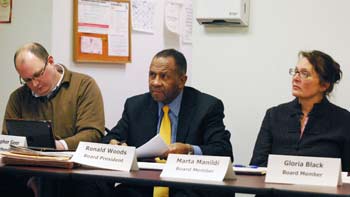
Hall also suggested changing the way that meeting minutes are written up. Instead of including a detailed description of the board’s discussions, she said, the minutes could provide a summary of the discussion and a note about the outcome, if a vote is taken. Some commissioners expressed concerns about truncating the minutes dramatically. Board president Marta Manildi said the AAHC board would like a richer level of detail than what’s provided in Ann Arbor city council minutes, which she described as too terse.

During the time available for public commentary, two residents of Miller Manor – an AAHC apartment complex on Miller Avenue – raised concerns about security issues in the building. Manildi told them that their comments would be forwarded to a working group of staff that’s addressing security problems at all AAHC properties. [Full Story]

Creek Project Ramps Up at Leslie Park Golf

Ann Arbor park advisory commission (Dec. 20, 2011): Park commissioners were briefed about a project on the section of Traver Creek running through the city’s Leslie Park golf course, addressing erosion and stormwater issues along the streambank.

Jen Lawson, Doug Kelly

Jen Lawson, the city's water quality manager, talks with Doug Kelly, the city's director of golf, prior to the start of the Dec. 20, 2011 park advisory commission meeting. (Photos by the writer.)

Jen Lawson, the city of Ann Arbor’s water quality manager, said the city hopes to hire a design consultant in January, with preliminary designs for the project ready by April. Final designs and construction plans would be done by July, and construction is projected to start in November of 2012.

The project would be completed by the spring of 2013, Lawson said, although an additional two growing seasons would be needed for plants to take hold. The intent is to minimize the impact on golfers during construction – parks and recreation manager Colin Smith noted that the project team is sensitive to the need for revenues from the course.

During the December meeting, commissioners also got an update on the city’s natural area preservation program, which has increased the number of volunteers who help with tasks like invasive species control and animal/plant monitoring.

Communications from staff included an update on the Argo Dam bypass, where work has stopped for the season. Additional work, including paving of a footpath, will occur in the spring. And in communications from commissioners, Sam Offen reminded his colleagues of the upcoming sustainability forums. The first forum is on Thursday, Jan. 12, focusing on resource management. All forums, held once a month, will be at the downtown Ann Arbor District Library building, 343 S. Fifth Ave. starting at 7 p.m. [Full Story]

Medical Marijuana: Local Board Eyes 2012

On Dec. 14, 2011, Ann Arbor’s medical marijuana licensing board met to continue deliberations on applications that the city has received for a limited number of medical marijuana dispensary licenses. At its Nov. 30 meeting, the board had taken an initial straw poll on one license application. Board members were favorably inclined to make a recommendation to the city council that a license be awarded to MedMarx at Arborside Compassion, located at 1818 Packard St.

Map fo 10 License applications

The city of Ann Arbor has received 10 applications from businesses seeking to be licensed as medical marijuana dispensaries. Their locations are indicated with the green pushpins. In January, the licensing board will decide whether to made recommendations to the city council to award licenses. (Image links to dynamic Google Map)

At its Dec. 14 meeting, the board continued to review materials that had been submitted to determine completeness of other applications, and heard an argument from a business owner that his application should be considered as a pre-moratorium business.

The moratorium had been imposed by the Ann Arbor city council on Aug. 5, 2010 for 120 days – it prohibited the future use of property inside the city for cultivation facilities or dispensaries, and was extended several times in the course of the council’s consideration of the medical marijuana issue. That consideration culminated on June 20, 2011 in the enactment of zoning and licensing requirements for medical marijuana businesses.

Ann Arbor’s local laws require that businesses operate in conformance with the Michigan Medical Marijuana Act, which was enacted by statewide voter referendum in 2008. The city has explicitly required of applicants for dispensary licenses that they explain how their business conforms with the law, including an Aug. 23, 2011 court of appeals ruling that has been interpreted by many authorities to mean that no medical marijuana dispensaries are legal. [.pdf of the McQueen case ruling]. Based on remarks made at the Dec. 14 meeting, it appears that Ann Arbor’s city attorney is open to the possibility that dispensary business models may exist that do conform to the McQueen case ruling.

Recommendations by the board on the award of licenses, along with recommendations for any revisions to the ordinance, are due to be submitted to the city council by the end of January 2012.

The licensing board’s work comes even as some marijuana advocates have begun to recruit volunteers for an eventual petition drive that would seek an amendment to Michigan’s constitution to repeal the state’s general marijuana prohibition. If successful, such a constitutional amendment would appear to remove state-level legal hurdles to obtaining medical marijuana or operating a medical marijuana dispensary. However, the legal ability of federal agents to enforce federal drug laws would be unaffected by a change to Michigan’s constitution.

A sign-up sheet for people to indicate willingness to help with the petition campaign was passed around by audience members at the Dec. 14 licensing board meeting. To place the constitutional amendment on the Nov. 6, 2012 ballot, the beginning and end dates for the signature collection period (based on typical strategies used by petition initiatives and Michigan’s election law) translate to Jan. 12 and July 9, respectively. To qualify, 322,609 valid signatures would need to be collected.

The Jan. 12 petition start date comes a day after Michigan’s Supreme Court is scheduled to begin hearing arguments in two medical marijuana cases. One involves the growing of medical marijuana in an “enclosed, locked facility” (People v. King) and the other involves the timing of a physician’s recommendation that is needed to support a defense against prosecution (People v. Kolanek). [Full Story]

Ann Arbor Adds Flashers, Alters Traffic Law

Ann Arbor city council meeting (Dec. 19, 2011): At its last meeting of the year, the council ended the current round of discussion on the city’s pedestrian safety ordinance by finalizing changes that clarified conditions under which vehicles are required to stop for people who are trying to cross the street.

Jane Lumm crosswalk ordinance approaching air quotes

Jane Lumm (Ward 2) made air quotes around the word "approaching" as the council discussed the city's ordinance on crosswalks. (Photos by the writer.)

The current ordinance amendment maintains an existing requirement that motorists accommodate not just pedestrians who are “within” a crosswalk, but also those who are verging on entering a crosswalk. What’s different is the way the concept is expressed. In July 2010, the council chose to describe pedestrians who are about to enter a crosswalk as “approaching” the crosswalk. The version of the ordinance finalized on Dec. 19 requires motorists to accommodate “… a pedestrian stopped at the curb, curb line or ramp leading to a crosswalk and to every pedestrian within a crosswalk …”

As part of the previous amendments made in 2010, the council also had removed language that specified a half of the roadway where drivers needed to accommodate pedestrians. This time around, the council restored similar language, which reads, “… when the pedestrian is on the half of the roadway on which the vehicle is traveling or when the pedestrian is approaching so closely from the opposite half of the roadway as to be in danger.”

In other crosswalk-related business, the council approved an expenditure of $81,000 to install five rectangular rapid flashing beacons (RRFB) on existing pedestrian islands in the city. Four of the locations are along Plymouth Road, at Georgetown, Traver Village, Beal and Bishop. The fifth location is at Seventh and Washington.

Also at the Dec. 19 meeting, the council ended a long process of review by the city and negotiation with neighbors by approving a change to the zoning of the Hoover Mansion property on Washtenaw Avenue, which University Bank uses as its headquarters. The change will allow University Bank to build 13 new parking spaces on the east side – behind the main building, allowing the bank in accommodate expanded employment.

Towards the end of the council’s meeting, a relatively rare debate unfolded about a mayoral nomination to a city board. At issue was the nomination of a city employee – transportation program manager Eli Cooper – to the board of the Ann Arbor Transportation Authority. He’s replacing another city employee on the board, public services area administrator Sue McCormick, who left her position with the city in mid-December. In the end, Cooper’s nomination was confirmed with dissent from two councilmembers. A separate vote on a general policy opposing nominations of city employees to boards and commissions received only four votes of support.

The council considered two compensation-related issues – one for its city attorney, Stephen Postema, and another for election workers who staff the polls. After a closed session to discuss Postema’s performance review, the council voted with dissent from one councilmember to award Postema the ability to cash out 250 hours of banked time. The council delayed its vote on pay increases for election workers, on the possibility that their pay could be increased more than what’s proposed, to match the amount specified in the city’s living wage ordinance.

In other business, the council approved a bond re-funding, authorized reimbursement for a broken electromagnet at the materials recovery facility, accepted additional federal money for solar projects, and heard about a possible strategy for addressing vacant and dilapidated properties. [Full Story]

Art Commission Plans for the Future

Ann Arbor public art commission meeting (Dec. 13, 2011): Marsha Chamberlin, who chairs the city’s public art commission, began the meeting by congratulating her colleagues on the recent defeat of a city council proposal to reduce funding for the Percent for Art program, which AAPAC oversees. “What that means is a lot of work in the next year,” she added.

Aaron Seagraves

Aaron Seagraves, Ann Arbor's public art administrator, goes over some ideas for possible programs to be funded through the city's Percent for Art program. (Photos by the writer.)

Most of AAPAC’s December meeting was spent looking forward to the coming year – discussing how to develop the next annual art plan, which is due to be delivered to the city council in April. Commissioners talked about how to increase the amount of public art funded through the city’s Percent for Art, including putting in place new programs that would expedite the process. Some city councilmembers have raised concerns that few public art projects have been completed since the Percent for Art was created in 2007. The program, overseen by AAPAC, allocates 1% for public art from all of the city government’s capital projects.

So far, only two projects have been installed: (1) a tree sculpture at West Park, and (2) a large water fountain in front of city hall. Updates on several other projects were reviewed at AAPAC’s December meeting, and several days after the meeting, action was taken toward the selection of artists for two projects. A task force for a mural in Allmendinger Park is recommending Ann Arbor muralist Mary Thiefels for that work, with a $10,000 budget. And a task force that’s selecting artwork for the lobby of the Justice Center is recommending Ed Carpenter of Portland, Oregon for that $150,000 project. AAPAC is expected to get more details and vote on both recommendations at its Jan. 25 meeting.

During Dec. 13 discussion of the annual plan, it emerged that there’s been a revision to a key constraint on Percent for Art spending: The aspect of permanence. Previously, city staff had told AAPAC that because all artwork needed to be capitalized, it had to last a minimum of five years. Now, Chamberlin reported, the city’s finance department has revised its definition of “permanent” to a minimum of two years, not five. “That does change things a lot,” she observed.

One item that fits the “permanent” requirement, but posed other concerns, was a proposed donation to the city via local attorney Kurt Berggren. The work is an eight-panel set of gates called the Global Peace Gateway, originally located at a cathedral in Los Angeles. Commissioners discussed several issues related to that donation, including the cost of transporting the work to Ann Arbor and the fact that the gates contain religious iconography. Ultimately, they voted to reject the donation.

One thing that wasn’t mentioned during the meeting: Margaret Parker’s decision to leave the commission one year before her term expired. The news was revealed later in the month at a city council meeting, when mayor John Hieftje put forward a nomination for her replacement – John Kotarski. Parker, a local artist, has served on AAPAC since its inception, including three years as its chair, and was instrumental in creating the Percent for Art program. [Full Story]

AATA Preps Stage for Future Transit Choice

Ann Arbor Transportation Authority board meeting (Dec. 15, 2011): At its last meeting of the year, the AATA board bid farewell to boardmember Sue McCormick, voted to give its CEO Michael Ford a 3% raise, and paused a proposed $247,000 contract with a pair of consultants, who’ve been selected to conduct an internal organizational review of the AATA.

Sue McCormick AATA board member

Outgoing AATA board member Sue McCormick receives the traditional token of appreciation from the AATA – a mailbox marked up to resemble an AATA bus. (Photos by the writer.)

Background for the meeting included a proposed four-party agreement between the AATA, Ann Arbor, Ypsilanti and Washtenaw County that would set a stage to allow voters countywide to transition AATA into a countywide-funded transit authority. On Dec. 7, 2011, Ford presented the four-party agreement to the Washtenaw County board of commissioners. The Ann Arbor city council also received a presentation on the proposed four-way agreement at a Dec. 12, 2011 working session.

The four-way agreement is in large part an if-then statement: If an adequate funding source can be identified for a countywide authority (likely through a voter-approved tax) then the assets of the AATA would be transfered to the new authority, along with the existing transit tax the cities of Ann Arbor and Ypsilanti currently levy. The county would file the articles of incorporation, but would not incur any liability.

Also in December, a subcommittee of the advisory group that is reviewing financial aspects of the countywide transit master plan (TMP) met to continue its work analyzing the proposed elements of expanded service. The intended early January finish date for the group’s white paper to be delivered to the AATA has slipped somewhat, because of legislation that may start moving through Michigan’s House of Representatives in January 2012.

Current AATA initiatives mentioned at the Dec. 15 board meeting include ongoing contract negotiations with Michigan Flyer to provide public transit service from Ann Arbor to Detroit Metro airport, the reconstruction of the downtown Ann Arbor Blake Transit Center, and the development of a new website.

Other highlights from the board’s meeting included a discussion of the two-grocery-bag limit for AATA’s para-transit service, and public commentary on a pending lawsuit against the AATA over its decision to reject an advertisement for the sides of its buses that calls for a boycott of Israel. [Full Story]

Traver Village Site Plan Approved

Ann Arbor planning commission meeting (Dec. 20, 2011): With four of the city’s nine planning commissioners absent, the last meeting of the year was brief, with only one action item: site plan approval for changes at Traver Village.

Earl Ophoff, Jeff Kahan

From left: Earl Ophoff of Midwestern Consulting talks with Jeff Kahan of the city's planning staff about proposed changes at Traver Village. (Photos by the writer.)

The owner, First Martin Corp., plans to reconfigure retail space that the Blockbuster video store previously occupied, at the southern part of the complex near Plymouth Road, converting it into three smaller retail spaces.

Plans call for adding a new 25-space parking lot to serve that location, between the south side of the building and Plymouth. Elsewhere within the complex, 128 parking spaces will be removed – primarily in the northwest area behind the Kroger grocery. More bike spaces and landscaping are part of the plan as well, which was approved unanimously by commissioners after brief discussion. It will now be forwarded to the city council for consideration.

Communications during the 30-minute meeting included a reminder of a series of public forums on sustainability starting early next year. The first one, on Thursday, Jan. 12, will feature a panel of city staff on the topic of resource management. All forums will be held at the Ann Arbor District Library’s downtown building, 343 S. Fifth Ave., beginning at 7 p.m. It’s part of a broader sustainability initiative that began earlier this year, funded by a Home Depot Foundation grant. [Full Story]

Two Top AAPS Administrators Get Raises

Ann Arbor Public Schools board of education meeting (Dec. 14, 2011) Part 1: After an extensive, sometimes heated discussion – and a rarely used parliamentary action taken well after midnight – the AAPS school board voted 4-3 to ratify contract amendments for two of its top administrators.

Brought forward by superintendent Patricia Green, the amendments raised the salary of deputy superintendent of operations Robert Allen by 7%, and that of assistant superintendent of human resource and legal services Dave Comsa by 12%. The board also reclassified Comsa’s position, bringing him up to the executive level of the superintendent’s cabinet, and changing his title to “deputy superintendent of human resources and general counsel.”

Dawn Linden, Liz Margolis, Alesia Flye, Dave Comsa, and Robert Allen

From left: Ann Arbor Public Schools administrators Dawn Linden, Liz Margolis, Alesia Flye, Dave Comsa, and Robert Allen. At its Dec. 14 meeting, the AAPS board voted on contracts for all of these administrators, with the exception of Margolis. (Photo by the writer.)

The board initially voted to consider the contracts as a first briefing, which meant the item would return to the board’s next meeting for a final vote, allowing more time for public input. But later in the meeting – about 1:30 a.m. – board president Deb Mexicotte moved to reconsider that initial vote, which it did, and the item was then classified as a special briefing, allowing the board to take a final vote that night. Trustee Simone Lightfoot called the move a “bait and switch.”

Mexicotte defended her decision, saying that she is elected to make decisions like these on behalf of the district. Other trustees backed that view. Irene Patalan said she often explains her vote to constituents after the fact, and this time would be no different.

In the end, concerns over transparency and equity for other employees were outweighed by the belief that salary adjustments were needed to retain Comsa and Allen, and to reflect their value to the district.

Also at the Dec. 14 meeting, on a 6-1 vote, the board ratified contracts for two new administrators hired by Green to complete her cabinet: deputy superintendent of instruction Alesia Flye, and assistant superintendent of elementary education Dawn Linden.

The set of contract ratifications reflect Green’s desire to reorganize her executive cabinet to contain three deputy superintendents – Allen, Comsa, and Flye – at an equivalent salary of $140,000.

This report will cover in detail the discussions and procedure regarding the administrative contract ratifications. Additional coverage of the remainder of the Dec. 14 board of education meeting will be forthcoming in a separate report. [Full Story]

Shouts, Songs Occupy UM Regents Meeting

University of Michigan board of regents meeting (Dec. 15, 2011): The December regents meeting reflected campus activism and the arts – nearly in equal measure.

Occupy UM protesters

Occupy UM protesters walking toward the Fleming administration building prior to the Dec. 15 regents meeting, where they protested against the high cost of public education. Flyers taped to The Cube repeated the same theme. (Photos by the writer.)

As UM president Mary Sue Coleman began her opening remarks to start Thursday’s meeting, about two dozen “Occupy UM” protesters, who’d been sitting in the boardroom, stood up and shouted, “Mic check!” For the next five minutes, in a call-and-response delivery, protesters outlined their grievances against the university’s leadership – primarily, that once-affordable public education has been turned into an expensive commodity. [A video of the protest is posted on YouTube.]

When the group finished, they left the boardroom chanting “Instruction, not construction!” Neither the regents nor Coleman responded to them or alluded to the protest during the rest of the meeting.

Another group of students gave a decidedly different performance just minutes later. The a cappella group Amazin’ Blue sang five holiday songs, prompting board chair Denise Ilitch to don a blue Santa’s hat – embroidered with “Michigan” – and sing along.

The meeting included two issues related to the Ann Arbor community and parking. During public commentary, Chip Smith of the Near Westside Neighborhood Association highlighted problems with a UM parking lot that’s surrounded by homes on the Old West Side. And in a staff memo accompanying a resolution to issue bonds for capital projects, Fuller Road Station was on the list in the category of projects that would require final approval by regents prior to being funded with bond proceeds. The regents had approved the controversial project – a joint UM/city of Ann Arbor parking structure, bus depot and possible train station – in January 2010, but a formal agreement between the city and university has not yet been finalized.

Other items on the Dec. 15 agenda included: (1) presentations by three UM faculty who were named MacArthur Fellows this year; (2) approval of the Michigan Investment in New Technology Startups (MINTS) initiative; and (3) approval of several renovation projects, including work on the Law School’s historic Charles T. Munger Residences in the Lawyers’ Club and the John P. Cook Building. [Full Story]

No Raises for Ann Arbor Mayor, Council

Editor’s note: A Jan. 14, 2011 Ann Arbor Chronicle article on mayoral and councilmember compensation concluded with the following: “Sometime during 2011 it’s likely that the two vacancies on Ann Arbor’s local officers compensation commission will be filled. And when the year’s session schedule is announced, The Chronicle will add the LOCC’s sessions to its meeting coverage.”

During the course of 2011, mayor John Hieftje did not appoint anyone to fill the two vacancies. And since that time, a third vacancy has been added. However in this report, The Chronicle makes good on its promise to cover the commission’s only meeting this year.

Ann Arbor local officers compensation commission (Dec. 16, 2011): Salaries for Ann Arbor’s mayor and 10 city councilmembers will remain constant for the next two years at $42,436 and $15,913, respectively. That was the conclusion of the four members on the local officers compensation commission (LOCC), who met Friday morning for around a half hour.

Ann Arbor mayor and councilmember salaries from 2000 through 2013. The local officers compensation commission's recommendation, made at its Dec. 16, 2011 meeting, means that salaries will stay constant from 2009 through 2013. (Image links to higher resolution .jpg file)

Commission members cited the down economy as a main reason for not bumping the salaries higher. They discussed the fact that a flat salary, even with little inflation, translates into a pay cut – which was also a possibility they briefly mentioned.

The seven-member body currently has just four members, because no appointments have been made by the mayor to fill vacancies. Attending the meeting were Martha Darling, William Lockwood, Roger Hewitt and Eunice Burns. Hewitt chaired the commission two years ago when it last met, and he was again drafted by his commission colleagues to serve as chair this year.

The  LOCC is required to meet in odd-numbered years, so this year is a required meeting year. The LOCC makes a recommendation to the city council – a decision that automatically takes effect unless the city council votes to reject it. The council does not need to take affirmative action to approve the LOCC recommendation.  [Full Story]

Greenbelt Group Weighs Gordon Hall Issue

Ann Arbor greenbelt advisory commission meeting (Dec. 14, 2011): The main discussion at December’s GAC meeting focused on land falling outside of Ann Arbor’s greenbelt boundaries – but with possible broader implications for all regional land preservation efforts.

Dan Ezekiel, Tom Bloomer

From left: Dan Ezekiel, chair of the Ann Arbor greenbelt advisory commission, talks with commissioner Tom Bloomer. (Photos by the writer.)

The land in question, outside the greenbelt boundaries, is owned by The Dexter Area Historical Society. The society is seeking a change to the conservation easement for a parcel that includes the historic Gordon Hall – a change that would allow parking for several hundred vehicles on the land for spectators of Civil War re-enactments that the society intends to hold. Webster Township trustees will ultimately vote on the request, but the township’s land preservation board – which includes Tom Bloomer, who also serves on GAC – has recommended denying it.

Bloomer told GAC commissioners that altering the agreement in this way would set a bad precedent, and call into question the trustworthiness of regional land preservation efforts. Bloomer asked for GAC to weigh in with support for the land preservation board’s position, prior to the trustees’ vote. GAC will likely take up the issue again at its Jan. 5 meeting.

Other action at GAC’s Dec. 14 meeting included passing a resolution of appreciation for Tom Freeman, deputy director of Washtenaw County parks & recreation, who is retiring at the end of the year. GAC chair Dan Ezekiel said Freeman has been “absolutely indispensable” to land preservation efforts in the county, including deals in which Ann Arbor’s greenbelt program has participated.

Ezekiel also presented a letter to the editor that he drafted, in response to misinformation expressed by commenters on AnnArbor.com articles regarding the greenbelt boundary expansion. He plans to send the letter sometime next week, pending feedback from other commissioners. [.pdf of draft letter to the editor]

During Wednesday’s meeting, commissioners also welcomed the newest commissioner, Shannon Brines, to his first meeting of GAC. Brines, who’s active in the local food movement, was appointed by the city council at its Nov. 21 meeting. [Full Story]