Stories indexed with the term ‘city-DDA relations’

Column: Taxing Math Needs a Closer Look

A bit more than a month ago, the Ann Arbor Downtown Development Authority board was poised to ratify a new contract with the city of Ann Arbor, under which it would continue to manage the city’s public parking system. But at noon on May 2, when board members met, they were greeted with some news that caused them to postpone their vote on that 11-year deal, which called for 17% of gross parking revenues to be transfered to the city of Ann Arbor.

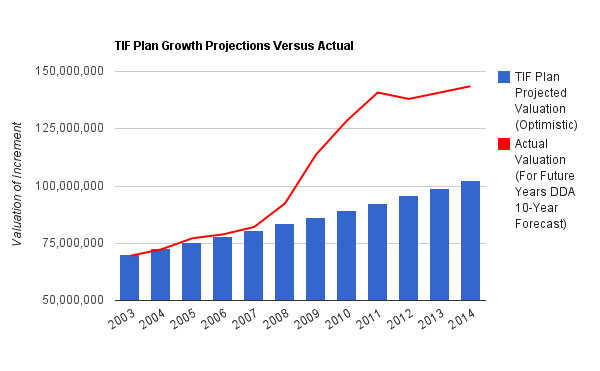
Excess TIF Capture

Blue bars represent the "optimistic" projections of the increment valuation in the Ann Arbor DDA's TIF plan. The red line represents actual valuation of the increment on which taxes have been captured. For 2013-2014, the valuation is based on estimates in the DDA's 10-year planning document.

That news had been conveyed to DDA staff by the city of Ann Arbor’s finance department just that morning: Some of the taxes captured in the DDA’s tax increment finance (TIF) district since 2003 might be owed to local taxing units, including the city. With an uncertain financial obligation to return TIF monies that had already been captured from taxing units in the district, the DDA board understandably balked at approving the new parking contract on May 2.

The postponement of the DDA’s vote on that contract ultimately led to a delay in the Ann Arbor city council’s adoption of the city’s fiscal year 2012 budget – as the council stretched its May 16 meeting to May 23 and then on to May 31. But by the end of May, the issue of excess TIF capture had been settled to the DDA board’s satisfaction, and the parking contract was ratified – first by the DDA, and then by the city council.

The Ann Arbor city council was also content with the DDA’s proposed solution to the excess TIF capture. That solution included returning a total of roughly $473,000 to the Ann Arbor District Library, the Washtenaw Community College and Washtenaw County. The city of Ann Arbor chose to waive its $712,000 share of the calculated excess.

Those three other taxing units no doubt welcomed the news that their budgets would get an unexpected boost. But the governing bodies of those taxing units should take a closer look at how the excess TIF was calculated. If they do, they will discover that the amount actually due to be returned to them (and divided proportionately as required under the city’s of Ann Arbor’s DDA ordinance) may not be $473,000, but more than twice that: $1.27 million. In ballpark numbers, for the Ann Arbor District Library that translates to the difference between about $75,000 and $200,000. For Washtenaw County, it’s the difference between $242,000 and $648,000. And for Washtenaw Community College, it’s the difference between $157,000 and $419,000. [Full Story]

City Accepts Prior Payment for Excess TIF

At the May 31, 2011 session of its meeting that had begun two week before, on May 16, resumed briefly on May 23, only to be immediately recessed, the Ann Arbor city council agreed to accept prior contributions of the Ann Arbor Downtown Development Authority toward city of Ann Arbor projects as payment for the city’s share of excess tax increment finance (TIF) capture that the DDA has received since 2003.

At a special meeting on Friday, May 20, the DDA had calculated that a total of $1,185,132 should be returned to taxing authorities that levy property taxes in the downtown district. The city’s share of that is $711,767. The council’s resolution states that the acceptance of prior contributions to city … [Full Story]

DDA Finalizes Its Side of Parking Deal

Ann Arbor Downtown Development Authority special board meeting (May 27, 2011): At a special DDA board meeting held at noon on Friday, board members voted to give final approval to a contract under which the DDA would continue to manage the city’s public parking system. The vote was unanimous among the 10 board members who attended. Absent were Gary Boren and Newcombe Clark.

Roger Hewitt John Hieftje Leah Gunn

(Left to right): DDA board members Roger Hewitt, mayor John Hieftje, and Leah Gunn at the special May 27 DDA board meeting. (Photos by the writer.)

The financial part of the contract calls for the city to receive 17% of gross revenues from the public parking system, and would have an initial term of 11 years, with one renewal option for another 11 years. That would end the contract in 2033, which coincides with the DDA’s currently established endpoint.

The contract includes a new underwriting clause for the DDA’s fund balance. Key features of that clause are: (1) it’s applicable only through 2016; (2) it’s triggered if combined DDA fund balance fall below $1 million; (3) the trigger is evaluated based on the annual audit of DDA books in September or October, for the previous fiscal year; (4) if underwriting were triggered, it would take the form of reducing existing payments that the DDA makes to the city; (5) the city’s liability is limited to $1 million annually and $2 million cumulatively; and (6) any money the city is deprived of through this underwriting would be restored to the city, at whatever point the DDA’s cumulative fund balance reaches $4 million.

After brief deliberations, the DDA board voted unanimously to ratify the contract, which now includes the underwriting clause. [.pdf of ratified draft contract]

With that vote, the DDA board also approved a new contract clause that specifies how the DDA board and city council will handle a contractually required consultation between the two groups, in conjunction with parking rate changes. The consultation by the DDA will now be a required agenda item at annual joint working sessions between the DDA board and the city council. Currently, the DDA proposes rate changes, which are automatically enacted, unless the city council vetoes them. The new contract stipulates that the DDA would have sole authority to set rates.

The city council may now ratify the parking contract on Monday, May 31, which would help settle part of the city’s revenue issues in its fiscal year 2012 budget. It would allow the council to finalize its budget on that same evening. [For additional background, see Chronicle coverage: "Ann Arbor Council Defers Action Again"]

Councilmembers Sabra Briere (Ward 1) and Stephen Kunselman (Ward 3) sat in the audience of the DDA’s May 27 meeting. On May 31, the contract could face stiff opposition from at least those two, and possibly other councilmembers. After the DDA’s May 27 board meeting, Kunselman characterized the underwriting clause to The Chronicle as a “no-layoff clause for the DDA.”

Another lingering DDA issue that could result in discussion not just by the Ann Arbor city council – but also by the Washtenaw Community College board of trustees, the Washtenaw County board of commissioners, and the Ann Arbor District Library board – is the return of excess TIF capture by the DDA. [Full Story]

Ann Arbor DDA Ratifies Parking Contract

At a special board meeting of the Ann Arbor Downtown Development Authority, held at noon on May 27, 2011, the DDA board voted to give final ratification to a contract under which the DDA would continue to manage the city’s public parking system. The vote was unanimous among the 10 board members who attended. Absent were Gary Boren and Newcombe Clark.

At a special meeting held last week on May 20, the DDA board had initially ratified the contract, with a contingency that the city of Ann Arbor would provide an amendment that adequately underwrites DDA fund balances. Then at a Wednesday, May 25 meeting of two “mutually beneficial” committees – one from the city council and one from the … [Full Story]

Another Special Meeting for Ann Arbor DDA

At a Wednesday, May 25, 2011 joint meeting of the “mutually beneficial” committees – one from the Ann Arbor city council and the other consisting of Ann Arbor Downtown Development Authority board members – committee members agreed on language that would serve to “underwrite” the DDA’s combined fund balances for the next five years. A special DDA board meeting has been set for Friday, May 27 to ratify the agreement.

The underwriting was a necessary condition of the DDA’s ratification of a new contract with the city, under which the DDA would continue to operate the city’s public parking system. At a special meeting last Friday, May 20, the full DDA board had approved a contract that would transfer 17% … [Full Story]

Ann Arbor Council Does Not Act on Budget

At the May 23, 2011 session of its meeting that had begun the week before on May 16, the Ann Arbor city council did not address two issues it was expected to settle so that it could adopt its fiscal 2012 budget: (1) ratification of a new contract under which the Ann Arbor Downtown Development Authority would continue to manage the city’s public parking system; and (2) acceptance of prior contributions by the DDA to city projects, as payment for excess tax increment finance (TIF) revenues that have been captured in the DDA’s TIF district since 2003.

Instead of addressing those issues or any other budget issues, the council voted at the very start of the meeting to recess the meeting and continue it on May 31, 2011.

Per Ann Arbor’s city charter, the city council needs to adopt the city administrator’s proposed budget with any amendments no later than the second meeting in May. Failure to adopt the budget results in adoption of the administrator’s proposed budget by default. The city council is hoping to avoid some of the cuts to police and firefighters that are a part of that budget.

For a preview of the council meeting, see Chronicle coverage: “To Be Continued: Ann Arbor Council

The vote to recess, taken before any other item was considered or could be introduced, could be seen as a move to prevent Stephen Kunselman (Ward 3) from proposing a resolution to take back responsibility for managing the city’s public parking system from the DDA. The Ann Arbor DDA has a current contract with the city that runs through 2015.

However, Kunselman’s proposed budget amendment would have essentially ignored that contract, and restored oversight of the city’s parking system to the city’s public services unit, by transferring all of the DDA’s parking funds to the city and eliminating two full-time employees at the DDA. [.pdf of Kunselman's resolution as proposed]

This brief was filed from the city council’s chambers on the second floor of city hall, located at 301 E. Huron. A more detailed report will follow. [Full Story]

To Be Continued: Ann Arbor Council

The gathering of Ann Arbor city council members tonight – May 23 – counts not as a separate meeting, but rather as a continuation of the same meeting the council began on May 16. Because of issues that could remain unresolved, councilmembers are likely to recess tonight’s meeting as well, to be continued on Tuesday, May 31 – after the Memorial Day holiday.

This is a preview of the council’s continued meeting, which starts at 7 p.m. in council chambers at city hall. Topics that council might address include excess TIF (tax increment finance) capture in the Ann Arbor Downtown Development Authority district, a new parking contract with the DDA, and possible amendments to the FY 2012 budget. Factors that might play a role in council’s deliberations include alternative calculations of the excess TIF capture, and issues of control regarding components of the proposed parking contract – such as giving the DDA sole authority to set parking rates. [Full Story]

DDA: Parking, Excess Taxes Still Not Done

Ann Arbor Downtown Development Authority special board meeting (May 20, 2011): A special meeting held by the board of the DDA on Friday was meant to give some final resolution to the DDA’s side of a new contract under which it would continue to operate the city’s public parking system.

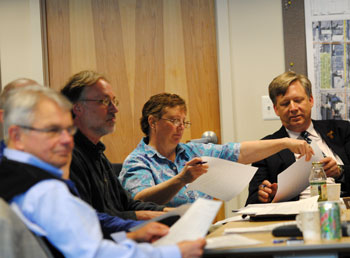
Bob Guenzel, John Mouat, Sandi Smith, Russ Collins, DDA special board meeting

Left to right: DDA board members Bob Guenzel, John Mouat, Sandi Smith, and Russ Collins at the May 20 DDA special board meeting. Obscured from view between Guenzel and Mouat is John Hieftje. They were distributing the paper handouts with calculations of excess TIF revenues. (Photos by the writer.)

It was also intended to settle the matter of excess capture of TIF (tax increment finance) revenue in the DDA district – an issue raised by the city of Ann Arbor just before the DDA board had originally planned to vote on the new parking contract on May 2.

The board did vote on Friday to affirm a calculation by DDA staff that roughly $473,000 of excess TIF capture since 2004 would be divided among the following taxing authorities, which have a portion of their tax revenues captured in the DDA TIF district: Washtenaw County; Washtenaw Community College; and the Ann Arbor District Library.

Based on a representation at the special meeting by mayor John Hieftje – who has a statutory seat on the DDA board – the city of Ann Arbor is likely to agree to “forgive” the $711,767 in excess TIF capture that would be due to the city. More than that amount has effectively already been returned to the city, in the form of a roughly $0.5 million annual grant to the city to help make bond payments on its new municipal center, and a $1 million expenditure to demolish the old YMCA building, as well as other grants. In total, around $7.5 million has gone to the city, according to the DDA.

At Friday’s special meeting, the DDA board also voted to ratify its side of a new contract under which it would continue to operate the city’s public parking system. Among other features, the new contract would obligate the city of Ann Arbor to report regularly on how it is using public parking system revenues for street repair in the downtown, and how it is enforcing parking regulations downtown.

More controversially, the new contract would allow the DDA to set parking rates. Currently, the DDA forwards proposed rate changes to the city council, which can then veto the DDA’s proposal if it acts within 60 days. If the council does not act to block the rate change, the change is enacted. Although Hieftje said at the DDA board meeting he felt there was adequate support on the council to approve such a contract, there are currently at least five likely no votes on the 11-member council.

Also controversial is the exact percentage of gross revenues the city would receive from the public parking system. Before the issue of the excess TIF capture arose, the DDA board was poised to ratify a parking contract that would transfer 17% of gross parking revenues to the city of Ann Arbor’s general fund. At Friday’s special meeting, the resolution before the board dropped that number to 16%. Hieftje proposed an amendment to raise the figure to 17%. That amendment was attached to a contingency that the city council would provide a plan amendable to the DDA in which the city would “underwrite” the DDA’s fund balances. It was the 17% with a contingency that the DDA board passed.

So the special DDA board meeting did not settle with finality either the issue of the excess TIF capture or the DDA’s side of the parking contract. For the TIF capture issue, the relevant taxing authorities – especially the city of Ann Arbor – will need to affirm the solution that the DDA board approved.

For the parking contract issue, the DDA’s contingency means that the city council’s Monday, May 23 meeting – which is a continuation of its May 16 meeting, when it was supposed to approve the FY 2012 budget – will likely be recessed and continued again on May 31.

One possibility for how events would unfold is this: (1) May 23 – the city council ratifies the city’s side of the parking contract and provides the plan for underwriting DDA fund balances; city council also deliberates and amends FY 2012 budget but does not take a final vote on it; (2) May 24-27 – DDA schedules a special meeting to accept the parking contract contingency; and (3) May 31 – city council resumes the meeting started May 16 and previously continued on May 23, and approves FY 2012 budget. [.pdf of draft parking contract] [Full Story]

Ann Arbor DDA to Return $473K in Taxes

At a special meeting held at noon on Friday, May 20, the board of the Ann Arbor Downtown Development Authority voted to return $473,365 in taxes previously captured as part of the DDA’s tax increment finance (TIF) district. The money will be divided among three taxing authorities: Washtenaw County ($242,179); Washtenaw Community College ($156,520); and the Ann Arbor District Library ($74,666).

The decision was prompted by questions raised on Friday, April 29 by the city of Ann Arbor about the implementation of the city’s ordinance governing TIF capture for the DDA district. The ordinance includes a clause stipulating that if the growth rate in the TIF capture exceeds what is anticipated in the formal TIF plan, at least half of the excess must be divided proportionately among the taxing authorities that had some of their taxes captured in the TIF district.

The total amount of excess TIF capture that has accumulated since 2004 in the Ann Arbor DDA district is $1,185,132. The difference between that total and the combined $473,365 to be paid to Washtenaw County, WCC and AADL is $711,767. That difference is the proportionate share that would be due to the city of Ann Arbor (including the Ann Arbor Transportation Authority), which also has some of its taxes captured in the DDA TIF district. In fact, around 60% of the taxes captured in the TIF district are due to city of Ann Arbor millages.

However, Friday’s resolution included a “whereas” clause indicating that the city of Ann Arbor is likely to recognize that the $711,767 in excess TIF capture has effectively already been returned to the city, in the form of (1) a roughly $0.5 million annual grant to the city to help make bond payments on its new municipal center, and (2) a $1 million expenditure to demolish the old YMCA building, as well as other grants.

The determination of the excess was based on: (1) the “optimistic” projections in the TIF plan; (2) the combined real and personal property valuations in the district; and (3) excess growth calculated by comparing the actual growth rate between successive years against the forecast growth rate in the TIF plan between those years.

The payments to the other three taxing entities are planned to be made before June 30, making them a part of the 2011 fiscal year, which ends June 30. That will require the board to amend the FY 2011 budget.

The financial impact of the payments on the DDA led the board on Friday to review the financial component to the new contract currently being negotiated with the city under which the DDA operates Ann Arbor’s public parking system.

Before the excess TIF issue came to light, the DDA board had been prepared on May 2 to agree to a contract that would have transferred 17% of gross parking revenues to the city each year. Gross parking revenues are projected to be around $16 million in the next year.

At Friday’s meeting, the DDA board ratified its side of an agreement that would transfer 17% of gross parking revenues to the city, but added a contingency that would require the city of Ann Arbor to formalize a plan proposed by mayor John Hieftje to backstop fund balances for the DDA.

The contingency means that the city council’s May 16 budget meeting, which is continuing on May 23, will likely continue past that Monday to resume again on Tuesday, May 31. Hieftje, who also sits on the DDA board, said he felt there would be sufficient support on the council on May 23 to ratify the parking contract and formalize the backstopping plan.

The DDA will need to schedule another special meeting the week of May 23 after the council meets to resolve the contingency. The council would then be able to finalize its budget on May 31.

This brief was filed from the DDA’s offices at 150 S. Fifth Ave., where the special meeting took place. A more detailed report will follow: [link] [Full Story]

DDA Delays Parking Vote Amid TIF Questions

Ann Arbor Downtown Development Authority board meeting (May 2, 2011): At its Monday meeting, the DDA board was expected to ratify its side of a new contract under which the DDA would continue to operate the city of Ann Arbor’s public parking system.

John Hieftje Roger Hewitt

Mayor John Hieftje (left) and DDA board member Roger Hewitt (right) head to their seats to start the DDA's board meeting. (Photos by the writer.)

Instead, the board received this news from the chair of its bricks and money committee: The city has raised the possibility that the DDA might need to return money to various taxing entities – including the city of Ann Arbor – from the taxes captured through the DDA’s tax increment finance district. The city communicated its concern to the DDA on Monday morning, the day of the noon meeting.

The issue concerns the DDA’s TIF plan, which was renewed in 2003, and language in the city’s ordinance establishing the DDA under the state’s enabling legislation. The TIF plan contains projections for the growth in taxable value of property (both real and personal) in the district. The city’s ordinance stipulates that if the actual “captured assessed valuation” grows at a rate faster than the expectation expressed in the TIF plan, then at least 50% of the additional amount must be returned proportionately to the taxing authorities from which the taxes were captured.

The vagueness of the ordinance language leaves several open questions that will require further review by the city attorney’s office and the DDA’s own legal counsel, as well as the financial staff from both organizations.

Those questions include: (1) What’s the relevant time period? (2) Which set of TIF plan estimates are applicable – the one labeled pessimistic, optimistic or realistic? (3) Who is the responsible party for adherence to the ordinance? (4) Does the ordinance language refer to real property only or also to personal property? (5) Do payments already made by the DDA to the city of Ann Arbor out of the TIF for the new municipal center count towards any sum that might need to be returned?

After hearing the news, the board decided to table the resolution on its agenda that would have ratified the DDA’s side of a new parking contract under which it would continue to manage the city’s parking system. [Previous Chronicle coverage: "Column: Ann Arbor Parking – Share THIS!"]

Board members recognized that it would likely be necessary to convene a special meeting of the board, given the city’s need to approve its budget on May 16. Later the same day, on the evening of May 2, the city council struck from its agenda the item that would have ratified the city’s side of the new parking contract. The city council has not yet weighed in on the text of the contract, but did express its view on the financial terms at its April 19 meeting.

As DDA board members absorbed the news about the TIF question, they heard their usual set of reports from their committees and wrapped up the meeting is less than an hour – they had no further business to transact. Board member Russ Collins, who was prepared to call in to the meeting from Detroit, where he’d been summoned for federal jury duty, did not need to do that.  [Full Story]

DDA Delays Parking Contract Vote

At its May 2, 2011 meeting, the Ann Arbor Downtown Development Authority board delayed voting on the new parking contract under which the DDA would continue to operate the city’s public parking system.

An issue identified by the city of Ann Arbor late Friday raised questions about whether some of the tax increment financing (TIF) revenue captured since 2002 by the DDA should, in fact, be returned to the taxing authorities from which it was collected. So the board wanted additional time to clarify the issue before voting on the contract.

Added information after original publication: [At issue is the proper interpretation of the following paragraph of the city's ordinance establishing the DDA: "If the captured assessed valuation derived from new construction, and increase in value of property newly constructed or existing property improved subsequent thereto, grows at a rate faster than that anticipated in the tax increment plan, at least 50% of such additional amounts shall be divided among the taxing units in relation to their proportion of the current tax levies. If the captured assessed valuation derived from new construction grows at a rate of over twice that anticipated in the plan, all of such excess amounts over twice that anticipated shall be divided among the taxing units. Only after approval of the governmental units may these restrictions be removed."] [.pdf of Ann Arbor city ordinance establishing DDA]

The resolution to ratify the contract with the city was tabled by the board, and board members recognized that it would likely be necessary to convene a special meeting of the board, given the city’s need to approve its budget on May 16. [Previous Chronicle coverage: "Column: Ann Arbor Parking – Share THIS!"]

This brief was filed from the DDA offices at 150 S. Fifth Ave., where the board meets. A more detailed report will follow: [link] [Full Story]

Column: Ann Arbor Parking – Share THIS!

It’s budget season for the city of Ann Arbor.

Over the last half decade, Ann Arbor’s annual spring budget conversation has evolved to include a discussion of public parking system revenues.

parking meters in Ann Arbor

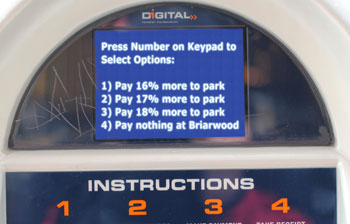
In discussions about parking revenue, it's been suggested that what the city of Ann Arbor is proposing is the equivalent of a tax on downtown parkers. (Photo illustration by The Chronicle. This is not what Ann Arbor parking meters actually look like. Yet.)

This year is no exception. The city council’s public hearing on the budget takes place at its May 2 meeting, with a vote on the 2012 fiscal year’s budget scheduled for May 16. At that May 2 meeting you’ll also hear the city council discuss revenues from the public parking system. The board of the Ann Arbor Downtown Development Authority – which manages the city’s public parking system – will meet at noon the same day to ratify its side of a contract renewal.

As likely as any other scenario is an offer from the DDA for the city to receive 17% of gross revenues from the public parking system for each year of an 11-year term. But that offer stands a decent chance of getting rejected by the city council. The city’s last bargaining position was 18% for a 10-year term and multiple three-year renewals.

Public parking revenues were already part of council deliberations at a city council budget work session on April 11, when city administrator Roger Fraser had given a dress rehearsal of his budget proposal. At the work session, councilmembers and Fraser played out a scene, in which councilmembers offered up questions to Fraser to elicit this conclusion: If the city does not extract enough revenue from the city’s public parking system, the city will need to lay off additional police or firefighters – four this year and two the following year.

The scene was reprised on April 19, when the city’s budget was formally premiered. The budget did not appear to depart in significant ways from the department-by-department budget impacts that city managers have presented to the council at a series of work sessions since the beginning of the year.

On April 19, it was the city’s CFO Tom Crawford (later in the meeting to be appointed interim city administrator) who played the role of the “numbers guy.” So it was Crawford who gave the recommendation in response to councilmember prompts: Without sufficient revenue from the public parking system, he would recommend laying off an additional four public safety officers. That’s in addition to the five police officers, three other non-officer positions in the police department, and five firefighters who are already slated for layoff.

Councilmembers Christopher Taylor, Carsten Hohnke, Marcia Higgins, Stephen Kunselman and mayor John Hieftje played starring roles in their portrayal of elected officials that evening. But more to the point of this column, I wonder who the city council’s imagined audience is for this sort of theater? Presumably it’s for an audience that pays the price of admission. But in Ann Arbor, it’s an audience that typically doesn’t pay much attention: the city’s shareholders.

Yes, that’s exactly the word I want. Shareholders. [Full Story]

Council Delays Pot, Takes Shots at DDA

Ann Arbor city council meeting (April 19, 2011): The city council delayed a second and final vote on two local laws that involve regulation of medical marijuana businesses in the city – one on zoning and the other on licenses.

Roger Fraser, Tom Crawford

Seated is Roger Fraser, who attended his last Ann Arbor city council meeting on April 19 as city administrator – he gave a formal presentation to the council of the FY 2012 budget. He's chatting before the meeting with the city's chief financial officer, Tom Crawford, who was appointed interim administrator later in the evening. He's not telling Crawford: "Whatever you do, don't let the council tie your hands, see?" (Photos by the writer.)

After public hearings on the two medical marijuana laws, the council did not deliberate long in deciding to postpone both votes until its next meeting, on May 2. Substantive amendments that had been presented to councilmembers late that day for consideration made them reluctant to attempt grappling with the amendments in detail. The May 2 vote on the two laws will likely count only as their initial approval, assuming the amendments are adopted at that meeting. The laws would then need an additional final reading after May 2 before they are enacted.

A tweak to the city’s panhandling ordinance was given its second and final approval at the April 19 meeting. That change to the existing ordinance had come as a recommendation from a task force that worked for six months on the issue, following up on a longer effort in the early 2000s that had led to adopting the language in the existing ordinance.

The longest deliberations of the night involved a resolution of instruction to the council’s “mutually beneficial” committee, which is currently negotiating a new contract under which the Ann Arbor Downtown Development Authority would continue to manage the city’s public parking system. The direction given to the committee was not to stay firm with its previous bargaining position, but rather to escalate the city’s expectations for revenues from the public parking system.

Previously, the city’s committee had taken the position that the city should receive 16% of gross parking revenues in the first two years of a 10-year contract, and 17.5% in remaining years. That compared with the DDA’s position that the city should receive a flat 16% across all years. But at the meeting, the council voted to direct its committee to take the position that the city should receive a flat 18%. The council’s deliberations included comments directed towards the DDA that could fairly be described as inflammatory.

Called to the podium to comment on the parking revenue figures and the DDA’s overall financial health was the city’s chief financial officer, Tom Crawford. Later in the meeting, Crawford was appointed interim city administrator, effective April 28. Current administrator Roger Fraser is leaving the post to take a job as a deputy treasurer for the state of Michigan.

Although councilmembers did not comment on it, Fraser was attending his last meeting of the council as city administrator. And in his final major act, he gave a formal presentation to the council of his proposed fiscal year 2012 budget, as required by the city charter. The charter stipulates that the council will need to amend and approve the budget by May 16, its second meeting that month. [Full Story]

City to DDA: We’d Like More Parking Money

At its April 19, 2011 meeting, the Ann Arbor city council instructed its “mutually beneficial” committee – which is currently renegotiating a new contract under which the Ann Arbor Downtown Development Authority would continue to operate the city’s public parking system – to change its position, by escalating its request for additional parking revenues. The council voted to direct the committee to now ask the DDA for 18% of gross parking revenues in each year of a 10-year contract. The vote was 9-2, with dissent from Christopher Taylor (Ward 3) and Sandi Smith (Ward 1).

The city’s negotiating team had previously been insisting that in the first two years of a 10-year contract, 16% of gross revenues to the public parking system would be allocated for use by the city at its discretion, with that amount rising to 17.5% of gross revenues in remaining years.

The DDA’s position had been consistent with the city’s previous request for the first two years of the contract, which would have the city withdrawing 16% of gross revenues from the public parking system in each of those years. But the DDA’s position is that for remaining years of the contract, the city’s share of gross parking revenues should remain at 16% instead of rising to 17.5%.

The city’s chief financial officer, Tom Crawford, said on the flat-16% scenario, he would recommend cutting four police or firefighters this year and two additional police or firefighters next year – the first two years of the proposed parking contract.

The decision to bring a resolution of instruction to the council had come at a meeting between the respective mutually beneficial committees of the city council and the DDA on Monday morning, April 11. [For detailed previous coverage: "City, DDA Continue to Talk Parking, Taxes"]

This brief was filed from the city council’s chambers on the second floor of city hall, located at 301 E. Huron St. A more detailed report will follow: [link] [Full Story]

Ann Arbor Council to Weigh Parking Deal

At a 7:30 a.m. Monday, April 11, 2011 meeting of two “mutually beneficial” committees – one composed of Ann Arbor Downtown Development Authority board members and the other made up of city councilmembers – a consensus was reached that the full city council should now give some direction on the new contract under which the DDA would continue to operate the city’s public parking system. The two committees agreed that a “resolution of instruction” should be put to a city council vote at the council’s April 19 meeting.

The contract will call for the city of Ann Arbor to be paid a percentage of the public parking system’s gross revenues. The two committees have been unable to reach a consensus on that percentage. So on April 19, the council will be presented with two options: (1) 16% in each of the first two years of a 10-year deal, and 17.5% in the remaining years – the 16-16-17.5 scenario, which is advocated by the city’s committee; (2) 16% in every year of a 10-year deal – a flat-16 scenario reflecting a compromise from an earlier DDA board position.

For additional details and history of the negotiations, see previous Chronicle coverage: “City, DDA Continue to Talk Parking, Taxes

On the council’s committee are councilmembers Carsten Hohnke, Margie Teall and Christopher Taylor. Serving on the DDA committee are Gary Boren, Russ Collins, Roger Hewitt and Sandi Smith. Monday’s April 11 meeting was attended by Smith and Teall in person, with Hewitt, Taylor and Hohnke joining by conference phone. Sue McCormick, public services area administrator for the city, also attended the meeting. [Full Story]

City, DDA Continue to Talk Parking, Taxes

Ann Arbor Downtown Development Authority board meeting (April 6, 2011): Since June 2010, the city of Ann Arbor and the Ann Arbor DDA have been negotiating a new contract under which the DDA would continue to operate the city’s public parking system.

While the city and the DDA have achieved much agreement on the non-monetary details of the arrangement, Wednesday’s board meeting left the financial piece still unclear.

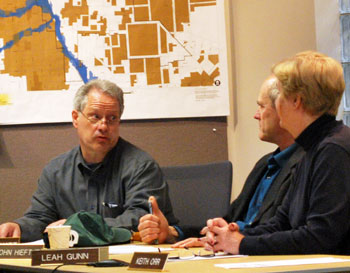
Keith Orr DDA Ann Arbor

Keith Orr pores over the figures under various scenarios for the new contract under which the DDA would operate the public parking system. (Photos by the writer.)

The board discussion included a focus on the contrast between the combined fund reserve of the DDA – which includes those funds it collects as a tax-increment finance authority – and the reserves of just the public parking fund. Sandi Smith, who’s a DDA board member and an Ann Arbor city councilmember, stressed throughout the conversation that it’s not just the overall fund balance, but the public parking fund balance itself that needs to be monitored.

Last week, the board had come to a consensus that the public parking system could absorb a payment to the city equal to 16% of gross parking revenues in every year of a 10-year contract, which represented a revision upward from its previous position of 14% in the first two years, followed by 15% in subsequent years.

After lengthy back-and-forth, the only consensus reached by DDA board members was that they were not prepared to revise their position upward (again) to meet the city’s request that the city be paid 16% of the public parking gross revenues in the first two years of the contract, but 17.5% in remaining years. Mayor John Hieftje, who serves on the DDA board, was the lone voice of support for that position.

The mayor also found himself somewhat isolated on another issue in front of the board at its Wednesday meeting – the only action item on the agenda. The board voted to sign a new, more favorable lease agreement for its roughly 3,000 feet of office space at 150 S. Fifth Ave. for a term of five years.

Although the mayor voted with the rest of the board in authorizing the lease agreement, he had announced at the city council’s Monday, April 4 meeting that he would be asking his fellow DDA members to consider moving into space that’s currently being renovated in the city hall building. Two days later, at Wednesday’s DDA board meeting, the mayor appeared to understand that there was little enthusiasm on the board for the move, based partly on the fact that it would cost the DDA more in the short term.

At the meeting, the board also heard its usual range of reports and communications, including an update from DTE on the addition of a new substation near the Broadway bridge, to meet increased demand for electricity. [Full Story]

DDA Renews Lease of Office Space

At its April 6, 2011 meeting, the Ann Arbor Downtown Development Authority board authorized signing a new five-year lease for its office space at 150 S. Fifth Ave.

Under terms of its current lease, which expires on June 30, 2011, the DDA pays $26 per square foot for 3,189 square feet of office space. Under terms of the new lease, the DDA would pay $16.75 per square foot in the first year of the five-year deal, for a total of $53,415. After the first year, the amount would increase to $17.25, $18, $18.75 and $19.50 per square foot.

The decision to renew the lease came in the context of mayor John Hieftje’s announcement at the April 4 city council meeting that he’d be inviting the DDA board to consider moving the DDA offices to newly renovated space in the city hall building. But at the Wednesday DDA board meeting, he indicated that he’d discussed the lease with DDA board member Roger Hewitt and understood that securing just a one-year renewal of the lease would mean agreeing to the less favorable terms of the current lease. Hieftje voted for the five-year lease extension, along with the rest of the board.

This brief was filed from DDA offices at 150 S. Fifth Ave. A more detailed report of the board meeting will follow: [link]
[Full Story]

Ann Arbor Council Focuses on Downtown

Ann Arbor City Council meeting (April 4, 2011): At its Monday meeting, the council focused much of its time discussing the future of downtown Ann Arbor.

higgins-counts-parcels

Councilmember Marcia Higgins (Ward 4) ticks through the list of parcels that would be the focus of a DDA-led development process. (Photos by the writer.)

Councilmembers voted on two major downtown-related agenda items – one affecting the immediate future of an individual parcel, the city-owned Library Lot. The other item involves a process by which the Ann Arbor Downtown Development Authority would lead the planning of development for multiple downtown parcels, including the Library Lot.

The council voted, over dissent from two of its members, to end the RFP process for the Library Lot and to reject a draft letter of intent they’d discussed at a March 14 work session, which would have called for the city to work with Valiant Partners to craft a development agreement for construction of a conference center and hotel on the lot. The Ann Arbor DDA is currently building a roughly 640-space underground parking garage on that parcel.

Based on a separate resolution passed by the council, the future use of the Library Lot could emerge from a process to be led by the DDA. The council required lengthy deliberations before narrowly approving an amendment that reduced the area of focus for the DDA-led process. The amendment limited the area to the square bounded by Ashley, Division, Liberty and William streets, which would include the Library Lot on South Fifth Avenue, the Kline Lot on Ashley, the old YMCA Lot at Fifth and William, and the Palio Lot at Main and William.

The resolution on the DDA-led process is part of a broader ongoing negotiation between the city and the DDA, related to the contract under which the DDA operates the city’s public parking system. That contract is being renegotiated, and since January, the city has not budged from its position that the DDA should pay the city a percentage-of-gross parking revenue of 16% in the contract’s first two years and 17.5% in years thereafter. It appears that the DDA board is gradually conceding to the city’s bargaining position. That will become clearer at the DDA board meeting on Wednesday, April 6.

The city’s negotiating position is based in part on the idea that the DDA is, as mayor John Hieftje has described it, “an arm of the city.” Hieftje’s view of the DDA as part of the city was further accentuated on Monday, when he announced at the end of the council’s meeting that he would be inviting the DDA to move its offices into newly-renovated space in the city hall building. The DDA currently leases space about a block south of city hall.

Also a part of Monday’s downtown-themed meeting was initial approval the council gave to a revision to the city’s ordinance on panhandling. That ordinance revision – which added some areas where panhandling is prohibited – will require a second reading and a public hearing in front of the council before it can be enacted.

An additional part of the downtown discussion came at the start of the council’s meeting, with a presentation on work being done to plan and study the 415 W. Washington parcel for future use as a center for artists and as a greenway park.

In non-downtown business, the council accepted a series of easements that will set the stage for TIGER II grant funds – already awarded by the federal government – to be formally obligated to the city. At stake is $13.1 million, which is currently still part of a continuing resolution for the federal budget. But that continuing resolution expires April 8, so the council was acting with some urgency.

The council also gave necessary approvals for a bus pullout to be constructed on Washtenaw Avenue, and authorized emergency purchase orders for furniture. And the council heard a presentation from Andrew Brix, the city’s energy programs manager, about efforts to increase the percentage of renewable energy that the city uses. [Full Story]

DDA to Get Invite to Move Office to City Hall

During his communications period at the conclusion of the Ann Arbor city council’s April 4, 2011 meeting, mayor John Hieftje announced that he and councilmember Sandi Smith (Ward 1) would be presenting the Ann Arbor Downtown Development Authority with an invitation to move its offices into newly renovated space on the lower level of city hall. That invitation will be made at the DDA’s Wednesday, April 6 board meeting. The DDA is currently contemplating signing a lease renewal for its existing space at 150 S. Fifth Ave.

This brief was filed from the city council’s chambers on the second floor of city hall, located at 100 N. Fifth Ave. A more detailed report will follow: [link] [Full Story]

Ann Arbor Council Finally OKs DDA-Led Plan

At its April 4, 2011 meeting, the Ann Arbor city council finally voted to approve a resolution that would establish a process to develop alternate uses of city-owned downtown surface parking lots, to be led by the Ann Arbor Downtown Development Authority. The vote was unanimous.

The council had considered but postponed the resolution at its March 7, 2011 meeting, and before that at its Jan. 18, 2011 meeting. At the March 7 meeting, Marcia Higgins (Ward 4) had complained that no revisions had been made to the resolution to accommodate objections made at the Jan. 18 meeting. [.pdf of the unamended resolution with the parcel-by-parcel plan] At that meeting, objections to the proposal included “resolved” clauses in the resolution that would (1) require placement of items on the city council’s agenda; and (2) under some circumstances require the city to reimburse the DDA for its expenses.

At the April 4 meeting, Christopher Taylor (Ward 3) offered amendments to the resolution that among other things added additional language about public process: “Solicit robust public input and conduct public meetings to determine residents’ parcel-level downtown vision.” Taylor also added clarifying language that would require the DDA to account for its direct costs and that they be reported along the way, in order to potentially have their costs reimbursed. Those amendments were undertaken as revisions to the resolution at the start of deliberations.

Sandi Smith (Ward 1) offered an amendment that confined the focus to the area bounded by William, Ashley, Liberty and Division streets, which passed on a 6-4 vote, with dissent from Taylor, Carsten Hohnke (Ward 5), Mike Anglin (Ward 5) and Tony Derezinski (Ward 2).

At its Jan. 5 board meeting, the Ann Arbor DDA board had approved a resolution urging passage of the council resolution, which had been circulated as early as the city council’s Dec. 20, 2010 meeting, when Taylor had attached a copy of the the draft resolution to the council’s meeting agenda, and alerted his council colleagues to it at that meeting

This brief was filed from the city council’s chambers on the second floor of city hall, located at 100 N. Fifth Ave. A more detailed report will follow: [link] [Full Story]

Column: DDA – The Sure Thing

In 1985, Rob Reiner made a movie called The Sure Thing, starring John Cusack as a college student who made a 3,000-mile journey on a break from school in order to meet up with a “sure thing” – a girl who didn’t need any convincing to have sex.

Given the movie’s plot, it was a little odd to hear a scene from it cited by an Ann Arbor city councilmember to bolster a budget argument.

Carsten Hohnke, who represents Ward 5 on Ann Arbor’s city council, used the “credit card scene” from that movie – without naming the movie or giving the broader context of the plot – during a meeting of two committees on Monday morning, April 4, 2011. Known as the “mutually beneficial” committees, one is composed of Ann Arbor Downtown Development Authority board members and the other is made up of city councilmembers.

To understand the reference to The Sure Thing scene, it’s useful to have some brief background on the city-DDA parking drama. Understanding that drama, in turn, leads to some interesting conclusions about the relationship between the city and the DDA, and about what city councilmembers might be willing to say to get what they want. [Full Story]

Column: Library Lot – Bottom to Top

Editor’s note: Although the parcel immediately north of the Ann Arbor District Library’s downtown location is known as the Library Lot, it does not belong to the library, but rather to the city of Ann Arbor.

Last Thursday, news of a breach in the earth-retention system of a downtown Ann Arbor construction site had reached all the way to Detroit’s Channel 4 News. Channel 4 sent a crew Friday evening to file a report. It was tagged on the Channel 4 website with the summary: “An Ann Arbor construction project is sinking, literally.” Chalk that up to the hyperbole of television news.

Library Lot conference center schematic, retaining wall

Top: View to the northeast along Fifth Avenue from Valiant Partners' concept for a conference center and hotel, proposed for the top of the Library Lot underground parking garage. Bottom: Breach in the earth retention system for the underground parking garage currently under construction on the Library Lot.

While the roughly 640-space underground parking garage, being built by Ann Arbor’s Downtown Development Authority, is not sinking in any way, a conference center and hotel proposal for the top of the underground structure might be sinking.

At first glance, the 190,000-square-foot project proposed by Valiant Partners Inc. seems like it’s on a path to approval by the city council. In November 2010, an advisory committee – charged with evaluating responses to a city of Ann Arbor request for proposals issued in late 2009 – finally settled on the Valiant proposal as the best of the six the city had received.

That decision came with the aid of Roxbury Group, a consultant hired to help evaluate the proposals and to negotiate an agreement with a developer. At an early March meeting of the advisory committee, a Roxbury representative presented a draft letter of intent, which had been worked out by Valiant and Roxbury, to be signed by the city of Ann Arbor and Valiant. The committee voted unanimously to recommend that the city council consider the letter of intent.

Then, on March 14, the city council held a work session on the proposed conference center. The council heard essentially the same presentation about the letter of intent that Roxbury had made to the advisory committee. The council is scheduled to consider the letter formally at its second meeting in April, which is now scheduled for Tuesday, April 19, to accommodate the first night of Passover. The letter of intent calls for a development agreement to be presented to the city council within four months of signing the letter of intent – which would mean sometime near the end of August 2011.

But I think it’s clear at this point that a development agreement between Valiant and the city of Ann Arbor to develop the Library Lot would not achieve the necessary eight-vote majority for an actual real estate deal. That’s why I think the city council might vote down the letter of intent – even if there are at least six councilmembers who would support going forward with the letter, which is all it would take for the letter’s approval.

I base that conclusion on remarks made by councilmembers at the March 14 work session, and regular politics as reflected in the council’s history – both recent and ancient. But before considering politics, let’s dig into some really ancient history – the kind measured in geological time – to gain some additional insight into why a pile of dirt spilled unintentionally into the underground parking garage construction pit. [Full Story]

“Transformer Plaza” Money OK’d by Council

At its March 21, 2011 meeting, the Ann Arbor city council authorized the transfer of $90,000 from its parks memorials and contributions fund to the Ann Arbor Downtown Development Authority. The money will be used by the DDA for the design and construction management of improvements to a plaza near the Forest Street parking structure. Because of the number of DTE transformers that are situated near the plaza, it’s known in some circles as Transformer Plaza.

The $90,000 figure stems from the $50,000 and $40,000 contributions made to the parks fund by the 601 S. Forest and Zaragon I developments, respectively, which are located in the vicinity of the plaza. As part of any site plan review process in the city of Ann Arbor, developers are asked to make a donation of land so that new residents have access to adequate open space. But the city also accepts cash donations in lieu of land contributions.

This brief was filed from the boardroom in the Washtenaw County administration building, where the council is meeting due to renovations in the city hall building. A more detailed report will follow: [link] [Full Story]

Beyond Pot: Development, Liquor, Parks

Ann Arbor city council meeting (March 7, 2011) Part 1: The city council’s Monday meeting lasted nearly until midnight, with most of the five hours devoted to discussion of a proposed medical marijuana ordinance, which the council ultimately elected to postpone. The meeting included other significant business as well, and Part 1 of this meeting report is devoted to just those non-marijuana-related business items.

Tony Derezinski Ann Arbor city council

At the March 7, 2011 city council meeting, Tony Derezinski (Ward 2) was appointed as a hearing officer to consider appeals of recommendations to revoke liquor licenses. To Derezinski's right are Margie Teall (Ward 4), Sandi Smith (Ward 1) and Stephen Kunselman (Ward 3). (Photos by the writer.)

Also postponed – until the council’s first meeting in April – was a resolution that would outline a way for the Ann Arbor Downtown Development Authority to lead the process of transforming surface parking lots currently owned by the city of Ann Arbor to alternate uses.

The resolution, which articulates the so-called “parcel-by-parcel plan,” had already been postponed once before. In explaining the rationale for the postponement, Christopher Taylor (Ward 3) cited the desire of the DDA to ensconce the parcel-by-parcel plan in a contractually binding agreement, which he said had not been previously indicated.

Not postponed was a vote on appointing a hearing officer for appeals of recommendations that liquor licenses not be renewed. The original resolution was to appoint the members of the council’s liquor license review committee to a hearing board, but it was amended at the table – to the surprise of some councilmembers – to allow for appointment of just one hearing officer: Tony Derezinski (Ward 2). Derezinski also serves on the liquor license review committee. Voting against the amendment, as well as the final appointment, were three councilmembers, including Stephen Rapundalo (Ward 2). Rapundalo chairs the council’s liquor license committee and has served on it since it became a permanent council committee in 2008, as well as before that, when it was an ad-hoc committee.

The council also approved the city’s Parks and Recreation Open Space (PROS) plan – an inventory, needs assessment and action plan for the city’s parks system, which is required by the state for certain grant applications. The deadline faced by the council to renew the five-year plan was April 1, 2011.

In other non-marijuana business, the council approved a “complete streets” policy, authorized a stormwater study in the Swift Run drain system, established a loan loss fund for the Property Assessed Clean Energy (PACE) program, and authorized the purchase of LED streetlight fixtures.

The council also heard its usual range of public commentary and communications from its own members. A public hearing was held on the establishment of a Washtenaw Avenue corridor improvement authority (CIA), during which Ypsilanti mayor Paul Schreiber spoke. The Chronicle will cover the mayor’s comments as part of a future report on a CIA public meeting conducted by city planning staff. [Full Story]

DDA-Led Development Stalls Again

At its March 7, 2011 meeting, the Ann Arbor city council again delayed action on a resolution that would have authorized the city’s downtown development authority to create a parcel-by-parcel plan for the development of downtown city-owned surface parking lots. The council had also considered but postponed a vote on the proposal at its Jan. 18, 2011 meeting. Objections at that meeting to the proposal included “resolved” clauses in the resolution that would (1) require placement of items on the city council’s agenda; and (2) under some circumstances require the city to reimburse the DDA for its expenses.

The postponement at the March 7 meeting was accomplished on a 10-1 vote, with Sandi Smith (Ward 1) casting the dissenting vote. Smith also serves on the DDA board. Christopher Taylor (Ward 3) noted that the DDA appeared to be interested in creating a contractual, binding relationship – instead of working based on city council and DDA board resolutions – and in light of that he wanted to postpone the issue until the council’s first meeting in April.

The two “mutually beneficial” committees of the city council and the DDA board met for the first time since the council’s Jan. 18 meeting on the morning of March 7, providing little lead time for the discussion by the whole council of the latest proposal. The committees are negotiating a revision to the contract under which the DDA manages the city’s public parking system, as well as a framework under which the DDA would lead the redevelopment of city-owned downtown surface parking lots.

At its Jan. 5 board meeting, the Ann Arbor DDA had passed a resolution urging passage of the council resolution, which had been circulated as early as the city council’s Dec. 20, 2010 meeting, when Taylor attached a copy of the the draft resolution to the council’s meeting agenda, and alerted his council colleagues to it at that meeting.

This brief was filed from the boardroom in the Washtenaw County administration building, where the council is meeting due to renovations in the city hall building. A more detailed report will follow: [link] [Full Story]

DDA Passes Budget, Pig to Follow

Ann Arbor Downtown Development Authority board meeting (March 2, 2011): At its regular monthly meeting, the DDA board approved its budget for the next two years – fiscal years 2012 and 2013. The DDA’s fiscal calendar is aligned with the city of Ann Arbor’s, which runs from July 1 to June 30.

Board members of the Ann Arbor Downtown Development Authority

DDA board members study the budget proposal they approved at the March 2 meeting. From left to right: Bob Guenzel, Sandi Smith, Russ Collins. Obscured, sitting between Guenzel and Smith, is John Mouat. (Photo by the writer.)

For FY 2012, the DDA is budgeting for $20,118,601 in total revenues – of that amount, $3,893,943 is forecast to come from tax capture, $16,162,752 from parking revenues, and $61,906 from interest earnings. Budgeted expenses, at $20,631,328, will exceed revenues by $512,727.

The board has not yet incorporated into its budget the likely revisions that will be made to the DDA’s contract with the city of Ann Arbor, under which it manages the city’s public parking system. Those contract revisions are expected to result in a total parking-contract-related payment to the city of $2.26 million in FY 2012. The approved DDA budgets for FY 2012 and 2013 include only the roughly $1 million of payments to the city that the DDA is currently obligated to make.

While the DDA expects to be drawing down its fund balances over the next two years – due in large part to the expense of the Fifth Avenue underground parking structure that’s under construction – the longer-range forecast by the DDA shows increases in revenue that are expected to replenish reserves. The DDA estimates that its tax capture revenue will increase from its current level of roughly $3.9 million to $4.7 million by 2020. Parking revenues are also forecast to increase – due in part to the increase in parking space inventory offered by the underground garage, but also due to increases in parking rates – from an estimated $16 million next year to $22 million by 2020.

About the underground parking garage, at the February 2009 board meeting, Russ Collins had said the board needed to keep alert for their next projects after “this pig makes it through the python.” At Wednesday’s meeting, mayor John Hieftje alluded to Collins’ remark in trying to emphasize the long-range projected financial health of the DDA.

In the other business item handled by the board at its Wednesday meeting, Hieftje cast the lone vote of dissent on a vote to approve $45,000 out of $50,000 for a discretionary management incentive that’s part of the DDA’s contract with Republic Parking, which manages day-to-day operations for the city’s parking system.

The board also heard its usual round of committee reports; however, no one addressed the board during either of the opportunities for public comment. Highlights from Ray Detter’s report from the Downtown Citizens Advisory Council included an update on plans for the new Blake Transit Center and a report from the city’s panhandling task force. [Full Story]

Ann Arbor Parks Plan Moves to City Council

Ann Arbor planning commission meeting (Feb. 15, 2011): Planning commissioners unanimously recommended approval of the city’s Parks and Recreation Open Space (PROS) plan on Tuesday, and gave parks planner Amy Kuras a round of applause for her work updating the document over the past year.

Evan Pratt, Jeff Kahan

Ann Arbor planning commissioner Evan Pratt, left, gets a handout from Jeff Kahan of the city's planning staff prior to the commission's Feb. 15 meeting. (Photos by the writer.)

Earlier in the evening, the plan was also approved by the city’s park advisory commission. Both groups suggested minor revisions, and the document will next be forwarded to the city council for final approval in early March.

Updated every five years, the PROS plan is a comprehensive look at current assets and future needs. The current update spans 2011 through 2015. It’s a document required by the state to qualify for grant funding.

Discussion of the PROS plan was the main agenda item at Tuesday’s meeting, which lasted less than an hour. The commission also set a public hearing for its March 1 meeting, regarding a request by Sigma Phi Epsilon fraternity to convert the church at 730 Tappan Ave. into a fraternity house.

During his communications, commission chair Eric Mahler reported that the city’s Library Lot review committee – the group that’s evaluating potential development atop the city-owned underground parking structure being built on South Fifth Avenue – will meet next on March 3. Tony Derezinski, who serves as the city council’s representative to the planning commission, highlighted two upcoming public forums regarding a Washtenaw Avenue corridor improvement authority, set for Feb. 23 and March 2.

No one spoke during public commentary on Tuesday, but nine students from Skyline High School attended the meeting as part of a class assignment.  [Full Story]

Marijuana Issue Lingers; DDA-City Deal Stalls

Ann Arbor City Council meeting (Jan. 18, 2011): At its most recent meeting, scheduled a day after the Martin Luther King Jr. holiday, the council was due to consider, for a second time, a first-reading of a licensing scheme for medical marijuana businesses that has been put forward by city attorney Stephen Postema.

Stephen Kunselman, Roger Fraser

In deliberations on a resolution that would have authorized the Ann Arbor Downtown Development Authority to start designing a plan to develop city-owned surface parking lots, Stephen Kunselman (Ward 3), who's speaking here, said he did not want to tie the city administrator's hands. The hands in question are visible in the right of the frame, clearly still untied. (Photos by the writer.)

After amending the licensing proposal heavily at its Jan. 3, 2011 meeting, the council had decided to postpone the measure until Tuesday’s meeting. After a relatively brief attempt to undertake further amendments, the council decided to postpone consideration again – until its Feb. 7, 2011 meeting. They also voted to extend the moratorium on opening additional marijuana dispensaries and cultivation facilities through March 31, 2011.

Not relatively brief were Christopher Taylor’s (Ward 3) opening remarks about a resolution that would have authorized the Ann Arbor Downtown Development Authority to design a plan to develop city-owned downtown parking lots.

In the end, the council decided to postpone consideration of the DDA parcel-by-parcel proposal – on a 6-4 vote, with some of those voting against postponement looking to vote it down. The effect of the postponement was likely similar to what outright rejection would have been. The clear message was this: Substantial revision to the proposal would be required to gain the kind of overwhelming support the measure will likely need to persuade DDA board members that the council is in agreement with the proposal.

Another piece of major business, which passed quietly, was approval of an overhaul of the ordinance language defining the city’s retirement system. An additional tax abatement for Edwards Brothers received a lot of discussion, but was ultimately approved.

The city also accepted a grant from the Home Depot Foundation for sustainability work, that earned praise for the city’s environmental coordinator, Matt Naud. In other city environmental action, David Stead was reappointed to the city’s environmental commission, and Steve Bean’s decision was announced that he had not sought reappointment to that commission, after a long tenure.

Th site plan for Lake Trust Credit Union at the southeast corner of West Liberty and West Stadium Boulevard was approved. And two additional parcels were added to the land that is protected by the city’s greenbelt program.

As budget season looms, Stephen Rapundalo (Ward 2), who serves on both the city council’s budget committee and the labor and administration committee, gave a status update on the city’s negotiations with its unions. [Full Story]

Ann Arbor Council Delays DDA-led Plan

At its Jan. 18, 2011 meeting, the Ann Arbor city council delayed action on a resolution that would have authorized the city’s downtown development authority to create a parcel-by-parcel plan for the development of downtown city-owned surface parking lots. The postponement was accomplished on a 6-4 vote – Margie Teall (Ward 4) was absent. Voting against postponement were: Stephen Kunselman (Ward 3), Marcia Higgins (Ward 4), Stephen Rapundalo (Ward 2), and Sabra Briere (Ward 1). Kunselman, Higgins, and Rapundalo were clear that they were prepared to vote against the resolution, if the motion to postpone had not passed.

At its Jan. 5 board meeting, the Ann Arbor DDA had passed a resolution urging passage of the council resolution, which had been circulated as early as the city council’s Dec. 20, 2010 meeting, when Christopher Taylor (Ward 3) attached a copy of the the draft resolution to the council’s meeting agenda, and alerted his council colleagues to it at that meeting.

This brief was filed from the boardroom in the Washtenaw County administration building, where the council is meeting due to renovations in the city hall building. A more detailed report will follow: [link] [Full Story]

Parking Money for City Budget Still Unclear

On Jan. 5, the Ann Arbor Downtown Development Authority board held a retreat to discuss current negotiations with the city of Ann Arbor about the agreement under which the DDA manages the city’s parking system. And this past Monday, the respective “mutually beneficial” committees of the city council and the DDA board met to continue their conversation on the parking contract – a dialogue that has taken place in public view since June 2010.

Newcombe Clark, Sabra Briere

Left to right: Teddy Bear (on screen); DDA board member Newcombe Clark; Ward 1 city council representative Sabra Briere. Clark and Briere were chatting during the break between the regular DDA board meeting and the DDA board retreat. Briere did not take part in the meetings – she was there as a member of the public. The teddy bear was featured in a video short that was meant to kick off the retreat with a bit of humor. (Photos by the writer.)

Two days later, at Wednesday’s meeting of the DDA partnerships committee, board member Gary Boren reported back to his colleagues about the conversation that had taken place at Monday’s mutually beneficial committee meeting. Boren was frank in his assessment that the city’s team appeared intransigent.

To Boren, it appeared that city representatives had staked out their position, and they saw anything less than that position as meaning the city was not receiving what it is properly owed. For his part, Boren considers the DDA to be in the driver’s seat, because the current contract runs through 2015, and would not require the additional payments the city is seeking for that period.

At the partnerships committee meeting, Susan Pollay – executive director of the DDA – drew attention to the fact that there will be an increasing sense of urgency to firm up the contract as both the city and the DDA put together their respective budgets for the next fiscal year. The city administrator will need firm numbers by March, she suggested.

In this report, we put Boren’s comments and the ensuing discussion by the DDA’s partnerships committee in the context of the DDA’s board retreat last week, when board chair Joan Lowenstein noted, “We’re not a savings bank. We’re supposed to spend money.”

The retreat included a discussion of the kinds of projects the DDA would like to undertake over the next 10 years, some of which would need to be deferred, depending on the amount of parking revenue the DDA passes through to the city. The DDA also appears ready to defer some of its scheduled maintenance to the parking decks, if the maintenance activity is of a more aesthetic or cosmetic nature.

It emerged during the retreat that the politics of parking contract negotiations include the city’s ability to fund public safety – firefighters and police. The speculation was floated at the retreat that it might actually help the city’s negotiating stance with its labor unions, if the DDA took a firmer approach to the parking contract. [Full Story]