Stories indexed with the term ‘living wage’

Ann Arbor Bumps Pay for Election Workers

At its Jan. 9, 2012 meeting, the Ann Arbor city council voted to increase the pay for election inspectors – those who work at the polls on election day to verify the registration of voters and to handle all the other duties associated with ensuring compliance with election laws at each precinct.

The approved increases are as follows: election inspector from $8 to $9/hour; floater from $8.50 to $9.50/hour; chairperson from $11.25 to $12/hour; and absent voter count board supervisor from $14 to $14.50/hour. According to a staff memo accompanying the resolution, prepared by the city clerk’s office, the increase in pay is expected to cost $2,000 in a local election and $8,000 in a presidential election. For the upcoming 2012 presidential … [Full Story]

AATA Finalizes Transit Plan for Washtenaw

Ann Arbor Transportation Authority board meetings (June 3 and June 16, 2011): The AATA board met twice in June – first at a special morning retreat held at Weber’s Inn on  June 3 June 6, and again 10 days later for its regular monthly meeting.

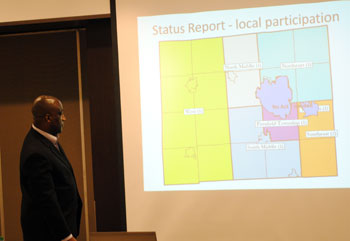
Michael Ford Slide Act 196 Local Participation

Michael Ford, CEO of the Ann Arbor Transportation Authority, presents a possible board configuration for a countywide transit authority at the board's June 3 meeting at Weber's Inn. (Photos by the writer.)

On both occasions, a significant focus was the AATA’s countywide transit master plan. At the June 16 meeting, the board approved the final version of the first two volumes of the plan, which had previously been released in draft form. The two volumes cover a vision and an implementation strategy. A third volume, on funding options, is not yet complete.

The plan is the culmination of over a year of work by AATA staff and a consulting firm to perform a technical analysis and gather public input. The goal was to create a document to guide transit planning in the county over the next 30 years. The timing of the next step – beginning to translate a neatly formatted document into reality – will depend in part on a third volume of the plan, which has not yet been finalized. The third volume will describe options for how to fund expanded transit service in the county. Countywide transit funding will ultimately be tied to the governance structure of some entity to administer transit throughout Washtenaw County.

And governance is a topic that’s ultimately reflected in the actual wording of the resolution that the board adopted at its June 16 meeting on the transit master plan. The resolution authorizes transmittal of the documents not just to the public, but also to an unincorporated board, described as an “ad hoc committee” that will work to incorporate a formal transit authority under Michigan’s Act 196 of 1986. [AATA is currently incorporated under Act 55 of 1963.]

For the last few months, CEO Michael Ford’s regular monthly reports to the AATA board about his activities have included his efforts to meet with individuals and representatives of government units throughout the county to discuss participation in the governance of a countywide transportation authority. June continued that trend. So wrapped into this combined report of the AATA board’s last two meetings is a description of the June 2 visit that Ford and board chair Jesse Bernstein made to the Washtenaw County board of commissioners.

At its June 3 retreat, the board also voted to shift some funding to the AATA staff’s work associated with the countywide transit master plan.

At its June 16 meeting, the board handled some business not specifically related to the transit master plan. The board adopted two policies that it has previously discussed: one on the rotation of auditors, and the other on a living wage for AATA vendors. They also received updates on the expansion of service to the University of Michigan’s East Ann Arbor Health Center and to the Detroit Metro airport.

Progress on those two fronts led board member David Nacht to suggest that the kind of movement and progress the AATA was demonstrating, even without additional money that could come from a countywide funding source, showed that the agency’s future plans deserved support from the community. [Full Story]

Ann Arbor Law Nudges Living Wage Upwards

At its May 16, 2011 meeting, the Ann Arbor city council recorded on its agenda of written communications a memo from its financial services staff that its living wage, as defined by city ordinance Chapter 23, Section 1:815, will be raised slightly in order to conform with the ordinance.

The new wage is set at $11.83/hour for those employers paying health insurance, and $13.19/hour for those employers not paying health insurance. That’s an increase from previous levels which have remained flat for at least year years at $11.71 per hour for employers offering health insurance and $13.06 per hour for those who don’t offer health insurance.

The Ann Arbor city ordinance applies to the wages that must be paid by companies who have contracts with the city worth more than $10,000. Passed in 2001, the city’s living wage ordinance stipulated in that year that workers vendors who held contracts with the city had to pay their employees a minimum of $8.70/hour if the contractor provided employee health care and $10.20/hour if not.

The ordinance provides a mechanism for increasing the living wage based on federal poverty guidelines. Ann Arbor’s living wage is to be increased each year by “… a percentage equal to the percentage increase, if any, in the federal poverty guidelines as published by the United States Department of Health and Human Services …” This year, the guidelines showed a 1.0% increase, and the living wage has thus been increased as well. [.pdf of poverty guidelines]

[Previous Chronicle coverage on the living wage ordinance: "Living Wage: Insourcing City Temps"]

[Full Story]

AATA Mulls Living Wage, Adds Chelsea Trip

Ann Arbor Transportation Authority board meeting (Dec. 16, 2010): At their last meeting of the year, the AATA board unanimously approved a contract for janitorial services at the Blake Transit Center, which had been postponed from its November meeting amid concerns about how the new vendor was achieving its considerably lower cost.

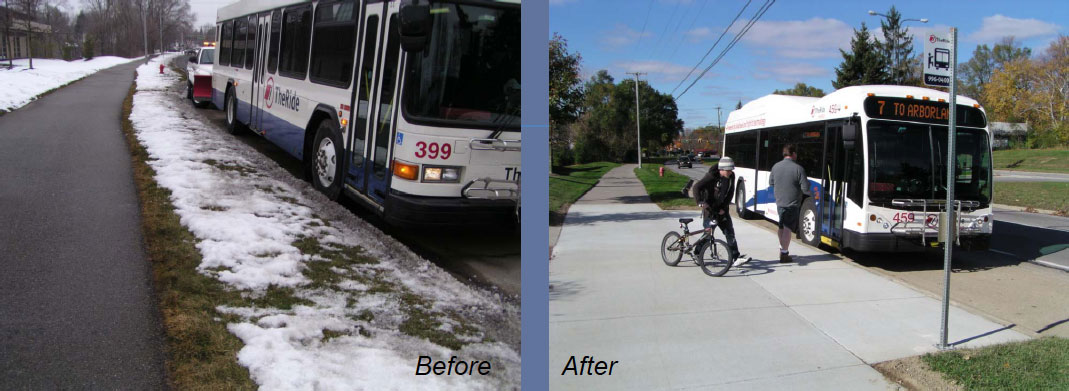
From AATA documentation, before (left) and after (right) bus stop improvements at the Mallets Creek branch of the Ann Arbor District Library. (Image links to higher resolution file.)

Board member Rich Robben had raised concerns regarding whether appropriate wages were being paid, but was convinced to support approval of the contract in part because of another resolution on the agenda. That resolution, which the board also passed unanimously, directed AATA staff to explore the possibility of a living wage provision for its contractors that would be similar to the ordinance used by the city of Ann Arbor.

The board also approved adding an additional return trip for the AATA’s commuter express service between Chelsea and Ann Arbor. The trip will leave Ann Arbor for Chelsea at 7:10 p.m. It was added in part due to feedback from current riders, who would have greater flexibility to work later on days when they take the bus to work. Many of the riders are University of Michigan employees. Robben, who is executive director for plant operations at the university, reported that the value placed on the express service by riders had been “bludgeoned” into him by some of his coworkers. He voted for the additional trip, along with the rest of the board.

The board was also given a presentation on the AATA’s bus stop improvement program, which featured several before-and-after slides. And among the topics reported out by the board’s committees and CEO Michael Ford was the on-time performance of AATA buses.

At the start of the meeting, during the time for communications and announcements, board member David Nacht noted the passing of Rev. S. L. Roberson, whose memorial service was taking place that evening. Nacht described Roberson as a force for equality in Washtenaw County and an important person in the community. Board chair Jesse Bernstein recalled having worked with Roberson in the ’70s at Ford Motor Co., and described him as an excellent person.

Bernstein concluded the meeting by thanking the AATA staff and the board for all their hard work this year, and suggested that next year they’d be asked to work even harder. [Full Story]

Living Wage: In-Sourcing City Temps

At their March 15, 2010 meeting, the Ann Arbor city councilmembers heard an update from city administrator Roger Fraser during his regular report to them: The staffing of temporary positions administered by Manpower, a temporary staffing agency, would be be brought back in-house.

And two months later, attached to the city council’s May 3, 2010 agenda was a communication about Health and Human Services guidelines for poverty levels – there was no change this year. That means there’s no change to the minimum compensation required under the city’s living wage ordinance.

How does the living wage ordinance relate to the approximately 35-40 temporary employees who are transitioning from Manpower to the city’s payroll? It doesn’t. The city itself is not required to pay its own workers at the level stipulated by the living wage ordinance – it applies to outside contractors with the city, like Manpower.

But the majority (with some exceptions) of the transitioned workers won’t see a drop in their wages – and that’s viewed as a positive outcome by the city. On the other hand, there’s no health insurance benefits through the city for those workers – Manpower had offered a health insurance option. And a hoped-for increase in temporary workers’ wages – a move supported by some city supervisors – did not materialize, foundering on an overall budget climate that made talk of wage cuts easier than a discussion of increases.

The recent move away from the use of Manpower as an agency to staff temporary city positions provides a good excuse to review the living wage ordinance itself, and its less-than-obvious connection to the upcoming Ann Arbor Summer Festival and to the city’s recycling program. In the case of the recycling program, the city is spending several hundred thousand dollars over a 10-year period to ensure that workers for a private company operating the city’s materials recovery facility are paid in compliance with the living wage ordinance. [Full Story]

Meeting Watch: City Council (17 November 2008)

Carsten Hohnke and Mike Anglin, both of Ward 5, framed by the chairs of Christopher Taylor and Leigh Greden, both of Ward 3.

Outside the Larcom Building around 6 p.m., Ann Arbor Police Lt. Michael Logghe was using a “slim Jim” to try to gain entry to a citizen’s car. The woman had locked herself out of her vehicle with the engine running.

She was there to pay a $15 parking ticket. She was hoping to avoid a call to the tow truck. Logghe had not achieved success by the time The Chronicle headed inside for the reception for new members of council.

Later, inside Larcom, the newly constituted city council with four new members began its year of work by approving the transfer of a liquor license to Quickie Burger, three drainage projects to be implemented to reduce phosphorus load along Allen Creek, plus a contract with Dawn Farms to provide in-patient and out-patient drug abuse counseling and rehabilitation services to the 15th Judicial District Court. [Full Story]