Stories indexed with the term ‘Ann Arbor City Council’

Column: FOIA Hazards, Christmas Gifts

Christmas came a little early for Ann Arbor’s fire department, as well as for the local news media. A report on Ann Arbor’s fire protection services arrived five days before Santa.

Fire Station 1

This does not depict Ann Arbor dressed in Christmas colors. Numbered locations are fire stations. This map pertains to Station #1. The green area is the area of the city reachable from Station #1 in four minutes. The red area corresponds to 10 minutes. (Image links to higher resolution file)

The report was a long time arriving, though. It was almost a year ago – on Feb. 7, 2011 – when the Ann Arbor city council authorized the expenditure of up to $54,000 for a contract with the International City/County Management Association to conduct the study.

It was a study that then-city administrator Roger Fraser had wanted, and it came in the context of a city council budget retreat a month earlier. At that retreat, councilmembers were briefed on various alternatives to the city’s current approach to staffing its fire protection – including an approach that uses a combination of paid on-call and full-time fire service professionals. At the same council meeting when the ICMA report was authorized, Stephen Rapundalo, who at the time was chair of the city council’s labor committee, criticized the city’s firefighters union for its reluctance to accept a benefits package similar to the one for non-union city workers.

So, how important was the ICMA fire protection study to the city?

Here’s one way of answering that. When Fraser announced his resignation, the city council’s search committee identified in April of this year a handful of top priority items for the interim administrator. The interim – Tom Crawford, the city’s CFO – was supposed to keep the place running, and make sure a small list of priority items didn’t fall through the cracks during the transition in the city’s top position. The ICMA fire protection study made the list.

The report was originally due in the spring, and then was delayed, and delayed again. The city was paying the ICMA for its work – a total of $38,000 in June 2011. I spoke with Crawford about the report this fall – he couldn’t offer much in the way of explanation, but indicated that the delay was on the ICMA’s end.

New city administrator Steve Powers started the job in mid-September. No ICMA report had materialized. Then in mid-November, the city paid an additional $400 to the ICMA. Shortly after that, word filtered through firefighter rank-and-file that a draft report had been released to the city by the ICMA.

At the time, The Chronicle had a Freedom of Information Act (FOIA) request pending with the city for a different set of records – maps depicting fire response-time boundary areas. Why? I’d seen one such map hanging in a public area on the second floor of city hall, that had – ahem – sparked a burning desire to see copies of all such maps.

When that request came back partly denied (no maps were produced), The Chronicle submitted a “clarification” of the original request, and added a request for the draft ICMA report. Other media had reported that their request for the draft report had been denied – but the city’s given reason for the denial was, to us, simply wrong. We figured that citing a specific prior court case might give us a shot.

We didn’t receive a denial. Instead, the city asserted its right to a 10-day time extension. And apparently this extension came on the very same day that the city turned down an appeal made by a different requester regarding the city’s denial of a similar request. It’s not entirely clear why the city denied an appeal made on one request, while on the same day claiming an extension for a similar request – from a different requester.

During the extension, I approached Powers, essentially outside the formal mechanism of the FOIA process. My pitch to Powers was not a legal argument. My pitch was based on the organizational interests of the city and the public interest of the community. We met on Friday, Dec. 16.

In that meeting, Powers assured me the draft report, the final report (which is still watermarked “draft”) and the maps would be released the following week. And the records were, in fact, released. We withdrew our FOIA request when we got the information we requested.

So Christmas did come early, right? But seriously, WTF? By the way, that does translate politely – as “Where’s the fire?”

We got what we wanted, and we should be happy about that.

Yet I still feel like the city wrapped up new socks and underwear in colored paper and called it a Christmas present. I want socks and underwear every time I yell FOIA in this democratic theater that we call Ann Arbor, not just at Christmas time. [Full Story]

Postema’s Performance Review: No Raise

At its Dec. 19, 2011 meeting, the Ann Arbor city council conducted a closed session to review the performance of its city attorney, Stephen Postema, for 2011. The result of the session was that the council voted, with dissent from Sabra Briere (Ward 1), to approve an amendment to Postema’s contract that allows him to cash-in up to 250 of hours of accrued banked time before June 30, 2012.

The position of city attorney is one of two positions that reports directly to the council – the other is the city administrator. Under Michigan’s Open Meetings Act, reviews of personnel are allowed to be conducted in a closed session on request from the employee, but are not required to be. However, Postema’s contract contains a clause specifying that: “The results of the evaluation shall be in writing and shall be discussed with the Employee in closed session.”

A performance review conducted just two months ago at the council’s Oct. 24, 2011 meeting had been just for 2009 and 2010. That review did not result in any adjustment to Postema’s base salary, but also allowed him to cash-in up to 250 hours of accrued banked time before the end of 2011.

In a rare move, Sabra Briere (Ward 1) sat out most of the closed session on Dec. 19 and voted no on the contract amendment this time around. She questioned whether the council’s administration committee had provided other councilmembers with opportunity to offer feedback on Postema’s performance since the Oct. 24 review. She noted that other councilmembers had been given an opportunity to provide their view on Postema’s performance before the Oct. 24 review, but that review had specficially been just through 2010.

And Briere did not recall being given an opportunity to provide additional feedback since October for the current review – which included 2011. None of the members of the council’s administration committee could point to an occasion when feedback had been solicited during that time period. Mayor John Hieftje offered that sometimes all the forms are confusing.

This brief was filed from the city council’s chambers on the second floor of city hall, located at 301 E. Huron. A more detailed report will follow: [link] [Full Story]

Ann Arbor Poll Workers Pay Bump Delayed

At its Dec. 19, 2011 meeting, the Ann Arbor city council postponed an increase in the pay for election inspectors – those who work at the polls on election day to verify registration of voters and to handle all the other duties associated with ensuring compliance with election laws at each precinct.

The proposed increases are as follows: election inspector from $8 to $9/hour; floater from $8.50 to $9.50/hour; chairperson from $11.25 to $12/hour; and absent voter count board supervisor from $14 to $14.50/hour. According to a staff memo accompanying the resolution, prepared by the city clerk’s office, the increase in pay is expected to cost $2,000 in a local election and $8,000 in a presidential election. For the upcoming 2012 presidential election, the increase would total $5,000 – a cost that will be reimbursed by the state.

The justification for the increase in pay for Ann Arbor’s election inspectors was based on comparative pay with other nearby jurisdictions. For example, the raise for election inspectors from $8 to $9 now matches what the city of Ypsilanti pays.

After the raise, however, the proposed compensation for election inspectors would still fall short of the amount set forth in Ann Arbor’s living wage policy, which the city itself is not obliged to follow. By ordinance, the wages paid by city contractors to their workers must meet minimum thresholds that are adjusted each year, based on federal poverty guidelines. In May of 2011, the new living wage minimums were set at $11.83/hour for those employers paying health insurance, and $13.19/hour for those employers not paying health insurance.

The living wage factored into the council decision to postpone the election inspectors’ pay raise. Sabra Briere (Ward 1) questioned why the raise did not match the city’s living wage and that prompted the postponement until the first meeting in January 2012. Briere requested information on the budget impact of the additional raise before the council votes.

One highlight from the staff memo accompanying the resolution, which indicates increasing use of digital technology at the polls: ”Ann Arbor is expected to receive electronic pollbooks from the State of Michigan in the next year.”

This brief was filed from the city council’s chambers on the second floor of city hall, located at 301 E. Huron. A more detailed report will follow: [link]

[Full Story]

Resolution Fails Opposing Mayoral Picks

At its Dec. 19, 2011 meeting, the Ann Arbor city council voted 4-7 on a resolution opposing mayoral appointments of city of Ann Arbor employees to serve on boards and commissions, which meant that it failed. Councilmembers voting for the resolution were its sponsors: Stephen Kunselman (Ward 3), Mike Anglin (Ward 5), Jane Lumm (Ward 2)  and Sabra Briere (Ward 1) .

The “resolved” clause read: “Therefore be it resolved, That Council opposes Mayoral nominations of City of Ann Arbor employees to office appointments.”

Reasons cited in the “whereas” clauses include the possible appearance of conflicting interests and commitments, as well as a clause in the city charter that might be construed as limiting the rights of city employees who are appointed to boards or commissions: “The personnel of the City, other than the elective and appointive officers, shall be deemed City employees.”

The resolution came in the context of mayor John Hieftje’s nomination at the council’s previous meeting (on Dec. 5, 2011) of a city employee to serve on a board. Hieftje nominated the city’s transportation program manager, Eli Cooper, to serve on the board of the Ann Arbor Transportation Authority.

The council’s vote on Dec. 19 to confirm Cooper filled the vacancy on the AATA board left by another city employee, Sue McCormick. McCormick was, until Dec. 16, the city’s public services area administrator. She left to take a job as head of the Detroit water and sewerage department.

This brief was filed from the city council’s chambers on the second floor of city hall, located at 301 E. Huron. A more detailed report will follow: [link] [Full Story]

Cooper Confirmed for AATA Board

At its Dec. 19, 2011 meeting, the Ann Arbor city council confirmed the nomination of the city’s transportation program manager, Eli Cooper, to serve on the board of the Ann Arbor Transportation Authority. The council vote on Cooper’s nomination was only 8-2, with Stephen Kunselman (Ward 3), and Jane Lumm (Ward 2) dissenting. They objected to the appointment of a city employee to the position, not because they felt that Cooper himself was unsuitable. Cooper is filling the vacancy on the AATA board left by Sue McCormick.

McCormick is leaving her post at the city of Ann Arbor as public services area administrator to take a job as head of the Detroit water and sewerage department. McCormick’s last day on the job was Dec. 16. City administrator Steve Powers announced at the Dec. 5 meeting that the city’s head of systems planning, Craig Hupy, will fill in for McCormick on an interim basis. Powers reported that Hupy had no interest in the permanent position.

McCormick’s last AATA board meeting was Dec. 15. On that occasion, she was presented the AATA’s traditional token of appreciation for board service: a mailbox marked up to resemble an AATA bus.

Cooper’s city position as transportation program manager falls under the city’s systems planning unit. The council previously appointed Cooper to serve on the AATA board on June 20, 2005. He served through June 2008, and was replaced on the board by current board chair Jesse Bernstein.

When Cooper previously served on the AATA board, along with McCormick, their service prompted an op-ed in The Ann Arbor News criticizing the appointment of city employees to citizen boards. [.pdf of "Let's Stick With Autonomous Appointees for Citizen Boards"]

This brief was filed from the city council’s chambers on the second floor of city hall, located at 301 E. Huron. A more detailed report will follow: [link] [Full Story]

Kotarski Nominated for Art Commission

At the Ann Arbor city council’s Dec. 19, 2011 meeting, mayor John Hieftje nominated John Kotarski to replace Margaret Parker on the Ann Arbor public art commission (AAPAC). Kotarski has been a media consultant who previously worked for the Mount Clemens Schools.

Parker served for several years on the commission on art in public places (CAPP), the precursor to AAPAC. She was last re-appointed to AAPAC on June 15, 2009 for a three-year term, which would have ended Dec. 31, 2012. Parker served as chair of AAPAC from the enactment of the city’s Percent for Art ordinance in 2007 until the end of 2010. Marsha Chamberlin agreed to assume responsibility as chair in April this year.

This brief was filed from the city council’s chambers on the second floor of city hall, located at 301 E. Huron. A more detailed report will follow: [link] [Full Story]

Drop-Off Recycling Contract OK’d

At its Dec. 19, 2011 meeting, the Ann Arbor city council approved a contract with Recycle Ann Arbor to continue the operation of the drop-off recycling center on the city-owned property at 2950 E. Ellsworth Road, with no financial support from the city.

Previously, the drop-off station was supported by three municipalities: the city of Ann Arbor ($30,000), Washtenaw County ($50,000) and Pittsfield Township ($7,500).

According to a staff memo accompanying the resoultion, when Washtenaw County withdrew its support in 2009, Recycle Ann Arbor declined support from the other governmental units – because it would have required tracking where users lived in order to determine the appropriate use charge. Roughly 60% of the users of the facility live outside Ann Arbor. Recycle Ann Arbor now charges a $3 entry fee, in addition to the specific drop-off charges for specific kinds of items. For example, the charge for dropping off a car tire is $5 – with the $3 entry fee, it would total $8.

The previous contract with Recycle Ann Arbor to operate the drop-off facility expired nearly two years ago, on Jan. 1, 2010. The new contract is retroactive to that date.

The staff memo for the agenda item notes some significant sinking of the southeast corner of the building at the facility, but indicates there is no immediate danger. Still, building repairs are recommended.

This brief was filed from the city council’s chambers on the second floor of city hall, located at 301 E. Huron. A more detailed report will follow: [link] [Full Story]

More Solar Money for Ann Arbor

At its Dec. 19, 2011 meeting, the Ann Arbor city council voted to accept an additional $20,000 in federal funds from the U.S. Department of Energy (USDOE). Of that amount, $17,500 will be applied to a contract with the Clean Energy Coalition for its XSeed Energy community solar program. The remaining $2,500 will go to the city of Ann Arbor to cover grant administration and oversight costs.

The original grant from the USDOE, as a part of the Solar America Cities Project, was made in July 2007 for $200,000. According to a staff memo, Ann Arbor has secured commitments from 11 local organizations for various matching funds for a additional $355,008.

This brief was filed from the city council’s chambers on the second floor of city hall, located at 301 E. Huron. A more detailed report will follow: [link] [Full Story]

Ann Arbor Reimburses for MRF Magnet

At its Dec. 19, 2011 meeting, the Ann Arbor city council voted to authorize reimbursement of $94,788 to the company that operates its materials recovery facility (MRF) for costs of replacing an electromagnet that failed back in February 2011.

RRS Inc. made the request for reimbursement in September. The electromagnet is used to separate metal from other material. The reimbursement will be made from the city’s MRF capitalized renewal and replacement account.

This brief was filed from the city council’s chambers on the second floor of city hall, located at 301 E. Huron. A more detailed report will follow. [Full Story]

Ann Arbor OKs Five Flashing Beacons

At its Dec. 19, 2011 meeting, the Ann Arbor city council authorized a budget modification, drawing on its major street fund, to allow an expenditure of $81,000 – to install five rectangular rapid flashing beacons (RRFB) on existing pedestrian islands in the city. Four of the locations are along Plymouth Road (at Georgetown, Traver Village, Beal and Bishop). The fifth location is at Seventh and Washington. [.pdf with schematic of intersections and an RRFB] [.pdf of map depicting locations]

The flashing function of an RRFB would not be continuous – it would be activated by a pedestrian pushing a button. The staff memo accompanying the resolution describes an RRFB as “similar in nature to the light bars on the top of emergency vehicles.” The flashing beacons do not count as traffic control signals for the purposes of the city’s pedestrian safety ordinance, which addresses motorist behavior “[w]hen traffic-control signals are not in place or are not in operation …” Otherwise put, the pedestrian safety ordinance will still apply at those crosswalks where RRFBs are installed.

Annual costs for operation and maintenance of the RRFBs are estimated at $160 per crossing. Installation of the new signs is scheduled to begin in February 2012, and to be completed by April 2012.

This brief was filed from the city council’s chambers on the second floor of city hall, located at 301 E. Huron. A more detailed report will follow: [link] [Full Story]

Ann Arbor Crosswalk Law Amended

At its Dec. 19, 2011 meeting, the Ann Arbor city council gave final approval to a tweak to its pedestrian safety ordinance. The language given final approval by the council now reads in relevant part: ” … the driver of a vehicle shall stop before entering a crosswalk and yield the right-of-way to a pedestrian stopped at the curb, curb line or ramp leading to a crosswalk and to every pedestrian within a crosswalk, when the pedestrian is on the half of the roadway on which the vehicle is traveling or when the pedestrian is approaching so closely from the opposite half of the roadway as to be in danger.”

The council struck from the ordinance an addition to which it had given initial approval on Nov. 10, 2011 that required motorists to stop for pedestrians “without regard to which portion of the roadway the pedestrian is using.”

This recent round of revisions to the ordinance comes after the council modified the pedestrian safety ordinance on July 19, 2010 to include an expansion of the conditions under which motorists must take action to accommodate pedestrians. Specifically, the 2010 amendments required accommodation of pedestrians not just “within a crosswalk” but also “approaching or within a crosswalk.” The modification approved on Dec. 19 was intended to address a perceived ambiguity of the word “approaching.”

Besides the “approaching” phrase, the 2010 amendments also included two other key elements. The 2010 amendments included a requirement that motorists “stop” and not merely “slow as to yield.” And the 2010 amendments also eliminated reference to which half of the roadway is relevant to the responsibility placed on motorists for accommodating pedestrians. That eliminated phrase was restored in the version approved by the council on Dec. 19.

[Pending Question: Was the change between the first and second readings substantial enough to require an additional reading before the council? Update: According to city clerk Jackie Beaudry, "... nothing proposed (and finally approved) was significant enough to warrant sending the ordinance back as a first reading."]

This brief was filed from the city council’s chambers on the second floor of city hall, located at 301 E. Huron. A more detailed report will follow: [link] [Full Story]

Final OK for Hoover Mansion Rezoning

At its Dec. 19, 2011 meeting, the Ann Arbor city council gave final approval to altering the University Bank PUD and the site plan for the bank’s property at 2015 Washtenaw Ave., known as the Hoover Mansion. The bank wanted the revision to the existing planned unit development (PUD) for the site – originally approved in 1978 – to allow for an increase in the total number of employees and parking spaces permitted on the parcel. The site serves as the bank’s headquarters.

The change will allow University Bank to build 13 new parking spaces on the east side – behind the main building – for a total of 52 spaces on the site. The city planning commission unanimously recommended approval of the change at its Oct. 4, 2011 meeting, after the proposal had been submitted to the city at least a year earlier. The council gave its initial approval to the change in the PUD at its Nov. 21, 2011 meeting.

The long approval process could in part be attributed to opposition from immediate neighbors to specific elements of the plan, which was to some degree modified in response. A letter of opposition, attached to the council’s Dec. 19 agenda packet, made a more general objection to “the likelihood of further commercialization of the residential neighborhood.” [.pdf of letter of opposition][.jpg of aerial view with parcels]

Because the proposal was a change to the city’s zoning, it was a change to the city’s ordinances – a process that required a second approval by the council at a separate meeting, preceded by a public hearing.

This brief was filed from the city council’s chambers on the second floor of city hall, located at 301 E. Huron. A more detailed report will follow: [link] [Full Story]

No Raises for Ann Arbor Mayor, Council

Editor’s note: A Jan. 14, 2011 Ann Arbor Chronicle article on mayoral and councilmember compensation concluded with the following: “Sometime during 2011 it’s likely that the two vacancies on Ann Arbor’s local officers compensation commission will be filled. And when the year’s session schedule is announced, The Chronicle will add the LOCC’s sessions to its meeting coverage.”

During the course of 2011, mayor John Hieftje did not appoint anyone to fill the two vacancies. And since that time, a third vacancy has been added. However in this report, The Chronicle makes good on its promise to cover the commission’s only meeting this year.

Ann Arbor local officers compensation commission (Dec. 16, 2011): Salaries for Ann Arbor’s mayor and 10 city councilmembers will remain constant for the next two years at $42,436 and $15,913, respectively. That was the conclusion of the four members on the local officers compensation commission (LOCC), who met Friday morning for around a half hour.

Ann Arbor mayor and councilmember salaries from 2000 through 2013. The local officers compensation commission's recommendation, made at its Dec. 16, 2011 meeting, means that salaries will stay constant from 2009 through 2013. (Image links to higher resolution .jpg file)

Commission members cited the down economy as a main reason for not bumping the salaries higher. They discussed the fact that a flat salary, even with little inflation, translates into a pay cut – which was also a possibility they briefly mentioned.

The seven-member body currently has just four members, because no appointments have been made by the mayor to fill vacancies. Attending the meeting were Martha Darling, William Lockwood, Roger Hewitt and Eunice Burns. Hewitt chaired the commission two years ago when it last met, and he was again drafted by his commission colleagues to serve as chair this year.

The  LOCC is required to meet in odd-numbered years, so this year is a required meeting year. The LOCC makes a recommendation to the city council – a decision that automatically takes effect unless the city council votes to reject it. The council does not need to take affirmative action to approve the LOCC recommendation.  [Full Story]

Council Agenda Item: Mayoral Nominations

The Ann Arbor city council’s Dec. 19, 2011 meeting agenda, published online on Dec. 14, includes a resolution that expresses opposition to mayoral nominations of city of Ann Arbor employees to serve on boards and commissions. The resolution is sponsored by Stephen Kunselman (Ward 3), Mike Anglin (Ward 5) and Jane Lumm (Ward 2).

The “resolved” clause, as it currently appears on the agenda, simply records the view that those voting in the affirmative are opposed to such appointments: “RESOLVED, Those council members voting in the affirmative to this resolution oppose Mayoral nominations of City of Ann Arbor employees to office appointments.”

Update: As of Friday, Dec. 16, the resolved clause has been revised to read: “Therefore be it resolved, That Council … [Full Story]

Ann Arbor to Consider 4-Way Transit Accord

At a working session of the Ann Arbor city council on Dec. 12, 2011, Ann Arbor Transportation Authority CEO Michael Ford described the legal and governance mechanisms by which the AATA would like to transition to offering countywide transportation services. [For general background on a variety of transportation issues, see recent Chronicle coverage: "Washtenaw Transit Talk in Flux"]

A key part of the transition to countywide service is a four-party agreement to be struck between the AATA, Washtenaw County, the city of Ypsilanti and the city of Ann Arbor. Highlights of the four-party agreement include the role of Washtenaw County – it would approve, sign and file the articles of incorporation for the new transit authority, under Act … [Full Story]

Art Lobby Averts Temporary Funding Cut

Ann Arbor city council meeting (Dec. 5, 2011): In a meeting that pushed well past midnight, the Ann Arbor city council backed off making a temporary reduction to the city’s public art funding.

Marsha Chamberlin Christopher Taylor

Marsha Chamberlin and Christopher Taylor (Ward 3) before the start of the Ann Arbor city council's Dec. 5 meeting. Chamberlin is chair of the Ann Arbor public art commission. (Photos by the writer.)

At its Nov. 21 meeting, the council had given initial approval to ordinance revisions that included temporarily reducing the required 1% allocation to public art from all city capital improvement projects, dropping the amount to 0.5% for the period from 2012 to 2015. Neither that provision, nor one that would have required allocated funds to be spent on public art within a specific period of time, survived a final vote. What did survive was a prohibition against using general fund dollars for public art projects, as well as an exclusion of sidewalk repair from the definition of projects triggering the public art requirement.

Councilmembers who had previously argued for the temporary reduction, but changed their positions after intense lobbying by the arts community – both privately and at the lengthy public hearing – included Sandi Smith (Ward 1), Christopher Taylor (Ward 3) and mayor John Hieftje. All face possible re-election campaigns in 2012. Questions about the legal foundation of Ann Arbor’s public art program, which taps utility fees and dedicated millage funds to pay for public art, were raised again at the meeting by Stephen Kunselman (Ward 3).

In other significant business, the council gave final approval to an expansion of the area around Ann Arbor that is eligible for protection using funds from the voter-approved greenbelt millage.

The council also approved its side of a deal to contract out Ann Arbor police dispatching services to the Washtenaw County sheriff’s office – at an annual cost of $759,089. The city expects eventually to save $500,000 a year with the move, which will entail laying off all of the city’s current dispatchers, not all of whom would be able to obtain employment within the expanded sheriff’s office dispatch operation.

The council also formally tabled a proposed ordinance that would have provided residents with the ability to forbid the delivery of newspapers to their property – by posting a notice on their front doors. The city’s code already prohibits depositing newspapers onto sidewalks.

A sidewalk along Dexter Avenue, east of Maple Road, was the subject of a special tax authorized by the council to be applied to property owners there. The city will use the funds to construct a continuous sidewalk along that stretch, and make curb and gutter improvements.

The council took care of several housekeeping issues, including approving its set of rules for the coming year and making its committee appointments. Those included the appointment of Christopher Taylor (Ward 3) as the council representative to the board of the local development finance authority – replacing Stephen Rapundalo, who was defeated by Jane Lumm (Ward 2) in the Nov. 8 election. But Rapundalo was appointed as a citizen representative to the board and will thus continue to serve on that body. Council committee appointments were only slightly shuffled, because Lumm was assigned to a number of spots Rapundalo had previously filled.

At the end of the meeting, Hieftje announced a nomination to replace Sue McCormick on the board of the Ann Arbor Transportation Authority – Eli Cooper. Cooper has previously served on the AATA board and is the city’s transportation program manager.

Highlights during public commentary included advocacy for a 24/7 warming shelter to be staffed by volunteers from the community, and support for 14-year Ann Arbor resident Lourdes Salazar Bautista, who faces deportation later this month. [Full Story]

Work Session: Snow Plows, Buses, LDFA, Peds

The relatively heavy agenda of the Ann Arbor city council’s Dec. 12 work session includes: (1) a demonstration of the city’s new automatic vehicle location (AVL) snow plow tracking system; (2) the annual report of the local development finance authority (LDFA); (3) a presentation on countywide transit from the Ann Arbor Transportation Authority; and (4) a review of pedestrian safety issues at crosswalks.

The AVL snow plow tracking system is supposed to provide residents with real-time information on the status of plowing activity, through GPS devices mounted on the trucks. The devices monitor not only a vehicle’s location, but also whether the plow is deployed, along with other vehicle performance information. The city’s snow plow status page currently requires … [Full Story]

Cooper To Be Tapped for AATA Board

At the Dec. 5, 2011 Ann Arbor city council meeting, mayor John Hieftje nominated the city’s transportation program manager, Eli Cooper, to serve on the board of the Ann Arbor Transportation Authority. On confirmation by the city council, Cooper would fill the vacancy on the AATA board left by Sue McCormick.

McCormick is leaving her post at the city of Ann Arbor as public services area administrator to take a job as head of the Detroit water and sewerage department. McCormick’s last day on the job is Dec. 16. City administrator Steve Powers announced at the Dec. 5 meeting that the city’s head of systems planning, Craig Hupy, will fill in for McCormick on an interim basis. Powers reported that … [Full Story]

Dexter Ave. Property Taxed for Sidewalk

At its Dec. 5, 2011 meeting, the Ann Arbor city council approved a special assessment on property owners along Dexter Avenue east of Maple Road for a total of $11,651, to pay for sidewalks. The one-time payments by the individual property owners are due June 1, 2012. Required payments range from $30.57 to more than $3,000. The project has a total cost of $92,955 – $74,364 of that amount will be paid with federal money. For the north side of Dexter Avenue, the project includes construction of a new sidewalk for a portion of the stretch, as well as a new curb and gutter for the street across from Veteran’s Memorial Park. For the south side of the street, the project includes a new curb along Veteran’s Memorial Park.

The council started the multi-step process for levying the special assessment at its Sept. 19, 2011 meeting.

Because of the special assessments, the Dexter Avenue sidewalk improvements do not require a portion of the project budget to be allocated for public art. From the city’s public art ordinance: “A capital improvement project funded by special assessments or improvement charges is not subject to the requirements of subsection (1) of this section.”

This brief was filed from the city council’s chambers on the second floor of city hall, located at 301 E. Huron. A more detailed report will follow: [link] [Full Story]

Ann Arbor Tables “No Newspaper” Law

At its Dec. 5, 2011 meeting, the Ann Arbor city council tabled a revision to its littering and handbill ordinance that was meant to give residents the ability to regulate the kinds of newspapers that are deposited onto their property. The ordinance was aimed in part at publications that are delivered free in the community. The ordinance would make it a misdemeanor to deposit a newspaper on someone’s property, if a notice forbidding delivery of that specific newspaper is posted on the front door. The misdemeanor is punishable by a combination of a fine up to $500 and 90 days in jail. [.pdf of marked up version of ordinance]

The ordinance would also create liability not just for the person who might deposit commercial handbills or newspapers onto someone’s property, but also for the corporate entities who “cause” that activity to take place.

First Amendment issues raised by the city’s attempt to restrict unwanted delivery include the possibility that the proposed ordinance has created a content-based distinction between newspapers and commercial handbills. [.pdf of City of Fresno v. Press Communications, Inc. (1994)] However, the U.S. Supreme Court has established a right of residents to regulate the degree to which they must contend with printed matter delivered to their property. [.pdf of Rowan v. U.S. Post Office Dept. (1970)] And in a more recent New York Supreme Court case, the court ruled that “neither a publisher nor a distributor has any constitutional right to continue to throw a newspaper onto the property of an unwilling recipient after having been notified not to do so.” [.pdf of Kenneth Tillman v. Distribution Systems of America]

Carsten Hohnke (Ward 5) indicated that the ordinance was expected to be taken up again sometime in January 2012.

This brief was filed from the city council’s chambers on the second floor of city hall, located at 301 E. Huron. A more detailed report will follow: [link] [Full Story]

Council Appoints Committee Members

At its Dec. 5, 2011 meeting, the Ann Arbor city council voted to approve the city council committee assignments for 2012. Some assignments are for subcommittees of the council, while others are for city council appointments to other public bodies.

Compared to last year, the most significant change to the council’s committee structure was the separation of the joint administration and labor committee into a council administration committee and a council labor committee. On the labor side, Jane Lumm (Ward 2) was slotted in for Stephen Rapundalo, whom she defeated in the Nov. 8 election. Shuffling among other councilmembers, who all returned to this edition of the council, included the replacement of Tony Derezinski (Ward 2) on the labor committee by Sandi Smith (Ward 1).

The council administration committee retains the same membership as the former administration and labor committee, except for Rapundalo, who was replaced by Christopher Taylor (Ward 3). Taylor also took over Rapundalo’s council appointment to the local development finance authority (LDFA) board. [Google spreadsheet contrasting 2011 with 2012 city council appointments]

Changes to committee assignments were on the whole relatively minimal. That was due in part to the fact that Lumm was given four of Rapundalo’s previous committee appointments, including labor budget, liquor control, and housing & human services advisory board. Lumm was also assigned to represent the city council on the Ann Arbor downtown development authority’s (DDA) partnerships committee, relieving Margie Teall (Ward 4) of that duty.

Teall will also no longer represent the council on the Washtenaw Metro Alliance – Sabra Briere (Ward 1) will pick up that responsibility. Of the veteran councilmembers, Teall’s committee assignments reduced the most, as she’ll also no longer serve on the city environmental commission – a spot also picked up by Briere. Teall – along with Carsten Hohnke (Ward 5) and Christopher Taylor (Ward 3) – will also no longer need to serve on the committee established by the council to negotiate a new contract with the Ann Arbor Downtown Development Authority under which the DDA operates the city’s public parking system. At the Dec. 5 meeting, the council formally dissolved the committee, the parking contract having been signed in May.

At the meeting the council also adopted its rules, which included essentially one change. Included in council minutes currently are all emails received by councilmembers on their government accounts. The revision to the rules stipulates that only those emails related to the subject matter of the meeting will be included in the meeting minutes.

This brief was filed from the city council’s chambers on the second floor of city hall, located at 301 E. Huron. A more detailed report will follow: [link] [Full Story]

Ann Arbor OKs New Investment Policy

At its Dec. 5, 2011 meeting, the Ann Arbor city council authorized a new investment policy. The item had been on the council’s agenda at its Nov. 21 meeting, but was postponed at the request of Marcia Higgins (Ward 4), who wanted to have the council’s budget committee review the policy first.

Highlights of the policy changes include the extension on maturity timelines for several different instruments: U.S. Treasury Obligations (from seven to 15 years); Federal Agency Securities (from seven to 10 years); Federal Instrumentality Securities (from seven to 10 years), Certificates of Deposit (from three to five years), and Obligations of the State of Michigan (three to 10 years).

Balanced against those extensions were some changes to portfolio restrictions that prevent the city from having too many longer-term maturity instruments: no more than 25% of the portfolio may be invested in securities with maturities greater than seven years, and no more than 12.5% of the portfolio may be invested in securities with maturities more than 11 years.

This brief was filed from the city council’s chambers on the second floor of city hall, located at 301 E. Huron. A more detailed report will follow: [link] [Full Story]

Ann Arbor Adds Notches to Eligible Greenbelt

At its Dec. 5, 2011 meeting, the Ann Arbor city council gave final approval to a change in the boundaries for the city’s greenbelt program – an open space preservation effort funded by a 0.5 mill tax approved by voters in 2003.

The area in and around Ann Arbor eligible for land preservation under the greenbelt program is defined in Chapter 42 of the Ann Arbor city code. The council has expanded the boundaries once before, in 2007. The current proposal is essentially to square-off the area by adding a mile to the southwest in Lodi Township, and one mile to the northeast in Salem Township. [.jpg of map by The Chronicle showing original boundaries, the 2007 expansion and the currently proposed expansion]

As part of the amendment to Chapter 42, the council approved a change that allows a parcel of land adjacent to the greenbelt boundary to be eligible for protection, if it is also adjacent to a parcel under the same ownership within the greenbelt boundary. The greenbelt advisory commission had voted to recommend the ordinance changes at its Sept. 14, 2011 meeting. The council gave the changes initial approval at its Nov. 21, 2011 meeting.

Since the start of the greenbelt program, roughly $18 million has been invested by the city of Ann Arbor in protecting open space. That has been matched by roughly $19 million from other sources, including the federal Farm and Ranch Land Protection Program, surrounding townships, Washtenaw County and landowner donations. That funding has protected roughly 3,200 acres in 27 separate transactions.

This brief was filed from the city council’s chambers on the second floor of city hall, located at 301 E. Huron. A more detailed report will follow: [link] [Full Story]

Ann Arbor Tweaks Art Law But Keeps 1%

At its Dec. 5, 2011 meeting, the Ann Arbor city council gave final approval to a revision of its public art ordinance – but without a provision that would have temporarily reduced the amount allocated from all capital project budgets to public art from 1% to 0.5%. The city has a law – enacted in 2007 – that requires 1% of all capital project budgets to include 1% for public art, with a limit of $250,000 per project. At its Nov. 21 meeting, the council gave initial approval to the ordinance amendments, which at that time had included a reduction of funding from 1% to 0.5%.

The reduction would have applied for just the next three years, from fiscal 2012-2015. That three-year timeframe was … [Full Story]

Initial OK: Less Art Money, Bigger Greenbelt

Ann Arbor city council meeting (Nov. 21, 2011): After the ceremonial swearing in of councilmembers who won their elections on Nov. 8, the council devoted more time to deliberations on modifying its public art ordinance than on any other item on its agenda.

Leslie Morris Jane Lumm Ann Arbor City Council

Before the Nov. 21 meeting, former councilmember Leslie Morris (left) might be reminding Jane Lumm (Ward 2) which ward Lumm represents on the Ann Arbor city council. (Photos by the writer.)

In the end, the council gave initial approval to an ordinance amendment that would temporarily reduce the required allocation to public art from city capital improvement projects – from 1% to 0.5% for a period of three years. After three years, the percentage would automatically revert to 1%. Of the various amendments to the ordinance, the percentage of the required allocation was the focus of the most controversy during council deliberations. A bid by Jane Lumm (Ward 2) to lower the percentage further to 0.25% gained little support.

Other art ordinance amendments given the council’s initial approval include a requirement that public art money be returned to its fund of origin after three years, if not encumbered by a specific art project. The amendment also included a definitional change that effectively excludes sidewalk repair from the public art ordinance. The amendments also addressed the general fund, making explicit the exclusion of general fund projects from the public art ordinance.

During deliberations, city staff confirmed that at least a portion of the public art allocation required from the new municipal building (aka the police/courts building) could be associated with the general fund – about $50,000 out of the $250,000. [This is for art in the interior of the building, and is separate from the outdoor fountain designed by German artist Herbert Dreiseitl.]

As part of her Ward 2 election campaign, Jane Lumm had argued that general fund dollars were connected to supporting public art at the new municipal building – an idea that had been, until Monday’s meeting, poo-pooed by some councilmembers, including mayor John Hieftje, who had said no general fund money had been used for the public art program.

Lumm was active in her first council meeting since serving in the 1990s. During deliberations on a revision to the ordinance on the city’s greenbelt boundaries, she prompted extended discussion on the part of the revision dealing with the boundary expansion. A less controversial part of the proposed revision involved allowing parcels adjacent to the boundary to be eligible for protection. In the end, the council gave initial approval to both parts of the greenbelt boundary change.

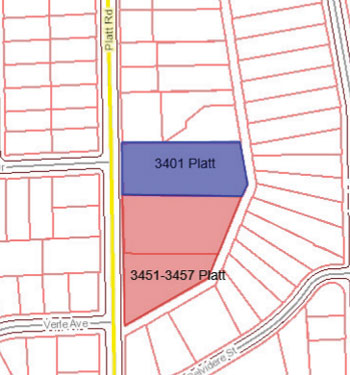
Also related to land use were two site plans on the agenda. The council gave initial approval to altering the University Bank site plan for its property at 2015 Washtenaw Ave., known as the Hoover Mansion. And the council signed off on the site plan, as well as the brownfield plan, for Arbor Hills Crossing, a proposed retail and office complex at Platt and Washtenaw.

Because the content of a proposed revision to the city’s littering and handbill law was not available to the public until late in the day Monday, just before the council met, the council postponed its consideration of that item. The ordinance amendment would allow residents to prevent delivery of unwanted newspapers to their homes by posting a notice on their front doors.

In other business, the council expressed its opposition to a bill pending in the Michigan legislature that would nullify an Ann Arbor ordinance on non-discrimination against people based on sexual orientation, gender identity, or student status. At the meeting, the council also authorized acceptance of several grants for the 15th District Court for programs on domestic violence and substance abuse.

In routine business for the first council meeting after newly elected councilmembers take office, the council elected Marcia Higgins (Ward 4) as mayor pro tem. Committee appointments and rule changes were postponed until Dec. 5. [Full Story]

Council OKs 15th District Court Grants

At its Nov. 21, 2011 meeting, the Ann Arbor city council authorized receipt of a total of $512,898 in grants for programs associated with the 15th District Court.

The largest of the grants – $399,898, from the U.S. Dept. of Justice – is provided over the course of two years and is intended to help prevent domestic violence. The money will be used to fund an existing program. Of the grant amount, $217,696 will pay for one full-time domestic violence probation officer, and four other part-time positions to support the program. Another $90,000 will pay for a contract with SafeHouse Center for domestic violence prevention services. And $77,202 will pay for a contract with the 14A District Court for domestic violence probation services and domestic violence data entry services. Training costs amount to $15,000.

Smaller grants come from the Michigan Supreme Court Administrative Office (SCAO) – for $63,000 and $50,000 – that will help fund the 15th District Court’s sobriety court. The council also approved a $75,000 contract with Dawn Farm to provide in- and out-patient drug abuse counseling for defendants in the sobriety court program.

This brief was filed from the city council’s chambers on the second floor of city hall, located at 301 E. Huron. A more detailed report will follow: [link] [Full Story]

City Council OKs Arbor Hills Crossing Plan

At its Nov. 21, 2011 meeting, the Ann Arbor city council approved the site plan for Arbor Hills Crossing, a proposed retail and office complex at Platt and Washtenaw.

The project involves tearing down three vacant commercial structures and putting up four one- and two-story buildings throughout the 7.45-acre site – a total of 90,700-square-feet of space for retail stores and offices. Three of the buildings would face Washtenaw Avenue, across the street from the retail complex where Whole Foods grocery is located. The site would include 310 parking spaces.

The city’s planning commission unanimously recommended approval of the site plan at its Oct. 18, 2011 meeting. Action had been postponed at the commission’s June 7, 2011 meeting so that the developer – Campus Realty – could address some outstanding issues with the plan.

The council also approved the brownfield plan for the project, which includes $6.7 million in tax increment financing to be paid back over a 19-year period. The Washtenaw County board of commissioners will still need to sign off on the brownfield plan. Commissioners scheduled a public hearing on the brownfield plan to be held at their meeting on Jan. 18, 2012.

This brief was filed from the city council’s chambers on the second floor of city hall, located at 301 E. Huron. A more detailed report will follow: [link] [Full Story]

Ann Arbor Opposes Bill to Limit Protections

At its Nov. 21, 2011 meeting, the Ann Arbor city council unanimously passed a resolution expressing its unanimous opposition to a proposed Michigan state house bill from Tom McMillin, a Republican representing District 45, which includes Rochester. McMillin’s bill would amend Michigan’s Elliot-Larsen Civil Rights Act by declaring null and void legislation enacted by local units that expands the set of protected classes in the Civil Rights Act. [.pdf of Michigan's Elliot-Larsen Civil Rights Act] [.pdf of McMillin's proposed bill (HB 5039)]

The protected classes enumerated in the Elliot-Larsen Civil Rights Act include categories based on religion, race, color, national origin, age, sex, height, weight, or marital status. The city of Ann Arbor’s non-discrimination ordinance adds sexual orientation, gender identity, or student status as classes of people against whom discrimination is prohibited. [.pdf of Ann Arbor's Chapter 112 non-discrimination ordinance]

So McMillin’s bill, if eventually signed into law, would nullify Ann Arbor’s Chapter 112 of its city code. The Ann Arbor city council’s resolution cites Michigan’s Constitution, which provides that ”Each such city and village shall have power to adopt resolutions and ordinances relating to its municipal concerns, property and government, subject to the constitution and law.” [.pdf of Section 22 of Michigan Constitution]

The bill has been referred to the state House judiciary committee. The 17-member judiciary committee for the state House includes 10 Republicans and seven Democrats, one of whom is Jeff Irwin (D-53), who represents a district that includes most of Ann Arbor.

This brief was filed from the city council’s chambers on the second floor of city hall, located at 301 E. Huron. A more detailed report will follow: [link] [Full Story]

Initial OK for Hoover Mansion Rezoning

At its Nov. 21, 2011 meeting, the Ann Arbor city council gave initial approval to altering the University Bank site plan for its property at 2015 Washtenaw Ave., known as the Hoover Mansion. The bank would like to revise the existing planned unit development (PUD) for the site (originally approved in 1978), allowing an increase in the total number of employees and parking spaces permitted on the parcel. The site serves as the bank’s headquarters.

The proposal includes a request to build 14 new parking spaces on the east side – behind the main building – for a total of 53 spaces on the site. The city planning commission unanimously recommended approval of the change at its Oct. 4, 2011 meeting, after the proposal had been initially submitted to the city about a year earlier.

Because the proposal is a change to the city’s zoning, it’s a change to the city’s ordinances – a process that requires a second approval by the council at a separate meeting, preceded by a public hearing.

This brief was filed from the city council’s chambers on the second floor of city hall, located at 301 E. Huron. A more detailed report will follow: [link] [Full Story]

Greenbelt Expansion Gets Initial OK

At its Nov. 21, 2011 meeting, the Ann Arbor city council gave initial approval to a change in the boundaries for the city’s greenbelt program – an open space preservation effort funded by a 0.5 mill tax approved by voters in 2003.

The area in and around Ann Arbor eligible for land preservation under the greenbelt program is defined in Chapter 42 of the Ann Arbor city code. The council has expanded the boundaries once before, in 2007. The current proposal is essentially to square-off the area by adding a mile to the southwest in Lodi Township, and one mile to the northeast in Salem Township. [.jpg of map by The Chronicle showing original boundaries, the 2007 expansion and the currently proposed expansion]

As part of the amendment to Chapter 42, the council gave initial approval to a change that allows a parcel of land adjacent to the greenbelt boundary to be eligible for projection, if it is also adjacent to a parcel under the same ownership within the greenbelt boundary. The greenbelt advisory commission had voted to recommend the ordinance changes at its Sept. 14, 2011 meeting.

Since the start of the greenbelt program, roughly $18 million has been invested by the city of Ann Arbor in protecting open space. That has been matched by roughly $19 million from other sources, including the federal Farm and Ranch Land Protection Program, surrounding townships, Washtenaw County and landowner donations. That funding has protected roughly 3,200 acres in 27 separate transactions.

At the Nov. 21 council meeting, it was announced that Cherry Republic – a retail store selling cherry products that has an Ann Arbor location on Main Street – will be donating $2,500 to the city, to support the greenbelt program.

Also at the Nov. 21 meeting, the city council approved the appointment of Shannon Brines to the greenbelt advisory commission. The current commission had recommended his appointment at its Oct. 12, 2011 meeting.

This brief was filed from the city council’s chambers on the second floor of city hall, located at 301 E. Huron. A more detailed report will follow: [link] [Full Story]