Center Column Section

June 17, 2013 Ann Arbor Council: Final

The council’s June 17, 2013 meeting could include final action on two ordinance revisions. One local law relates to the regulation of digital signs and billboards. The other law regulates the time of day when fireworks are allowed to be set off. While the fireworks regulation is probably seen as somewhat uncontroversial, the council might be inclined to postpone the final vote on digital signs and billboards – as it has done previously.

Door to Ann Arbor city council chambers

Door to the Ann Arbor city council chamber.

In addition to possible final votes on those two ordinance changes, several items related to the 15th District Court appear on the council’s agenda. The court handles all civil claims up to $25,000, including small claims, landlord-tenant disputes, land contract disputes, and civil infractions, as well as preliminary exams for felony cases. Salaries for judges are reimbursed by the state, but the court is funded by the city through its regular budgeting process, with other costs borne by the city or by grants.

The council will be asked to approve an adjustment to the city’s current fiscal year’s budget (FY 2013) to bring it in line with actual expenditures. The general fund total budget adjustment is to increase it by $567,000. And of that, a significant part is attributable to the 15th District Court – including $112,000 in salary increases based on an interest in retaining employees, $203,000 due to a “catch up” payment to the law firm that provides indigent representation, and a back-bill for security from Washtenaw County for two fiscal years for $110,000.

Also on the council’s agenda is the authorization of a contract revision for the current year with the law firm that provides indigent representation. The “catch up” payment stems from the firm’s practice of delaying billing until a defendant’s legal costs are thought to be complete – instead of billing along the way. Because that approach doesn’t give a clear picture of the actual current cost of indigent representation, a new contract with the firm for next year (FY 2014) will be based on a flat fee. That $240,000 annual flat-fee contract is with Nassif and Reiser, P.L.L.C. (f/k/a Funkhouser and Nassif, P.L.L.C.), d/b/a Model Cities Legal Services (“MCLS”). Nader Nassif is a board member of the Ann Arbor Downtown Development Authority.

The council will also be asked to approve a $160,000 contract with the Washtenaw County sheriff’s office for weapons screening at the Justice Center, the building next to city hall that houses the 15th District Court. The estimated annual cost is based on $25.25 per hour per court security officer.

On the consent agenda – a group of items that are considered routine and voted on as a group – are two other items related to the 15th District Court. One is approval of $30,000 for a Sobriety Court grant program contract with the Washtenaw Community Health Organization (WCHO) to provide mental health treatment to 15th District Court defendants. The second is approval of $65,000 for a Sobriety Court grant program contract with the nonprofit Dawn Farm to provide in-patient and out-patient drug abuse counseling to 15th District Court defendants.

The Dawn Farm item includes a provision that could cause it to be pulled out of the consent agenda for separate consideration. That possibly controversial provision is a waiver of the city’s living wage ordinance for Dawn Farm to provide its counseling services. According to the staff memo accompanying the resolution, Dawn Farm employs 70 people, including 15 employees who are paid less than $12.52 per hour with health care coverage, and 18 people who are compensated at rates less than $13.96 per hour without health care coverage. Those are the rates specified in the city’s living wage ordinance. Last fall the council engaged in a vigorous discussion of a living wage ordinance waiver for Community Action Network (CAN), which ultimately resulted in the granting of a waiver at the council’s Nov. 8, 2012 meeting.

Other agenda highlights include revisions to contracts for six unions in the police department, which include a 2% wage increase starting July 1, 2013 and another 1% starting Jan. 1, 2014.

At the June 17 meeting, the council may also vote to adopt revisions to its own internal rules. Among other changes, the revised rules would reduce speaking times for the public from three to two minutes per turn.

Some other agenda items relate to site plans and brownfield plans.

Details of the meeting agenda are available on the city’s Legistar system. Readers can also follow the live meeting proceedings on Channel 16, streamed online by Community Television Network.

The Chronicle will be filing live updates from city council chambers during the meeting, published in this article “below the fold.” The meeting is scheduled to start at 7 p.m. [Full Story]

County to Acquire More Nature Preserves

Washtenaw County parks & recreation commission meeting (June 11, 2013): WCPARC’s June meeting, the first since the summer season kicked off on Memorial Day weekend, focused on two of the commission’s main responsibilities: maintaining and improving its parks and recreational facilities, and acquiring land for its natural areas preservation program (NAPP).

DF Land Development LLC, Washtenaw County parks & recreation commission, The Ann Arbor Chronicle

Within the black circle, three parcels outlined in black are owned by DF Land Development LLC and might be acquired by the Washtenaw County parks & recreation commission for nature preserves.

One NAPP deal that’s been years in the works took a step forward, with commissioners giving initial approval to acquire three parcels totaling 71 acres in Ann Arbor Township, owned by a subsidiary of Domino’s Farms. The deal includes a 54-acre parcel that had received widely varying appraisals, which had delayed the acquisition process. That property will cost a total of $3.25 million – with NAPP paying $928,780 and the remainder coming from other partners, including a contribution by the owner. The other two parcels are (1) five acres at a cost of $100,000, and (2) 12 acres for $215,000, with a possible contribution from Ann Arbor’s greenbelt program. The commission will consider giving final approval to all three acquisitions at its July meeting.

In other NAPP-related action, the commission gave final approval to $1,502,336 worth of NAPP purchases: the four-acre Jarskey property in Scio Township for $57,140, and the 249-acre Ramsey-Lippert-Carr properties in Northfield Township for $1,445,196. Both proposals had been described and discussed at WCPARC’s May 14, 2013 meeting.

Commissioners also approved a staff recommendation to expand NAPP’s stewardship program by creating three new staff positions, doubling the county’s investment in NAPP crews to about $350,000 a year. The expansion is possible because of an ordinance change approved by the county board on Sept. 19, 2012, removing constraints on how funds are allocated between NAPP acquisition and maintenance.

Regarding parks & recreation facilities, WCPARC staff updated commissioners on a new water park – called Blue Heron Bay – that’s located at Independence Lake county park. The water park, fenced off from the rest of the facility with a separate admission fee, has amenities designed for younger children, including spray-and-play features and a water slide.

Another expanded facility – Rolling Hills water park, on the east side of the county – includes a wave pool and spray-and-play installations. One of the improvements that seemed of great interest to commissioners was the new three-story water slide.

Commissioners were also briefed on recent market research regarding a proposed east county recreation center, to be built and managed in a partnership with WCPARC, the city of Ypsilanti and the Ann Arbor YMCA. The study indicated support for a 44,000-square-foot center – smaller than the county’s 51,000-square-foot Meri Lou Murray Recreation Center in Ann Arbor and the 70,000-square-foot Ann Arbor YMCA. The full report will be presented on June 25 to WCPARC members and other stakeholders.

In other updates, WCPARC staff noted that bids for construction of the Ann Arbor Skatepark were received, with the lowest bid of $1.2 million coming from Ann Arbor-based Krull Construction. The skatepark’s original budget was $800,000, including a $400,000 contribution from WCPARC. The city of Ann Arbor is working to amend the project’s scope and find additional revenue sources. [The item is on the agenda for the Ann Arbor park advisory commission's June 18 meeting, with a revised construction bid of $1,031,592, based in part on changes to the project's scope. The total project budget is now $1,224,311.] [Full Story]

County Board Grapples with Court Budget

Washtenaw County board of commissioners meeting (June 5, 2013): In a move that appeared to surprise many commissioners and staff, Washtenaw County commissioner Alicia Ping formally proposed giving notice to eliminate a lump-sum budgeting approach for the county’s court system.

Yousef Rabhi, Alicia Ping, Washtenaw County board of commissioners, The Ann Arbor Chronicle

Board chair Yousef Rabhi and vice chair Alicia Ping. (Photos by the writer.)

After a lengthy and often heated debate, the board voted 5-4 to give initial approval to the notice, but postponed final action until July 10. Voting in favor of initial approval were Ping, Conan Smith, Dan Smith, Andy LaBarre and Kent Martinez-Kratz. Voting against the proposal were Yousef Rabhi, Ronnie Peterson, Rolland Sizemore Jr. and Felicia Brabec.

Ping noted that her goal isn’t necessarily to cut funding for the courts, but rather to be more transparent about where the money goes. The board could ultimately decide to leave the lump-sum approach in place. Giving a notice to terminate the agreement simply gives the board the option to end it.

Conan Smith, who has wrangled with court officials in the past on this issue, argued that the legislative branch is responsible for budgeting, and the board has abrogated that responsibility by agreeing to lump-sum funding. The board gives up far too much authority over line-item expenditures in exchange for “peace in the valley,” he said. “I want to see something different.” With a line-item approach, the county board could indicate priorities for the courts by allocating more funds to specific areas. Dan Smith also argued in favor of the action, noting that the courts are funded with essentially no oversight.

No court officials attended the June 5 meeting. The proposal had not been on the published agenda.

Ronnie Peterson argued most strongly against Ping’s proposal, fearing it would damage the board’s relationship with the courts. Peterson also felt the board itself hadn’t been very accountable regarding a $345 million bond proposal it’s considering. “So as we blast others, let’s prepare to take a few pellets ourselves,” he said. Rolland Sizemore Jr. warned that the board might be starting a fire that they couldn’t put out. He noted that if court officials decide to sue, the county would be required to pay the attorney fees.

Commissioners initially were set to take a final vote at the board meeting that same night – held immediately after the ways & means committee meeting. However, after a break between the two meetings, corporation counsel Curtis Hedger reported that the memorandum of understanding with the courts actually requires a 12-month notice, not the six months that had been discussed. This turned the opinion of some commissioners, who wanted to take more time to study the issue. Andy LaBarre, who chairs the board’s working session, offered to schedule the topic for a working session as soon as possible.

The motion to postpone final action passed on a 6-3 vote, with dissent from Alicia Ping, Dan Smith and Kent Martinez-Kratz. So the proposal will appear on the board’s July 10 agenda.

That July 10 meeting will also include action related to the county’s major bonding initiative to cover unfunded pension and retiree healthcare obligations, including a public hearing. The first public hearing for the potential $345 million bond proposal was held on June 5. It drew four people who all expressed caution about the possible action, with some suggesting a millage or additional budget cuts to cover the retiree obligations instead of bonding.

On June 5, commissioners also set other public hearings for July 10: (1) for two brownfield redevelopment projects in Ann Arbor – at Packard Square (the former Georgetown Mall), and 544 Detroit St.; and (2) for the annexation of industrial property from Scio Township into the village of Dexter. And the July 10 meeting will include final consideration of a strategic space plan for Washtenaw County government facilities totaling about $5 million. The proposals, which got initial approval on June 5, include creating a plan to redevelop the Platt Road site where the old juvenile center was located. The redevelopment might entail a mix of uses, including affordable housing.

A range of other items addressed on June 5 included: (1) creating an historic district for the Jarvis Stone School in Salem Township; (2) an update on the county’s Head Start program, which will be falling under control of the Washtenaw Intermediate School District; and (3) resolutions of opposition – one against gun violence and one against the long-range transportation plan of the Southeast Michigan Council of Governments (SEMCOG). The SEMCOG plan calls for expansion of I-94 in Detroit and I-75 in Oakland County. Some commissioners think that funding should be used to repair existing roads and bridges instead. [Full Story]

Council Mulls Speaking Rule Changes

A June 13, 2013 meeting of the Ann Arbor city council’s rules committee has resulted in proposed revisions to the council’s rules, many of which affect speaking turns and time – for members of the public and for councilmembers.

An across-the-board change for city council meeting public speaking times is a reduction from three minutes to two minutes.

An across-the-board proposed change for city council meeting public speaking times is a reduction from three minutes to two minutes for each turn. The two councilmember speaking turns per question are proposed to be reduced from five to three minutes, and from three to two minutes.

The revisions will be considered by the full council at its June 17 meeting, as agenda item 13-0767. [.pdf of marked up rules for June 17, 2013 council meeting]

Among the changes is a proposal that an opportunity for general public commentary explicitly be included in the standard agenda template for the council’s work sessions – scheduled for the second and fourth Mondays of the month.

However, the length of public participation speaking turns is proposed to be reduced – from three minutes to two minutes – across all categories of public input, at both work sessions and regular meetings. Types of public speaking turns that would be limited to two minutes include: formal public hearings; general public commentary; and the 10 speaking slots that can be reserved in advance of a council meeting.

The procedure for reserving one of those 10 slots is also proposed to be revised. Only people who did not address the council at its immediately previous meeting would be eligible to reserve a slot. And of the 10 slots, eight would be designated for those who want to address the council on agenda action items. Two slots would be provided for those who want to address the council on any topic.

Given the council’s two meetings per month, the change would mean that a person would potentially be able to reserve a slot at the start of a meeting once a month. But anyone would still be able to address the council during general commentary time at the end of any meeting. The right to address public bodies during their meetings is provided by Michigan’s Open Meetings Act.

Speaking time for councilmembers is also proposed to be reduced. For each item considered by the council, councilmembers get two speaking turns. Councilmember speaking time is proposed to be reduced by a total of three minutes – from five to three minutes for the first turn, and from three to two minutes for the second turn.

Other changes are meant to give some clarity to the timeline for preparing the council’s agenda. The goal is to ensure that a regular meeting agenda is less susceptible to late additions of items or the late addition of supporting informational material for the items.

Added after initial publication: On the regular meeting agenda template, the time for mayoral communications, which include nominations to boards and commissions, is proposed to be moved from near the end of the meeting to just after the initial public commentary reserved time at the beginning of the meeting.

A rule is also proposed that would prohibit councilmembers from using mobile telecommunications devices while seated at the council table during a meeting.

The rules committee is also proposing to change the meta-rule about how the council’s rules can be changed. Currently, the meta-rule requires that the councilmembers not vote to adopt rule revisions unless they were presented with the changes at a previous meeting. The proposed change is to require only that councilmembers are provided with the proposed rule changes in advance of a meeting – as part of the regular agenda preparation process. Under the existing meta-rule, the council would need to wait until its July 1 meeting to adopt the new rules.

However, based on the rules committee discussion on June 13, the intent is to ask the full council to adopt the revised rules at its June 17 meeting – in accordance with the revised meta-rule on rule changes. Rules committee members indicated on June 13 they’d be content to use another provision in the rules – a 2/3 majority vote to suspend temporarily the existing rules – to adopt the rules changes on June 17.  [Full Story]

Ann Arbor Looks to Future: Housing, Transit

Ann Arbor city council meeting (June 3, 2013): At a meeting that lasted until nearly 1 a.m., the council took major steps that will affect the future of services in two core areas: housing and transportation.

Stephen Kunselman (Ward 3) and Ann Arbor Housing Commission Executive Director Jennifer Hall.

Stephen Kunselman (Ward 3) and Ann Arbor Housing Commission executive director Jennifer Hall. (Photos by the writer.)

On the housing side, a unanimous vote of the council approved the transfer of ownership for city properties managed by the Ann Arbor Housing Commission (AAHC) to the commission itself – an arrangement that’s actually more common across housing commissions in other cities. That step will allow conversion of the AAHC’s 355 public housing units to a project-based voucher system under HUD’s Rental Assistance Demonstration (RAD) program. AAHC will then be pursuing low-income housing tax credits through a ground lease of the properties to a private/public limited partnership. The tax credits are intended to fund several million dollars in needed capital improvements to the existing properties, as well as build 20-30 new units.

Other unanimous votes related to the AAHC’s plan included: a resolution to approve a payment in lieu of taxes (PILOT) for the properties now owned by AAHC – so that no property taxes will be owed; a resolution declaring that AAHC employees are and will remain city employees; and a $200,000 allocation from the city’s affordable housing trust fund to support improvements to Miller Manor.

On the transportation side, the council unanimously authorized membership of the city of Ypsilanti in the Ann Arbor Transportation Authority, by approving changes to the articles of incorporation for the AATA. The number of board seats is expanded from seven to nine, with one of the seats to be appointed by the city of Ypsilanti. The transportation authority will go by the name Ann Arbor Area Transportation Authority. The board of the AATA and the city of Ypsilanti also will need to formally approve the new articles, but are expected to do that in a straightforward fashion.

While the amendment of the articles of incorporation changes only the governance of the AAATA, the intent is to provide the potential for increased transportation funding. The AAATA could, with voter approval, levy a uniform millage on all member jurisdictions of the authority – now the cities of Ann Arbor and Ypsilanti. It’s a right the current AATA already has, but has never exercised. Each city itself already levies a transit millage, and transmits the proceeds of those taxes to the AATA. For Ypsilanti, the advantage of a transit authority millage is that it would not count against the state constitutional 20-mill cap that a city can levy – a cap that Ypsilanti has already reached.

Deliberations on those two agenda items – housing and transportation – did not begin until after 11 p.m.

Taking an hour of the council’s time before that was a debate on a change to the city’s public art ordinance. The council unanimously supported eliminating the requirement of an automatic 1% set-aside for public art in the budget for every capital project – known as Percent for Art. But lengthy deliberations unfolded about an additional change: A provision that would allow for the return of previous years’ public art allocations to their funds of origin.

The ordinance revision that had already been given initial approval by the council allowed for such a return just for the FY 2014 public art set-asides. In the end, the council opted for an ordinance change that did not provide for a return of previous years’ public art allocations. That leaves roughly $845,000 in funds that can be used for the public art program as defined in the revised ordinance – one that places the onus on city staff to identify capital improvement projects that might be suitable for incorporating public art.

Another significant item on the council’s June 3 agenda was a resolution encouraging the Ann Arbor Downtown Development Authority to allocate funding for three police officers. That resolution passed on an 8-2 vote. The council also gave final approval to utility rate increases (an annual item) and a reduction in utility improvement charges imposed on first-time connections.

Other business included final approval of rezoning requests for Parkway Place and State Street Center. The Parkway Place rezoning – at 490 Huron Parkway – was from R3 (townhouse dwelling district) to R1B (single-family dwelling district). The State Street Center rezoning, near the intersection of South State and Ellsworth, was from O (office district) to C3 (fringe commercial district).

In anticipation of the upcoming July 4 holiday, the council took initial action on an ordinance that would restrict use of fireworks to the hours of 8 a.m. to midnight.

During public commentary, the topic of Pizza in the Park was reprised as a theme from the council’s previous meeting. Advocates for the homeless community lobbied for a written commitment from the city that a parks and recreation fee would not be imposed on a church that distributes food and other aid at Liberty Plaza, a downtown city park. [Full Story]

Column: Time for Non-Partisan Elections

At a recent forum for Democratic primary candidates for the Ann Arbor city council, Ward 5 incumbent Mike Anglin expressed a generally positive outlook about the direction the council and the city are headed. But Anglin did not have praise for the level of participation in primary elections: “Our turnout in a primary election is devastatingly low. It’s embarrassingly low. And our community cannot be proud of that at all.”

non-partisan elections, elephant, donkey, lame ducks

This graphic was poached from a column written for The Chronicle last year by former city attorney Bruce Laidlaw – advocating for non-partisan elections. Laidlaw’s argument was based in part on the idea that it reduces the potential for lame ducks. It might also encourage more competition and participation. (Image links to Laidlaw’s column.)

How bad is it? The August 2012 Democratic primary featured contested races in four of the city’s five wards – with voter turnout ranging from a high of 13.9% in Ward 5 to a low of 8.2% in Ward 1.

In Wards 1 and 4, the winner received less than 1,000 votes. That compared to a citywide turnout of 56.2% in the November 2012 mayor’s race.

What about the Republican primary? If you’re not familiar with Ann Arbor politics, that’s a punch line.

Only in Ward 5 did voters have a choice of city council candidates in November 2012 – Republican Stuart Berry or Democrat Chuck Warpehoski. And 62% of the ward’s voters turned out to choose Warpehoski – by a wide margin. In the other wards, the decision had already been made – in August, by fewer than 10% of registered voters in those wards. In Ward 3, no candidate stepped forward as an alternative to incumbent Democrat Christopher Taylor, in either the primary or the general election.

While Anglin recently lamented the lack of participation in the Democratic primary, I don’t think that exhorting residents to vote on Aug. 6 is likely to bump participation to anywhere near the level we might see in November. So the decisions about who represents Ann Arbor residents on the city council will likely again this year be made when less of the electorate will head to the polls – in August, not November.

But Ward 2 will be a definite exception. That’s because voters will choose between two formidable candidates in November: Democrat Kirk Westphal (unopposed in the primary) and incumbent Jane Lumm, who’s indicated she’ll again be campaigning as an independent. They might be joined by independent Conrad Brown, if he submits enough signatures by the August deadline.  Still, in Ward 2, there’s no question the choice will be made in November, not August.

In Wards 1, 3 and 4, other independent candidates affiliated with a University of Michigan student group calling itself the Mixed Use Party have taken out petitions. None have yet filed the required signatures. But to the extent they prove to be serious candidates, voters in those wards might also feel they were offered a legitimate choice in November.

But when three legitimate candidates take out petitions, why are we forcing a selection between just two of them – precisely at a time of year when few voters turn up at the polls to make that selection?

Take Ward 3 as an example. Julie Grand, current chair of the city’s park advisory commission, and incumbent Democrat Stephen Kunselman are solid choices. They’ll be offered to voters in August. Only one will advance to the November general election. And as voters get to know him, independent Sam DeVarti – if he files his nominating petitions – could also prove to be another solid choice in November.

If they’re all three credible candidates, I think a more rational approach to an August primary would be to use that initial election to winnow the field of all three (or more) candidates down to two. That way the important choice, between the two finalists, would come in November, when more voters participate. Or all the candidates could be offered to voters in November, with no primary election at all.

It’s fairly common now for a city council election to draw only two candidates, both Democrats, who compete in August. If there’s no other candidate in the race at all, it would be more rational to offer those same two candidates to voters in November, when many more voters participate.

That kind of rational approach to candidate choice would be possible if Ann Arbor city council elections were non-partisan.

But under the city charter, Ann Arbor city council elections are conducted on a partisan basis.

Last year around this time, former city attorney Bruce Laidlaw wrote two op-eds for The Chronicle, the first explaining the historical background for Ann Arbor’s partisan system, and the second making a case for changing the city charter to provide for non-partisan elections.

There seems to be at least some interest this year in moving the idea forward. One indication came in a response to a recent Ward 2 resident satisfaction survey. An open-ended question asked respondents to identify the one issue that councilmembers should focus on in the next six months. Among the question’s many responses was this one: “Implement a non-partisan election process for city council and mayor.”

A question about non-partisan elections also was posed this week to Ann Arbor mayor John Hieftje, who spoke at a Rotary Club lunch. [Full Story]

Dems Forum Part 3: Connections

Editor’s note: A forum hosted by the Ann Arbor Democratic Party on Saturday, June 8, 2013 drew six of seven total city council candidates who’ve qualified for the primary ballot.

From left: Julie Grand (Ward 3 challenger), Stephen Kunselman (Ward 3 incumbent), Jack Eaton (Ward 3 challenger), Mike Anglin (Ward 5 incumbent), Kirk Westphal (Ward 2 challenger), Sabra Briere (Ward 1 incumbent).

From left: Julie Grand (Ward 3 challenger), Stephen Kunselman (Ward 3 incumbent), Jack Eaton (Ward 4 challenger), Mike Anglin (Ward 5 incumbent), Kirk Westphal (Ward 2 candidate), Sabra Briere (Ward 1 incumbent).

In the Aug. 6 Democratic primary, only two wards offer contested races. In Ward 3, Democratic voters will choose between incumbent Stephen Kunselman and Julie Grand. Ward 4 voters will have a choice between incumbent Marcia Higgins and Jack Eaton. Higgins was reported to have been sick and was unable to attend.

The format of the event eventually allowed other candidates who are unopposed in the Democratic primary to participate: Mike Anglin (Ward 5 incumbent), Sabra Briere (Ward 1 incumbent), and Kirk Westphal, who’s challenging incumbent Jane Lumm in Ward 2. Lumm, who was elected to the council as an independent, was in the audience at the forum but didn’t participate. The event was held at the Ann Arbor Community Center on North Main Street. The Chronicle’s coverage is presented in a multiple-part series, based on common threads that formed directly in response to questions posed to the candidates, or that cut across multiple responses.

One question posed to candidates explicitly involved transportation: What do we do to implement an effective transportation plan for Ann Arbor that would decrease congestion and encourage alternative modes of travel? But transportation fit into a broader set of themes at the forum that could be collected under the notion of “connection” – connectedness of citizens not just to physical locations, but to their local government.

Candidates had clearly prepared to talk about the topic of transportation generally. Jack Eaton criticized last year’s demised countywide planning effort, based on the fact that other communities were not asked to defray the costs of that planning. At the same time he called for better maintenance of roads, partly out of concern for bicyclist safety. He also called for more frequent bus service during extended hours – but cautioned that he was focused on spending Ann Arbor’s local transit millage money on transit in Ann Arbor.

As far as millages go, Mike Anglin was clear that he would vote for a possible new millage resulting from the admission of Ypsilanti to the Ann Arbor Transportation Authority. However, Anglin was emphatic that he did not support trains, but rather only buses – with a focus on moving people around inside the city.

Julie Grand said she was glad that the possibility of adding rail service was being studied, and that by council resolution, the question of possibly using the Fuller Road site for a new train station would go to the voters. She pointed out that the park advisory commission, on which she serves, focuses on the potential for non-motorized connections when it considers parcels to acquire as parkland. She called transit a regional issue, but said that ultimately we need to focus on transit within the community.

Stephen Kunselman was specific with a suggestion of how to return a focus to the city’s own transportation needs: Remove the city’s transportation program manager, Eli Cooper, from the AATA board – so that Cooper could focus on issues like sidewalk gaps and bicycle lanes. Kunselman also stated that he would be proposing that the city council rescind its memorandum of understanding with the University of Michigan to build a parking structure as part of the Fuller Road Station project.

Although UM has withdrawn from participation in that project under the MOU, Kunselman said he wanted to “kill it.” That way, he said, the conversation could turn away from using the designated parkland at the Fuller Road Station site as a new train station, and could instead be focused on the site across the tracks from the existing Amtrak station.

Sabra Briere ventured that the community did not have a consensus about the basic question of what kind of transportation system is best for Ann Arbor – one that was geared primarily to commuters or one that was designed mainly for city residents as a replacement for personal automobiles.

Kirk Westphal told the audience that he’d chosen a house to buy in Ann Arbor based on its proximity to a bus line. He ventured that the transportation system needs to be robust enough to attract people out of their cars, and that to be financial viable, a certain amount of density is required. It’s important to support development near transit lines to provide that density, he said.

In addition to the question about connecting people to physical locations (i.e., transportation), candidates at the forum responded to a question about connecting people to local government. The question was specific to involving youth in local government. But candidates also delivered a range of comments throughout the forum related to the theme of connecting residents to government.

Among the specific suggestions was one from Westphal, who floated the idea of a “citizens academy” for general government along the lines of Ann Arbor’s citizens police, courts and fire academy.

Part 1 of this series focused on the candidates’ concept of and connection to Ann Arbor, while Part 2 looked at their personal styles of engagement and views of how the council interacts. Other themes from the forum will be presented in subsequent reports. Chronicle election coverage is tagged with “2013 primary election.” [Full Story]

Dems Forum Part 2: How Loud Is Loud?

Editor’s note: A forum hosted by the Ann Arbor Democratic Party on Saturday, June 8, 2013 drew six of seven total city council candidates who’ve qualified for the primary ballot.

From left: Julie Grand (Ward 3 challenger), Stephen Kunselman (Ward 3 incumbent), Jack Eaton (Ward 3 challenger), Mike Anglin (Ward 5 incumbent), Kirk Westphal (Ward 2 challenger), Sabra Briere (Ward 1 incumbent).

From left: Julie Grand (Ward 3 challenger), Stephen Kunselman (Ward 3 incumbent), Jack Eaton (Ward 4 challenger), Mike Anglin (Ward 5 incumbent), Kirk Westphal (Ward 2 candidate), Sabra Briere (Ward 1 incumbent).

In the Aug. 6 Democratic primary, only two wards offer contested races. In Ward 3, Democratic voters will choose between incumbent Stephen Kunselman and Julie Grand. Ward 4 voters will have a choice between incumbent Marcia Higgins and Jack Eaton. Higgins was reported to have been sick and was unable to attend.

The format of the event eventually allowed other candidates who are unopposed in the Democratic primary to participate: Mike Anglin (Ward 5 incumbent), Sabra Briere (Ward 1 incumbent), and Kirk Westphal, who’s challenging incumbent Jane Lumm in Ward 2. Lumm, who was elected to the council as an independent, was in the audience at the forum but didn’t participate. The event was held at the Ann Arbor Community Center on North Main Street. The Chronicle’s coverage is presented in a multiple-part series, based on common threads that formed directly in response to questions posed to the candidates, or that cut across multiple responses.

Although they were not asked an explicit question about their personal style of engagement, candidates commented on the topic throughout the forum. A question about the council’s overall performance – with attention to factionalism in the group – prompted much of that commentary.

That question came relatively late in the forum. But opening remarks from Ward 3 candidate Julie Grand put the issue on the table, when she described herself as not necessarily wanting to be the loudest or most polarizing voice in the room. It was a bid to contrast herself with incumbent Stephen Kunselman, whose critics would likely characterize him as a loud and polarizing influence on the council.

Kunselman’s introductory remarks came immediately following Grand’s. And in a somewhat ironic twist, Kunselman had to be encouraged by the audience to speak up – because they couldn’t hear him. As the forum progressed, Kunselman turned up the volume. The substance of his response, which was echoed by other incumbents, rested in part on the idea that the council’s dynamic now, with its current composition, is better than it was five years ago. Candidates’ remarks related to this issue are presented in more detail below the fold.

Part 1 of this series focused on the candidates’ concept of and connection to Ann Arbor. Other themes from the forum will be presented in subsequent reports. Other Chronicle coverage is tagged with “2013 primary election.” [Full Story]

Dems Forum Part 1: Conceptual Ann Arbor

Editor’s note: A forum hosted by the Ann Arbor Democratic Party on Saturday, June 8, 2013 drew six of seven total city council candidates who’ve qualified for the primary ballot.

From left: Julie Grand (Ward 3 challenger), Stephen Kunselman (Ward 3 incumbent), Jack Eaton (Ward 3 challenger), Mike Anglin (Ward 5 incumbent), Kirk Westphal (Ward 2 challenger), Sabra Briere (Ward 1 incumbent).

From left: Julie Grand (Ward 3 challenger), Stephen Kunselman (Ward 3 incumbent), Jack Eaton (Ward 4 challenger), Mike Anglin (Ward 5 incumbent), Kirk Westphal (Ward 2 candidate), Sabra Briere (Ward 1 incumbent).

In the Aug. 6 Democratic primary, only two wards offer contested races. In Ward 3, Democratic voters will choose between incumbent Stephen Kunselman and Julie Grand. Ward 4 voters will have a choice between incumbent Marcia Higgins and Jack Eaton. Higgins was reported to have been sick and was unable to attend.

The format of the event eventually allowed other candidates who are unopposed in the Democratic primary to participate: Mike Anglin (Ward 5 incumbent), Sabra Briere (Ward 1 incumbent), and Kirk Westphal, who’s challenging incumbent Jane Lumm in Ward 2. Lumm, who was elected to the council as an independent, was in the audience at the forum but didn’t participate. The event was held at the Ann Arbor Community Center on North Main Street. The Chronicle’s coverage is presented in a multiple-part series, based on common threads that formed directly in response to questions posed to the candidates, or that cut across multiple responses.

In their introductory remarks and in the course of responding to other questions, some of the candidates described their concept of and connection to Ann Arbor – how they came to live here, and how they conceive of the place. Other themes from the forum will be presented in subsequent parts of this series. Other Chronicle coverage is tagged with “2013 primary election.” [Full Story]

Ann Arbor Greenbelt Group Marks Transition

Ann Arbor greenbelt advisory commission meeting (June 6, 2013): Three long-time commissioners attended their final GAC meeting this month, marking a pivotal point in the history of the greenbelt program.

Laura Rubin, Archer Christian, Ann Arbor greenbelt advisory board, The Ann Arbor Chronicle

From left: Ann Arbor greenbelt advisory commissioners Laura Rubin and Archer Christian came to city hall by bike. This was the last meeting for Rubin, who is term limited. She and other outgoing commissioners Dan Ezekiel and Tom Bloomer were honored during GAC’s June 6 meeting. (Photos by the writer.)

Tom Bloomer, Dan Ezekiel and Laura Rubin, whose terms end this month, are term-limited. Ezekiel and Rubin are the only remaining members of the original commission, which was formed in 2004. “I’m just really, really proud of what we’ve accomplished, and of what you all will continue to accomplish,” Ezekiel, GAC’s chair, told commissioners at the end of the meeting. “I’m done being on the commission, but I’m not done with land preservation – and I’m sure Tom and Laura feel the same way.”

It was the first meeting for GAC’s newest commissioner, Stephanie Buttrey, who replaced Liz Rother. Jennifer Fike will join GAC next month to replace Rubin, but there are still two remaining vacancies. Anyone who’s interested in applying should contact their city council representative. [.pdf of application form for city boards and commissions]

An ongoing concern emerged during the June 6 meeting related to Civil War Days – a reenactment event being held this weekend at Gordon Hall in the Dexter area. A dispute over spectator parking on the land has prompted Scio Township trustees to move toward rescinding an existing conservation easement and replacing it with a new easement. The new easement would allow for parking, without a requirement to seek permission for parking each year. The property is owned by the Dexter Area Historical Society, a group that was sharply criticized by Bloomer. “Quite frankly, the Dexter Area Historical Society has been an untrustworthy partner from the very beginning,” he said, “and I don’t know why [the township board] thinks they’ll honor a new easement any more than they honored the old one.”

Although the land in question is outside of the greenbelt boundaries, it’s of interest to GAC because of the underlying issue of easement enforcement.

Commissioners were also briefed on a proposed greenbelt registry that’s being developed. The intent is create a way to formalize relationships with landowners who aren’t yet part of the greenbelt program, but who are committed to the program’s principles of land preservation. [Full Story]

DDA Board Grumbles: Budget, Streetlights

Ann Arbor Downtown Development Authority board meeting (June 5, 2013): An oblique quip from a DDA board member during the June meeting signaled likely ongoing friction between the DDA and the Ann Arbor city council: “Too many people’ve been staying up too late on Mondays …” The comment came in the context of two different board votes – one on adopting the DDA’s upcoming fiscal year 2014 budget, and another on adjustments to its current year’s budget as the year comes to a close on June 30.

Left to right: DDA board member Keith Orr, mayor John Hieftje.

Left to right: DDA board member Keith Orr, mayor John Hieftje.

The DDA had actually already adopted its FY 2014 budget – back on Feb. 6, 2013. And although it’s been customary in the past years for the DDA to adopt its budget in advance of the city council’s approval, the state enabling statute for downtown development authorities provides a different sequence: “Before the budget may be adopted by the board, it shall be approved by the governing body of the municipality.”

Considerable debate on the DDA’s budget had unfolded among city councilmembers at their May 20, 2013 meeting. And the council had ultimately decided on a 10-1 vote to approve a FY 2014 budget for the DDA that differed from the one the DDA had adopted in February. In addition to recognizing an additional $568,000 in tax increment finance revenue (TIF), the council’s action transferred an additional $300,000 from the DDA’s TIF fund to the DDA’s housing fund.

At their June 5 meeting, some DDA board members balked at the council’s action, citing the replacement of rusting-out light poles on Main Street as a more pressing need than reserving funds for undetermined future housing projects. But ultimately the board adopted the council’s approved budget on an 8-2 vote – with dissent from Sandi Smith and John Mouat. Absent from the meeting were Russ Collins and Nader Nassif.

At the June 5 meeting, the board concluded that a portion of the more than $516,000 cost for the Main Street light poles would need to come from the city’s general fund. Mayor John Hieftje indicated at the meeting that in the next month he expected the city council would be presented with a budget resolution authorizing the difference between the $516,000 total cost and the $268,000 that the DDA considers available in its council-approved budget.

Also approved by the DDA board were annual routine adjustments to its current year’s budget, which are undertaken to ensure that actual expenses and revenues are reflected accurately. The adjustments are made so that expenses do not exceed revenues in any of the funds. During those deliberations, back-and-forth between board treasurer Roger Hewitt and Newcombe Clark indicated a realization that the kind of budget amendment they were undertaking for FY 2013, at the end of the fiscal year, might be used to work around the budget levels authorized by the city council. It’s not completely clear if that strategy is possible.

But in response to Hewitt’s assurance that budget amendments could be enacted for any reason – as long as expenditures didn’t exceed revenues – Clark made his comment about people staying up too late on Monday nights. [The city council meets on Monday nights, and the council's deliberations on the DDA budget have gone long into the evening. If the DDA board can change its budget after adopting the council-approved version, then the council's deliberations would seem to be moot.]

The June meeting was Clark’s penultimate one, as his term expires at the end of July and he’s moving to Chicago to take a job there. The board’s July 3 meeting will also be board chair Leah Gunn’s last meeting, which will mark the end of over two decades of service on the DDA board, beginning in 1991.

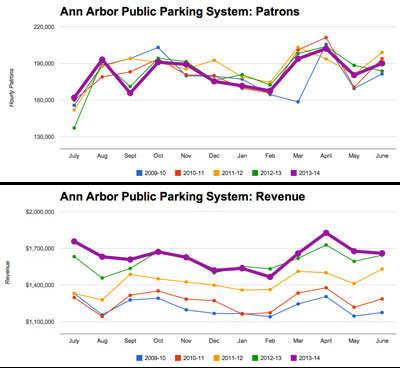
The parking revenue and patrons report from the public parking system was one of the regular highlights of the meeting. The DDA manages Ann Arbor’s public parking system under a contract with the city. The parking report was complemented by a board resolution that awarded five additional monthly parking permits to The Varsity residential project, bringing its total to seven. The DDA can assign monthly permits to residential projects under the city’s contribution in lieu (CIL) program – which provides a mechanism for building housing without providing parking spaces onsite.

Local developer Peter Allen addressed the board during public commentary, reporting that his company had been one of three to submit bids in response to the city’s RFP (request for proposals) for brokerage services to sell the former Y lot at Fifth and William streets. He told the board he thinks the parcel is worth $5-7 million or more. [Full Story]

Column: Disparate Impact of AAPS Cuts?

Editor’s note: This marks the launch of a new column in The Chronicle, focused on Ann Arbor Public Schools and other educational issues. Readers might know Ruth Kraut from her commentary on Ann Arbor Schools Musings, where she’s been writing about these issues for several years. For recent background on The Chronicle’s coverage of AAPS, see “Milestone: Why You Keep Running a Marathon.”

Ruth Kraut, Ann Arbor Public Schools, The Ann Arbor Chronicle

Ruth Kraut

Next week, the board of the Ann Arbor Public Schools will need to cut about 5% from the district’s budget. That’s a reduction of about $8.6 million. Teachers have already taken a 3% pay cut.

Per-pupil funding for next year ($9,025) will be less than the per-pupil funding of 12 years ago in 2001-2002 ($9,034). So it’s no surprise that we’re at the point where cuts are painful. Cutting teachers, cutting programs – none of it is happy news. There will be consequences. The question is, what kind of consequences?

In the civil rights world, a “disparate impact” occurs when a policy is non-discriminatory in its intent but affects a “protected class” of people in a disproportionate way. In Michigan’s Elliott-Larsen Civil Rights Act, for example, these protected classes include race, religion, color, national origin, age, sex, height, weight, and marital status.

AAPS is a district with a large achievement gap – between white students and African American and Hispanic/Latino students. And this gap has persisted for many years. Although in state civil rights law, income is not a protected status, income is highly correlated with race, age, and marital status. District-wide, there is also an achievement gap that is related to income: Poor kids are more likely to do poorly in school.

So it’s important to consider the AAPS budget from a perspective of potential disparate impacts. On the surface, the proposed budget cuts treat all students equally. But if we look deeper, would we find that certain budget cuts worsen – or perhaps improve – the achievement gap?

Three proposed budget cuts have raised a significant amount of opposition this year: (1) eliminating high school transportation; (2) cutting reading intervention teachers; and (3) cutting seventh hour or making it a tuition-only option. Together, these three account for just under $1.5 million of the $8.6 million in cuts. Do these cuts, in particular, have a disparate impact on any groups? [Full Story]

Column: Gordon Gee’s Greatest Gaffes

John U. Bacon

John U. Bacon

Ohio State University president Gordon Gee’s ability to put money in the bank – both his and his university’s – was equaled only by his ability to put his foot in his mouth. Well, this week he was finally fired – er, retired. Entirely voluntarily, of course. Not pushed at all. Nooooo.

Over his long career as president of West Virginia, Colorado, Brown, Vanderbilt and Ohio State – twice – Gee has raised billions of dollars, while delivering a seemingly endless stream of gaffes, slanders and just plain stupid comments, which culminated in his unexpected departure.

In politics, they say, when a man is shooting himself in the foot, don’t grab the gun. In that spirit, I’ll let the man’s words speak for themselves.

In 1992, when the Buckeyes ended their four-game losing streak against Michigan with a 13-13 tie, Gee said, “This tie is one of our greatest wins ever.” Ooo-kay.   [Full Story]
June 3, 2013 Ann Arbor Council: In Progress

The Ann Arbor city council’s June 3, 2013 meeting agenda features two significant topics that will have an impact on the future of public housing and public transportation in the city.

Door to Ann Arbor city council chambers

Door to the Ann Arbor city council chamber.

The council will be asked to vote on a series of resolutions related to a proposed conversion of the city’s 355 public housing units to a project-based voucher system under HUD’s Rental Assistance Demonstration (RAD) program. The council had been briefed at a Feb. 11, 2013 work session on the details of the proposal.

Key steps the council will be asked to take on June 3 include transferring ownership of properties managed by the Ann Arbor Housing Commission (AAHC) from the city of Ann Arbor to the AAHC. Because it involves the transfer of a land interest, approval will require an 8-vote majority on the 11-member council. The properties would eventually be owned by a public/private partnership. The AAHC selected a co-developer earlier this year at its Jan. 10, 2013 meeting.

AAHC is seeking to undertake with this initiative in order to fund several million dollars worth of needed capital improvements. On the RAD approach, they would be funded in large part through low-income housing tax credits (LIHTC).  The council will also be asked to approve a payment in lieu of taxes to the AAHC, so that no property taxes will be owed by AAHC.

The AAHC had originally conceived of converting its properties to project-based vouchers in phases over a few years. The impact of federal sequestration had led AAHC to contemplate converting all the properties this year, to soften part of that impact. However, a hoped-for change in HUD’s rules that would allow the all-in-one-go approach was not made, AAHC learned last week. So “Scenario 3″ described in the staff memo accompanying the council resolution is no longer possible. The negative financial impact of that HUD decision totals around $550,000 over the course of three years.

On the public  transportation side, the council will be asked to approve a change to the articles of incorporation for the Ann Arbor Transportation Authority. The change will admit the city of Ypsilanti as a member of the authority, and expand the AATA board from seven to nine members. The name of the authority would change to Ann Arbor Area Transportation Authority. One of the board members would be appointed by the city of Ypsilanti.

The request comes in the context of a demised attempt in 2012 to expand the AATA to all of Washtenaw County. Since then, conversations have continued among a smaller cluster of communities geographically closer to Ann Arbor. Previous Chronicle coverage includes “Ypsilanti a Topic for AATA Planning Retreat” and “Ypsi Waits at Bus Stop, Other Riders Unclear.

While the change will affect the governance of the AATA, the goal of the governance change is to provide a way to generate additional funding for transportation. The AATA could, with voter approval, levy a uniform property tax on the entire area of its membership – but the AATA does not currently do that. The cities of Ann Arbor and Ypsilanti currently levy their own millages, which are transmitted to the AATA. However, Ypsilanti is currently at its 20-mill statutory limit. A millage levied by the AATA would not count against that 20-mill cap.

Other significant items on the council’s June 3 agenda include a resolution encouraging the Ann Arbor Downtown Development Authority to allocate funding for three police officers. The council will also be considering a final vote on ordinance changes to which it’s already given initial approval: public art (eliminating the 1% capital project budget set-aside); utility rate increases (an annual item); and a reduction in utility improvement charges imposed on first-time connections.

In anticipation of the upcoming July 4 holiday, the council may also take initial action on an ordinance that would restrict use  of fireworks to the hours of 8 a.m. to midnight. The local regulation is only possible as a result of a change in the state law that has been passed by the Michigan House and is expected to be ratified and signed into law before July 4. The item had not yet been added to the city council’s agenda as of 4 p.m. today.

Other agenda items are available on the city’s Legistar system. Readers can also follow the live meeting proceedings on Channel 16, streamed online by Community Television Network.

The Chronicle will be filing live updates from city council chambers during the meeting, published in this article “below the fold.” [Full Story]

Survey Drafted for Input on Downtown Parks

At a May 28, 2013 meeting interrupted by a tornado warning, members of the Ann Arbor downtown parks subcommittee reviewed a draft survey to gather input as the group develops recommendations for the city council.

Alan Haber, Ann Arbor park advisory commission, The Ann Arbor Chronicle

Alan Haber takes notes on a draft survey about downtown parks. He was attending the May 28 meeting of a subcommittee of the Ann Arbor park advisory commission, which is putting together a survey that will be released in June. The subcommittee will be making recommendations regarding downtown parks and open space. (Photos by the writer.)

In a variety of ways, the survey attempts to gauge interest in downtown parks and open space, and to identify the types of activities and features that people might want, such as playgrounds or performance space. The survey also includes questions about assessing the existing downtown parks, including the farmers market, Liberty Plaza at Liberty & Division, and Sculpture Plaza at Fourth & Catherine.

This subcommittee of the Ann Arbor park advisory commission has been meeting regularly since early February. Their work relates in part to a request that mayor John Hieftje made last summer. It’s also meant to supplement the Ann Arbor Downtown Development Authority’s Connecting William Street project. For additional background, see Chronicle coverage: “Parks Group To Weigh In On Downtown Need,” and “Committee Starts Downtown Parks Research,” as well as coverage included in the PAC meeting reports for March 19, 2013 and May 21, 2013.

Several leaders of the Library Green Conservancy attended the May 28 meeting, and gave input on the survey throughout the discussion. The conservancy previously has criticized a survey conducted by the DDA as part of Connecting William Street, saying that the DDA survey did not give respondents the option of supporting downtown parks and open space.

Based on feedback at the May 28 meeting, parks staff will revise the survey for final review at the subcommittee’s June 11 meeting. The intent is to launch the survey soon after that meeting. The goal is to incorporate survey results as recommendations are developed for downtown parks/open spaces, which will likely be delivered to the city council in August. [Full Story]

Column: Counting on the DDA to Fund Police?

The Ann Arbor Downtown Development Authority has enjoyed significant attention from the city council through the spring – and that attention will continue at least through next week.

Ann Arbor police department mug shots. Please note: When it comes to counting police officers or DDA board members, six of one is not half a dozen of the other.

Ann Arbor police department mug shots. Please note: When it comes to counting police officers or DDA board members, six of one is not half a dozen of the other. (“Art” by The Chronicle)

Stephen Kunselman (Ward 3) has been leading the effort by the council to have an impact on the DDA – first by proposing ordinance amendments, then by bringing forward a proposal during the council’s FY 2014 budget deliberations on May 20 – to reallocate DDA funds toward housing. More on that later.

Next week’s June 3 city council meeting would have marked the start of a three-month DDA-free period on the council’s agenda. However, Ward 2 councilmembers Jane Lumm and Sally Petersen, joined by Sumi Kailasapathy from Ward 1, have now placed a resolution on that meeting’s agenda calling on the DDA to allocate money for three additional police officers dedicated to patrolling the downtown area.

For Lumm, this might appear to be a course reversal. Earlier this spring she argued that funding for police officers should be found within the regular city budgeting process. She argued that police officers should be paid for with city general fund dollars – because the city is responsible for public safety. Specifically, she argued that the city should not be looking to the DDA to pay for police.

Yet it’s not actually a course reversal for Lumm. If you follow the city council and the DDA closely, her position now – calling on the DDA to fund police – makes perfectly logical sense, if “logical sense” means “political sense.”

The fact that this reversal makes perfect political sense is not an indictment of Lumm specifically, but rather of the entire 11-member council. They’ve managed as a group to forget what they accomplished together at their retreat in December 2012.

At that retreat, the council achieved a consensus that the city’s achievement of success for the public safety area would not be measured by the number of sworn officers. Instead they agreed that success would be based by actual crime stats, perceptions of safety by residents, and an objective measurement of the time that officers can spend on proactive policing. Yet the council’s debate on May 20 reverted to the familiar past habit of measuring safety success by counting sworn officers.

To the credit of the June 3 resolution’s sponsors, their proposal at least claims that adding police officers downtown would contribute to the perception of increased safety – a nod to the council’s retreat consensus. But I can imagine arguments both ways about whether that claim is true.

The council’s general distraction from its budget retreat consensus might be linked to the energy spent on the DDA. So what has stoked that interest? The fuel for this political fire is the perverse interpretation the DDA has given to Chapter 7 of the city code, which regulates the DDA’s tax increment finance (TIF) revenue. The DDA contends that the revenue constraint that’s articulated in Chapter 7 isn’t really a constraint. The DDA further contends that the $470,000 it returned to other taxing jurisdictions in 2011 was paid back “erroneously.” Kunselman’s ordinance amendments would exclude the DDA’s interpretation.

Throughout the council’s months-long debate about the DDA, the DDA board and staff have enthusiastically participated in city council politics. They’ve done so in a way that has not added much value to the city of Ann Arbor, except in the form of political drama.

In this column I’ll lay out the DDA’s role in the most recent political play that was performed at the council’s May 20 meeting. [Full Story]

Column: Hockey Fans Ask – Now What?

John U. Bacon

John U. Bacon

Most sports fans are happy just to see their team make the playoffs. But Detroit Red Wings fans have been able to take that for granted for a record 22 straight seasons. The last time the Red Wings didn’t make the playoffs, not one current NHL player was in the league. Some of the current Red Wings weren’t born. Nine current franchises weren’t yet created.

But the record seemed doomed to be broken this season.

To start, there almost wasn’t a season at all, thanks to the contract dispute between the players and the owners, who both thought the other side was making too much money.  And, of course, both sides were right – setting up a game of chicken between self-destructive lunatics.

When a federal mediator finally brought them to their senses in January, they had just enough time left to play a 48-game schedule – which actually seemed about right. But the Red Wings came out flat-footed, falling so far behind they had to win their last four games just to sneak into the seventh of eight playoff spots.

In the first round, they faced the Ducks of Anaheim – formerly the Mighty Ducks – which is already an affront to everything that is holy about hockey.

Amazingly, the Red Wings beat them in seven games – quite an upset. Their reward: an even tougher opponent, the top-seeded Chicago Blackhawks, who earned at least one point in their first 24 games, which is a record.

But for hardcore hockey fans – and really, are there any other kind? – this series was a reward. [Full Story]

Kerrytown Place Praised, Despite Parking

Ann Arbor planning commission meeting (May 21, 2013): A proposed condominium project on North Main and North Fourth Avenue – called Kerrytown Place – won planning commission approval, though some commissioners expressed disappointment with the amount of surface parking on the site.

Kerrytown Place, McKinley, Ann Arbor planning commission, The Ann Arbor Chronicle

A reserved parking spot on the site of the future Kerrytown Place development. The view is looking north toward an empty lot where the St. Nicholas Church was formerly located. Cars along Main Street are seen on the left. (Photos by the writer.)

The development covers four parcels – at 402, 408 and 414 N. Main and 401 N. Fourth, with the Main Street parcels separated from the North Fourth site by a public alley, which runs north-south. The vacant St. Nicholas Church had been located on the North Main property, but was demolished last year.

McKinley Inc.’s headquarters is south of the site on North Main, and the firm holds a permanent easement for 57 parking spaces on the Kerrytown Place land. Those spaces will be provided on the development’s surface parking lots. Developer Tom Fitzsimmons told commissioners that finding a way to accommodate those parking requirements into the design had been “challenging.”

The North Main site will include 16 townhouse units in a building with a central courtyard. A 3-story structure with 8 units will front Main Street, and a 4-story structure on the east side of the parcel will have 8 additional units facing the courtyard. There will be an underground garage, and additional parking in 12 carport spots and 24 surface spaces.

On the North Fourth site – now a surface parking lot, with an entrance across from the Ann Arbor farmers market – the plan calls for constructing a duplex with a 2-car garage for each unit and a 21-space parking lot behind the building, accessed from the alley. Each unit of the duplex would face North Fourth.

The project includes a rezoning request and modifications to the city’s landscaping and setback requirements. Commissioners praised the development, but Bonnie Bona in particular was critical of the surface parking. She was reluctant to compromise on the developer’s request to decrease a 15-foot minimum setback, saying that “when I’m giving up front yard for more asphalt, I’m just not as happy.”

City planning staff pointed out that the parking easement “runs with the land,” meaning that any development would need to accommodate those parking spaces. Ultimately, commissioners unanimously approved all requests related to the project, which will now be forwarded to the city council for consideration.

In other action at the May 21 meeting, commissioners held a public hearing on suggestions related to the city’s master plan, but postponed action until their June 18 meeting. A review is required by the planning commission’s bylaws to be done annually. The hearing drew six speakers on a range of topics, including development in Lowertown, a park in downtown Ann Arbor, and adequate sidewalks, cleared of vegetation, so that kids can walk to school safely.

There is also a list of resource documents that are used to support the master plan. [.pdf of resource document list] Commissioners spent a fair amount of time discussing why the Calthorpe report isn’t included on the list. The commission appeared to reach consensus that it would be worth reviewing the entire list of resource documents.

Also on May 21, the commission held a public hearing to get input on the South State Street corridor plan, as a possible addition to the city’s master plan. Commissioners and staff have been working on this project for more than two years. No one spoke at the hearing, and commissioners voted to add the South State Street corridor plan to the city’s master plan, as an amendment to the plan’s land use element. The city council will also need to vote on this item.

One request that commissioners rejected was rezoning for 2271 S. State St., where owners would like to sell cars. The vote was 1-8, drawing support only from Eric Mahler. Some commissioners had leaned toward approval, saying it would be good to have some kind of use on the long-vacant site, where Pilar’s restaurant had once been located. But others expressed concern that it didn’t fit with the goals of the South State corridor, and that it could set a precedent for other rezoning requests. It would be possible for the owner, Capital Investments, to bring the rezoning request to the city council, even though it did not receive a recommendation of approval by the planning commission.

During public commentary, commissioners heard from three people expressing concerns about development and city services in southeast Ann Arbor, along the Ellsworth corridor. They asked for a moratorium on any zoning changes or high-density housing there, until the area can be further studied. Residents have formed a task force to pursue the issue. [Full Story]

Besides the Budget: Council’s May 20 Meeting

Ann Arbor city council meeting Part 2: Non-budget items (May 20, 2013): Although the approval of the FY 2014 budget took up the majority of its meeting time, the council still completed a lot of other business. Budget deliberations are reported separately in Part 1 of the May 20, 2013 meeting report. Part 2 focuses on non-budget items.

From left: Community services area administrator Sumedh Bahl and city administrator Steve Powers

From left: Community services area administrator Sumedh Bahl and city administrator Steve Powers. At the council’s May 20 meeting, Bahl was called on to explain the circumstances under which a homelessness outreach ministry was apparently charged a facility rental fee. (Photos by the writer.)

On the surface it seemed like a controversial new development at 413 E. Huron – approved by the council at its May 13 session – might be reconsidered with a different outcome. But the item added to the agenda at the start of the May 20 meeting was simply motivated by a need to rectify a technical detail – to correct a reference to the most recent set of project plans. The council dispatched the item with scant discussion.

Fees were a highlight of the meeting in several ways, beginning with public commentary. Several residents spoke against the city charging a parks & recreation rental fee to a local church, for its homelessness outreach ministry in Liberty Plaza. Mayor John Hieftje gave an assurance that it was his intent for the Pizza in the Park event to continue without being assessed a fee by the city.

On the council’s agenda were three sets of fees for different service areas of the city, including those for parks and recreation. The council approved fee increases for facility rental at Gallup Park and Cobblestone Farm, as well as various public services area fees, and fire inspection and permitting fees. The fire permit fees prompted moderate discussion among councilmembers, pushed by Mike Anglin (Ward 5) and Stephen Kunselman (Ward 3). Kunselman’s colleagues agreed to his call for a substantial reduction in fire permit fees for bonfires – based on the idea that lower fees would result in higher compliance.

Fees were also on the agenda in the form of utility rate increases, which the council gave initial approval. Because the utility rates are part of the city’s ordinances, they need an initial approval followed by a public hearing and then a second and final vote. In terms of revenue generated to the city, the proposed rate increases are expected to generate 3.55% ($739,244) more for drinking water, 4.25% ($955,531) more for the sanitary sewer, and 4% ($233,811) more for stormwater.

In other business, an economic development task force, put forward by Sally Petersen (Ward 2) over the last several weeks, was formally established by the council. Appointed to the task force for the city were Petersen, Marcia Higgins (Ward 4) and city administrator Steve Powers. The two other entities that are being asked to participate are Ann Arbor SPARK and the Ann Arbor Downtown Development Authority. They can appoint up to three members each.

Appointments to standing boards and commissions approved by the council at its May 20 meeting included Stephanie Buttrey to the greenbelt advisory commission (GAC), Susan Baskett to the board of the Ann Arbor Transportation Authority (AATA), Paras Parekh to the city planning commission, and Jennifer Geer to the park advisory commission. Nominated to serve on GAC was Jennifer Fike.

A proposed ordinance on video privacy was again postponed by the council, this time until June 17. But the council did take action to approve a contract for roof repair at the Veterans Memorial Park ice arena.

Public commentary included a focus on how the city allocates its share of Act 51 money, which comes from the state to fund road maintenance. The city designates a portion of those funds for non-motorized facilities. In years past, that portion was 5%, but was reduced to 2.5% as a result of the economic downturn. Non-motorized transportation advocates are now calling for restoration to the 5% level. [Full Story]

Column: Good News for Book Artists

A group of people in this city care so much about the art of making books that they’ve launched a center dedicated to it, one that will pass down an artistic tradition while incorporating cutting-edge technologies to widen its boundaries.

Jim Horton, boundedition, bookmaking, The Ann Arbor Chronicle

Printmaker Jim Horton at the boundedition studio on May 16 with his Chandler & Price letterpress, made in Cleveland in the 1930s.

Its founders call boundedition a “member-based community resource for the preservation, practice and expansion of the book and paper arts.” They call themselves its managing members: bookseller Gene Alloway, book artist Barbara Brown, graphic designer Laura Earle, printmaker Jim Horton, and product designer Tom Veling, a retired Ford Motor Co. engineer.

They were moved to act when Tom and Cindy Hollander announced last summer that Hollander’s School of Book and Paper Arts would close its doors after the spring 2013 session. The school operated on the lower level of the Hollander’s Kerrytown store for more than 10 years.

Brown, a longtime teacher of bookbinding classes at Hollander’s, reached out to fellow teacher Horton as well as Earle, Veling and others who met weekly at the open studio there. Serious discussions began in February, Horton says, when “we decided that what we’d done at Hollander’s was too good to give up.”

Earle, whose family has been involved with Ann Arbor’s Maker Works, was instrumental in finding a home for boundedition inside the member-based workshop at 3765 Plaza Drive. Maker Works’ managers were receptive to letting boundedition rent some space, and Brown says Earle, her husband and her son “pretty much built the office singlehandedly” – including a set of modular work tables that can be arranged according to the requirements of individual classes.

Brown credits Earle’s energy and determination for the speed with which boundedition took shape. “It would have happened,” she said, “but Laura made it happen now instead of later.”

Ann Arbor’s community of book artists and book lovers got a chance to look around at a May 16 curtain raiser. Tom and Cindy Hollander were in attendance; Horton reports that they’ve given boundedition “a thumbs up” and Brown says “Tom has really been very supportive.”

An open house is coming up on Sunday, June 2, from 1-6 p.m. “The whole community is invited to come out to see the space,” Horton says, “to sign up for classes, to let us know if they’re interested in teaching classes.” [Full Story]

Details on FY 2014 Budget Debate

Ann Arbor city council meeting Part 1: Budget debate (May 20, 2013): The council’s meeting did not conclude until nearly 2 a.m. after a 7 p.m. scheduled start. This portion of The Chronicle’s meeting report focuses mostly on the council’s fiscal year 2014 budget deliberations, which started at about 9 p.m. and ended around 1:30 a.m.

From left: Chuck Warpehoski (Ward 5), Christopher Taylor (Ward 3) and Stephen Kunselman (Ward 3). Budget deliberations pushed the meeting until nearly 2 a.m.

From left: Chuck Warpehoski (Ward 5), Christopher Taylor (Ward 3) and Stephen Kunselman (Ward 3). Budget deliberations pushed the meeting until nearly 2 a.m.

The council considered several amendments to the FY 2014 budget. But the total impact on the general fund of all the successful amendments was not significant, leaving mostly intact the “status quo” budget that had been proposed by city administrator Steve Powers a month earlier. That was a budget with $82.9 million in general fund expenditures. [.pdf of one-page summary of possible amendments] [.pdf of longer detail on FY 2014 budget amendments]

Most of the successful amendments were voted through with relatively little debate, and involved amounts of $100,000 or less. For example, the Washtenaw Health Initiative received an additional $10,000 allocation, and the Miller Manor senior meals program received a $4,500 boost. Allocations to human services nonprofits were increased by $46,899. And the general fund balance was tapped to conduct a $75,000 study of sidewalk gaps so that projects could be prioritized.

The affordable housing trust fund received an infusion of $100,000 from the general fund reserve. The council also approved an amendment prohibiting the spending of $326,464 that was set aside in the FY 2014 budget for public art, in anticipation of a final affirmative vote on a change to the public art ordinance. A vote on amending that ordinance is likely to take place on June 3, before the fiscal year begins on July 1.

The “parks fairness” amendment, which came after deliberations on all other amendments, was a straightforward calculation in accordance with a city policy. The policy requires that any increase in general fund spending be matched by a parallel increase for parks. The council approved that $22,977 amendment with scant remark.

Just three issues took about 80% of the council’s roughly 4.5-hour budget deliberations: (1) the budget of the Ann Arbor Downtown Development Authority, (2)  the possible reduction of the 15th District Court budget in order to pay for three additional police officers, and (3) the proposed restoration of loose leaf collection in the fall.

Of the most time-consuming items, the change to the DDA’s budget was ultimately approved – after escalating political rhetoric led to a kind of compromise that had almost unanimous support. The DDA compromise budget amendment called for a $300,000 transfer from the DDA’s TIF (tax increment finance) fund to the DDA’s housing fund, and a recommendation to spend $300,000 of TIF money on the replacement of Main Street light poles. Only Christopher Taylor (Ward 3) dissented.

The lone dissenting vote on the budget as a whole was Jane Lumm (Ward 2), who issued a verbal spanking of her colleagues and the city administrator – for proposing and approving a budget she did not feel reflected a priority on public safety. Countering Lumm was Taylor, who pointed out that roughly half of the general fund expenditures are related to public safety. [Full Story]

Milestone: Why You Keep Running a Marathon

The Chronicle’s monthly milestone column is by custom published on the second day of the month. It’s a chance for us to touch base with readers on topics related to this publication.

My shoes from the Oct. 26, 2003 Marine Corps Marathon in Washington D.C.

My shoes from the Oct. 26, 2003 Marine Corps Marathon in Washington D.C.

It’s not June 2 yet, so today’s publication means we’re jumping the gun a bit. That’s due in part to a selfish, practical interest I have in not writing separate emails to every reader who inquires: Where is your coverage of the Ann Arbor Public Schools? We’ve suspended that coverage for the indefinite future – but obviously not because we don’t think education is important.

When The Chronicle first launched back in 2008, we didn’t offer any coverage of the local public schools. Mostly through sheer good fortune we found independent freelancers – first Jennifer Coffman, and then Monet Tiedemann – who were able to provide coverage of AAPS to Chronicle readers.

It is not easy to find writers who believe that The Chronicle’s approach to coverage – through detailed reports of public meetings – is a worthy endeavor. And among those who believe it’s worth doing, it’s not easy to find writers who can actually meet the standard. And among that smaller group, it’s not easy to find those who are able to reconcile the economics of the compensation we offer with the sacrifice of time and effort.

It is really not easy to find a writer who is willing to sit through a school board meeting that lasts until 3 a.m.

The Chronicle’s publisher and I can absorb a certain amount of flux in available resources, but we’re past capacity. The size of our organization means that when a single person isn’t able to continue in a particular function, it can mean the end of the coverage that person was providing. So for the immediate future, we won’t be able to continue schools coverage.

And for the medium to longer term, I don’t anticipate being able to restore schools coverage unless our revenues through voluntary subscriptions and advertising were to dramatically increase and show evidence of sustaining that increase.

Ultimately, providing sustainable regular coverage of a public body will require more than the good fortune of finding people who, for a while, can wedge The Chronicle into their lives based on the compensation we can offer.

Isn’t some schools coverage better than none at all? Perhaps so. In this column, I’ll lay out my thoughts on that in terms of a metaphor familiar to regular readers of The Chronicle’s milestones: marathon running. [Full Story]

Park Updates: Roof, Rain Garden, Parking Lot

Ann Arbor park advisory commission meeting (May 21, 2013): The meeting featured a briefing on a project to install rain gardens at Arbor Oaks Park, part of a broader effort to address drainage and flooding problems in the Bryant neighborhood in southeast Ann Arbor.

Bob Galardi, Ann Arbor park advisory commission, The Ann Arbor Chronicle

Bob Galardi was elected chair of the budget & finance committee for the Ann Arbor park advisory commission at PAC’s May 21, 2013 meeting. (Photos by the writer.)

Jerry Hancock, the city’s stormwater and floodplain programs coordinator, described the project, which is being paid for out of the city’s stormwater utility fund – not the parks and recreation budget. It will involve regrading the perimeter of the park in the fall, then putting in native plants next spring. Soil excavated to create the rain gardens will be used to elevate the park’s central lawn area, which often has standing water following heavy rains. The work will be done prior to improvements planned for the park’s playground next year.

Later in the meeting, commissioners voted to recommend awarding a contract for roof replacement at the Mack indoor pool, located within the Ann Arbor Open school near the corner of Miller and Brooks. The recommendation is to select Pranam GlobalTech Inc., which put in the low bid of $193,000. A 10% construction contingency brings the project’s budget to $212,300, with a portion of that amount to be paid for by the public schools.

Also recommended was using $8,280 from the public market fund to upgrade a surface parking lot – known as the “sand lot” – on the Fourth Avenue side of the farmers market. The paving is viewed as a short-term solution, pending longer-term improvements expected at the market in a few years.

Commissioners also elected Bob Galardi as chair of PAC’s budget & finance committee. He replaces Tim Doyle as committee chair, following the end of Doyle’s term on PAC earlier this month. Jen Geer – Doyle’s replacement on PAC – was confirmed by the city council the previous evening but did not attend PAC’s May 21 meeting. Geer has worked with Galardi and councilmember Christopher Taylor – an ex-officio member of PAC – in another capacity, in the performing arts. Most recently, she was executive producer for the Ann Arbor in Concert production of Ragtime, performed at Michigan Theater on May 18. Both Taylor and Galardi were lead performers in that show.

Updates during PAC’s May 21 meeting covered a range of topics, including news that bids for construction of the new skatepark came in a little higher than anticipated. Parks staff and skatepark designer Wally Hollyday will be reviewing the bids to see what options are available. Parks and recreation manager Colin Smith reported that at PAC’s June 18 meeting, commissioners will be presented with a resolution to award a construction contract, as well as an agreement between the city and the Friends of the Ann Arbor Skatepark related to operating the skatepark.

Other updates from Smith included the fact that parks staff is gearing up for Memorial Day weekend, with the opening of the city’s outdoor pools. He also highlighted the completed renovations of ball fields at Veterans Memorial Park, West Park and Southeast Area Park, and improvements made at Liberty Plaza. In addition to removing some bushes there, he said, “we also removed all sorts of things that were in the bushes, which are no longer there – and I’m glad they’re not.”

Other brief reports were given regarding work of PAC’s dog park and downtown park subcommittees, and public forums for the North Main-Huron River task force. Public commentary focused on input from the Library Green Conservancy, which is advocating for a park or public space atop the city’s Library Lane parking structure. [Full Story]

County Budget, Bonding Decisions Loom

Washtenaw County board of commissioners meeting (May 15, 2013): A presentation that county commissioners called “daunting” and “sobering” was among several budget-related items on the May 15 agenda.

Young Women Making Washtenaw Better, Washtenaw County sheriff, Washtenaw County board of commissioners, The Ann Arbor Chronicle

From left: Princess Logan and Monique Franklin, students at Ypsilanti High School, are part of the Young Women Making Washtenaw Better program. Seated behind them is Natalia Harris,community outreach coordinator for the Washtenaw County sheriff’s office, which sponsors YWMWB. (Photos by the writer.)

In her state-of-the-county address, county administrator Verna McDaniel set a goal of identifying $6.99 million in structural reductions for the 2014 budget. The approach to addressing this $6.99 million target depends on whether the county moves ahead with a major bond proposal, which would cover the county’s pension and retiree healthcare obligations. [See Chronicle coverage: "County Board Debates $345M Bond Proposal."]

If the board decides not to bond for those obligations, McDaniel said that most of the $6.99 million would need to come from a reduction in operating costs, as well as $100,000 in cuts to outside agency funding. Finding the $6.99 million in cuts would be very challenging, she added, given the amount of reductions that have already occurred in the past few years. Serviceability levels and major programs would be affected.

Action related to the bonding proposal – for up to $345 million, the largest ever issued by the county – was originally on the May 15 agenda. But early in the meeting, board chair Yousef Rabhi announced a decision to push back the process until the board’s July 10 meeting. He cited the need for more time for public input and additional information – including updated actuarial reports that are due in late June. Public hearings on the proposal are set for June 5 and July 10, with a board working session on the issue scheduled for June 6.

The board also voted to hold a special meeting on July 24, to allow for additional bond-related votes and public commentary, if needed. Rabhi also announced a series of informal meetings at coffee shops in Ann Arbor to discuss the bond proposal with residents. The first “Bonding Over Coffee” will be held on Tuesday, May 28 from 4-6 p.m. in the basement of Elixir Vitae (formerly Café Ambrosia) at 326 Maynard St. in Ann Arbor.

Among the several items that the board is expected to vote on at its July 10 meeting is a “notice of intent” to issue the bonds. This is a standard initial step in the bonding process, letting residents know that they have 45 days during which they can circulate petitions to require a vote of the people before any bonds are issued. Ronnie Peterson reminded commissioners that just a few years ago, a citizens group had gathered enough signatures to force another bond proposal – for expansion of the county jail – onto the ballot, where it was defeated by voters. For the current bond proposal, about 15,000 signatures would be required to force a voter referendum.

In another budget-related item on the May 15 agenda, the board received a first-quarter 2013 briefing. The county’s financial staff is now projecting a $818,999 shortfall for the year – the difference between $102,364,815 in projected general fund revenues and $103,183,814 in projected expenditures. That shortfall is lower than the $3.03 million shortfall that was originally projected for 2013.

The board continued its budget discussion at a retreat on May 16, where they worked to hone priorities for the next four years. This Chronicle report includes a summary of that two-hour session.

In other May 15 action, the board gave initial approval to set the 2013 county general operating millage rate at 4.5493 mills – unchanged from the current rate. Several other county millages are levied separately: emergency communications (0.2000 mills), the Huron Clinton Metroparks Authority (0.2146 mills), two for county parks and recreation (0.2353 mills and 0.2367 mills) and for the natural areas preservation program (0.2409 mills). That brings the total county millage rate to 5.6768 mills, a rate that’s also unchanged from 2012. A final vote and public hearing is expected on June 5.

The board also passed a resolution expressing support for the state of Michigan to expand the federal Medicaid program, as part of the Affordable Care Act – a measure currently being debated in the state legislature. During deliberations, Dan Smith (R-District 2) voiced his objection to the county weighing in on state issues, but he left the room prior to the vote.

A range of other issues were raised as items of communication by commissioners or during public commentary. Topics included: (1) a corridor improvement authority planned by Pittsfield Township for a section of State Street; and (2) the possibility of renewing the county’s membership in the Michigan Association of Counties. [Full Story]

May 20, 2013 Ann Arbor Council: In Progress

The main event of the May 20, 2013 Ann Arbor city council meeting will be the council’s approval of the FY 2014 budget. The city’s fiscal year starts July 1. Under terms of the city charter, the council is required to amend and approve the city administrator’s proposed budget by its second meeting in May – which this year falls on May 20. The Chronicle will be filing live updates from city council chambers during the meeting, published “below the fold.”

Door to Ann Arbor city council chambers

Door to the Ann Arbor city council chamber.

If the council fails to act, then the city administrator’s budget, which Steve Powers presented formally to the council on April 15, 2013, would automatically be adopted. It’s been described as essentially a “status quo” budget, with no major changes to personnel levels or basic approaches to service delivery. The council has held work sessions on various aspects of the budget starting in February.

For the general fund, the status quo budget translates to $82,893,312 in total expenditures, which will require tapping the general fund balance for $260,514. That would leave the general fund with $13.8 million in reserves or 17% of operating expenses.

But it’s possible that the council will undertake amendments to that budget. Among the amendments that might be proposed are some that would change the budget of the Ann Arbor Downtown Development Authority. Other amendments that might be put forward provide funding for an increase in the number of police officers. One strategy for increasing funding for police officers is to take money out of the 15th District Court budget. Another strategy that could be brought forward for funding police officers is to re-allocate the salary for retiring assistant city attorney Bob West.

Affordable housing and human services funding will likely be the topic of some amendments. It’s possible to change the budget later in the year, after the May 20 meeting, but that would require an eight-vote majority. Amendments to the main budget resolution of the year – this year on the May 20 agenda – require only a six-vote majority. [Full Story]

Green Light for 413 E. Huron

Ann Arbor city council meeting (May 6, 2013 – May 13 session): In the session’s main business, the council voted 6-5 to approve a controversial 14-story residential project at 413 E. Huron. The vote came at around 9 p.m., about two hours into the session.

View looking north east at Division and Huron. A chain link fence around the construction site has been in stalled in anticipation of construction of the 413 E. Huron project.

View looking northeast at Division and Huron. A chain link fence around the construction site has been installed in anticipation of construction for the 413 E. Huron project. (Photos by the writer.)

While there’d been some speculation earlier in the day that Christopher Taylor (Ward 3) would not be able to attend the May 13 session – which was a continuation of the meeting that began on May 6 – he was present for the meeting. And his support of the project was crucial in providing the six-vote majority it needed. Taylor was joined in the vote by mayor John Hieftje, Marcia Higgins (Ward 4), Margie Teall (Ward 4), Chuck Warpehoski (Ward 5) and Sally Petersen (Ward 2).

A decision on the site plan for the project, which will offer more than 200 apartments with more than 500 bedrooms, had been previously postponed on April 15, 2013, April 1, 2013 and March 18, 2013. The council recessed its May 6 meeting at around 11:30 p.m. just as it reached the 413 E. Huron site plan. So when the meeting resumed on May 13, the site plan was first on the council’s agenda.

Councilmembers who voted against site plan approval for 413 E. Huron gave pointedly specific reasons for voting no – citing traffic safety issues or failure to comply with aspects of the East Huron character district, or other aspects of the city code. It was a clear contrast to the approach a previous council had taken nearly 40 years ago in 1975, when then-councilmember Bob Faber explained his vote to deny approval of a site plan this way: “Finally, I will vote against this and I will move that the attorney and the planning director tell us why we voted no because obviously we don’t know yet and see what he can do with that in the court …” That decision had led to a losing lawsuit.

It was fear of losing a lawsuit that councilmembers cited in voting to approve the 413 E. Huron project.

After voting on the 413 E. Huron project, the council finished off the substantial number of remaining items on its agenda.

The council gave initial approval to changes to the city’s public art ordinance. The proposal includes removing the requirement that 1% of all capital project budgets be set aside for public art. Drawing some discussion from councilmembers was an additional change to which they gave preliminary approval. The additional change allows the council the flexibility to return money to its fund of origin, which might be set aside for public art in the FY 2014 budget. The council takes up the ordinance changes for final approval on June 3.

Another ordinance change to which the council gave initial approval is a change to utility improvement charges for undeveloped property. That will also appear on the council’s June 3 agenda for final approval.

In addition to initial approval of changes to those two ordinances, the council gave initial approval to rezoning of two different parcels – a property at 490 Huron Parkway and on South State Street. The property on Huron Parkway is proposed to be rezoned from R3 (townhouse district) to R1B (single-family dwelling) and would allow the currently vacant 1.22-acre site, located north of Ruthven Park, to be divided into three separate lots.

The State Street Center project is located adjacent to a new Tim Hortons restaurant, which opened last year near the intersection of State and Ellsworth. The rezoning request is from O (office) to C3 (fringe commercial). It would make the actual zoning consistent with the city’s official zoning map, which had been mislabeled. The site plan calls for demolishing a vacant 840-square-foot house and building a one-story, 1,700-square-foot building with a drive-thru Jimmy John’s restaurant facing South State Street.

An expansion to the Theta Delta Chi house on State Street near the University of Michigan campus was given quick approval after first appearing on the April 15 agenda and getting bumped to the May 6 agenda, when the council postponed all remaining items due to the late hour. The council didn’t reach the Theta Delta Chi item until the May 13 session.

And the council gave approval to two items affecting the Ann Arbor fire department – one to accept a federal grant that will pay for exhaust fume removal systems at fire stations, and another to appropriate funds to replace protective gear worn by firefighters.

The University of Michigan appeared in connection with two different agenda items. One resolution authorized a contract for the city worth more than $600,000 in connection with a vehicle-to-vehicle study – for which the UM Transportation Research Institute (UMTRI) won a $14 million federal grant. That won quick approval from the council.

The other item related to UM involved a right-of-way agreement for placing electrical conduit under Tappan Street – so that an emergency generator can serve a law school dorm. The resolution reflected a disagreement between the city and the university about whether the agreement was a transfer of land interest. The university insisted the council treat it as such a transfer, with an eight-vote majority requirement. The resolution received only seven votes, and thus failed.

Councilmembers passed two resolutions necessary to impose a special assessment on property owners along Miller Avenue, to help pay for construction of new sidewalks. And the council authorized a contract with Coca-Cola as the vendor for Ann Arbor’s city parks – but not without concern expressed by some councilmembers about the company’s human rights record and the nutritive value of soft drinks.

Receiving more discussion than they typically do were confirmations of mayoral appointments, in particular that of Eric Mahler to the board of the Ann Arbor Transportation Authority. Four councilmembers voted against Mahler, though that was still not enough to derail his appointment. Dissenters argued in part that it’s important to expand the total pool of people who are appointed to boards and commissions. Mahler has served two terms on the city planning commission. Dissenters also cited an alternate candidate, unnamed at the meeting, who was thought to be preferable to Mahler – because she would be able to represent the disability community better. The alternate candidate was LuAnne Bullington. [Full Story]

Ypsilanti a Topic for AATA Planning Retreat

Ann Arbor Transportation Authority board meeting (May 16, 2013): Possible membership for the city of Ypsilanti in the AATA was a main theme of the board’s monthly meeting.

Ypsilanti mayor Paul Schreiber addressed the board at its May 16 meeting.

Ypsilanti mayor Paul Schreiber addressed the AATA board at its May 16 meeting. (Photos by the writer.)

Ypsilanti mayor Paul Schreiber attended the meeting in support of the city’s request for membership, and the board unanimously passed a resolution acknowledging the request. The resolution also directed staff to prepare for a detailed discussion on the issue at the board’s planning retreat, scheduled for May 22. Board members were positively inclined toward the request, but wanted to be sure that due diligence is done to ensure all the implications are understood.

Because the addition of the city of Ypsilanti would require revision to the AATA’s articles of incorporation, there’s some interest by some board members in approaching the changes in a way that could accommodate the addition of more members than just the city of Ypsilanti. It’s possible that Ypsilanti Township, Pittsfield Township or other jurisdictions might request membership in the near future. A more comprehensive approach to revising the articles, or delaying until all jurisdictions are admitted to the AATA at one time, could eliminate the need to revise the articles multiple times in quick succession.

The possible membership of Ypsilanti in the AATA is part of an effort to continue working with “urban core” communities in the immediate Ann Arbor area – after a more ambitious effort to extend AATA governance and services countywide in the summer of 2012 failed to gain traction.

A revision to the articles of incorporation would likely include a change in the AATA board membership structure. Ann Arbor mayor John Hieftje had indicated he’d support adding two seats to the current seven-member board, with one of the two additional seats to be appointed by the city of Ypsilanti.

Related to board membership, the May 16 meeting included a resolution of appreciation for the service of Jesse Bernstein on the board. He concluded a five-year term of service in April. Susan Baskett, currently an AAPS trustee, has been nominated as his replacement on the board. If she’s confirmed at the Ann Arbor city council’s May 20 meeting, she’ll join Eric Mahler as another new appointment. Mahler’s appointment to replace David Nacht was subjected to political wrangling at the council’s May 13 session, but he was confirmed on a 7-4 vote. [Full Story]

County Gives More Support to Rutherford Pool

Washtenaw County parks and recreation commission (May 14, 2013): At their most recent meeting, county parks & rec commissioners voted to grant $150,000 to the city of Ypsilanti to help complete the Rutherford Pool project. The Friends of Rutherford Pool is trying to raise about $1 million to rebuild the community pool, located on the eastern end of Recreation Park at 975 North Congress Street.

Recreation Park, Ypsilanti, Rutherford Pool, Washtenaw County parks & recreation commission, The Ann Arbor Chronicle

The entrance to Recreation Park in Ypsilanti, where Rutherford Pool is located. (Photos by the writer.)

Commissioners also took steps that could lead to spending over $1.713 million on natural areas preservation. They voted to move forward with the acquisition of three deals for the county’s natural areas preservation program: 17 acres in Scio Township ($55,000); about 245 acres in Northfield Township (about $1.4 million); and 65 acres in Freedom Township ($420,000). The latter two purchases were approved contingent on completing due diligence assessments, followed by final approval from the commission.

In addition, WCPARC approved an initial step in replacing the HVAC system at the Meri Lou Murray Recreation Center on Washtenaw Avenue, and heard reports on upgrades at several other facilities. Those include the nearly-completed major improvements and expansion of water parks at Rolling Hills and Independence Lake parks. Both are set to open Memorial Day weekend, kicking off WCPARC’s summer season.

In other news related to Ypsilanti projects, WCPARC director Bob Tetens reported that the Ypsilanti city council had recently passed a resolution reaffirming support for the east county recreation center project, proposed in the Water Street site near the Huron River. Tetens also presented a report on WCPARC’s marketing and communications program, which staff have expanded into new venues – including AATA buses. The effort is partly in preparation for a millage renewal coming in 2014.

Commissioners also discussed the desire to add another off-leash dog park in addition to Swift Run, which the county runs in partnership with the city of Ann Arbor. Interest is especially keen in light of Ann Arbor’s difficulty in finding a new dog park location. Some commissioners want to include a water element where dogs could play. Jan Anschuetz put it this way: “We’ve done so much to provide water recreation for people – now let’s do it for the dogs.” [Full Story]

In it for the Money: Independent Risk

Editor’s note: Nelson’s “In it for the Money” opinion column appears regularly in The Chronicle, roughly around the third Wednesday of the month. At the May 20, 2013 meeting of the Ann Arbor city council, a resolution will appear on the agenda that would establish a task force on “economic development.” This month we asked Nelson to write about a segment of the local economy we think is likely to receive scant attention from that task force: independent workers. [0]

David Erik Nelson Column

David Erik Nelson

In abstract, my monthly column is about money – how money is a way that we signal our values, the way we track our interest, and the trail left by our investments of time and attention.

Last month I wrote about the stuff I do to earn money. This month let’s talk about something I do that can’t conceivably ever earn me a damned dime: The Workantile.

The Workantile is a business-like entity on Main Street in Ann Arbor [1]. In contrast to pretty much any other “business” on Main Street, we sell neither goods nor services.

Our business is maintaining a space where a community of independent workers can sit together and work on their own things. Our space is around 3,000-square-feet, and has lots of rolling tables and chairs (so that the space can be reconfigured in any way that interests the members and serves their ends), as well as a kitchenette, a clean and commodious bathroom, a couple of phonebooth-esque things, a couple of conference rooms, some lockers and bike racks, and an awesome printer/scanner/copier.

We also have half of an ancient, homebrew quadrophonic stereo hooked up to a wifi bridge which, combined with our brick walls, high ceilings, and hardwood floors, means that we have a pretty sweet-ass dance hall sound system, too. [2]

Some of our members work together formally – either for the same employer with home offices in some distant and exotic place (usually California), or on projects of their own devising. But mostly we work separately, tapping away on our keyboards with headphones on.

We work on our own without having to work all alone. It’s nicer than a coffee shop, because there’s no milk-steamer roar, no awkward break-up happening at the next table, and no creepy old dudes leering at your sandaled feet. Our doors lock, so the crazies are limited to those who stay current on their membership dues (i.e., me).

You can go to the bathroom without worrying that someone is going to steal your laptop or rifle your purse. Also, when clients meet you in a coffee shop, they think, “Ugh. I guess this is how we have to do business in the 21st Century.” When clients meet you at Workantile — with our industrious brick walls, antiquey tin ceilings, and huge windows — they think “I can’t believe this gal isn’t charging me more!”

That, my friends, is an excellent thing for your clients to think.

So, to dispense with the hard sell: Come down today (or any other weekday) for a tour and a FREE Day Pass!!! [Full Story]